INTRODUCTION
Animal recording is a systematic process that leads to outcomes that facilitate a comparison of production alternatives, the availability of baseline information on the performance of animals, animal management decisions and genetic improvement that are beneficial to the governments and policy-makers, farmers and by extension the consumers (FAO 1998). This process involves collection of data on identified animals and processing it into information for use in decision-making. The outcomes of recording are realized through the interaction of a set of players within the defined parameters. The efficiency with which animal recording outcomes are realized is a variable that is influenced by many factors within and outside the system (Wasike et al. Reference Wasike, Peters, Kahi and Tielkes2008). Among the factors are institutional issues that determine the set of players, their actions, outcomes and incentives of engagement. These factors should be considered during the evaluation of the efficiency of animal recording.
Most evaluation approaches define efficiency in economic terms with little regard to institutional issues. They consider a system to be efficient when the least amounts of resources are used to produce a particular amount of output or when an amount of resource is used to produce the highest possible output (del Hoyo et al. Reference Del Hoyo, Espino and Toribio2004; Diaz & Sanchez Reference Diaz and Sanchez2008). Resources and outputs in these approaches are valued in monetary terms, making them only suitable in systems with directly marketable outputs where input and output price information are known. Animal recording systems are support subsystems of major systems in animal agriculture and are characterized by outputs (records and evaluation results) that do not have direct market value (economic benefit). The value of outputs from the system is the utility derived from them. Consequently, price information about the input and the output of the system are not readily available. In addition, a rigorous focus on the definition of efficiency in classical economic terms risks over favouring intensification of animal production, since the increased outputs can easily be quantified whereas increased inputs, e.g. delayed reproduction and farmer labour, are less easy to value. This may result in perceiving increased output as a benefit without properly weighting other farmer costs. Therefore, the evaluation of efficiency of animal recording would be more appropriate when based on the utility derived from the outputs of the system than on economic returns. This would avoid the bias towards high output production. In doing so, a system would be considered efficient when an outcome-utility-dependent participation is sustained.
A recording system needs to achieve utility in order to secure sustainability of the stakeholder interactions and the system as a whole. Output utility is influenced by the institutional set-up of animal recording that affect the patterns of stakeholder interactions, the form of the outputs from interactions, the utilization of the outputs and the overall functioning of the system (Barrett et al. Reference Barrett, Lee and Mcpeak2005; Ramírez & Lee Reference Ramírez and Lee2007; Tamsyn et al. Reference Tamsyn, Arendse, Rogers, Sihlophe, Van Wilgen, Van Wyk and Zeka2007; Dong et al. Reference Dong, Lassoie, Shrestha, Yan, Sharma and Pariya2009). Therefore, it is critical that the efficiency of systems is evaluated considering the effects of institutions on the utility in order to answer questions on how stakeholders take what actions, what rules govern actions and what rewards come with engagement in certain actions. This can only be achieved by using evaluation approaches based on output utility. Currently, approaches for evaluating efficiency based on utility are unavailable. The objective of the current study is to describe an approach for the evaluation of the efficiency of animal recording systems using utility of outputs as the parameter and use the approach to assess the efficiency of beef and dairy cattle recording practices in Kenya.
MATERIALS AND METHODS
Analytical framework
The approach is based on the Institutional Analysis and Development (IAD) framework as described by Ostrom et al. (Reference Ostrom, Gibson, Shivakumar and Andersson2002). The IAD framework provides a useful means for a holistic assessment of institutional setting by linking multiple decision-making levels, namely: (i) the operational level, where decisions made directly affect resources management, (ii) the collective-choice level, where decisions made affect the rules-in-use at the operational level and (iii) the constitutional level, where decisions made affect who decides and how decisions are made in the collective-choice arena (Ostrom Reference Ostrom and Sabatier1999; Clement & Amezaga Reference Clement and Amezaga2008). These levels, though distinct, are interactive with actors operating in multiple levels (Clement & Amezaga Reference Clement and Amezaga2009). The framework has three components that could be considered as focal points for efficiency evaluation namely the context, the action arena and the patterns of interactions and the associated outcomes.
The framework introduces the context in which the local actors potentially interact to create institutions that shape their collective decisions and individual actions. Institutions are prescriptions that humans use to organize all forms of repetitive and structured interactions (Ostrom Reference Ostrom2005). North (Reference North1990) referred to institutions as the rules of the game that encompass both written legal documents and informal, orally agreed upon rules. They are distinguished from organizations, which are seen as the players of the game that use the rules to win the game. The context constitutes inherent characteristics of the system that influence the way actions are taken and how outcomes are realized. It is evaluated by looking at three key variables: (i) the physical and material conditions, (ii) the attributes of the community and (iii) the rules in use (Ostrom et al. Reference Ostrom, Gibson, Shivakumar and Andersson2002). Physical and material conditions determine possible actions, outcomes produced, how actions are linked to outcomes and the content of actor information sets. Community attributes encompass norms of behaviour generally accepted, the level of common understanding, the extent of homogeneity in preferences and the distribution of resources among the members of a community. Rules prescribe what actions are required, permitted or prohibited and are important if order and predictability in human actions are to be achieved.
After defining the context, boundaries of the analysis are established by delineating the action arena (Andersson Reference Andersson2006). An action arena is a conceptual unit containing a set of variables about an action situation and the actor. The examination of the action situation helps with the isolation of structures affecting a process in order to provide an explanation of the occurrence of particular outcomes (Ostrom et al. Reference Ostrom, Gibson, Shivakumar and Andersson2002). It involves the evaluation of actors, the positions they fill, the actions they take, the level of control they have over the choice of actions, linkage of actions to outcomes, costs and benefits of engagement and information available to each actor. Actors within a system interact to produce outcomes that are subjected to various evaluation criteria. A detailed description of the IAD framework is provided in Ostrom et al. (Reference Ostrom, Gibson, Shivakumar and Andersson2002).
Efficiency evaluation from an institutional perspective is pertinent, because of the dynamism and changes in the institutional environment occasioned by processes such as political change, privatization, market liberalization, globalization and shifts in resource bases, which impact on organizations and conventions that govern systems' operations (Matsaert Reference Matsaert2002; Clement & Amezaga Reference Clement and Amezaga2009). Livestock production systems are equally affected by these changes at both policy and operational levels. Using an institutional approach to evaluate the efficiency of animal recording provides a broader frame of assessment, enhances understanding of the working parts of the system and enables the valuation of non-monetary outputs of the systems.
Description of the approach for efficiency evaluation based on the IAD framework
Animal recording was considered as a system with several components: livestock identification, pedigree recording and registration, performance recording and livestock evaluation and information utilization. The approach considers the recording system as an action arena, while the components constitute action situations within the arena. Each of the action situations is evaluated using the variables mentioned in the description of the IAD framework. Stakeholders in animal recording are considered as actors. An actor is described as an individual or a group functioning as a corporate actor that takes actions (Ostrom et al. Reference Ostrom, Gibson, Shivakumar and Andersson2002; Koontz Reference Koontz2003). The actions include interactions, exchange of goods and services, solving problems or fighting within a social space also called an action situation. Actors are evaluated for the resources they bring into the system and the values they attach to actions and outcomes. This is achieved using a Stakeholder Roles Rights and Responsibility matrix in focus group discussion forums. The positions in action situations are defined based on activities in the recording system as described by Flamant (Reference Flamant1998) and ICAR (2009), and assigned to stakeholders on the basis of the roles they play. Any positions not occupied by stakeholders are then identified and their effects on the functioning of the system evaluated. The rights and responsibilities of stakeholders and their positions are critical in the evaluation of their actions and outcomes. These are assessed to ascertain the effectiveness of the system.
Stakeholders in the recording system engage in interactions that yield certain outputs. The patterns of interactions are evaluated to ascertain who engages who, in what actions, how and the expected outcomes. Venn diagrams are used to map out patterns of stakeholder interactions and the relationship between the system and the context within which recording exists. The diagrams are then analysed in focus group discussions to link the interactions to the outcomes and associated utility. Since the utilization of the outcomes of the recording system on production units is time-bound, the frequency of interaction and timeliness of outcomes are critical for high utility rates and therefore important indicators of efficiency. Contextual analysis is achieved by: (a) assessing production systems' characteristics, the level of infrastructure development and available production resources that influence engagement and the utilization of outcomes of recording and (b) assessing the rules governing stakeholder interactions to ascertain conformance, their impact on relationships and the utility of outcomes.
Data
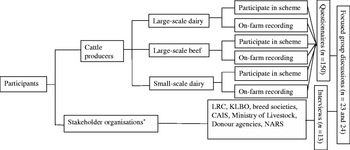
Data on issues influencing animal recording practices were collected using semi-structured interviews with key informants and questionnaires and focus group discussions with stakeholders in animal recording. Interviews were conducted with 13 members of staff from stakeholder organizations and captured information on stakeholder characteristics, roles, rights and their interrelationships. The questionnaire survey was conducted with 150 beef and dairy cattle producers (80 producers participating in a recording scheme that has a total of 305 participating farms and 70 producers recording on-farm, i.e. they record animal pedigree and performance, but do not submit the records to the recording organization) from selected districts in the country. The selection of districts was based on accessibility of the areas at the time of research implementation and proportionate livestock population. A stratified purposeful sampling technique was used to identify the participants. The questionnaires had open-ended questions that probed producers for reasons of engagement in farm animal recording and participation in national animal recording scheme, their roles and rights as stakeholders in the recording system, the benefits from animal recording, the level and the reason for interaction with other stakeholders and the rules governing their interactions. Figure 1 shows the structure of the participants in the survey, interviews and focus group discussions.
Schematic structure of the participants in questionnaire survey, interviews and focused group discussions. LRC, Livestock Recording Centre; KLBO, Kenya Livestock Breeders' Organisation; CAIS, Central Artificial Insemination Station.

Focus group discussions were conducted after interviews and questionnaire surveys. A group was constituted of cattle producers and staff from stakeholder organizations (Fig. 1). Two discussion sessions were conducted with 23 and 24 participants in the first and second sessions, respectively. The aims of the focus group discussions were to facilitate an active engagement of producers and triangulate the information collected from individual stakeholders during interviews and questionnaires, and coalesce it into a systems perspective. During the group discussions, the roles, rights and responsibility matrix were used to explore stakeholders' actions and incentives to recording, the organizations conventions and policies and the legislations that affect animal recording practices. This was instrumental in providing information on the variables in the action arena and the context of animal recording. A Venn diagram was used to assess the patterns of interaction between stakeholders and resultant outcomes, key institutions, their importance and links with the client group.
RESULTS AND DISCUSSION
Actors and action situations within the animal recording system
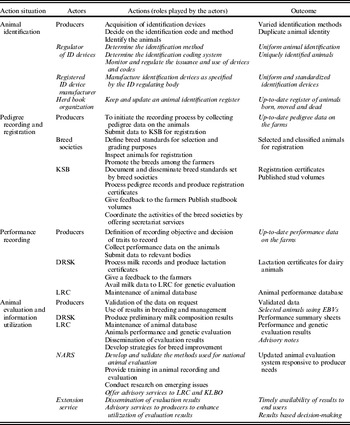
The various actors within the action situation of the animal recording system in Kenya, their actions and associated outcomes are presented in Table 1. Animal identification as an action situation involves decision-making actions on which identification methods and devices to use, and the goal of identification. It also involves the physical actions of putting the device or mark on the animal and a backup system in case the mark or device is lost or tampered with. In addition, there are supervisory and regulatory actions to ensure proper identification. This is necessary for unique identification of the animals within time and space for management, breeding and traceability (FAO 1998; Wismans Reference Wismans1999; Lawrence et al. Reference Lawrence, Strohbehn, Loy and Clause2003).
Actors* (existing and expected) within action situations of animal recording, their actions and associated outcomes. Variables in italics are non-existent although stakeholders felt they were necessary and expected them in the system

* KSB, Kenya Studbook; DRSK, Dairy Recording Services of Kenya; LRC, Livestock Recording Centre; KLBO, Kenya Livestock Breeders Organization; NARS, National Agricultural Systems; ID, identification; EBVs, estimated breeding values.
Within the Kenyan recording system, producers performed all animal identification roles including those that would otherwise be done by other actors (Table 1). They aimed at uniquely identifying animals on the farm at a given time or to show ownership. Apparently, there were no identification standards, which led to high variations in the identification devices and the codes used between farms. Also, cases of duplicated identification codes between or at times within farms were observed. These findings clearly identify the need for an official body to determine the identification method and devices, accredit device manufacturers, regulate the usage of the codes and manage the herd/stock book which is a critical part of recording systems elsewhere (ICAR 2009). Consequently, animal identification falls short of the basic requirement of a standard national identification system despite partially meeting the farm needs (Hooven Reference Hooven1978; Holst Reference Holst1999; Caja et al. Reference Caja, Ghirardi, Hernández-Jover and Garín2004; ICAR 2009). The goal of national animal identification is a fairly recent one and has been mainly motivated by issues of traceability. While developed countries would consider traceability in terms of consumer safety and disease surveillance, national animal identification may directly be beneficial to producers for the traceability of animals lost as a result of cattle rustling, which is common in Kenya, in addition to disease surveillance and consumer safety.
Actors in pedigree recording and registration action situations engaged in producing the registration certificates and publish studbook volumes. The actions included the collection of pedigree data on animals to be registered, animal inspection and classification, verification of these data for accuracy, registration and production of the certificates of registration. Key actors in animal pedigree recording and registration were the Kenya Studbook (KSB), breed societies and livestock producers (Table 1). The producers collected pedigree information and submitted it to KSB using specially designed application forms for animal registration. The KSB cross-checked the information provided for accuracy, classified the animal in various registration categories, produced the registration certificates for the registered animals and annually published studbook volumes. The studbook volumes were available as sources of information on the available breeding stock to producers, although this utility was hardly acknowledged. Breed societies had a role as quality controllers of genetic resources; a role that is shared by other breed societies elsewhere (Vares et al. Reference Vares, Habe, Klopcic and Kompan2001). The societies trained judges/inspectors who assessed the quality of candidate animals prior to registration. They determined which animals were to be registered and in which class they would be registered. Although some dairy breed societies passed on this role to the KSB, beef cattle breeders strictly handled inspection, certification and classification roles and forwarded the qualified animals to KSB for registration. Although this structure is not the most optimal and may sometimes be exclusionary, it has enabled sustainability of breed purity among the stud herd populations.
Performance recording (action situation) constituted actions of decision-making about which traits to record, the objective of recording, the collection of performance data, the submission of records to the recording organization and the delivery of outputs from the records. Actors within this situation included livestock producers, Dairy Recording Services of Kenya (DRSK) and Livestock Recording Centre (LRC) (Table 1). The DRSK defined the modalities to be used by producers in milk recording. They stipulated when to start and stop recording, how to take milk samples and also produced lactation certificates for animals whose records were received from the farms. The records received by the DRSK were later made available to LRC for evaluation. The LRC received beef performance records from the beef producers. Unlike DRSK, LRC did not define the modalities of beef cattle performance recording. However, it maintained the performance database of both dairy and beef cattle. Both organizations had a responsibility of verifying accuracy of data from farms. This was achieved by organizations' staff paying impromptu visits to the farms to cross-check the records and imposition of penalties on producers in case of data manipulation. The role of producers was to record milk and growth performance traits, and additionally for those participating in the national performance recording scheme, to submit the records to DRSK and LRC, respectively. The producers decided which traits to record and for what purpose they kept the records, since participation in the national recording scheme was optional. In other recording systems, producers sent their records to breed societies which in turn submitted the records to recording organizations (SASAIA 2007). Breed societies were conspicuously missing and their roles taken up by DRSK and LRC. This arrangement was occasioned by weak administrative systems of breed societies leading to an agreement to transfer the roles of breed societies in performance recording to public-funded recording organizations. Consequently, there were delays in verification of data accuracy which negatively impacted on the efficiency of the recording system. According to FAO (1998), mistakes in data are easily corrected if verification is closer to the data source. Breed societies are considered to be closer to producers than the recording organizations and are therefore better placed to verify data than recording organizations. In addition, the arrangement hampered collective responsibility in the actions of producers and in the definition of production objective among beef producers leading to highly varied data. This is a hindrance to across farm comparison and national genetic evaluation (FAO 1998).
Animal evaluation and information utilization requires actors to decide on the evaluation methods and models to use, organize the data for analysis, perform the analysis, compile the evaluation results in usable format, communicate the results to and support information utilization by end users (Flamant Reference Flamant1998). The LRC performed all roles related to animal evaluation and endeavoured to deliver evaluation results to the end user (Table 1). A report on genetic evaluation methods, pedigree and performance recording systems revealed that LRC used contemporary comparison in evaluation of animals (A.K. Kahi et al., unpublished results). Given the shortcomings of this methodology (Mabry & See Reference Mabry and See1990; Norman et al. Reference Norman, Powell and Wiggans1991), the report recommended the use of animal models. Animal models were adopted in the genetic evaluation of productive traits of dairy cattle; however, challenges of incomplete pedigree files had to be faced. It was observed that the inclusion of National Agricultural Research Systems (NARS) in animal recording would alleviate the challenges of model development and genetic evaluation as producers improved their ability to record pedigree information.
The LRC was not effective in timely delivery of evaluation results back to the farms. Besides, it did not ensure proper utilization of the evaluation results by the end users due to its limited resources. This hampered the use of evaluation results for selection and management decisions on farm. Animal recording is a cost component in a production system; therefore, the participation of producers is dependent on utility derived from evaluation results. Utility could be in the form of between farm performance comparison, animal selection based on breeding value estimates and advisory services on animal management. When these perceived benefits are not met, it is highly unlikely that a producer would participate in the evaluation scheme. A recommendation was made to engage the NARS in animal evaluation and utilization of the national livestock extension system, which has a countrywide network to disseminate the evaluation results (C. B. Wasike et al., unpublished results). This would improve the quality of the output from the evaluation process and expedite the transfer of the results to the farms besides the extension agent being available to respond to any questions raised by producers. In the Kenyan situation, the recommendation to use NARS was made after the previous collaborations between NARS and recording organizations improved the service delivery. However, the inclusion of the NARS should be considered as a buy-in to service role acceptable to the organizations, since the NARS may be less responsive to the producer needs.
Biophysical conditions and community attributes for animal recording
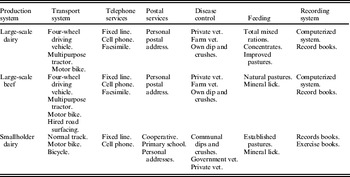
The approach identified the scale of production, transport and communication, the level of resource availability, the existence of production challenges and production strategies as the main conditions and attributes influencing animal recording practices. This implies that the engagement of producers in animal recording and the scope of implementation of animal recording on the farm are functions of an array of conditions that producers are predisposed to. Table 2 presents the levels of producer investment to mitigate production challenges.
Levels of producer investment to mitigate production challenges

Animal recording is an information transfer exercise and requires an effective transport and communication systems for efficient and reliable data transmission. Most livestock production units in Kenya are located in rural areas that are characterized by poor infrastructural and communication facilities. According to the Kenya Roads Board website (http://www.krb.go.ke/index.php/road-network/classification, accessed on 22 Dec 2009), only 0·17 of the roads were in good condition; consequently, most of the roads to the farms are loose surface roads except for the smallholder dairy farms around the major towns. This affected the accessibility of the farms and the rate of information transfer. To mitigate this challenge, producers invested resources in transport systems, either through the purchase of four-wheel drive vehicles or by upgrading the road to enhance accessibility (Table 2). Large-scale producers had better and more diverse options for transport than small-scale producers, indicating the vulnerability of the small-scale producers in accessing essential services, recording included.
Unlike transport, telecommunication services were within the reach of most livestock producers (Table 2). Communication was through mobile telephony, fixed line telephones or radio-call communication. Mobile phone communication was observed in all farming systems. It was the primary form of telephone communication for smallholder producers and a back-up of fixed line phones commonly used by large-scale producers. Most farms that had fixed lines also had fax machines. Postal communication was the commonest means of communication that was used for the transmission of recorded information from the farms and evaluation results from recording organization. All large-scale producers and most small-scale producers had private postal addresses and could send and receive data and information by post. Those that lacked personal postal addresses relied on institutions such as schools and cooperative societies within their localities to receive mails. However, it is a slow means of communication and negatively affects the rate of information flow. Therefore, to cope with the slow speed of information delivery by post, the despatch of postal mail should be within a reasonable time to give allowance for the delay as systems continue to be upgraded to more efficient electronic systems. Electronic modes of data transfer have been advocated for and are applied in various recording systems (Caja et al. Reference Caja, Ghirardi, Hernández-Jover and Garín2004; Winters & Clay Reference Winters, Clay and Sattler2009). Only a handful of producers, mainly in the large-scale category, had computerized data capturing systems using either MS Office tools or specialized data capturing software (Table 2). The development in data transfer via cellular phones occasioned by the upgrade of networks to 3G could be an important avenue for the transmission of animal records if an appropriate software is developed.
Livestock production in Kenya, like in other tropical countries, is faced with challenges such as diseases, scarcity of good quality feed resources and harsh climatic conditions to support highly productive animals (Bebe et al. Reference Bebe, Udo and Thorpe2002; Kahi et al. Reference Kahi, Wasike and Rewe2006). Producers attached primary importance to feed, health and adaptation of the animals (Flamant Reference Flamant1998; Bebe Reference Bebe2003). Therefore, a considerable amount of resources was spent on the purchase of concentrate feeds and forage, formulation of total mixed rations, mineral supplementation, employment of veterinarians and installation of structures for disease management (Table 2). This posed a great resource competition to investment in animal recording. To enhance producer participation in animal recording, recording organizations could offer services to mitigate some of these high-priority producer challenges as an incentive. This could either be direct or indirect, by engaging other stakeholders in livestock production.
The producer community applying animal recording could be classified into small-scale and large-scale, based on factors such as farm and herd sizes and the level of input use (commercialization) (Peeler & Omore Reference Peeler and Omore1997). Small-scale producers applied cost minimization strategies in their production, resulting in the observed minimum investment in inputs, including recording (Table 2). This was due to their low resource base and risk threshold vis-à-vis high production challenges within the tropics (Burrow Reference Burrow2001; Bebe Reference Bebe2003). As a result, small-scale producers would be reluctant to embrace animal recording, which they consider a cost component in the production system. On the other hand, large-scale producers employed profit maximization strategies. This was consistent with the results reported earlier on production strategies of small-scale dairy and large-scale beef cattle producers (Bebe et al. Reference Bebe, Udo, Rowlands and Thorpe2003; Rewe et al. Reference Rewe, Indetie, Ojango and Kahi2006). Production strategies applied by small-scale producers also affected the type of animals kept. Most small-scale dairy producers had small herds of crossbred animals, whereas their large-scale counterparts kept purebred exotic breeds or crossbreds with high exotic blood levels. A similar scenario was observed among beef producers. This was consistent with producer practices reported elsewhere in the literature (Bebe et al. Reference Bebe, Udo, Rowlands and Thorpe2003; Mwacharo & Drucker Reference Mwacharo and Drucker2005). In small herds and where production aimed at minimizing the production costs, recording would not be considered a priority.
Performance and pedigree data collection and genetic evaluation were not a tradition among most small-scale producers. Consequently, performance and pedigree data from these producers was scarce. Animal identification was carried out to show ownership by putting an identification mark unique to that farm on all animals. This kind of identification was useful in tracing animals in case of theft, but could not facilitate effective farm management decisions and genetic improvement, which require unique animal identification (Campher Reference Campher2004). Large-scale producers and a few small-scale dairy producers performed unique individual animal identification for farm management decisions and also genetic improvement. Animal recording on these farms were individual producer initiatives that led to variability between records from different farms.
Animal recording was also influenced by mating strategies adopted by producers. Beef producers and a number of small-scale dairy producers used natural mating systems, with the former using multiple sires in the herd except for the stud herds. Consequently, there was difficulty in the determination of the paternity of the offspring, resulting in incomplete pedigree files. Where artificial insemination (AI) was used, there was variability in the information producers recorded from the semen straw. This was a challenge in the development of pedigree files on the farm, during evaluations at LRC and the generation of studbook volumes at KSB. The adoption of ICAR regulations on recording of AI information could probably help in enhancing the consistency of the information recorded (ICAR 2009).
The approach used in the current study reveals recording organizations as an important component of the recording system whose attributes influenced the recording practice. The KSB and DRSK were producer organizations whose membership was open and voluntary similar to breed societies. Open entry and voluntary participation were meant to attract participation; however, it also resulted in a lack of commitment to recording and inconsistent participation. Inspection and classification of animals by breed society inspectors prior to registration or participation in milk recording ensured breed purity and conformity to breed standards. However, this arrangement also locked out interested small-scale producers from participation. Establishment of a studbook for crossbred genotypes from planned crossbreeding systems would offer the interested smallholder producers an opportunity to participate in animal recording. The LRC was a government agency for genetic evaluation of livestock whose operations were regulated by the Ministry of Livestock Development. This implied that individual producers and breed societies, despite being the prime beneficiaries of its services, had little influence on its operations. Making it an autonomous state corporation or a private organization would make it more competitive and responsive to producers and the changing trends in livestock production.
Rules governing animal recording practice
In any system where various individuals or organizations engage in interactive association, rules are required to govern their conduct (Dong et al. Reference Dong, Lassoie, Shrestha, Yan, Sharma and Pariya2009). Rules are shared understandings among those involved (actors) that refer to enforced prescriptions about actions. They shape the actions of actors by allocating rewards to acceptable actions and sanctions to unacceptable actions (Ostrom et al. Reference Ostrom, Gibson, Shivakumar and Andersson2002). This is achieved through five key elements of the rules namely attribute, deontic, aim, conditions and or-else (i.e. consequences of non-compliance with the rules) (Ostrom et al. Reference Ostrom, Gibson, Shivakumar and Andersson2002; Saravanan Reference Saravanan2008). A detailed description of principles, procedures and persons involved in rule formation and execution of any given system is provided by Ostrom et al. (Reference Ostrom, Gibson, Shivakumar and Andersson2002). However, briefly, rules are a result of efforts to achieve order and predictability among humans by creating classes of persons required, permitted or forbidden to take certain classes of actions in relation to required, permitted or forbidden actions. Some of these classes of persons form the agreed-upon enforcers of the rules themselves and have the power to coerce conformance. There is great variation in rule enforcement depending on the level of openness of the society. Enforcers follow agreed-upon procedures for enforcement in more open societies, whereas in authoritarian systems, enforcement is arbitrary. However, it is generally accepted that rule enforcement is necessary if order and predictability in human action is to be achieved. This also implies that rules ought to be enforced to facilitate sustainable existence of the system (Gibson et al. Reference Gibson, Williams and Ostrom2005). Therefore, the sustainability of an animal recording system is dependent on the extent to which rules are enforced and on stakeholders' compliance.
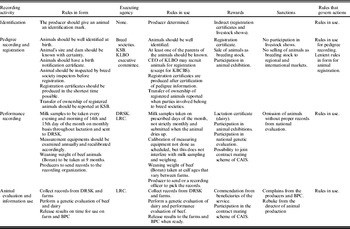
Animal recording follows a prescribed procedure as outlined by Flamant (Reference Flamant1998). For this process to be adhered to and to achieve the desired outcomes, there is a need for rules and an agency to enforce them (Gibson et al. Reference Gibson, Williams and Ostrom2005). Table 3 presented the rules governing animal recording practice, rewards and sanctions. Generally, there were no clear rules in existence to define the general animal-recording practice in Kenya. Livestock producers voluntarily participated in animal recording and decided on what to record and the extent of recording depending on the eventual use of records. However, recording organizations, i.e. breed societies, KSB and DRSK defined rules through their constitutions that facilitated their operation (rules in form or formal rules) (Table 3).
A representation* of rules governing animal recording practise, rewards and sanctions

* KSB, Kenya Studbook; DRSK, Dairy Recording Services of Kenya; LRC, Livestock Recording Centre; KLBO, Kenya Livestock Breeders Organisation; BPC, Bull Purchasing Committee; CAIS, Central Artificial Insemination Station; KBCBS, Kenya Boran Cattle Breeders Society.
Rules defined by recording organizations addressed issues of their roles and responsibilities (WHAT ought to be done), but did not adequately address the questions of HOW and WHEN the WHAT would be done especially at interaction points. For instance, a rule on milk recording in dairy cattle (Table 3) states that milk should be recorded on the evening and morning of the 14th and 15th days of the month, respectively, and the records sent to DRSK. The rule is not clear on HOW the recording should be done and how the records should be processed at DRSK (e.g. the verification of record accuracy), and when the results should be sent back to the producers (specific times of the year or any time after processing?). These are important parameters that would guarantee efficiency of the recording system but were omitted. As a result, producers crafted their own rules on which they operated (rules in use or informal rules). The voluntary nature of producer participation in recording enhanced adherence to rules in use such that rules in form were at times superseded or subverted (Table 3). Recording organizations were compelled to exercise flexibility by adopting the informal rules in order to sustain the participation of producers in recording. Similar observations were made by Helmke & Levitsky (Reference Helmke and Levitsky2006) and Tenenberg (Reference Tenenberg2008) in their studies of informal institutions and democracy, and institutional analysis of software teams, respectively. Participants in these studies normally crafted their own informal rules within the formal rules upon which they operated.
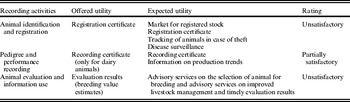
The approach attributed the observed producers' non-conformity to rules in the form to three factors: (i) The total lack of the ‘or-else’ element in the rules, or non-stringent enforcement where they existed. Producers would conform to set rules when the costs of the sanctions imposed are greater than the benefits of non-conformation or exclude them from critical benefits in the system (Gibson et al. Reference Gibson, Williams and Ostrom2005; Dudley Reference Dudley2007). Producers cited lack of economic gains out of recording. Therefore, in order to stringently apply the rules in form, the recording organizations ought to enhance utility out of recording. Producers rated the offered utility against expected utility from most recording activities as ‘unsatisfactory’ (Table 4). This implies that they would be less inclined to undertake the activities under the rules in form. (ii) The lack of or weak enforcement agencies. The importance of rule enforcement in successful management of systems has also been reported by Gibson et al. (Reference Gibson, Williams and Ostrom2005). The observed weak enforcement was due to poor supervisory structure of these agencies, poor remunerations and facilitation of the agency staff, and low returns from recording to uphold producers' participation in the scheme. (iii) The absence of a clearly defined constitutional level of action in the hierarchy of the animal recording system and constant multiple positioning of the stakeholders within the hierarchy. Ostrom et al. (Reference Ostrom, Gibson, Shivakumar and Andersson2002) and Clement & Amezaga (Reference Clement and Amezaga2008) presented a hierarchy of decision-making action within a system. The absence of clarity in decisions at the constitutional level in the Kenya's recording system affects rule formation and the implementation at the collective choice level which in turn influences the implementation of rules at the operational level.
Producer rating of offered utility against expected utility of animal recording activities

Contrary to the observed recording practice in the Kenyan recording system, countries across the development spectrum depict a picture of rule compliance and structured interactions between decision-making levels (Lawrence et al. Reference Lawrence, Strohbehn, Loy and Clause2003; van der Westhuizen et al. Reference Van der Westhuizen, Scholtz, Mamabolo, Rege, Nyamu and Sendalo2006). A part of this can be attributed to market exclusion of products as a sanction of non-compliance, strong and vigilant enforcement agencies and use of records by recording organizations and government departments to offer services of high priority to livestock producers, such as disease surveillance, traceability and compensation (Mapholi et al. Reference Mapholi, Harris, Kotze, Rege, Nyamu and Sendalo2006).
Linking patterns of stakeholder interactions in animal recording to outcomes
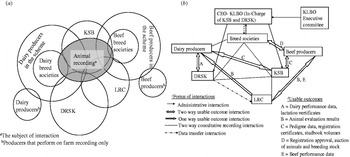
Interactions between stakeholders take a variety of forms which could include conflicts, cooperation and dependency with corresponding opportunities for resolution, analysis of trade-offs and synergies (Grimble & Wellard Reference Grimble and Wellard1997; Grimble Reference Grimble1998). The Venn diagram in Fig. 2a shows the interaction between various stakeholders in relation to the subject (animal recording). The interaction is very intensive, so that no distinctive distance exists between the stakeholders and the subject except for the producers who only perform on-farm recording. This could be attributed to interdependence between stakeholders and the critical importance of the role of each stakeholder to animal recording.
Patterns of stakeholders (LRC, Livestock Recording Centre; KLBO, Kenya Livestock Breeders' Organisation; KSB, Kenya Studbook; DRSK, Dairy Recording Services of Kenya) interactions in animal recording and the resultant outcomes of interactions. (a) Venn diagram. (b) Formsc and outcomesd of interaction.

A complex relationship is observed between stakeholders where both horizontal and vertical interactions exist. Horizontal interactions are essential for cooperation, because they imply the existence of relationship (Tamsyn et al. Reference Tamsyn, Arendse, Rogers, Sihlophe, Van Wilgen, Van Wyk and Zeka2007). Producers interacted with each other to various extents. A more constant and regular interaction was between producers who participated in the recording scheme and were members of breed societies. They had a great influence on the recording system, as depicted by the size of the circles in Fig. 2a, due to their roles as custodians of the animals, identification and data collection. Producers interacted with each other to share information on the benefits of animal recording and participation in the recording scheme. Producers who only did on-farm recording considered their counterparts in the recording scheme slightly higher in hierarchy and consulted them to seek information prior to making animal recording-related decisions such as submission of records to recording organizations (Fig. 2b). These producers had a limited influence on the recording system and their opinion was not highly important to the system as depicted by the size of the circles and distance to the subject. Producer interactions greatly influenced participation in animal recording and hence effectiveness of recording. Horizontal interactions were also observed between the various breed societies (implicit), KSB, DRSK and LRC. LRC frequently engaged both DRSK and KSB in the transfer of information and data and the verification of authenticity and accuracy of records from the producers. However, the interaction between DRSK and KSB was less frequent. These relationships were important in according credibility to the certificates issued and the evaluation results. However, they were also the cause of delayed outcomes B and C in Fig. 2b. These interactions were based on mutual understanding and were therefore governed by informal rules and sustained by the benefits derived by each organization.
Vertical interactions imply connectedness among stakeholder groups and are the basis of hierarchical representation in systems that must operate over various spatial scales (Tamsyn et al. Reference Tamsyn, Arendse, Rogers, Sihlophe, Van Wilgen, Van Wyk and Zeka2007). These interactions within the recording system involved producers, breed societies and recording organizations, and resulted in various usable outcomes (Figs 2a and b). Producers interacted with breeder societies resulting in approvals of animal registration, auction of animals and breeding stock (Fig. 2b). Dairy producers both members and non-members of breed societies had close interaction with DRSK as indicated by the large intersection in Fig. 2a. This could be attributed to the provision that made participation in milk recording independent of membership to breed society. The provision aimed at attaining higher participation rates in milk recording. This could also be enhanced to expedite data processing for a timely production of lactation certificates (outcome A in Fig. 2b) and minimize errors, since one data transfer point (breed society) is eliminated. Beef breed societies interacted more closely with KSB than their dairy counterparts, as depicted by the degree of intersection between beef breed societies and KSB. This was due to the strict regulation by beef societies to have animals inspected by certified society inspectors prior to registration. On the contrary, KSB could inspect and register dairy animals without consulting the respective dairy breed society, a practice that undermined the performance of dairy breed societies. Therefore, KSB should advise producers to seek inspection of animals from breed societies. Otherwise they should only inspect animals for registration after consulting the breed society or if the breed society for the animals seeking registration is non-existent. LRC interacted closely with beef producers and DRSK. As an evaluation centre, it received records from beef producers and DRSK, analysed them and sent the results back to the producers. The direct link between beef producers and LRC encouraged free exchange of information and enhanced the rate of data validation. Although dairy producers received evaluation results directly from LRC (Fig. 2b), the latter had to rely on DRSK to verify the data accuracy, a process that caused delay in the process.
Due to the producer perception of recording as cost component and the voluntary nature of participation in animal recording, sustainability of the cooperation between stakeholders was mainly a function of the utility derived from the outcomes rather than the system's rules. For instance, the interactions between producers and KSB and producers and DRSK were sustained by the value attached to the outcomes (registration and lactation certificates) as a prerequisite for participation in the auction of breeding stock and animal exhibitions. The interactions between the various stakeholders should be symbiotic. Since animal recording revolves around the producer, who is the custodian of the animal and the beneficiary of eventual outcomes, all actors at various interaction levels and action situations should aim at yielding outcomes that complement each other in order to offer high value utility to the producer for sustained participation and for the system's sustainability.
CONCLUSION
The evaluation of efficiency using utility as a parameter based on the IAD framework provides a broader view and gives value to animal recording which would otherwise be considered non-valuable under the ordinary efficiency evaluation methodologies. The approach successfully identifies areas of inefficiency in animal recording in Kenya as the institutional environment, i.e. biophysical conditions, missing actors, type of rules, rule formation structures and conformance which affect the realization of recording outcomes. It may therefore be recommended for use on systems with non-marketed products. Sustainability of actor interactions and efficiency in animal recording was a function of the utility derived. These could be achieved in a recording system especially where systematic and uniform recording are critical, if rule conformance was upheld. This emphasizes the importance of strong enforcement agencies and the better form of rules (rules that govern outcomes and utility of the outcomes) for conformance to the rules and collective responsibility in animal recording. However, a strong enforcement of rule compliance should be commensurate to the benefits accrued from the system. A constitutional decision-making level should be established to define rules and standards for the collective choice level, and the latter to define rules for the operational level. Rules and rule formation structures should be dynamic in response to the dynamism in the utility of outcomes of animal recording. Institutions should be established to invoke participation of the missing actors and to support partnerships between recording organizations, private service providers and government departments. Stakeholders should endeavour to enhance the utility of animal records by alleviating factors that compete with animal recording for producer resources to ensure sustainable participation and efficiency.