Introduction
Anticipation forms an integral part of our lives. Language is no exception. Linguistic anticipation consists of the pre-activation of linguistic information before it has been heard (Huettig, Reference Huettig2015). Monolinguals constantly predict morphological information of upcoming words (Kamide, Reference Kamide2008) and suffixes within a word (Roll, Reference Roll2015), but the evidence is mixed regarding L2 learners (see Kaan, Reference Kaan2014, for a review). Relevant to our study, to predict a word's suffix, native speakers use both suprasegmental (e.g., tone, stress, vowel duration) and segmental (e.g., syllabic structure) information, high proficiency learners use suprasegmental and less frequent segmental (e.g., CVC but not CV syllabic structure) information, and low proficiency learners do not use suprasegmental or segmental information (see Sagarra & Casillas, Reference Sagarra and Casillas2018, for a review). However, it is unclear what makes proficient learners better anticipators than non-proficient ones: is it their higher L2 proficiency or their increased anticipatory experience?
This study investigates whether native speakers and advanced learners use suprasegmental and segmental information to predict a word's suffix, and whether anticipatory experience affects L2 predictions. To this end, advanced English learners of Spanish (with and without professional interpreting experience) and Spanish monolinguals looked at two Spanish verbs on a screen while hearing Spanish sentences containing one of the two verbs. Eye fixations to the target verb before hearing the suffix measured the use of suprasegmental (lexical stress) and segmental (syllabic structure) information in the verb stem to predict the verb suffix. Professional interpreters were included because they have extensive practice anticipating linguistic information (Liontou, Reference Liontou2012). Lexical stress was chosen because it is contrastive in English and Spanish, yet it is realized differently in each language, resulting in cross-linguistic interference in L2 learners (Face, Reference Face2005; Lord, Reference Lord2007). Syllabic structure was selected because it can be used to reduce competition during lexical activation for speech production (Cholin, Levelt & Schiller, Reference Cholin, Levelt and Schiller2006). Finally, the visual world paradigm methodology was employed because it measures attention to upcoming linguistic information prior to disclosure by time-locking listeners’ eye-movements to a visual stimulus (e.g., a written word) in response to an oral stimulus (e.g., a sentence) (see Huettig, Rommers & Meyer, Reference Huettig, Rommers and Meyer2011, for a review). Taken together, the findings of this study will advance our understanding of how humans gain anticipation expertise and will inform cognitive models and instructional practices.
Anticipation in monolinguals
Native speakers use a myriad of information to make linguistic predictions, including semantics (Altmann & Kamide, Reference Altmann and Kamide1999), morphology (Grüter, Lew-Williams & Fernald, Reference Grüter, Lew-Williams and Fernald2012; Lew-Williams & Fernald, Reference Lew-Williams and Fernald2010), and phonology (intonation: Nakamura, Arai & Mazuka, Reference Nakamura, Arai and Mazuka2012; Weber, Grice & Cocker, Reference Weber, Grice and Crocker2006; tone: Roll, Reference Roll2015; Roll, Horne & Lindgren, Reference Roll, Horne and Lindgren2011; pauses between clauses: Hawthorne & Gerken, Reference Hawthorne and Gerken2014; Kjelgaard & Speer, Reference Kjelgaard and Speer1999; vowel duration: Rehrig, Reference Rehrig2017). Such predictions depend on speech rate (slower rates increase prediction), preview time (longer times increase prediction), task instructions (explicitly instructing participants to predict increases prediction) (Huettig & Guerra, Reference Huettig and Guerra2019), and age (younger age increases prediction) (Wlotko, Lee & Federmeier, Reference Wlotko, Lee and Federmeier2010). Interestingly, older monolinguals with larger vocabularies and higher verbal fluency are as effective as younger monolinguals making linguistic predictions (Federmeier, Mclennan, De Ochoa & Kutas, Reference Federmeier, McLennan, De Ochoa and Kutas2002), suggesting that prediction is not always affected by age.
Relevant to our study, native speakers make use of suprasegmental and segmental information to predict morphology within a word. For suprasegmentals, Swedish speakers use tone to predict number (singular/plural) (Roll et al., Reference Roll, Horne and Lindgren2010; Söderström, Horne & Roll, Reference Söderström, Horne and Roll2015; Roll, Söderström & Horne, Reference Roll, Söderström and Horne2013) and tense (present/past) (Söderström, Roll & Horne, Reference Söderström, Roll and Horne2012; Roll, Reference Roll2015), Hispanophones use lexical stress to predict tense (present/past) (Sagarra & Casillas, Reference Sagarra and Casillas2018), and Anglophones use vowel duration to predict voice (active/passive) (Rehrigh, Reference Rehrig2017) – but this study mixed suprasegmental (vowel duration) and segmental variables. With regard to segmentals, Swedish speakers use the phonotactic frequency of a word's first two segments to predict number (singular/plural) (Roll, Söderström, Frid, Mannfolk & Horne, Reference Roll, Söderström, Frid, Mannfolk and Horne2017), and Hispanophones use syllabic structure of a word's first syllable to predict tense (present/past) (Sagarra & Casillas, Reference Sagarra and Casillas2018). Considered together, these studies indicate that native speakers utilize both suprasegmental and segmental information to anticipate a word's suffix.
Anticipation in L2 learners
Contrary to native speakers, L2 learners show a high degree of variability when making predictions (Kaan, Reference Kaan2014). Thus, they may (Foucart, Ruiz-Tada & Costa, Reference Foucart, Ruiz-Tada and Costa2016) or may not (Martin, Thierry, Kuipers, Boutonnet, Foucart & Costa, Reference Martin, Thierry, Kuipers, Boutonnet, Foucart and Costa2013) use contextual cues, and they may (Marull, Reference Marull2017) or may not (Lew-Williams & Fernald, Reference Lew-Williams and Fernald2010) use morphological cues. This variability has been attributed to cross-linguistic differences. For instance, Dussias, Valdés Kroff, Guzzardo Tamargo and Gerfen (Reference Dussias, Valdés Kroff, Guzzardo Tamargo and Gerfen2013) found that low-proficiency learners of a gendered L1 (Italian) can partially use gender information to make gender agreement predictions in a gendered L2 (Spanish), whereas low-proficiency learners of a genderless L1 (English) cannot. In addition, Hopp (Reference Hopp2016) reported that lacking a mental representation of gender marking hinders L2 prediction of gender agreement.
Cross-linguistic effects are also evident in suprasegmental information: higher, but not lower, proficiency learners use suprasegmental information in a word stem to predict its suffix when the L1 lacks the target prosodic distinction (Rehrig, Reference Rehrig2017; Schremm, Söderström, Horne & Roll, Reference Schremm, Söderström, Horne and Roll2016), or realizes it differently (Sagarra & Casillas, Reference Sagarra and Casillas2018). For example, advanced (Schremm et al., Reference Schremm, Söderström, Horne and Roll2016), but not beginning (Gosselke Berthelsen, Horne, Brännström, Shtyrov & Roll, Reference Gosselke Berthelsen, Horne, Brännström, Shtyrov and Roll2018), L2 learners of Swedish with a non-tonal L1 background make tone-suffix anticipatory associations. Unfortunately, these findings are confounded, because the study with advanced learners examined tone-suffix associations to predict tense in verbs, whereas the one with beginners focused on number-suffix associations to anticipate number in nouns. To address this limitation, Sagarra and Casillas (Reference Sagarra and Casillas2018) investigated stress (suprasegmental) and syllabic structure (segmental) as predictors of verb tense in both beginning and advanced English learners of Spanish. They found that advanced, but not beginning, learners anticipated suffixes preceded by a CVC stem, but not a CV stem, regardless of the stem stress. Similarly, Rehrig (Reference Rehrig2017) reported that Chinese learners of English failed to use vowel duration to predict verb suffixes essential to interpreting the sentence as active or passive, possibly due to low proficiency (assessed via self-ratings), the use of a contrast known to be acquired late even in monolinguals (active/passive voice), or vowel duration being confounded with syllabic structure (long duration items contained complex codas; short duration items contained open syllables). Finally, Schremm, Hed, Horne and Roll (Reference Schremm, Hed, Horne and Roll2017) reported that beginning learners of Swedish extensively exposed to tone-suffix associations via a digital game training interpreted and produced these associations more effectively than a control group. Unfortunately, these studies mix proficiency with anticipatory experience. We isolate the role of anticipatory experience by comparing L2 learners of equivalent proficiency with and without interpreting experience.
Anticipation in interpreters
Simultaneous interpreting is cognitively taxing (Gile, Reference Gile, Ferreira and Schwieter2015) because it requires interpreters to retain information from the source language in working memory (WM), access meaning, connect to previous information, translate into the target language, and produce the message in the target language (Bajo, Padilla & Padilla, Reference Bajo, Padilla and Padilla2000). This explains why interpreters are better at: (1) detecting written errors than interpreter students, non-interpreter bilinguals, and monolinguals (Yudes, Macizo, Morales & Bajo, Reference Yudes, Mazizo, Morales and Bajo2013), (2) adapting their strategies to tasks (e.g., repeating information vs. interpreting into their L2) (Togato, Paredes, Macizo & Bajo, Reference Togato, Paredes, Macizo and Bajo2015), and (3) reading comprehension and WM (Bajo et al., Reference Bajo, Padilla and Padilla2000) (but see Dong & Cai, Reference Dong and Cai2015, for a review of studies against this WM-interpreter advantage). Furthermore, interpreters exhibit increased cortical thickness in brain areas related to phonetic processing, higher-level formulation of propositional speech, conversion of items from WM into a sequence, and domain-general executive control and attention (Hervais-Adelman, Moser-Mercer, Murray & Golestani, Reference Hervais-Adelman, Moser-Mercer, Murray and Golestani2017). We examine whether this “interpreter advantage” extends to non-interpreting situations, specifically, L2 anticipation.
Anticipation plays a central role in interpreting, allowing interpreters to pre-activate and produce pre-activated information before hearing it, and is commonly taught in simultaneous interpreting courses (Li, Reference Li2015) to decrease cognitive load and to facilitate efficient interpreting (Seeber & Kerzel, Reference Seeber and Kerzel2011). To predict, interpreters employ discourse redundancy (Chernov, Reference Chernov2004) and contextual and syntactic knowledge (Moser-Mercer, Reference Moser-Mercer1978). This allows interpreters to anticipate often – about 1 sentence every 85 seconds (Van Besien, Reference Van Besien1999) – and effectively – they predict accurately 95% of the time (Liontou, Reference Liontou2012). Furthermore, increased levels of prediction are associated with fewer errors and with a more complete interpretation with fewer omissions from the source speech (Kurz & Färber, Reference Kurz and Färber2003). Despite the frequency and efficiency of anticipation in interpreters, to our knowledge, there is currently only one study on the subject involving this population. Chernov (Reference Chernov2004) investigated interpreters’ anticipation of highly constraining sentences with unexpected endings while performing simultaneous interpreting. The results showed that the interpreters generated more accurate predictions when interpreting from their L1 to their L2 than when interpreting from their L2 to their L1. However, the participants’ L1s were mixed, the variables were unclear, and statistical analyses were absent.
Our study stakes out new territory by investigating whether interpreters’ vast anticipatory experience, developed over a prolonged period of time, extends to non-interpreting situations. This is important to tease apart proficiency from anticipatory experience's effects on lexical anticipation. As previously mentioned, short-term training on the association between prosodic cues and morphology strengthens prediction (Schremm et al., Reference Schremm, Hed, Horne and Roll2017). The present study makes a contribution to prediction models by investigating how experience with interpreting could act as long-term training.
Lexical stress and syllabic structure in Spanish and English
This study includes two linguistic variables related to morphological anticipation: lexical stress (suprasegmental) and syllabic structure (segmental).Footnote 1 Both segments, discrete units of sound identifiable in the speech signal, and suprasegmentals, elements of speech extending over a range of segments, can be used contrastively. Lexical stress, a suprasegmental, refers to the relative prominence of one syllable over the rest of the syllables in a word. Prominent syllables typically have higher pitch, longer duration, and are louder (Hualde, Reference Hualde2013). Lexical stress is contrastive in both Spanish (SÁbana ‘bed sheet’ vs. saBAna ‘savannah’) and English (CONflict vs. conFLICT), but it is realized differently in the two languages. English is typically categorized as a stress-timed language in which the time interval between stressed syllables is approximately the same and is partially modulated by vowel reduction processes. Specifically, unstressed vowels typically have shorter duration and formant frequencies often centralize towards [ə]. Spanish, on the other hand, is generally assumed to be a syllable-timed language in which syllables, both stressed and unstressed, have approximately the same duration and vowel quality tends to remain steady-state. These differences may explain why Anglophones encounter difficulties producing (Lord, Reference Lord2007) and perceiving (Face, Reference Face2005, Reference Face2006) lexical stress in L2 Spanish, though it is also clear that Spanish and English monolinguals use this suprasegmental property in different ways. For instance, a prosodically matched prime facilitates perception in Spanish and English monolinguals, but a mismatched prime inhibits (slower RTs) perception in Spanish monolinguals (Soto-Faraco, Sebastián-Gallés & Cutler, Reference Soto-Faraco, Sebastián-Gallés and Cutler2001), but not in English monolinguals (Cooper, Cutler & Wales, Reference Cooper, Cutler and Wales2002). These differences suggest that lexical stress in Spanish is used to reduce the number of competitors for lexical access; this does not seem to be the case in English, likely due to the fact that vowel reduction can efficiently fill this role.
With regard to syllabic structure, both Spanish and English permit open and closed syllables, though there is a presumably universal preference for onset + vocoid sequences to remain open, i.e., codaless (see Hyman, Reference Hyman1975, and Jakobson, Reference Jakobson1968, for a review). This preference is evidenced by the fact that some languages allow codas, but no language requires them. Likewise, in some languages onsetless syllables are legal, but no language forbids onsets. Given this tendency to avoid coda segments, CVC syllables in English and Spanish are considered marked with regard to CV syllables under current phonological frameworks. As a result, the mere presence of a coda may be perceived as more salient acoustically (Hahn & Bailey, Reference Hahn and Bailey2005) or articulatory (Côté, Reference Côté1997) to the listener. Crucial to our study, the structure of a word's first syllable can reduce competition during lexical access (Cholin et al., Reference Cholin, Levelt and Schiller2006), such that initial segments with fewer possible and more frequent endings trigger stronger preactivation (Roll et al., Reference Roll, Söderström, Frid, Mannfolk and Horne2017). In other words, the syllable structure of a lexical item might aid anticipatory processes before morphological information becomes available.
The present study
Previous studies suggest that native speakers use suprasegmental and segmental information to predict a word's suffix, and that non-native speakers use this information depending on proficiency (higher proficiency correlates with better anticipation) and frequency of occurrence (lower frequency is associated with fewer lexical competitors) (see Sagarra & Casillas, Reference Sagarra and Casillas2018, for a review). However, most studies examine either natives or non-natives, and suprasegmental or segmental variables, and thus cannot be directly compared. To address this limitation, we investigate native and non-native use of suprasegmental (lexical stress: oxytone, paroxytone) and segmental (syllabic structure: CVC, CV) information to predict word suffixes. In addition, L2 anticipatory studies cannot explain why higher, but not lower, proficiency learners can use linguistic variables to anticipate, as they confound proficiency and anticipatory experience. To tease the two apart, we compare equally proficient learners (advanced) with and without extensive interpreting experience.
The first research question examined whether Spanish monolinguals and advanced English learners of Spanish use suprasegmental and segmental information to anticipate word suffixes, and, if they do, whether frequency of occurrence (oxytones and CVC are less frequent than paroxytones and CV) affects their anticipation. We tested four hypotheses. First, based on studies showing that natives use suprasegmental information (Swedish tone: Roll et al., Reference Roll, Horne and Lindgren2010, Reference Roll, Söderström and Horne2013; Söderstrom et al., Reference Söderström, Horne and Roll2015; Schremm et al., Reference Schremm, Söderström, Horne and Roll2016; English vowel duration: Rehrig, Reference Rehrig2017; Spanish stress: Sagarra & Casillas, Reference Sagarra and Casillas2018) and segmental information (Swedish phonotactic frequency: Roll et al., Reference Roll, Söderström, Frid, Mannfolk and Horne2017; Spanish syllabic structure: Sagarra & Casillas, Reference Sagarra and Casillas2018) to anticipate inflectional morphology during spoken word recognition, we predicted that monolinguals would use both stress and syllable structure. Second, we assumed that monolinguals anticipate earlier and faster than non-interpreter L2 learners, considering that lexical stress is a stronger cue for lexical disambiguation in Spanish (Soto-Faraco et al., Reference Soto-Faraco, Sebastián-Gallés and Cutler2001) than in English (Cooper et al., Reference Cooper, Cutler and Wales2002). Third, we expected the non-interpreter L2 learners to use stress, but only for the less frequent syllable structure (CVC), to anticipate a word's suffix, based on prior work indicating that high proficiency learners use suprasegmental properties (Swedish tone: Schremm et al., Reference Schremm, Söderström, Horne and Roll2016) but only for less frequent segmental features (Spanish CVC structure: Sagarra & Casillas, Reference Sagarra and Casillas2018). Fourth, we hypothesized that monolinguals and non-interpreter L2 learners would anticipate earlier and faster with less frequent CVC oxytone words than with more frequent CV paroxytone words, considering earlier studies revealing that cues related to a smaller pool of lexical competitors increase brain activation (suprasegmental: Roll et al., Reference Roll2015) and strengthen anticipation (segmental: Roll et al., Reference Roll, Söderström, Frid, Mannfolk and Horne2017).
The second research question explored whether increased anticipatory experience acquired via interpreting facilitates anticipation in non-interpreting L2 situations. This question generated three hypotheses. First, we assumed that interpreters would predict earlier and faster with less frequent suprasegmental and segmental cues, like the monolinguals and the non-interpreter learners. Second, we expected interpreters to start predicting earlier than non-interpreters and monolinguals because earlier prediction releases cognitive load facilitating interpretation of upcoming speech (Seeber & Kerzel, Reference Seeber and Kerzel2011). Third, we hypothesized that interpreters would anticipate at a faster rate than non-interpreters (albeit slower than monolinguals), based on studies indicating that interpreting practice not only results in increased cortical thickness in brain areas implicated in simultaneous interpreting, but also in other areas related to the production of propositional speech (Hervais-Adelman et al., Reference Hervais-Adelman, Moser-Mercer, Murray and Golestani2017). Some studies show that the production system is involved during prediction (see Pickering & Gambi, Reference Pickering and Gambi2018, for a review) and, thus, interpreters’ more robust productive system could accelerate their predictive processing.
Methods
Participants
The sample pool consisted of 25 Spanish monolinguals, 25 non-interpreter advanced English L2 learners of Spanish, and 22 advanced English (L1) – Spanish (L2) interpreters, between 18 and 76 years old. The data were collected at two large universities in the United States and Spain. The monolinguals were born and raised in a monolingual region of Spain, had not been abroad for more than 3 months, and were not proficient in English according to a multiple-choice section adapted from the TOEFL. The learner groups were born and raised in an English monolingual environment, attended school in English, learned Spanish in a formal setting after the age of 12, and most of them had studied abroad in a Spanish-speaking country (range = 0–418 months, M = 22.7, SD = 60.8). The non-interpreters had no translating or interpreting experience. The interpreters had official interpreting certifications (courts, medical interpreting, etc.) or professional training (master's and bachelor's), and had been working as professional interpreters full-time for at least two years (range = 2–35 years, M = 14.2, SD = 9.23). Most of the interpreters worked in the simultaneous interpreting mode (the interpreter translates the speech at the same time as the speaker is talking) and occasionally in consecutive interpreting (the interpreter renders the translation after the speaker finishes one section of the speech).
To rule out the possibility of interpreters performing better than non-interpreters due to higher WM or L2 proficiency, we tested for homogeneity of variance for WM (all groups) and L2 proficiency (L2 groups), and then conducted two one-sided tests of equivalence for all pairwise comparisons (Lakens, Reference Lakens2017). We tested moderate effects with a Cohen's D of 0.3. The results revealed equal homogeneity for WM (K 2(1) = 2.29, p = 0.13) and L2 proficiency (K 2(1) = 0.32, p = 0.57). Furthermore, the observed effects were statistically not different from zero for all pairwise comparisons for WM (monolinguals vs. interpreters: t(34.69) = 0.49, p = 0.69; monolinguals vs. non-interpreters: t(47.22) = 0.78, p = 0.22; interpreters vs. non-interpreters: t(37.72) = 0.639, p = 0.737) and for L2 proficiency (interpreters vs. non-interpreters: t(42.36) = 1.89, p = 0.07). Table 1 summarizes the descriptive statistics for age, WM, and L2 proficiency.
Descriptive statistics for Participant's WM and Spanish Proficiency test (DELE)

Materials and procedure
Participants completed a language background questionnaire (5 minutes), a proficiency test (20 minutes), an eye-tracking task (20 minutes), a phonological short-term memory test (10 minutes), a WM test (10 minutes), a gating task (10 minutes), and a production task (15 min), in this order. All tasks were collected individually in one session (approx. 1 hour and 30 minutes). The present work focuses on the eye-tracking data.
Screening tests
The language background questionnaire included questions about the participants’ L1 and L2 acquisition, education, stays abroad, and current percentage of use of both languages. The interpreters group had an extra set of questions related to their professional activity: working languages, modes of interpreting most commonly used (consecutive, simultaneous, or sight translation), interpreting training and certification, and years of professional experience. The language proficiency test was an adapted version of the Diploma de Español como Lengua Extranjera (DELE) with a total of 56 multiple-choice questions. Three blocks of 12 questions assessed grammar and the last 20 questions evaluated reading comprehension. Correct answers received 1 point and incorrect answers received 0 points.
Eye-tracking task
An EyeLink 1000 Plus desktop mount eye-tracker from SR Research was used to record eye movements (sampling rate: 1k Hz; spatial resolution was less than .05o; averaged calibration error: .25-.5o). The task was presented to participants on a BenQ XL2420TE monitor at a resolution of 1920 x 1080 pixels and using Sol Republic 1601-32 headphones. There were 66 sentences: 18 practice, 16 experimental, and 32 fillers. All sentences were 5 to 7 words long, there were equal proportions of two filler types (number: col-coles ‘cabbage-cabbages’; lexical: mar-marco ‘sea-frame’), and all word pairs presented to the participant (experimental and filler) had segmentally identical syllables. The target words were paroxytones (8 disyllabic verbs) and oxytones (8 disyllabic verbs). Approximately half of the target words’ first syllable had CV structure (la.var ‘to wash’), and the other half had CVC structure, with a rhotic or nasal coda (fir.mar ‘to sign’). Finally, the paroxytone and oxytone target words were comparable in terms of overall lexical frequency (K 2(1) = 2.70, p = 0.11, TOST: t(37.11) = 0.67, p = 0.75) as measured by the LEXESP Spanish frequency dictionary (Sebastián-Gallés, Martí, Carreiras & Cuetos, Reference Sebastián-Gallés, Martí, Carreiras and Cuetos2000).
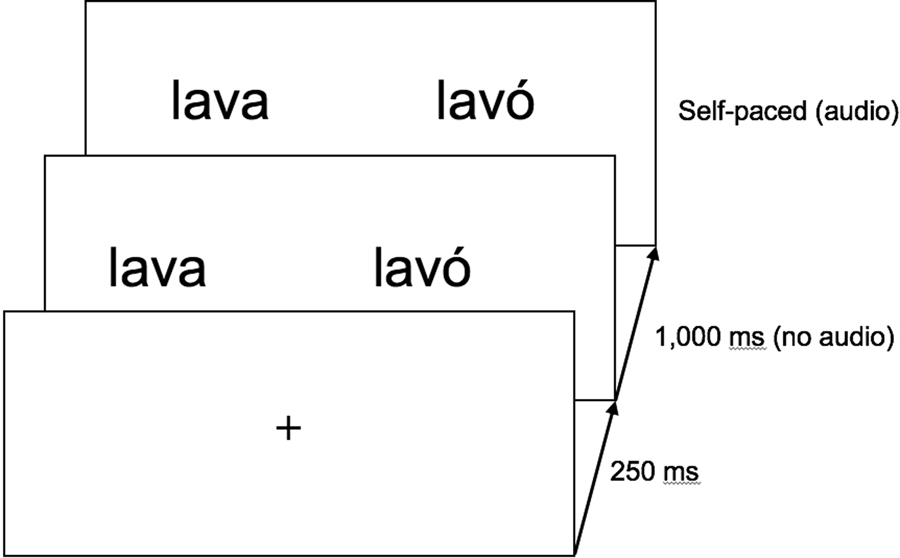
The procedure was the following: participants rested their heads on a chin-rest and performed a nine-point calibration while looking at a monitor. Then, they completed the practice trials followed by the experimental and filler trials, separated by a 500-ms blank screen. Participants were randomly assigned to one of the two versions of the experiment. The practice trials were identical in both versions, were presented in the same order, and served to familiarize participants to the speaker's voice, speech rate and acoustic characteristics of the sound files. For each trial (practice, experimental or filler), the participants completed a drift correction, followed by a fixation point in the center of the screen for 250 ms, they read the target and distractor words (e.g., lava - lavó, ‘(s)he washes - washed’), and 1,000 ms later they heard the sound file (e.g., El primo lavó los coches, ‘the cousin washed the cars’). Next, they chose one of the two words as soon as they could by pressing the right or left shift key (see Appendix I for a complete list of stimuli). Participants did not need to listen to the entire sentence, but key presses before the target onset did not stop the sound file nor were they recorded (see Figure 1).
Sample trial in the eye-tracking task.

Words rather than images were used, because a pilot eye-tracking task with monolinguals showed that imageability of the target words was low and that participants could not decipher what the image meant even after hearing the target word. Also, words show stronger phonological competitor effects with non-predictive contexts (Huettig & McQueen, Reference Huettig and McQueen2007). Words were displayed in Arial font and 150pt size, were centered in the left and right halves of the screen, and were counterbalanced (half of present verbs appeared on the left, half as targets and half as distractors, and half of past tense verbs appeared on the right, half as targets and half as distractors).
Auditory stimuli were recorded in a sound-attenuated booth, using a Shure SM58 microphone and a Marantz Solid State Recorder PMD670, at a sampling rate of 44.1 kHz and 16-bit quantization. A female native speaker of Peninsular Spanish recorded each sentence three times, taking into consideration speaking rate and standard intonation. The best iteration was selected according to clarity. Next, volume was normalized at -18dB, and 100 ms of leading and trailing silence was added using Praat (Boersma & Weenink, Reference Boersma and Weenink2017). The mean speech rate of all utterances was 3.03 ± 0.49 SD syllables per second, and the mean length of all sentences was 2.51 ± 0.22 SD seconds. Finally, sentences were organized following a Latin Square design (each block included only one sentence of a specific condition) and were later pseudo-randomized to reduce the chances of two sentences of the same type and condition appearing consecutively.
Statistical analysis
The time course data from the eye-tracking task were analyzed using weighted empirical-logit growth curve analysis (GCA, Mirman, Reference Mirman2016). We used GCA to model how the probability of fixating on target items changed over time and under different suprasegmental and segmental conditions. We downsampled the data to bins of 50 ms which were centered at the offset of the first syllable of target items. The empirical logit transformation (Barr, Reference Barr2008) was applied to the binary responses (fixations to the target or the distractor). The time course of fixation ranged from 200 ms before target syllable offset to 600 ms after. We chose this window because it captured the portion of the time course in which target fixations began to steadily increase from chance. We modeled the time course using linear, quadratic, and cubic orthogonal polynomials with fixed effects of group, lexical stress, and syllable structure on all time terms. For the group predictor, monolinguals were set as the baseline, thus the interpreters and non-interpreters’ parameters described how the growth curve of the learners differed from that of the native controls. Lexical stress and syllable structure were sum coded such that parameter estimates represent the effect size associated with a change from CV to CVC syllables and paroxytone to oxytone stress. All models included by-subject random effects on all time terms and the syllable structure and lexical stress predictors, as well as by-item random effects on all time terms. Main effects and higher order interactions were assessed using nested model comparisons. The analysis was conducted in R (R Core Team, 2019) and the GCA models were fit using lme4 (Bates, Mächler, Bolker & Walker, Reference Bates, Mächler, Bolker and Walker2009). Pairwise comparisons between learner groups were conducted using the R package multcomp (Hothorn, Bretz & Westfall, Reference Hothorn, Bretz and Westfall2008).
Results
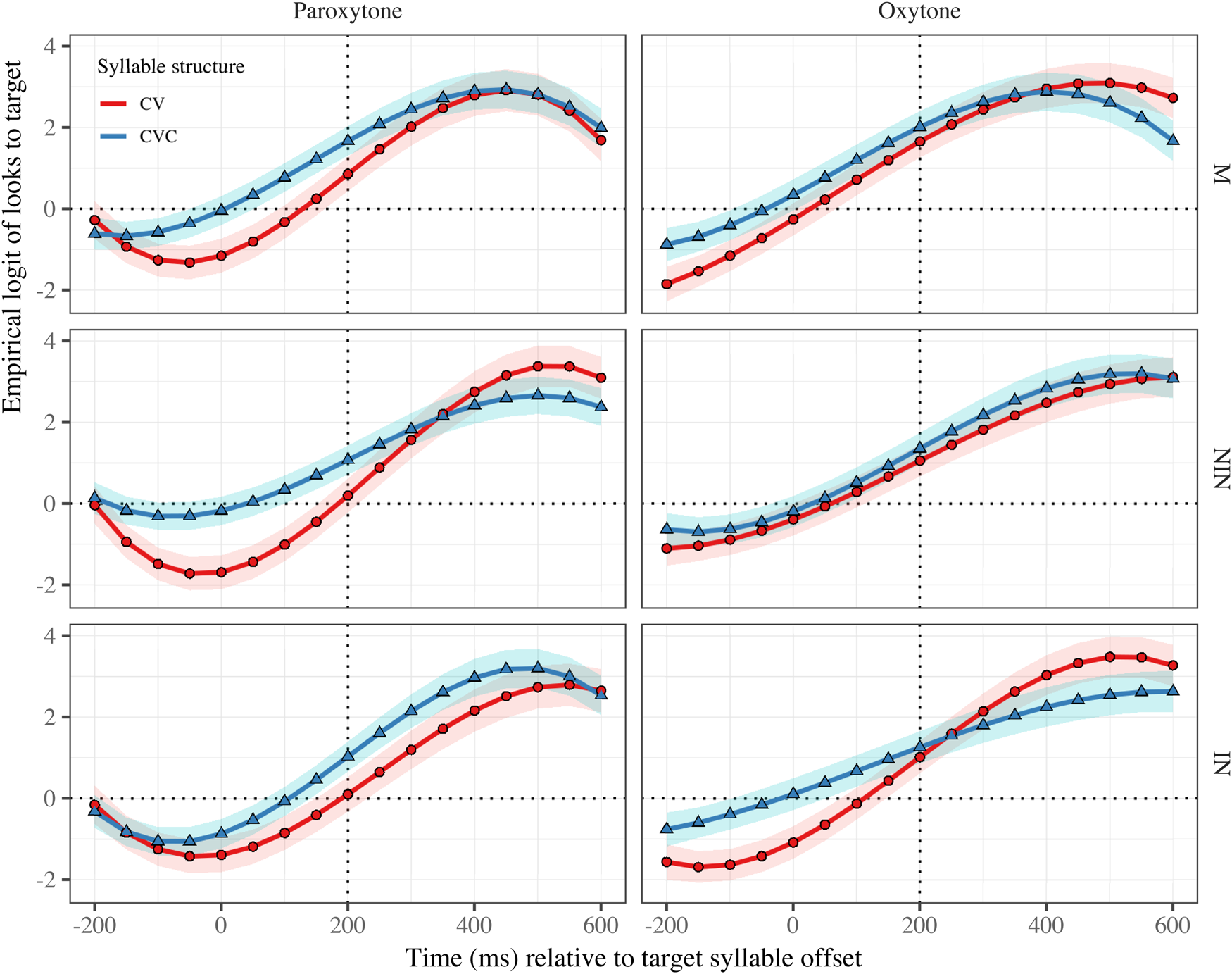
Figure 2 plots the model estimates from the GCA, and the full model summary is available in Appendices 2 and 3. We report the results for the monolingual group and then provide comparisons with and between the learner groups. The model intercept estimates the log odds of monolinguals fixating on the target, averaging over the time course, lexical stress and syllable structure. The log odds were γ00 = 1.17 (proportion: .76). The linear, quadratic, and cubic polynomial time terms captured the sigmoid shape of the time course and were retained in the model (γ10 = 5.704; SE = 1.042; t = 5.476; p = .001; γ20 = −1.373; SE = 0.423; t = −3.246; p = .001; γ30 = −1.711; SE = 0.367; t = −4.658; p = .001).
Growth curve estimates of target fixations for each group. Symbols and lines represent model estimates, and the transparent ribbons represents ±SE. Empirical logit values on y-axis correspond to proportions of 0.12, 0.50, 0.88, and 0.98. The horizontal dotted line represents the 50% probability of fixating on the target. The vertical dotted line indicates 200 ms after the offset of the target syllable.

There was a main effect of lexical stress on the quadratic time term (χ2(1) = 4.4, p = .036). Averaging over syllable structure, a change from paroxytonic (e.g., LAva) to oxytonic (e.g., laVÓ) stress decreased the bowing of the trajectory at the center of the time course (γ22 = 0.666; SE = 0.305; t = 2.184; p = .029) indicating that monolinguals fixated on oxytonic targets earlier than paroxytonic targets. There was also a main effect of syllable structure on the cubic time term (χ2(1) = 4.4, p = .037), as well as a syllable structure × lexical stress interaction on the linear time term (χ2(1) = 4.6, p = .032), such that the effect of lexical stress decreased the overall slope (γ31 = −0.594; SE = 0.260; t = −2.283; p = .022) and the bowing of the vertices (i.e., turning points) of closed, paroxytonic syllables (γ15 = −1.047; SE = 0.464; t = −2.255; p = .024). This indicates that monolinguals fixated on the paroxytone targets slightly later in the time course, whereas they fixated on oxytone targets earlier, but at a slower and steadier rate. The presence of the coda increased the rate of target fixation on paroxytone items, but had little effect on oxytone items (see the upper panels of Figure 2).
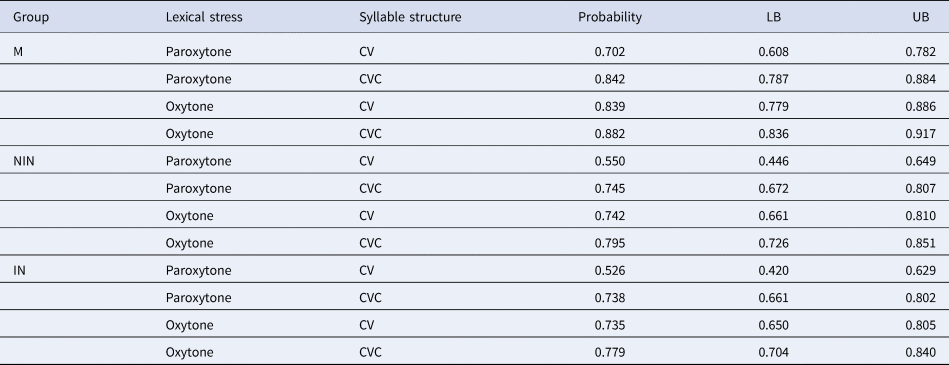
Focusing on the offset of the target syllable, the model estimated target fixations above 50% in all conditions (Paroxytone CV: Probability = 0.702; LB = 0.608; UB = 0.782; Paroxytone CVC: Probability = 0.842; LB = 0.787; UB = 0.884; Oxytone CV: Probability = 0.839; LB = 0.779; UB = 0.886; Oxytone CVC: Probability = 0.882; LB = 0.836; UB = 0.917). Table 2 provides estimates ± SE for all groups in all conditions. Overall, the analyses indicated that the monolinguals group anticipated target suffixes in all conditions, though certain conditions seem to facilitate prediction. Specifically, defaulting from a paroxytone with a CV penult (e.g., LAva), one observes earlier target fixations with the addition of a coda and with a shift of stress to the final syllable (e.g., firMÓ), suggesting that marked sequences facilitate lexical access in native speakers.
Model estimates for probability of target fixations ± SE at 200 ms after the target syllable offset.

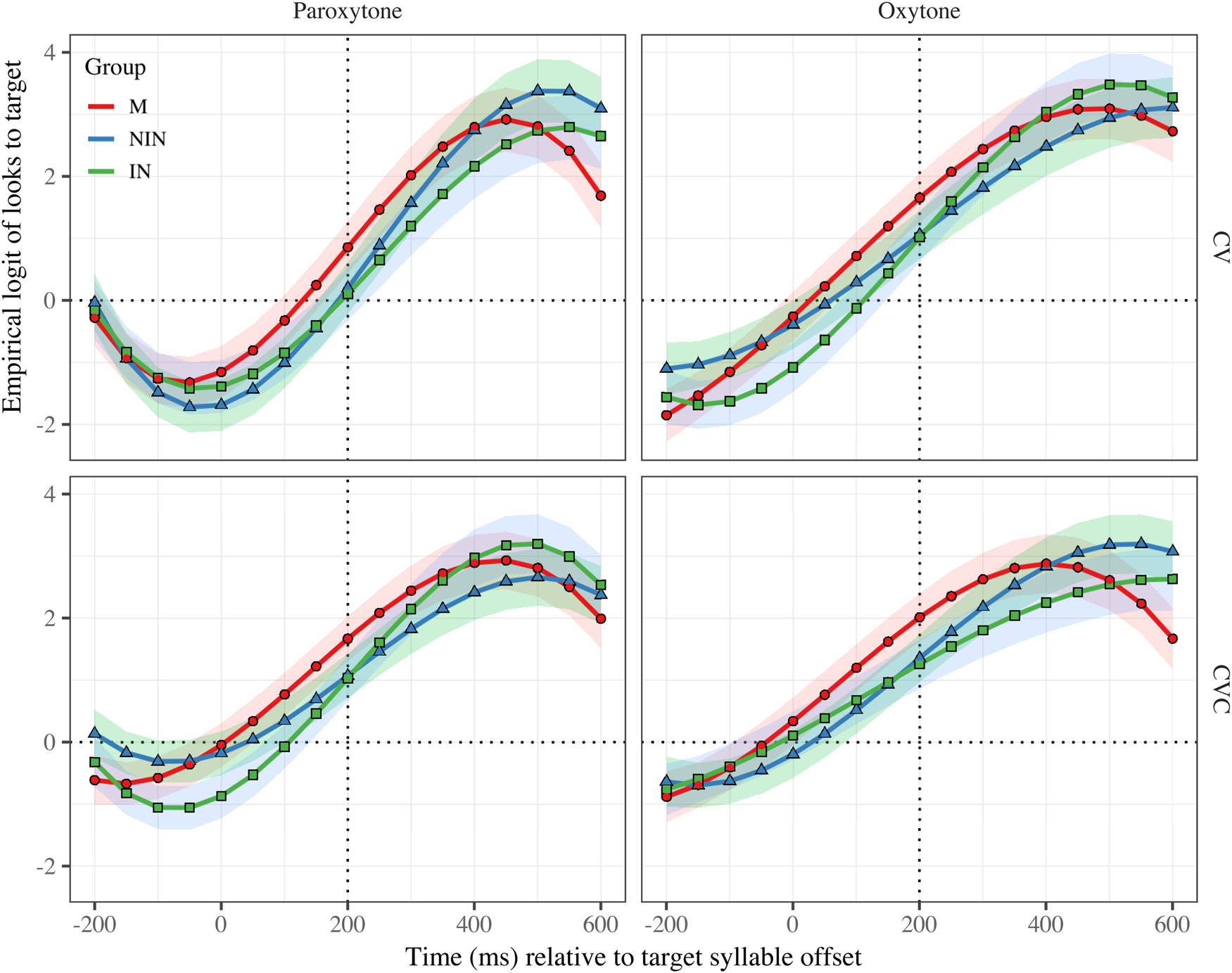
With regard to interpreters and non-interpreters, there was a simple interaction of the quadratic time term on the intercept for the non-interpreters group (γ23 = 1.819; SE = 0.448; t = 4.060; p = .001). That is, the non-interpreters had a more bowed trajectory at the offset of the target syllable than monolinguals, indicating that, overall, non-interpreters fixated on targets later than monolinguals. Additionally, there was a lexical stress × syllable structure × non-interpreter group interaction on the linear slope (γ16 = 1.004; SE = 0.271; t = 3.708; p = .001), such that non-interpreters had a steeper slope than monolinguals in CV syllables of paroxytone words. This indicates that non-interpreters fixated on targets later under the default condition (e.g., LAva), but earlier in other conditions (e.g., laVÓ, FIRma, firMÓ). For the IN group, there was also a simple interaction of the quadratic time term on the intercept (γ24 = 1.615; SE = 0.462; t = 3.496; p = .001). Thus, with regard to monolinguals, interpreters also fixated later on targets overall. Finally, there was a lexical stress × syllable structure interaction with interpreters on the cubic time term (γ37 = 0.773; SE = 0.275; t = 2.816; p = .005), indicative of sharper vertices for CV oxytone targets. Thus, IN fixated on CV oxytones (i.e., laVÓ) at a faster rate than monolinguals, though they did so later in the time course. Interpreters also showed a lower proportion of target fixations than monolinguals 200 ms after the target syllable offset (see the upper right panel of Figure 3).
Growth curve estimates of target fixations as a function of lexical stress and syllable structure for each group during the analysis window. Symbols and lines represent model estimates, and the transparent ribbons represents ±SE.

To sum up, both learner groups showed later target fixations in the default, CV paroxytone condition (i.e., LAva). This assertion is corroborated by examining the non-interpreters and interpreters’ proportion of target fixations at the target syllable offset (see Table 2). Specifically, the model estimates suggest that non-interpreters did not anticipate with CV paroxytones (Probability = 0.55; LB = 0.446; UB = 0.649), but did so at a higher rate in all other conditions (Paroxytone CVC: Probability = 0.745; LB = 0.672; UB = 0.807; Oxytone CV: Probability = 0.742; LB = 0.661; UB = 0.81; Oxytone CVC: Probability = 0.882; LB = 0.836; UB = 0.917). The same was true for the interpreter group (Paroxytone CV: Probability = 0.526; LB = 0.42; UB = 0.629; Paroxytone CVC: Probability = 0.738; LB = 0.661; UB = 0.802; Oxytone CV: Probability = 0.735; LB = 0.65; UB = 0.805; Oxytone CVC: Probability = 0.779; LB = 0.704; UB = 0.84). Importantly, pairwise comparisons (see Appendix 3) showed that the learner groups also differed from each other. In particular, there was a lexical stress × syllable structure interaction on the linear and cubic time terms (γ19 = 1.51; SE = 0.28; t = 5.46; p < .001; γ39 = −0.81; SE = 0.27; t = −2.95; p = .003, respectively). Figure 3 shows that the learners have nearly identical trajectories for CV paroxytones (LAva). In all other conditions, interpreter have steeper slopes with more bowed vertices, indicating later target fixations with regard to non-interpreters. That said, in all conditions the interpreters group fixated on targets in equal proportion to non-interpreters at the offset of the target syllable (the dotted vertical lines), suggesting interpreters fixate on targets later but at a faster rate in some conditions.Footnote 2
Discussion
We investigated whether native and non-native speakers use suprasegmental (lexical stress) and segmental (syllabic structure) information to anticipate verb morphology during spoken word recognition, and whether increased anticipatory experience acquired via interpreting facilitates anticipation in non-interpreting L2 situations. The results showed that all groups used suprasegmental and segmental information to anticipate words (except the advanced learners in CV paroxytone words), that all groups anticipated better in the less frequent conditions (CVC oxytone words), that monolinguals anticipated earlier than L2 learners, and that interpreters anticipated at a faster rate than the rest in some conditions. These findings demonstrate that native and non-native spoken word recognition is modulated by suprasegmental and segmental information, revealing that structural integration and lexical recognition go hand in hand. Additionally, phonological sequences associated with fewer possible endings facilitate prediction, and, anticipatory experience, rather than L2 proficiency alone, enhances L2 prediction.
Our first research question explored whether Spanish monolinguals and advanced English learners of Spanish use suprasegmental and segmental information to anticipate word endings, and whether they anticipate earlier and faster with less frequent CVC oxytone words than more frequent CV paroxytone words. The hypothesis that monolinguals would use suprasegmental and segmental information to predict a word's suffix was supported. Our data are consistent with prior studies showing that natives use suprasegmental information to predict morphological information (tone: Roll, Reference Roll2015; Söderström et al., Reference Söderström, Roll and Horne2012) and syntactic information (intonation: Nakamura et al., Reference Nakamura, Arai and Mazuka2012; Weber et al., Reference Weber, Grice and Crocker2006; pauses between clauses: Hawthorne & Gerken, Reference Hawthorne and Gerken2014; Kjelgaard & Speer, Reference Kjelgaard and Speer1999), and segmental information to anticipate morphological information (syllabic structure: Sagarra & Casillas, Reference Sagarra and Casillas2018; phonotactic probability: Roll et al., Reference Roll, Söderström, Frid, Mannfolk and Horne2017). The influence of these linguistic variables is so robust that listeners anticipate a word's suffix even when it is not present (Sagarra & Casillas, Reference Sagarra and Casillas2018; Söderström, Horne & Roll, Reference Söderström, Horne and Roll2017). One unanswered question is whether the data of the studies exploring morphological anticipation extend to lexical anticipation. We are currently analyzing the data of a follow-up study investigating this.
Our second hypothesis that monolinguals would anticipate earlier and faster than non-interpreter learners was supported. Our data align with studies showing that lexical disambiguation depends more on lexical stress in Spanish (Soto-Faraco et al., Reference Soto-Faraco, Sebastián-Gallés and Cutler2001) than English (Cooper et al., Reference Cooper, Cutler and Wales2002). Our findings suggest that learners’ native language may have interfered with their L2 perception of lexical stress. However, the lack of a language pair with similar stress and syllabic structure in L1 and L2 prevents us from making strong assertions about this issue. To address this limitation, we plan to collect data with Mandarin Chinese learners of Spanish (Mandarin Chinese and Spanish are both assumed to be syllable-timed languages, but English is stress-timed), keeping syllabic structure constant.
Our third hypothesis that non-interpreter learners would use lexical stress but only less frequent syllabic structure (CVC) was partially supported. As expected, non-interpreters were able to predict suffixes in the CVC condition, similar to Sagarra and Casillas (Reference Sagarra and Casillas2018). However, they also anticipated suffixes in the CV condition with the less frequent stress pattern (oxytone verbs, e.g., laVÓ). Our data mirror preceding studies showing that high proficiency learners use suprasegmental information, although less extensively than monolinguals (Schremm et al., Reference Schremm, Söderström, Horne and Roll2016). Our findings support the notion that L2 predictive processing is qualitatively similar to monolingual prediction (L2 learners benefit from the same facilitatory cues as monolinguals), but quantitatively different (they predict less and cannot predict when neither facilitatory information type is present).
Finally, our fourth hypothesis that monolinguals and non-interpreter learners would anticipate earlier and faster in CVC oxytone words than CV paroxytone words was supported. This is so because oxytones and CVC occur less often and have fewer lexical competitors, which increases brain activation (suprasegmentals: Roll et al., Reference Roll2015), and strengthens lexical access (Cholin et al., Reference Cholin, Levelt and Schiller2006), morphological anticipation in words (segmental: Roll et al., Reference Roll, Söderström, Frid, Mannfolk and Horne2017), and semantic anticipation in sentences (natives: DeLong, Urbach & Kutas, Reference DeLong, Urbach and Kutas2005; Martin et al., Reference Martin, Thierry, Kuipers, Boutonnet, Foucart and Costa2013; non-natives: Foucart et al., Reference Foucart, Ruiz-Tada and Costa2016). Overall, these studies and our data support a phonological account of syllable typology as it relates to markedness theory (Hayes & Steriade, Reference Hayes, Steriade, Hayes, Kirchner and Steriade2004; de Lacy, Reference de Lacy2006) (see Colina, Reference Colina2009, for an account of the role of syllable structure in Spanish and its interplay with markedness constraints under an Optimality Theory framework). It is noteworthy that the advantage of CVC over CV can also be explained by listeners having a longer time to anticipate in CVC than CV conditions.Footnote 3 This alternative explanation is rooted in studies showing that increased time facilitates anticipation (e.g., Kukona, Fang, Aicher, Chen & Magnuson, Reference Kukona, Fang, Aicher, Chen and Magnuson2011). To further investigate this, we conducted statistical analyses at CV offset of CVC and CV syllables, and we found identical results as at first syllable offset (analyses reported elsewhere due to space limitations).
Our second research question examined whether increased anticipatory experience acquired via interpreting facilitates anticipation in non-interpreting L2 situations. Our first hypothesis that interpreters would predict earlier and faster with less frequent suprasegmental and segmental cues, like the monolinguals and the non-interpreter learners, was supported. These findings are discussed above. Our second hypothesis that interpreters would start predicting earlier than the rest was rejected. Indeed, interpreters began predicting later than monolinguals and non-interpreters, except in CV paroxytones (e.g., LAva), where interpreters and non-interpreters began predicting at the same time. Interpreters’ delayed anticipations can be explained in two ways. First, this could be due to interpreters taking a conservative approach to anticipation. In effect, interpreters pay a high price when making anticipation mistakes while interpreting, because they need to restate the utterance (“or actually…”) while continuing to listen to the speaker and retaining new input in memory). Moreover, anticipation depends on the listener's goals, prior knowledge, and expected utility of anticipating (providing an accurate prediction, in the interpreters’ case) (Kuperberg & Jaeger, Reference Kuperberg and Jaeger2016). Second, interpreters’ delayed predictions can also be due to the older age of the interpreter group, a feasible option considering that cognitive functions can decline with age (e.g., WM: Park, Welsh, Marschuetz, Gutchess, Mikels, Polk, Noll & Taylor, Reference Park, Welsh, Marschuetz, Gutchess, Mikels, Polk, Noll and Taylor2003) and that older adults have a reduced ability to make predictions unless they have larger vocabularies and higher verbal fluency (Federmeier et al., Reference Federmeier, McLennan, De Ochoa and Kutas2002). However, our data indicated that all groups were homogeneous in WM, and additional statistics examining age effects in the interpreter group indicated that age did not impact the interpreters’ ability to make predictions (see footnote 2). These two pieces of evidence rule out age as an explanation for the interpreters’ delayed predictions.
Our third hypothesis that interpreters would anticipate at a faster rate than non-interpreters, but at the same rate as monolinguals, was partially supported. Thus, interpreters were faster than non-interpreters in all conditions except for CV paroxytones (LAva). This condition involves a larger pool of lexical competitors, which might prone interpreters to adopt a more conservative anticipatory strategy due to the high cost of prediction error. Interestingly, interpreters were also faster than monolinguals in some conditions, i.e., CV oxytones (laVÓ) and CVC paroxytones (FIRma). We attribute interpreters’ faster rate to their extensive anticipatory experience. Interpreting experience also makes them faster to non-interpreters in coordination of simultaneous actions (García, Muñoz & Kogan, Reference García, Muñoz and Kogan2019) and dual tasks (Morales, Padilla, Gómez-Ariza & Bajo, Reference Morales, Padilla, Gomez-Ariza and Bajo2015; Strobach, Becker, Schubert & Kühn, Reference Strobach, Becker, Schubert and Kühn2015). Faster anticipation is important because it facilitates recognition and interpretation of information by limiting the repertoire of potential candidates, saves resources to allow the listener to prepare for upcoming information, and guides top-down deployment of attention by improving information seeking and decision making (Bubic, Von Cramon & Schubotz, Reference Bubic, Von Cramon and Schubotz2010). Finally, although we explain interpreters’ faster anticipation via their extensive anticipatory experience, we acknowledge that their superiority could be due to other measures of language experience, such as increased weekly contact with the L2, or of cognitive abilities, such as stronger resistance to articulatory suppression.
In sum, our data suggest that natives and non-natives use suprasegmental and segmental information to access spoken words (see Roll, Reference Roll2015, for a review), and anticipate better when there are fewer lexical competitors. Also, adult learners can adjust their weighting of acoustic correlates of stress in an L2-appropriate manner, in support of accessibility models of adult L2 acquisition. Finally, increased anticipatory experience results in later but faster L2 predictions. There is still a wealth of unsolved problems and unanswered questions regarding how humans anticipate information. Does prediction involve pre-activation (Huettig, Reference Huettig2015) or just a state of preparedness (Ferreira & Chantavarin, Reference Ferreira and Chantavarin2018)? Is pre-activation probabilistic (DeLong, Urbach & Kutas, Reference DeLong, Urbach and Kutas2005) or all-or-nothing (see Kuperberg & Jaeger, Reference Kuperberg and Jaeger2016 for discussion)? Do people predict specific word forms (DeLong et al., Reference DeLong, Urbach and Kutas2005) or just certain features (semantic, morphological, etc.) (Pickering & Gambi, Reference Pickering and Gambi2018)? Is prediction pervasive (Dell & Chang, 2014) or confined to certain situations (Nieuwland, Politze-Ahles, Heyselaar, Segaer, Bartolozzi, Kogan, Ito, Mézière, Barr, Rousselet, Ferguson, Busch-Moreno, Fu, Tuomainen, Kulakova, Husband, Donaldson, Kohút, Rueschemeyer & Huettig, Reference Nieuwland, Politze-Ahles, Heyselaar, Segaer, Bartolozzi, Kogan, Ito, Mézière, Barr, Rousselet, Ferguson, Busch-Moreno, Fu, Tuomainen, Kulakova, Husband, Donaldson, Kohút, Rueschemeyer and Huettig2018)? Future research investigating these issues must take place to have a comprehensive understanding of the cognitive mechanisms underlying prediction.
Conclusion
We evaluated the role of suprasegmental and segmental information and anticipatory experience in native and non-native morphological anticipation during spoken word recognition. Eye-tracking data revealed that monolinguals and L2 learners with and without interpreting experience used suprasegmental and segmental information about lexical stress and syllable structure to predict word suffixes, except the L2 groups in CV paroxytone words. Overall, all groups showed stronger prediction when suprasegmental and segmental information reduced the number of possible lexical items (oxytonic stress and CVC). Also, both learner groups predicted later than monolinguals, but interpreters did so at a faster rate than non-interpreters (all conditions except CV paroxytones) and monolinguals (in CV oxytones and CVC paroxytones). These findings indicate that less frequent suprasegmental and segmental information and anticipatory experience facilitate native and non-native spoken word prediction. This study advances our understanding of the complexity of anticipatory processes by separating L2 proficiency from prediction experience, and by measuring not only whether natives and non-natives anticipate, but also when and how fast they anticipate.
Supplementary Material
For supplementary material accompanying this paper, visit https://doi.org/10.1017/S1366728919000634
Acknowledgements
We would like to thank Nicole Rodríguez for assisting with data collection, Cristina Sanz for giving as access to the advanced L2 speakers, and the three anonymous reviewers that provided constructive comments to improve the manuscript. We also appreciate the time and involvement in the project of all our participants: interpreters, advanced L2 speakers, and Spanish monolinguals.