INTRODUCTION
Biological invasions are one of the major threats to global marine ecosystems due to their negative impacts on biodiversity and ecosystem functioning (Costello et al., Reference Costello, Coll, Danovaro, Halpin, Ojaveer and Miloslavich2010). With regards to the Mediterranean Sea, the highest number of alien species is reported as coming from the Red Sea via the Suez Canal (the so-called lessepsian migration). However, an increasing number of tropical Atlantic species has invaded the Mediterranean Sea. The alien status of these species is still debated (Galil, Reference Galil2009; Zenetos, Reference Zenetos2010), mostly due to difficulties in determining whether their spread is tied to natural dispersal or to human activities. This results in authors reporting or deleting species from lists of aliens according to subjective faunal views only, and often without any discussion of the rationale. As a matter of fact, the possible number of alien taxa that have invaded the Mediterranean Sea ranges from more than 600 to nearly 1,000 (Zenetos et al., Reference Zenetos, Gofas, Morri, Rosso, Violanti, García Raso, Çinar, Almogi-Labin, Ates, Azzurro, Ballesteros, Bianchi, Bilecenoglu, Gambi, Giangrande, Gravili, Hyams-Kaphzan, Karachle, Katsanevakis, Lipej, Mastrototaro, Mineur, Pancucci-Papadopoulou, Ramos Esplá, Salas, San Martín, Sfriso, Streftaris and Verlaque2012; Galil & Goren, Reference Galil, Goren, Goffredo and Dubinsky2014). Among them, molluscs play a leading role, accounting for almost one-fifth (or even more) of exotic taxa in the Mediterranean Sea. This number is currently estimated to be around 200 taxa (Zenetos et al., Reference Zenetos, Gofas, Morri, Rosso, Violanti, García Raso, Çinar, Almogi-Labin, Ates, Azzurro, Ballesteros, Bianchi, Bilecenoglu, Gambi, Giangrande, Gravili, Hyams-Kaphzan, Karachle, Katsanevakis, Lipej, Mastrototaro, Mineur, Pancucci-Papadopoulou, Ramos Esplá, Salas, San Martín, Sfriso, Streftaris and Verlaque2012; Sabelli & Taviani, Reference Sabelli, Taviani, Goffredo and Dubinsky2014). Their occurrence and distribution varies among Mediterranean countries, with eastern countries accounting for the highest number of introduced species. A difference occurs also considering origins and vectors: alien species in the western basin were mainly introduced by maritime transport and aquaculture, whereas those in the eastern basin are mainly lessepsian species that have entered the Mediterranean Sea via the Suez Canal (Nunes et al., Reference Nunes, Katsanevakis, Zenetos and Cardoso2014). However, a general concordance occurs in considering this phenomenon as underestimated, and the possible magnitude of the gap appears difficult to assess differing among taxa, locations and habitats (Galil & Goren, Reference Galil, Goren, Goffredo and Dubinsky2014).
Despite these limitations, molluscs constitute a ‘popular’ and thus frequently investigated phylum, and at least in some geographical areas, including Italian seas, current statements regarding the biological invasion magnitude seem to be not so far from reality. Taking into account recent reviews only, and excluding cryptogenics and potential newcomers, Occhipinti-Ambrogi et al. (Reference Occhipinti-Ambrogi, Marchini, Cantone, Castelli, Chimenz, Cormaci, Froglia, Furnari, Gambi, Giaccone, Giangrande, Gravili, Mastrototaro, Mazziotti, Orsi-Relini and Piraino2011) recently reported 31 confirmed alien mollusc species from Italy. These data were then reviewed by Crocetta (Reference Crocetta2012), Crocetta et al. (Reference Crocetta, Macali, Furfaro, Cooke, Villani and Valdes2013), Macali et al. (Reference Macali, Conde, Smriglio, Mariottini and Crocetta2013) and Valdes et al. (Reference Valdes, Alexander, Crocetta, Yokeş, Giacobbe, Poursanidis, Zenetos, Cervera, Caballer, Galil and Schembri2013), stating a final number of 35 alien mollusc taxa reported in Italy, of which 21 (or 20 according to Giacobbe & De Matteo, Reference Giacobbe and De Matteo2013) are now considered as established. The aim of the present paper is to provide new distributional data from the Italian seas of four already established aliens, Haminoea cyanomarginata (Heller & Thompson, 1983), Melibe viridis (Kelaart, 1858), Anadara transversa (Say, 1822) and Pinctada imbricata radiata (Leach, 1814), and the possible alien (see below for discussions) Aplysia dactylomela Rang, 1828, together with a brief review of their known Italian distribution. Also, possible dispersal pathways are discussed in the light of the new records reported in this paper.
MATERIALS AND METHODS
Alien species definition and establishment status
The inclusion (or not) of the taxa listed as aliens in the Mediterranean is based on strict accordance to the definition of alien species by the International Union for Conservation of Nature, as in previous reviews from alien mollusc species in Italy (Crocetta, Reference Crocetta2012; Crocetta et al., Reference Crocetta, Macali, Furfaro, Cooke, Villani and Valdes2013). Therefore, four of the species hereby discussed fit this definition well. On the contrary, the current status of Aplysia dactylomela Rang, 1828 is still debated since at present it remains unresolved if its Mediterranean spread has been a human-mediated or a natural event, even though the second hypothesis seems to be the more likely (see discussions in Valdes et al., Reference Valdes, Alexander, Crocetta, Yokeş, Giacobbe, Poursanidis, Zenetos, Cervera, Caballer, Galil and Schembri2013). Since it also cannot be listed as cryptogenic (see Carlton, Reference Carlton1996: a species that cannot be included with confidence among native nor among introduced ones) due to its large sizes and unmistakable colour pattern, that would not have left it overlooked in the Mediterranean Sea for at least two centuries (therefore also excluding it is a strictly native species), we hereby prefer to list it as a ‘possible alien’.
Systematics and data collection
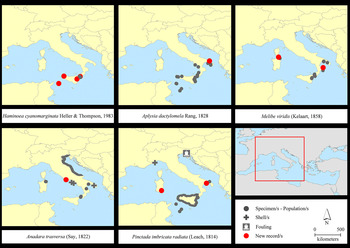
A survey of published Italian records of the taxa listed in the present paper was conducted. Unpublished records are listed under each species and come from the examination of both preserved specimens and photographs obtained from recreational SCUBA divers or within the framework of different research projects. Updated systematics used here follow those described in the World Register of Marine Species (WoRMS: last accessed 25 April 2014). Unpublished records have been deposited in EASIN (European Alien Species Information Network: see Katsanevakis et al., Reference Katsanevakis, Bogucarskis, Gatto, Vandekerkhove, Deriu and Cardoso2012). Detailed Italian distributional data, including the new records reported here, are shown in Figure 2.
RESULTS
SYSTEMATICS
Class GASTROPODA Cuvier, 1795
Order CEPHALASPIDEA P. Fischer, 1883
Family HAMINOEIDAE Pilsbry, 1895
Genus Haminoea Turton & Kingston in Carrington, 1830
Haminoea cyanomarginata Heller & Thompson, 1983
UNPUBLISHED MATERIAL EXAMINED
Calabria
(i) Saline Joniche (Reggio Calabria) (37°55′45.19″N–15°44′3.21″E)—6 January 2013: ~50 specimens—10–30 m, legit Domenico Tripodi; (ii) Scilla (Reggio Calabria) (38°15′00″N–15°43′00″E)—17 November 2013: ~50 specimens—10–30 m, legit Domenico Tripodi.
Sicily
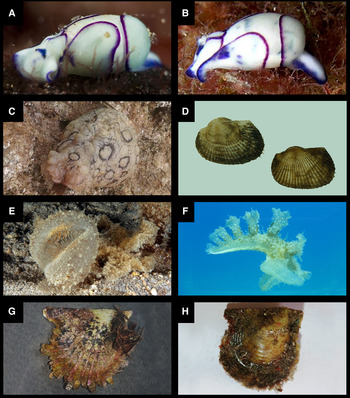
(i) Acicastello (Catania) (37°40′50″N—15°12′20″E)—16 October 2013: 2 specimens on a rocky bottom—11 m, legit Alessandro Pagano (Figure 1A); (ii) Castellammare del Golfo–Riserva dello Zingaro (Trapani) (38°06′16″N–012°47′38″E)—December 2008: several specimens on a rocky bottom with algae, sponges and hydrozoans—10–12 m, legit Santo Tirnetta and Anna Macaluso (Figure 1B); (iii) Scauri–La Paretina (Pantelleria Island, Trapani) (36°46′08″N–011°57′51″E)—9 September 2011: 2 specimens on a rocky bottom with small crevices—13 m, and 3 specimens on a boulder—18 m, legit Maria Ghelia and Francesco de Marchi.
Alien molluscan species hereby reported from Italy: (A) Haminoea cyanomarginata from Acicastello (photograph by A. Pagano); (B) H. cyanomarginata from Castellammare del Golfo (photograph by S. Tirnetta); (C) Aplysia dactylomela from Torre Guaceto (photograph by G. Stasolla); (D) Anadara transversa from Sabaudia Lake (photograph by A. Macali); (E) Melibe viridis from La Maddalena (photograph by A. Colacino); (F) M. viridis from Cirò Marina (photograph by F. Riolo); (G) Pinctada imbricata radiata from Baccu Mandara (photograph by M. Pisanu); (H) P. imbricata radiata from Mar Grande (photograph by C. Pierri).

ITALIAN KNOWN DISTRIBUTION AND REMARKS
Haminoea cyanomarginata Heller & Thompson, 1983 Italian distribution was previously restricted to the Calabrian shores of the Strait of Messina area, where it was first found in September 2007 at Saline Joniche, 6 m depth, on calcareous boulders covered by a thin algal film and colonized by Cystoseira, other algae and sessile organisms such as sponges, vermetids and molluscs (Crocetta & Vazzana, Reference Crocetta and Vazzana2008), and then at Lazzaro, on a rocky bottom with thin algal film and Cystoseira, 3–5 m depth, and on gravel and pebbles covered with algae, 20 m depth (Crocetta et al., Reference Crocetta, Renda and Vazzana2009a) (Figure 2). Limited information is available on the biology and the ecology of this species. Crocetta & Vazzana (Reference Crocetta and Vazzana2008) reported specimens feeding on filamentous algae and presumably on diatoms, as other species of the genus Haminoea (see Malaquias et al., Reference Malaquias, Condinho, Cervera and Sprung2004).
Alien molluscan species hereby reported from Italy: previously known records/distribution (specimen/s-population/s, grey dot/area; shell/s, grey cross; fouling, ship) and new records (red dots). Scale bar refers to species maps.

Class GASTROPODA Cuvier, 1795
Order ANASPIDEA Fischer, 1883
Family APLYSIIDAE Lamarck, 1809
Genus Aplysia Linnaeus, 1767
Aplysia dactylomela Rang, 1828
UNPUBLISHED MATERIAL EXAMINED
Apulia
Torre Guaceto (Brindisi) (40°43′08″N–017°46′44″E)—23 March 2014: one specimen in a tide pool, legit Gianluca Stasolla (Figure 1C).
ITALIAN KNOWN DISTRIBUTION AND REMARKS
Aplysia dactylomela (Rang, 1828) was first recorded in the Mediterranean Sea in 2002 from Lampedusa Island (Trainito, Reference Trainito2003). Early Italian records included one specimen in a tide pool at 0.1–0.2 m depth at the ‘Isola Lachea and Faraglioni dei Ciclopi Marine Protected Area’ (Scuderi & Russo, Reference Scuderi and Russo2005) and about 30 specimens and egg-masses at a low depth on rocky bottoms covered by an algae layer at Giardini Naxos (Greco, Reference Greco2006). It soon became common along the whole eastern Sicilian shores, from Messina to Syracuse (Crocetta & Colamonaco, Reference Crocetta and Colamonaco2010; Giacobbe et al., Reference Giacobbe, Dedomenico, Larrera, Mangano, Porporato and Spanò2010; Crocetta & Galil, Reference Crocetta and Galil2012), with records even from the Calabrian shores of the Strait of Messina area (Punta Pellaro and Bocale, Reggio Calabria) (Crocetta et al., Reference Crocetta, Renda and Vazzana2009a). It then spread to Pantelleria (Crocetta & Galil, Reference Crocetta and Galil2012), Egadi (Mannino et al., Reference Mannino, Balistreri and Yokes2014) and Linosa (Lodola et al., Reference Lodola, Savini and Occhipinti-Ambrogi2012) Islands, along the Tyrrhenian shores of Calabria at Diamante and Ricadi (Crocetta & Galil, Reference Crocetta and Galil2012; Valdes et al., Reference Valdes, Alexander, Crocetta, Yokeş, Giacobbe, Poursanidis, Zenetos, Cervera, Caballer, Galil and Schembri2013) and Campania at Palinuro (Salerno: Valdes et al., Reference Valdes, Alexander, Crocetta, Yokeş, Giacobbe, Poursanidis, Zenetos, Cervera, Caballer, Galil and Schembri2013), and in the Gulf of Taranto at Gallipoli (Crocetta & Colamonaco, Reference Crocetta and Colamonaco2010, Reference Crocetta and Colamonaco2011; Crocetta & Galil, Reference Crocetta and Galil2012), Nardò (Crocetta & Galil, Reference Crocetta and Galil2012) and Torricella (Valdes et al., Reference Valdes, Alexander, Crocetta, Yokeş, Giacobbe, Poursanidis, Zenetos, Cervera, Caballer, Galil and Schembri2013) (Figure 2).
Class GASTROPODA Cuvier, 1795
Order NUDIBRANCHIA Cuvier, 1817
Family TETHYDIDAE Rafinesque, 1815
Genus Melibe Rang, 1829
Melibe viridis (Kelaart, 1858)
UNPUBLISHED MATERIAL EXAMINED
Sardinia
La Maddalena–Punta Tegge (Olbia-Tempio) (41°12′40″N–009°23′03″E)—27 September 2013: 14 specimens on a fine sandy bottom, with sparce rocks and Posidonia oceanica—0.8–3 m, legit Antonio Colacino (Figure 1E).
Calabria
Cirò Marina–Punta Alice (Crotone) (37°40′50″N–015°12′20″E)—25 August 2012: 10 specimens with egg masses on bottom characterized by pebbles of various sizes, covered by a thin layer of filamentous algae and cyanobacteria—4–5 m, legit Francesca Riolo (Figure 1F).
ITALIAN KNOWN DISTRIBUTION AND REMARKS
Melibe viridis (Kelaart, 1858) was first recorded from Italy along the Calabrian shores of the Strait of Messina area (Mojetta, Reference Mojetta1998: based on photographs by Francesco Turano) at depths between 5 and 15 m on algal beds mainly composed of Cymodocea nodosa (Ascherson, 1870) and Halophila stipulacea (Ascherson, 1867). The correct finding date of this record, held both by F. Turano and Gianni Neto, was then stated in 1997 (G. Neto, personal communication in Crocetta et al., Reference Crocetta, Renda and Vazzana2009a). Previous statements regarding its first Italian record in 1984 (e.g. see Mastrototaro et al., Reference Mastrototaro, Panetta and D'onghia2004; Occhipinti-Ambrogi et al., Reference Occhipinti-Ambrogi, Marchini, Cantone, Castelli, Chimenz, Cormaci, Froglia, Furnari, Gambi, Giaccone, Giangrande, Gravili, Mastrototaro, Mazziotti, Orsi-Relini and Piraino2011) were due to a misunderstanding of Mojetta (Reference Mojetta1998), due to the lack of a comma. Mojetta (Reference Mojetta1998) was originally referring to a 1984 published article (Thompson & Crampton, Reference Thompson and Crampton1984) and not to a finding date (Crocetta et al., Reference Crocetta, Renda and Vazzana2009a). However, its first record from the Italian shores was then backdated to 1991 (Crocetta et al., Reference Crocetta, Renda and Vazzana2009a). Its known Italian distribution includes the Ionian coasts both of Sicily (Scuderi & Russo, Reference Scuderi and Russo2003) and Calabria (record from Capo Bianco, Isola Capo Rizzuto, by Guido Villani, personal communication in Zenetos et al., Reference Zenetos, Gofas, Russo and Templado2004 and Crocetta et al., Reference Crocetta, Renda and Vazzana2009a), the Strait of Messina area (Mojetta, Reference Mojetta1998; Crocetta et al., Reference Crocetta, Renda and Vazzana2009a; Giacobbe et al., Reference Giacobbe, Dedomenico, Larrera, Mangano, Porporato and Spanò2010), the Gulf of Taranto (Carriglio et al., Reference Carriglio, Fanelli and Rubino2004; Mastrototaro et al., Reference Mastrototaro, Panetta and D'onghia2004), and the roadstead of Golfo Aranci (Olbia-Tempio: Doneddu & Trainito, Reference Doneddu and Trainito2008). Its declared presence in WST (western-southern Tyrrhenian excluding the Sicilian shores), reported in Crocetta (Reference Crocetta2012, table 2), was due to a literature misreading (F. Crocetta, unpublished data) (Figure 2).
Class BIVALVIA Linnaeus, 1758
Order ARCOIDA Stoliczka, 1871
Family ARCIDAE Lamarck, 1809
Genus Anadara Gray, 1847
Anadara transversa (Say, 1822)
UNPUBLISHED MATERIAL EXAMINED
Latium
Sabaudia Lake (Latina): (i) 41°15′03″N–013°02′31″E: 12 specimens amidst concretions of the Roman Channel; (ii) 41°15′11″N–013°02′21″E: 5 specimens amidst concretions, 2 byssed on the substrate; (iii) 41°15′13″N–13°02′30″E: 3 specimens byssed on old mooring pole lying on the bottom; (i), (ii) and (iii): 27 November 2012, legit Armando Macali (Figure 1D); (iv) 41°16′49″N–013°01′39″E—5 May 2014: 2 specimens amidst Ficopomatus colonies and 3 specimens under Roman bricks—1 m, legit Armando Macali; (v) 41°16′04″N–13°02′16″E—5 June 2014: 3 specimens byssed on tree trunks laying on mobile bottom with Zoostera and Ulva—0.5 m, legit Armando Macali.
ITALIAN KNOWN DISTRIBUTION AND REMARKS
Soon after its first appearance in Italy, in 2000 (Mizzan, Reference Mizzan2002), Anadara transversa (Say, 1822) (often recorded in the Mediterranean Sea as A. demiri) has then mostly colonized the northern and central Italian Adriatic Sea, with some records in its southern part (e.g. Morello & Solustri, Reference Morello and Solustri2001; Rinaldi, Reference Rinaldi2001; Morello et al., Reference Morello, Solustri, Antolini and Froglia2004a, Reference Morello, Solustri and Frogliab; Mizzan, Reference Mizzan2007; Mizzan & Vianello, Reference Mizzan and Vianello2007; Albano et al., Reference Albano, Rinaldi, Evangelisti, Kuan and Sabelli2009; Crocetta, Reference Crocetta2011). Sporadic occurrences of this species (both as specimens and empty shells) were reported from the Gulf of Naples (Crocetta et al., Reference Crocetta, Renda and Colamonaco2009b), the Ionian Sea at Sant'Isidoro (Trono, Reference Trono2006), Schiavonea di Corigliano Calabro and Castellaneta Marina (Crocetta et al., Reference Crocetta, Renda and Colamonaco2009b), the Faro Lake in the Strait of Messina (Cosentino et al., Reference Cosentino, Giacobbe and Potoschi2009) and the Olbia area (Doneddu, Reference Doneddu2011; Lodola et al., Reference Lodola, Savini, Mazziotti and Occhipinti-Ambrogi2011), mostly related to mussel aquaculture (Figure 2).
Class BIVALVIA Linnaeus, 1758
Order PTERIOIDA Newell, 1965
Family PTERIIDAE Gray, 1847
Genus Pinctada Röding, 1798
Pinctada imbricata radiata (Leach, 1814)
UNPUBLISHED MATERIAL EXAMINED
Sardinia
Baccu Mandara (Cagliari) (39°09′42″N–009°23′06″E)—November 2012: 1 specimen byssed on Posidonia oceanica—1 m, legit Michele Pisanu.
Apulia
Mar Grande (Taranto) (40°26′02″N– 017°14′16″E)—19 May 2014: 1 specimen byssed on ropes, amidts fouling communities—11 m, legit Cataldo Pierri.
ITALIAN KNOWN DISTRIBUTION AND REMARKS
Pinctada imbricata radiata (Leach, 1814) was first reported in Italy before 1917 from Lampedusa Island (Monterosato, Reference Monterosato1917). This record was often overlooked and several authors incorrectly stated its first Italian record to be in the 1960s (e.g. Crocetta et al., Reference Crocetta, Renda and Vazzana2009a; Occhipinti-Ambrogi et al., Reference Occhipinti-Ambrogi, Marchini, Cantone, Castelli, Chimenz, Cormaci, Froglia, Furnari, Gambi, Giaccone, Giangrande, Gravili, Mastrototaro, Mazziotti, Orsi-Relini and Piraino2011). Therefore, if using the rationale of inclusion as in Occhipinti-Ambrogi et al. (Reference Occhipinti-Ambrogi, Marchini, Cantone, Castelli, Chimenz, Cormaci, Froglia, Furnari, Gambi, Giaccone, Giangrande, Gravili, Mastrototaro, Mazziotti, Orsi-Relini and Piraino2011) (taxa considered as alien only if recorded from the year 1945), this species should have been deleted from the alien species list of Italy. However, we hereby prefer to retain it, as also done in previous reviews (Crocetta, Reference Crocetta2012; Crocetta et al., Reference Crocetta, Macali, Furfaro, Cooke, Villani and Valdes2013). Soon after its first record, it has then spread to Pantelleria (e.g. Sabelli, Reference Sabelli1969), Syracuse (e.g. Paccagnella, Reference Paccagnella1967), Palermo (e.g. Bombace, Reference Bombace1967), Lipari and Acitrezza (e.g. Di Natale, Reference Di Natale1982) and from the Catania harbour (e.g. Di Geronimo, Reference Di Geronimo1971). Recent records include the Strait of Messina area (Crocetta et al., Reference Crocetta, Renda and Vazzana2009a; Giacobbe et al., Reference Giacobbe, Dedomenico, Larrera, Mangano, Porporato and Spanò2010) and Linosa Island (Lodola et al., Reference Lodola, Savini and Occhipinti-Ambrogi2012), but altogether the species is considered as widespread all along the Sicilian shores (Zenetos et al., Reference Zenetos, Gofas, Russo and Templado2004). A very recent record from the Italian Adriatic Sea (Torre Guaceto) was also published (Scuderi & Terlizzi, Reference Scuderi and Terlizzi2012). Finally, empty shells were recorded at Alassio (Isola Gallinara, Liguria) (Garavelli & Melone, Reference Garavelli and Melone1967) and a specimen was found on an oil platform under repair in Trieste (Northern Adriatic), but coming straight from the Sicily Channel (Vio & De Min, Reference Vio and De Min1996) (Figure 2).
DISCUSSION
The Italian peninsula, with over 7,000 km of coastline, has a critical position in the Mediterranean Sea. Around 160 marine and brackish non-indigenous species have been recorded, and the Venice Lagoon, Taranto seas, Gulf of Naples and the Leghorn harbour, along with the small islands, clearly represent hot-spots of alien introduction and secondary spread (Occhipinti-Ambrogi et al., Reference Occhipinti-Ambrogi, Marchini, Cantone, Castelli, Chimenz, Cormaci, Froglia, Furnari, Gambi, Giaccone, Giangrande, Gravili, Mastrototaro, Mazziotti, Orsi-Relini and Piraino2011). The highest number of living mollusc species has been recorded so far from the northern Adriatic Sea, the southern Ionian Sea (including the Strait of Messina area) and the eastern-central Tyrrhenian Sea (Crocetta, Reference Crocetta2012). Although with discrepancies in the total number of species recorded from each area, these data are mostly in agreement with Occhipinti-Ambrogi et al. (Reference Occhipinti-Ambrogi, Marchini, Cantone, Castelli, Chimenz, Cormaci, Froglia, Furnari, Gambi, Giaccone, Giangrande, Gravili, Mastrototaro, Mazziotti, Orsi-Relini and Piraino2011). However, constantly updated data on the distribution of alien species provide reliable information to assess their status, population dynamics and ecological features. Trends in abundance, temporal occurrence and spatial distribution in the wild, notably in risk areas, may aid the tracking of the origin and source of alien species and the monitoring of the impacts. The same data represent a strong basis to assess invasiveness and propagule pressure and to provide recommendations for management measures, and therefore should be highlighted as soon as available.
The previously published presence of Haminoea cyanomarginata Heller & Thompson, 1983 together with its egg-masses (Crocetta & Vazzana, Reference Crocetta and Vazzana2008; Crocetta et al., Reference Crocetta, Renda and Vazzana2009a), as well as the new records hereby reported from the same area, brings evidence of the stability of a breeding population in the Strait of Messina. Further records of this species from the central Mediterranean Sea include Malta (Mifsud, Reference Mifsud2007; Mifsud & Cachia, Reference Mifsud and Cachia2011), and our additional new records from three different sites of Sicily may represent an ongoing expansion of the species along the whole Sicilian shores, presumably throughout secondary natural dispersal from the Maltese or the Calabrian population(s). Records from Tunisia may also be soon expected.
Aplysia dactylomela Rang, 1828 has received much attention from scientists for its spreading pattern in the Mediterranean Sea and its taxonomic status. This former pantropical species was recently split into two different species: A. dactylomela from the Atlantic Ocean and A. argus (Rüppell & Leuckart, 1830) from the Indo-Pacific Ocean (Alexander & Valdés, Reference Alexander and Valdés2013). After its first record from Lampedusa Island, the species has rapidly spread in the eastern basin and the Adriatic Sea, while there is no evidence of its presence in the western basin. Despite its presence along the eastern Adriatic shores being already known at least since 2008 from Montenegro and Croatia (Despalatović et al., Reference Despalatović, Grubelić, Nikolić, Dragičević, Dulčić, Žuljević, Cvitković, Antolić and Briand2008; Turk & Furlan, Reference Turk and Furlan2011; Kljajić & Mačić, Reference Kljajić, Mačić and Thessalou-Legaki2012), records from the western Adriatic shores were still lacking. Italian shores are heavily sampled, and a constant contribution from amateurs and professional marine biologists and malacologists in the analysis of faunal changes would suggest that a big species, with highly distinctive characters, would not have been overlooked. Therefore, in absence of further data, our record suggests a very recent spreading of this species along the Italian Adriatic coastline, presumably from the eastern Adriatic or the Ionian Sea.
The presence of Melibe viridis (Kelaart, 1858) in Italy seems mostly restricted to the Ionian Sea, suggesting that the species is well adapted to southern areas. The findings at Golfo Aranci (Doneddu & Trainito, Reference Doneddu and Trainito2008) and the present record from La Maddalena, representing the northernmost record for the Tyrrhenian Sea, indicate that the species might be expanding its range northwards. Within the Mediterranean, the species seems to have spread partly by range expansion and partly by internal transport via shipping. There is no information about the duration of its larval stage, but for comparison the veliger larvae of Melibe leonina (Gould, 1852) metamorphoses after 30–48 days (Bickell & Kempf, Reference Bickell and Kempf1983). If M. viridis development is similar, this extended larval stage could be an advantage for dispersal. The most important abiotic factor in determining the dispersal of lessepsian species is temperature. The actual distribution and the expansion along the Italian coast of M. viridis, a thermophilic species, could be tied to oceanographic changes.
After its arrival in the Mediterranean Sea, Pinctada imbricata radiata (Leach, 1814) has successfully spread throughout the whole basin and has been reported in Italy from the Adriatic, Ionian and Tyrrhenian Seas. It is an epifaunal suspension feeder of the subtidal zone and a fouling species, living attached by its byssus to hard substrata (under stones, in crevices of rocks, algae) from very shallow to mid-water depths. The reason for the success of this species is likely due both to its adaptation to subtropical environment and the tolerance to chemical contamination (Tlig-Zouari & Zaouali, Reference Tlig-Zouari and Zaouali1994). Furthermore, its rapid dispersal may be due to ship-borne individuals (Zibrowius, Reference Zibrowius1992) and even by phoresy. Indeed the species has been found as an epibiont on a loggerhead sea turtle, Caretta caretta (Linnaeus, 1758), off Lampedusa Island (Oliverio et al., Reference Oliverio, Gerosa and Cocco1992). Our finding reports the first record of the species for Sardinia and only the third one of living specimens for the north-western Mediterranean, after the records for Toulon, where it was scraped off the hull of a French ship (Zibrowius, Reference Zibrowius1979), and Corsica, where it was observed by J. Godeaux (Boudouresque, Reference Boudouresque, Sandlund, Schei and Viken1999), suggesting a potential spreading of P. imbricata radiata in the western-central Tyrrhenian Sea. Additionally, records of this species were still lacking from the Gulf of Taranto. Given the established, and even invasive, presence of this species along the Greek Ionian shores, our record would suggest a secondary natural dispersal from the nearby areas.
Anadara transversa (Say, 1822) is among the top ‘100 worst invasive species threatening biodiversity in Europe’ (Streftaris & Zenetos, Reference Streftaris and Zenetos2006) and is well established along the entire Italian coast (central and northern Adriatic, Ionian, southern Tyrrhenian). The species seems well adapted to harbour environments and it even prospers and dominates in heavily contaminated areas or degraded benthic ecosystems. It was probably introduced in the Mediterranean Sea by shipping (Zenetos et al., Reference Zenetos, Gofas, Russo and Templado2004), but a secondary spreading via aquaculture has been suggested by very recent records from Campania, Gulf of Taranto and Faro Lake. Several species were introduced in the Sabaudia Lake via mussel aquaculture (Macali et al., Reference Macali, Conde, Smriglio, Mariottini and Crocetta2013), and indeed this vector is hereby considered as the most likely one for its very recent appearance in the Sabaudia Lake too. Anadara transversa principally lives buried within the sediment on muddy and sandy–muddy bottoms, but, as other Arcidae, a further competitive advantage could be conferred by its ability, retained into adult life, of attaching by means of byssus threads to all kinds of hard substrata that range from natural rocks to plastic materials or living molluscs (Solustri et al., Reference Solustri, Morello and Froglia2003). So far, no studies have covered ecological features of this species in the Mediterranean Sea, but the presence of the species was related to a sharp decrease in abundance of Mytilus galloprovincialis (Lamarck, 1819) adults in the Black Sea (Preda et al., Reference Preda, Memedemin, Skolka and Cogălniceanu2012).
These records and the previous data reported confirm the increasing trend of invasion by alien species in marine environments in the Mediterranean Sea. The spread and the settlement of these species of subtropical and tropical origin could represent a proxy of the ongoing changes that are shaping the already impacted Mediterranean marine ecosystems.
ACKNOWLEDGEMENTS
Antonio Colacino, Francesco de Marchi, Francesco De Rosa, Maria Ghelia, Anna Macaluso, Alessandro Pagano, Michele Pisanu, Walter Renda, Santo Tirnetta and Domenico Tripodi (in alphabetical order) provided unpublished records and photographs. Gianna Innocenti critically reviewed the present manuscript. Douglas Fenner proofread this manuscript and provided useful insights. We are grateful to all of them.