Introduction
The care of and support for people with disabilities have been a subject of German social policy debates for a long time. With the implementation of the Social Code IX ‘Rehabilitation and Participation of People with Disabilities’ in 2001, a fundamental change of perspective was undertaken by replacing the paradigm of ‘welfare for people with disabilities’ by ‘participation of people with disabilities’. The social situation of people with disabilities was no longer to be confined to treatment and care. The new main focus was on enabling them to take responsibility for pursuing their own interests (German Federal Ministry of Labour and Social Affairs, 2007). A major emphasis was placed on participation in working life.
Some years later, Germany enforced an overarching bundle of interrelated social security reforms. A key element of these so-called Hartz Reforms was the introduction of Social Code II ‘Basic Security Benefits for Job-Seekers’, combining the welfare benefit system and the long-term unemployment benefit system in 2005, establishing a single support structure for all labour market participants in need (Ebbinghaus and Eichhorst, Reference Ebbinghaus and Eichhorst2006). It was accompanied by a cut in the maximum duration of unemployment benefit and a wider definition of the suitability of jobs offered to long-term unemployed people (see, for example, Bruttel and Sol, Reference Bruttel and Sol2006; Dingeldey, Reference Dingeldey2007; Konle-Seidel et al., 2007). People with disabilities were not really in the legislative spotlight.
Comparing these two reforms, at first glance both were oriented towards strengthening and enhancing the participation of the individual. But the new definition of ‘participation’ introduced with the 2005 welfare reform differed from and sometimes even opposed the intention of existing policies regarding the participation of people with disabilities. We will show that the new welfare legislation has had negative impacts on the labour market integration of long-term unemployed people (unemployment lasting more than one year) with disabilities, exemplified by declining acceptance rates of vocational rehabilitants since 2005.
Our article starts with an overview of the legislative context to give some insight into the complexities that legislation has caused in the field of the labour market integration of people with disabilities. We then describe the resulting modified integration patterns which are contrasted with evidence from an implementation study we carried out. It deals with the impact of the introduction of Social Code II on the system of vocational rehabilitation from an institutional perspective. We discuss the results of the study against the background of the antinomy of the legislative context.
The integration of people with disabilities – from welfare to participation
Until the 1960s, in many countries the social and political focus concerning people with disabilities was on individual and functional limitations, which, according to Barnes and Mercer (Reference Barnes and Mercer2005), legitimated inequalities and exclusion from mainstream society. People with disabilities were viewed as being in need of ‘cure’ or ‘care’ (Oliver, Reference Oliver1983, in Barnes and Mercer, Reference Barnes and Mercer2005: 530). It was in the 1970s that people with disabilities around the world started to establish their own organisations ‘and engaged in protest campaigns to challenge the denial of their civil rights’ (Barnes and Mercer, Reference Barnes and Mercer2005: 528) and the barriers they faced in many other aspects of life in society. Following this development ‘the theory and practice of independent living had a considerable impact on disabled people's organisation and political campaigns’ (Barnes and Mercer, Reference Barnes and Mercer2005: 529; see also Barnes, Reference Barnes2002).
As a reaction to the ongoing activities, many governments reconsidered their national disability policies. That also applied to Germany, even if progress was slower. First steps on the way to more participation were made in the 1990s when the German disability movement, influenced by the 1990 Americans with Disabilities Act, was ‘fully mobilised . . . and working toward a comprehensive disability antidiscrimination law’ (Heyer, Reference Heyer2002: 724; see also Maschke, Reference Maschke2004). In consequence, an antidiscrimination clause1 in the German Basic Law was adopted in 1994 followed by the Federal Law for the Equal Treatment of People with Disabilities in 2002.
In 2001, the Social Code IX of the German social law came into force, comprising regulations for the rehabilitation and integration of people with disabilities. Its introduction was framed by the slogan of the disability movement ‘nothing about us without us’ and marks a shift in perception and political awareness: from special needs provisions and expansion of welfare towards equal rights and integration, from ‘assistance policy’ to the promotion of self-determination and equal participation (Maschner, Reference Maschner2001; Liebig, Reference Liebig2001; Dornette et al., Reference Dornette, Rauch, Schubert, Behrens, Höhne and Zimmermann2008). Now the individual with his or her personal needs, ideas, wishes and also disabilities is no longer viewed as a target of policy but rather as an actor. Supported and enabled by the new legislation and its measures to encourage integration, people with disabilities are now supposed to take responsibility for pursuing their own interests (Liebig, Reference Liebig2001). Integration is thereby defined as social integration, with social security benefits providing assistance for participation in social life, where necessary.
The German enhancements were embedded in the European Commission's aims of achieving a ‘sustainable and operational approach to disability issues in the enlarged Europe’ (CEC, 2003: 3). The EU's approach to disability issues is based on the social model of disability emphasising the rights of all individuals to participate fully and equally in society (CEC, 2004). Labour market integration plays a prominent role in this respect. The European programmes ‘put entry to the work-force at the core of their strategies to combat social exclusion’ (Abberley, Reference Abberley, Barnes, Oliver and Barton2002: 130). For example, the first phase of the implementation of the European Union Disability Plan focuses ‘on creating the conditions necessary to promote the employment of people with disabilities’ (CEC, 2003: 3), while the second phase focuses on ‘the active inclusion of people with disabilities’ (CEC, 2003: 3). This second phase, based on the citizens' concept of disability (European Parliament, 2000) implies ‘that disabled people have the same individual choices and control in their everyday life as non-disabled. This emphasises the need for an environment that enables disabled people to be more independent’ (CEC, 2005: 9).
Also, in Germany employment integration plays a more crucial role (see, for example, CEC, 2005; German Federal Ministry of Labour and Social Affairs, 2007; Konle-Seidel et al., 2007). This political purpose is promoted by a system of vocational rehabilitation schemes designed to facilitate entry into the labour market for people with disabilities. In this respect, the term ‘rehabilitation’, similar to the UN definition, describes the goal of reintegration as well as the system of schemes and efforts created in order to reach that goal (UN, 1994). The principle of ‘rehab goes before pension’ is applied (OECD, 2003).
People are eligible for vocational rehabilitation schemes if they are defined as disabled according to the regulations of Social Code IX: ‘if physical ability, mental capacity or psychological health are likely to be impaired for longer than six months to the extent that they deviate from that typical for the person's age and thus hinder their participation in society’ (German Federal Ministry of Labour and Social Affairs, 2008: 28). People at risk of becoming disabled have the same legal rights if the possibility of a disability (lasting longer than six months) is anticipated. Different institutions such as the Federal Employment Agency, the German Pension Insurance Fund or the German Statutory Accident Insurance are responsible for this assistance, depending on the number of years of social security contributions, for example.
In order to decide if a rehabilitation scheme is granted, the person's eligibility for assistance should be assessed according to individual circumstances (Niehaus, Reference Niehaus, Niehaus and Montada1997). In practice, various other factors affect the decision, such as the possibility of integration or re-entry into the labour market, age or level of education (Dornette et al., Reference Dornette, Rauch, Schubert, Behrens, Höhne and Zimmermann2008). All schemes mainly rely on supply-side and individual approaches. They aim to protect or to increase the ability to work, to enable people with disabilities to take up a job as well as to make them more attractive to potential employers (Barnes and Mercer, Reference Barnes and Mercer2005). Emphasis is placed on an individualised and lasting integration or reintegration, regarding the individual state of health. Additionally, the protection of the socio-economic and employment status plays a prominent role, as it did in the past. For instance, with its ‘Law on the Severely Disabled’ in 1920, Germany installed one of the earliest examples of status protection (Heyer, Reference Heyer2002: 728).
However, the crucial point is that Social Code IX implies general regulations with no direct effect, but defines rather a kind of stipulated minimum standard. When it comes to labour market schemes, it refers to Social Code III (‘Employment Promotion’), which is applicable if the Federal Employment Agency is in charge. In this Social Code, most of the actual labour market integration schemes are codified. It generally regulates active labour market policy and corresponding benefits for all unemployed people and has the greater validity.
To sum up, the legislative system that regulates the participation possibilities of people with disabilities includes different codes of social law with different degrees of regulatory specifications. In addition to this complex situation, a further code of social law, namely Social Code II, came into effect with the welfare state reform of 2005.
The shift to the ‘activation-based intervention model’
Until 2004, the German welfare state could be typified as a conservative welfare regime employing a status and occupation-orientated unemployment benefit system with the preservation of socio-economic status as a dominant principle (Esping-Andersen, Reference Esping-Andersen1990; Fenger, Reference Fenger, Henman and Fenger2006; Hudson et al., Reference Hudson, Hwang and Kühner2008). It had a three-tier system of income protection in the case of unemployment, regulated in Social Codes III and XII (‘Social Welfare’) (Konle-Seidl et al., Reference Konle-Seidl, Eichhorst and Grienberger-Zingerle2007). The Federal Employment Agency was responsible for active labour market policies and administered unemployment benefit payments for the short-term unemployed2 as well as long-term unemployment benefits,3 both of which were income-related. On the other hand, social welfare benefits were means-tested, flat-rate and administered by the municipalities (local authorities), which were also in charge of reintegrating these benefit recipients into the labour market (Konle-Seidl et al., Reference Konle-Seidl, Eichhorst and Grienberger-Zingerle2007).4
Since the mid-1970s, social protection systems throughout Europe have been exposed to new challenges. Governments have been forced to respond not only to their ageing societies but also to changes in the nature of employment related to the emerging services and knowledge economy and its job requirements (Konle-Seidl et al., Reference Konle-Seidl, Eichhorst and Grienberger-Zingerle2007). These changes led to rising unemployment rates, increasing numbers of recipients of welfare or unemployment benefits and intense retrenchment (Konle-Seidl et al., Reference Konle-Seidl, Eichhorst and Grienberger-Zingerle2007). Similar to other countries, Germany responded by reforming its legislation on social welfare and unemployment (Dingeldey, Reference Dingeldey2007; Hudson et al., Reference Hudson, Hwang and Kühner2008).
The most substantial modifications were indicated by the so-called ‘Hartz Reforms’ and the introduction of Social Code II of the German social law in 2005. The aim of the reform was to reduce unemployment, as well as ‘to ease the burden of taxation and non-wage labour costs by reducing benefit dependency’ (Konle-Seidl et al., Reference Konle-Seidl, Eichhorst and Grienberger-Zingerle2007: 11). However, it still contains the ‘principle of care’ by securing the financial subsistence of people in need. It merged former long-term unemployment assistance with social benefits (German Federal Ministry of Labour and Social Affairs, 2008).5 Unlike its predecessors, the new benefit is a needs-based, flat-rate benefit, provided in full by the state. It applies to all long-term unemployed people between the age of 15 and 64 who are able to work but need assistance. Included are ‘people entering the labour force and employees or self-employed with insufficient earnings’ (Konle-Seidl et al., Reference Konle-Seidl, Eichhorst and Grienberger-Zingerle2007: 51), as well as their partners or spouses who were not eligible for support before the reform.
It marks a shift towards a new model of intervention by reviving existing but dormant activation principles in German social welfare legislation. According to Serrano Pascual (Reference Serrano Pascual, Serrano Pascual and Magnusson2007: 14), three fundamental features characterise this model: an individualised approach, an emphasis on employment and contractualisation. Therefore, this policy favours an increasing individualisation of interventions (tailored, ‘client’-centred services) and a focus on influencing individual behaviour in the labour market (with the help of incentives). In addition to the contract as a key mechanism of social regulation, ‘deservingness’ becomes one of the key principles (Serrano Pascual, Reference Serrano Pascual, Serrano Pascual and Magnusson2007).
These features reflect the underlying approach of the European employment guidelines, which identify the need to draw up a personalised activation plan with unemployed people in order to take account of their specific circumstances (EU, 2005). Together with this came the shortening of benefit periods as well as an expansion of labour market measures aimed at activation. Additionally, the use of sanctions increased, and the definition of the suitability of jobs was widened (Serrano Pascual, Reference Serrano Pascual, Serrano Pascual and Magnusson2007).
In Social Code II, this model of intervention as well as the European employment guidelines approach was realised. It is governed by two overarching principles – ‘demand’ and ‘promotion’ – which were introduced by and widely used in the political debate of the time. The first principle says that long-term unemployed people are expected to take an active part in finding employment as soon as possible. Advanced job placement and stricter job suitability criteria were set up in order to shorten periods of individual unemployment. It also reflects a shift away from the protection of the socio-economic status: the focus on the occupation one was originally trained for has been abolished; now any employment is considered suitable.6 In addition, long-term unemployed people are pushed towards a higher regional mobility and the use of sanctions increased. Refusing job offers, apprenticeships or activation measures, or resigning from work without good reason, now leads to sanctions (Bruttel and Sol, Reference Bruttel and Sol2006; Dingeldey, Reference Dingeldey2007; Konle-Seidl et al., Reference Konle-Seidl, Eichhorst and Grienberger-Zingerle2007).
The principle of ‘promotion’, on the other hand, is less prominent. It operates mainly through new active labour market instruments: for example, public employment opportunities (Arbeitsgelegenheiten) have to be created if needy people capable of working cannot find other jobs. Contracts are concluded between the so-called needy job-seekers and placement officers regarding the route of entry or re-entry into the labour market. They are designed as an instrument of support, with a two-way and mutually negotiated agreement.
Within the reorganisation, the administration was also decentralised. This corresponds to the conclusion of Henman and Fenger that ‘welfare reform has replaced the traditional form of bureaucracy that formed the base of welfare administration in almost all countries with either neo-liberal managerial character of administration or with consensual, “governance” forms’ (Reference Henman, Fenger, Henman and Fenger2006: 261). Germany has moved towards a neo-liberal managerial form by dividing up administration for unemployed people: while the Federal Employment Agency is still responsible for the short-term unemployed, the administration and activation of long-term unemployed people have been decentralised and new agencies have been set up.7 Local employment offices (belonging to the Federal Employment Agency) and local authorities (municipal providers) now form joint agencies (Arbeitsgemeinschaften) to work in cooperation (German Federal Ministry of Labour and Social Affairs, 2008).
One consequence has been that the newly established institutions8 have to deal with a larger share of the dependent population (Konle-Seidl et al., Reference Konle-Seidl, Eichhorst and Grienberger-Zingerle2007). The preassigned ratio between placement officers and long-term unemployed people originally intended by legislation was 1 to 75 (German Bundestag, 2003). In 2006, the real proportion went up to 1 to 171 (ISR et al., 2007). This increase is due to two factors: the broader definition of benefit recipients under Social Code II as described above, and the introduction of the rather vague term ‘employable’. People are defined as ‘employable’ if they are capable of working for at least three hours a day under normal labour market conditions. This implies that the majority of the benefit recipients are employable. In consequence, many more people than expected are now subject to the new regulations, and the new institutions and the new unemployment benefit scheme have been overwhelmed (Konle-Seidl et al., Reference Konle-Seidl, Eichhorst and Grienberger-Zingerle2007). In summary, the introduction of Social Code II has had grave implications, in particular for long-term unemployed people with disabilities.
Too many cooks spoil the broth
Although Codes IX and III were retained, the introduction of Social Code II has had a major impact on the system of vocational rehabilitation for long-term unemployed people with disabilities. The newly established institutions are now also accountable for this group. The fact that the competence is subdivided makes rehabilitation processes even more complicated, because the new institutions are not taking charge completely:9 service provision and integration are in the remit of the new institutions, whereas the Federal Employment Agency (with its local offices) is responsible for rehabilitation task management (Dornette et al., Reference Dornette, Rauch, Schubert, Behrens, Höhne and Zimmermann2008).10
To illustrate the situation: if a long-term unemployed person has health problems, the placement officer in the new institution should identify a genuine need for rehabilitation in accordance with the requirements of Social Codes III and IX. Then the placement officers have to contact their colleagues in the corresponding department of the Federal Employment Agency, who are responsible for the assessment of rehabilitation demands. They recommend appropriate employment or training measures. Then the person is sent back to the initial new institution with these recommendations. The new institution is responsible for the delivery and funding of the schemes recommended as well as for subsequent employment integration.
To complicate matters even further, the distribution of responsibilities also differs according to the age of the individual concerned. While the task of reintegration into the labour market (Wiedereingliederung; adults) is divided between old and new institutions as described above, measures for primary integration into the labour market (Ersteingliederung; people under the age of 25) are only provided by the Federal Employment Agency (Dornette et al., Reference Dornette, Rauch, Schubert, Behrens, Höhne and Zimmermann2008). Additionally, at the starting point of Social Code II, this division was not legally defined and in the new institutions insecurity was widespread. One and a half years after the reform, an amendment was enacted, covering the distribution of responsibilities. Hence, since 2005 responsibilities for rehabilitation have been far from transparent. Placing a person with a disability into a suitable rehabilitation scheme requires not only a certain amount of knowledge of the legal background, but also exceptional coordination and cooperation between the old and new institutions.
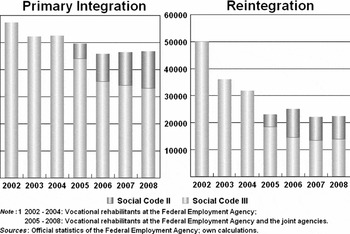
Looking at the figures, we find decreasing numbers of acceptance as a vocational rehabilitant (see Figure 1). The decline started in 2003 with the beginning of the Hartz Reforms, mainly due to the reorganisation of the Federal Employment Agency. During this process, major changes were made, especially in the field of the allocation of actual labour market schemes (Schneider et al., Reference Schneider, Brenke, Kaiser, Steinwede, Jesske and Uhlendorff2006; Kruppe, Reference Kruppe, Loebe and Severing2006). Acceptance rates reached a low in 2005 with the implementation of Social Code II. As the decline is taking place mainly in the field of reintegration, for which the new institutions are responsible, the implementation could partly be associated with the decline.
Acceptance as a vocational rehabilitant, Primary- and Reintegration, 2002 to 20081.

To illustrate this assumption: people taking part in primary integration schemes often come from special schools. They are informed at an early stage, usually at school, that the Federal Employment Agency is responsible for their apprenticeship placement. In consequence, they have little or no contact with the new institutions and are generally not affected by the passing back and forth between the institutions that affects adults. Therefore, their acceptance rates decrease less dramatically.
In addition, an institutional-analytic perspective should be noted. One can assume that the decline in the field of reintegration may be a side-effect of the implementation of Social Code II which might not be intended by legislation. With regard to Engelhardt's model of ‘allocational choices’ in the health care system (Engelhardt, Reference Engelhardt1986), we assume that decisions taken at governmental or macro level have consequences on every subsequent level within public administration.
Translating this into the process of introducing a new Code within the German Social Security System, the regulations are laid down by the German legislators. Their overall goals were to reduce long-term unemployment and benefit dependency, but still secure the financial subsistence of people in need. These goals were transformed into legal regulations in Social Code II. To a certain degree, these regulations leave some freedom of action, because they only set the framework for all further activities. Apart from the intended effects, they can have far-reaching outcomes at the lower meso and micro levels.
In our case, the meso level is represented by the Federal Employment Agency with its local employment offices and the joint agencies. Here the new welfare regulations are translated into organisational procedures and combined with existing organisational goals at the meso level, such as efficiency and reduction of costs. Executives at this level also implement management accounting systems to assess the work of actors at the micro level. These actors are placement officers, who have to apply regulations from both the macro level and the meso level to their working routines. They have to put into practice the regulations set at the macro level and are at the same time subject to the efficiency and management accounting demands coming from the meso level. They therefore have to interpret, implement and put into practice the legal and organisational rules defined at higher levels (Lay and Hansmeier, Reference Lay, Hansmeier, Liebig, Lengefeld and Mau2004) concerning Social Code II. These rules, especially in respect of people with disabilities, are not clearly defined. So the scope of interpretation can lead to a neglect of the other relevant social code, Social Code IX, even if this was not planned by the German legislators.
These possibly unintended effects together with the complex legal situation, as described earlier, could be both the cause and the consequence of the declining acceptance rates as vocational rehabilitants. To explore this, the Institute for Employment Research carried out an implementation study in cooperation with the University of Halle-Wittenberg. It examined the impact of Social Code II from an institutional perspective.
Methods and approach to the research
We interviewed 32 placement officers responsible for vocational rehabilitation for people with disabilities in the third quarter of 2006. They were based in 11 local employment offices, 12 joint agencies and seven municipal providers in 21 cities or regions, categorised according to whether they were based in a rural or metropolitan area. The interviewees were randomly selected from each of the categories. Thus, the sample covers old and new institutions, differing levels of experience concerning the role and tenure of the organisation as well as diverse regional labour market situations. Face-to-face in-depth interviews were guided by a semi-structured schedule. To provide a certain level of comparability between the interviewees' statements, four virtual clients or ‘paper patients’ were designed and included in each interview (Schubert et al., Reference Schubert, Behrens, Hauger, Hippmann, Hobler, Höhne, Schneider, Zimmermann, Dornette and Rauch2007). The interviewees were asked to explain their decision-taking processes concerning the request for vocational rehabilitation and all further integration measures according to the characteristics of the paper patients. They were also asked what they perceived as the main reasons for the declining acceptance rates in the rehabilitation field. The study is of explorative character and not representative for all responsible institutions in Germany, but provides an informative basis of the situation of vocational rehabilitation in the year 2006.
Consequences of hasty implementation
While the considerations of introducing welfare reforms were the subject of political discussion for a long time, the implementation of Social Code II did not begin until 2004. German legislators opted for a prompt introduction, so the new institutions were set up in the second half of 2004 and had to start work in January 2005. Consequently, the personnel and technical infrastructure were not fully developed. Not surprisingly, the interviewees talk of a chaotic and long-lasting initial phase when referring to the year 2005.
The new institutions first hired new and reorganised established staff. Many externally recruited career changers were hired, but there was also a considerable influx of personnel from existing local employment offices and municipal providers. Staff from the municipalities frequently came from post and telecommunication offices. While the employees from the local employment offices were familiar with the administration and placement business, the two other groups had little or no experience. These interviewees state that they had to become acquainted with the whole field of work (Schubert et al., Reference Schubert, Behrens, Hauger, Hippmann, Hobler, Höhne, Schneider, Zimmermann, Dornette and Rauch2007). This includes not only the new legal basis of their day-to-day work, but also often the entire administration and advisory service for long-term unemployed people. This process starts with the calculation and punctual payment of benefits, includes the allocation of employment and training schemes in general and ends with the management of special cases. The financial aspect in particular was considered to be the most pressing task and was therefore handled with priority.
As described earlier, the process of rehabilitation for people with disabilities requires a certain amount of knowledge. Taking into account that the new placement officers often lacked job-specific skills, they could hardly be expected to have special knowledge about the integration of people with disabilities, respectively the regulations of Social Code IX. Additionally, the training of staff was postponed as a result of the rapid uptake of the new task and the necessity of prioritising other, mainly financial aspects. The interviewees complained that if training was offered, it often focused on administration in general, on the handling of computer programmes or on the calculation of benefits. Many of them missed organised training on special cases, including the legal foundations that regulate the integration of job-seekers with disabilities and their support. Their superiors justified this differently; reasons varied from ‘we don't need it’ to ‘no time for this’. In consequence, the placement officers had little knowledge about pertinent social codes other than the Social Code II. In particular, the regulations of Social Code IX were, and often still are, almost irrelevant for the day-to-day activation and integration work in the new institutions.
However, the knowledge of legal regulations is only one prerequisite. Just as important is the identification of an actual need for rehabilitation. People with disabilities who do not actively broach the issue of health problems are often in danger of falling through the cracks. The results of the study suggest that the rehabilitation requests of long-term unemployed people were only identified in obvious cases (Schubert et al., Reference Schubert, Behrens, Hauger, Hippmann, Hobler, Höhne, Schneider, Zimmermann, Dornette and Rauch2007). The acceptance of the rehabilitation request, however, presents the opportunity to enter a vocational rehabilitation scheme. They are designed to enhance the chances of sustainable labour market integration. Therefore, neglecting existing rehabilitation needs may lead to a type of labour market integration that is detrimental to the state of health.
To ease the burden of the situation, a knowledge transfer between the newly founded institutions and the local employment offices would have been helpful. But in 2006 there was still no formalised, specified way of cooperation in many cases. In many aspects, the new institutions were left to their own devices. The interviewees indicate that the establishment of the necessary co-operation networks was enormously time-consuming and lacked ‘best-practice examples’. They state that this caused a considerable delay in developing an efficient infrastructure. Especially in the field of the placement and training of people with disabilities, communication and agreement between placement officers in old and new institutions are necessary. Communication processes were worked out when placement officers coming from the local employment offices were in charge. They were familiar with the regulations or were already in contact with experts. In consequence, cooperation between the institutions was and is working in those places, but in others the establishment of communication is still in progress. Therefore, the process described often leads to a temporary ‘deprofessionalisation’ in the field of employment advice and integration. So the guidelines at the macro level, the resulting prompt start and the complex legal regulations are causing major hurdles for long-term unemployed people with disabilities. This is confirmed by the interviewees.
New principles versus appropriate integration
Declining numbers of accepted vocational rehabilitants are not only due to the aforementioned ‘deprofessionalisation’, however. A more significant set of arguments points directly to the new activation policies and regulations associated with Social Code II (Schubert et al., Reference Schubert, Behrens, Hauger, Hippmann, Hobler, Höhne, Schneider, Zimmermann, Dornette and Rauch2007). One crucial point for the labour market integration of people with disabilities stems from the newly introduced term ‘employable’. The legislation defines long-term unemployed people as ‘employable’ if they are able to work three hours a day under normal labour market conditions. Even people with severe disabilities are classed as ‘employable’. Consequently, possible rehabilitation needs are often neglected if not requested directly by the person concerned. This enables the alternative of swift integration into any kind of job, mostly a job-creation measure.
Indeed, statements from our interviewees in the new institutions show that they often try to integrate anyone into any sort of employment. They say any job is deemed to be reasonable. This principle holds even if the status of that job is lower than the previous one, if the new job results in income loss and if the uptake of the new job requires moving house. But these jobs are often low-paid with poor working conditions and, most importantly, few opportunities for advancement (Lindsay et al., Reference Lindsay, McQuaid and Dutton2007). The question whether these jobs are beneficial or harmful for the state of health remains unanswered. The same holds for integration in public employment opportunities.
All of this is in accord with Social Code II, encapsulated in the principle of ‘demand’, and in particular in stricter job suitability demands. But this approach opposes Social Code IX since the employment officer should at least arrange a health examination to clarify whether a job-seeker with a disability is eligible for vocational rehabilitation.
Additionally, newly implemented management accounting systems, focused on the meso level, affect the integration of long-term unemployed people with disabilities (Schubert et al., Reference Schubert, Behrens, Hauger, Hippmann, Hobler, Höhne, Schneider, Zimmermann, Dornette and Rauch2007). The interviewees in the new institutions state that their work is now assessed in terms of strict efficiency demands. More precisely, the new management accounting mechanisms connect their work with average integration measures. They are urged to integrate long-term unemployed people as fast as possible and with the least expense. Most of the interviewees complain that they have to organise their work according to efficiency goals and that fast integration has to be their main focus. They also know that the labour market integration of people with disabilities is seldom quick or easy to achieve. However, this target group in particular often needs intensive advisory services. This may be followed by time-consuming and costly retraining schemes. The interviewees state that this is often not in accordance with the principle of fast integration. In consequence, interviewees admit that they often prioritise those people who have the highest likelihood of entering the labour market rapidly.
The new regulations within Social Code II play a decisive role when interviewees elaborate on their perception of reasons for declining rates of acceptance for rehabilitation. The situation described makes it hard for them to take adequate care of long-term unemployed people with disabilities. Additionally, they often state that even if the aspects associated with the principle of ‘demand’ and the stricter management accounting mechanisms did not play such a prominent role, another aspect would hinder them from attending to this matter appropriately. They complain that individual support for unemployed people with disabilities became even more difficult, because they are in charge of many more clients than preassigned by legislation. So, even if they acknowledge the necessity of health-based retraining, in some cases their work-load makes it almost impossible to respond to every person as they should. Therefore, vocational rehabilitation and jobs that are genuinely suited to an individual's state of health are rarely provided as a priority.
Conclusions
In Germany, research on the interaction of the labour market integration of people with disabilities, social security reforms and organisational practice is still in its infancy, particularly if we consider the much broader discussion of the impacts of welfare state reform on disability policy in other European countries (see, for example, Hyde, Reference Hyde2000; Kemp et al., Reference Kemp, Sundén and Bakker-Tauritz2006; Clarke et al., Reference Clarke, Bingham, Michielsens and Miller2007). With this article we hope to stimulate discussion.
We currently face a situation in which different codes of social law with differing underlying principles are applicable for the labour market integration of people with disabilities. Social Code IX aims at appropriate integration, taking into account the state of health. It focuses on widening self-determination, but only defines a kind of stipulated minimum standard when it comes to labour market integration grants. These are codified in other codes, Social Code III and II. The latter focuses on rapid integration with limited self-determination and its implementation has had multiple implications. ‘Demand’ and ‘promotion’ are the new principles for organising integration activities. The main principle – better and faster integration of long-term unemployed people into the labour market – is beyond doubt. But people with disabilities in particular, who are also subject to these principles, now face a rather disadvantageous situation.
With Social Code II, new institutions are responsible for the long-term unemployed, their implementation leading to destabilised integration routines (Dornette et al., Reference Dornette, Rauch, Schubert, Behrens, Höhne and Zimmermann2008). The placement officers, often new to the job, slowly became acquainted with the entire field of work. Building up knowledge as well as establishing cooperation networks between old and new institutions took time. As a result, the level of awareness about specialist programmes and the integration rights of people with disabilities was low and a certain ‘deprofessionalisation’ occurred.
Bearing in mind that the responsibility for the primary integration and reintegration of people with disabilities is divided, the differing figures regarding the decline of acceptance rates can be associated with the implementation phase (Dornette et al., Reference Dornette, Rauch, Schubert, Behrens, Höhne and Zimmermann2008). To start a rehabilitation procedure, a person's need for vocational rehabilitation has to be identified by the placement officer. This is the critical point in the process. Placement officers in the new institutions are responsible for the reintegration of adults and have often been overchallenged with the identification of a need for rehabilitation. Participants in primary integration, in contrast, have little or no contact with the new institutions. The Federal Employment Agency with its local offices is responsible for their apprenticeship placement. They are therefore less affected by the uncertainties in the new institutions and the supposed ‘deprofessionalisation’. In consequence, the rehabilitation acceptance rates for school leavers with disabilities, for so-called primary integration, are relatively stable, and the rates for the reintegration of adults are declining.
However, we expect most of this to be a temporary symptom of the implementation phase of Social Code II, assuming that a lasting and systematic training programme for placement officers is to be set up. There is still one element of risk. A certain proportion of the placement officers are hired on fixed-term contracts, which expire during 2008/2009. Consequently, the ‘deprofessionalisation’ is likely to convert from a temporal to a structural problem if the placement officers who have been in charge since the implementation of the reform in 2005 are to be replaced by newly hired external staff, presumably again on fixed-term contracts.
But there are further important implications for acceptance rates. The results of our research show first of all that the stricter management accounting procedures, to which the placement officers are subjected, hinder the integration of people with disabilities into work which is appropriate for their state of health. So, for example, a fast integration into the labour market often does not harmonise with a presumably intense advisory service for people with disabilities.
Secondly, as is the case with other people subject to the regulations of Social Code II, the training and labour market integration of long-term unemployed people with disabilities is now managed according to broader job suitability criteria. Thirdly, the introduction of the term ‘employable’ in Social Code II has been the vehicle to rapid integration into any sort of regular or subsidised employment. Consequently, the chances of being granted a place on rehabilitation scheme or receiving a job placement appropriate to one's individual state of health appear to be rather slight.
The importance of labour market integration of people with disabilities, in a way that is appropriate for their state of health, is laid out in Social Code IX. With this, Germany possesses a legal foundation that enhances the importance of vocational rehabilitation. However, it is partly inconsistent with Social Code II. Referring to people with disabilities, this inconsistency creates a field of conflict for placement officers in their day-to-day work. This might be a virtual field of conflict which does not always affect daily work.
But the level of awareness about this conflict will not be raised as long as legislation approves that mainly the principles of Social Code II guide the integration routines. It cannot be the responsibility of the placement officers at micro level to decide which of the purposes of legal bases are more relevant to the labour market integration of people with disabilities. This is a macro level, political decision by German legislators. All of the problems and inconsistencies that emerge at micro level from differing purposes of the relevant Social Codes can and must be clarified by legislation. Thereby, unintended side-effects can be minimised and this could help to ease the situation for long-term unemployed people with disabilities. As long as the contradiction between the social codes is not resolved, people with disabilities often fall through the cracks.
In conclusion, simply applying the same rights to people with disabilities and to non-disabled persons does not help to resolve the problems faced by people with disabilities when it comes to entering the labour market. Furthermore, as Kuptsch and Zeitzer (Reference Kuptsch, Zeitzer, Hoskins, Dobbernack and Kuptsch2001: 228/9) put it, problems may arise ‘if disabled people's demand for equal rights is misinterpreted and social policy decisions are taken on the basis that “they are all equally able to work now” (Gooding, Reference Gooding and Zarb1995: 75)’. Personal responsibilities must be matched by real opportunities for people with disabilities to provide for themselves, and appropriate support must be provided for their attempts to become economically self-sufficient and integrated. Taking into account that the German Federal Constitutional Court declared the joint agencies unconstitutional and that the German government has to readjust this form of administration by the year 2010, one can hope that disability politics will return to the spotlight once more. If people with disabilities are meant to participate in socioeconomic changes and to keep up or achieve more equality and inclusiveness, welfare politics and labour market politics should be inseparably connected.
Acknowledgements
This article is based on data from the qualitative study ‘Changes in structures and processes in the vocational rehabilitation system after the introduction of Social Code II’. It was carried out in 2006 by the Institute for Employment Research in cooperation with the Institute of Health and Nursing Science of the Martin-Luther-University Halle-Wittenberg. We thank the colleagues in Halle for their valuable contribution to the success of the study. We would also like to thank the two anonymous referees for their helpful suggestions for improving the article.