Introduction
There is evidence that both genetic and environmental factors may occasion enduring liability to psychotic disorder, and, in addition, that genes and environment may not always operate independently, interacting synergistically (Van Os et al. Reference Van Os, Kenis and Rutten2010). Environmental effects may be conceptualized at the individual or the contextual level. For example, individuals sharing a common environment, such as a neighbourhood, will be jointly exposed and thus share neighbourhood contextual effects. Thus, all residents of a neighbourhood are exposed to the same level of area socio-economic disadvantage or social capital, irrespective of their individual socio-economic status, social contacts and other individual-level characteristics. Neighbourhood socio-economic disadvantage is a key concept of the quality of the neighbourhood social and structural environment that may impact on various mental health outcomes (Drukker et al. Reference Drukker, Gunther and Van Os2007), including psychotic disorder (Marcelis et al. Reference Marcelis, Navarro-Mateu, Murray, Selten and Van Os1998; March et al. Reference March, Hatch, Morgan, Kirkbride, Bresnahan, Fearon and Susser2008; Zammit et al. Reference Zammit, Lewis, Rasbash, Dalman, Gustafsson and Allebeck2010). Related constructs are neighbourhood poverty and low neighbourhood socio-economic status; they summarize a set of social indicators that are thought to vary together as a function of underlying poverty (Wilson, Reference Wilson1987; Kasarda, Reference Kasarda1993). Neighbourhood socio-economic disadvantage implicates a continuum of severity of problems with affluent neighbourhoods at one end and deprived and disorganized neighbourhoods at the other. The proportions of unemployed and low-income residents can be considered as proxies for this construct. Social capital reflects the quality of intra-neighbourhood relations based on different social, cultural and administrative bonds or bridges (Whitley & McKenzie, Reference Whitley and McKenzie2005). Various potential positive and negative consequences of social capital have been reported in mental health studies (McKenzie et al. Reference McKenzie, Whitley and Weich2002; Drukker et al. Reference Drukker, Driessen, Krabbendam and Van Os2004; De Silva et al. Reference De Silva, McKenzie, Harpham and Huttly2005; Allardyce & Boydell, Reference Allardyce and Boydell2006; Drukker et al. Reference Drukker, Krabbendam, Driessen and Van Os2006), including incidence of schizophrenia (Kirkbride et al. Reference Kirkbride, Boydell, Ploubidis, Morgan, Dazzan, McKenzie, Murray and Jones2008).
Previous work examining gene–environment interactions in psychotic disorder has focused exclusively on individual-level risk factors such as cannabis and prenatal infection (Van Os et al. Reference Van Os, Rutten and Poulton2008). However, there is increasing evidence that neighbourhood contextual variables operate by moderating individual-level risk factors for psychiatric disorder including psychotic disorder (Van Os et al. Reference Van Os, Driessen, Gunther and Delespaul2000a; Allardyce & Boydell, Reference Allardyce and Boydell2006; Meier et al. Reference Meier, Slutske, Arndt and Cadoret2008; Zammit et al. Reference Zammit, Lewis, Rasbash, Dalman, Gustafsson and Allebeck2010). Recently, this paradigm was extended to the analysis of contextual neighbourhood factors that may moderate expression of genetic liability for mental disorder (Lee et al. Reference Lee, Glass, James, Bandeen-Roche and Schwartz2011). There are good reasons to study contextual neighbourhood influences in psychotic disorder. First, there is consistent evidence for an association between urban environments and expression of psychosis (Marcelis et al. Reference Marcelis, Navarro-Mateu, Murray, Selten and Van Os1998; Krabbendam & van Os, Reference Krabbendam and van Os2005; March et al. Reference March, Hatch, Morgan, Kirkbride, Bresnahan, Fearon and Susser2008; Zammit et al. Reference Zammit, Lewis, Rasbash, Dalman, Gustafsson and Allebeck2010) that may be secondary to interactions between neighbourhood and individual-level characteristics (Van Os et al. Reference Van Os, Driessen, Gunther and Delespaul2000a; March et al. Reference March, Hatch, Morgan, Kirkbride, Bresnahan, Fearon and Susser2008). It was hypothesized that neighbourhood contextual effects such as higher levels of affluence and social capital acted as a buffer (Kirkbride et al. Reference Kirkbride, Boydell, Ploubidis, Morgan, Dazzan, McKenzie, Murray and Jones2008), conferring protection to vulnerable individuals against persistence of normally transitory subthreshold psychotic experiences (Van Os et al. Reference Van Os, Linscott, Myin-Germeys, Delespaul and Krabbendam2009).
Contrary to most previous research in this area, the present dataset includes information on the full spectrum of severity ranging from psychotic experiences, without dysfunction or impairment, to psychotic symptoms, with variable degrees of dysfunction and impairment but below the threshold of formal diagnosis, to psychotic disorder. Previous analyses with this dataset provided evidence for an extended psychosis phenotype that can be operationalized as a continuum of clinical severity. This was the outcome that was analysed in the present paper.
The aim of the present paper was to investigate whether neighbourhood contextual effects operate by moderating the expression of familial liability for psychosis across the full spectrum of phenotypic variation (Binbay et al. Reference Binbay, Drukker, Elbi, Aksu, Özkınay, Önay, Zağlı, Van Os and Alptekin2011a). Family history of severe mental illness and common mental disorder, both strongly associated with psychotic disorder (Mortensen et al. Reference Mortensen, Pedersen and Pedersen2010), served as a proxy variable for familial liability in a representative general population sample from the urban area of Izmir, Turkey. The urban social environment including socio-economic deprivation and social capital was assessed in an independent sample and aggregated to the Izmir neighbourhoods.
Method
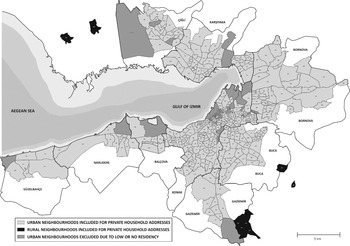
Before 2008, the Izmir metropolitan area was divided into nine administrative districts; most were urban but differed in terms of population density and socio-economic deprivation (Fig. 1) (Ünverdi, Reference Ünverdi2005; Binbay et al. Reference Binbay, Elbi, Alptekin, Aksu, Drukker, Önay, Özkınay, Zağlı and Van Os2011b). The TürkSch study (Izmir Mental Health Survey for Gene–Environment Interaction in Psychoses) consisted of a three-stage data collection to assess individual-, family- and neighbourhood-level variables (Binbay et al. Reference Binbay, Elbi, Alptekin, Aksu, Drukker, Önay, Özkınay, Zağlı and Van Os2011b). The study aimed to assess the prevalence of mental health problems with a special focus on psychotic outcomes (stage 1), and social capital in neighbourhoods in the city of Izmir, Turkey (stage 2). The last stage (stage 3) was a nested case–control study that recruited individuals with psychotic outcomes and healthy controls from stage 1 (Binbay et al. Reference Binbay, Elbi, Alptekin, Aksu, Drukker, Önay, Özkınay, Zağlı and Van Os2011b). The present paper uses data collected in stages 1 and 2. The TürkSch study has been described in more detail in previous papers (Binbay et al. Reference Binbay, Drukker, Elbi, Aksu, Özkınay, Önay, Zağlı, Van Os and Alptekin2011a, Reference Binbay, Elbi, Alptekin, Aksu, Drukker, Önay, Özkınay, Zağlı and Van Osb).
Map representing administrative neighbourhoods of the Izmir metropolitan area. Urban neighbourhoods included for private household addresses; rural neighbourhoods included for private household addresses; urban neighbourhoods excluded due to low or no residency.

Sample
The study was approved by the Ege University ethics committee and subjects provided written informed consent. The sample covered 294 of the 348 administrative neighbourhoods in Izmir with an additional eight rural neighbourhoods out of 35 rural neighbourhoods located at least 30 km from the city centre.
The Ege University team sent letters to each selected address to announce the visit and interviewers visited each address. After providing informed consent, one household member aged between 15 and 64 years and available to complete the interview was randomly selected using the Kish within-household sampling method (Kish, Reference Kish1949). If one of the residents of the household was already diagnosed with a psychotic disorder, he or she was recruited for the study without application of the Kish method. Persons who were not immediately available (due to hospitalization, military service, travel, imprisonment or acute exacerbation of a mental disorder) were contacted later in the year.
Out of 6000 addresses, 5242 households were eligible for interview in stage 1. Main reasons for ineligibility were change of address, incorrect address and addresses with residents not meeting the inclusion criteria (not aged between 15 and 65 years). In the 5242 eligible households, a total of 4011 individuals were successfully interviewed, yielding a response rate of 76.5%. Main reasons for non-response were refusal to participate (18.2%), failure to contact anyone in the identified household (3.1%) and failure to contact the sampled individual in an identified household (3.0%).
Response was lower in moderately urban and urban areas (75%) than in low urban and rural areas (82%; based on all 764 non-respondents and 4011 participants; χ2 = 26.8, df = 1, p < 0.001). In a convenience sample of non-respondents (n = 177, 23%), mean age was 41.2 years (s.d. = 12.9) and significantly higher than in respondents (mean age = 37.4 years, s.d. = 13.4; t = 2.9, p = 0.004); 42% of respondents and 51% of non-responders were male (χ2 = 5.3, p = 0.02).
Interviewers, interviewer training and quality control
Lay interviewers had at least high school education, a health-related profession, and/or were experienced in doing field surveys (Binbay et al. Reference Binbay, Drukker, Elbi, Aksu, Özkınay, Önay, Zağlı, Van Os and Alptekin2011a, Reference Binbay, Elbi, Alptekin, Aksu, Drukker, Önay, Özkınay, Zağlı and Van Osb). Training of the interviewers included basic information on mental health problems, symptom dimensions of psychotic disorders, fieldwork and ethical as well as medico-legal aspects. Training for the Composite International Diagnostic Interview (CIDI) interview was carried out using official CIDI training material (Binbay et al. Reference Binbay, Elbi, Alptekin, Aksu, Drukker, Önay, Özkınay, Zağlı and Van Os2011b).
Screening and diagnostic instrument
In order to assess psychotic experiences and to diagnose disorders with psychotic features, assessments were based on the relevant sections of the CIDI 2.1 (Andrews & Peters, Reference Andrews and Peters1998). The CIDI is a fully structured interview developed by the World Health Organization (Robins et al. Reference Robins, Wing, Wittchen, Helzer, Babor, Burke, Farmer, Jablenski, Pickens, Regier, Sartorius and Towle1988) and has been used in various surveys around the world including Turkey (Deveci et al. Reference Deveci, Taskin, Dinc, Yilmaz, Demet, Erbay-Dundar, Kaya and Ozmen2007; Alptekin et al. Reference Alptekin, Ulas, Akdede, Tumuklu and Akvardar2009). Primarily designed for use in epidemiological studies of mental disorders, the CIDI can be used by both clinicians and trained interviewers. CIDI-based screening of symptoms provides diagnoses of various mental disorders in accordance with the definitions and criteria of the International Classification of Diseases, Tenth Revision (ICD-10), and the Diagnostic and Statistical Manual of Mental Disorders, Fourth Edition (DSM-IV), along with information about frequency, duration, help-seeking, severity of symptoms and psychosocial impairment.
Psychotic symptoms were rated using 14 CIDI delusions items (G1, G2, G3, G4, G5, G7, G8, G9, G10, G11, G12, G13, G13b and G14) and five CIDI hallucinations items (G17, G18, G20, G20C, G21). All items were rated dichotomously indicating presence or absence. The process of rating has been described in more detail in previous papers (Binbay et al. Reference Binbay, Drukker, Elbi, Aksu, Özkınay, Önay, Zağlı, Van Os and Alptekin2011a, Reference Binbay, Elbi, Alptekin, Aksu, Drukker, Önay, Özkınay, Zağlı and Van Osb).
Respondents, and available relatives, were asked if respondents had ever been treated for a mental health problem and/or had received a diagnosis of psychiatric disorder. When needed, the respondent was asked for permission to contact the clinician involved in the diagnosis or the treatment of the respondent in order to verify the diagnosis and review case material. Of 27 respondents, 19 allowed us to review their medical records.
In order to identify individuals with psychotic disorder, several layers and steps of case identification were applied. All individuals endorsing at least one CIDI psychotic symptom associated with help-seeking or, if there was no help-seeking, occurring with a frequency of at least once per week, were re-contacted by the study team and invited for a clinical evaluation with the Structured Clinical Interview for DSM-IV (SCID) by the team psychiatrist and psychologist (225 out of 296 such individuals were successfully re-interviewed).
Using CIDI item G25 (duration of the psychotic experiences: between 1 day and 6 months or more), CIDI items G26, G28, G29 and G29A (level of dysfunction) and CIDI items G16 and G23 (told doctor about psychotic beliefs), an impairment sum score was generated (all CIDI items dichotomized, sum score range 0–7) (Binbay et al. Reference Binbay, Drukker, Elbi, Aksu, Özkınay, Önay, Zağlı, Van Os and Alptekin2011a, Reference Binbay, Elbi, Alptekin, Aksu, Drukker, Önay, Özkınay, Zağlı and Van Osb).
Dependent variable
Guided by previous literature (Poulton et al. Reference Poulton, Caspi, Moffitt, Cannon, Murray and Harrington2000; Van Os et al. Reference Van Os, Hanssen, Bijl and Ravelli2000b; Hanssen et al. Reference Hanssen, Bak, Bijl, Vollebergh and van Os2005) and as described in a previous paper (Binbay et al. Reference Binbay, Drukker, Elbi, Aksu, Özkınay, Önay, Zağlı, Van Os and Alptekin2011a), a psychosis spectrum variable was constructed in which severity of symptoms and impairment associated with symptoms were combined. Psychotic disorder (category 4, n = 99) included all individuals with (i) a past or current DSM-IV diagnosis of any disorder with psychotic symptoms, based either on hospital diagnosis, any health care-based diagnosis or other clinical register diagnosis, or (ii) diagnosis at clinical re-interview with the SCID. Categories 1 to 3 all included individuals who scored positive on the psychosis screening questions, but did not have psychotic disorder. In the subclinical psychotic experience group (category 1, n = 625), the impairment score was zero. Low-impact psychotic symptoms (category 2, n = 198) included individuals with impairment scores between 1 and 3 and high-impact psychotic symptoms (category 3, n = 109) included individuals with impairment scores between 4 and 7. All other individuals were included in the reference category (0, absence of psychosis, n = 2980).
Individual-level independent variables
Using interview sections (with the respondent as source) derived from the Family Interview for Genetic Studies (National Institute of Mental Health Genetics Initiative, 1992) on mental health problems in father, mother and siblings, presence of mental illness in the family was determined (a positive rating requiring reports of a visit to a health professional for mental problems). If required, additional information was obtained from parents and/or siblings by telephone or during the clinical reappraisal. Severe mental illness in the family was coded ‘yes’ if any first-degree relative had any diagnosis of psychotic disorder, bipolar disorder or completed suicide, or had been admitted to a psychiatric in-patient unit. Common mental disorder in family included any diagnosis of depression, anxiety, conversion or somatization among parents or siblings (in the absence of severe mental illness; conversion and somatization are common in this population).
Socio-economic position was based on the subject's profession recoded to include four ordinal categories: (1) I and II professional and IIIa non-manual high employees; (2) IIIb non-manual low employee and V and VI skilled workers and technicians; (3) IVa, IVb and IVc owners of small businesses; and (4) VIIa and VIIb manual workers. Parental socio-economic position was also recoded to these categories, using the highest position of mother and father. Urbanicity between age 6 and 15 years (urbanicity of the address where respondents lived between the ages of 6 and 15 years) was included in the models to control for the association between urban upbringing and psychosis outcomes (Krabbendam & van Os, Reference Krabbendam and van Os2005; Lederbogen et al. Reference Lederbogen, Kirsch, Haddad, Streit, Tost, Schuch, Wust, Pruessner, Rietschel, Deuschle and Meyer-Lindenberg2011). If a respondent lived at more addresses, the most urban address was included.
The wider social environment
Two sets of characteristics pertaining to the wider social environment were included in the analyses: (i) social capital and (ii) socio-economic deprivation. In order to obtain measures of social capital that were not biased by the outcome under study, items were assessed in a separate sample of informants that were not participating in stage 1 (Buka et al. Reference Buka, Brennan, Rich-Edwards, Raudenbush and Earls2003; Drukker et al. Reference Drukker, Kaplan, Feron and Van Os2003; Subramanian et al. Reference Subramanian, Lochner and Kawachi2003). Thus, in stage 2, for each stage 1 address, two addresses were drawn from the same neighbourhood within the same address cluster, in order to obtain an assessment of the neighbourhood of the stage 1 address, independent of the stage 1 respondent. Of the two addresses, one was contacted; the second address was only contacted in case of non-response from the first address. For stage 2, a total of 5819 respondents (48.2% males and mean age 37.8 years) were interviewed. Answers were aggregated to the neighbourhood level to assess neighbourhood-level social capital and socio-economic deprivation.
Dimensions of social capital used in the analyses were: informal social control (ISC) and social disorganization (SocD). Questions on ISC (eight items) were derived from the Sampson collective efficacy scale, adapted for use in the Turkish population (Sampson, Reference Sampson1997). The ISC scale measures the willingness to intervene in hypothetical neighbourhood-threatening situations, for example, in the case of children misbehaving. ISC items were assessed using a five-point Likert scale ranging from ‘strongly agree’ to ‘strongly disagree’. Eight items relating to SocD were derived from the McCulloch instrument (Buckner, Reference Buckner1988; McCulloch, Reference McCulloch2003). Respondents rated the frequency of certain scenarios occurring in their neighbourhood (presence of graffiti, teenagers on street, vandalism, attacks due to race or skin colour, other attacks, burglary and the theft of, or from, vehicles). Each item was assessed using a four-point Likert scale ranging from ‘very common’ to ‘not at all common’.
Factor analysis of ISC and SocD separately showed that items of each scale loaded on the same factor. Thus, ISC and SocD sum scores were obtained from individual answers (negative items were reversed), divided by the number of items and aggregated to the neighbourhood level. Higher scores indicated lower levels of ISC and lower levels of SocD.
In order to construct a measure of neighbourhood socio-economic deprivation, the proportion of unemployed residents and proportion of residents with low income (i.e. total monthly net income of the household below 1000 Turkish lira, equivalent to €500 or US$750) were obtained from the stage 2 sample. For both variables, higher scores indicated more socio-economic deprivation. Social capital and socio-economic variables were standardized to unity s.d. and mean = 0. Pearson correlations between the neighbourhood-level variables were between 0.07 and 0.31 (neighbourhood level).
Statistical analysis
Analyses were performed using Stata (version 11; StataCorp LP, USA). As it was hypothesized that residents within the same neighbourhood would be more similar than residents across different neighbourhoods, data conceptually are clustered in neighbourhoods. Multilevel or hierarchical linear regression techniques are a variant of the more often used unilevel linear regression analyses and are ideally suited for the analysis of clustered data, in this case consisting of multiple persons clustered within a single neighbourhood. The β's are the regression outcomes of the predictors in the multilevel model and can be interpreted identically to the estimates in unilevel analyses.
In all models, the dependent variable was the five-level psychosis spectrum variable as described above (range 0–4). First, a model was analysed including gender, age categories (15–24 = reference), being unmarried (i.e. single or divorced), current and parental socio-economic position (reference = high employees), ethnicity (non-Turkish), (individual-level) unemployment, and high urbanicity between the ages of 6 and 15 years (model 1). Second, the four neighbourhood variables (ISC, SocD, unemployment, poverty) were included in four separate models, in order to avoid collinearity. These models also included the individual-level variables of model 1.
Interaction terms between severe mental illness in the family and common mental disorder in the family on the one hand and the four neighbourhood variables on the other (eight interaction terms in total) were included in order to examine moderation. Interaction terms were removed from the model top-down (i.e. starting with a model with eight interaction terms and removing the non-significant terms). If the final model included one or more interaction terms, effects of severe mental illness in the family on the psychosis spectrum variable are presented for different levels of each of the interacting neighbourhood variables (average level: neighbourhood variable mean = 0; worse than average level and better than average level, respectively: mean –1 s.d. and mean + 1 s.d.), constraining the other interacting neighbourhood variables to ‘average’ (i.e. these neighbourhood variables had the mean value of 0).
Results
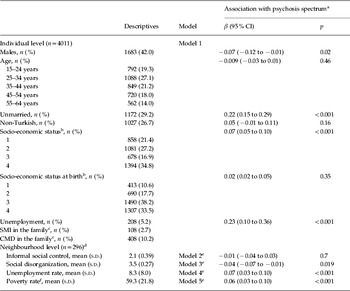
Subjects who were female, unmarried, unemployed, low in current socio-economic status, or lived in more urban areas between the ages of 6 and 15 years scored higher on the psychosis spectrum variable (Table 1). In disadvantaged neighbourhoods (i.e. with a higher proportion of unemployment, a higher proportion of people in poverty or more disorganization), respondents scored higher on the psychosis spectrum variable (Table 1). Neighbourhood ISC was not associated with outcome.
Distribution of demographic and background variables, and their associations with psychosis spectrum

CI, Confidence interval; SMI, severe mental illness; CMD, common mental disorder; s.d., standard deviation.
Data are given as number of participants (percentage) or as mean (s.d.).
a 0, Absence of psychosis; 1, subclinical psychotic experience, no impairment; 2, low-impact psychotic symptoms; 3, high-impact psychotic symptoms; 4, psychotic disorder.
b 1, Professional and non-manual high employee; 2, non-manual low employee skilled workers and technicians; 3, small proprietors with or without employees; 4, manual workers.
c Not included in the base regression model.
d Pearson correlations between the four neighbourhood variables were between 0.07 and 0.31 (296 neighbourhoods).
e No confounders included.
f Percentage of residents with total monthly net income of the household below 1000 Turkish lira (equivalent to below €500 or US$750).
Do neighbourhood variables modify the association between severe mental illness in the family and psychosis spectrum?
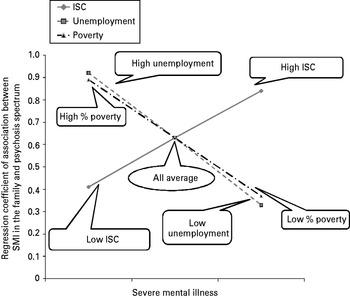
In the association between family severe mental illness and psychosis spectrum, three neighbourhood variables were modifiers: ISC (χ2 = 5.7, df = 1, p = 0.02), unemployment (χ2 = 8.4, df = 1, p = 0.004) and poverty (χ2 = 5.9, df = 1, p = 0.02). In neighbourhoods with average levels of all three neighbourhood-level modifiers, respondents with severe mental illness in the family scored 0.63 points higher on the psychosis spectrum variable (p < 0.001; Table 2). The association was stronger in neighbourhoods with higher unemployment rates (β = 0.92, p < 0.001, other neighbourhood variables constrained to average; Table 2), neighbourhoods with more poverty (β = 0.89, p< 0.001) and neighbourhoods with high levels of ISC (β = 0.84, p < 0.001).
Association between SMI in the family and psychosis spectrum for different values of neighbourhood-level variables (other interacting variables being set at ‘average’

SMI, Severe mental illness; CI, confidence interval; df, degrees of freedom.
a Any psychotic disorder, bipolar disorder, completed suicide or psychiatric hospitalization of parents or siblings.
b Proportion of residents with total monthly net income of the household below 1000 Turkish lira (equivalent to below €500 or US$750).
In the model including the three above interaction terms, there was no interaction between severe mental illness in the family and social disorganization, but when excluding the other interaction terms the interaction between severe mental illness in the family and social disorganization was also statistically significant (χ2 = 6.1, df = 1, p = 0.01), showing that the association between severe mental illness in the family and psychosis spectrum was stronger in disorganized neighbourhoods.
Do neighbourhood variables modify the association between common mental disorder and psychosis spectrum?
Family common mental disorder was associated with psychosis spectrum (β = 0.30, p < 0.001, 95% confidence interval 0.20–0.39). There was no evidence of effect modification by neighbourhood variables (Table S1, available online).
Discussion
ISC and neighbourhood level of unemployment and low income were modifiers in the association between severe mental illness in the family (as a proxy for familial and genetic liability) and psychosis spectrum. The association between genetic liability and psychosis spectrum was stronger in neighbourhoods with higher rates of disadvantage and in neighbourhoods with higher levels of social control. The moderating effect of social disorganization was reducible to the other neighbourhood variables. There was no evidence for neighbourhood moderation of the association between common mental disorder and psychosis spectrum. Results are consistent with the possibility that there is a specific pathway of interaction between vulnerability, indexing liability for severe mental illness, and shared neighbourhood environment.
Methodological issues
Information on family history of severe and common mental disorder may have been biased as patients, and their relatives attending the interview, may be more aware of psychiatric symptoms in relatives in the past or the present. On the other hand, patients may neglect symptoms of both themselves and their relatives. The association between family mental illness and psychosis spectrum could be inaccurate when patients over- or under-report mental illness in the family compared with non-patients. Importantly, however, the differences in association between different levels of independently assessed neighbourhood variables cannot be explained by this possible bias.
Second, familial liability may not only be a consequence of genetic variation as suggested in the present paper, but also be related to common environmental exposures. It has been shown, however, that familial clustering of mental disorders like schizophrenia is mostly due to genetic factors (Gottesman & Wolfgram, Reference Gottesman and Wolfgram1991; McGue & Gottesman, Reference McGue and Gottesman1991).
Finally, respondents with severe mental illness in the family may be over-represented in disadvantaged areas (social drift) (Samele et al. Reference Samele, van Os, McKenzie, Wright, Gilvarry, Manley, Tattan and Murray2001) and this could have introduced bias. However, in the present data, there were no large or significant associations between neighbourhood proportion of respondents with familial liability to severe mental illness on the one hand and neighbourhood poverty, neighbourhood unemployment or ISC on the other (β = 0.008, p = 0.37; β = 0.002, p = 0.81; β = 0.005, p = 0.62, respectively; n = 252 neighbourhoods). In addition, distribution of urbanicity was slightly different in respondents and non-respondents, and a convenience sample also showed small differences in age and gender. However, since the response rate was relatively high (76.5%), bias induced by any selective non-response in the context of these small differences would be minimal.
Findings
While the evidence suggests neighbourhood moderation of the association between familial liability to severe mental disorder and expression of psychosis, the direction of moderation was not uniform (Fig. 2). Thus, the association between family severe mental illness and psychosis spectrum was stronger in neighbourhoods with higher rates of unemployment or poverty or social disorganization, suggesting that living in an advantaged neighbourhood confers protection. On the other hand, the association between severe mental illness in the family and psychosis spectrum was stronger in neighbourhoods with higher levels of ISC. Thus, neighbourhood context may moderate individual-level risk factors for psychotic disorder. Genetic liability may be expressed only in combination with another component cause in the disadvantaged neighbourhood environment, together making up a sufficient cause (Rothman & Greenland, Reference Rothman and Greenland1998). Several mechanisms have been proposed by which neighbourhood disadvantage may exert effects, such as competition for scarce resources and copying bad behaviour of other residents (Jencks & Mayer, Reference Jencks, Mayer, Lynn and McGeary1990; Leventhal & Brooks Gunn, Reference Leventhal and Brooks Gunn2000; Ross et al. Reference Ross, Reynolds and Geis2000; Drukker et al. Reference Drukker, Gunther and Van Os2007). Residents of disadvantaged neighbourhoods may feel trapped and powerless to change current stresses in the environment (Ross et al. Reference Ross, Reynolds and Geis2000; Drukker et al. Reference Drukker, Gunther and Van Os2007). Follow-up research is required to replicate the current findings and identify possible mechanisms.
Association between severe mental illness in the family and psychosis spectrum for different values of neighbourhood-level variables (other interacting variables set at ‘average’). Each line reflects the varying regression coefficients of the association between severe mental illness in the family and psychosis spectrum as the neighbourhood variable in question varies from low to high (linear interaction term in the model) and other neighbourhood variables are fixed at 0 (=mean). ISC, Informal social control; SMI, severe mental illness.

Social control
ISC in Turkish neighbourhoods may be higher than in Western European neighbourhoods and this may explain the fact that modifying effects were in the opposite direction. Mean ISC in the present study was 2.1 (s.d. = 0.39, 296 neighbourhoods); this is much higher than in a similar study in Maastricht, the Netherlands (Drukker et al. Reference Drukker, Kaplan, Feron and Van Os2003), which recorded a value of 3.1 (s.d. = 0.18, 36 neighbourhoods − lower scores on the variable indicating higher levels of ISC). Although the way Turkish and Dutch respondents understood and answered the questions may have contributed to these differences (Drukker et al. Reference Drukker, Buka, Kaplan, McKenzie and Van Os2005), the comparison suggests that there is far more social control (>2 s.d.) in Izmir. It may be hypothesized that, in the specific cultural climate in Izmir, high levels of family-based neighbourhood ISC may give rise to high levels of ‘expressed emotion’ – particularly interpersonal criticism – that may be experienced as stressful rather than beneficial, and provoke psychotic responses in vulnerable individuals. A previous study suggested a non-linear association between social capital and schizophrenia incidence, which may result from exclusion of vulnerable residents in high ISC neighbourhoods (Kirkbride et al. Reference Kirkbride, Boydell, Ploubidis, Morgan, Dazzan, McKenzie, Murray and Jones2008). Thus, high levels of ISC in a familial context may give rise to a climate favouring expression of psychosis liability.
Severe and common mental disorder
Both common mental disorder and severe mental illness are associated with psychotic disorder, characterized by, respectively, strong attributable and relative risks, and low and high phenotypic resemblance (Mortensen et al. Reference Mortensen, Pedersen and Pedersen2010). However, neighbourhood variables were only modifiers in the association between severe mental illness in the family and psychosis spectrum. Neighbourhood moderation is only shown when both phenotypic resemblance and relative risk are strong. This may indicate a possible specific pathway of environmental moderation when relative risk and phenotypic resemblance are high. As far as we know this is the first study analysing interaction between psychosis liability and neighbourhood factors. Thus, we can only speculate on the pathways and more research is needed.
Urbanicity and family relationships
Neighbourhood variables may mediate the association between urbanicity and psychosis expression (Zammit et al. Reference Zammit, Lewis, Rasbash, Dalman, Gustafsson and Allebeck2010). Current urbanicity was defined using the classification of the Turkish Institute of Statistics (TURKSTAT). The Urban Information System is based on the governmental, social and physical facilities within the administrative area. Classification depends on the level of organized features of streets and buildings (regularity of sidewalks, status of road, completeness of drainage system, and quality of outer paintings of buildings, etc.) and includes three urban categories (highly, moderately and weakly developed urban areas) as well as one rural category (Metropolitan Municipality of Izmir, 2007). A post hoc analysis showed that current urbanicity also modified the association between familial liability (severe mental illness) and psychosis spectrum (χ2 = 11.7, df = 2, p = 0.003). The association was largest in moderately urban areas (β = 0.89, p < 0.001) and smallest and non-significant in highly urban areas (β = 0.19, p = 0.24). As 87% of slum areas are moderately urban, and 58% of the affluent neighbourhoods are highly urban, these results indeed suggest that it is not level of urbanicity per se, but other factors, such as social capital and poverty that determine the association between urbanicity and psychosis spectrum, and moderation thereof by familial vulnerability.
An Izmir sociological study suggested that social capital is stronger in urban slum areas than in inner city areas, while both types of areas are populated by poor people (Sönmez, Reference Sönmez2007). In slum areas, new houses/slum dwellings are built when new family or friends arrive, contributing to the mutual benefits and reciprocity needed to survive in urban poverty. In the inner city, in contrast, the existing deteriorating housing stock prevents this process so that residents tend to move out as soon as they have the chance (Sönmez, Reference Sönmez2007).
Social capital in the neighbourhood benefits from what Sampson called ‘intergenerational closure’, referring to a state when residents of a neighbourhood are linked (Sampson et al. Reference Sampson, Morenoff and Earls1999). Thus, if two respondents live in the same neighbourhood and are related, family exposure and ecological exposure overlap. In that situation, intra-class correlation is not only a consequence of neighbourhood clustering, but also of familial clustering. However, this has no effect on the modifying effects of social control and poverty.
On the other hand, when individual-level equivalents of the neighbourhood variables are not in the models, the neighbourhood-level results may reflect proxy results of the individual-level variable. Individual socio-economic position and unemployment were included in the models. However, individual-level and, more importantly, family-level equivalents of social capital were not. The ISC results, thus, reflect both neighbourhood-level ISC and extended family control. In Izmir neighbourhoods, these two concepts probably are so intertwined that disentangling them is not feasible. In other words, in Turkey, the controlling environment of the extended family may represent an important part of neighbourhood social capital.
Supplementary material
For supplementary material accompanying this paper, visit http://dx.doi.org/10.1017/S0033291712000700.
Acknowledgements
This work is part of the TürkSch project, funded by the Scientific and Technological Council of Turkey 1001 programme (project no. 107S053). Stage 2 of the TürkSch project was also funded by the Psychiatric Association of Turkey (award for research projects, 2008).
This study was supported by the European Community's Seventh Framework Program under grant agreement no. HEALTH-F2-2009-241909 (project EU-GEI).
The authors acknowledge Dr Cengiz Kılıç for providing CIDI 2.1 training, Dr Baybars Veznedaroğlu and Dr Bülent Kayahan for sharing their clinical expertise in psychosis phenomenology, Dr Özen Önen Sertöz for help in lay interviewer training, Dr Hür Hassoy for providing key questions on sociodemographic features, Meriç Selvi for help in data logistics and fieldwork, Gökçe Özer and Ezgi Karabacak for data validation, Nalan Demirutku, Arzu Nurcihan Kaya, Emine Akdeniz, Halise Akça, Seçil Kükrer, Senem Şengeldi, İdris Altıntaş, Emre Çimen and Hüsniye Karabulut for data collection, and all the TürkSch respondents who kindly participated.
Declaration of Interest
None.