

INTRODUCTION
Per capita food production in Africa has been declining over the past two decades, contrary to the global trend. The growth rate for cereal grain yield is about 1% while population growth is about 3% (Bationo et al., Reference Bationo, Kimetu, Ikeera, Kimani, Mugendi, Odendo, Silver, Swift, Sanging and Bationo2004). Researchers have attributed food reduction to soil fertility decline. Traditionally, smallholder farmers relied on long fallow periods under shifting cultivation to replenish soil fertility. Shifting cultivation, however, has disappeared as increasing population density and pressures on land use has led to intensive, sedentary agriculture on small-scale landholdings and expansion of agriculture into marginal areas. This has resulted in soil fertility decline resulting from a combination of high rates of erosion, leaching, removal of crop residues, and continuous cultivation of the land without adequate fertilization or fallowing (Sanchez and Jama, Reference Sanchez, Jama, Vanlauwe, Diels, Sanginga and Merkx2002). This is aggravated by the inherent poor fertility of most tropical soils. Consequently, sub-Saharan Africa has experienced a decrease in overall per capita food production with poor soil fertility being recognized as the fundamental root cause for declining food security.
In Kenya and many other countries on the African continent, maize (Zea mays) is a major food crop and dominates all food security considerations with a per capita consumption of 103 kg yr−1 (Pingali, Reference Pingali2001). The central highlands of Kenya are generally densely populated and the high population has led to land sub-division into smallholdings, ranging from 0.1 to 2.5 ha with an average of 1.2 ha−1, which are subjected to intensive cultivation without adequate soil nutrients replenishment. The farmers rely on maize as the staple food crop; it is is cultivated from season to season mostly intercropped with beans (Phaseolus vulgaris). Production is low, estimated at 0.5–1.5 t ha−1 yr−1 due to declining soil fertility. Other food crops include sweet potato (Ipomea batatas), banana (Musa spp.) and vegetables that are mainly grown for subsistence consumption. Livestock production is a major enterprise, especially of improved dairy cattle breeds.
The magnitude of nutrient depletion in agricultural land in Africa is enormous, as is indicated by indicated by negative nutrient balances. The average annual loss in soil nutrients of 42 kg N, 3 kg P and 29 kg K ha−1 in Kenya is among the greatest in Africa (Smaling et al., Reference Smaling, Nandwa, Janssen, Buresh, Sanchez and Calhoun1997). Reversal of soil fertility depletion is required to increase per capita agricultural production. Use of inorganic fertilizers is one of the ways of addressing this situation but is constrained by the high costs that the resource poor farmers cannot afford. Macro-policy changes imposed externally in the past decade; such as structural adjustment programmes and removal of subsidies on agricultural inputs have rendered fertilizers unaffordable to smallholder farmers. This has resulted in many smallholder farmers reducing or abandoning the use of chemical fertilizer altogether.
Emerging evidence indicates that integrated soil fertility management (ISFM) involving the judicious use of combinations of organic and inorganic resources is a feasible approach to overcome soil fertility constraints within the smallholder farms. Combining organic nutrient resources and mineral fertilizers has been shown to result in synergy and improved synchronization of nutrient release and uptake by crops (Palm et al., Reference Palm, Myers, Nandwa, Buresh, Sanchez and Calhoun1997). A major challenge is how to replicate the high yields obtained from on-station plots on farms as conditions on farms are variable. Testing performance of ISFM practices under local conditions in on-farm experiments would enhance the relevance of research and accelerate finding adoptable and sustainable options. The objective of this study was therefore to assess the effect of applying organic materials, solely or combined with inorganic fertilizer on maize yields under both on-station and on-farm conditions. The hypothesis tested in this study is that maize yields are higher in treatments that have combine organic inputs and inorganic fertilizer than in treatments with either sole organic input or inorganic fertilizer. Experiments were conducted both at an on-station site and on farmers' fields.
MATERIALS AND METHODS
The study area
The study was conducted in Chuka division of Meru South district, Kenya. According to agro-ecological conditions (based on temperature and moisture supply), the area lies in the Upper Midland Zone (UM2-UM3) (Jaetzold et al., Reference Jaetzold, Schmidt, Hornet and Shisanya2006) on the eastern slopes of Mount Kenya at an altitude of 1500 m asl with an annual mean temperature of 20 °C and a total annual rainfall of 1200–1400 mm. The rainfall is bimodal with long rains from March to June and short rains from October to December. This gives rise to two cropping seasons in a year, the long rains season (LR) and the short rains season (SR). The soils are mainly humic Nitisols (Jaetzold et al., Reference Jaetzold, Schmidt, Hornet and Shisanya2006), which are deep and well weathered with moderate to high inherent fertility, but their fertility has declined due to intensive cultivation without adequate replenishment of soil nutrients. The district is a predominantly maize growing zone with smallholdings ranging from 0.1 to 2 ha with an average of 1.2 ha per household.
The distribution of rainfall during the study period is shown in Figure 1. The total rainfall received in the 2002 LR and SR was 858.1 mm and 790.1 mm, respectively, while in the 2003 LR and SR a total of 840.1 and 241.4 was recorded, respectively. The rainfall peaks coincided with the months of April and November during the study period, a rainfall pattern expected for this area.
Rainfall during 2002 long rains (March to September, 2002) and 2002 short rains (October to February 2002), and 2003 long rains (March to September, 2003) and short rains (October to February, 2003) at Chuka, Meru South district, Kenya.

On-station experiment establishment and management
A field experiment was established in March 2000 in Kirege School in Chuka division, Meru South district. The trial had 14 treatments comprising six organic resources applied solely or combined with inorganic fertilizer, sole inorganic fertilizer and a control. The organic resources were two herbaceous legumes, Mucuna pruriens and Crotalaria ochroleuca (intercropped with maize); two leguminous shrubs, Calliandra calothyrsus and Leucaena trichandra (biomass transfer); cattle manure and Tithonia diversifolia (biomass transfer) (Table 1). The experiment was a randomized complete block design with three replications. External nutrient replenishment inputs were applied to give an amount equivalent to 60 kg N ha−1, which is the recommended rate of N to meet maize nutrient requirements for optimum crop production in the area (FURP, 1987). These were applied at the beginning of each of the four seasons under study (2002 LR, 20002 SR, 2003 LR and 2003 SR). Maize (var. H513) was the test crop. Plot sizes measured 6 m × 4.5 m and maize was planted at a spacing of 0.75 m and 0.5 m inter and intra-row spacing, respectively.
Treatments showing organic resources, amount of inorganic N applied and the cropping system in the experiment at Chuka, Meru South district, Kenya.

†Total organic N applied varied among seasons and depended on amount of biomass produced during the previous season (see Table 2).
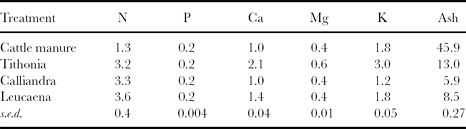
The organic materials (calliandra, leucaena, tithonia and cattle manure) were incorporated into the soil to a depth of 15 cm during land preparation. Calliandra, leucaena and tithonia were harvested from nearby plots established for that purpose while cattle manure was obtained from a nearby farm. A sample of each organic input was taken and N content determined (Table 2), then the amount of organic input to be applied, equivalent to 30 or 60 kg N, was determined (for the treatments with sole organic an equivalent of 60 kg N ha−1 and for the treatments with integration an equivalent of 30 kg N ha−1 was applied). Fertilizer N was applied in split applications with 33.3% being top-dressed four weeks after planting and the rest (66.6%) four weeks later. A uniform P application was done in all the plots at the recommended rate of 60 kg P ha−1 (FURP, 1987) as triple super phosphate. Other agronomic procedures for maize production were followed appropriately after planting.
Average nutrient composition (%) of organic materials applied in the soil during the study period at Chuka, Meru South District, Kenya.
The herbaceous legumes (mucuna and crotalaria) were intercropped between two maize rows one week after planting maize. After maize had been harvested, these legumes were left to grow in the field until land preparation for the subsequent season when they were harvested, weighed, chopped and incorporated into the soil to a depth of 15 cm. The weight of the herbaceous legume biomass applied during the study period varied across the seasons (Table 3). The amount of N contributed into the soil via the incorporated biomass was calculated by multiplying the amount of biomass (kg) with the N concentration in the biomass (%). The quantity of herbaceous legumes produced and their N contribution into the soil are shown in Table 3.
Amount of biomass produced by herbaceous legumes and their N contribution into the soil during long rains (LR) to 2003 short rains (SR) at Chuka, Meru South District, Kenya.

Value in parentheses: amount of N contributed by the biomass, calculated from the biomass in t ha−1 and N content (2.2–2.8 %) in the biomass.
For the treatments with additional N from inorganic fertilizer, total N added includes the amount in parenthesis + 30 kg N
Maize grain and stover were harvested at maturity from a net plot of 21.0 m2 (out of the total area of 27 m2) after leaving one row on each side of the plot and the first and last maize plants on each row to minimize the edge effect. Maize cobs were manually separated from the stover, sun-dried and packed in paper bags before threshing. After threshing, moisture content of the grains was determined using a moisture meter and grain weights adjusted to 12.5% moisture content.
Analysis of plant samples
Subsamples of all organic materials were collected uniformly at the beginning of each season and analysed. The samples were first washed with distilled water and oven dried at 65 °C for 48 hours. Samples were ground, packed in polythene bags and stored under dry conditions. The dry plant samples were analysed for N, P, K, Ca and Mg using Kjedahl digestion with concentrated sulphuric acid (Anderson and Ingram, Reference Anderson and Ingram1993). N and P were determined colorimetrically and K by flame photometry (Okalebo et al., Reference Okalebo, Gathua and Woomer2002). Mg and Ca were determined by atomic absorption spectrophotometery (Anderson and Ingram, Reference Anderson and Ingram1993).
On-farm trials
Researcher designed and farmer managed on-farm trials, classified as ‘Type 2’ according to Franzel et al. (Reference Franzel, Scherr, Coe, Cooper, Place, Franzel and Sherr2002), were established during the 2002 LR. The aim was to assess performance of the different soil fertility replenishment technologies, tested in the on-station experiment, under a variety of farmers' conditions. High variability in management among farmers is known to sometimes mask treatment performance and control of some factors is recommended for purposes of providing appropriate biophysical data (Mutsaers et al., Reference Mutsaers, Weber, Walker and Fischer1997). Farmers for these on-farm trials were selected during field days organized every growing season at the grain filling stage at the on-station trial between the 2000 and 2001 SR. During the field days resource persons who explained the treatments led farmers through the field trials in small groups. After touring the plots farmers were allowed to discuss their observations in small groups and also asked to select the technologies they wished to test.
In these Type 2 trials, variability was controlled by ensuring that all farmers participating in the trial used the same maize variety and inorganic fertilizer. The farmers were provided with maize seed, Hybrid 513 (H513), and compound fertilizer, nitrophosphate (NPK 23:23:0). The planting arrangement was similar to the on-station experiment, but numbers of treatments and plot sizes varied among the farms because farmers had different farm sizes. Seeds for herbaceous legumes were provided to farmers and were intercropped between the maize rows. Farmers had planted the leucaena and calliandra trees using seedlings from farmer group nurseries initiated in 2000. These trees were mainly planted along terraces and on farm boundaries. Tithonia, on the other, is traditionally found growing along home hedges and roadsides. At the beginning of each cropping season, farmers harvested prunings of calliandra and leucaena from their farms and tithonia from the roadsides. Chopped prunings were incorporated into the soil using hand hoes to a depth of 15 cm just as in the on-station trial where they had received training. During planting, technicians were present to ensure that the required procedures were followed and the correct amounts of inputs were applied. For example, they weighed the amounts of organic materials to be applied to provide an equivalent of either 60 kg N ha−1 or 30 kg N ha−1 depending on the treatment. After planting the farmers carried out all the necessary agronomic practices independently. At crop maturity the researcher visited the farmers and organized the harvesting and data taking. During harvesting a representative net plot of 3 × 3 m was marked and maize yields taken.
Soil characterization
Before planting the experiments (both on-station and on-farm), soil characterization was carried out. For the on-station trial, soil was sampled in March 2000 at 0–15 cm depth. Soils were also sampled at 0–15 cm depth from 31 farms. Samples were taken from the cropland, which farmers demarcated as their main cropland where they mainly planted maize. The samples were analyzed for pH and macronutrients using standard procedures (Okalebo et al., Reference Okalebo, Gathua and Woomer2002). The on-station site had a pH of 5.2, total N and C of 0.21 % and 1.8 %, respectively. Available P was 7.1 cmolc kg−1, K was 0.3 cmolc kg−1, Ca was 3.4 cmolc kg−1 and Mg was cmolc kg−1. On the farms the pH ranged from 4.1 to 6.0 with a mean of 4.8, indicating that soils in the smallholder farms in this study were acidic. Total C and N were found to be low in most farms ranging from 1.45 to 2.26% and 0.05% to 0.25%, respectively. The mean C content was 1.73% while the mean N content was 0.16%. Available P was found to be low, ranging from 1.3 to 15.8 ppm with more than 70% of the farms being critically deficient in P. Only two farms (6%) had P in the adequate range of 13–22 ppm, possibly due to use of some forms of manure or inorganic P fertilizer additions.
Statistical analysis
After testing for normality the data were subjected to analysis of variance (ANOVA) using Genstat 5 for windows (Release 8.1) computer package. Differences were declared significant at p ≤ 0.05 and treatment means found to be significantly different were separated by least significant differences at p ≤ 0.05.
RESULTS
On-station experiment
Maize grain yields were significantly affected by the treatments (p < 0.002). Application of external inputs significantly increased maize yields compared to the control (Table 4). For example, in the 2002 LR yields increased by 92% (sole mucuna) to 295% (calliandra + 30 kg N ha−1), and in the 2003 SR it increased by 25% and 204% in sole mucuna and sole tithonia treatments, respectively.
Maize grain yields from on-station trial under different soil fertility replenishment inputs during 2002 long rains (LR) to 2003 short rains (SR) at Chuka, Meru South District, Kenya.

Over the four seasons, results showed that application of a combination of tithonia, calliandra, leucaena with inorganic fertilizer consistently gave significantly higher maize yields than from inorganic fertilizer. For instance, in the 2002 LR, yield increases with application of a combination of these organic resources with inorganic fertilizer were 284% for calliandra + 30 kg N ha−1 and 253 % for cattle manure + 30 kg N ha−1 treatments, compared to 169% for inorganic fertilizer treatment. Similarly, in the 2002 SR inorganic fertilizer increased yields by 123%, while calliandra + 30 kg N ha−1, tithonia + 30 kg N ha−1 and leucaena + 30 kg N ha−1 treatments increased yields by 208%, 203% and 176%, respectively.
A different trend was observed with cattle manure. Manure was inferior in performance and recorded lower maize yields than treatments that had tithonia, calliandra and leucaena in most seasons. A combination of cattle manure increased yields more than the inorganic fertilizer in two of the seasons (2002 LR and 2003 SR). In the other two seasons, yields were similar to that of inorganic fertilizer (Table 4).
Application of sole organic resources especially tithonia, calliandra and leucaena increased yields more than inorganic fertilizer in most seasons. For instance, in the 2003 LR, sole application of tithonia and leucaena increased yields by 204% and 175%, respectively, compared to 120% increase from the fertilizer treatment. Similarly in the 2003 LR, application of inorganic fertilizer increased yields by 233% compared to 616% and 550% by calliandra and sole tithonia, respectively.
Herbaceous legumes yielded significantly less than the other organic materials in most seasons. Sole mucuna gave maize yields that were lower than inorganic fertilizer in three seasons (2002 LR, 2002 SR and 2003 LR). In all seasons, mucuna + 30 kg N ha−1, sole crotalaria and crotalaria + 30kg N ha−1 gave similar yields to inorganic fertilizer except in the 2003 LR when yields were lower. For example, in the 2002 LR, fertilizer gave 5.8 t ha−1 while herbaceous legumes gave yields ranging from 4.6 to 6.1 t ha−1.
There was variation in yields among the seasons (Table 4). In the 2002 SR and 2003 LR, treatments using tithonia, calliandra and leucaena prunings alone or combined with inorganic N fertilizer recorded very high yields of more than 6.2 t ha−1. Information from maize breeding research activities in Kenya indicated that these were optimum yields for hybrid H513, the variety used in this study (Mutinda, maize breeder with Kenya Agricultural Research Institute, personal communication). Maize grain yields during 2003 SR were the lowest among the four seasons under study, and ranged from 0.6 t ha−1 (control) to 4.8 t ha−1 (tithonia + 30 kg N ha−1) (Table 4). The differences across the seasons could be attributed to differences in rainfall distribution during the study period (Figure 1).
On-farm experiments
Maize yields from the on-farm trials varied significantly (p < 0.032) among the treatments (Table 5). Results from the on-farm experiments showed that in most seasons application of inputs significantly increased yields beyond the control treatment (Table 5). Plots without application of inputs gave yields ranging from 1.1 to 1.4 t ha−1. The positive effect of combining organic materials with inorganic fertilizer on maize yields at the on-farm trials had no definite trend similar the one observed on-station. In the 2002 LR, it is only cattle manure and cattle manure + 30 kg N ha−1 treatments that gave higher yield than the inorganic fertilizer. Most other treatments gave lower yields that the inorganic fertilizer treatment. In the 2002 SR, treatments with application of either sole tithonia, calliandra, leucaena or combined with inorganic fertilizer, except tithonia, gave similar yields to that of inorganic fertilizer. During the following season (2003 LR), all treatments with application of tithonia, calliandra and leucaena either sole or combined with fertilizer recorded similar yields to inorganic fertilizer. In the 2003 SR, it was only cattle manure + 30 kg N ha−1 and sole tithonia that gave higher yields than inorganic fertilizer. All the other treatments gave similar yields to inorganic fertilizer except sole calliandra and sole crotalaria that gave lower yields. Herbaceous legumes performed poorly recording yields not significantly different from the control treatments in most seasons. Also the yields were significantly lower than inorganic fertilizer in all seasons except the 2003 LR.
Maize grain yields from Type 2 on-farm trial during long rains (LR) to 2003 short rains (SR) under different soil management practices at Chuka, Meru South District, Kenya.

n.d. = not determined.
DISCUSSION
On-station experiment
The higher yields from organic materials plus inorganic fertilizer treatments compared to the recommended rate of inorganic fertilizer is an indication that integrated use of organic and inorganic nutrient sources of N is advantageous over the use of inorganic fertilizer alone. This observation is consistent with findings of other researchers who reported higher maize yields in plots that had organics plus fertilizer compared to sole application of inorganic fertilizers (Esilaba et al., Reference Esilaba, Byalebek, Delve, Okalebo, Ssenyange, Mbalule and Ssali2005; Kimetu et al., Reference Kimetu, Mugendi, Palm, Mutuo, Gachengo, Bationo, Nandwa and Kungu2004; Mugendi et al., Reference Mugendi, Nair, Mugwe, O'Neill and Woomer1999). This implies that integration of inorganic and organic nutrient inputs enhances nutrient use efficiency. The combination of organic nutrient resources and mineral fertilizers has been shown to result in synergy and improved synchronization of nutrient release and uptake by crop (Palm et al., Reference Palm, Myers, Nandwa, Buresh, Sanchez and Calhoun1997), as well as reduced acidity and a more balanced supply of nutrients (Donovan and Casey, Reference Donovan and Casey1998) leading to higher yields.
The lower maize yield in manure treatments than those with tithonia, calliandra and leucaena could partially be attributed to lower rates of manure decomposition and subsequent N release to the maize crop. Though the amount of N added via all these organic materials was the same (60 kg N ha−1), cattle manure was a lower quality organic resource, as it contained a lower N concentration and high ash than the others (Table 3) and therefore could have released the N more slowly due to higher C:N ratio than the other organic materials (Cadisch et al., Reference Cadisch, Handayanto, Malama, Seyni and Giller1998).
The consistently higher maize yields recorded in treatments where tithonia, calliandra and leucaena prunings either alone or in combination with fertilizer were applied suggests that these organic resources could be used to partially or fully substitute inorganic fertilizer. Several studies have shown large maize yield responses with application of tithonia, calliandra and leucaena biomass. For example, in Western Kenya, yield increase of up to 200% was reported following application of tithonia biomass (Gachengo et al., Reference Gachengo, Palm, Jama and Othieno1999; Jama et al., Reference Jama, Palm, Buresh, Niang, Gachengo, Nziguheba and Amadalo2000), while in central Kenya increases in maize yield with application of tithonia, calliandra and leucaena biomass has been reported (Kimetu et al., Reference Kimetu, Mugendi, Palm, Mutuo, Gachengo, Bationo, Nandwa and Kungu2004; Mugendi et al., Reference Mugendi, Nair, Mugwe, O'Neill and Woomer1999). Studies from other parts of Africa have also reported increased maize yields following incorporation of tithonia biomass (Ganunga et al., Reference Ganunga, Terokun and Kumwenda1998; Jiri and Waddington, Reference Jiri and Waddington1998). Apart from providing nutrients, other indirect benefits from the organic materials, for example, improved moisture retention (Wallace, Reference Wallace, Ong and Huxley1996) and provision of other additional nutrients such as Ca, Mg and K (Gachengo et al., Reference Gachengo, Palm, Jama and Othieno1999) could have contributed to the superior performance. Moreover, the availability of C from the organics may also prime the mineralization of N from soil organic matter and this adds to the availability N for the growing crop.
On-farm experiment
The fact that application of tithonia, calliandra, leucaena and cattle manure either alone or combined with inorganic fertilizer recorded similar yields to that of the recommended rate of inorganic fertilizer implies that these organic resources could be used to partially or fully supplement inorganic fertilizer. They are possibly friendly to resource poor farmers who lack cash to purchase inorganic fertilizer.
The mixed performance of herbaceous legumes indicates that they are limited in their contribution to crop production under the prevailing circumstances. Some reasons advanced by farmers (through a survey carried out in 2002 LR and 2002 SR) for the low performance was poor establishment of the legumes resulting in low biomass production. Other authors have reported mixed performance of herbaceous legumes. Some authors have reported increased crop yield (Abayomi et al., Reference Abayomi, Fadayomi, Babatola and Tian2001; Amede, Reference Amede2003) while others have reported reduced yields (Baijukya, Reference Baijukya2004; Kaizzi et al. Reference Kaizzi, Ssali and Vlek2006). The reasons reported for low crop yields are competition and coiling of mucuna on maize stalks (Kumwenda et al., Reference Kumwenda, Saka, Kabambe, Ganunga and Kumwenda1999) and low biomass production (Kaizzi et al. Reference Kaizzi, Ssali and Vlek2006).
The higher maize yields from the on-station experiment than the on-farm trials were probably due to on-station plots having higher soil fertility status than plots on the farms. From the characterization data, C and N content of soils sampled from the farms was 0.73% and 0.16%, respectively, while it was 1.78% and 0.24% in soils sampled from the on-station experiment. The poor soil fertility could further explain the poor establishment of herbaceous legumes reported by farmers. Another possible explanation for the higher yields from on-station treatments compared to on-farm is better management/agronomic practices on-station than on the farms.
CONCLUSIONS
Application of sole tithonia, calliandra and leucaena at 60 kg N ha−1 or combined application of organic materials (30 kg N ha−1) and inorganic fertilizer (30 kg N ha−1) gave significantly higher maize yields than the recommended rate of inorganic fertilizer in the on-station experiment, an indication that the organic materials improved nutrient use efficiency from inorganic fertilizer. In the on-farm experiment the advantage of combining organics plus inorganic fertilizer was not well demonstrated across seasons. However, application of manure calliandra, leucaena and tithonia applied solely or in combination with inorganic fertilizer at 60 kg N ha−1 gave similar yields to that of recommended rate of fertilizer. This implies that these organic resources could be used as nutrient sources and can meet N requirements for maize in smallholder farming systems and give more than 100% higher yields than the current yield of 1.2 to 1.4 t ha−1 obtained by farmers who crop without any inputs.
There was a yield gap between yields obtained at the station and those from the farms. On station yields were generally more than 50 % higher than on farm yields. This is an indication that there exists the potential to increase yields at the farm level through use of the tested inputs. There is therefore need to determine factors that cause the yield gap as this would help provide recommendations for maximizing production.
Acknowledgements
Financial support for this work was provided by The Bentley Fellowship research grant to the first author and The Rockefeller Foundation. We would also like to acknowledge the contributions of collaborators from Kenya Forestry Research Institute, Kenya Agricultural Research Institute, World Agroforestry Centre and Kenyatta University. We are grateful to all the farmers who participated in this work.



