1. Introduction
In China – Anti-Dumping and Countervailing Duties on Certain Automobiles from the United States (China–Autos (US)),Footnote 1 the US challenged China's imposition of anti-dumping (AD) and countervailing (CVD) duty measures on certain automobiles from the US, as set out in Notices 20 and 84 of the Ministry of Commerce of the People's Republic of China (MOFCOM).Footnote 2 The Panel found that several procedural and substantive aspects of the investigations leading to the imposition of the measures were inconsistent with the Agreement on Implementation of Article VI of the General Agreement on Tariffs and Trade 1994 (Anti-Dumping Agreement) and the Agreement on Subsidies and Countervailing Measures (SCM Agreement). Under these two agreements, a WTO Member may not impose AD or CVD measures unless its relevant authorities conduct an investigation that determines the existence of dumping or subsidization respectively, as well as consequential injury to the domestic industry.
Regarding the procedural aspects of the investigations, the Panel found that China had acted inconsistently with Article 6.5.1 of the Anti-Dumping Agreement (ADA) and Article 12.4.1 of the SCM Agreement because it failed to require interested parties providing confidential information for the investigations to furnish adequate non-confidential summaries of that information, that is, summaries detailed enough to permit a reasonable understanding of the substance of the information. The Panel also found that China acted inconsistently with Article 6.9 of the ADA, which requires the authorities to inform interested parties, before making a final determination, ‘of the essential facts under consideration which form the basis for the decision whether to apply definitive measures’. However, the Panel found that China had not acted inconsistently with provisions of the ADA and the SCM Agreement regarding disclosure of essential facts and public notice in connection with MOFCOM's determination of the residual AD/CVD rates for unknown US exporters.
As for the substantive analysis in the investigations, the Panel found that China had acted inconsistently with Article 6.8 and Annex II para. 1 of the ADA and Article 12.7 of the SCM Agreement in determining the residual AD/CVD rates for unknown US exporters. The Panel also found that China had acted inconsistently with: Articles 3.1 and 3.2 of the ADA and Articles 15.1 and 15.2 of the SCM Agreement in the analysis of price effects; and Articles 3.1 and 3.5 of the ADA and Articles 15.1 and 15.5 of the SCM Agreement in the analysis of causation. The Panel also made a finding of consequential violation of the overarching obligations in Article 1 of the ADA and Article 10 of the SCM Agreement. Finally, the Panel found that China had not acted inconsistently with Article 3.1 or 4.1 of the ADA or Article 15.1 or 15.6 of the SCM Agreement in defining the domestic industry.
Many of the US claims were similar to those raised by the US in several previous WTO disputes brought by the US against China: China–GOES, Footnote 3 and China–X-Ray Equipment, Footnote 4 and in China–Broiler Products.Footnote 5 As a result, to the extent that the issues have already been analyzed in previous ALI reports (Prusa and Vermulst, Reference Prusa and Vermulst2014, Reference Prusa and Vermulst2015; Moore and Wu, Reference Moore and Wu2015), we will not analyze them in this report again, although we elaborate on the overlap in issues in Section 3. We review some of the procedural shortcomings of the MOFCOM investigation in Section 4 and discuss substantive issues related to MOFCOM's determination of injury in Section 5. Section 6 will offer several perspectives on the reasons why we have observed multiple cases involving China's recurring issues with causality and price effects. Finally, we conclude in Section 7 with a few comments on the political economy dimensions of this dispute and the specter of WTO-consistent tit-for-tat trade disputes.
2. Adoption and implementation of the Panel's adverse ruling
The Panel issued its interim report to the parties on 21 February 2014 to allow comments from the parties pursuant to Article 15.2 of the Understanding on Rules and Procedures Governing the Settlement of Disputes (DSU). During the interim review process, China advised the Panel that the measures at issue had been repealed on 15 December 2013 and therefore contended that the Panel had no basis for making recommendations under Article 19.1 of the DSU.
The Panel agreed with the US that China had not provided evidence demonstrating the repeal of the relevant measuresFootnote 6 and therefore included in its report a recommendation ‘that China bring its measures into conformity with its obligations under the Anti-Dumping and SCM Agreements’ (para. 8.3).
On 18 June 2014, in the absence of an appeal of the Panel Report by either party, the Dispute Settlement Body (DSB) adopted the Panel Report in China–Autos (US). At that meeting of the DSB, China again stated that it had terminated the relevant measures on 15 December 2013, as announced by MOFCOM on that date.Footnote 7 The US welcomed this development and acknowledged that ‘it would appear that no more action was necessary for China in respect of the findings and recommendations in the Panel Report’ but nevertheless urged China to take ‘broader action … to address the systemic problems’ highlighted in this and other dispute settlement reports.Footnote 8 We return to these related disputes below.
The question of whether a Panel or the Appellate Body (AB) should make a recommendation under DSU Article 19.1 in relation to an expired, modified, superseded, or terminated measure has arisen surprisingly frequently in WTO disputes. Moreover, the answer to this question is not clear-cut. In US–Certain EC Products, the AB found that the relevant Panel ‘erred in recommending that the DSB request the US to bring into conformity with its WTO obligations a measure which the Panel has found no longer exists’.Footnote 9 Accordingly, in several subsequent disputes, Panels have declined to make a recommendation under Article 19.1 in respect of measures that have been withdrawn or expired.Footnote 10 In one such case, China itself unsuccessfully argued for a recommendation under Article 19.1 in respect of certain expired EU anti-dumping measures ‘in order to avoid a repetition of the lapsed measures in future’.Footnote 11 In another, the Panel declined China's request to make a recommendation regarding an expired measure under the second sentence of Article 19.1 ‘that the United States does not revert to language similar to that in Section 727 in its future legislation’, because the Panel found ‘future measures … outside our terms of reference’.Footnote 12
Nevertheless, other cases confirm the difficulties that can arise in relation to implementation of an adverse ruling where a Panel declines to make a recommendation under DSU Article 19.1, and the complexity involved in determining whether to make such a recommendation:
[P]ast Panels have ruled on repealed or expired measures if those measures still had lingering effects after the repeal or if they thought such a ruling would aid in securing a positive resolution to the dispute as required by Article 3.7 of the DSU. Panels have also decided to make rulings on repealed or expired measures where the respondent Member had not conceded the WTO-inconsistency of the measure and the repealed measure could be easily re-imposed.Footnote 13
Under general international law, in certain situations, a State's failure to recognize its act as internationally wrongful might be seen as a failure to fulfill its obligation ‘[t]o offer appropriate assurances and guarantees of non-repetition, if circumstances so require’.Footnote 14
In some cases, as in China–Autos (US), a Panel may consider the evidence before it insufficient to conclude that the measure had been terminated.Footnote 15 In others, a qualified recommendation may be made. For example, in Dominican Republic–Import and Sale of Cigarettes, faced with a request by both parties to rule on the WTO-consistency of a measure that had since been modified, the AB recommended that the DSB ‘request the Dominican Republic to bring the tax stamp requirement … into conformity with its obligations … if, and to the extent that, the … modifications to the tax stamp regime have not already done so’.Footnote 16 Similarly, in EC–Approval and Marketing of Biotech Products, the Panel recommended that the DSB ‘request the European Communities to bring the general de facto moratorium on approvals into conformity with its obligations under the SPS Agreement, if, and to the extent that, that measure has not already ceased to exist’.Footnote 17
The significance of Article 19.1 recommendations is further complicated in the context of compliance proceedings under Article 21.5 of the DSU, which applies ‘where there is disagreement as to the existence or consistency with a covered agreement of measures taken to comply with the recommendations and rulings’ of the DSB.Footnote 18 Compliance proceedings have the advantage of being subject to shorter deadlines and ‘wherever possible resort to the original Panel’.Footnote 19 Should China reintroduce the measures challenged in China–Autos (US), the US may be able to bring proceedings under Article 21.5 of the DSU alleging a failure to comply with the Panel's Article 19.1 recommendation, which became a recommendation of the DSB upon adoption of the Panel Report. In the absence of a recommendation from the Panel under Article 19.1, the US might be regarded as having no DSB recommendation or ruling on which to base a compliance proceeding. On the other hand, one Panel has suggested that a DSB ruling, as distinct from a recommendation, may arise simply from a finding in an adopted Panel Report, even if the report includes no recommendation under Article 19.1.Footnote 20
Given these complexities, and notwithstanding the AB's decision in US–Certain EC Products, Panels do have some discretion in deciding whether to make findings and recommendations in relation to terminated measures.Footnote 21 The exercise of that discretion may depend on factors such as the evidence demonstrating the termination of the measure, the time of termination relative to the establishment of the Panel,Footnote 22 and circulation of the Panel Report, and any continuing effects of the measure despite its termination.
The utility of Panel findings and recommendations concerning measures that are neither in force nor continuing to have any effects may be reduced, in part because of the prospective nature of remedies in WTO dispute settlement. This forward-looking approach to remedies may be particularly problematic in some areas. For example, WTO law allows a member in certain circumstances to impose safeguards in the form of quantitative restrictions or increased tariffs on imports of a particular product as a temporary measure to address an unexpected flood of imports of that product.Footnote 23 Due to their temporary nature, safeguards may well be terminated as a matter of course, having fulfilled their objective by the time a formal challenge to the imposition of safeguards in the WTO dispute settlement system is resolved. Effectively, then, the complainant may have no remedy for a WTO-inconsistent safeguard that has already been removed; conversely, the respondent has enjoyed ‘free’ protection for a number of years.
Even in those circumstances, WTO members may benefit from enhanced clarity about the meaning of particular WTO provisions as a result of a Panel's findings and recommendations. In the context of anti-dumping and countervailing duties, as in China–Autos (US), the benefits of Panel findings and recommendations may be more pronounced than in the safeguards context, because anti-dumping and countervailing duty measures may otherwise continue for many years, and even the requirement to engage in so-called sunset reviews of existing measures does not preclude their continuation (Bown and Wauters, Reference Bown and Wauters2008).Footnote 24
3. Related disputes
As the US highlighted at the meeting at which the DSB adopted the Panel Report in China–Autos (US), this dispute forms part of a series of disputes in recent years concerning AD and CVD measures imposed by China. The US is the complainant in three of these disputes, while Japan and the EU have brought additional claims.
In 2011–2012, in China–GOES, the US challenged China's imposition of AD and CVD measures imposed by China on grain-oriented flat-rolled electrical steel from the US (Prusa and Vermulst, Reference Prusa and Vermulst2014).Footnote 25 That decision covered several issues common to China–Autos (US) as discussed further below, including transparency in the investigation. The Panel found that China acted inconsistently with several provisions of the Anti-Dumping and SCM Agreements. An appeal by China focused on procedural and substantive aspects of MOFCOM's findings concerning price effects, with the AB upholding the Panel Report.Footnote 26
In a subsequent but overlapping dispute that took place from 2011 to 2013, in China–Broiler Products, the US successfully challenged several aspects of the imposition by China of AD and CVD measures imposed on broiler products from the US (Prusa and Vermulst, Reference Prusa and Vermulst2015).Footnote 27 The complaint again raised some issues addressed in China–GOES, as well as some additional issues raised in China–Autos (US) such as the definition of the domestic industry, and a distinct substantive issue concerning the cost of production under Article 2.2.1.1 of the ADA. That Panel Report was not appealed.
At around the same time as China–Broiler Products, a Panel heard a complaint by the EU against China in relation to definitive anti-dumping duties imposed by China on X-ray security inspection equipment from the European Union (China–X-Ray Equipment).Footnote 28 The Panel upheld a number of the EU claims, including several procedural and substantive claims raised again in China–Autos (US). That decision was not appealed (Moore and Wu, Reference Moore and Wu2015).
More recently, in 2013, after the Panel in China–Autos (US) had been composed, Japan and the EU brought complaints against China in respect of anti-dumping duties imposed on high-performance stainless steel seamless tubes (HP-SSST).Footnote 29 The Panel found numerous inconsistencies with the ADA, in some instances regarding similar claims to those brought by the US in China–Autos (US). The Panel Reports regarding those complaints were circulated on 13 February 2015 and have not yet been adopted at the time of writing. At the DSB meeting on 25 March 2015, Japan, the EU, and China jointly requested an extension of the time period for adoption or appeal of the Panel Reports in these disputes beyond the usual time period of 60 days from circulation of the Panel Reports pursuant to Article 16.4 of the DSU, ‘[t]aking into account the current workload of the AB’. The DSB agreed to adopt the reports by 20 May 2015 in the absence of an appeal.Footnote 30
As China mentioned at the DSB meeting at which the Panel Report in China–Autos (US) was adopted, the existence of such a series of disputes is not unprecedented in WTO dispute settlement. Indeed, it is a fairly common occurrence. China pointed in particular to the series of cases brought against the US in relation to its so-called zeroing methodology in calculating anti-dumping duties (Kolsky Lewis, Reference Kolsky Lewis2012; Prusa and Vermulst, Reference Prusa and Vermulst2011, Voon, Reference Voon2007).Footnote 31 As with the zeroing cases, the ongoing complaints against China in relation to its AD and CVD investigations and measures raise systemic issues in relation to WTO dispute settlement.
In the WTO, as in public international law more generally,Footnote 32 DSB recommendations and rulings are binding only on the parties to the dispute and only in respect of the matters raised in the dispute.Footnote 33 Thus, strictly speaking, in order to implement an adverse ruling, a respondent such as China or the US need to modify only the specific measure found non-compliant with its WTO obligations and only to the extent necessary to remedy that non-compliance. A provision of a domestic anti-dumping law that is challenged only ‘as applied’ in a particular instance (e.g., in a particular anti-dumping investigation) rather than ‘as such’ may therefore continue in force, along with applications of the law in new investigations in the manner previously found non-compliant. WTO members will need to challenge the new application in order to obtain a remedy for it. Yet at some point a question of the respondent's interpretation and application of WTO obligations in good faith may arise,Footnote 34 if the same measure or practice continues to be successfully challenged in WTO proceedings. This may be why the US will eventually in some zeroing disputes take the unusual step of conceding substantial aspects of the claims (Huerta-Goldman, Reference Huerta-Goldman2013).Footnote 35
The difficulty for complainants in challenging a particular approach, method or procedure falling short of an official law or regulation (such as the US ‘Sunset Policy Bulletin’ regarding sunset reviews of AD and CVD measures) may be in establishing the existence of an ongoing ‘measure that … is applied systematically and will continue to be applied in the future’.Footnote 36 If the WTO-inconsistency arises simply from the conduct of officials or authorities in particular investigations or proceedings, and the respondent refuses to outlaw or introduce broader reforms to address that conduct, piecemeal attacks may be necessary, increasing the costs of dispute settlement and diminishing the likelihood of a meaningful remedy.
4. Procedural aspects of the MOFCOM investigations
In China–Autos (US), the US successfully challenged several procedural aspects of the investigations conducted by MOFCOM. These procedural claims are all common to several other disputes brought against China in relation to AD and CVD measures and therefore we do not examine them in detail. The primary procedural claims relate to Article 6 (Evidence) of the ADA and also cover Article 12 (Evidence) of the SCM Agreement.
Disclosure of essential facts
In relation to Article 6.9 of the Anti-Dumping Agreement, the Panel stated that:
What constitutes essential facts must … be understood in light of the content of the findings needed to satisfy the substantive obligations with respect to the application of definitive measures under the Anti-Dumping Agreement, as well as the factual circumstances of each case … [S]uch data must relate to the elements set forth in Article 2 of the Anti-Dumping Agreement, including the determination of normal value and export price, the determination of constructed normal value and constructed export price, if relevant, and the fair comparison between these normal values and export prices.Footnote 37
China and the US made arguments about the evidence needed to demonstrate whether MOFCOM had complied with Article 6.9. China had sent final disclosure letters to the US respondent companies, but the US did not have copies of those letters, and China declined to submit them into evidence.Footnote 38 The parties also disputed whether the Panel could accept ‘as rebuttal evidence’ a letter dated 28 April 2011 from Mercedes-Benz USA to MOFCOM, with China maintaining that the letter was not admissible and refusing to rebut it.Footnote 39 The letter stated that ‘MOFCOM failed to explain in detail how it generated the margins in the final disclosure and did not provide the calculation steps, detailed descriptions, formulas, and program language, nor did MOFCOM describe the relevant calculation process in the final disclosure’.Footnote 40 The Panel admitted the letter into evidence and found that although the letter ‘does not demonstrate, in itself, that the disclosure was inconsistent with … Article 6.9, it does lend support to the US claim, and is unrebutted by any evidence put forward by China’.Footnote 41 The Panel therefore found that the US had made a prima facie case of inconsistency with Article 6.9 and in the absence of a rebuttal by China, the Panel found that China had acted inconsistently with Article 6.9.Footnote 42
Use of ‘facts available’
In China–Autos (US), the US challenged MOFCOM's preliminary and final determinations ‒ on the basis of facts available ‒ of the ‘residual’ AD rate (21.5%) for US companies that did not register with MOFCOM in the anti-dumping investigation, and a subsidy rate (12.9%) for companies that did not register in the CVD investigation.Footnote 43 The US successfully challenged these rates under Article 6.8 (and Annex II(1)) of the ADA and Article 12.7 of the SCM Agreement, and unsuccessfully challenged them under a number of other provisions in connection with disclosure and notice to interested parties.Footnote 44
Essentially, the Panel's finding of violation under Article 6.8 and Annex II(1) of the ADA was based on its assessment that MOFCOM did not request from interested parties, in its public notice to unknown producers, the type of information that MOFCOM ended up using as ‘facts available’, namely information in the petition ‘on normal value, export price and possibly certain adjustments’.Footnote 45 Rather, the public notice simply requested information about ‘the identity, volume and value of exporters of the products’.Footnote 46 According to the Panel, a ‘disparity between the information requested from a producer and the determination ultimately made on the basis of facts available undermines the due process rights of the parties concerned’.Footnote 47
As regards Article 12.7 of the SCM Agreement, the Panel noted the absence of an equivalent to Annex II(1) of the ADA.Footnote 48 The Panel explained, nevertheless, that WTO decisions including the Panel Reports in China–GOES and China–Broiler Products demonstrated that ‘the SCM Agreement establishes the same general requirements regarding the use of facts available as the ADA, despite the lack of an analogue to Annex II’.Footnote 49 Adopting the same approach, the Panel found a violation of Article 12.7 of the SCM Agreement on the basis of the same legal reasoning applied with respect to Article 6.8 of the ADA.Footnote 50
5. Substantive analysis of MOFCOM in determining injury
A WTO member's determination of injury in an AD or CVD investigation must ‘be based on positive evidence’ and must ‘involve an objective examination’ of both (a) the ‘volume’ of dumped or subsidized imports and their ‘effect … on prices in the domestic market for like products, and (b) the consequent impact of these imports on domestic producers of such products’ (ADA Article 3.1; SCM Agreement Article 15.1).Footnote 51 The agreements also refer to the domestic producers of the like products as the domestic industry.Footnote 52 In China–Autos (US), the Panel assessed the US allegations that China breached the WTO requirements in determining injury in relation to three aspects of this determination: the definition of the domestic industry, the analysis of price effects, and the analysis of causation. We consider these three aspects in turn.
Definition of domestic industry
The ADA and the SCM Agreement contain detailed provisions regarding the definition of domestic industry for the purposes of determining the impact of the imported products on that industry. Generally,Footnote 53 the domestic industry means ‘the domestic producers as a whole of the like products or … those of them whose collective output of the products constitutes a major proportion of the total domestic production of those products' (ADA Article 4.1; SCM Agreement 16.1). In China–Autos (US), the US contended that MOFCOM's definition of the domestic industry was inconsistent with these provisions (and consequently ADA Article 3.1 and SCM Agreement Article 15.1) on the basis that MOFCOM's definition of domestic industry (i) was distorted because it excluded producers who declined to participate in the investigation of injury, and (ii) was not based on a major proportion of total domestic production. The Panel rejected these claims by the US.
According to the Panel, MOFCOM defined its domestic industry on the basis of ‘those producers whose output of saloon cars and cross-country cars of a cylinder capacity equal to or greater than 2500cc constitutes a major proportion of total Chinese production of such automobiles’ (para. 7.211). The Panel distinguished this case from EC–Fasteners (China), where the AB found that the investigating authority ‘shrank the universe of producers whose data could have been used for part of the injury determination’ ‘by including only those willing to be part of the sample in the domestic industry definition’.Footnote 54 The Panel stated that, unlike the Commission in EC–Fasteners (China), MOFCOM did not define the domestic industry on the basis of a subset or sample of participating producers, but rather included in its definition all relevant producers, subject to the requirement that they register their participation within a given deadline (paras. 7.221–7.223). Moreover, ‘MOFCOM communicated its notices and forms in an open manner, and the possibility of participation in the investigations was equally available to any interested party’ (para. 7.215).
In relation to the claimed distortion of the domestic industry, the Panel distinguished between the definition of the domestic industry and data collection problems that may arise following that definition: ‘Provided a registration requirement strikes an appropriate balance between the right of interested parties to participate in an investigation, and administrative efficiency, we see nothing in the relevant provisions that would preclude it’ (paras. 7.212, 7.214). As the Panel pointed out, this finding is consistent with the following conclusion of the AB in EC–Fasteners (China):
[I]t was reasonable for the Commission to set a deadline by which producers were required to make themselves known. Given the multiple steps that must be carried out in an anti-dumping investigation and the time constraint on an investigation, an investigating authority must be allowed to set various deadlines to ensure an orderly conduct of the investigation.Footnote 55
In relation to the US claim that MOFCOM's definition of domestic industry was not based on a major proportion of total domestic production, the Panel stated that ‘producers in the domestic industry accounted for no less than 33.54% of total domestic production during the period examined, and as much as 54.16%’, and that the US had not substantiated its argument that these percentages were low or required justification. The Panel also maintained that no hierarchy exists between the two bases for defining the domestic industry (total domestic production vs. major proportion of total domestic production) and that where the major proportion basis is used that proportion need not be shown to be representative of total domestic production (paras. 7.229–7.230).
The Panel in China–Broiler Products made similar findings, rejecting the alleged self-selection of producers in defining the domestic industry.Footnote 56 While maintaining this claim in China–Autos (US), the US appears to have decided not to pursue other claims about the definition of domestic industry that it made in China–Broiler Products, such as that authorities must first attempt to define the domestic industry as a whole before turning to the major proportion basis.Footnote 57 Just as respondents may be expected to consider broader reform in response to repeated common findings of violation, complainants may also decide to abandon arguments that persistently fail. Yet in the absence of a direction from the AB (due to the absence of an appeal) in China–Autos (US) and China–Broiler Products, the US may continue to pursue this claim in future disputes with China or other WTO members.
Analysis of price effects
In an injury investigation, in assessing the effect of dumped or subsidized imports on prices, the ADA (Article 3.2) and the SCM Agreement (Article 15.2) specify that:
the investigating authorities shall consider whether there has been a significant price undercutting by the … imports as compared with the price of a like product of the importing Member, or whether the effect of such imports is otherwise to depress prices to a significant degree or prevent price increases, which otherwise would have occurred, to a significant degree.
In China–Autos (US), the Panel rejected the US allegation of breach of these provisions on the basis that MOFCOM had improperly defined the domestic industry,Footnote 58 due to its conclusion on that issue discussed above.
In assessing the other claims by the US regarding MOFCOM's analysis of price effects, the Panel emphasized the requirements of ‘positive evidence’ and an ‘objective examination’ in Article 3.1 of the ADA and Article 15.1 of the SCM Agreement. The Panel also reiterated the AB's conclusion in China–GOES that investigating authorities must determine whether the dumped or subsidized imports have ‘explanatory force’ for the observed effect on domestic pricesFootnote 59 (that is, authorities must establish a connection between the imports and the price effects).
The Panel found that China had acted inconsistently with the ADA (Articles 3.1–3.2) and the SCM Agreement (Articles 15.1–15.2) in its price effects analysis because:
(a) MOFCOM determined that the prices of the imported products depressed the prices of the Chinese domestic like product on the basis of parallel prices of the two products, yet it provided no explanation of: the fact that from 2006 to 2007 the prices of the imported and domestic products moved in different directions; the relationship between parallel pricing and price depression of domestic industry prices; or the relationship between the prices and volumes of the imported products in affecting domestic prices;Footnote 60
(b) MOFCOM failed to explain its finding of price depression in view of the fact that the imported products ‘oversold’ the domestic like product by a significant margin during most of the period of investigation (that is, the average price of the imported products was higher than that of the domestic like product);Footnote 61
(c) MOFCOM relied on average unit values in its price effects analysis without making adjustments to account for differences between the imported and like domestic products, such as a different mix of products and some lack of competitive overlap between the products, contrary to the general requirement of comparing ‘like with like in comparing prices’,Footnote 62 and
(d) MOFCOM did not explain why a loss in market share of the domestic industry was necessarily linked to a gain in market share of the imported products in view of changes during the period of investigation and evidence of the impact on the domestic industry market share of Chinese producers outside the domestic industry and third country imports.Footnote 63
These findings confirm previous Panel and AB rulings identifying the need for authorities engaging in an analysis of price effects to ensure price comparabilityFootnote 64 and also to examine the relationship between price effects and the relevant imported products.Footnote 65 While arguably not supplanting the causation analysis,Footnote 66 the latter requirement means that some aspects under consideration in an analysis of price effects will be similar to those examined in terms of causation.
Analysis of causation
In an injury investigation, domestic authorities must also demonstrate that the dumped or subsidized ‘imports are, through the effects of’ dumping or subsidies respectively, ‘causing injury’ (ADA Article 3.5; SCM Agreement Article 15.5). These provisions continue, stating that the:
demonstration of a causal relationship between the … imports and the injury to the domestic industry shall be based on an examination of all relevant evidence before the authorities. The authorities shall also examine any known factors other than the … imports which at the same time are injuring the domestic industry, and the injuries caused by these other factors must not be attributed to the … imports.
The US challenged China's causation analysis in China–Autos (US) on several grounds. Having found that MOFCOM's domestic industry definition was consistent with WTO requirements but that its price effects analysis was not, the Panel found that the flawed price effects analysis (but not the domestic industry definition) also led to a violation of the causation requirements (para. 7.328). The Panels in China–GOES and China–X-Ray Equipment similarly found that shortcomings in MOFCOM's price effects analysis undermined its causation analysis.Footnote 67
While dismissing two of the other arguments on causation by the US, the Panel also found MOFCOM's causation analysis inconsistent with Articles 3.1 and 3.5 of the ADA and Articles 15.1 and 15.5 of the SCM Agreement because:
(a) despite evidence before MOFCOM that ‘the domestic industry lost market share in 2007 mostly to Chinese producers not part of the domestic industry’, MOFCOM's final determination did not discuss the role of those producers in analysing causation;Footnote 68
(b) MOFCOM found that third country imports had no bearing on the causation analysis based on the starting and ending figures for third country import market shares in 2006 and 2009 without examining the changes in those shares during the period of investigation;Footnote 69
(c) towards the end of the period of investigation, the domestic industry experienced increased labor costs, decreased pre-tax profits, and a sharp decline in productivity, yet MOFCOM did not assess the impact of the decline in productivity on the state of the domestic industry;Footnote 70
(d) MOFCOM dismissed evidence presented by Chrysler suggesting that ‘domestic and imported US automobiles occupied largely different market segments’;Footnote 71 and
(e) MOFCOM did not address elements such as ‘decreased sales, increased inventories, and possibly lower prices’ in determining that the decline in apparent consumption was not relevant to its causation analysis.Footnote 72
In the earlier case of China–X-Ray Equipment, the Panel found similar problems with MOFCOM's analysis of evidence and failure to explain certain conclusions and decisions regarding evidence submitted by interested parties. These decisions emphasize the need for MOFCOM and other authorities to conduct an analysis of causation that is ‘reasoned and adequate’,Footnote 73 a phrase derived not from provisions of the ADA or the SCM Agreement but from AB reports.Footnote 74 In turn, the requirement of ‘reasoned and adequate’ explanations in AD and CVD investigations appears to be derived from AB interpretationsFootnote 75 in disputes arising under the Agreement on Safeguards, which does require in Article 3.1 that the ‘competent authorities … publish a report setting forth their findings and reasoned conclusions reached on all pertinent issues of fact and law’.Footnote 76
6. China's recurring issues with causality and price effects
Why have we seen multiple cases involving the same issues?
As discussed earlier, a number of the same procedural and substantive issues in the China–Autos (US) were contested in at least four other recent WTO disputes: China–GOES, China–Broiler Products, China–X-Ray Equipment, and China–HP-SSST. The ongoing complaints against China in relation to its AD and CVD investigations and measures raise systemic issues in relation to WTO dispute settlement. While the existence of the same issues in a series of disputes is not unprecedented, it does give the impression that China is an obdurate Member.
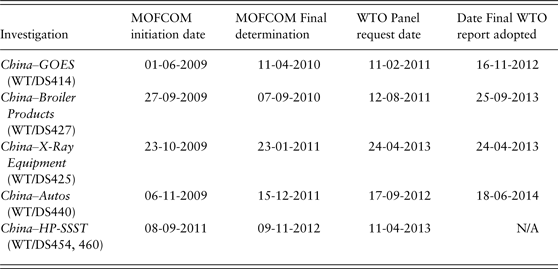
There are several possible reasons for this flurry of cases all involving (many of) the same issues. One possible explanation is that China is guilty of nothing more than being an active AD/CVD user who fell short on a set of procedures during a fairly narrow window of time. As evidence, consider Table 1 where we report key dates in MOFCOM's original investigations and in the associated WTO disputes. Four of the five investigations were initiated before the US even requested a WTO Panel on these issues. Moreover, MOFCOM made its final determination in all five investigations before the WTO final report had been adopted in any of these disputes. Thus, MOFCOM might argue that it simply did not understand what its obligations were until after all five investigations were concluded. Now that the WTO has ruled on these issues, MOFCOM will have to revise its procedures. Whether MOFCOM revises its procedures in a timely and WTO-consistent manner will enlighten us as to whether this benign description holds water.
Chinese AD/CVD investigations with recurring issues

A second possible explanation (somewhat related to the first) is that China is a ‘new’ AD user and MOFCOM bureaucrats are still learning how to implement its statute in a WTO-consistent fashion. Like many new developing country users, China needs to learn what is required to satisfy WTO requirements and often this learning is of the ‘learning by doing’ variety. Weak analysis of price effects and causality characterizes the practice of many developing countries.Footnote 77
A challenge to this interpretation is the fact that China reported its first AD investigation in 1998 and had initiated more than 170 investigations by 2009. This intensive usage made China the sixth most active AD user over that time period. Given the large number of investigations it might be surprising that China had not yet learnt how to do pricing analysis by mid-2009. It is obvious from this series of disputes – all involving the same issues – that China had not learnt what is expected in terms of price effects and causality. If MOFCOM bureaucrats are learning, they are apparently learning very, very slowly!
Given that China is a slow learner it is worth asking why China's inconsistent practices were not challenged in one (or more) of the 170+ AD cases between 1998 and 2009. We believe the answer largely lies with the countries targeted by China's AD protection. In general, (1) most developing countries generally target their AD use toward other developing countries (Bown, Reference Bown2013; Bown and Reynolds, Reference Bown and Reynolds2015) and (2) developing countries generally do not bring WTO disputes (Bown, Reference Bown2009).Footnote 78 These patterns hold true for China. Between 1998 and 2998, China filed about half its cases against its Asian competitors (Japan, Korea, and Taiwan), none of whom are aggressive users of the WTO DSU. In addition, about 25% of China's cases were against developing countries. Less than 15% of China's AD cases were against either the EU or US. Further, no country had ever filed a WTO challenge to any Chinese AD action prior to China–GOES. Thus, it appears that the most likely explanation for why poor procedures existed for 15 years is not that China is learning slowly, but rather that China was never informed what areas of its AD and CVD methods were WTO-inconsistent.
A third possible explanation is that China has learned from the recalcitrance of other WTO members in bringing their WTO-inconsistent policies into compliance. Ironically, the US is arguably the leading offender of this type of foot dragging. The US Foreign Sales Corporation was the subject of various WTO disputes from 1999 through 2004. Similarly, the US took six years after the initial WTO finding to repeal the Anti-dumping Act of 1916. Of course, the delays in bringing these policies into compliance pale in comparison to US stubbornness with respect to zeroing. After more than a decade and more than 30 adverse WTO rulings the US continues to zero (Bown and Prusa, Reference Bown, Prusa, Martin and Mattoo2011). If China follows this model of delaying implementation, then we can expect many more WTO disputes involving similar issues.
Shortcomings with MOFCOM's price effects and causation analysis
The ADA specifies that the investigating authority examine the volume of dumped imports, their effect on domestic prices, and the consequent impact of the imports on domestic producers. With respect to price effects, the ADA expects the investigating authority to consider whether there has been significant price undercutting or price depression or suppression. The investigating authority must also evaluate the impact of dumped imports on the domestic industry by examining all relevant economic factors, including factors of domestic origin (e.g., factory shutdowns, rising wages) and those whose origin are in subject and non-subject markets.
From what we can ascertain from the Report, MOFCOM's analysis falls short of what is required by the WTO and hence that the Panel's conclusions are correct. While many of the details about MOFCOM's exact analysis are not reported, the Panel Report does provide a summary of several aspects of MOFCOM's approach and a number of glaring deficiencies were noted.
By way of background, we note that the price effects and causality analysis under the ADA fall well below what economists believe is sufficient to draw conclusions with a high degree of confidence. In the EU and US, for instance, trends and correlations are generally what pass for economic analysis. By contrast, economists would argue that each aspect of the price effects and causality analysis should consider the multitude of contributing factors that are all changing at the same time. It is clear, however, that the economics perspective on analytical requirements go well beyond what the WTO currently requires for AD and CVD determinations.
One serious deficiency involves the product definition used in the analysis. MOFCOM based its pricing analysis on an overly broad product definition. In general, even though an investigation might involve a single ‘product’ (e.g., automobiles), the investigative authority will often base its pricing analysis on a finer product definition. For example, MOFCOM could have requested data on four or five different classifications of automobiles, for example defined by engine size or vehicle weight. This would have allowed the agency to do an ‘apples to apples’ comparison rather than simply combining all types and sizes of automobiles together into a single price index. The issue of properly defining the product for purpose of price effects is sometimes called ‘price comparability’ and is something fairly easy for MOFCOM to incorporate into its procedures. If, for example, subject imports were composed mostly of large cars and domestic production is mostly small cars, one would not be surprised to find a single automobile price index a very poor instrument for determining price effects. It would be much better, for example, if MOFCOM compared subject and domestic trends for small cars and large cars separately. In this investigation, the Panel Reports that MOFCOM knew the product mix differed across domestic and import suppliers and MOFCOM also acknowledged a lack of competitive overlap across these product segments. Nevertheless, MOFCOM failed to do a finer price comparison. It is impossible to imagine how MOFCOM could have expected its approach to pass muster.
Further muddying the analysis was the fact that MOFCOM did not collect its price information in a consistent time period basis. Said differently, the EU and the US generally collect on a quarterly basis prices (often at a narrowly defined product level). MOFCOM mixed annual price data with some quarterly data which makes inference essentially impossible. We cannot conceive of how causality can be established when the authority simply compares one annual price with a second annual price.
Assuming China had collected data using a proper product definition and on a monthly or quarterly basis, even then MOFCOM's trends analysis was problematic. Trends analysis is commonly used by investigating authorities in many jurisdictions. Figure 1 depicts what a trends analysis chart might look like. In the figure, we plot quarterly hypothetical import and domestic price trends for a product under investigation. The investigating authority would likely note that subject import prices are lower than competing domestic prices and that the subject import prices appear to be leading the domestic prices. Formal statistical analysis does not have to be done, but the investigative agency does perform some type of quantitative analysis to justify its finding of price effects and causality, and a ‘factor by factor’ graphical analysis of this sort is not uncommon.
An example of simple trend analysis
By contrast, MOFCOM's analysis fell short of even the relatively informal analysis depicted in Figure 1 on a number of grounds. First, MOFCOM did not properly account for the differences in the level and movement of subject import and domestic prices. In particular, for a significant part of the period of investigation subject import prices and domestic prices were moving in opposite directions (i.e., rather than being positively correlated they were negatively correlated). Figure 2 depicts what such a non-obvious trend might look like. This unexpected difference in price trends, by itself, does not mean MOFCOM could not have found price effects, but MOFCOM did not provide any explanation for how it explained the negative correlation. Ironically, the negative correlation may have easily been caused by a changing mix of products over the period, but because MOFCOM did not collect sufficiently disaggregated data, it could not determine if this was a factor. Moreover, the fact that for much of the period subject import prices were higher than domestic prices could have also been due to product mix issues.
Non-obvious trend analysis
MOFCOM also failed to account for, and explain the impact of, non-subject imports. Because formal statistical methods are eschewed by most investigative authorities the role of non-subject imports is a serious issue for many investigative authorities, not just China. But, in this investigation MOFCOM essentially disregarded the potential role played by non-subject imports. This is particularly a problem in this investigation because non-subject imports were not only much, much larger than subject supply but grew much faster during the period (see Table 2). Germany's share grew from 14% to 45% over the period, and Japan's share grew from 10% to 16%. By contrast, subject imports grew from 2% to 8%. The failure to discuss the difference in the causes for, and effects of, the changing fortunes of the various foreign suppliers allowed the US to successfully make a compelling non-attribution claim.
Share of China import market (passenger cars)
Source: HS codes from Bown (Reference Bown2014). Trade data from ‘UN Comtrade Database’, http://comtrade.un.org/data/.
Finally, we note that MOFCOM failed to discuss the role of domestic factors that could have affected industry profitability. In particular, the US pointed to a 33% increase in labor costs (due to a large decrease in labor productivity) that was not discussed in MOFCOM's determination.
It is our opinion that correcting most of these deficiencies is not an insurmountable task for MOFCOM. While improving its data collection approach will require a change in approach, most of the other problems are issues that MOFCOM can likely address by improving its written determinations and explaining (i) that it considered these factors and (ii) how its conclusions were drawn.
7. Concluding comments
In light of the previous Panel and AB decisions on similar procedural and substantive issues in at least four other recent WTO disputes we do not believe any of the findings in this dispute are surprising or establish an important new WTO Panel/AB view on the issues. To put it bluntly, this is a rather pedestrian dispute. In fact, most of the related disputes contained other issues which were of potentially greater consequence than the procedural and substantive issues in China–Autos (US), e.g., the cost allocation issue in China–Broiler Products or the strategic trade policy aspects of China–X-Ray Equipment. In this sense, this dispute is more akin to a number of the recent zeroing disputes where the WTO was largely confirming the same inconsistent policies, and procedures were still in place.
One aspect of this case worth noting is that this case, much like China–Broiler Products, is a striking example of tit-for-tat trade policy. A timeline of key events is given in Table 3. After six months of deliberation, in September 2009 the US imposed China safeguard duties on passenger vehicle and light truck tires from China. China initiated its investigation into US chicken parts just teb days later and its investigation into US automobiles about five weeks later.
Tit-for-tat trade policies
This timing is no coincidence. The prospect of Chinese AD investigations on US chicken parts and automobile exports were rumored in advance of the US safeguard decision. The products with which China chose to retaliate could not be more different. The US exported more than $700 million of chicken broilers and parts (primarily chicken paws) to China in 2008 and 2009. The US was easily China's largest supplier of chicken parts.
While the US exported a similar dollar value of automobiles in 2008 and 2009, it was not the largest auto supplier to China. As shown in Table 2, the US accounted for about 2% of auto imports in 2008. What is remarkable is the tremendous increase in US auto exports that occurred even though AD/CVD duties were in place. The US exported about $700 million in autos in 2007; by 2010 US auto exports to China had increased to $3.3 billion and by 2013 to $8.5 billion.
Thus, it is our opinion that China AD/CVD duties on US autos were not about imposing huge dollar losses on the US (as was the case in chicken parts), but rather about saber rattling – sending a signal about what important industries of the future could be subject to discretionary protection. The fact that China revoked the tariffs before the WTO Panel had even made its report further supports this view.
From a broader perspective, the ability for China to use a potentially WTO-consistent measure such as AD and CVD for a short period of time (i.e., two to three years) and then repeal the orders with little to no cost poses a serious problem for the WTO system. By design WTO, DSU relief is prospective. This means even if a WTO Panel rules that China must remove its duties, China will have gained in the short run (at least politically), either by punishing a trading partner it is unhappy with or by satisfying the demands of an important domestic industry. The prospective nature of WTO relief makes it almost impossible for the WTO to discourage the type of opportunistic protectionist actions exemplified by this dispute. It may be well be that China is the one responding to politically motivated WTO-inconsistent trade policies (e.g., US tariffs on Chinese automobile tires), nevertheless, the lack of retrospective relief makes ‘short run’ cheating inevitable. Given the pedestrian nature of the specific policies being challenged, we believe the legacy of this dispute will not involve the dispute specifics but will rather serve as a clear example of tit-for-tat trade policy.