Introduction
Ethnographic documentation from throughout the world indicates that stone projectile points were generally designed for hunting big game animals (>40kg) or for use in warfare, and arrow tips intended for these two separate tasks commonly had different designs (Stevens Reference Stevens1870: 564; Mason Reference Mason1894: 24; Ahler Reference Ahler, Hofman and Enloe1992; Cotterell & Kamminga Reference Cotterell and Kamminga1992: 181; Keeley Reference Keeley1996; Christenson Reference Christenson and Knecht1997: 134; Ellis Reference Ellis and Knecht1997; Rea Reference Rea2007: 81; Loendorf Reference Loendorf2012). A common distinction is that tips intended for warfare were designed to detach from projectile shafts, while hunting points were securely attached (Keeley Reference Keeley1996). Hereafter, the terms ‘warfare’ points and ‘hunting’ points are used for convenience; our central premise is, however, that certain point designs were intended for use against people, whereas other types were designed for killing large animals.
Until recently, prehistorians largely approached the analysis of stone projectile points using the assumption that measurable patterns among artefacts reflected differences in sociocultural groups (Mason Reference Mason1894: 655; Whittaker Reference Whittaker1994: 260–68; Waguespack et al. Reference Waguespack, Surovell, Denoyer, Dallow, Savage, Hyneman and Tapster2009: 787). Comparatively little attention has been paid to the functional characteristics of projectile technology and the role that performance plays in morphological variation. Furthermore, with the exception of studies that attempt to replicate prehistoric technology, few carefully controlled experiments have been conducted using stone projectile points (but see Bergman & Newcomer Reference Bergman and Newcomer1983; Shea et al. Reference Shea, Davis and Brown2001, Reference Shea, Brown, Davis and Mathieu2002; Cheshier & Kelly Reference Cheshier and Kelly2006; Hunzicker Reference Hunzicker2008; Waguespack et al. Reference Waguespack, Surovell, Denoyer, Dallow, Savage, Hyneman and Tapster2009; Fauvelle et al. Reference Fauvelle, Smith, Brown and des Lauriers2012; Lipo et al. Reference Lipo, Dunnell and O’Brien2012; Tomka Reference Tomka2013).
This paper presents a case study of the Akimel O’odham (or Pima) projectile data from the Gila River Indian Community, which is located in the Hohokam core area along the middle Gila River in southern Arizona. In contrast to most other regions of the world, the Akimel O’odham continued to employ flaked-stone projectile points until around AD 1880. As a result, extensive oral traditions, ethnographic documentation and ethnohistorical information are available regarding stone-point manufacture and use. These data, which are unavailable for prehistoric contexts where most stone points occur, are employed here to develop expectations that are tested against archaeological data and experimental results. Projectile points are one of the most commonly preserved artefacts at stone age sites worldwide, and if it is possible to identify the differences in design that are associated with intended use, then this will provide an important analytical method for inferring diachronic and synchronic variation in both conflict and subsistence practices for global archaeological contexts.
Ethnohistorical and ethnographic descriptions
The following discussion summarises research that suggests warfare projectile tips from around the world were designed differently to points intended for big game hunting. For example, in a cross-cultural study of over 100 societies, Ellis (Reference Ellis and Knecht1997) found that stone points were almost invariably associated with hunting large animals (>40kg) or warfare, while organic tips were far more commonly employed for small game (<40kg) hunting. He found that “stone points used for warfare could differ in size and shape, and often in the presence or absence of barbs, from those used on large game” (Ellis Reference Ellis and Knecht1997: 45). Similarly, when discussing preindustrial warfare around the world, Keeley (Reference Keeley1996: 52) observed that “[p]oints of war projectiles were commonly weakened or hafted in such a way that when the shaft was extracted, the point or some part of it would remain in the wound”.
The description of North American Plains arrow technology in 1832 given by Catlin (Reference Catlin1975: 109) is an example of a common distinction for warfare and hunting points recorded in the literature:
The one [point type] to be drawn upon an enemy is generally poisoned, with long flukes or barbs. They are designed to hang in the wound after the shaft is withdrawn. The other is used for their game, with the blade firmly fastened to the shaft and the flukes inverted so that it may easily be drawn from the wound and used on a future occasion.
As another example, when summarising North American bows and arrows in general, Stevens (Reference Stevens1870: 564) said the following:
The Indians of the West use two kinds of arrows, the one for hunting and the other for war. The hunting arrow is armed with a leaf-shaped or triangular head, sometimes with a stemmed head, but never with one possessing barbs. The war arrow has invariably a barbed head; this is very slightly attached to the shaft, so that, if the arrow enters the body of the enemy, it cannot be withdrawn without the head being left in the wound.
Projectile technology and conflict among the Akimel O’odham
By the Historic period (c. AD 1500–1900), the Akimel O’odham rarely hunted large animals (Russell Reference Russell1908; Rea Reference Rea1998; Loendorf Reference Loendorf2012: 54–55). They instead primarily pursued locally available small game, and the arrows they used for this purpose lacked stone tips. Arrows designed for use against people, however, had flaked-stone points attached (Bancroft Reference Bancroft1886: 520; Mason Reference Mason1894; Russell Reference Russell1908). Although the nature and intensity of warfare varied substantially over time and geographically, conflict was endemic among American south-west historic populations (Kroeber & Fontana Reference Kroeber and Fontana1986; Shaw Reference Shaw1994: 10–14; LeBlanc Reference LeBlanc1999; Rice Reference Rice, Rice and LeBlanc2001; Lekson Reference Lekson2002; Basso Reference Basso2004; Jacoby Reference Jacoby2008). During the nineteenth century the Akimel O’odham experienced two primary forms of organised violence, which are generally classified as raiding and warfare.
Both Yavapai and Apache groups raided the villages along the middle Gila on a regular basis (Russell Reference Russell1908; Gifford Reference Gifford1936). Although individual attacks were generally minor, this conflict affected Akimel O’odham settlement patterns and led to the abandonment of large areas of former habitation (Russell Reference Russell1908: 201). In response to these raids, the Akimel O’odham organised punitive campaigns (Webb Reference Webb1959: 30). These expeditions usually ended with the death of one or two Akimel O’odham and the destruction of an Apache camp, with “perhaps half a dozen of the enemy killed and a child taken prisoner” (Russell Reference Russell1908: 202). The Akimel O’odham also engaged in larger scale pitched battles, particularly against Yuman groups from the Colorado River, over 250km west of the middle Gila region. These conflicts were generally more formalised and in some instances fixed rules of engagement were agreed upon prior to battles (Kroeber & Fontana Reference Kroeber and Fontana1986). The Akimel O’odham documented details of these engagements in their calendar-stick oral histories, and conflicts were by far the most commonly recorded events (Russell Reference Russell1908: 34–66).
Warfare and big game hunting: performance constraints
Physical differences between people and animals mean that the design of projectile points intended for warfare or hunting vary (Cotterell & Kamminga Reference Cotterell and Kamminga1992: 181; Christenson Reference Christenson and Knecht1997: 134). First, the upright posture of people alters effective shot-placement areas. Second, people can employ defences such as shields; some points were therefore designed to penetrate armour. Third, people are capable of firing projectiles in return. Fourth, the conditions of conflict between people are likely to vary from hunting in ways that affect arrow recovery rates. Fifth, people are considerably more adept than other animals at removing a projectile from their body, either by themselves or with help from others; in order to create a more serious wound, warfare projectiles were designed so that the stone tips readily detached.
The most reliable and rapid way to kill an animal with a projectile is to penetrate both lungs and the heart completely (Stevens Reference Stevens1870: 564). Nearly any wound to the heart will quickly result in death and a puncture to even a single lung may cause incapacitation through suffocation. The internal haemorrhaging caused by lung penetrations also makes strenuous activities such as running difficult or impossible. Furthermore, this area is a larger target than the head or neck, and is encased by less bone. This vital area, however, is still protected by the rib cage, a potentially effective barrier, and the shot is required to pass through or between the ribs. Loosely attached points are more likely to detach when they hit bone, resulting in a shallow and non-life threatening wound on the exterior of the rib cage. As a result, hunting points were designed to stay on arrows.
When attempting to attach a point tightly several problems occur if the stem is wider than the arrow shaft (Christenson Reference Christenson and Knecht1997: 134–35). First, firmly fastening the point is difficult because the binding materials are cut by its sharp edges (Géneste & Maury Reference Géneste, Maury and Knecht1997: 183; Fauvelle et al. Reference Fauvelle, Smith, Brown and des Lauriers2012). Second, the bindings necessarily extend over a larger perpendicular area to the cutting edges of the point, which increases the cross-sectional area and impedes penetration (Christenson Reference Christenson and Knecht1997; Knecht Reference Knecht and Knecht1997: 201–202). Notching is one solution for reducing the width of the stem and facilitating secure hafting of the point (Christenson Reference Christenson and Knecht1997: 135).
For quadruped animals the most effective shot placement is at the animal's side, but the upright posture of people presents a smaller target in profile, complicating the rapid kill shot to the heart and lung. The bone and muscle of the arm may also cover this vital area, whereas it is possible to shoot behind the front leg of animals. People present the largest target in a frontal position. In this stance, however, the dense bone of the sternum protects the heart and narrower gaps exist between the ribs—it is also impossible to penetrate both lungs and the heart with a single projectile.
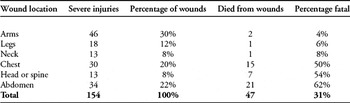
These observations are supported by data collected by US Army surgeons who treated arrow wounds received by unarmoured soldiers (Milner Reference Milner2005). For example, Bill (Reference Bill1862, Reference Bill and Ashhurst1882) provided information regarding the location of injuries and survival rates for 154 men who were severely wounded by Native American arrows (Table 1).
Arrow-wound locations and fatality rates (adapted from Bill Reference Bill and Ashhurst1882: 107).

Although less than one third of arrow wounds were fatal, impacts to the chest, head, spine and abdomen were most dangerous. Injuries to the arms were most common and 42 per cent of all wounds were to the extremities. Half of the chest injuries were fatal, but in 30 per cent of these cases the lungs and heart were not injured; all of these patients survived their wounds. In both cases where the heart was injured, however, the patient died; one instantly and the other within five minutes (Bill Reference Bill1862). Bill (Reference Bill1862: 376) also observed that when people were hit with an arrow it “sometimes goes through the chest and passes out. It would always do so if it were not that it can scarcely miss hitting a bone” These data also show that arrow injuries to the abdomen were most likely to be fatal. Ninety per cent of the instances where the intestines were wounded resulted in death, but this generally took several days or even weeks (Bill Reference Bill1862: 385–86). Bill (Reference Bill1862, Reference Bill and Ashhurst1882) also observed that Native Americans intentionally targeted the abdomen, and arrow points that detached within all wounds were likely to cause death if they were not extracted.
Finally, the circumstances of warfare are expected to have resulted in a lower recovery rate for these projectiles, whereas hunting arrows (with broken points attached) were more commonly retrieved for reuse of the shaft (Rea Reference Rea1998: 74). Even if the warfare arrows were recovered, the points are likely to have detached because they were intentionally loosely secured. In contrast, the bases of side-notched points were more readily retrieved because they were firmly attached to arrows. These points were then removed and discarded at habitation sites, where the artefacts were collected (Loendorf Reference Loendorf2012: 67).
Warfare and big game hunting: summary of expectations
Ethnographic information and performance requirements suggest the following expectations for warfare and hunting point designs: 1) hunting points should generally have rounded tangs, while warfare points should have barbed tangs that resist removal from wounds; 2) when defensive armour is present, as was the case along the middle Gila (Webb Reference Webb1959: 25; Shaw Reference Shaw1994: 35–46), warfare points are expected to have narrower bases than hunting points (Cotterell & Kamminga Reference Cotterell and Kamminga1992: 181); 3) as arrows with broken points attached were recovered for reuse, hunting points are expected to have higher fragmentation rates, while warfare points are anticipated to be whole more often; 4) hunting points were designed to remain firmly attached to projectile shafts and they therefore had characteristics such as side notches that facilitated secure hafting. In contrast, warfare points were designed to detach from arrows, and they are thus expected to lack features such as side notches (see Engelbrecht Reference Engelbrecht2014: 364).
Archaeological data from the middle Gila river
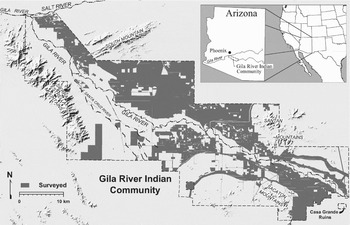
The expectations presented above are tested in the following analyses using data collected by the Gila River Indian Community Cultural Resource Management Program as part of the Pima-Maricopa Irrigation Project. This research includes archaeological survey of nearly 57000ha within the community, where over 1000 projectile points have been collected (Figure 1; Loendorf & Rice Reference Loendorf and Rice2004; Loendorf Reference Loendorf2012, Reference Loendorf2014; Loendorf et al. Reference Loendorf, Fertelmes and Lewis2013).
Pima-Maricopa Irrigation Project survey coverage within the Gila River Indian Community.

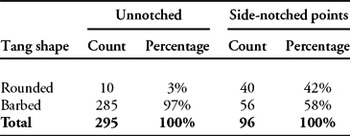
Table 2 summarises tang shapes for side-notched and unnotched points. Ethnographic research suggests that rounded basal corners should be more common on hunting points, whereas barbed (i.e. pointed) tangs should be more frequent on points designed for warfare. As hypothesised, a significant difference exists in basal corner treatment for notched and unnotched points, supporting the expected variation between these designs (Yates-corrected chi-square = 91.8, p< 0.001). Yet the high proportion of side-notched points with barbs suggests that additional factors also conditioned this feature, and the presence of pointed basal corners alone does not necessarily indicate that the point was designed for warfare.
Tang treatment by arrow-point notch design.

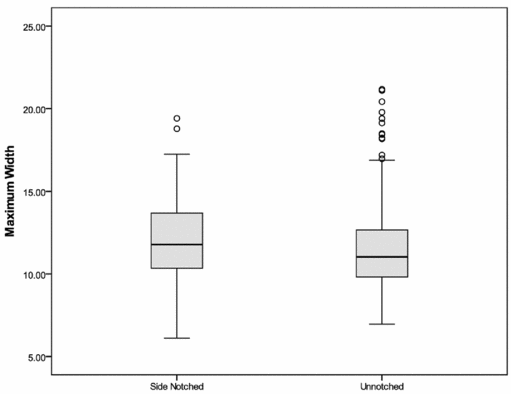
As shielding was employed in the study area, it is expected that warfare points should be narrow types that were intended to pierce these defences. Figure 2 shows box plots of maximum widths for unnotched and side-notched points from the study area. A significant difference exists in the basal widths of these designs as postulated (unpaired t-test: t = 2.51, df = 489, p = 0.01). While the difference in the mean widths is small, these data are for a collection that was made by many people over the course of more than 1000 years, and stochastic variation as well as other factors are expected to have increased the range of variation in this dataset.
Widths for side-notched and unnotched small projectile points.

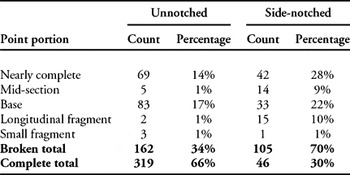
Comparison of breakage patterns for unnotched and side-notched points also suggests that they were made for different tasks (Table 3). Points that lack notches are significantly more likely to be whole than side-notched points (Yates-corrected chi-square = 59.1, p<0.001). This patterning is also consistent with hypothesised differences between hunting and warfare point designs.
Point completeness by projectile-point notch design.

In summary, archaeological data reviewed here support the hypothesis that triangular projectile points with side notches were designed for big game hunting, while unnotched points were made for use against people. The next section summarises the research methods employed in controlled experiments that were undertaken to test the proposed effects of these differences in point design further.
Projectile experiment: research methods
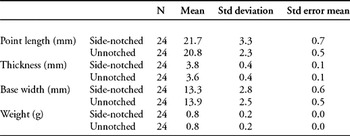
To control as many variations as possible, 36 commercially manufactured wooden arrows were employed. Sixteen arrows were tipped with notched points and sixteen had unnotched points. Stone points were not attached to the remaining four arrows, which were employed as controls. The tips of these arrows were sharpened. In order to control for differences in manufacturing technique, all projectile points were made from Government Mountain obsidian by Daniel Dybowski. The comparatively large nodule size and low fracture toughness of this material facilitated making uniform points. All points approximated the average size of arrow tips in the Pima-Maricopa Irrigation Project survey collection (Figure 3; Loendorf & Rice Reference Loendorf and Rice2004). Forty-eight isosceles triangular points were made for the experiments. Half were randomly chosen and given side notches, while the other half were left unnotched. The experimental points have straight blade margins and straight bases. Although there is minor variance, notched and unnotched points are not statistically significantly different (Table 4).
Metric attributes of experimental points.

Representative side-notched points from the Gila River Indian Community (top row), unnotched Gila River Indian Community points (middle row) and points used in the experiments (bottom row).

All points were hafted as securely as possible by Daniel Dybowski using approximately 500mm of 2mm-wide artificial sinew, and no adhesives were employed. To minimise shot-to-shot variability, all projectiles were fired using a fixed stand that maintained a uniform draw length and point of aim (Figure 4). Different bow designs were used, including a self bow with a 22kg draw weight and a recurve bow with a 19kg draw weight.
Michael Withrow (left) and Daniel Dybowski (right) using the bow bench rest.

The target was composed of 5 layers of 70mm thick polystyrene foam that were covered with 2 layers of 0.15mm thick plastic and an outer layer of 5mm thick foam-core poster board. Targets were placed 2.3m from the bow. The first arrow shot lacked a stone point and this projectile was employed to establish the point of aim. Arrows with notched and unnotched points were then alternately fired until all points detached. To aid in controlling for intra-run variation, approximately every tenth shot was a control arrow. Projectiles were fired into the target media more than 350 times during the experiment.
Stone projectile-point experiment results
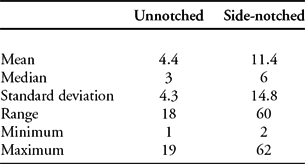
Figure 5 shows box plots of the average number of times arrows were fired before the points detached (Table 5). Points without side notches are significantly less likely to stay attached to arrow shafts than points with notches (unpaired t-test: t = -2.69, df = 56, p = 0.009). These results therefore suggest that points were notched in order to secure them more firmly to projectile shafts. By inference, this indicates that these tips were designed for hunting large animals. At the same time, the large range of variation for side-notched points suggests that additional attachment methods such as the use of adhesives are necessary to ensure firm point attachment.
Shot count before point-detachment summary statistics by tip type.

Side-notched and unnotched point detachment data.

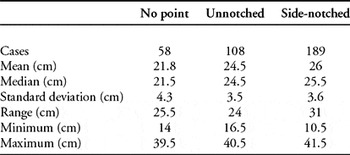
Table 6 summarises penetration results for points with different designs. Figure 6 graphically depicts these data, which show that side-notched points penetrated roughly 6 per cent deeper than unnotched points and that this variation is statistically significant (unpaired t-test: t = -3.53, df = 295, p<0.001). This difference appears to result from the fact that in order to haft unnotched points securely it was necessary to wrap around the blade margins, whereas side notches provide a recessed location where the ligatures were attached. Interestingly, side-notched points penetrated almost 20 per cent deeper on average than arrows without stone points. This is nearly twice the value reported by Waguespack et al. (Reference Waguespack, Surovell, Denoyer, Dallow, Savage, Hyneman and Tapster2009), who tested sharpened tips vs arrows with side-notched points. This variation is unsurprising because point width and penetration depth are inversely related (Pope Reference Pope1923: 43; Loendorf Reference Loendorf2012: 37), and the points employed by Waguespack et al. (Reference Waguespack, Surovell, Denoyer, Dallow, Savage, Hyneman and Tapster2009) had maximum widths of approximately 20mm, whereas points in the current study average 13.6mm.
Penetration depth summary statistics by tip type.

Penetration depth by tip type.

These results show that it is possible to attach unnotched points relatively securely using only ligatures (see also Fauvelle et al. Reference Fauvelle, Smith, Brown and des Lauriers2012); yet this comes at the cost of decreased penetration, and it is still not possible to attach points as firmly as can be accomplished with a side-notched design. These observations are consistent with the hypothesis that unnotched projectile points were designed for use in warfare and as a result were intentionally insecurely attached to projectiles. Features of side-notched points, on the other hand, facilitate secure attachment, a design that is consistent with hunting large animals.
Discussion
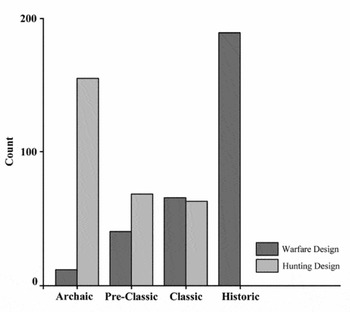
Our archaeological and experimental analyses support expectations for differences in design between flaked-stone points intended for use in warfare vs those made for hunting. Therefore, this research suggests that stone points can be employed as proxy measures of big game hunting and warfare. Figure 7 shows counts of these two designs for Archaic (c. 5000 BC–AD 600), pre-Classic (c. AD 600–1150), Classic (c. AD 1150–1500) and historic (c. AD 1500–1900) stone projectile points from the middle Gila River (Loendorf & Rice Reference Loendorf and Rice2004).
Bar chart of all classified projectile points in the Pima-Maricopa Irrigation Project survey collection by time period and point design.

While the incidence of warfare points tends to increase over time, the count of hunting designs declines. The environment along the middle Gila is not suitable for large game, and increased conflict limited access to hunting locations in higher elevations away from the river (Loendorf Reference Loendorf2012: 97–104). Thus, the decrease in hunting designs and the increase in warfare designs may both result from increased conflict over time. These data therefore suggest a general trend of intensifying violence over time; by the historic period, when written records document severe warfare, points with design features associated with hunting large game animals no longer occur (Loendorf et al. Reference Loendorf, Fertelmes and Lewis2013; Loendorf Reference Loendorf2014).
Conclusions
Stone points are integral parts of weapon systems, but until recently prehistorians have largely focused on the identification of ‘styles’ within collections. As archaeologists have concentrated on cultural aspects, the discussion of performance characteristics has commonly been directed towards the identification of variables (e.g. point-shape characteristics) that differ independently of function. Rather than eliminating factors associated with projectile function, this study has instead identified and analysed tasks that points were designed to perform. Ethnographic research, performance constraints and archaeological data all indicate that flaked-stone points were made either for hunting large game or for killing people. The goals of hunting and warfare differ fundamentally in that the former practice is undertaken to obtain food, while the primary intent of the latter is to kill or wound adversaries. As a result, different constraints exist for these two tasks. Given the considerable effort required to track a wounded animal, as well as the increased chance it will not be recovered for consumption, hunting points were made to kill as rapidly and consistently as possible. In contrast, warfare points were designed to maximise the probability that injury or death resulted, regardless of how long this might take.
This investigation has presented archaeological and experimental evidence that support the hypothesis that flaked-stone points were designed differently for warfare and hunting. This possibility can also be further tested using other lines of evidence, including faunal data and archaeological indicators of conflict (LeBlanc Reference LeBlanc1999; Loendorf Reference Loendorf2012). Distinguishing these types allows investigators to infer changing frequencies in warfare and hunting within communities where stone points were employed. Flaked-stone point data from the middle Gila River suggest that social conflict generally intensified over time, and by the historic period the Akimel O’odham were only producing stone points designed for warfare (Loendorf et al. Reference Loendorf, Fertelmes and Lewis2013; Loendorf Reference Loendorf2014).
Acknowledgements
This research was conducted as part of the Pima-Maricopa Irrigation Project, which is funded by the Department of the Interior, US Bureau of Reclamation, under the Tribal Self-Governance Act of 1994 (Public Law 103–413), for the development of a water-delivery system that uses Central Arizona Project water. This paper would not have been possible without the support of M. Kyle Woodson, Gila River Indian Community Cultural Resource Management Program Director. Michael Withrow, Daniel Dybowski, John Higgins, Brett Coochyouma and Joshua Massey put in the many hours that were necessary to collect the experimental data, and we appreciate their contribution. Lynn Simon volunteered his time to construct the arrow-launching device, and the experiments would not have been possible without him. Comments provided by R. Jane Sliva and John Whittaker provided pivotal insights for clarifying and improving this manuscript.