Negative Dialectics: A Relevant Analytical Tool?
For every positive thing that we accomplish, something negative
comes out of it, and vice versa. (Isaac BrockFootnote 1)
Isaac Brock, frontman of Seattle-based indie-rock act Modest Mouse, has always been fascinated by irreconcilable contradictions. More than any other band on the 21st century indie circuit, Modest Mouse's songs, textures, forms, timbres and dynamics are permeated by paradoxes. The layers of meaning in Brock's poetic lyrics suggest that this stems from his profound and complex worldview. No single solution suffices for him; his musical problems are too numerous and his existential field too vast. The dialogues he stages are, I claim, dialectical in ways that approach the dense negativity that Theodor Adorno thought impossible in popular music.
Why Adorno again? From his 1941 diatribe, it is clear that the philosopher would baulk at a marriage between ‘serious’ categories of reason and ‘standardised’ popular music, but the aisle has since been prepared by many theorists. Richard Middleton (Reference Middleton1990) blew open Adorno's stereotype of bourgeois middle-class listening, making way for a more nuanced understanding of youth subcultures (mods and rockers in particular); Adam Krims carved a Marxist path into urban geography through the ruins of Adornian theory (Krims Reference Krims2001, Reference Krims and Moore2003, leading ultimately to his work on rap); Giles Hooper (Reference Hooper2007) used Habermas and Honneth with Kurt Cobain (Nirvana's ‘Tourettes’ from In Utero) to sweep more debris aside. Such studies attest to a general feeling that Adorno's denigration of ‘popular’ music against ‘serious’ music (Adorno Reference Adorno and Gillespie1941, p. 437) should not bar his other, more open concepts from the sociopolitical study of Western popular music.
Martin Morris has reconceptualised heavy metal, asserting that ‘Adorno's negative dialectics can continue to illuminate the analysis of contemporary popular music’ (Morris Reference Morris2014, p. 4), and it is to negative dialectics that this study turns. Morris's justification historicises Adorno's account of pop, tacitly realising the promised hope of Max Paddison, that Adorno's castigation resulted from a blinkered view of Paul Whiteman's dance-band arrangements of the 1930s (Paddison Reference Paddison1982), suggesting that certain strains of what we now call ‘popular music’ would not necessarily be categorised thus by Adorno (what Morris Reference Morris2014, p. 3 calls ‘mass culture music’).Footnote 2 Adorno despised musics that simply accepted their fate as commodities and appealed to mass culture, and lionised those that played out the social contradictions that brought them into being. These latter (‘serious musics’) participated in a negative dialectic; they laid bare the tensions behind their conception (tensions immanent in the object itself), but refused reconciliation as positive syntheses: ‘the negation of the negation does not result in a positive’ (Adorno Reference Adorno, Livingstone; and Livingstone;2008a, p. 17). This species of negativity celebrates the newly revealed, suppressed, hidden factors that would have been neglected by a positive Hegelian synthesis.
Examining certain ‘popular’ acts that combined radical protest with self-reflective critique, Paddison breaks open Adorno's argument contra pop music but, in a truly negatively dialectical fashion, reinstates his original point of view, while recognising the smaller fragments of the argument that could not be swept away. Paddison (Reference Paddison1982) uses Frank Zappa to exemplify Adorno's ‘authentic music’, as does Ben Watson in his Negative Dialectics of Poodle Play (Reference Watson1996). But 30 years on, we can update the criteria for selecting the acts that Paddison proposed, valid though these undeniably were in 1982–1996. Morris goes as far as heavy metal, but Paddison already isolated artists with ‘experimental’ leanings, such as John Cale, Carla Bley, Henry Cow and the Art Bears (Paddison Reference Paddison1982, p. 215). It strikes me that recent indie artists, even by mere virtue of their aspirations to independence from major record labels, make an ideal research field as they attempt to resist the mass approval that it behoves serious popular music to critique.
Why Modest Mouse?
Judging by the many oblique literary riddles in Modest Mouse's abstruse lyrics,Footnote 3 Isaac Brock is widely read, but he confesses to no direct philosophical influence. The reader may now question the value of taking a fresh new band in a new century for a walk down the well-trodden lane of Adornian dialectics. But in fact the tactics that Modest Mouse offer listeners to negotiate oppositions, swing between poles, connect the disconnected and disconnect the connected prove Brock to be among the most adroit dialecticians in the business, notwithstanding his stylised posturing of suburban trailer-park ignorance. But rather than simply examine a sample of Modest Mouse's most intriguing songs, and take stock of Brock's lyrics and performance mannerisms, I develop a musico-analytical technology bespoke to this group, and in particular to the contradictions that bombard us when listening to Modest Mouse's songs. The technology is inspired by Edward T. Cone's now legendary article, ‘Stravinsky, Progress of a Method’ (Reference Cone1962), which details an approach to musical form that was influential to composers such as Birtwistle and theorists such as Kofi Agawu and Jean-Jacques Nattiez.
The application of ‘classical’ analytical techniques onto ‘pop’ is a contentious one, and this study thus takes a double risk. In ‘The High Analysis of Low Music’, Dai Griffiths bemoans the fact that textbooks on analysis woefully ignored rigorous innovations in popular music theory and this, more than 10 years on, still rings true (Griffiths Reference Griffiths1999).Footnote 4 While he demonstrates that many theoretical advances in the analytical ‘canon’ were pre-empted by popular music studies (Philip Tagg and semiotics for example, Griffiths Reference Griffiths1999, p. 408), he also demonstrates the common sense logic that ‘Pop music is tonal music; and so there is no need not to apply Schenkerian models to pop music’ (Griffiths Reference Griffiths1999, p. 409). I would entirely concur: an opera-goer's top hat can still keep a hippy's long hair dry; it may even ‘catch on’. But the classical analytical method I wish to revisit is not so ipso facto applicable to pop as Schenkerian theory. Cone's tools were specifically designed to unearth the links that connected Stravinsky's blocks of contrasting material; hidden beneath Cone's ‘positivistic’ analytically hermetic façade is a vital dialectic that counters the critique of Stravinsky's work in Adorno's Philosophy of New Music. Cone's technique, in tacitly challenging Adorno's reading of Stravinskian dialectics, can fruitfully challenge his claims about ‘standardisation’ – if not of all pop repertoires, then at least those types of construction that resemble Stravinskian ‘block’ forms. The spirit of this enquiry does not naively make Adorno deconstruct Adorno, however: Negative Dialectics refutes the scientific maxim that a negative multiplied by a negative yields a positive (Adorno Reference Adorno, Livingstone; and Livingstone;2008a, p. 14), and though not producing a Hegelian ‘positive’ here, I attempt to posit new insights into the dialectical heart of an exciting band.
Yet we cannot maintain Cone's Reference Cone1962 hermeticism and be truly negatively dialectical. The object under study must be allowed to connect to its social function; we cannot be phenomenologically reductive for Adorno:
Cognition of the object in its constellation is cognition of the process stored in the object. As a constellation, theoretical thought circles the concept it would like to unseal, hoping that it may fly open like the lock of a wellguarded safe-deposit box: in response, not to a single key or a single number, but to a combination of numbers. (Adorno Reference Adorno and Ashton1973 [1966], p. 163)
Lambert Zuidervaart (Reference Zuidervaart1991, p. 49) cites Adorno's two main negatively dialectical antimonies as (1) the particular vs. the universal, and (2) culture vs. society. And yet Adorno claims that tensions are immanent in the works of art themselves: ‘we are compelled from the vantage point of objective reality to apply the concept of contradiction, not simply between two unrelated objects, but as an immanent contradiction, a contradiction in the object itself’ (Adorno Reference Adorno, Livingstone; and Livingstone;2008a, p. 9). This examination of ‘the object’ was the justification for Morris' analysis of heavy metal (Morris Reference Morris2014, p. 5), but he rightly allows his dialectic to spiral out of the artwork: ‘historically manifested “tension of dialectical contradictions” must be found in the music itself, the practices of participants in the music and in relation to the significantly different historical context of popular music today.’ (Morris Reference Morris2014, p. 4)
Analysis of the work itself must also dialectically engage with and antagonise the world outside. It is in this spirit that I trace tensions played out between oppositions immanent in the individual songs, albums and recurring themes of Modest Mouse, finding either resonance or productive dissonance with cultural readings. My hope is that, rather than point the way forward, my particular ‘one off’ approach may allow others to reappropriate, reinvent, reconceptualise analytical technologies for releasing the philosophical, cultural, political from the music itself, and that these technologies should fully complement (or contradict in the spirit of dialectical negation) rather than replace other, more culturally oriented approaches that can yield entirely different readings.
First, I explore Brock's earliest recordings – some averaging only 30 seconds – that become narrativised critiques of formal structure, that harbour themes of social difference and otherness. Second, after examining Modest Mouse's ‘road music’, I consider these fragments as traumatic reactions to the suburbanisation of American landscapes, played out through innovative formal constructs. Giving voice to these forms, I adopt Cone's graphical techniques, employing also his theories of stratification, interlock and synthesis (this latter being a problematised category). Third, following Adorno's work on Mahler, I find in Modest Mouse a recurring Durchbruch (‘breakthrough’) by which a repressed piece of ‘the real’ breaks through the ego's constituent barriers; ruptures in formal construction often become peripeteia that disrupt and critique to produce new forms. Fourth, I consider the band's biggest commercial success, Good News for People Who Love Bad News (2004), whose hit single ‘Float On’ is a pathologically optimistic message of ‘fetishitic disavowal’;Footnote 5 its success based on the public's ignorance of its self-critical subtext. The ironies at play, and the brutal theatrical staging of trauma beneath these songs, render the perfect negative dialectic. But a pseudo-positive dialectic is enacted in a song that I analyse in significant depth: ‘March into the Sea’, from We Were Dead Before the Ship Even Sank (2007), Brock's magnificent denial of the suburbs and coastal erosion. This song comes closest to a Hegelian dialectic, and yet its abrupt termination at the very moment of synthesis nihilistically sabotages a false reconciliation that threatened to throw us into a sea of unbounded, uncritical, positive ‘pseudo-individualisation’ (Adorno Reference Adorno and Gillespie2002, p. 445). Modest Mouse, like Adorno, are not so frivolous.
The split subject (or Sad Sappy Sucker), suburbanised shopping that ‘sparkles, shimmers and shines’
Raised in communes until he settled into a trailer park in Issaquah, Washington at the age of 11, Isaac Brock made his earliest recordings at home, released as the album Sad Sappy Sucker (2001): pure lo-fi bricolage, fragments of which are simply sketches in song. Two underlying themes emerge from this collection of aphoristic gems: (1) an inability to connect opposites, and (2) an immediate sense of travel and driving. Disconnectedness is our first experience in ‘Worms vs Birds’, but ‘Classy Plastic Lumber’ equally offers no bridge between the 37 seconds of ultra-lo-fi monodic mumbling of ‘ba-da-ba-ba-ba-ba’ (culminating in the line ‘You've got a voice so talk to yourself’) and the jubilant, fully orchestrated, strophic pop-anthem that follows.
The next song on Sad Sappy Sucker is even more negative in its dialectics of (mis-)communication: ‘From Point A to Point B’ similarly has two simple halves. The first is a power-chord driven, riff-based strophe that accompanies Brock's inability to move out of the circularity of concepts, as he performs their inability to fix with objects. As Adorno (Reference Adorno, Livingstone; and Livingstone;2008a, p. 7) reminds us, ‘the concept enters into contradiction with the thing to which it refers’, and Brock sings of being ‘so lonely but never alone’Footnote 6 and ‘I'm at my house, but I wish that I was at home’ – each instance actively creating a self-critiquing gulf between two near-synonyms. Whether or not the second half of the song represents ‘Point B’, it is certainly the diametric opposite of the first half: a funereal adagio, interrupted by an ad libitum bandoneón playing independently from Brock's lethargic double-tracked, barely synchronised drawl of ‘only you know how’, with further laments about ‘working on the railroad’ – an elegy to his inability to connect Point A with Point B. This railway metaphor opens up references to the sprawling urbanisation of Brock's beloved landscape. However, we are told that no points exist between A and B, justifying the cyclical nature of the mesmeric chord progression of Point A, and the drone of Point B – a road stretching nowhere.
Yet other Modest Mouse songs resist both teleological and fragmented narrative forms, usually celebrating the ‘drifting’ escapism of life on the road. For me, these ‘road songs’, while not the most formally inspired, lie at the heart of the band's oeuvre. Long-winded and meandering, the interest of these songs lies in their complex chugging grooves, rather than their teleology.Footnote 7 Despite formal aimlessness (what Goldsher [2006, p. 66] calls ‘aimless instrumental drifting’), Brock contextualises these songs as self-performing negations (see also ‘The Fruit that Ate Itself’, or the joke that laughs at itself in ‘Steam Engenius’). ‘Interstate 8’ from Interstate 8 (1996) sets the scene: ‘I'm driving ‘round here like a figure 8; I'm going nowhere but I'm guaranteed to be late.’ Strophic, but only subtly so, its angrier chorus barely interrupts the monotonous (although distinctively novel) groove (see Example 1). The line, ‘I drove around for hours / I drove around for days / I drove around for months and years and never went no place’, is hardly inspiring; nor is the rap-like melody that merely circles the pitch ‘axially’ (Meyer Reference Meyer1973, pp. 183–91; Moore Reference Moore2012, p. 97); nor are the rhythm guitarist's chugging palm-mutes. But the words and music fully reflect each other as in the 1996 single, ‘A Life of Arctic Sounds’, which parodies itself with the ludicrously tedious lyric:
100 miles is a long drive inside a car
200 miles is a long drive inside a car
300 miles is a long drive inside a car
[…]
900 miles is a long, long, long, long ways in a car
1000 miles is a long drive inside a car
The ‘narrative’ ends with comic appeal: ‘1100 miles is too far inside a car’.Footnote 8 Self-reflexive negation is terminal.Footnote 9 These songs are distilled moments, with only occasional jolts to the simplistic surface. Fragments as minimal as the 30-second phone messages of Sad Sappy Sucker expand to 12 minutes in Interstate 8 without obvious development, but in the broader context of Modest Mouse's oeuvre they are a springboard for the band to say what they really want to say.Footnote 10
‘Interstate 8’ from Interstate 8.

Brock seems to trap himself in a double-bind in which the road symbolises the escape from the suburbs, but according to recent urban geographers, construction of the interstate highway in the 1940s was the main catalyst for the suburbanisation that so offended the band. The road is Modest Mouse's home but it leaves behind the ‘Frankenstein’ suburb it created;Footnote 11 the subject and object become inverted. Tension is inherent within the object itself, but changes place with the subject outside. Their obsession with the interstate highway partly explains the elasticated sense of time in the road songs: because of flexibility and denial of public transport timetables, highways ‘constrain the “users” of cars to live their lives in particular spatially stretched and time-compressed ways’ (Sheller and Urry Reference Sheller and Urry2000, p. 744). Brock soon became quite specific about the embodiment of both road-time and suburb-time in his more developed music on both This Is a Long Drive for Someone with Nothing to Think About (1996) and The Lonesome Crowded West.
If it was not obvious from Brock's lyrics of the late 1990s, a 2012 Pitchfork documentary on Lonesome Crowded West proved the entire band to be virulently opposed to the urban sprawl that was strangling the life out of their beloved country. The paving of the American landscape that led to the erection of shopping malls (Jackson Reference Jackson1987) particularly offended Brock, who describes Issaquah as being ‘mall-fucked … Front row seat to watching forests disappear and the urban sprawl begin’ (Pitchfork 2013). Drummer Jeremiah Green similarly recalls, ‘I lived in the middle of a shopping mall basically with my mom and my brother’ (Pitchfork 2013). Brock sardonically calls for moderation: ‘I like buying shit, but when it gets to the point when you're crippling and fucking up this amazing chunk of property that we're living in – I mean, it's a nice property; rent should be higher’ (Goldsher Reference Goldsher2006, p. 74).
As monuments to capitalism, shopping malls have featured in many of Brock's songs; two in particular, ‘Novocain Stain’ and ‘Classy Plastic Lumber’ from This Is a Long Drive, overtly bemoan suburbanisation, a complaint with even deeper significance for the songs' formal construction. ‘Novocain Stain’ is a triptych, similar to ‘Classy Plastic Lumber’ in its drift from monodic rambling to anthemic jubilance, but a synthetic transitional stage now bridges the polarities with careful channelling of energy towards the third section. With a reflective vocal monody, accompanied by clean, sparse power chords and subtle tom-toms, Brock wistfully tries to recollect the land before media corruption and urban sprawl: ‘If I can work out how it was before, then I'll tell you.’ The entrance of the drums and bass signals the shift to section B with a key change from D to G major. Brock now leaves the symbolic order, attempting to regain his memory by appealing only to physical senses: ‘Remember through sounds; Remember through smells; Remember through colours. Remember through towns.’ As the song becomes euphoric, some awkwardly direct lyrics break through: ‘Interchange causes a mall, and crowded chain rest'rants. More housing developments go up, named after the things they replace. So welcome to minnow brook, and welcome to shady space. No I don't like this change of pace.’ Ironically, the symbolic world of urban construction (names of spaces) is the key to remembering the destroyed natural environment, creating another negative double-bind.
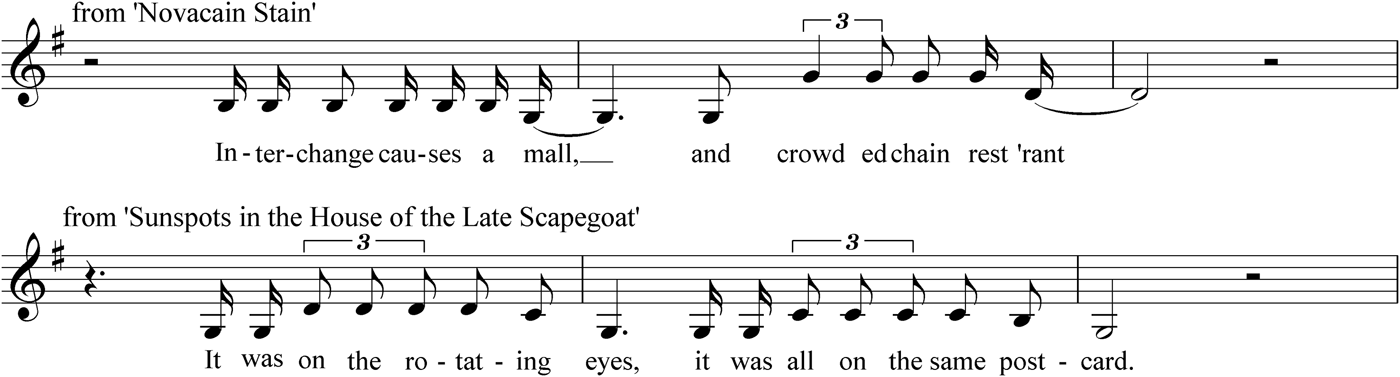
The jubilant melody of ‘Novocain Stain’ is ‘parodied’ in a song released the following year, ‘Sunspots in the House of the Late Scapegoat’ (1997) – a song that Goldsher (Reference Goldsher2006, p. 67) calls ‘a throwaway muse on one of Isaac's favourite subjects, the mallisation of the Northeast and/or America’. It similarly loops a G major guitar riff, while Brock lists his woes, sharing ‘Novocain Stain's’ ‘verbal space’ (Griffiths Reference Griffiths, Dalmonte and Baroni1992) (see Example 2). Here, the teleology missing from the road songs is built into the lyrics, with an anaphora that could have opened a Dickens novel:
It was on the rotating eyes; It was all on the same postcard;
It was all on the same damn shirt, said to sleep in the same Sear's camp house;
It was all in the great state parks; It was all on the same Greyhound.
Only at the anaphora's end does Brock reveal the definition of ‘It’. Typically, the root of this section of intensified rhetoric is a crude shopping mall: ‘It was all so many miles beneath the dirty brown dirt, twenty miles down the islands: the biggest mall on earth.’ But the unusual aspect of ‘Novocain Stain’ is that a trite form of rapturous music repeats the classic Modest Mouse ‘lament bass’ (which Goldsher [2006] terms IDP – ‘Isaac's Drop Progression’) now an upbeat passacaglia with improvised guitar solo (Goldsher's ‘wankage’) for almost three minutes, without any particular telos – it becomes a road song.Footnote 12
Comparison of verbal space of ‘Novocain Stain’ and ‘House of the Late Scapegoat’.
Both the words and music may be hackneyed and unsophisticated in construction, but their simplicities are different and their contradictory relationship invites deep introspection. Simplicity in Modest Mouse is always itself drawn into an antagonism with a complex framing. Why jubilant music to accompany the lamentation of urban sprawl? Why a joyous anthem when Brock explicitly objects to the tempo change? Does the music then represent past wholeness? Or is this the eternal repetition of the clichéd Freudian ‘death drive’ (where the mind gets stuck in a groove, focusing on negative thoughts in a futile attempt to synthesise them)? Is this then another Freud–Adorno correspondence?Footnote 13 Is the euphoria the contentment of a ‘pseudo-individualised’ public duped by capitalism, a joy that the lyrics scorn? The negative dialectic here is that the blocks of musical negativity and the words do not coincide in any conclusive way; they antagonise rather than synthesise. An actively synthesising listening subject is driven into a corner without any hope of mediated truth.
A more subtle problem is posed in ‘Beachside Property’: a song about coastal erosion on one level, it becomes an indictment of moral erosion on another – the ocean starts to swallow the towns because the earth is tired of mistreatment under capitalism – but with mixed messages that resist easy interpretation. The song's form follows the words closely, and inherits its ambiguous dialectic, with three starkly disjointed sections (see Figure 1).
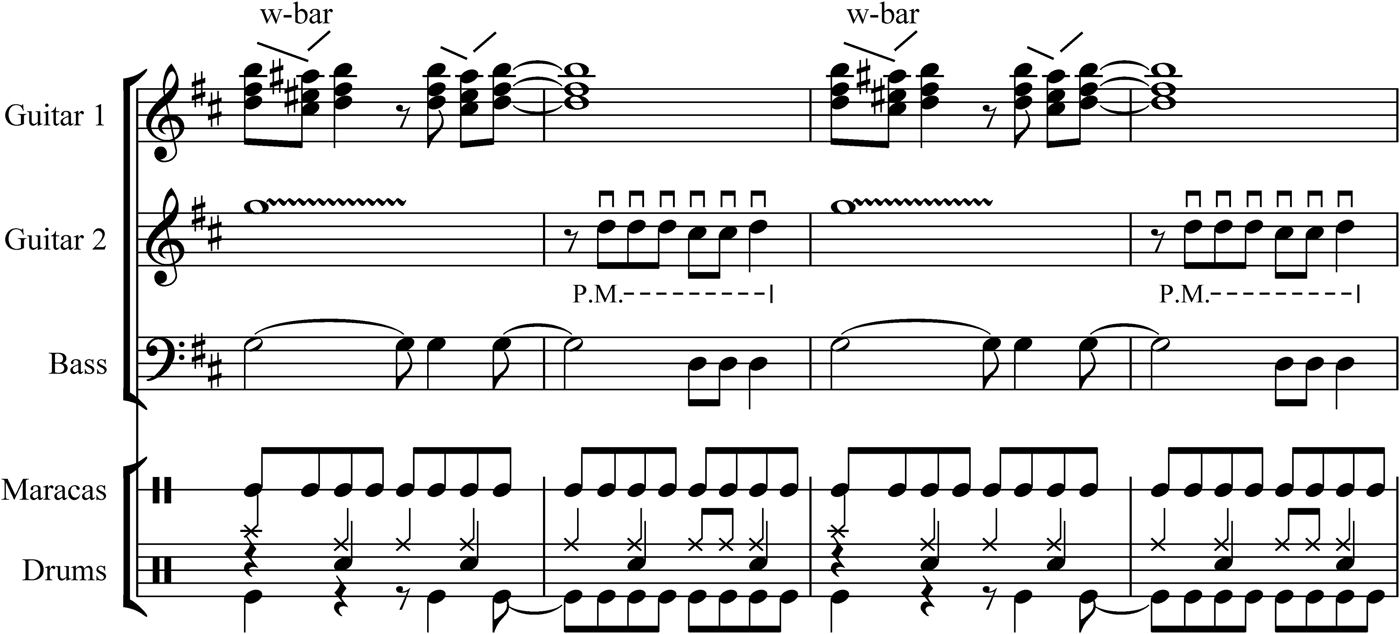
1. Bars 1–44: a two-bar riff alternating E♭ with B♭ chords, bound by a descending pattern (see Example 3).
2. Bars 45–85: a bass-driven sequence of ambiguous G major/E minor tonality, whose initial Em7 bass riff clashes with the preceding E♭ pattern, marking a new beginning. This coincides with the drift of the coastal erosion from the particular (the beach) to more general physical erosion (‘I got wood legs and bow legs and no legs at all … I got poor eyes and sore eyes and no eyes at all’).
3. Bars 97–198, the gently rocking mise en scène, the focal point: begins in C major, punctuated on its repeat by heavy guitar and meandering pentatonic guitar improvisation. This fizzles out.
Only Brock's unassailable rage connects the disparate sections; his menacing roar on the first beat of each is always either explicitly vocal or carefully woven into the instrumental fabric. In section A, gigantic screams enunciate ‘wow’, ‘town’, ‘ground’ and ‘plan’. Brock loosely hits the upper fifth of this E♭ triad here, but interrupts the more lyrical section B twice with shouts of ‘damn’. In turn this is replaced by a distorted guitar proxy, the rage introjecting from verbal to non-verbal. Section C frames the mis-en-scène – the words pinned on the forehead of God, ‘signed and sealed by the saints who sang this song’ – that is projected purposefully through a rising whole-tone triadic progression, remembering Ringo's introduction as ‘Billy Shears’ leading into ‘With a Little Help from My Friends’ (C-D-E in Sgt. Pepper; F-G-A here).
Plan of ‘Beach Side Property’
Riff from ‘Beach Side Property’ from Long Drive.
Emerging from the expectant hush, the song-within-a-song celebrates objects that cause their own destruction. The idea is Adornian and dialectical, of course, his object containing already its antithesis, its own undoing. ‘We're going union like they say. We'll buy the congregation then one day you'll find us sitting in your chair with big ideas of stocks and shares.’ The message is alien to God (pinned to his forehead and sealed) but contains warning of God's own destruction through his creation of capitalism. In section C, rage is twofold. First, the guitar's stacked fourths are non-desiring, non-teleological, with Hendrixesque ‘bite’, reminiscent of ‘Foxy Lady’ in rhythmic articulation (see Example 4, bar 2). Second, guitar pitch-bends follow the melodic line but distort the frequency at metrically equivalent moments to the earlier shouts. The guitar thus translates Brock's trademark double-track with ‘Pavementesque’ wobbly intonation. Pitch-bending increases dramatically upon repeat, utterly destabilising the whole scenario. The familiar is defamiliarised; the song has undone itself – classic symptoms of the Adornian dialectic.
‘Biting’ Guitar Chords from ‘Beach Side Property’.
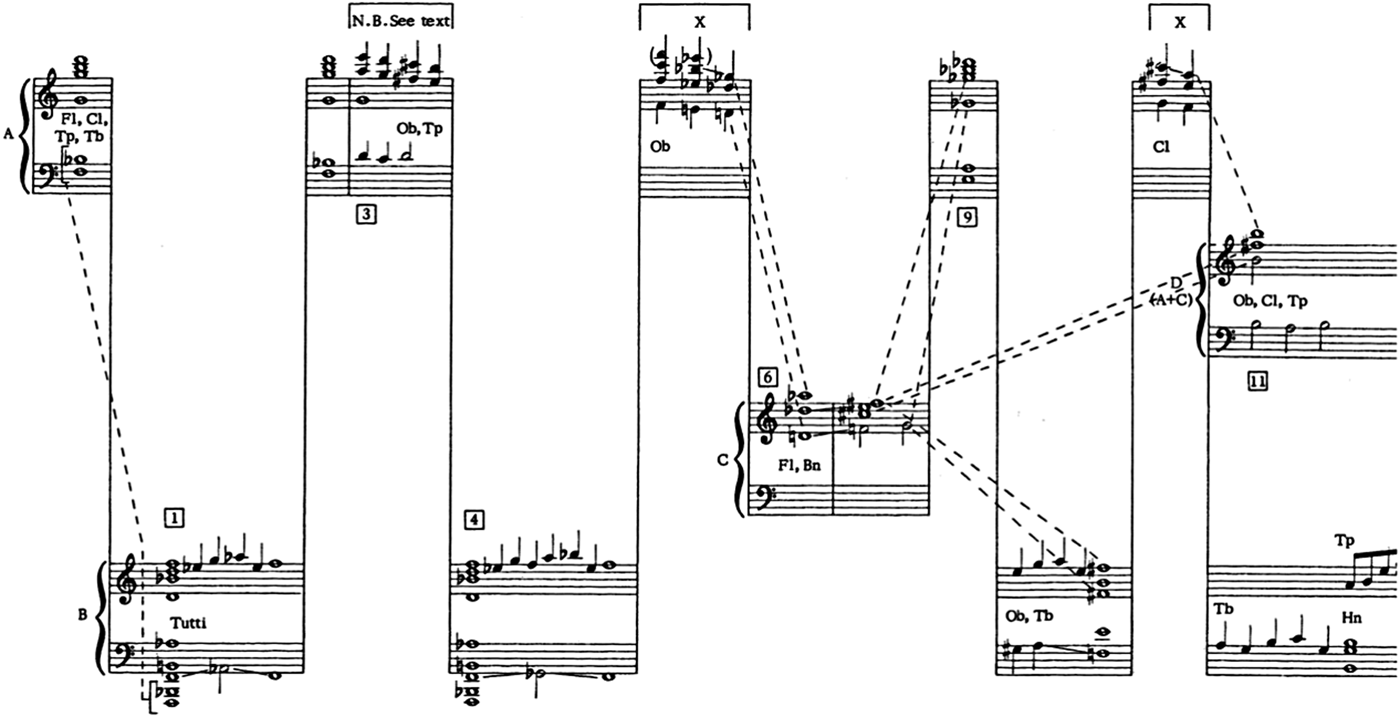
A particular technology is needed to help us scrutinise such unique song forms, one both microscopic and telescopic, to highlight the disjunctures at all levels of song construction. My solution reincarnates Cone's stratification analysis whose methodology, developed to understand better Stravinsky's kaleidoscopic formal juxtapositions, has maintained influence upon music theory up to the recent ‘ordered succession’ of Gretchen Horlacher (Reference Horlacher2001, Reference Horlacher2011).Footnote 14 Cone claims that ‘Stravinsky's textures have been subject to sudden breaks affecting almost every musical dimension: instrumental and registral, rhythmic and dynamic, harmonic and modal, linear and motivic’ (Cone Reference Cone1962, p. 18). Theorising these contrasting units as interacting ‘strata’, he describes three primary processes: stratification (violent contrasts between units), interlock (the ‘horizontal counterpoint’ created by the development or extension of interpolated strata, producing an effect akin to cinematic montage) and synthesis (as strata merge together, typically in phrase liquidation). He replicates the various bridges (the connections between strata) and divergences (when a single stratum diverges), on his graphs in this example from Symphonies of Wind Instruments. The connector between strata A and B demonstrates that, notwithstanding the radically altered harmony, texture, and instrumentation, the bass' f/b♭ pedal remains, and bridges the strata (effecting ‘gentler stratification’: Cone Reference Cone1962, p. 20) (see Figure 2).
Edward's Cone's stratification graph of Stravinsky's Symphonies of Wind Instruments. Cone indicates Bridges (the connections between strata) [1] and Divergences (when a single stratum diverges) [9] with dashed lines.
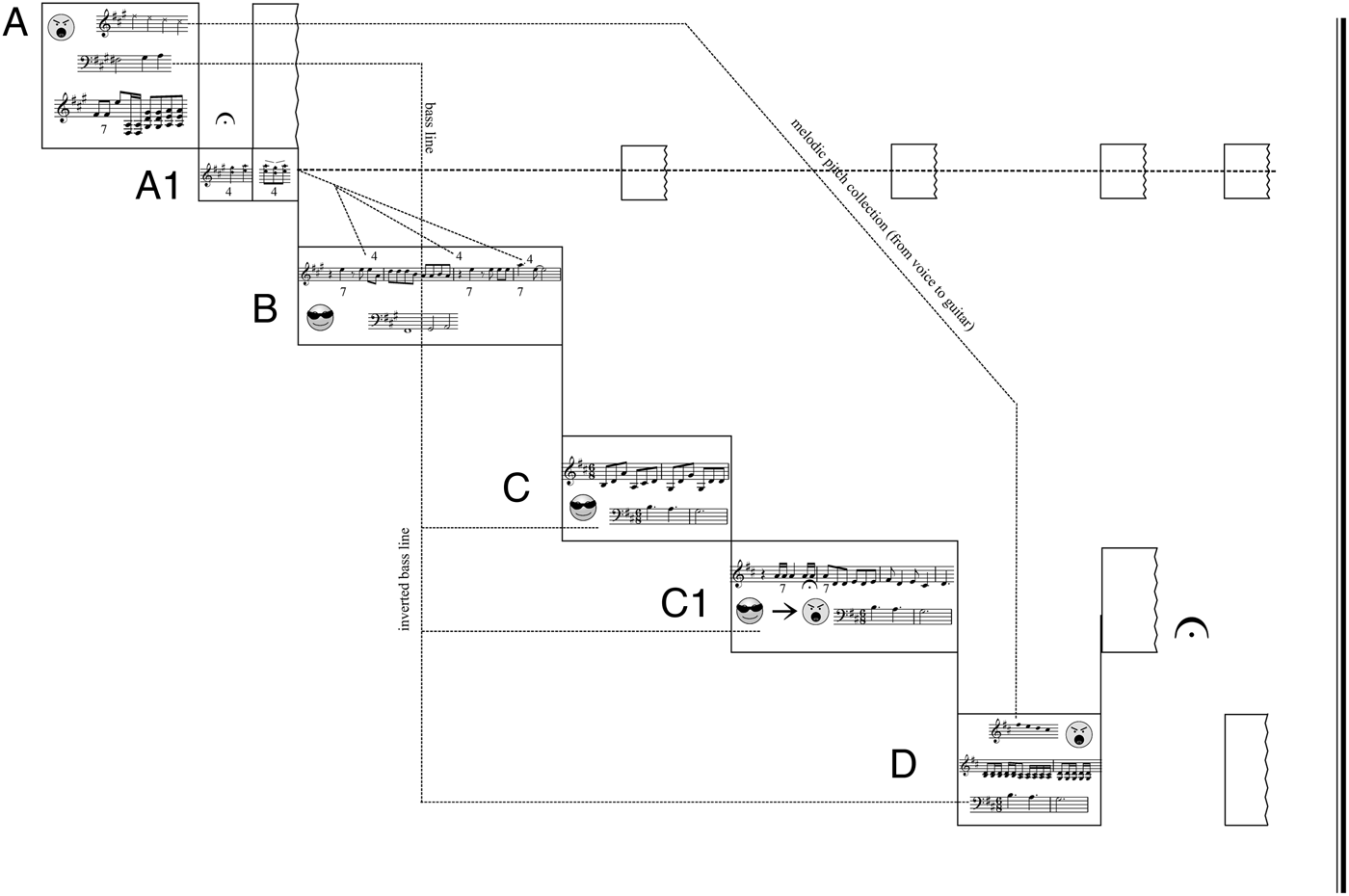
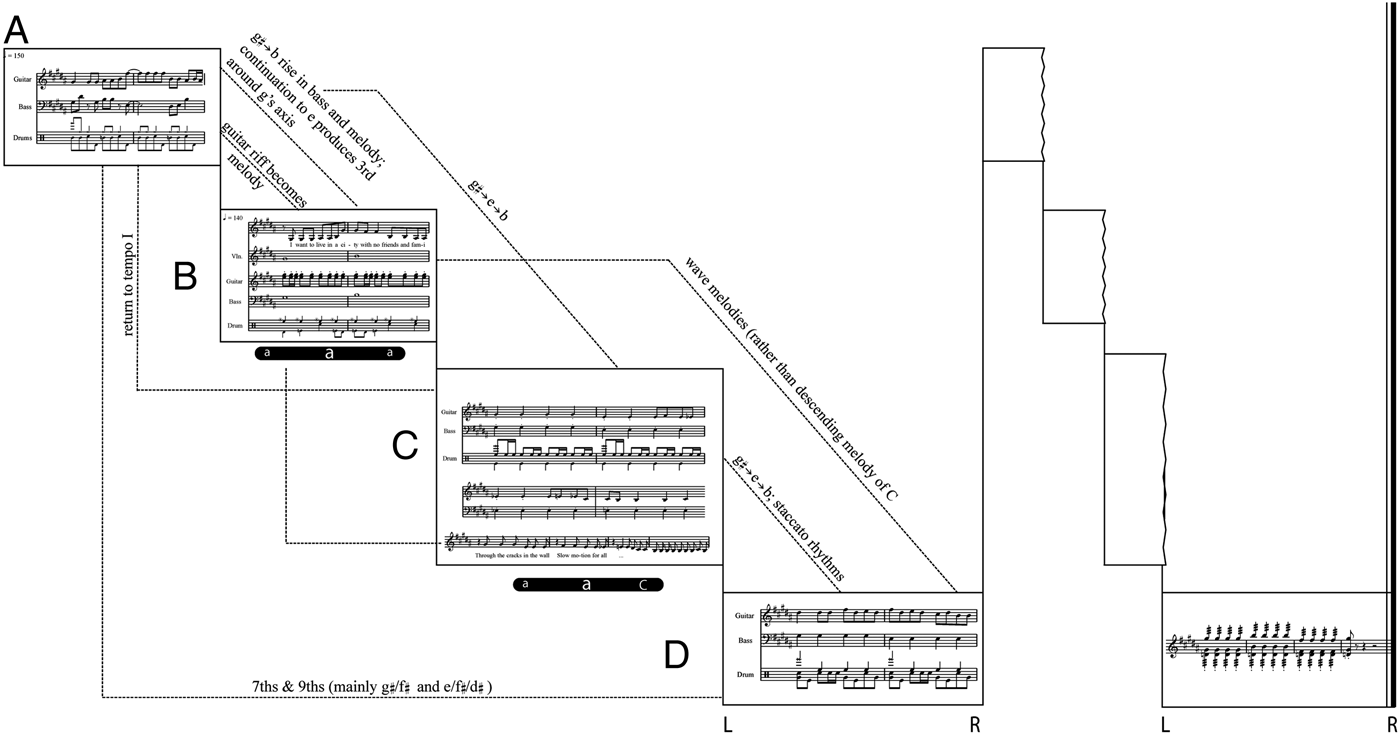
Now, adapting Cone's technology to suit one of Modest Mouse's most disruptive structures, we can model ‘Teeth Like God's Shoeshine’ from Lonesome Crowded West. Alan Goldsher (Reference Goldsher2006, p. 73) dubs the song ‘a lo-fi symphony in three or however many movements’, and Brock himself claimed, ‘I'm a lot more satisfied when it's got a few different songs in the same song. Let's say “Teeth Like God's Shoeshine” for instance – it goes from one thing into the other and whatnot, but it kind of flows into them, I think’ (Goldsher Reference Goldsher2006, p. 72). The 6‘53” chain of fragments (A, B, C, C1, D) eventually settles to alternate two particular segments: C and D. A provisional chart labels the areas chronologically (with time moving from left to right; see Figure 3): strata A and D here share heavy-rock rage with distorted thrashing, hard drumming, and the band's most ‘metalised’ vocals. The vocal rhythmic inflections of area D imitate those of C1 though, and to model these connections, my new graph (Figure 4) reforms the strata outlined above, with bounded boxes containing notation, words and pictures (the emoticons describe Brock's vocals; they will soon be replaced with more precise technology). Connections between discrete elements can now be rendered with some precision (which is lost in Cone's version of Stravinsky, whose complexities are often reduced to a single sonority).
Stratification outline of ‘Teeth Like God's Shoeshine’ from The Lonesome Crowded West.
Stratification graph of ‘Teeth Like God's Shoeshine’ from The Lonesome Crowded West.
Stratum A is fairly heavy: an aggressive guitar riff opens with a dissonant seventh; the stepwise bass moves upwards (f♯-g-a); a parlando melody draws from a descending f♯-e-d-c♯ collection. An exchange of harmonic fourths abruptly, but temporarily, arrests development; I call this wedge A1 because it is tightly nestled between presentations of A. The second stanza is graphically represented by the rectangle with a serrated edge to indicate that the section is broadly speaking a repeat. However, the guitar harmonics are now subject to pitch-bending (with tremolo-arm) throughout. This addition reduplicates precisely Cone's ‘interlock’: the ‘horizontal counterpoint’ that brings a ‘synthesis’ of A and A1. Stratum B uses a clean channel; sevenths dissonantly unite melody with bass; the same bass-line is augmented, as shown by the connecting bridge; the vocals are now calm; the fourths (a/e) at the melody's ending bridge the guitar's former fourth harmonics. Out of the haze appears stratum C, now in a lullabyesque 6/8. The bass now descends b-a-g (an inversion of the former f♯-g-a rise); the pitch-bends and harmonics refer to A1 (these harmonics and fourths occur towards the ends of sections, and usually act as an intensification device, such as the raging harmonic/tremolo riffs at the piece's close, as shown by the long dashed line). This morphs into C1, and this anthemic section (which equally revels in sevenths and ninths) merges in turn into stratum D, with distorted guitars. While Brock borrows the melody from C1 initially, the heavy guitars unite with the melody of stratum A in their f♯-e-d-c♯ descent. Thus the paradigms A and D not only share the same heavy rage, but also the vocal skeleton, passed from stratum A's melody to the heavy guitar octave riff.
The ‘emotions’ in Brock's voice(s) begin with rage in stratum A, a kind of suppressed passive-aggression in B and C, while sections D and C register the progression from one to the other. From this graph we can see that Modest Mouse digress more readily than they synthesise: A becomes B, becomes C, becomes D. C merges into D by becoming C1: a stream of consciousness perhaps, or Brock's ‘flowing from one into the other’. Towards the song's terminus, however, C and D are reprised in interlocking alternation as total contrasts, with their connecting link (C1) removed. Stratum C reaches a natural cadence before a reprise of D violently erupts, lasting for two further minutes: the song ends with a resistance towards synthesis. In fact Modest Mouse's chain of largely dissimilar elements generally eschews any synthetic procedure, and the connections found through ex post facto analysis, powerfully generative though they may be, are certainly less ‘on display’ than the more ostentatiously performing kaleidoscopic differences that mark the failure of the synthesis stage – a negative dialectic.
The lyrics may comprise broken images, but Brock reveals some clues to the song's ‘meaning’. The most obvious theme from the outset is his claustrophobia as he traps himself between ‘the top of the ocean’ and ‘the bottom of the sky’: ‘Goddamn, well I get claustrophobic, Goddamn.’ But the main clue to the song's ideology are the lines:
Here's the man with the teeth like God's shoeshine, he sparkles, shimmers, shines.
Let's all have another Orange Julius – thick syrup, standing in line.
The malls are the soon to be ghost towns;
So long, farewell, Goodbye.
Brock's hatred of ‘the man’ and ‘the malls’ – synecdochical of consumer culture, as is Orange Julius (a particularly sugary drink served in malls) – comes across with his passive-aggressive vocal tone as well as the gravitas of growing instrumental intensity in C1's debut. The relaxation in its second appearance has an opposite effect, however. The accumulation of energy had offered hope of synthesis between the raged voice-guitar and the sensibilities of the calm and clean guitar – between the individual free subject and his regulated place within capitalist society. However, we soon become resigned to the fragmented sentiments of the lyrics and the disjointed music, leading to pure rage at the failed dialectic in section D, without the guiding force of the voice. The dialectic may be a negative one but at least it flags up the correspondences between ‘the music’ and ‘the society’ that it is putatively railing against. Like Adorno's negative dialectics, the process and result (which are synonymous) are worth the effort.
Durchbruch from Outer Space
Apropos of the band's formal structures, one of Adorno's most fertile notions is that of Durchbruch, emerging from his study of Gustav Mahler. Translated as ‘breakthrough’, Adorno describes a passage in the scherzo of Mahler's Fourth Symphony as a violent ‘influx of reality’ (Adorno Reference Adorno and Jephcott1992, p. 10); Michael Spitzer draws attention to the visceral follow up, ‘of blood’ (Spitzer Reference Spitzer2006, pp. 21). Although doubtless an opportunistic opening gambit, we might well use the simplistic song from This Is a Long Drive, entitled simply ‘Breakthrough’, which opens with nonsense worthy of Lewis Carroll:
I got one, two, three, four, five, six, six, six, running round the neighbourhood pejorative ‘jinx’.
I said, ‘the groom's down on me ‘cause he ate the rice’; it was well intentioned but bad advice.
Hell yeah, yeah, yeah, yeah.
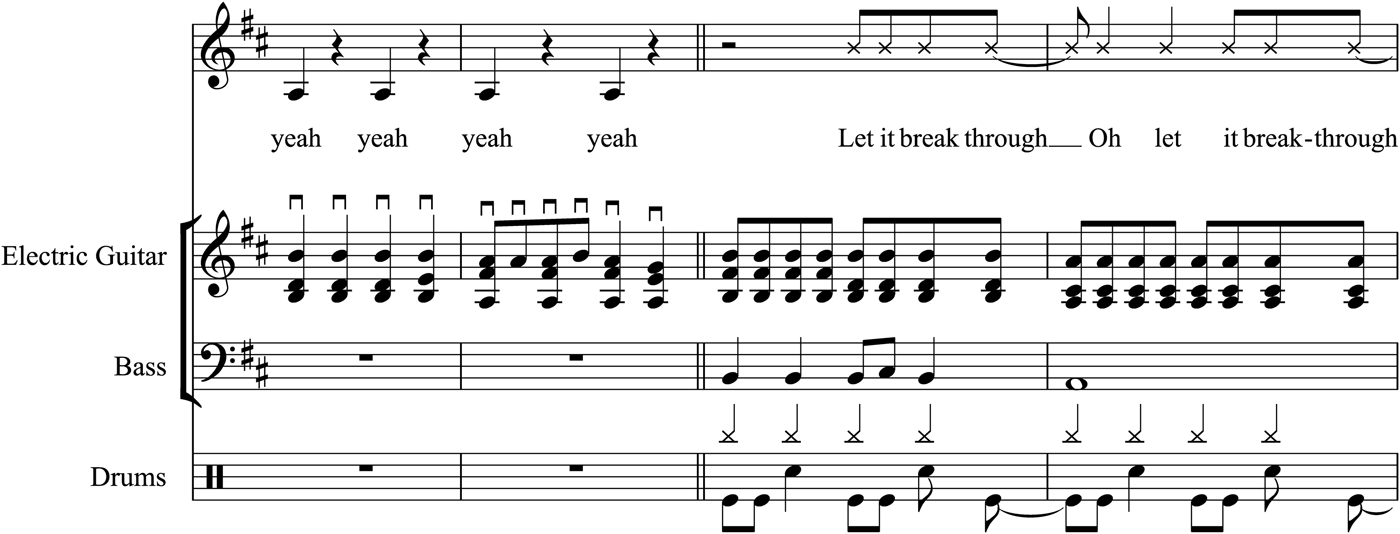
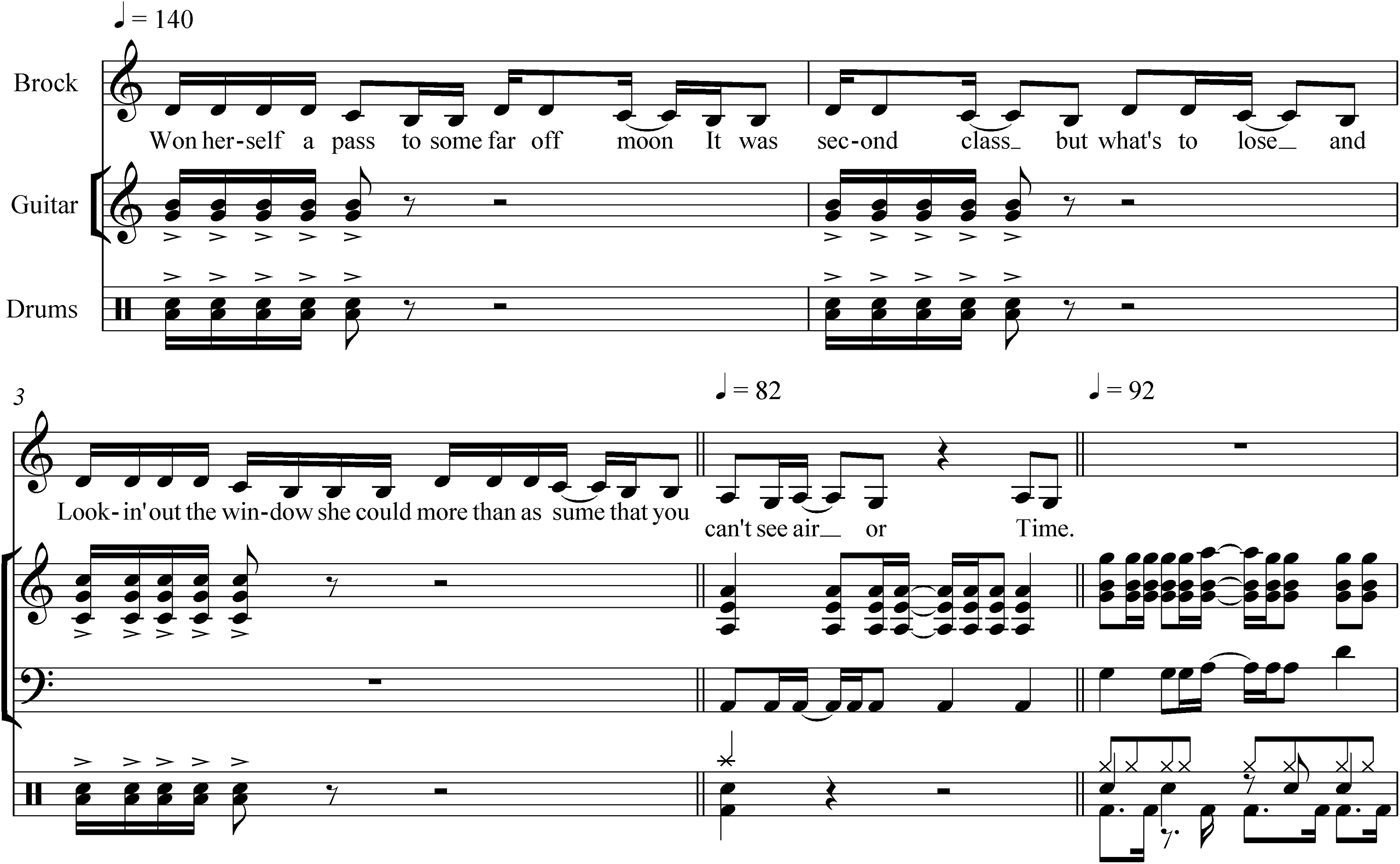
The guitar accompaniment is a simple, palm-muted, power-chord riff, and on the injunction ‘Let it breakthrough’ there is a forceful influx of Pixiesesque loudness (see Example 5). Of course, this breakthrough is obviously cruder than Mahler's carefully constructed eruptions, which for Adorno occur mainly at the climactic points of the First and Fifth Symphonies (Adorno Reference Adorno and Jephcott1992, p. 41). Interestingly, Adorno also cites the finale of the First, whose brass chorale ruptures the sonata form: ‘the fanfare of the breakthrough takes on the musical form of a chorale, no longer as alien territory but as thematically mediated to the whole’ (Adorno Reference Adorno and Jephcott1992, p. 11), but James Buhler (Reference Buhler1996) finds two ‘interlocking’ sonata forms here: there is the sonata-form proper in F minor vs. the D major ‘breakthrough’ with its own sonata-form agenda. Buhler's analysis intersects our reading of Modest Mouse in two ways. First, it shows that reality's breakthrough is not necessarily a purely visceral one (i.e. of blood), but is fully symbolic (a brass chorale engages extroversive meanings and contains its own carefully regulated form). Adorno drew on Freud's notion of hysteria and ‘the return of the repressed’, where a moment of hidden reality permeates the symbolic construction of day-to-day existence, but this reality itself is always condemned to symbolic articulation. We become a paradox that Lacan calls a ‘split subject’ – split between the Real and its Symbolic articulation. Modest Mouse's breakthrough may well enact this, their paradox being that the Durchbruch is a fully constituted song rather than a shocking, sublime Augenblick. The song insists that we return to basic sensory experience: ‘open the curtains and let in some atmosphere.’ Upon this command, the band become more focused and attempt to break through even the initial level of reality into some deeper form of reality, as verse after verse (Figure 5 strata A/A1), and chorus after chorus (stratum B) become more intense (the contrapuntal interlock denoted by arrows). The intensification process found by examining stratification and interlock elevates the form to something suppler than a simple verse-chorus alternation. Second, that breakthrough presents a persistent antagonism to an otherwise teleologically narrativised form, and acts dialectically to critique that form from beneath.
‘Breakthrough’ from Long Drive.
Stratification outline of ‘Breakthrough’ from Long Drive.
According to Buhler, Mahler offers no solution to the problem, refusing to draw antinomies into reconciliation. So too do Modest Mouse. After the A section, the A1 reinvention (bars 25–40) uses full drum kit and heavy guitars as if the breakthrough ‘chorus’ (B) has now flooded the ‘verse’ (A). B itself is palm-muted like A with the same power-chord progression (b → a → d → g that runs throughout the song). On the second chorus, guitar improvisations complete what the vocals temporarily leave unfinished. This significant gesture affirms that the breakthrough is less about the vocals that say ‘breakthrough’ than the guitar that does break through. The third chorus clinches this, when the voice disappears altogether and leads to a guitar solo that extends the accompanimental patterns by small increments into a minimalist solo. Modest Mouse give us the fundamentally Lacanian message that language castrates us, and that the dream of the breakthrough is to return to the place before linguistic pollution (as in ‘a language is the liquid that we're all dissolved in; good for solving problems, after it creates a problem’ from ‘Blame It on the Tetons’).Footnote 15 The particular guitar melody that crystallises this semi-improvised (pentatonic) pattern will serve 10 years later as the ‘breakthrough’ outro of ‘Parting of the Sensory’ (We Were Dead Before the Ship Even Sank, 2007). After the song's lyrical tone has failed to persuade, the folk violin supports a new vocal Durchbruch with words of harsh reality: ‘someday you will die somehow and something's gonna steal your carbon.’ This, if not the Lacanian real itself, issues a stark reminder of it (see Figure 5). And yet the message of ‘Breakthrough’ is that, once we have invited this influx of the real, the signifier is forever changed; the subject is forever split.
Casting our gaze slightly adrift, we might focus on The Moon and Antarctica (2001), Modest Mouse's 20th-century answer to Schubert's Winterreise, the ‘concept album’ (Thompsen Reference Thompsen2000) of the alienated individual searching for a home in the universe, setting out on a journey away from ‘this cold, cold part of the world’. The protagonist of ‘Different City’, like that of Schubert's ‘Rückblick’, is desperate to leave town and looks back only through fantasy: ‘I want to live in a different city, with no friends or family; I want to look out the window of my colour TV.’ He wants everyday reality to remain outside, allowing the actual material real to erupt within, and is prepared to indulge in fantasy until it does. The diagram in Figure 6 shows the song's three divergences. Its whole structure repeats verbatim, intensified only by distorted guitar power-chord tremolandi that force their way through the upper texture to close on a tritone (g♯/d). The relatively simple song brings two points home: (1) Brock's array of voices needs integrating into our analysis, and (2) outer space and the unknown are now the album's principal ‘breakthroughs’, making Modest Mouse's ruptures characteristic and stylistic – if perhaps more commercialised – at the turn of the millennium.
Stratification graph of ‘Different City’ from The Moon & Antarctica.
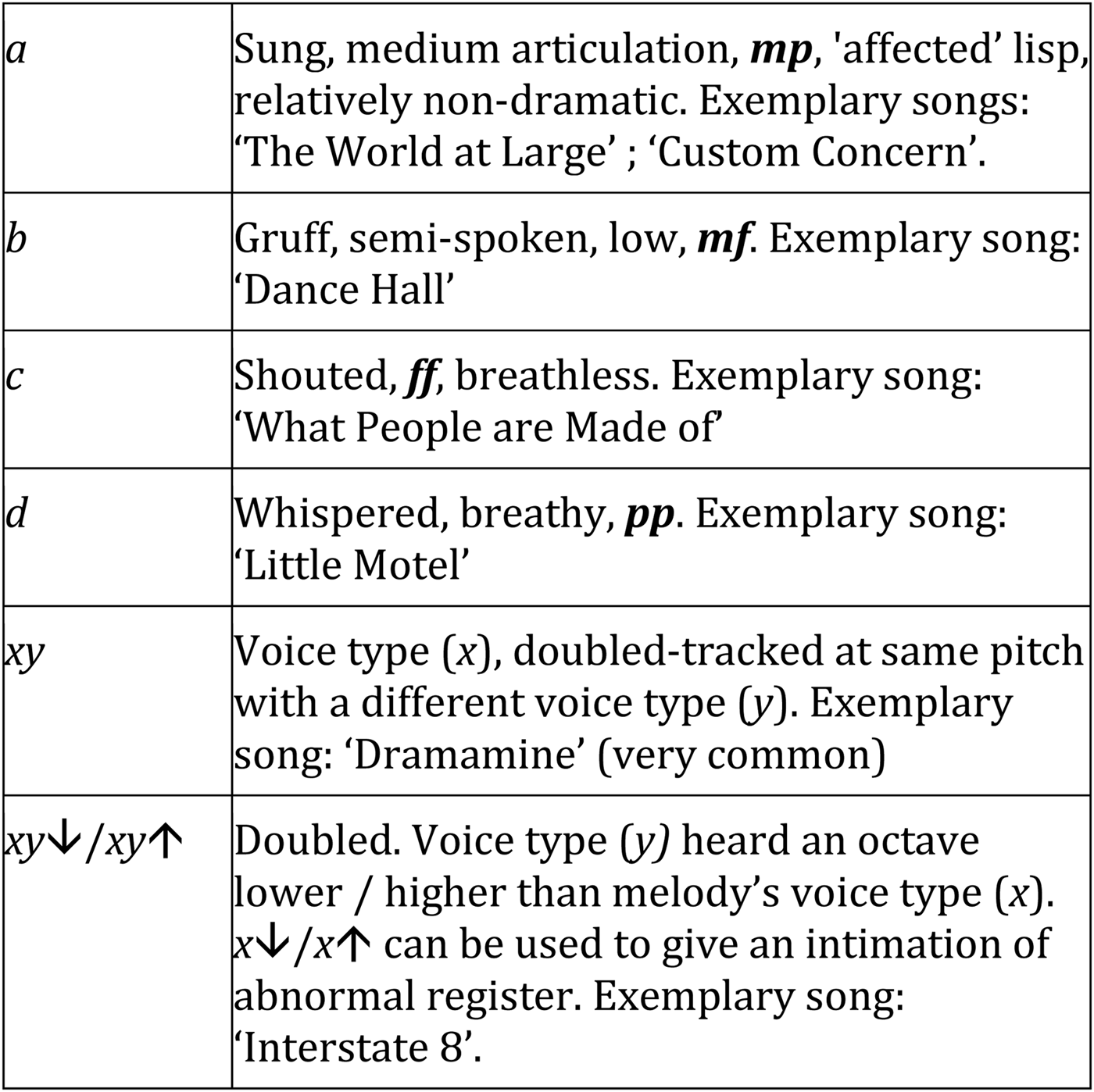
Recent research on the human voice is broad in scope (Žižek & Dolar Reference Žižek and Dolar2002; Lacasse Reference Lacasse and Bayley2010; Jarman-Ivens Reference Jarman-Ivens2011; Zuccarini Reference Zuccarini, Symonds and Taylor2014), and particularly relevant is Steven Rings' work on Bob Dylan (Rings Reference Rings2013a, Reference Rings2013b), a singer who famously developed a range of voices throughout his career, and whose ‘real’ voice is found somewhere in a ‘dialectic of vocal identity’ (Rings Reference Rings2013b) between personae. Brock has always employed different voices, often simultaneously in the stereo-field through double-tracking (or doubling).Footnote 16Figure 4's emoticons served the relatively uncontentious voices that followed the sentiment of the text of ‘Teeth Like God's Shoeshine’, but it is tricky to justify the inclusion of simplistic emotions on any empirical level, especially with the complex emotions that Moon and Antarctica (2001) invokes. A relatively neutral classification scheme would be the simple alphabetisation by voice-type, as in Figure 7.
Legend of alphabetised voice-types of Isaac Brock.
A primitive vocal ‘soundbox’ registers the three voices that simultaneously fill the stereo field of strata B and C in ‘Different City’.Footnote 17 These are graphically positioned from the left channel to the right in black boxes below the relevant stratum. In area B, voice c (thrice duplicated) is lazily synchronised, with reverb in the higher register (left and right) to create delay. Fully commensurate with the guitar effects throughout the album, this presents an acoustic analogy to the lonely, paranoid planet (‘the third planet is sure they're being watched, by an eye in the sky that can't be stopped’) with imagined voices and awe at the vastness of space (hence the album's lavish reverbs). These voices are relatively similar. However, shouts burst through the ‘cracks in the walls’ (right speaker: voice a) whenever the lyrics articulate the nothingness that enters his sealed world (‘Someone smart said nothing at all’; ‘They gave me a receipt that said I didn't buy nothing’; ‘talking out of his pants’). The song ends abruptly, revealing a snapshot of the outside world much like the hole punched through the wall in Stravinsky's Petrushka that invited an influx of banal street sounds. We hear a recorded military cadence of ‘I don't know but I've been told, you'll never die and you'll never grow old’ – a critique of a militant religion that lies outside.
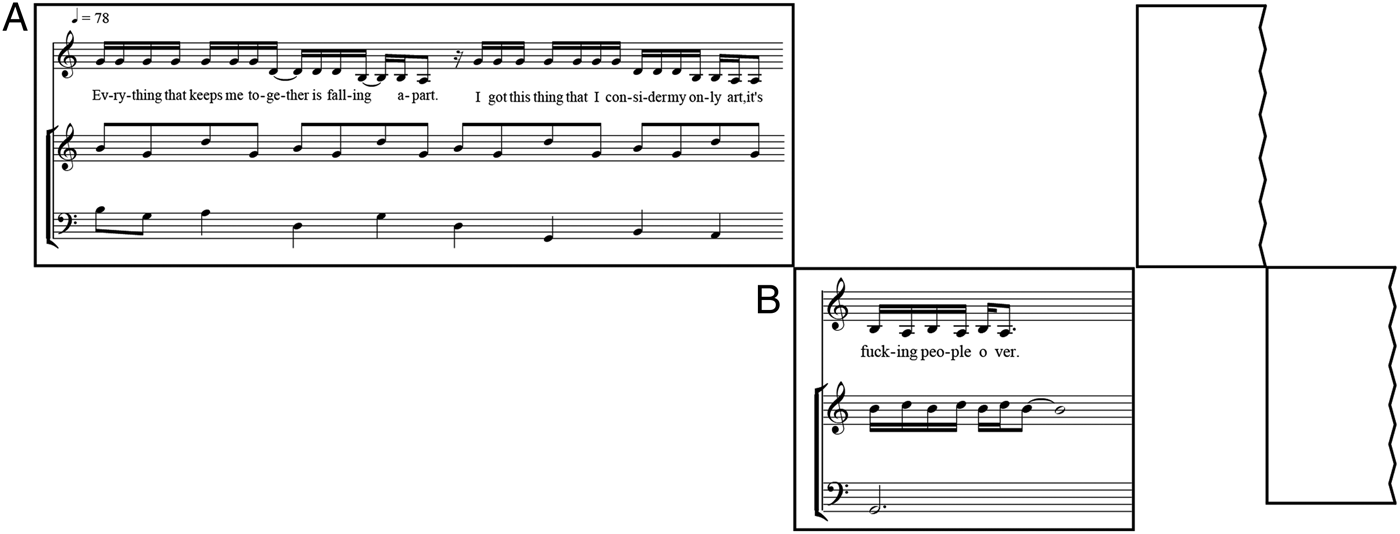
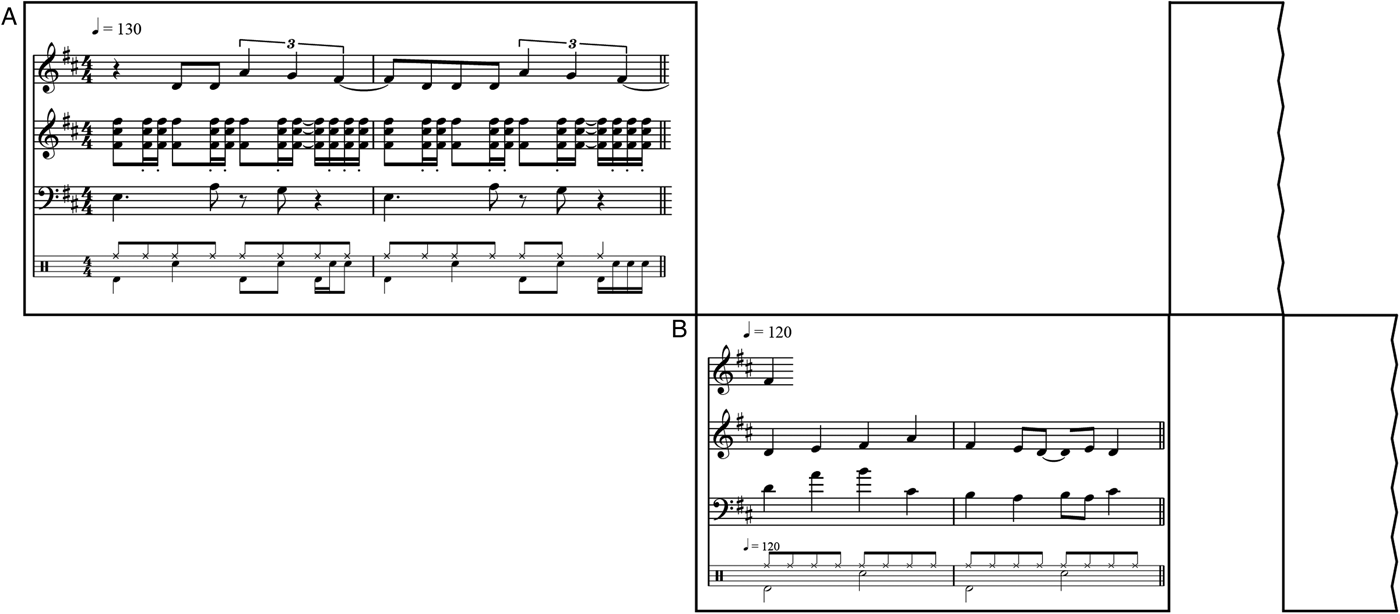
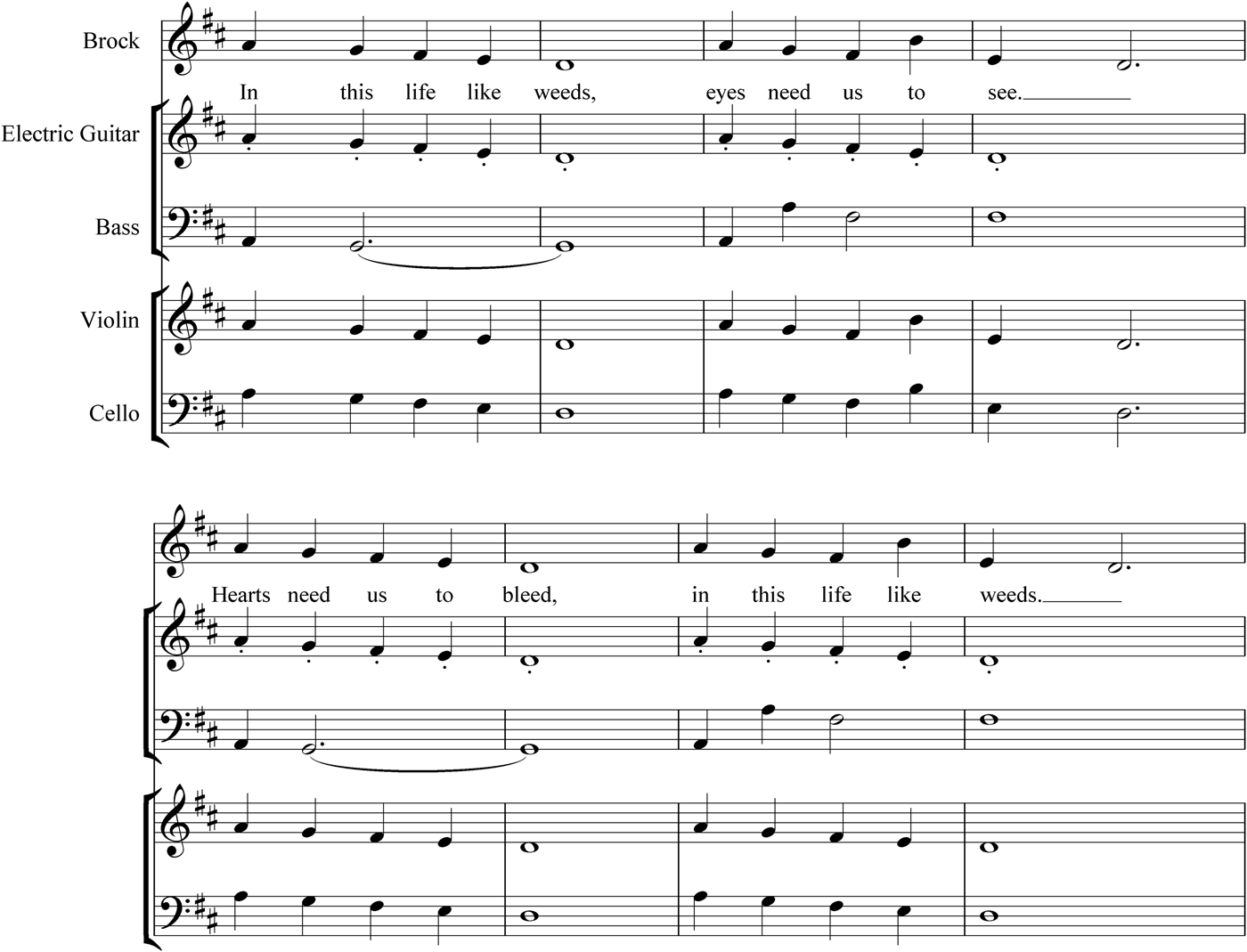
This distorted recording-of-recording contrasts the intimately visceral sounds of the guitar throughout, whose touch of modulation and overdrive are probably produced by some sort of vibe pedal that also adds chorus with slight phase.Footnote 18 The effect is similar to that created by the Manic Street Preachers at their most nihilistically realistic in The Holy Bible, particularly in ‘Of Walking Abortion’, ‘4st 7lb’, ‘ifwhiteamericatoldthetruthforadayitsworldwouldfallapart’ or ‘Archives of Pain’.Footnote 19 The vocals here mimic this ‘real’ guitar sound, copying its riff. But a new intrusion occurs; space suddenly expands; the guitar riff stops; the tempo decreases from the fevered 150 to 140 bpm; quavers yield semibreves; a softly muted rhythm guitar prevails. Listeners familiar with Debussy's Jeux may here recall the flexing of time and space that Jann Pasler (Reference Pasler, Deliège and Paddison2004) heard from a Bergsonian–Deleuzian perspective. As far as Modest Mouse are concerned, however, the expansion/contraction of space and time appeared much earlier in the closing song of Long Drive, ‘Space Travel Is Boring’. The drastic changes in all parameters in bar 5 of this song give the sensation of a space rocket leaving the atmosphere (replete with screams from a ‘canned crowd’). In Deleuzian terms, we take a ‘line of flight’ by leaving behind the ‘striated space’ of everyday life, to opt for a ‘smooth space’Footnote 20 where we form new, ‘nomadic’ relationships with surrounding processes (Deleuze and Guattari Reference Deleuze and Guattari1988). In earlier albums this relationship may have mapped onto the American plains as ‘smooth space’ vs. the suburb as ‘striated’; the rapid alternation of loud and soft is crystallised in Moon and Antarctica, but with more subtle tweaks to musical ‘space-time’ (see Example 6). One such example is the opening track, ‘3rd Planet’ (Figure 8). A rich tapestry of beautifully crafted guitar reverb gently eases in the drum kit and vocals (‘Everything that keeps me together is falling apart; I got this thing that I consider my only art, it's …’) but abruptly halts to near silence (on the words ‘… fucking people over’). After several attempts to match this antecedent with a consequent phrase, a treble-heavy guitar sharply strikes jangling chords, producing a meta-interlock of stratified blocks. These razor-sharp stabbing guitar chords later announce another song, ‘Life Like Weeds’. In bar 3 of ‘Life Like Weeds’, the band suddenly breaks out into smooth space (see Figure 9). Obviously the repeated, stuttering, guitar-driven antecedent represents the tangle of weeds, and the more profoundly relaxed consequent becomes an emotional release (‘In this life like weeds you're just a rock to me’). This ‘space-time’ music develops through the song, growing into a new riff that in time leads to the reverberated descending line so characteristic of the album that Michael Spitzer likens to a baroque lament bass in ‘Dark Center of the Universe’ (Spitzer Reference Spitzer2013). This lament bass, turned melody, becomes the song's anthem (see Example 7).
Stratification graph of ‘3rd Planet’ from The Moon & Antarctica.
Stratification graph of ‘Life Like Weeds’ from The Moon & Antarctica.
‘Space Travel is Boring’ from Long Drive.
‘Life Like Weeds’ from The Moon & Antarctica.
However, although the album tells the story of wrestling antinomies (the macrocosm vs. the microcosm; the individual's freedom beneath the controlling eye [qua Lacanian gaze]; religion vs. spirituality; city vs. the road) it does not posit anything as truth until its final line is screamed at full pelt: ‘the only thing you taught me about human beings was this: they ain't made of nothing but water and shit.’ Paradoxically this utterly nihilistic climax is Modest Mouse's positive outcome.
Continuing the loose Winterreise comparison, we remember the mysterious barrel-organ of ‘Der Leiermann’, the song from another plane of existence, another man's story: Death's. ‘What People Are Made Of’ likewise stands apart from the work's ‘concept’. It follows the conceptual construct of Sgt. Pepper, whose ‘A Day in the Life’ follows the opening number's reprise (see Moore Reference Moore2012, pp. 143–4). Moon and Antarctica's emotional nadir is its penultimate ‘Life Like Weeds’; the final song's heavy thrashing begins with incidental studio banter, sending us outside the concept. The song then hammers out its top-speed two-minute message. Like ‘Der Leiermann’ it undermines the aesthetic crafting of every other song with the blatant banality of its Affekt, creating a false conclusion with universalising soundbites, but making no attempt to synthesise antinomies except through ‘death’ (their only true positive). And in ending thus, rather than synthesising, Modest Mouse, like Schubert, found an alternative route through the antinomic deadlock: give up.
The full soundbox posits this as the album's final breakthrough; its biggest disjunctive intrusion, compressed into the final moments. After the penultimate song's delicate contrasts, ‘What People Are Made Of’ is a colossal eruption of raw sound; the violent influx of voice c, combined with extremely visceral imagery, is the real breakthrough. Its images remind us of our brutal materiality: ‘on the first page of the book of blue you read, “if you read this page then that'll be your death.” But by then it was too late and you wound up on an island of shells and bones that bodies had left.’ In this, the final stanza, the symbolic is underwritten by an appeal to the real, stripping back texturally and timbrally. We now have a cleaner (but still processed and slightly distorted) voice a, accompanied by a more prominent bass that suddenly contains the same kind of deep, ‘fat’ sound as ‘Different City’ with similar phasing distortion affect. The album's final summation (‘The one thing you taught me about human beings was this: …’) leads to the highly pressurised shout of the former voice c (‘They ain't made of nothing but water and shit’). This line and its intrusive distorted guitar effects mark this moment as the most impressive stratified shift of the album's sound-world. The song also bleeds perfectly into the subject of the next album, which begins by musing upon the nature of floating, in dialectically positive and negative ways, declaring ‘At the battle at the bottom of the ocean well the dead do rise. You want proof? I got proof, on the surface you can watch’ em float by.' The proof Brock offers is nothing less than the ‘real’ that has been erupting throughout this album and becomes the focused subject of introspection in the next. We broke open a critique of consumer culture and urban environment in the previous album; we burnt society into ‘tiny cities made of ashes’ in this one that negotiated our position in space and time, smooth and striated space; and the next album returns us to the dialectical starting point – the liminal boundary between the sea and sky from the opening lines of ‘Teeth Like God's Shoeshine’.
Positivity deconstructed? A truly negative indictment: Good News/Bad News?
‘Float On’ was Modest Mouse's biggest hit: its jangling guitar defied any suggestion that Brock couldn't write a hook. He excused his burst of optimism thus:
It was a completely conscious thing. I was just kind of fed up with how bad shit had been going, and how dark everything was, with bad news coming from everywhere. Our president is just a fucking daily dose of bad news! Then you've got the well-intentioned scientists telling us that everything is fucked. I just want to feel good for a day. I'd had some friends die, and with Jeremy [Green, drummer] kind of losing it … After we got out of that dark spot with everything melting down with the band, I just wanted to make a positive record. (Modell Reference Modell2004)
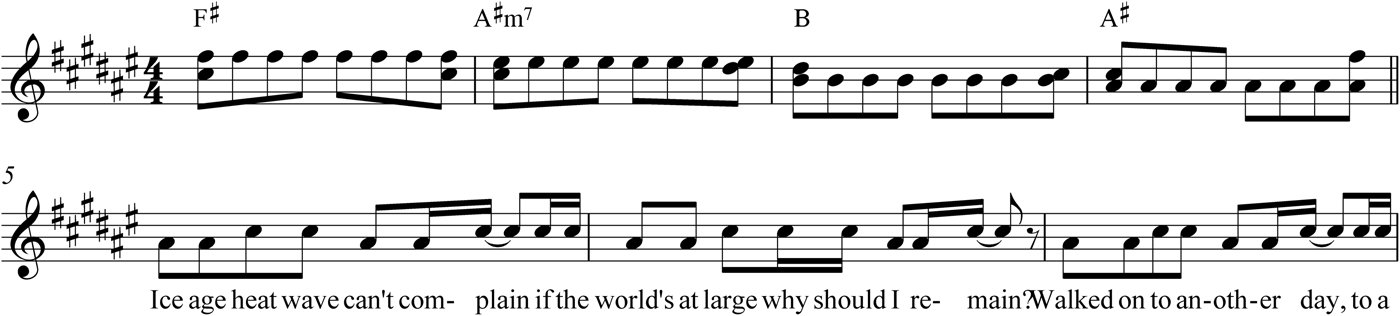
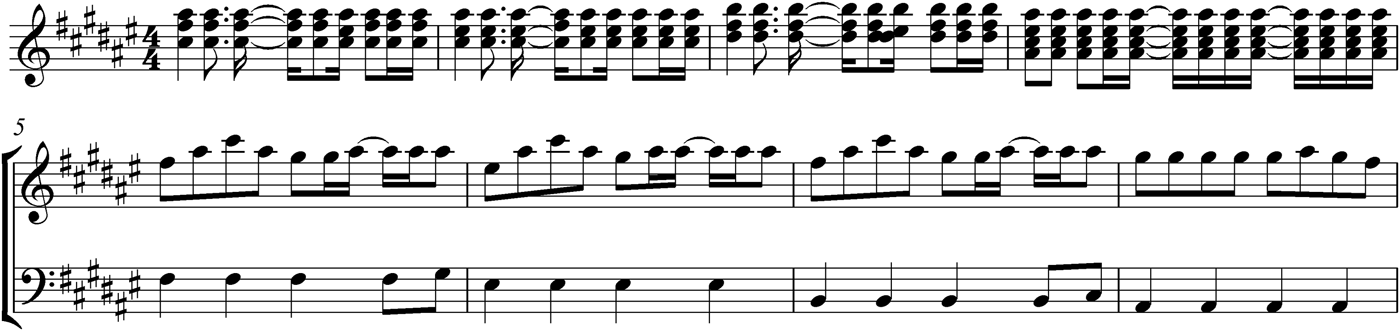
This partly explains the deconstructive title, Good News for People Who Love Bad News (2004); but beneath the album's beguilingly optimistic façade of communal euphoria lies Lacan's ‘real’ with images of death, sewage and decay. By way of example we could select the double-edged theme of ‘drifting’. In the first song, ‘The World at Large’, the protagonist is a drifter, resigned to whatever life throws at him (‘Ice age, heat wave, can't complain’). Obvious compositional techniques replicate this sentiment: (1) the ground bass cycle; (2) the repetitive rising anapest accent (ᴗᴗ– but not always obvious from the score) so characteristic of Modest Mouse;Footnote 21 (3) the musically indiscriminate itemisation of the lyric's positives and negatives, showing acceptance of fate (see Example 8). The remarkable segue into ‘Float On’ reinterprets the same chord progression as an upbeat, pop classic. ‘Float On’ was conceived during a session in which the band ‘as a joke … did a funny, dance-orientated version’ of ‘The World at Large’ (Goldsher Reference Goldsher2006, p. 167). The negative dialectics at play here should be fairly self-explanatory (see Example 9).
‘The World at Large’ from Good News for People Who Love Bad News.
‘Float On’ from Good News for People Who Love Bad News.
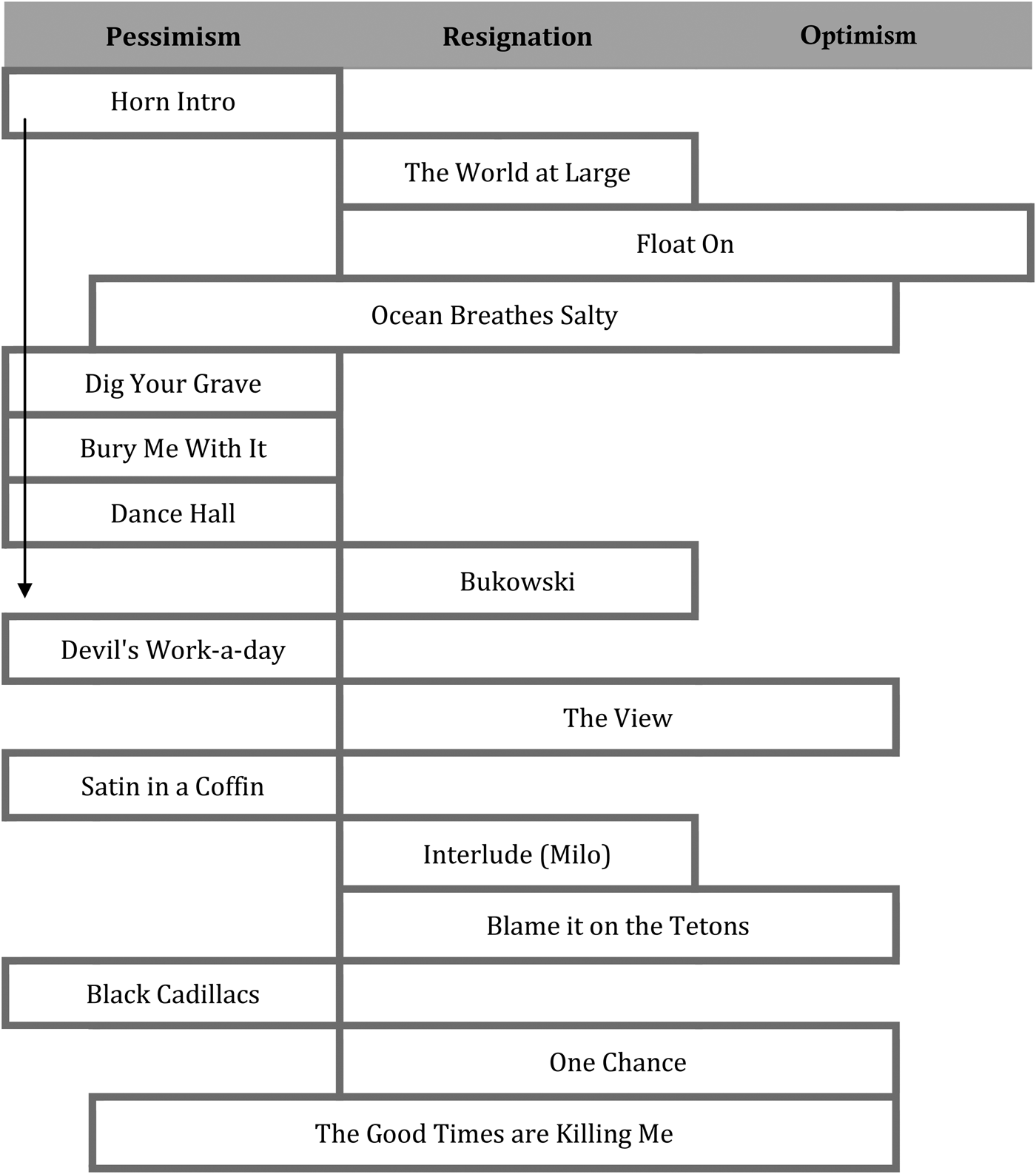
But after this ode to the mindlessly optimistic comes an elegy for the hopelessly pessimistic in ‘The Ocean Breathes Salty’, the unaccompanied hookline becoming a passage to the underworld: ‘You wasted life why wouldn't you waste death?’ We cross a Rubicon into the left-hand column of the graph in Figure 10 that positions each song on the everyday positivity/negativity spectrum. We take our lead from Brock:
I think we managed to make a quarter of the record positive, and the rest is either kind of dark or more just relaxing into things being how they are, resigned … It's got yelling songs and soft songs within the same album because it's more dimensional that way, but they still make sense together.Footnote 22
Figure 10 suggests that optimistic songs are always tinged with resignation, and are less common than hard-edged songs of despair. These latter are characterised by the sharply plucked banjo, the minor key, and the aggressive voice types. The lyrics position Brock as the spectator/persona of death – a figure that relishes the macabre: ‘Are you dead or are you sleeping? God I sure hope you are dead’ (‘Satin in a Coffin’). This particular song revels in the image of floating, as in Example 10. Brock's lower register (voice b) affords him a sinister, sneering, Mephistophelian persona. Of course the song becomes the grotesque underbelly of ‘Float On’; life's drifters are just pieces of dead flotsam.
Graph of ‘Outlooks’ of Songs from Good News for People Who Love Bad News.
‘Satin in a Coffin’ from Good News for People Who Love Bad News.
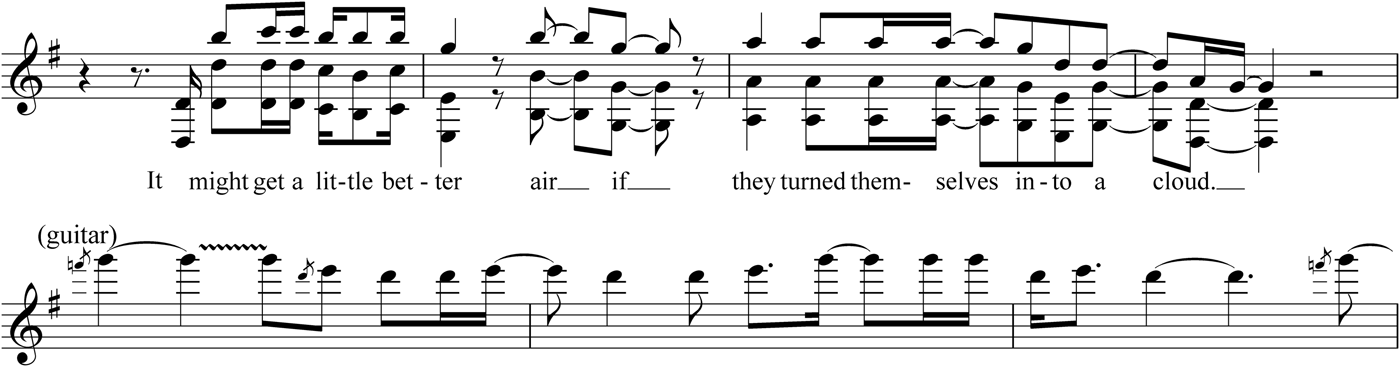
These songs radically shift all parameters, utterly disrupting the flow. Earthy associations with the acoustic folk instrumentation (a harsh, percussive violin in addition to the banjo), and Brock's fury-filled gravelly tone try to cast (through symbol and association of course) an atmosphere that renders a Lacanian real, retroactively positing ‘Float On’ as a fantasy – something fully imaginary. And these song types are Brock's antinomies, elevated now to macro-level. Intra-song antagonisms become inter-song antagonisms. The ‘horn intro’ by the Dirty Dozen Brass Band, for example, serves for ‘The World at Large’ as well as its antithesis ‘The Devil's Work Day’ (thus connected by the arrow on Figure 10). The two-sided image of the floater is transformed once more. If river flotsam puts us once again on the liminal border between sea and sky (see ‘Teeth Like God's Shoeshine’, or ‘The Ocean Breathes Salty’: ‘when the ocean met the sky’), this boundary is crossed later in the album when the symbol is vaporised as clouds. Clouds first arrive as the beautiful, lyrical optimists that point ‘the way out’ at the postlude of ‘Blame It on the Tetons’ (see Example 11). Here, the line ‘they might get a little better air if they turned themselves into a cloud’ provides hope to we who are ‘all in an ocean drowning’: our despair is located beneath the water's surface; Brock is in the sky. The violin soars through these clouds in the highest register (obvious word-painting), but then comes the crunch; the high register dive-bombs in the guitar's opening to the following song that tells us that ‘the clouds just hung around like Black Cadillacs outside a funeral’ (Example 12). There is now a dramatic stratification shift, with distorted guitars in the key of A minor (contrasting with the previous B minor) plodding the crotchet pulse to shouts of ‘we were done, done, done with all the fuck, fuck, fucking around; we were done with all the circ, circ, circling round.’ Something has been missed between the songs – the optimistic rhapsody to freedom becomes a grotesque rage of unrealised hope.
‘Blame It on the Tetons’ from Good News for People Who Love Bad News.
‘Black Cadillacs’ from Good News for People Who Love Bad News.
There is no synthesis between these elements, no mediation. The next song appears as a summary of the failed dialectic. The main line in ‘One Chance’ appears to be the megaphoned lo-fi shout/rap of ‘I'm just a box in a cage’. This may appear to be the positive (i.e. to posit) conclusion to the album, but I find the final line to be more epigrammatic: ‘I've seen so many ships sail, and go off sinking.’ Without a trace of anger in the musical backing, and with voice a (rather than the angry voice c that closed the previous album), the resignation here is profound. The final song, ‘The Good Times Are Killing Me’, opens with a diegetic moment with the band warming up with banal chatter before the song. The whole song in fact stands apart from the album, as a conclusion interposed from outside: eat, drink and be merry. Their discussion about smoking, upon which we are invited to eavesdrop, makes the song into a drunken celebration of the dialectical choice they decide not to take. The song makes clear that the band need to live between poles. As a parody of Nietzsche's Beyond Good and Evil, Brock is ‘Beyond Good and Bad News’.
A Positive? Marching into the Sea
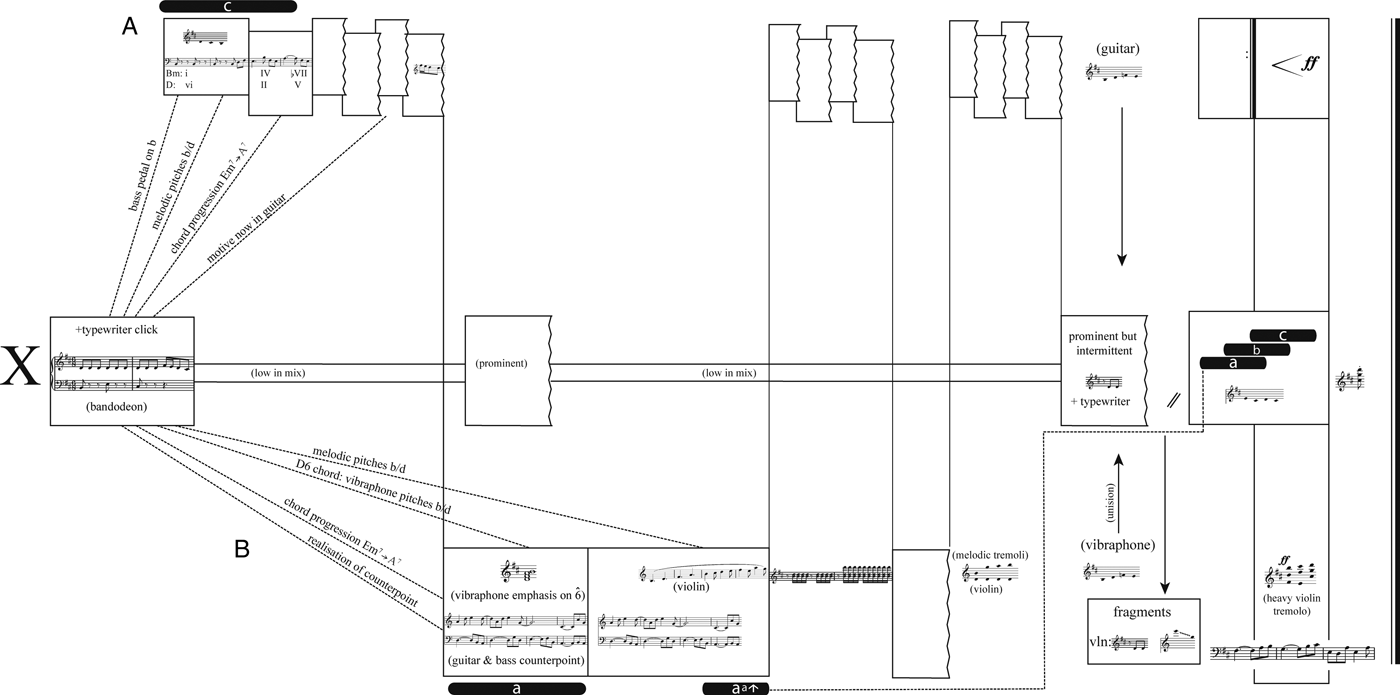
On the surface, Modest Mouse's later work presents a more positive dialectic: they organise a situation, like those of several songs by the Pixies, in which contrasts are placed in a dialectical framework in which A alternates with B (almost like a ‘verse-chorus paradigm’ but without either A or B acting as a clear refrain; see Osborn Reference Osborn2013, p. 23), but gains enough energy to expand into a moment of synthesis that transcends the paradigm. Take, for example, the opening track from the earlier We Were Dead Before the Ship Even Sank. In ‘March into the Sea’ and other songs on this album, the sea represents freedom through death, now pitched as a ‘positive’ aspect of life.Footnote 23 But in ‘March into the Sea’, the lyrics repeatedly entreat a former lover to masochistically injure the protagonist: ‘Well treat me like the fleas, like the rats, the disease.’ This is full of aggression, as is the stilted bass on B minor (see Figure 11) that bursts into a more melodic underlay to chords ii and V in D major. Area B contrasts with its easy-going lyrics, sea-shanty mannerisms in D major, with vibraphone and violin now creating a flowing counterpoint with the bass. Strand B showcases the more sugary tone of voice a against the fractious voice b of the opening. Area B runs back into Area A whose interrupting voice elides the cadence point (making the song impossible for a single singer to sing). These are our dialectical antinomies, with stratum A being the aggressive minor-key rant, and stratum B being the lyrical optimistic door through which ‘we just turned and marched into the sea’. These two, although doubtless inspired by the ‘loud-soft-loud-soft’ gimmick of the Pixies or Nirvana (what in Baroque would be called ‘terraced dynamics’), are far from the ‘verse-chorus paradigms’ (Osborn Reference Osborn2013) of songs like ‘Where Is My Mind?’ or ‘Smells Like Teen Spirit’. The characters and proportions of the typical verse-chorus paradigm are lost in this song, in favour of the intensification process: which is the verse? Which is the chorus? Both units A and B have elements of refrain, but we would call neither a ‘chorus’.
Stratification graph of ‘March into the Sea’ from We Were Dead Before the Ship Even Sank.
Strands A and B are not entirely contrasting. The song opens with a seemingly aryhthmic mechanised bandoneón,Footnote 24 peeking through occasionally to emphasise its sea-shanty mannerisms. But it holds a more significant structural role. While the innocuous bandoneón sounds like an exterior ‘object’ heard before the track begins, close listening confirms its repeated presence throughout, unchanged except when it breaks down completely, two-thirds in. Perhaps it is like Gretchen's spinning-wheel or Der Leiermann's barrel-organ. Either way, as in Adorno's Negative Dialectics, antinomies are always already present in objects themselves. Because of the silent first beat, the second and third quaver-beats of the triple metre are vagrants, slotting into place only as the song's later metric template unfolds, but the right hand of the bandoneón also never seems to know what the left is doing (this is true in Modest Mouse in general; listen to songs such as ‘Think Long’ and ‘Point A to Point B’). This mismatch engages us, foregrounding the conflict of the two metrically contrapuntal lines. And this conflict is generative. Figure 11 shows the many connections between strands A and B with connective lines running backwards, always to the third strand, X: the bandoneón. We hear:
• the repeated bass pitch b that connects X with A.
• the bandoneón's upper pedal d that becomes the opening lines 3^ of B minor (‘If food needed pleasing you'd suck all the seasoning off, suck it off!’). The twist to D major transforms this to 1^ (‘If you think you know enough to know you know you've had enough …’), where the bandoneón peaks through to show that its pedal point slots into both dark and light keys.
• the b/d minor third in X that connects to both A and B.
• the chord progression E → A that in both A and B was implied in the e → c♯ bass of X. This now fits the chord progressions, but was dissonant to the bandoneón's repeated D itself. A tension exists between the prison of the pitch d and the escape towards the cycle of fifths. (The same is found in ‘Gretchen’ of course).
• occasional references to the semiquaver flourish at the end of the bandoneón's phrase. It erupts for example in the guitar line later in A as further testament to the generative power of X.
• a melodic bridge between B minor and D in the pentatonic scale running from d to b, only occasionally stretching to C♯ to cadentially swing us to D as needed. Brock only sings pitches that are common to both keys, avoiding the A♯ leading note in B minor. In fact the angst-filled B minor sections swing to chords IV and V of D rather than B, so that the jolly D major drinking-song should not be such a harmonic surprise.
Stratum B releases the pent-up anger of the B minor section, becoming the perfect accompaniment to the bandoneón that now ascends to prominence in the mix. Note the flowing counterpoint between the guitar and the bass here. The contrapuntal Durchbruch is the release of the energy that the bass attempted in stratum A. The violin now enters as a rising counter-melody, but where its lyrical upwards contour should turn towards f♯ as it closes, it becomes an avatar of the barrel-organ's d/b ostinato instead as stratum A interrupts. It thereby adds intensity to A's return. Brock thus realises the interlocking counterpoint that Cone found in Stravinsky, that nudges the verse-chorus symbiosis towards what Mark Spicer (Reference Spicer2004) calls ‘cumulative form’. Upon A's second return, the melodic and percussive fuse; the rise from g to b in the melody (continuing where its original counter-melody left off) is contained in the violin's passionately disjointed playing. This manoeuvre towards synthesis precipitates ‘the breakdown’ section, heralded also by the failing bandoneón that can now only stutter. In the following ‘culmination’ section, the bandoneón repeats only a new riff of e-c♯-d-c♯, while Brock carefully transforms us from the smooth, contented voice a into the angry voice c, via voice b. All behind him fuse strands together: the bouncy bass line and voice type-a from B underpins material from A; the violin continues its climactic rise from B (b-c♯-d) to realise its melodic potential (in fact the violin is the main intensification technique, deftly shifting guise between A and B).
This is the recipe for the perfect ‘young Hegelian’ dialectic: thesis + antithesis = synthesis, the basic formula that Eisenstein manipulated into his ‘dialectical montage’ (Eisenstein Reference Eisenstein and Leyda1949) – a cinematic technique that Kofi Agawu likens to Cone's analysis of Stravinsky (Agawu 284). But note how, at the very point when the climactic wave rises towards what would usually be a repeat of a jingly chorus or what Brad Osborn calls a ‘terminal climax’, Brock simply shouts an unpitched ‘march on’ and the drums announce an immediate termination. Thus the antinomies have failed to synthesise. The only answer, according to Brock, is to learn from their differences, never allowing one to disappear into the other; after the best attempts to synthesise we find more truth in the debris.
For me, while the fully negative dialectic is heard more precisely after close analysis of the kind proposed in this article, contextualised listening can offer further productive (however negative) dialectical relationships that open up new spaces for arguments about Adorno and popular music theory. Fittingly, Brock claimed of this album that it was based on a contradiction, explaining the tattoo on his arm: ‘It's basically a hot air balloon with an anchor. Stasis. You've got two contradicting things going on’ (Rodriguez Reference Rodriguez2008). He even incorporated this into the album sleeve: two objects that fulfil their function by antagonising each other – the Apollo and the Dionysius. And it seems to me that, far from lapsing to the formal safety net of ABABABA, Brock kept alive his contradictions, constantly rejuvenating them throughout his work, in a way that, while sometimes appearing to slide into formal-cliché, actually provides ever new and invigorating critiques of those same clichés, as well as the social contradictions that they both embody and work through.