Introduction
Global consumption of poultry meat continues to rise in both developed and developing countries. A total of 82.2 million tons of broiler chicken was produced around the world in the year 2011-12 (USDA, Reference USDA2012). Poultry meat accounts for 30% of global meat consumption and by 2020 poultry is predicted to become the overall meat of choice (Bilgili, Reference BILGILI2002). In recent years, the poultry industry has experienced an unrivalled growth rate. This can be attributed to poultry having relatively low production costs, high nutritional values, rapid growth rates, and a great number of further-processed products. White meat is considered superior to red meat because of its low fat content, low cholesterol and, higher degree of unsaturation. Consumers also acknowledge the relatively low price, convenient portion control, and the lack of religious restriction towards the consumption of poultry meat (Jaturasitha et al., Reference JATURASITHA, THIRAWONG, LEANGWUNTA and KREUZER2004). The fast growing layer industry around the world also means that as there are a large number of broiler and layer parent stocks and spent and culled hens will be available. Disposal of this large quantity of birds may become a major problem for the poultry industry. Developing and underdeveloped countries cannot afford to waste this valuable source of proteins. The continued growth and competitive nature of the industry demands utilisation of less valued, spent hen meat to fulfil this growing demand. Spent hen meat, due to inherent reasons of age and type, is tough and difficult to process. Because of unacceptable toughness and brittle bones, the use of spent hen meat has long been a problem for the poultry industry.
Broiler chickens are usually slaughtered at 5-8 weeks of age as compared to spent hens which are generally slaughtered after completion of their productive period (75 weeks). Broiler or spent hen skeletal muscles are surrounded by epimysium and consists of muscle fibre bundles and muscle fibres covered by perimysium and endomysium respectively. Muscle fibre is a structural unit of muscle consisting of sarcoplasm, sarcolemma, sarcoplasmic reticulum, T-tubule, nucleus, mitochondria and lysosomes. Muscle fibre diameter increases with increasing age and spent hen meat has been reported to have higher muscle fibre diameter (Naveena and Mendiratta, Reference NAVEENA and MENDIRATTA2001). Each muscle fibre is composed of a number of small units called myofibrils. Myofilament is a functional unit of myofibril and consists of thick filaments (A-band) and thin filaments (I-band). The I band is bisected by a dark line called the Z line. The unit of myofibril between two adjacent Z lines is called a sarcomere. A band contains a narrow less dense area at the centre called the H zone and the narrow dense band bisecting this zone at the centre is called the M line (Warriss, Reference WARRISS2000). The toughness associated with spent hen meat is primarily due to the increased cross-linking in the connective tissue of older animals (Bailey and Light, Reference BAILEY and LIGHT1989). The primary use of spent hen meat is for comminuted/ ground meat products and retorted products such as soup that receive extreme heat treatments. If tenderness could be improved by physical degradation of the collagen protein, it would be possible to expand the market for the spent hen meat and increase its value. Even though many papers have been published on the mechanisms affecting meat texture and implications on meat quality, to our knowledge, very few reviews are available on the utilisation of spent hens, low value cuts, culled birds and any other tough meat from poultry birds. Therefore, this review has been prepared to highlight the ways in which consumer demands are being met through different post-harvest tenderisation methods to assure meat quality in terms of tenderness.
Meat quality
Meat quality is a term used to describe a range of attributes of meat. Meat tenderness is highly variable and difficult to predict, but it is very important for consumer acceptance. Tenderness, together with juiciness and flavour are the most important factors with respect to consumer satisfaction (Robbins et al., Reference ROBBINS, JENSEN, RYAN, HOMCO-RYAN, MCKEITH and BREWER2003). There is a large variation in both rate and extent of post-mortem tenderisation of meat that can lead to inconsistency of meat tenderness at the consumer level (Koohmaraie and Geesink, Reference KOOHMARAIE and GEESINK2006). Consumers are prepared to pay a premium price for improved tenderness. Variability in meat colour and tenderness result in major economical losses to meat industries throughout the world.
Factors affecting tenderness
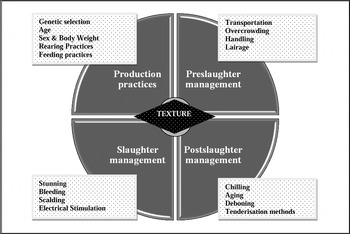
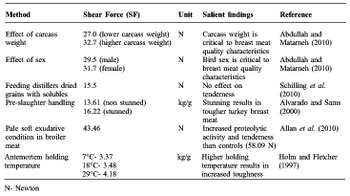
Researchers have shown that numerous pre-slaughter, slaughter and post-slaughter factors can influence the texture of poultry meat (Figure 1). Kamstra and Saffle (Reference KAMSTRA and SAFFLE1959) described tenderness as an elusive characteristic, because many of the factors which affect it are in a continual state of change from the time of slaughter. Goodwin (Reference GOODWIN1984) noted that several factor, such as age, sex, deboning time, and cooking method, can influence the ultimate tenderness of broiler meat. Many other factors including genotype (Farmer et al., Reference FARMER, PERRY, LEWIS, NUTE, PIGGOTT and PATTERSON1997), body weight (Muthukumar et al., Reference MUTHUKUMAR, SEN, NAVEENA, VAITHIYANATHAN and GIRISH2011), growth rate (Dransfield and Sosnicki, Reference DRANSFIELD and SOSNICKI1999), breed (Poole et al., Reference POOLE, LYON, BUHR, YOUNG, ALLEY, HESS, BILIGLI and NORTHCUTT1999), feeding and rearing conditions (Farmer et al., Reference FARMER, PERRY, LEWIS, NUTE, PIGGOTT and PATTERSON1997), pre-slaughter handling (Marple and Cassens, Reference MARPLE and CASSENS1973), stunning methods (Papinaho and Fletcher, Reference PAPINAHO and FLETCHER1995), post-mortem handling (Mendiratta et al., Reference MENDIRATTA, SHARMA, MAJHI and KUMAR2012) and muscle structure (Liu et al., Reference LIU, NISHIMURA and TAKAHASHI1996) are known to influence the texture of meat. Additionally, muscle fibre diameter and location have been demonstrated to influence the tenderness of a meat product (Papa and Fletcher, Reference PAPA and FLETCHER1988a). An overview of the effect of different pre-slaughter factors on tenderness of poultry meat is given in Table 1.
Factors influencing tenderness of poultry meat.

Overview of published data showing the effect of different pre-slaughter factors on poultry meat tenderness.

N- Newton
Tenderisation methods
According to Hedrick et al. (Reference HEDRICK, ABERIE, FORREST, JUDGE and MERKEL1993) the most important muscle characteristics affecting meat tenderness include amount and quality of connective tissue, the contractile state of muscle fibres and bundles, and the enzymatic processes during aging. Mendiratta and Panda (Reference MENDIRATTA and PANDA1995a) reviewed different methods for tenderisation of spent hen meat and concluded that in spite of the wide availability of research on meat tenderness, still there is a need to identify optimum and effective methods of tenderisation, because each method has its own limitations for practical applications.
physical methods
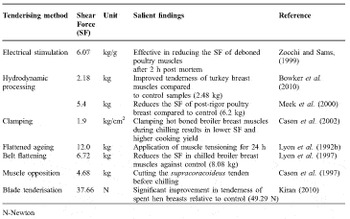
An overview of different physical methods and their effectiveness in improving tenderness of poultry meat is presented in Table 2. Physical methods induce tenderisation by either preventing cold shortening during rigor (muscle tensioning) or by disrupting the meat structure by physical or enzymatic means e.g. by electrical stimulation. (Hopkins, Reference HOPKINS2004).
Overview of published data showing tenderising efficacy of different physical methods in poultry meat.

N-Newton
Blade tenderisation
Blade tenderisation is a physical method used to effectively tenderise meat through the application of multiple blades or needle probes which disturb the myofibrillar apparatus and connective tissue (Seideman et al., Reference SEIDEMAN, SMITH, CARPENTER and MARSHALL1977). Blade tenderisation is widely used because it has been reported as an effective intervention for meat from animals with inherent challenges with regard to tenderness (Wheeler et al., Reference WHEELER, SAVELL, CROSS, LUNT and SMITH1990). Significant improvements in tenderness of spent hen breast meat fillets subjected to blade tenderisation were observed by Kiran et al. (Reference KIRAN, REDDY. K.S., RAO and NAVEENA2012). Blade tenderisation is known to increase tenderness more than aging alone, without negatively affecting palatability (Davis et al., Reference DAVIS, SMITH and CARPENTER1977). However, it has been associated with the introduction of spoilage or pathogenic microorganisms into meat (Krizner, Reference KRIZNER1999), which can be overcome by antimicrobial intervention.
Muscle tensioning or stretching
Herring et al. (Reference HERRING, CASSENS and BRISKEY1965) reported that muscles which are under some degree of tension during aging are more tender than those not under tension. Papa and Fletcher (Reference PAPA and FLETCHER1988b) tied the wings of poultry carcasses to breast muscle, causing a tensioning or stretching of the Pectoralis major muscles, and showed that the resulting meat was more tender. Tensioning of the breast muscles through wing restraint has been proposed to improve the texture of broiler meat (Cason et al., Reference CASON, LYON and DICKENS2002). The results of muscle tensioning studies indicate that less force is necessary to shear the cooked meat, and post-mortem aging time may be reduced (Cason et al., Reference CASON, LYON and DICKENS2002). Shear values for breast fillets harvested 1.25 hours post-mortem from muscle-tensioned carcasses were significantly lower than shear values of cooked fillets harvested at a similar time from conventionally handled broiler carcasses (Janky et al., Reference JANKY, DUKES and SAMS1992).
Electrical stimulation
Post-mortem electrical stimulation (ES) has been studied as a means of alleviating some of the toughness associated with early harvested meat (Li et al., Reference LI, SIEBENMORGEN and GRIFFIN1993). As with red meat, ES can help to alleviate textural problems in poultry meat. Post-mortem ES is not a new technology, but has only recently become a commercial possibility for use in broiler processing. In broilers, ES seeks to reduce the toughness of meat that is deboned prior to the normal aging period. The systems of ES can be grouped into low amperage (0-200 mA per bird) and high amperage systems (350-500 mA per bird). The low amperage systems accelerate rigor development and prevent sarcomere shortening in the breast fillet after deboning, while the high amperage systems induce the additional effect of myofibrillar damage to further improve tenderness (Sams, Reference SAMS2002). Different methods of applying ES as well as various voltages and amperages have been evaluated (Li et al., Reference LI, SIEBENMORGEN and GRIFFIN1993). Researchers have reported that both low and high voltage ES systems accelerated rigor mortis development (Thompson et al., Reference THOMPSON, JANKY and WOODWARS1987) however, the high voltage system also tenderised the meat by myofibrillar fragmentation (Thompson et al., Reference THOMPSON, JANKY and WOODWARS1987).
Breast contact methods of ES have been commercially implemented in poultry plants (Sams, Reference SAMS1994), but there are practical difficulties in maintaining contact between the bird and the metal rub bar because of the high bird density on the lines (Sams, Reference SAMS1995). Electrical current, when applied to the live bird (stunning) before death, delays rigor, whereas electrical current applied seconds later to the dead or dying bird (electrical stimulation) accelerates rigor development (Fletcher, Reference FLETCHER1999).
Pressure treatment
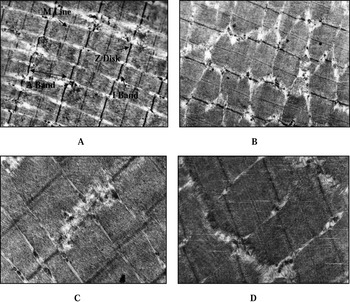
The beneficial effects of pressure in tackling toughness due to histological changes, especially disintegration of Z-lines of muscle tissue, has been reported by Macfarlane (Reference MACFARLANE1985), which was previously shown by other researchers (Boutan et al., 1977; Ratcliff et al., Reference RATCLIFF, BOUTON, FORD, HARRIS, MACFARLANE and O'SHEA1977). The study by Mendiratta and Panda (Reference MENDIRATTA and PANDA1995a) indicated the beneficial effects of pressure application on tenderness, cooking yield and protein extractability of spent hen meat. Pressure treatment has been reported to accelerate post-mortem glycolysis in pre-rigor meat without causing any myofibrillar toughness. It can be exploited for processing hot deboned pre-rigor meat immediately after dressing, which clearly demonstrates its potential usefulness in industrial application (Mendiratta and Panda, Reference MENDIRATTA and PANDA1995b). These authors have studied the ultra structural changes in spent hen Pectoralis major muscles (unpublished data) subjected to pressure treatment and reported a sarcomere disorganisation and significant breakdown of Z-discs (Figure 2B) compared to orderly arranged thin (I) and thick (A) bands in control samples (Figure 2A).
Transmission electron micrographs (TEM) of spent hen muscle tissues showing A. Control (4800 X); B. Pressure treatment (4600X); C. Enzyme (papain) treatment (8400 X); and D. Synergistic effect of enzyme (papain) and pressure treatment (6300 X).

Hydrodynamic pressure processing
The hydrodyne process is the use of a hydrodynamic force produced by a shock wave on an object in a fluid. The shock wave travels rapidly through the fluid (water) and any objects in the fluid that are an acoustical match to water. Since meat is composed of 75% water, the wave passes through the sample and ruptures the myofibrillar proteins, z-disks, and surrounding structures (Solomon et al., Reference SOLOMON, LONG and EASTRIDGE1997; Zuckerman and Solomon, Reference ZUCKERMAN and SOLOMON1998). The explosive used to create a shock wave is a combination of nitromethane (liquid) and ammonium nitrate (solid). These components are not explosive until combined (Solomon et al., Reference SOLOMON, LONG and EASTRIDGE1997).
High-pressure treatment has also been shown to improve the quality attributes of meat. Hydrodynamic pressure processing (HDP) is a post-harvest processing technology that uses high energy, high-pressure shockwaves through water to improve meat quality (Solomon et al., Reference SOLOMON, LONG and EASTRIDGE1997). It has been well established that HDP treatment of beef, pork, and lamb improves cooked meat tenderness (Solomon et al., Reference SOLOMON, LONG and EASTRIDGE1997; Reference SOLOMON, CARPENTER, SNOWDER and COCKETT1998; Moeller et al., Reference MOELLER, WULF, MEEKER, NDIFE, SUNDARARAJAN and SOLOMON1999). In poultry, the few studies that have been conducted indicate that HDP shockwaves improve the tenderness of early deboned chicken and turkey breasts (Meek et al., Reference MEEK, CLAUS, DUNCAN, MARRIOTT, SOLOMON, KATHMAN and MARINI2000). However, the effects of HDP on the marination process and meat quality characteristics of moisture-enhanced poultry products are relatively unknown. It has been hypothesised by Bowker et al. (Reference BOWKER, CALLAHAN and SOLOMON2010) that the impact HDP has on muscle ultrastructure enhances the processing and meat quality attributes in marinated poultry muscle with inconclusive results. This method has not been commercialised yet, and the concept is still under development for poultry meat.
Ultrasonic waves
Attempts to improve meat tenderness using sonication alone or in combination with marination have been reported. Applications of ultrasound to provoke changes in physical and chemical properties of meat and meat products have attracted the interest of research workers for the past few decades, because it is a pure physical technique, providing an alternative to chemical or thermal means of processing. Ultrasound was tested for its ability to induce membrane cell disruption that could increase meat tenderness either directly, through the physical weakening of muscle structure, or indirectly, by the activation of proteolysis either by release of cathepsins from lysosomes and/or of Ca ++ ions from intracellular stores so that it may activate the calpains (Dolatowski et al., Reference DOLATOWSKI, STADNIK and STASIAK2007). Use of sonic marination in chicken breast samples resulted in Allo-Kramer shear values of 3.4 kg/g compared to 3.7 kg/g in static marinated samples (Smith, Reference SMITH2011). Low power ultrasonic waves are not effective in improving the texture of broiler breast fillets and hence further studies with high intensity ultrasonic baths are required (Smith, Reference SMITH2011). During ultrasound application, the transmitted sound waves causes dissipation of heat that raises meat temperature, limiting its commercial application which can be overcome by integrating with hot boning operations (Hopkins, Reference HOPKINS2004).
chemical and enzymatic methods
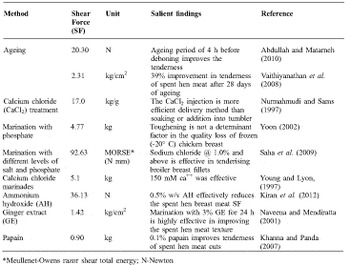
An overview of different chemical and enzymatic methods and their effectiveness in improving tenderness of poultry meat is presented in Table 3. Chemical and enzymatic methods tenderise the meat by altering post-mortem biochemical muscle systems through activation of calpain protease system, increasing ionic strength, changing the binding of actomyosin or cleavage of myofibrillar proteins (Hopkins, Reference HOPKINS2004). Few important methods are discussed below.
Overview of published data showing tenderising efficacy of different chemical and enzymatic methods in poultry meat.

*Meullenet-Owens razor shear total energy; N-Newton
Conditioning/aging
Poultry meat tenderness and other meat quality characteristics can be improved by aging, in which intact carcasses are stored for several hours under refrigeration (< 4°C) to allow the depletion of adenosine triphosphate and the development of rigor mortis (Sams, Reference SAMS1999). A four hour gap between chilling and boning has been reported as a critical period after which deboning does not cause toughening (Battula et al., Reference BATTULA, SCHILLING, VIZZIER-THAXTON, BEHRENDS, WILLIAMS and SCHMIDT2008). Dawson et al. (Reference DAWSON, JANKY, DUKES, THOMPSON and WOODWARD1987) found that broiler breast fillets processed within 3.33 hours post-mortem had shear values that would be judged by most consumers as tough, whereas Lyon et al. (Reference LYON, LYON, PAPA and ROBACH1992a) observed that increasing the aging time of breast fillets (Pectoralis major muscle) from 4 to 6 hours resulted in highly acceptable tender meat.
During aging, proteolysis affects all muscle proteins, including connective tissue (Hwang et al., Reference HWANG, DEVINE and HOPKINS2003), and it is now well established that post-mortem proteolysis of myofibrillar and myofibrillar-associated proteins is responsible for this process (Koohmaraie and Geesink, Reference KOOHMARAIE and GEESINK2006). Three proteolytic systems present in muscles have been investigated for their possible role in post-mortem proteolysis and tenderisation: the calpain system, the lysosomal cathepsins and the multicatalytic proteinase complex (MCP) (Koohmaraie and Geesink, Reference KOOHMARAIE and GEESINK2006). Some non-enzymatic factors, such as temperature, pH and Ca2+ concentration also influence the meat tenderisation process (Takahashi, Reference TAKAHASHI1996).
A low pH can cause inhibition of proteolytic enzyme activity, denaturation of myofibrilar proteins and excessive fibre shortening which consequently leads to toughness and loss of water-holding capacity (Khan and Cohen Reference KHAN and COHEN1977). The sarcoplasmic calcium ion concentration increases ultimately to 0.2 mM during tenderisation due to the inability of sarcoplasmic reticulum and mitochondria to accumulate calcium ions. This follows activation of the enzymatic proteolytic system resulting in breakage of myofibrilar and cytoskeletal proteins. This degradation includes troponin-I, troponin-T, desmin, vinculin, meta-vinculin, dystrophin, nebulin and titin (Koohmaraie, Reference KOOHMARAIE1996).
Use of proteolytic enzymes
Proteolytic enzymes derived from plants, such as papain, bromelain and ficin, have been widely used as meat tenderisers in most parts of the world (Naveena et al., Reference NAVEENA, MENDIRATTA and ANJANEYULU2004). Intravenous injection of papain solution (48 mg/kg weight) to live spent hens 30 min prior to slaughter significantly improves the tenderness in post-rigor meat (Mendiratta and Panda Reference MENDIRATTA and PANDA1995a). Transmission electron microscopy (TEM) of post-rigor spent hen muscles treated with papain (Figure 2C) indicated diffused muscle structure, degraded Z lines and digested pockets relative to organised structure of control sample (Figure 2A) indicating distinguished A and I bands (unpublished data). Papain is mainly effective when injected intravenously in pre-slaughter muscles, as it is reported to cause indiscriminate breakdown of proteins or mushy textured meat when applied as a marinade solution (Naveena et al., Reference NAVEENA, MENDIRATTA and ANJANEYULU2004). These factors limit its usage, and has prompted researchers to investigate herbs like ginger (Zingiber officinale roscae) that has been used in food since ancient times, not only as a traditional ingredient but also to improve quality parameters (Cutler, Reference CUTLER1995). Naveena and Mendiretta (2001) evaluated the proteolytic potential of ginger extract in spent hen meat and concluded that 3% ginger extract was optimum for improvement in tenderness of tough spent hen meat. In addition, ginger extract was proved to be effective in tenderising smoked spent hen meat (Naveena et al., Reference NAVEENA, MENDIRATTA and ANJANEYULU2001) Proteolytic plant enzymes are superior to bacterial derived enzymes mainly because of safety problems such as pathogenicity or other disadvantageous effects (Qihe et al., Reference QIHE, GUOQING, YINGCHUN and HUI2006). Enzymes derived from Cucumis trigonus Roxb (Kachri, a melon variety fruit) and ginger have been reported to increase the tenderness and the overall qualities of tough buffalo meat (Naveena et al., Reference NAVEENA, MENDIRATTA and ANJANEYULU2004; Naveena and Mendiratta, Reference NAVEENA and MENDIRATTA2004). Few enzymes, due to their broad substrate specificity, degrade the texture of meat and can cause the development of unfavourable tastes because of over-tenderisation (Cronlund and Woychik, Reference CRONLUND and WOYCHIK1987) which result in a product with a pasty texture (Miller et al., Reference MILLER, HOVER, COOK, GUERRA, HUFFMAN, TINNEY, RAMSEY, BRITTIN and HUFFMAN1995), which limits their commercial use.
Marination with food grade ingredients
Use of marination has increased dramatically in the past few years in the poultry industry, which has successfully implemented marination technologies to meet consumer demands and help to maintain product uniformity. Marination is a widely used method for improving the tenderness, juiciness, and flavour of poultry (Lemos et al., Reference LEMOS, NUNES and VIANA1999). It is used to improve both sensory (colour, flavour and texture) and functional properties (water-holding capacity, stability and cooking yield) of the meat. Marination of broiler breast meat has become an integral part of the poultry industry due to the increase in consumer, retailer, and restaurant demand for further-processed, ready-to-eat, convenience foods. Marination has also been used as a method of tenderisation (Young and Lyon Reference YOUNG and LYON1997). Mixtures can be applied to the meat through soaking, injection, or vacuum tumbling, depending on the type of meat product.
A typical marinade solution contains salt and phosphates with sodium tri-polyphosphate being the most common phosphate (Barbut et al., Reference BARBUT, MAURER and LINDSAY1988). Palladino and Ball (Reference PALLADINO and BALL1979) found that sodium ions in marinades produced a tenderising effect, and Goodwin and Maness (Reference GOODWIN and MANESS1984) reported this ability for phosphates. Hamm (Reference HAMM1960) postulated that dispersion of ions into the muscle provided a tenderising effect due to the repulsion caused by association of the ions with the proteins. This repulsion allowed increased water uptake and, therefore, increased moisture content of the cooked meat and increased tenderness. The incorporation of phosphates and salt into poultry muscle has been shown to improve tenderness (Palladino and Ball, Reference PALLADINO and BALL1979; Goodwin and Maness, Reference GOODWIN and MANESS1984).
Use of calcium chloride (CaCl2)
Tenderisation involves lysosomal enzymes, calpains or a combination of the two (Dutson, Reference DUTSON1983). The use of ionic strength as a tenderising factor is another possibility (Wu and Smith, Reference WU and SMITH1987). Because one of the isoforms of the calcium-activated calpain protease (m-calpain) is not degraded during normal post-mortem aging (Koohmaraie et al., Reference KOOHMARAIE, SEIDEMAN, SCHOLLMEYER, DUTSON and CROUSE1987), calcium-induced tenderisation may be achieved when calcium is applied to post-rigor muscle. Ionic strength and enzymatic proteolysis synergistically contribute to post-mortem myofibrillar protein solubilisation (Wu and Smith, Reference WU and SMITH1987). Taylor and Etherington (Reference TAYLOR and ETHERINGTON1991) conducted an in vitro experiment and found that solubilisation of proteins by calcium was due to salting in rather than proteolytic action by calpain. When CaCl2 solution was applied along with tumbling at 24 h post-mortem after rigor mortis development, the tenderising effect was significantly greater than that of pre-rigor application (Nurmahmudi et al., Reference NURMAHMUDI, VEERAMUTHU and SAMS1997). Taylor and Etherington (Reference TAYLOR and ETHERINGTON1991) suggested that two processes were responsible for the rapid tenderisation of meat when treated with high concentration of CaCl2. Firstly, they suggested an enzymatic degradation of proteins in or near the Z-disk and secondly, a calcium dependent solubilisation of other key myofibrillar proteins; components that have not been identified. These authors further suggested that the tenderising effects of CaCl2 were due to a combination of calcium-specific effects and general ionic strength effects. Few researchers have also reported that use of CaCl2 causes loss of moisture binding capacity (Young and Lyon, Reference YOUNG and LYON1989), reduced palatability (Eilers et al., Reference EILERS, MARTIN, MORGAN, MILLER, MENDEZ, HALE, ACUFF and SAVELL1994), reduced colour stability of fresh meat and decreased product shelf life (Hunt et al., Reference HUNT, SCHOENBECK, YANCEY, DIKEMAN, LOUGHIN and ADDIS2003).
Use of phosphates and bicarbonates
Phosphate has been used in poultry products for many years to improve water binding capacity, texture, colour, and flavour (Steinhauer, Reference STEINHAUER1983). The use of trisodium phosphate (TSP) was approved as a post-chill antimicrobial treatment of raw poultry to control Salmonella and to reduce total microbial contamination during poultry processing (Giese, Reference GIESE1993). Along with a superior antimicrobial effect, an increase in consumer acceptability of raw carcasses treated with TSP over untreated carcasses has been reported (Hathcox et al., Reference HATHCOX, HWANG, RESURRECCION and BEUCHAT1995). In addition, sodium tripolyphosphate (STPP) has been used to treat fresh poultry meat to improve the quality, including colour, cooking loss, and texture (Young and Lyon, Reference YOUNG and LYON1997; Young et al., Reference YOUNG, BUHR and LYON1999). Injection of tetrasodium pyrophosphate and sodium bicarbonate to post-rigor chicken breast fillets results in improved pH, colour, cooking yield, water-holding capacity and tenderness (Sen et al., Reference SEN, NAVEENA, MUTHUKUMAR, BABJI and MURTHY2005), although it was reported that the tenderising effect of bicarbonates was superior to pyrophosphate. Bicarbonates are reported to reduce shear force (Wynveen et al., Reference WYNVEEN, BOWKER, GRANT, LAMKEY, FENNEWALK, HENSON and GERRARD2001) by improving water holding at elevated pH (Bouton et al., Reference BOUTON, CARROLL and SHORTHOSE1973; Hamm, Reference HAMM1960). Use of sodium as a part of sodium tripolyphosphate or any other salts are increasingly associated with high blood pressure and other cardiac diseases in human consumers (CDC, Reference CDC2009) as well as adverse effects in people suffering from chronic kidney disease - hence food products with added phosphates are considered a health detriment (Kestenbaum et al., Reference KESTENBAUM, JOSHUA, KYLE, DONALD, STEPHEN, BESSIE, DONALD and DENNIS2005).
Use of weak acids
Weak organic acids, such as citric and acetic acids, are common components of flavoured marinades used with meats in limited quantities. Citric and lactic acids are the two most studied marinades used to enhance quality and tenderness of meats, with citrus fruit marinades being most commonly used in poultry meat. These acids are believed to influence collagen leading to some tenderisation (Aktas and Kaya, Reference AKTAS and KAYA2001). Weak acids act by creating low pH, which is optimal for the cathepsin system, solubilisation of perimyseal collagen and is beneficial in conjunction with lowering temperature which is required for denaturation of connective tissue (Hopkins, Reference HOPKINS2004).
Use of ammonium hydroxide
Ammonia treatment of meat has become an accepted process, duly approved by the FDA of the United States and the USDA since 2007, to ensure meat safety by eliminating pathogens such as E. coli and Salmonella. Marination of spent hen breast meat fillets with different concentrations of ammonium hydroxide has been reported to increase the pH, water holding capacity, protein extractability and collagen solubility (Kiran et al., Reference KIRAN, REDDY. K.S., RAO and NAVEENA2012). These authors also reported a significant reduction in shear-force values and increased consumer acceptability of ammonium hydroxide marinated samples. Tenderising effects from ammonium hydroxide treatment was also reported in other meat, such as from beef and buffalo (Hamling and Calkins, Reference HAMLING and CALKINS2008; Naveena et al., Reference NAVEENA, KIRAN, REDDY. K.S, VAITHIYANATHAN and DEVATKAL2011). Use of ammonia at very high levels has been reported to be mutagenic in cells however.
synergism
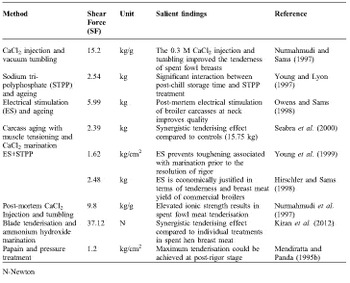
Different synergistic methods and their effectiveness in improving tenderness of poultry meat is presented in Table 4. In most physical and chemical/ enzymatic tenderisation studies, a single post-harvest intervention method was utilised, and the protocol did not allow for examination of potential synergistic effects of the simultaneous use of two or more methods. Indeed, few studies have evaluated the potential synergistic effects of the simultaneous use of two or more methods of tenderisation for the improvement of palatability of undervalued cuts that contain higher connective tissue levels (Savell et al., Reference SAVELL, MCKEITH, MURPHEY, SMITH and CARPENTER1982; Bowker et al., Reference BOWKER, LIU, SOLOMON, EASTIDGE, FAHRENHOLZ and VINYARD2007). Some synergistic tenderisation studies reported in the literature include examination of the combined effect of papain and pressure cooking in spent hen meat (Mendiratta and Panda Reference MENDIRATTA and PANDA1995a); use of CaCl2 and lactic acid in spent hen meat (Kanimozhi, Reference KANIMOZHI1998); combined effects of blade tenderisation and ammonium hydroxide marination in layer spent hen meat (Kiran et al., Reference KIRAN, REDDY. K.S., RAO and NAVEENA2012); combining marination and ultrasonic waves (Smith, Reference SMITH2011); use of electrical stimulation and marination to avoid toughening problems prior to the resolution of rigor (Young et al., Reference YOUNG, BUHR and LYON1999) and muscle tensioning and CaCl2 marination prior to aging (Seabra et al., Reference SEABRA, ZAPATA, FUENTES, AGUIAR, FREITAS and RODRIGUES2000). Electron micrographs of spent hen muscle (unpublished data) showing ultra structural changes due to synergistic papain and pressure treatment is shown in Figure 2D. The TEM photograph clearly indicate that muscle structure was affected to a greater extent in combined treatment compared to individual pressure cooking (Figure 2B) or papain (Figure 2C) treatments.
Overview of published data showing synergistic tenderising efficacy of different methods in poultry meat.

N-Newton
Conclusions
Meat produced from spent hens or parent stock is tougher and less palatable which makes it difficult for the poultry industry to effectively utilise this large source of meat profitably. In addition, variation in texture/ tenderness of poultry meat causes consumer dissatisfaction. A number of technologies are available for tenderisation of tough meat which can be gainfully used for improving the quality of spent poultry meat. In most of these tenderisation studies a single post harvest intervention method was utilised that did not allow an examination of potential synergistic effects of the simultaneous use of two or more methods. Combination of physical and chemical/ enzymatic methods may be tried to address both myofibrillar and connective tissue toughness from an unacceptably tougher meat. Different post-harvest tenderisation methods may be utilized to tackle toughness for assured meat quality. With changes in agricultural resources worldwide, many developing and underdeveloped countries cannot afford to ignore this valuable meat source which could be salvaged to help feed the burgeoning population of the world.