Introduction
The poultry industry is highly efficient with feed to meat conversion ratio ranging between 1.5 to 1.8 (Sengor et al., Reference SENGOR, YARDIMCI, OKUR and CAN2008) which makes chicken one of the most economically viable and important sources of meat for human consumption. Globally, poultry production relies heavily on plant protein supplements especially soybean meal. Soybean meal is a major protein supplement source for poultry and pig production systems in Australia due to its excellent amino acid composition and high level of digestibility (Willis, Reference WILLIS2003). However, the availability of soybean meal for use in animal nutrition in the Asia-Pacific region is limited due to its use as human feed and low productivity (Ravindran and Blair, Reference RAVINDRAN and BLAIR1992). Most soybean meal used by the poultry industry in Australia is imported from South American countries and the US (Willis Reference WILLIS2003) which adds to the overall cost of feeding.
Poultry production is based on grain, which is used for human consumption and therefore a high value commodity, which, combined with the increasing consumption of chicken on a global basis, has seen the cost of grain increase significantly. Furthermore, many of the traditional ingredients used in poultry diets are forecast to be in short supply within the next ten years mainly due to an increase in the human population and unfavourable climatic conditions (Cribb, Reference CRIBB2010). The increasing cost of grain has prompted the poultry industry to explore alternative sources of poultry feed. There is a need to identify alternative protein sources either for total or partial replacements which meet the dietary requirements and reduce feed costs (Ramos-Elorduy et al., Reference RAMOS-ELORDUY, GONZALEZ, HERNANDEZ and PINO2002; Das et al., Reference DAS, GANGULY and HALDAR2009).
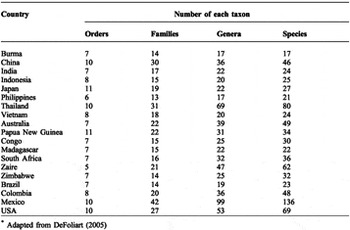
Protein-rich insects are one option being considered to reduce the cost of protein supplements in poultry feed. Insects have been used as a food source for a number of different species of animal, however relatively few studies have focused on incorporating insects into the diets of domestic livestock (Finke et al., Reference FINKE, SUNDE and DEFOLIART1985). World-wide, approximately 2,000 species of edible insects have been identified for human or animal nutrition (Ramos-Elorduy, Reference RAMOS-ELORDUY2005). The number of edible insects for human consumption in different countries as reported by DeFoliart (Reference DEFOLIART2005) is presented in Table 1. Hundreds of insect species have been used as food for a range of animals. Some of the more important groups include grasshoppers, caterpillars, beetles (usually the immature stages), winged termites, bee, wasp and ant brood (larvae and pupae) winged ants, cicadas, and a number of aquatic species.
Insects have high nutritive value, not only in proteins, but for fats, minerals and vitamins (Chapman, Reference CHAPMAN1998). Protein content of edible insects ranges from 30% (wood worms) to 80% (certain wasp species). Insects generally have a comparable, if not higher, number of calories/100g to cereals, vegetables, legumes and meats. Edible insects contain a diverse range of mineral salts (e.g. sodium, potassium, calcium, zinc, iron, and magnesium) comparable or in higher amounts than conventional human food stuffs, such as beef, fish, turkey, milk and eggs (DeFoliart, Reference DEFOLIART1992). Insects have good conversion efficiency due to their poikilothermic nature, i.e. not needing to maintain their body temperature. For example, crickets convert plants into biomass five times faster than beef cattle (Nakagaki and DeFoliart, Reference NAKAGAKI and DEFOLIART1991). Once selected, using appropriate breeding methods, suitable species have the potential to provide a reliable and sustainable source of high-quality protein for poultry consumption (Anand et al., Reference ANAND, GANGULY and HALDAR2008).
Number of edible insects for human consumption reported from different countries*.

* Adapted from DeFoliart (Reference DEFOLIART2005)
If the insects are fed on alternative food sources or organic waste products, they may add value to other agricultural industries. Acting as bio-transformers they would convert waste into protein rich animal biomass for use in poultry nutrition. The potential role of insects in agricultural diets has not been fully exploited, and culturing and rearing of insects as animal feed is not well established (apart from classic examples such as Apis mellifera and silk worms). Generally, the breeding and mass-rearing of insects does not require a complex infrastructure and their care is reportedly simple as demonstrated under laboratory conditions by Haldar et al. (Reference HALDAR, DAS and GUPTA1999) and Das et al. (Reference DAS, GANGULY and HALDAR2009). Haldar et al. (Reference HALDAR, DAS and GUPTA1999) reported that 84 females of Oxya fuscovittata (Marschall) (short-horned grasshopper Family Acrididae) in cages can generate approximately 1 kg of gross mass in 29-35 days.
Here we assess the feasibility of utilising insects as poultry feed and what types or species of insects and at what life stage could be fed to chickens safely and economically with special focus on poultry production systems prevalent in Australia. To ensure economic viability, a key feature of this study was to examine the prospects of using industrial waste by-products as insect feed and how these waste products could be recycled or modified for their subsequent use as insect feed. The benefits and disadvantages associated with the use of insects as feed for poultry are reviewed briefly in the following section.
Characteristics of insects as food sources
Insects have characteristics which make them an excellent alternative for use as feed for humans (Ramos-Elorduy, Reference RAMOS-ELORDUY2005) which would apply equally to animals. Some of the important characteristics of insects as described by Ramos-Elorduy (Reference RAMOS-ELORDUY2005) are summarised below:
(a) High species richness, biodiversity and short life cycle: Depending on dietary and other requirements like size, winged or wingless, physical and bio-chemical composition, a wide range of insects are available for use as poultry feed. Their relatively short development time and high fecundity rate would allow breeding insects in large numbers on a regular basis.
(b) Prevalent in most ecosystems and colonize a wide range of habitats: Many insect species are found in abundance in most geographical regions and some exhibit rapid and relatively simple developmental strategies, making their commercial breeding potentially straight forward and cost effective.
(c) Low breeding costs potential: Many insects do not require a sophisticated and expensive infrastructure for breeding, however good colony hygiene measures are essential.
(d) Large population and biomass: A short development time and high fecundity rate facilitates multiplication into a large population and biomass which can be easily used as poultry feed commercially.
(e) Breeding can be simple and controlled: Breeding of insects can be controlled in a relatively simple manner without involving complicated infrastructure and expensive labour costs.
(f) Contain good quality of proteins: Insect protein has been found to be of better nutritional quality than most proteins from grains and other sources of plant origin.
(g) Feed conversion efficiency: Insects have better feed conversion efficiency than most other animals which can be utilized to minimise production costs and simultaneously reduce wastage.
Nutritional value of insects
Numerous studies have focused on investigating the nutritional contents of a wide variety of alternative foodstuffs that could be used as protein or mineral supplements for poultry and other animals. There are numerous benefits of including insects in the diet of poultry. For example, in India, pupae of silkworms (Bombyx mori) are fed to chickens after oil has been extracted (Rao, Reference RAO1994). The feeding of fly larvae to free range chickens could assist in the recycling of animal manure in addition to the development of insect based recycling systems for the conversion of organic waste matter into feed supplements (Gullan and Cranston, Reference GULLAN and CRANSTON2005). Some studies have focused on recycling organic waste material and utilising the material as animal feed (Gullan and Cranston, Reference GULLAN and CRANSTON2005). The studies found no significant differences between the food conversion rate, food intake, weight gain, carcass quality and carcass palatability of young chickens when soybean meal was replaced by fly larvae or pupae. Ramos-Elorduy et al. (Reference RAMOS-ELORDUY, GONZALEZ, HERNANDEZ and PINO2002) reported that the amino acid content of larvae is dependent on larval size/weight and the type of waste material used to feed the developing larvae, implying the choice of waste matter for rearing insects as per the nutritional requirements of birds at different development stages is important. Protein is regarded as the most expensive ingredient in the diets of poultry (Teotia and Miller, Reference TEOTIA and MILLER1973), therefore feeding insects to chickens appears to be an economically viable option providing insect selection and appropriate breeding programs can be achieved (Ramos-Elorduy, Reference RAMOS-ELORDUY2005).
Animal proteins are of superior quality than those of plant origin (Ravindran and Blair, Reference RAVINDRAN and BLAIR1993). A review by Ravindran and Blair (Reference RAVINDRAN and BLAIR1993) demonstrated that essential amino acids derived from animal protein supplements are superior in terms of amino acid composition to those obtained from plant protein supplements in poultry feed formulations. Similar findings were reported by Bukkens (Reference BUKKENS2005) who stated that the amino acid composition of most insects is better than that of legumes or grains. Anand et al. (Reference ANAND, GANGULY and HALDAR2008) evaluated four acridid (short-horned grasshoppers commonly found in India) species for their nutritional composition and stated that acridids have a higher proportion of protein content in comparison to conventional fish and soybean meals. The authors concluded that acridids could be used as high protein feed supplement for poultry nutrition. Any of the four species evaluated by Anand et al. (Reference ANAND, GANGULY and HALDAR2008) could be used for feeding chickens as all have comparable nutrient levels, although carbohydrates are lowest in Asclepias exaltata. The authors reported that all four species of acridids have a high proportion of minerals, including calcium, magnesium, zinc, iron, and copper, which are sufficient to meet the daily requirements of important trace minerals for poultry.
Barker et al. (Reference BARKER, FITZPATRICK and DIERENFELD1998) evaluated nutrient composition of selected species of insects (mealworms, crickets, waxworms, and fruit flies) and found that the insects sampled had low concentrations of calcium and sufficient levels of copper, iron, magnesium, phosphorus, and zinc to meet requirements for domestic birds. Vries (Reference VRIES2000) stated that the overall crude protein consumption by chickens is significantly increased by the intake of insects and weeds. Similar research with other insect species will be able to determine their nutrient content so an insect species can selected appropriate to the chickens’ dietary need at different stages of development. However, a majority of insects and/or insect meals may have inadequate levels of calcium to meet chicken dietary needs especially for layer birds, e.g. Oyarzun et al. (Reference OYARZUN, CRAWSHAW and VALDES1996) found relatively low concentrations of calcium in termites (Nasutitermes spp.). Other examples of insects with low calcium levels include crickets (Acheta domesticus) and mealworms (T. molitor) (Bernard and Allen, Reference BERNARD and ALLEN1997; Barker et al., Reference BARKER, FITZPATRICK and DIERENFELD1998), waxworms (Galleria mellonella), fruit flies (Drosophila melanogaster), earthworms (Lumbricus terristris) (Barker et al., Reference BARKER, FITZPATRICK and DIERENFELD1998), and bee brood (pupae and larvae; Finke, Reference FINKE2005).
Similarly, some insect proteins are deficient in specific types of amino acids. Bergeron et al. (Reference BERGERON, BUSHWAY, ROBERTS, KORNFIELD, OKEDI and BUSHWAY1988) demonstrated that flour prepared from three genera of aquatic insects (Chironomidae, Chaoborus, and Povilla) in Uganda had cysteine as the limiting amino acid. Rao (Reference RAO1994) evaluated spent silk worm (Bombyx mori) pupae and reported tryptophan as the limiting amino acid. Ramos-Elorduy et al. (Reference RAMOS-ELORDUY, MORENO, PRADO, PEREZ, OTERO and DE GUEVARA1997) analysed seventy eight species of edible insects in Mexico and found that some species were deficient in tryptophan and lysine. Finke (Reference FINKE2005) found methionine and cystine to be the limiting amino acids in bee brood. Landry et al. (Reference LANDRY, DEFOLIART and SUNDE1986) evaluated larvae of six lepidobteran species for their protein quality and potential use as protein supplements for poultry nutrition. They found that the amino acids, arginine, methionine, cysteine, and possibly lysine were deficient when larvae were included in the chick ration. These findings indicate that insect feed will need to be supplemented with calcium and limiting amino acids prior to feeding poultry especially in the layer birds whose dietary calcium requirements are higher than that of broilers.
Food safety is an important issue with research showing that feeding of insects or insect meals has led to adverse effects on avian species. Stoewsand et al. (Reference STOEWSAND, MORSE, BACHE and LISK1987) reported deposition of cadmium in the tissues of Coturnix quail that fed on honey bees containing cadmium. In an experimental study, Webb et al. (Reference WEBB, BARNEY, DAHLMAN, DEBORDE, WEER, WILLIAMS, DONAHUE and MCDOWELL2004) reported that feeding of eastern tent caterpillars (Malacosoma americanum) to mares in the United States led to abortions (Mare Reproductive Loss Syndrome). Some insects produce toxic chemicals and serve as vectors or intermediate hosts for pathogenic microorganisms like bacteria and viruses, and helminth parasites. Therefore, the risk factors associated with the use of insects as feed must be assessed prior to their use on a commercial basis (DeFoliart, Reference DEFOLIART1992).
Another issue that warrants attention prior to including insects in the poultry ration is to investigate whether feeding insects could affect the overall palatability and quality of chicken meat. Teotia and Miller (Reference TEOTIA and MILLER1973) fed fly pupae to broilers and found no significant differences in carcass quality or taste in comparison to birds fed conventional soybean meal. In another study, Finke et al. (Reference FINKE, SUNDE and DEFOLIART1985) investigated the impact of feeding corn-cricket (Anabrus simplex) diet to broiler chicks and reported that no adverse impact on taste was evident. These findings indicate that the scope of feeding insects to poultry has immense potential. However, further research is required to examine the impact of feeding different species of insects on carcass quality, growth rate, and palatability prior to the widespread application of this system of feeding chickens on a commercial basis.
Processing or treatment of insects prior to feeding poultry
There are species of insects which are nutritionally rich in proteins and other minerals however due to the toxins secreted (e.g. Finke, Reference FINKE2005) or harmful mineral content (e.g. Stoewsand et al., Reference STOEWSAND, MORSE, BACHE and LISK1987) cannot be used as feed for poultry unless a safe and viable detoxifying process can be developed. Processed or dead insects are likely to be easier to handle and incorporate into existing feeding regimes making them suitable for both free range and caged production systems. Live insects may have potential difficulties in handling, incompatibility with current automated feeding systems and a potential to act as vectors in the transmission of bacterial and viral diseases. Processed insect feeds would also simplify handling, automated feeding and storage. Given the above mentioned difficulties associated with feeding live insects, the benefits of feeding live insects would need to be significant and warrant evaluation. Live insects fed to free range chickens may be economically viable but are at risk of escaping into surrounding ecosystems causing environmental or plant pest issues. The wingless grasshopper for example is a pest of viticulture, agricultural crops, pastures and trees (e.g. Walker et al., Reference WALKER, HUNTER and ELDER2007).
Rearing techniques for edible insects
Insects having been identified as suitable for poultry consumption can be bred on a large scale basis (Anand et al., Reference ANAND, GANGULY and HALDAR2008; Das et al., Reference DAS, GANGULY and HALDAR2009) for free range and caged production systems. For any poultry feed to be economically feasible insect production costs must be lower or equal to the cost of conventional grain feeds. Therefore, a key component of any research must be to develop low cost insect rearing systems. Since there are potentially significant costs involved in rearing insects in large numbers, namely insect feed, labour and transportation, it is important to assess the economics of breeding and rearing insects using standard economic analyses.
Sources and availability of waste materials
In general, the different types of waste materials commonly available on poultry farms surveyed in the states of New South Wales and Queensland are poultry manure, dead birds and egg shell wastes. In majority of farms, poultry manure is either sold for use as a fertilizer for agriculture or utilised on the farm itself for growing crops like lucerne and sorghum for feeding the birds. The dead birds and egg shell wastes are generally destined for composting. The types of waste matter generally available in different regions, excluding poultry farms, are green waste, food factory waste and industrial waste. A significant amount of waste obtained from the farms and elsewhere is used for composting. The waste could be used for feeding and rearing insects and further studies are required to investigate this issue in more detail on a case by case basis.
Insect requirements
Rearing and breeding of insects on a commercial scale will require equipment and new techniques for handling and colony hygiene measures. It will also involve labour and transportation costs which need to be assessed beforehand. There may be the risk of spreading of animal as well as human diseases through insects when bred in large colonies (Lounibos, Reference LOUNIBOS2002). Therefore, proper hygienic measures and management conditions to protect humans are a prerequisite for breeding insects on a large scale. Housing can be as simple as a 20 l drum with egg cartons and green wastes added regularly (for grasshoppers), through to temperature and humidity controlled environmental chambers. Previous study by Nakagaki and DeFoliart (Reference NAKAGAKI and DEFOLIART1991) has shown that mass-rearing of cricket (Acheta domesticus) as a novelty food is possible and that the food conversion efficiency of crickets at a temperature of 30°C or more is higher than that reported for several species of domestic farm animals like broiler chicks, pigs, sheep, and cattle. Additionally, research by Sheppard (Reference SHEPPARD1983), Sheppard et al. (Reference SHEPPARD, NEWTON and THOMPSON1994), Tomberlin (Reference TOMBERLIN2001) and Barry (Reference BARRY2004) has demonstrated that Hermetia illucens (Diptera: Stratiomyidae) could be economically used in poultry houses for reducing housefly production in poultry manure. The fly could be mass reared under artificial conditions for use as poultry feed and hence would aid in developing efficient waste recycling system. A challenge of breeding insects commercially would be to develop efficient management systems that would facilitate a regular supply of the insect crop for market requirements (DeFoliart et al., Reference DEFOLIART, FINKE and SUNDE1982), which are available all year round, or for the rearing of multiple species on a seasonal basis.
Harvesting insects from natural habitats and reduction in the use of pesticides in farming systems
A wide majority of naturally occurring wingless insects could be harvested from natural habitats like farms, paddocks and swamps. For example, wingless grasshopper (Phaulacridium vittatum) is native to Australia and is found in abundance in almost all the states. The wingless grasshopper is a pest to viticulture, agricultural crops, pastures and trees (Emery et al., Reference EMERY, MANGANO and MICHAEL2005). Besides cultural and chemical control, biological control of this species has been found to be more effective. Birds such as ibis, crows, guinea fowl, magpies and chickens have been reported to effectively control wingless grasshoppers. Chasing a food source increases poultry movement and exercise, enabling them to forage further and exhibit a wider range of natural behaviours. Therefore, the feasibility of feeding wingless grasshoppers to poultry appears to have immense potential because harvesting from natural habitats would be an economical option as well.
Harvesting insects from natural habitats will reduce, to a certain extent, the transfer of pesticides to humans via the food chain. In situations where insects could be harvested from the wild, such as during early swarming of locusts, it may serve as a means for the biological control of some pest species commonly found in agricultural systems. This in turn will also lead to a reduction in the widespread application of chemical pesticides (DeFoliart, Reference DEFOLIART1992) thereby reducing environmental pollution. The limitation or restricted application of chemical pesticides to food crops will bring the industry more in line with ever increasing awareness of consumers to the potential benefits of organic farming on a global basis. There is also a likelihood that the use of insects in poultry ration may improve the palatability of chicken meat. For example, it has been reported that in the Philippines free-range chickens fed on grasshoppers have a preferred taste and have a higher market price than those fed on conventional commercial feed.
Reduction in organic pollution and the use of chemicals in agriculture
The reduction in organic pollution can be achieved through recycling of agricultural and forestry waste material which can be later used as feed for insect colonies. Further research should identify insect species that grow well on plant and tree wastes. Previous research dealing with the recycling of organic waste matter and their subsequent use in animal nutrition has promising results and outcomes. For example, Ramos-Elorduy et al. (Reference RAMOS-ELORDUY, GONZALEZ, HERNANDEZ and PINO2002) investigated the feasibility of feeding Tenebrio molitor (pest of grain and distributed world-wide) on different types of organic waste matter and later feeding the mealworms to broiler chickens. Their results indicate that Tenebrio molitor has immense potential to be used as a protein source for feeding broiler chickens. The authors stated that (1) Tenebrio species (mealworms) have the potential to be used at an industrial level provided production systems utilizing a range of organic waste materials are developed and tested; (2) production costs at the industrial level would be significantly lower than that of conventional protein sources such as soybean meal used in poultry nutrition; and (3) no adverse effects on broiler performance were evident when Tenebrio molitor larvae were fed to the birds.
Further research and challenges in using insects as feed for free range poultry production systems
One of the major challenges in using insects as poultry feed will be to persuade industry people to adopt the new technology once appropriate insect species along with adequate breeding methods have been identified and tested. Another challenge would be to assess the economic viability of the new technique being adopted under farm conditions in Australia. Proposed new food source requiring different equipment and techniques of feeding insects to chickens will need to be simple and economical to adopt and implement under farm conditions.
Impact of including insects in poultry ration on growth rate and carcass quality
Previous research has shown that feeding certain types and species of insects has either improved or had no significant impact on production in both layers and broilers. Calvert et al. (Reference CALVERT, MORGAN and EBY1971) conducted experiments to examine the nutritional content of young house flies as a source of protein for growing chickens. They found that fly meal led to a slight improvement in the growth rate of chicks. The authors stated that the difference in feed intake/weight gain ratios for fly meal and soybean meal diets was not significant. Therefore, Calvert et al. (Reference CALVERT, MORGAN and EBY1971) further stated that the adult house fly could replace soybean meal as a protein source for growing chickens. These findings reveal that a range of insect species have the potential to replace conventional protein supplements in the poultry ration.
Johnson and Boyce (Reference JOHNSON and BOYCE1990) investigated the effect of insect reductions on the survival of sage grouse (Centrocercus urophasianus) chicks and reported that the quantity of insects in the diet was correlated with survival and growth. They found that an increase in the amount of insects in the diet led to an increase in survival and growth rate. Despins and Axtell (Reference DESPINS and AXTELL1994) evaluated the impact of feeding larvae of the darkling beetle (Alphitobius diaperinus) to turkey poults on feeding behaviour and growth rate. They found no significant difference between the body weight of chicks that fed on larvae and starter feed in comparison to that of poults that fed on starter feed only. On the contrary, Despins and Axtell (Reference DESPINS and AXTELL1995) investigated the effect of feeding larvae of the darkling beetle (Alphitobius diaperinus) to broiler chicks on their feeding behaviour and growth. They reported that the body weight of chicks feeding on starter feed and larvae was significantly higher than the body weight of chicks feeding on starter feed only. They stated that broiler chicks feeding on larvae only exhibited reduced growth rate and signs of distress, and therefore may lead to some mortality and poor performance in flocks. The authors also found that the beetle larvae had significantly higher proportions of 18 amino acids than conventional starter broiler diets.
Besides amino acids, the proportion of other feed nutrients in the beetle larvae and other species of insects is either comparable with or exceeds the starter feed. Therefore, the use of darkling beetle larvae in poultry nutrition needs to be further investigated (or not used) with regard to the age of birds as previous research by Despins et al. (Reference DESPINS, AXTELL, RIVES, GUY and FICKEN1994) and McAllister et al. (Reference MCALLISTER, STEELMAN and SKEELES1994) in turkeys and broiler chickens, respectively has demonstrated that the darkling beetle larvae are the carriers of viral, bacterial and fungal pathogens affecting gastrointestinal systems. Similar risk of hosting pathogens should also be investigated for other species of insects as well to minimise disease transmission via the food chain. Besides, the nutritional requirements of birds may vary with age and more likely to vary with differences in breeds, genetic make-up and differences between management systems. These aspects warrant further investigation.
Depending on the species, insects have different proportions of amino acids. Therefore, a combination of different insect species could be analysed jointly for their amino acid content prior to choosing an optimum for feeding chickens. However, as pointed by Finke et al. (Reference FINKE, SUNDE and DEFOLIART1985), depending on species examined and relevant data, the assessment of protein quality on the basis of amino acid analysis exclusively could be erroneous. Finke et al. (Reference FINKE, SUNDE and DEFOLIART1985) argued that evaluation of protein quality through a bioassay technique is a more precise indicator of limiting amino acids than through amino acid analysis. This may be attributed to the following reason. The first technique (amino acid analysis) measures protein quality based on the proportion of each type of amino acid in each species of insects. On the contrary, when protein quality is assessed using bioassay, physiological mechanisms and biochemical pathways are most likely to affect the relative percentage of each type of amino acid in different species of insects thereby impacting the final outcome.
Conclusions
In general, insects contain a high proportion of good quality protein and other necessary feed ingredients including energy, fat, fibre, minerals and vitamins, and therefore great potential exists in utilizing insects as protein supplements for poultry production systems. Different species of insects have different composition with regard to mineral content and insects in general are a rich source of minerals such as iron, magnesium, copper, and zinc, but are typically a poor source of calcium. However, as pointed by Studier and Sevick (Reference STUDIER and Sevick1992), differences in the mineral composition of insects are also due to factors like season of collection, size and age of insects, and possibly sex. Therefore, these factors need to be taken into consideration when evaluating insects for their overall mineral composition. Depending on the insect, selected calcium supplements will need to be incorporated with insect diet, particularly when feeding layer hens. If adding a calcium supplement is not economically feasible, a combination of different species of insects could be fed to chickens on a rotation basis ensuring the birds receive the required intake of essential dietary minerals, including calcium. Understanding the precise nutrient composition of different species of insects will enable feed formulations to be developed to meet the requirements of birds at different stages of growth and production. Similarly, insects to be included in poultry diet will need to be reared or harvested at the right developmental stage of their life cycle in order to meet the dietary requirements specified for both layer and meat chickens.
A preliminary assessment of the costs and other factors associated with the commercial breeding and rearing of insects for poultry consumption is required. Initially, different insect species need to be tested for their suitability as chicken feed, evaluating nutritional content, growth patterns and palatability. Insect-based diets in terms of the poultry products (meat and eggs) resulting from such a feeding strategy need to be assessed in terms of end-product palatability to humans. Insect breeding programs also need to be assessed and the impacts on animal (poultry) health, and the surrounding ecosystems. Research is required to develop and test methods for mass breeding and rearing of insects. The effect of feeding insects on the growth rate and other traits of economic significance in a poultry enterprise, e.g. egg production, egg quality, yolk colour also needs to be examined.
Recommendations
The value of using insects as potential protein supplements for both free range and cage/battery poultry production systems needs to be assessed in a variety of contexts. Some potential areas that need to be studied further include:
• Investigating the possibility and efficiency of rearing different insects for use as a feed ingredient (protein source) in poultry diets, determine the nutritional value of these insects and assess the growth performance and nutrient digestibility when fed to free-range chickens.
• Increasing the food security of free-range chickens via enhanced feeding systems by developing on-farm feeding systems. Once appropriate insects and waste products have been tested under laboratory conditions we would set up experimental feeding trails on free-range farms.
• Supplementing and improve the diet, increase the foraging range and exercise of free-range chickens by developing novel feeding methods using live insects and reared locally sourced waste material.
Increasing colour of egg yolk through manipulation of live insect diets and nutrient intake.