1. INTRODUCTION
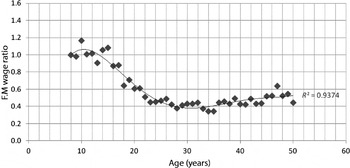
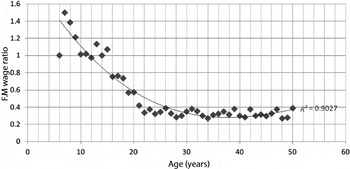
Visiting Huddersfield in 1849, Angus Bethune Reach found that for women employed in the mills of the town, ‘The average [weekly earnings] may be about 8s.6d.’, whereas for men they ‘may be placed at from 14s. to 15s. per week.’ This wage ratio contrasts favourably with the carding, drawing and spinning departments that Reach viewed at the Houldsworth mill in Halifax where, ‘the mechanism was almost exclusively looked after by women and girls at the low wages of 5s. and 5s.6d. The men employed were overlookers, and earned from 15s. to 22s.’Footnote 1 As can be seen in Figures 1 and 2, the typical wage ratio between men and women in the mills of the Lancashire cotton and the Yorkshire wool-textile industries was somewhere between the two preceding examples. This wage gap was seen as beneficial by many commentators, since it discouraged women's work. A pervasive ideology hostile to women's work outside of the home, particularly labour performed in factories and mines, had emerged by the 1820s and 1830s, attracting support from polemicists as diverse as Andrew Ure and Friedrich Engels.Footnote 2
Many historians of women's work argue that this ideology was highly significant in determining the relatively low wages of labouring women. Sonya Rose claims that employers influenced by the ‘separate spheres’ ideology customarily paid women a low wage, believing that it was natural for men to have better-paid jobs than women.Footnote 3 Deborah Valenze believes that ‘Employers did not offer a “living wage” to the female or child since they assumed that she was dependent upon a household headed by a male and therefore did not depend only on her wages for subsistence’.Footnote 4 Joyce Burnette challenges this interpretation, arguing instead that in the absence of ‘distributional coalitions’ – groups working to influence the distribution of income, such as trade unions and employers' organisations – and government interference, occupational segregation and the gender wage gap are determined by natural strength differentials and the unique ability of women to give birth and breastfeed. The high fertility of this period meant that women's comparative advantage in childcare, and absolute advantage in childbearing, had a particularly large impact on reducing their ability to earn.Footnote 5 For Burnette, ideology was created to explain existing patterns of work and pay rather than determining these patterns, and, ‘[e]mployers were not constrained by gender roles, but switched between men and women workers when prices signalled that they should.’Footnote 6
Contrary to the claims of Rose and Valenze, there is little evidence to suggest that employers were significant causes of gender discrimination in the English textile industries between 1760 and 1850. However, occupational segregation occurred to a higher degree than can be explained by the neoclassical approach of Burnette. Historians such as Deirdre Busfield, Katrina Honeyman, and Louise Tilly and Joan Scott have shown that occupational segregation along gender lines played a significant role in the limitation of the employment and earnings opportunities of women. This paper supports their findings and examines the causes of the segregation for the period 1760–1850.Footnote 7 Wage data are drawn from various sources to show the effect that this segregation had on the earnings of women relative to those of men.
2. THE 1834 REPORT
The present paper draws heavily on information provided in the 1834 Supplementary Report on the Employment of Children in Factories and attempts to assess the importance of gender ideology in determining female wages relative to those of men.Footnote 8 The Report is unrivalled for its period in terms of the geographical spread, and the number of workers and employers covered. Published in 1834, the Report provides male and female wage data for textile factories across Great Britain during the four-week period ending on 4 May 1833, and contains a high number of observations of individual employees and employers. For different sectors of the textile industry, such as cotton and silk, it provides the average wage for single-year age-groups – 17, 18, 19, etc. – by gender and region. Therefore it is possible to use these data to gain a clear picture of changes in male and female earnings and participation rates over the life-cycle in the early decades of the nineteenth century.
Unlike many other sources from the 1760–1850 period, the wages stated in the 1834 Report are the average, weekly net payments to each worker.Footnote 9 Thus, the data account for any deductions made from gross piece- or time-rates such as fines or payments for tools, machinery or materials. Moreover, any payments made to subcontracted workers are also deducted. Since men working in factories were much more likely to employ subcontracted assistants than were factory-working women,Footnote 10 the figures contained in the 1834 Report eliminate the overstatement of the gender wage gap that is seen when sources are used which record the payment for a man and his ‘team’ of assistants as though they were wages being received solely by ‘the head of the team’. However, as Hector Macdonald Boot and John Hilary Maindonald highlight, the data from the 1834 Report assume full employment, and so do not reveal gender differences in short-time working or unemployment.Footnote 11
The earnings by age in the 1834 Report were reported by employers on the assumption that the workers being described had worked a ‘standard’ 69-hour week. Thus, unlike many other contemporary sources, any differences in the number of hours actually worked do not affect the gender wage gap shown in the data. Further, when earnings are given by occupation within the cotton and silk industries, the average number of hours worked by individuals in that occupation is given. There is no correlation between the gender distribution of those employed in a particular occupation and the average number of hours reported.Footnote 12 The earnings by age data from the 1834 Report presented below have been truncated at the age of 50 years, since beyond this age the low number of observations and high observed variance made inference problematic and possibly misleading. Although there is also a low number of observations for workers aged less than 10 years, these data have been included since there is low observed variance.
David Jenkins estimates that not much more than a quarter of textile factories in Britain returned the questionnaires on which the 1834 Report is based.Footnote 13 Further, not all of those that did return the forms provided complete information about the workers at the factory. Responding to the questionnaire was voluntary, so the data in the report are almost certainly biased towards large, better-organised firms, which would have been more likely to possess detailed information on the wages they paid, and also to have staff available to complete the forms. Additionally, the owners of large firms can be expected to have been more concerned with their standing in the industrial and political community, with a greater incentive to appear to be doing the bidding of parliamentary investigators. Writing in 1842, William Cooke-Taylor found that: ‘Experience has everywhere shown that great capitalists are more equitable and more merciful employers than persons of limited fortune.’Footnote 14 This view is shared by many historians, with a consensus emerging that the worst exploitation probably occurred under small-scale employers.Footnote 15 Thus, the big-firm bias in this source is likely to give evidence that is not fully representative of typical employment conditions in the early nineteenth century.
Any bias towards large firms means that the gender wage gap is likely to be slightly overstated since trade unions, which often privileged men's work at the expense of women's, typically had greater influence at large firms.Footnote 16 Most other primary sources available for the textile industries in the study period are very heavily biased towards large firms, since such firms were most likely to leave company archives, but the District Commissioners responsible for gathering the data that formed the basis of the 1833 Report on the Employment of Children in Factories, from which the 1834 Report was also derived, were instructed that, ‘[i]t [was] desirable that as many of the smaller manufactories where children are employed as can well be visited should be carefully examined.’Footnote 17 Therefore, the big-firm bias in the Report is lower than in most other comparable sources.
Some errors in data collection for the 1834 Report may have arisen because of the short period of time allowed for the survey, due to ‘…the urgency of the promoters of the bill before the legislature’.Footnote 18 However, the large sample size means that any errors are unlikely to have significantly affected the data.Footnote 19 Of greater concern is the fact that from the introduction to the Report written by Dr James Mitchell it would appear that the District Commissioners did not check whether the returns were a true depiction of employment practices within the mills.Footnote 20 The Report was commissioned with the purpose of providing a statistical basis for proposed legislation on child and female labour, so the factory owners had an incentive to downplay the harshness and extent of the work these groups performed. Oz Frankel has shown that interested parties perceived that giving testimony to government enquiries gave ‘authority’ to their own claims,Footnote 21 suggesting that their testimony may have been biased. However, it is difficult to quantify the effect of this bias, especially as it may have been counteracted by some factory owners overstating the level of female and child labour, in order to claim that such workers were indispensable to the industry and, for the good of the national economy, should not have restrictions placed on their work. Such an argument was successfully used by the silk industry to gain an exemption from the restrictions placed on the labour of children aged 10 to 12 years old.Footnote 22 Because of the uncertainty over how truthful the responses were, the figures presented below are left unrevised.
The work carried out by Mark Blaug on the 1834 Report of the Poor Law Commissioners has revealed how biased Parliamentary Reports of this time could be.Footnote 23 In the 1833 and 1834 Factory Reports, however, the investigators' own reportage and their choice of interviewees provide an apparently balanced methodology. There is none of the strident one-sidedness that is so clearly apparent when, for example, reading the 1834 Report of the Poor Law Commissioners, which Blaug argues ‘...deliberately selected the facts so as to impeach the existing administration on pre-determined lines.’Footnote 24 The 1834 Factory Report includes abundant statistical information on issues such as employment, wages, health and the number of accidents at work. This gives further confidence in its lack of political bias: in the 1834 Report of the Poor Law Commissioners there was a distinct lack of quantitative evidence, and this, Blaug argues, meant that the Commissioners were able to distort the reality of the situation.Footnote 25 The instructions to the district commissioners compiling the 1833 Factory Report, and thereby contributing to the subsequent 1834 Report, state that ‘It should be distinctly understood that the Inquiry is in no respect to be narrowed to the views of any class, or any party or interest.’Footnote 26 Any potential fears that the investigators were in alliance with the employers are further allayed by John Cowell'sFootnote 27 firm rejection in the 1834 Report of British manufacturers' complaints that they were placed at a competitive disadvantage by the high price of labour:
It seems somewhat unaccountable that gentlemen who are in the habit of paying their own operatives according to a scale dependent on the varieties of productive capability in the machine, and according to the extent to which the operative developes [sic] such capability, should think it a simple and easy matter to compare the rate of wages in foreign and English cotton-working.Footnote 28
The data on earnings by age for ‘Lancashire’ cotton covers factories in south-eastern Lancashire as well as areas of Derbyshire, Cheshire and Yorkshire close to the Lancashire border. Unfortunately, it does not include cotton production in Preston, another large Lancashire centre for factory cotton, which was characterised by low wages and high proportions of female and juvenile labour relative to most other cotton-producing areas in Lancashire.Footnote 29 In the 1834 Report data on earnings by age are presented for West Riding wool-textile production, but are headed ‘Wool: Leeds’. Boot accepted this description when using these data, but this seems to have been inaccurate.Footnote 30 In the introduction to the age-earnings data in the 1834 Report, it is stated that ‘From the factories working in wool … [t]hose in the North are nearly all in the West Riding of Yorkshire, and have been classed together. A few from the neighbouring districts, being insufficient to form in any instance a satisfactory average, have been conjoined with them.’ Since no tables with earnings by age are given in the report for the West Riding other than that headed ‘Wool: Leeds’, it would seem that the latter table refers to the whole of the West Riding along with a few factories found in neighbouring areas.
3. MALE AND FEMALE EARNINGS AND OCCUPATIONS
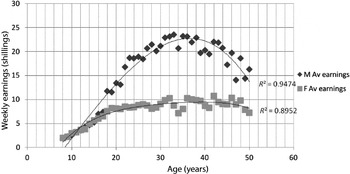
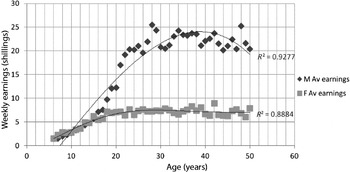
Figures 1 and 2 show female:male wage ratios of around or above 1.0 up until the age of 15 years in both Lancashire cotton and West Riding wool-textile production. After the age of 15 years, the ratio plunges dramatically in both figures. As can be seen from Figures 3 and 4, this is because male wages rise rapidly with age, particularly in the teenage years, relative to female wages which rise more slowly in both branches of the textile industry. The relationship between male and female wages then stabilises from the early 30s. Absolute average wages for both males and females level off, and in some cases begin to decline, from some point in the late 20s to late 30s. The 1834 Report reveals broadly similar general trends in the female:male wages ratios observed for the wool-textile industry in Somerset, Wiltshire and Gloucestershire, the silk industry in Derby, East Anglia and Somerset, the flax industry in Leeds, and the lace industry in Derby and Tiverton.Footnote 31
Female:male (F:M) wage ratio in Lancashire factory cotton production (1833). (Source: British Parliamentary Papers 1834, XIX, 279.)

Female:male (F:M) wage ratio in Yorkshire factory wool-textile production (1833). (Source: British Parliamentary Papers 1834, XIX, 281.)

Male (M Av) and female (F Av) average weekly earnings in Lancashire factory cotton production (1833). (Source: British Parliamentary Papers 1834, XIX, 279.)

Male (M Av) and female (F Av) average weekly earnings in Yorkshire factory wool-textile production (1833). (Source: British Parliamentary Papers 1834, XIX, 281.)

The strength advantage enjoyed by men partially explains the relative decline of female wages from the mid-teens, as some of the factory occupations at this time were physically demanding. The importance of strength as an explanation for some of the gender wage gap can be seen in the greater absolute and relative decline of male wages as workers move beyond their physical prime. However, trade unions also reduced the earning capability of women; in the cotton industry the mule-spinning and dressing unions acted to exclude women from these well-paid occupations.Footnote 32 A further reason for the gender wage gap lies in lower levels of investment in the human capital of females, by both themselves and by their parents.
There is no valid evidence of ‘direct discrimination’ – women being paid less than men for the same work – in the cotton industry in either the primary or the secondary literature relating to the period 1760–1850. The only evidence for direct discrimination in textiles comes from a Parliamentary Commissioners' report on handloom weavers in the declining West of England woollen trade in the late 1830s, which noted that women received lower piece-rates than men.Footnote 33 It should be noted that there was no mention of this practice occurring in the West of England, or anywhere else, in the extensive parliamentary reports of 1802–03 and 1806 on wool textiles, suggesting that direct discrimination may have been a late development in this region.Footnote 34
Johnson argues that direct discrimination occurred in Lancashire mule-spinning around 1830 when women were employed at half the male piece-rate for ‘equal work’.Footnote 35 However, his only reference for this is the article written by Mary Freifeld, and of the references she provides for Lancashire and Scotland, only Raymond Kirby and Arthur Musson mention women receiving a lower piece-rate. They describe women and ‘lads’ in 1831 being employed by Manchester small-mule masters for wages below list prices – a practice against which the local spinners had been striking during the winter of 1830Footnote 36 but do not state how much lower the piece-rate was.Footnote 37 From data on average weekly wages provided by previous authors, Freifeld apparently infers that women were paid half the piece-rate of men, a rather large assumption.Footnote 38 As discussed below, it is not at all clear that women mule-spinners did perform the same work as their male counterparts. As they were not responsible for paying, supervising or recruiting their assistants this would have reduced their value to employers. Women also tended to work on smaller mules and spin coarser yarn, which would have further reduced their earnings.Footnote 39
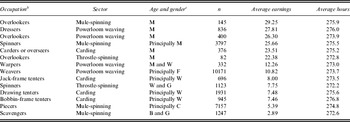
There actually seems to have been a strong aversion to paying men more than women for the same work. In early mills situated in the country there was only a limited demand for adult male labour: in supervision, machine-making and repair work. Rather than pay men higher wages to do the same work as that carried out by women or children in the factories, it was seen as preferable to create alternative employment that could be paid at the higher rate expected for men's labour. The mill built in 1804 by William Strutt went so far as to branch out into the running of an estate and its subsidiary trades in order to provide the employment for men necessary to attract families to come and work in the mill.Footnote 40 Much of the adult gender wage gap for factory workers can be explained by the different occupations in which men and women were employed, as seen in Table 1.

a Average earnings are expressed in shillings and are calculated for a standardized 69-hour week, thus any differences in hours worked do not affect earnings figures. Average hours presented in the table are recorded for a four-week period ending 4 May 1833.
b Explanation of occupational terms: ‘Overlookers’ were responsible for supervising the labour of workers within a given room in a factory. ‘Dressers’ cut the cloth after it had been woven. ‘Spinners (mule-spinning)’ operated spinning-mules to produce cotton thread, and were typically responsible for supervising and disciplining their assistants. ‘Carders’ were in charge of machines used to prepare the cotton for spinning. ‘Warpers’ prepared spun thread for weaving. ‘Weavers’ operated one or more powerlooms to produce cotton cloth. ‘Jack-frame tenters’ tended machines used to twist pieces of cotton after they had left the carding machine. ‘Spinners (throstle-spinning)’ produced cotton thread, but on a different principle to spinning-mules, and did not require any assistants. ‘Drawing tenters’ and ‘bobbin-frame tenters’ operated the carding machines. ‘Piecers’ and ‘scavengers’ assisted mule-spinners, performing a variety of tasks.
c Key to age and gender categories: M=males aged 18 years and above; W=females aged 18 years and above; B =males aged 17 years and below; G=females aged 17 years and below, C=both males and females aged 17 years and below; F=females of all ages.
Source: British Parliamentary Papers 1834, XIX, 427.
The exclusion of women from overlooking or overseeing – the terms are used synonymously in the source – shown in Table 1, is striking and would have been highly significant in restricting female earning capability, as such supervisory roles accounted for four of the six most highly paid occupations across the textile sectors. The average earnings of warpers, the highest-paid occupation to employ a large proportion of women, were only 54.8 per cent of those paid to throstle-spinning overseers, the lowest paid of the male-dominated occupations. It is also noticeable that of the six occupations for which women accounted for a large proportion of the workforce – ‘warpers’, ‘weavers’, ‘jack-frame tenters’, ‘throstle-spinners’, ‘drawing tenters’ and ‘bobbin-frame tenters’ – the most highly paid were ‘warpers’ and ‘weavers’ which also employed high numbers of men.
Busfield has shown that in the nineteenth-century wool-textile industry there was also a clear division between ‘men's work’ and ‘women's work’, with generally very little overlap between the two.Footnote 41 Her evidence is further supported by the employment practices at the woollen mill owned by Benjamin Gott at Bean Ing in Leeds; company records from 1830 show that of 36 distinct occupations employing adult workers across the firm, the only one in which men and women both worked was ‘warpers’. On average, adult females employed at Gott's mill earned only 37 per cent of the wage received by adult males.Footnote 42
It is impossible to ascertain whether any women were recorded as overseers in the original returns on which Table 1 is based, as only the aggregated tables remain. If a particular gender and age category accounted for only a small proportion of the workers, this category is not necessarily mentioned in the tables in the 1834 Report. For example, in the aggregate table for Lancashire given in the Report only ‘women’ and ‘girls’ are listed as performing throstle-spinning. However when these data are then broken down to show figures for eight sub-regions within the county, ‘men’ and ‘boys’ are reported to be employed in throstle-spinning in three of these sub-regions.Footnote 43 There is no mention of females working as overlookers or overseers in any of the tables for the eight sub-regions, however, suggesting that if any such women were employed they were very rare.
The 1834 Report also provides a breakdown of occupations by age and gender for silk manufacturing in the Lancashire town of Manchester and the Cheshire towns of Stockport and Congleton.Footnote 44 Across the three towns again only men were reported as being employed in the highly paid overseeing occupations, and this holds true even when the data are presented for each town individually.Footnote 45 In addition, the Reports derived from the 1833 investigation, which cover cotton, woollen, worsted, silk, flax, lace and carpet manufacture in both rural and urban locations across Great Britain, feature interviews with many men and women in a variety of occupations within the textile factories, yet all of the 199 overseers interviewed were male.Footnote 46 The only possible evidence for female overseers which can be derived from these interviews comes from the testimony of Mark Best, a former overseer in flax-spinning mills, who stated of Mr Hamond's mill in Leeds, ‘I think he has got a young woman there now for overlooker.’ However, this statement is far from conclusive, as Best was not definite that this was the case and was unable to say in which room the female overseer worked.Footnote 47
Examination of the wage books of three cotton mills in Derbyshire and Lancashire, two silk mills in Yorkshire and Essex, one lace mill in Devon, one woollen mill in Yorkshire, and three worsted mills in Yorkshire, encompassing the period 1786–1862, reveals evidence of female overseers only at the Courtaulds silk mill in Essex in the 1830s–1860s.Footnote 48 Even here, women were not employed as ‘second-class overseers’ or ‘principal overseers’, but only as ‘female assistant overseers’, their job title indicating a relative lack of authority, seniority and control over workers at the mill. ‘Female assistant overseers’ worked in the winding department, which employed the youngest workers (boys aged up to 15 and girls aged up to 17 years),Footnote 49 and their earning capacity was commensurate with their lower status; they earned a maximum of 8 s. 6 d. per week, whereas ‘second-class overseers’ and ‘principal overseers’ could earn up to 25 s. and 40 s., respectively.Footnote 50 Research conducted by Coleman on Courtaulds shows that females, including four daughters of George Courtauld, also worked in a supervisory capacity in the winding rooms of the firm in the 1810s, when the subordinate winding workers were female parish apprentices.Footnote 51
Although the shorter working week of women explains some of the gender wage gap that was common in domestic production,Footnote 52 this does not apply to the earnings figures given in the 1834 Report, since these are all calculated for a standard 69-hour week. Further, Table 1 shows no clear correlation between the gender balance of workers in an occupation and the number of hours typically worked, suggesting that other factory data prior to the Factory Acts of 1844 and 1847, which placed specific restrictions on women's labour may not suffer from a gender-time bias either.Footnote 53 The high level of fixed capital investment required for factory production meant that there could be little flexibility in workers' hours, especially at steam-powered urban mills. However, prior to mechanisation, with its concomitant increase in fixed capital requirements, there does seem to have been more of a gender gap with regard to the number of hours worked, and mothers would have worked the shortest hours. For example, the hand-pickers employed by McConnel & Kennedy Mills in Ancoats, Manchester, around the beginning of the nineteenth century were not subject to regular mill discipline or hours. Although their work was primarily based outside the home they had the option to take it home if they wished.Footnote 54 Domestic industry offered workers complete control over working hours, subject to income constraints, and it is no surprise that women and children were more likely than men to do handloom weaving on a casual or part-time basis.Footnote 55
Apart from the few women employed in mule-spinning, the highest-paid factory cotton occupation open to women in 1833 was warping, which offered an average wage of less than 12 s. 6 d. per week and provided only a limited number of jobs. Amongst women aged between 23 and 41 years in Lancashire cotton, and at all ages above 20 years in Yorkshire wool textiles, the average factory female wage was less than half of that paid to men. This compares unfavourably with the female:male wage ratio of 0.75 amongst the Manchester textile workers observed by Arthur Young in 1768, when all the workers worked at home or in small workshops. Amongst woollen cloth workers in Leeds in 1768, Young reported a female:male ratio in average wages of only 0.42, but this is still slightly above the equivalent ratio for those aged 22 years and above in Yorkshire factory wool-textile production in 1833.Footnote 56 It can also be expected that the women domestic workers in Manchester and Leeds worked shorter hours than men, thus overstating the gender wage gap relative to the 1833 factory data. Thus, there is little to suggest that the transition to factory production improved the earnings of women relative to men; indeed the opposite seems to have been the case.
Janet Greenlees rejects the claims of many historians and contemporaries that women in the factories of the cotton industry generally received wages between one-third and one-half of those of men, arguing that the gender wage gap was much smaller, a claim that is supported by my data.Footnote 57 However, she bases her argument on records from individual factories and does not distinguish between adult and child labour, instead basing her claims for the adult female:male ratio on data for all ages. As workers aged under 18 years accounted for 46.5 per cent of the factory cotton workforce in 1833, and workers aged under 16 years – for which the female:male wage ratio was particularly high – accounted for 35.4 per cent, it is easy to see how failing to distinguish wages by age would grossly understate the gender wage gap for adult workers.Footnote 58 Further, much of the data that Greenlees presents are for specific occupations, or for specific rooms within factories, and so fail to account for the importance of occupational segregation which denied women access to many of the best-paid jobs in the industry.
4. UNDERSTANDING GENDER DIFFERENCES IN EARNINGS AND OCCUPATIONS
A lack of data means that it is not possible to be confident of the size of the difference in muscular strength and stamina between the average men and women of the Industrial Revolution period, 1760–1850. However, it is clear that men are typically naturally stronger than women, and this difference probably increased during the Industrial Revolution owing to the preferential allocation of nutritional resources to men.Footnote 59 Differences in strength between the sexes help to account for some of the gender wage gap seen in both domestic and factory production, and in some textile occupations the level of strength required increased with the shift to the factory. The more rapid decline of male wages in the factory, compared with those of females, which can be seen in Figures 3 and 4, indicates the tendency for the work done by men to be more strength-intensive, with male earning capability in cotton dropping particularly fast as the men passed their physical prime.
Just as we lack an accurate measure of average strength differentials between men and women in the nineteenth century, so we do not have an accurate measure of the productivity advantage afforded by strength in factory cotton occupations, especially with regard to different-sized spinning mules. Nevertheless, there is no doubt that prior to the spread of the self-acting mule in the 1830s and 1840s, which all but removed any need for physical strength from the operative, mule-spinning could be done more productively by those with greater strength, as they could operate the heavier machines with more spindles and work these at a faster pace, thus producing a greater quantity of yarn in a given period of time.Footnote 60 Strength was particularly important for work on the largest hand-powered mules of the late eighteenth century, and then again in the 1820s and 1830s when water- and steam-powered mules were lengthened and ‘doubled-up’.Footnote 61
William Lazonick claims that strength advantage also mattered for the ability of operatives to exert the level of physical coercion on juvenile assistants such as piecers and scavengers that was deemed necessary by employers for maximum efficiency. Larger mules not only required more strength from the spinner for their technological operation, they also required more assistants, which under the interpretation made by Lazonick would increase the preference for stronger workers.Footnote 62 Many historians have also emphasised the importance of the male strength advantage in enabling men to create a powerful exclusionary union. Thanks to the union male dominance of mule-spinning continued, even after the introduction of the self-acting mule removed any strength advantage.Footnote 63
The literature emphasising the importance of strength in the evolution of the gender balance of the mule-spinning workforce has tended to understate the importance of ‘endogeneity’ – in this case the extent to which technological change was determined by the nature of the labour force – in the development of mule size. Michael Huberman has challenged this approach, instead claiming that when trying to understand the gender balance amongst mule-spinners:
… it is difficult to separate the relative influences of discrimination and pure abilities; we can, however, be more certain that technical change itself was more an effect than a cause of the substitution of men for women.Footnote 64
As Lazonick highlights, the relative cheapness of the labour of women, and, perhaps more importantly, their perceived docility, which was particularly important with regard to their lower tendency to unionise, should have made them more attractive to employers, but women mule-spinners were never widespread.Footnote 65 Hence it may seem strange that Huberman finds that the size of the mule was extended until it made efficient use of the physical capability of adult males, rather than employers making greater use of female labour.Footnote 66 However, an analysis that more explicitly examines the importance of an ideological climate unwilling to accept female authority or violence perpetrated by women can explain why employers were prepared to pay high wages to men who brought with them all the challenges presented by strongly unionised labour. Both Huberman and Lazonick find that the advantages that men brought to supervisory roles were crucial in creating the male domination of mule-spinning.Footnote 67 The claim made by Lazonick that men were better able to discipline their piecers due to their greater strength does not stand up to close scrutiny, however. The level of force perceived as being needed to motivate adolescent workers without injuring them and therefore making them less productive would not have been beyond the physical capabilities of a woman. The common use of leather straps and ropes for disciplining piecers would have made it easy to inflict pain with relatively little muscular power or exertion.Footnote 68 Even if they were as strong as the mule-spinner it seems improbable that piecers would have retaliated to any punishment or violent behaviour, knowing that they were hired by the day, or the week, and could easily be replaced.Footnote 69
Although it would seem that women possessed the physical capability to administer the requisite physical discipline, a 15-year-old piecer from Manchester testified to the 1833 Commission that the two female mule-spinners he had worked for had never ‘licked’ him or any of the other piecers or scavengers working for them, whereas all eight of the male spinners for whom he had worked had done so on a regular basis. When asked how the female mule-spinners had been able to motivate the piecers without using physical discipline he replied:
They used to ask them if they'd mind their work, and then they'd give ‘em a halfpenny or a penny; and then the piecers was pleased, and worked; and if the piecers had'nt [sic] meat, they used to give ‘em meat, and marbles, and tops; and at any pastime here gives ‘em money; 6d or 1s.Footnote 70
The differing methods of motivation used by the male and female mule-spinners may be seen as reflecting an ideological climate which had very different expectations regarding the behaviour of men and women, affecting their behaviour at work and influencing their desirability as workers to employers. Since it was widely perceived at the time of the 1833 Factory Enquiry that physical coercion was important to the productivity of mule-spinners,Footnote 71 if women were less willing to use such methods this would have made them less attractive to employers. The differing methods of motivation used by male and female mule-spinners, as described by the adolescent piecer quoted above, mirror the much lower frequency and degree of physical punishment meted out by female teachers than by male teachers in the schools of this era,Footnote 72 demonstrating the important influence of gendered cultural norms on workplace behaviour and the operation of labour markets.
Anna Clark has rejected explanations for mule-spinning being male dominated which involve male strength and supervisory capabilities, instead arguing this was achieved through the strength of the mule-spinners’ unions.Footnote 73 The latter were able to exert significant influence on the labour market in the first half of the nineteenth century, and their strength grew thereafter, enabling them to enforce rigid piece-rate lists covering most workers in the industry in the second half of the nineteenth century.Footnote 74 Almost all of the major spinners' strikes in the first four decades of the nineteenth-century included opposition to women's work as mule-spinners.Footnote 75 Such opposition was further encouraged by employers in Salford who replaced striking male spinners with women in 1807 which ‘[s]erved to raise a fear of male redundancy that was to persist through the century’.Footnote 76 Clearly, the mule-spinning unions played an important role in the continued exclusion of women from this branch of the industry. However, Clark fails to explain how the union gained sufficient labour market power to be able to limit effectively the access of women to an occupation that had been female dominated prior to the spread of the mule. The largely biologically determined strength advantage of men in addition to their ideologically based advantage as supervisors would have given their unions a sufficiently powerful basis to act in an exclusionary fashion. The higher levels of human capital of men would have further strengthened their power in the labour market.
Unfortunately, there is very little evidence to show the proportion of women mule-spinners who were supervising their own assistants. However, we do know that when, in an attempt to cut wage costs in 1810, McConnel & Kennedy began to hire women in the place of men on their mules, the women did not supervise, recruit or pay their own piecers, as was standard practice for male mule-spinners, both at their firm and throughout the industry, to do.Footnote 77 Instead, more spinning-room overlookers had to be employed as the system of internal subcontracting was broken up. In 1820, as a result of the increased wastage and search costs they were incurring, McConnel & Kennedy abandoned their strategy and reverted to employing male spinners who were once again responsible for supervising, recruiting and paying the piecers.Footnote 78 Women mule-spinners were widely perceived as being less effective at supervising their assistants, a perception that would have made them less attractive to employers.
In 1813 the first standard piece-rate list was adopted in Bolton and, as the nineteenth century advanced, such lists spread across Lancashire. The lists acted against women since mule-spinners who did not supervise their own piecers became more expensive to employ. In addition, the increasing size of mules not only placed a premium on strength but also required more assistants, increasing the supervisory aspect of mule-spinners' work and creating further preference for male workers.
We know that employers in the cotton industry faced considerable difficulty in finding overseers, particularly those who understood the production process they were supervising.Footnote 79 In female-dominated subsectors such as carding and throstle-spinning, there should have been strong economic incentives for factory owners to employ female overseers. Unlike in mule-spinning, where the picture is clouded by the difficulty of accurately measuring the importance of strength and trade union behaviour in limiting women's employment opportunities, there do not seem to have been any formal or physical barriers to women becoming overseers. No trade unions emerged for overseers employed in the cotton industry until the second half of the nineteenth century.Footnote 80 The only physical aspect of overseeing work was the disciplining of child workers, and as already argued in the case of mule-spinning, this was not beyond the physical capabilities of women. Indeed, the 1833 Report interviews many male overseers aged over 50 years, who would have been considerably weaker than younger adult males in their physical prime. One such man was 60-year-old James Paterson, who worked at the Brown flax-spinning mill in Dundee, ‘…and has been in their employment for about seven years; …he was previously at the spinning-mill at Glammis for twelve years and there lost his right hand and arm, caught by the belt of the wheels, in the preparing floor.’Footnote 81
Burnette argues that the lower level of human capital of women reduced their productivity, and thus their wages and occupational choice.Footnote 82 However, different levels of human capital or skill fail to explain the absence of female overseers. The only apparent formal skill necessary to be an overseer was sufficient numeracy to record worker output and/or hours worked, and the 1833 Report on the Employment of Children in Factories interviewed James Tomalson, a 29-year-old overseer in the picking-room of the White Abbey cotton-mill near Belfast who ‘[d]epones he cannot write’.Footnote 83 Human capital in the form of knowledge of the productive process being supervised would have been beneficial, as is demonstrated by the frustration of employers who could not find overseers with the requisite knowledge to be able to judge accurately worker performance. The years women spent working in the textile mills would have adequately prepared them for such a role. In the carding and throstle-spinning rooms of the cotton industry a considerable proportion of the female-dominated workforce should have had the potential to become overseers. A particularly powerful example of the exclusion of women from overlooking despite possessing greater apparent experience of the relevant production process is provided by the burling chamber at Gott's woollen mill where, in 1830, one male overseer was employed at the weekly rate of 24 s. to supervise a workforce of 120 women. Although it is likely that the female operatives had a more thorough understanding of the production process and of worker capabilities on the machines they were using than the male overseer, the two most highly paid women in the chamber, who were brushers, received an average wage of just 10 s., while the 114 burlers received an average wage of only 5 s. 1½ d.Footnote 84 It seems clear that a woman overseer could have been employed for considerably less than 24 s.
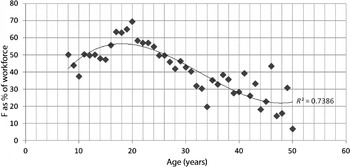
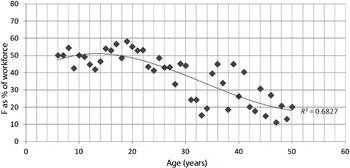
Tilly and Scott use evidence from various towns in Britain and France to show that ‘the vast majority’ of urban female workers, including mill workers, were young and single.Footnote 85 This view is supported by the evidence presented in Figures 5 and 6. Overseers tended to be drawn from the older members of the factory workforce; thus the tendency of women to withdraw from the factory on marriage would have prevented many of them from being able to become overseers. However, as can be seen in Figures 5 and 6, female withdrawal from the textile workforce was by no means total, and is insufficient to fully account for their relative absence amongst overseers. The information used to construct Figures 5 and 6 does not contain data on the length of the factory experience of each worker but women in their 30s and 40s can be expected to have typically spent a considerable length of time working in factories and to have gained an understanding of the processes in which they were involved. It may be speculated that had higher-paid work been available, this might have encouraged more women to remain at work in the factories for longer, creating a larger pool of potential female overseers.
Females (F) as a percentage of Lancashire factory cotton workers (1833). (Source: British Parliamentary Papers 1834, XIX, 279.)

Females (F) as a percentage of Yorkshire factory wool-textile workers (1833). (Source: British Parliamentary Papers 1834, XIX, 281.)

If overseers worked long hours this could have made it difficult for women to combine such work with mothering or domestic responsibilities. However, Table 1 shows that there was no significant difference between the average hours worked by overseers and those worked by employees in all-female and female-dominated factory cotton occupations. The same was true for silk factories in Manchester, Macclesfield and Congleton.Footnote 86 Since women aged above 30 years were still employed in factory textile production in considerable numbers despite the long hours they had to work, the long hours worked by overseers should not have precluded women from being employed in this occupation.
5. THE IMPORTANCE OF RESISTANCE TO FEMALE AUTHORITY
The only way to explain the near total absence of female overseers in textiles during the first half of the nineteenth century is through the existence of a pervasive ideology unaccepting of female authority. It is significant that the female assistant overseers at the Courtaulds mill worked only in the winding department, where males aged 16 years and over or females aged 18 years and over were never employed.Footnote 87 If women were sometimes found as overseers in English flax mills this can be explained by most of the processes in factory flax production being performed exclusively by children, women, or a combination of both so female overseers could have worked in rooms where no men would have been subject to their authority.Footnote 88 It was apparently ideologically unacceptable for labouring women to have authority over adult males, and a strong preference was shown for male supervision, even when the subordinate workers were children or women.
Examining cotton in the late nineteenth and early twentieth centuries, Schwarzkopf has shown the friction that existed between notions of gender-appropriate behaviour and employment that were constantly being renegotiated, particularly by working-class men and women.Footnote 89 However, the ideological unwillingness of men to accept female authority seems to have been too strong to be subjected to such a renegotiation during the period studied here.
The ideology concerning female authority affected economic relationships even where there were highly competitive product markets and no government or trade union interference. While employers may have been driven by ‘androcentric blindness’ unconsciously to underestimate the suitability of women for an occupation, it seems more probable that they were responding to worker preferences when appointing overseers.Footnote 90 Workers, particularly adult males, may have objected to working under female supervision and women may have been unwilling to take on jobs or to behave in a manner which compromised their feminine identity. Clark has shown that the honour ‘artisan’ men (i.e. men that worked in a manual trade perceived to be skilled, which typically featured means by which workers tried to restrict entry to the trade) derived from their employment was severely diminished by the presence of women in their occupation.Footnote 91 Whilst not all the men employed in textile mills could be categorised as ‘artisans’, any working in a position subordinate to a woman may have felt that their male ‘honour’ had been greatly diminished. Even where there is no explicit objection by workers to female supervision obviously apparent to the historian, it is likely that a distaste amongst workers for such an arrangement would have made female supervisors less productive, discouraging employers from employing women as overseers.Footnote 92
6. CONCLUSION
This paper has given what may seem a disproportionate amount of attention to the access of women to overseeing occupations, given the small proportion of adult factory employment for which these accounted and the small impact that they had on the aggregate gender wage gap. However, overseeing provides clear evidence of gender ideology limiting the access of women to supervisory work which is difficult to demonstrate conclusively for most factory occupations in the period of the Industrial Revolution due to insufficient evidence on a range of issues, such as the importance of trade unions or of strength differentials between the genders. The study of overseers provides greater confidence that gender ideology impeded the access of women to other factory occupations, such as mule-spinning, which involved the supervision of subordinate workers where the evidence for the impact of gender ideology is more complicated.
It was the occupational segregation that resulted from such ideology, as well as biological and physical differences between the sexes and trade union behaviour, that severely curtailed the earning capacity of women after the move to factory production. There is only very limited evidence of females being paid less for the same work as males in the period 1760–1850, and this occurred in domestic production. The adult female:male wage ratio calculated from the 1833 factory data contrasts unfavourably with Young's figures for Manchester and Leeds in 1768, when work was undertaken in the home, particularly given the shorter hours that women can be expected to have worked in domestic production. Recent work carried out by Craig Muldrew emphasises the high level of employment that spinning provided for women across the country prior to mechanisation in the mid-eighteenth century, something that declined dramatically from the mid-eighteenth century, along with the relatively good wages available to some of the women employed in hand-spinning.Footnote 93 The shift to factory production also meant that hours of work became much less flexible, typically requiring all workers to work full time and away from home or not at all. The decreased utility arising from the loss of control over the location and hours of work must have hit women particularly hard as it made it more difficult for them to combine paid work with the domestic and maternal responsibilities expected of them.
The decreased access of women to the best-paying jobs with the shift of textiles into the factories was the result of unionisation, as well as gender differences in strength and human capital, but was also due to an ideology that made workers unaccepting of female authority within the workplace being widespread at a time when the work environment was becoming increasingly formalised and hierarchical. Jobs requiring authority over other workers were the highest-paid forms of factory textile employment and as these were widely unavailable to women this had a significant negative effect on their earning capability.
ACKNOWLEDGEMENTS
I would like to thank all the members of the academic community who have provided comments on various versions of this paper, especially Jane Humphries and Joyce Burnette. This paper also benefited greatly from the suggestions of the anonymous reviewers. All errors are, of course, my own.