



Estimates of the stratigraphical and paleogeographical ranges of fossil taxa depend on sample sizes, with the limiting case being a sample consisting of a single known specimen. The cnidarian order Conulariida Miller and Gurley, Reference Miller and Gurley1896 in the subphylum Medusozoa Petersen, Reference Petersen, Larwood and Rosen1979 comprises multiple genera that are represented by < 50 reposited specimens, in some cases from a single locality and stratum. The present note deals with two such genera, Galliconularia Van Iten and Lefebvre, Reference Van Iten and Lefebvre2020 and Glyptoconularia Sinclair, Reference Sinclair1952. The former genus previously was known from the Lower Ordovician of the southern Montagne Noire in France; the latter was known from the Middle Ordovician of the central Moroccan Anti-Atlas (Van Iten et al., Reference Van Iten, Gutiérrez-Marco and Cournoyer2022) and from the Upper Ordovician of cratonic North America (Van Iten, Reference Van Iten and Landing1994; Van Iten et al., Reference Van Iten, Gutiérrez-Marco and Cournoyer2022). Glyptoconularia was represented by < 12 reposited specimens, and Galliconularia was based on a total of 32 specimens.
Described herein are (1) the first known specimen of Galliconularia from the Silurian System (Prague Basin, Czech Republic) and (2) the first known specimens of Glyptoconularia from the Middle–Upper Ordovician of the Prague Basin (Figs. 1, 2). Galliconularia cf. G. azaisi (Thoral, Reference Thoral1935) is from the Ludlovian Kopanina Formation at the Dlouhá hora (Kosov Hill) locality, which is situated ~1 km south of the town of Beroun in central Bohemia (Fig. 1). This specimen was first described and figured by Bouček (Reference Bouček1928, pl. 5, fig. 14), who named it Conularia poctai Bouček, Reference Bouček1928. Glyptoconularia is represented by three very small fragments preserved in siliceous nodules. These were collected by one of the present authors (OZ) in an open field as float material derived from the Middle–Upper Ordovician (upper Darriwilian–lowermost Sandbian) Dobrotivá Formation near the village of Malé Přílepy, which is located ~8 km north/northeast of Beroun (Fig. 1).
Locality map showing the sites where Ordovician Glyptoconularia and Silurian Galliconularia were found in Bohemia (Czech Republic). Modified from Chlupáč et al. (Reference Chlupáč, Brzobohatý, Kovanda and Stráník2002, fig. 19). 1, Dlouhá hora (Kosov Hill); 2, Malé Přílepy.
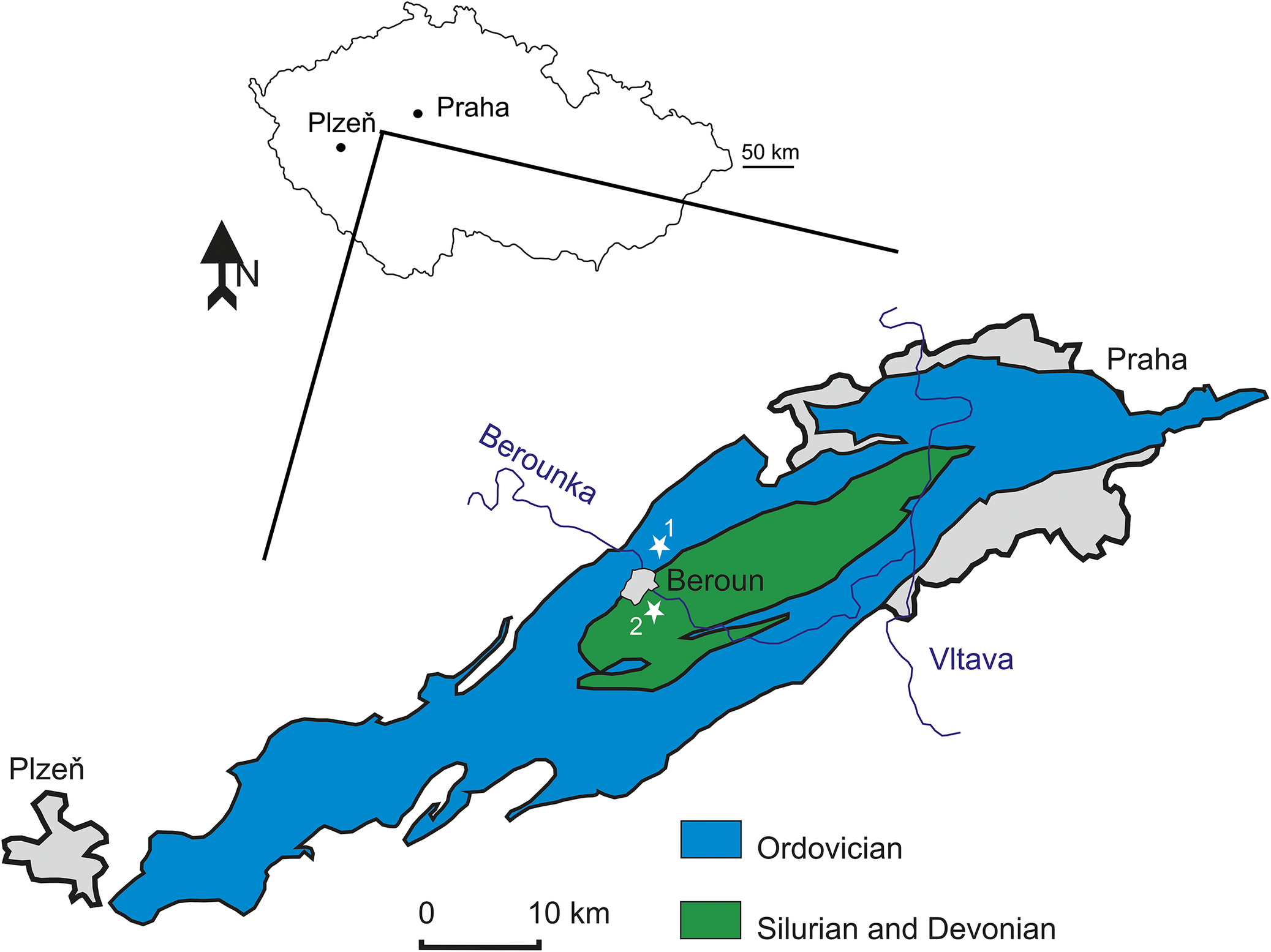
Figure 1. Long description
At the top left, an inset outlines the Czech Republic with Plzeň and Praha labeled, and a bold line indicating the main map area. The main map below is oriented with north at the top left, as shown by a north arrow. The map displays a region with blue for Ordovician rocks and green for Silurian and Devonian rocks, with gray for surrounding areas. The Berounka and Vltava rivers are labeled in purple, running through the map. The town of Beroun is marked in gray near the center. Two white stars indicate fossil localities: 1 is northwest of Beroun, labeled Dlouhá hora (Kosov Hill), and 2 is south of Beroun, labeled Malé Přílepy. A scale bar at the bottom shows 0 to 10 kilometers. The Ordovician unit forms a broad band from the northwest to southeast, enclosing the narrower Silurian and Devonian unit. The map legend at the bottom right explains the color coding.
(1) Stratigraphic chart for the Ordovician of the Prague Basin, showing the stratigraphic position of Glyptoconularia sp. indet. Modified from Kraft et al. (Reference Kraft, Kraft and Prokop2001, fig. 2) and Lajblová and Kraft (Reference Lajblová and Kraft2014, fig. 2). (2) Stratigraphic chart for the Silurian of the Prague Basin, showing the stratigraphic position of Galliconularia cf. G. azaisi (Thoral, Reference Thoral1935). Modified from Aubrechtová (Reference Aubrechtová2019, fig. 3).
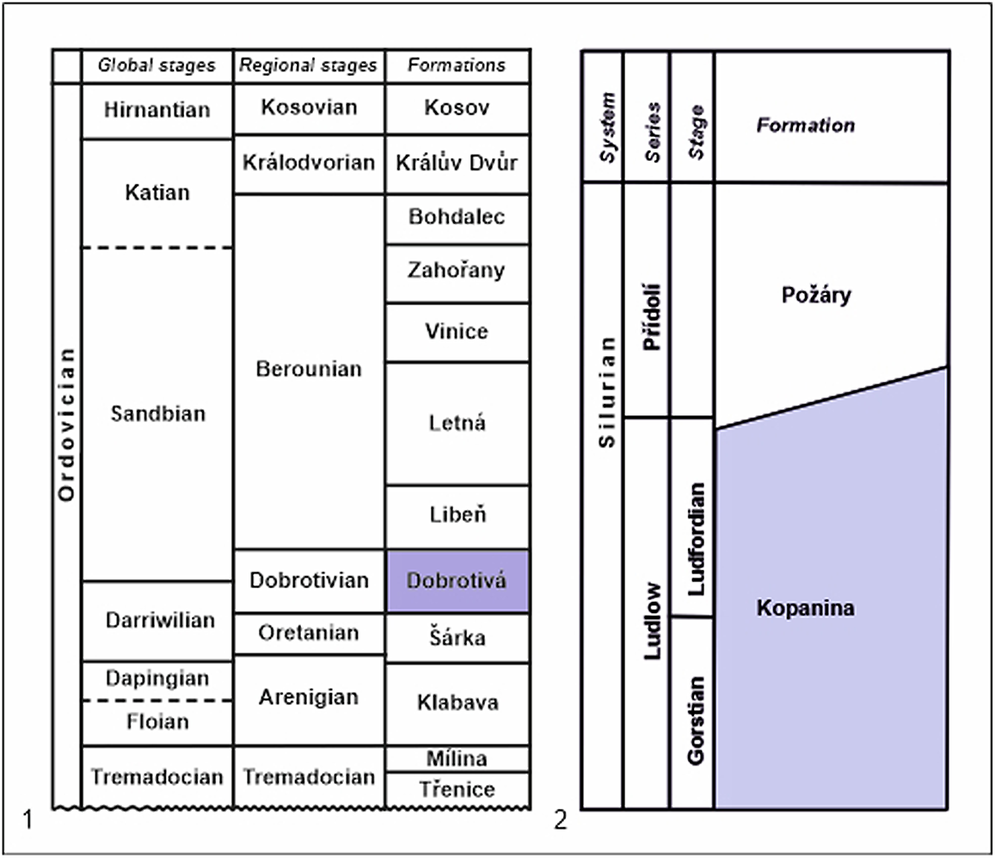
Figure 2. Long description
The left panel displays Ordovician stratigraphy with three columns labeled Global stages, Regional stages, and Formations. From top to bottom, Global stages are Hirnantian, Katian, Sandbian, Darriwilian, Dapingian, Floian, and Tremadocian. Regional stages are Kosovian, Králodvorian, Berounian, Dobrotivian, Oretanian, Arenigian, and Tremadocian. Formations are Kosov, Králův Dvůr, Bohdalec, Zahořany, Vinice, Letná, Libeň, Dobrotivá (shaded), Šárka, Klabava, Mílina, and Třenice. Dobrotivá is highlighted in purple. The right panel shows Silurian stratigraphy with columns System, Series, Stage, and Formation. From top to bottom, System is Silurian, Series are Přídolí and Ludlow, Stages are Přídolí, Ludfordian, and Gorstian. Formations are Požáry and Kopanina, with Kopanina shaded in purple and spanning Ludfordian and Gorstian stages. Požáry overlies Kopanina and extends into Přídolí.
Geological context
The Prague Basin (Fig. 1) is the denudation relict of a former rift basin that existed from the Early Ordovician (Tremadocian) to the Middle Devonian (Givetian) (Havlíček, Reference Havlíček1981, Reference Havlíček, Chlupáč, Havlíček, Kříž, Kukal and Storch1998). This is indicated by the corresponding record of continuous sedimentation within the basin. Again, the examined specimens of Glyptoconularia are from the Dobrotivá Formation, which represents the upper part of the Darriwilian and the lowermost part of the Sandbian stages (Fig. 2). The Dobrotivá Formation is composed primarily of black shales and quartzose sandstones. The black shales are richly fossiliferous at certain levels, as are the abundant siliceous nodules contained in these strata. The nodules commonly occur loose in the soil in open fields, so the precise stratigraphical position of such specimens is uncertain. The distinctive faunal assemblages of the Dobrotivá Formation inhabited a deep (> 200 m) offshore environment (Kraft et al., Reference Kraft, Linnemann, Mergl, Bruthansová, Laibl and Geyer2023).
Sedimentation in the Prague Basin continued smoothly from the Ordovician into the Silurian. The Llandoverian and Wenlockian portions of the Silurian section are represented mainly by black graptolitic shales and shales with tuffaceous admixtures. The single Galliconularia specimen comes from the Dlouhá hora (Kosov Hill) locality of the Ludlovian Kopanina Formation (Fig. 2). This is a shallowing-upward sequence, the lower part of which consists mainly of calcareous shales with tuffaceous intercalations. The upper part of the formation contains shallow-water, organic and biodetrital limestones (Horný, Reference Horný1955). The lone Galliconularia specimen occurs in sparry limestone, and therefore it probably came from the formation’s upper part.
Material and methods
Figured specimens were photographed under low angle illumination using a Nikon EOS 6D digital camera fitted to an Olympus SZX12 binocular microscope after whitening with ammonium chloride.
Repository and institutional abbreviation
The study specimens are housed in the paleontological collections of the National Museum of the Czech Republic (Prague), under collection numbers NM L 21972 (Galliconularia cf. G. azaisi) and NM L 69189–69191 (Glyptoconularia sp. indet.).
Systematic paleontology
Phylum Cnidaria Verrill, Reference Verrill1865
Subphylum Medusozoa Petersen, Reference Petersen, Larwood and Rosen1979
Class Scyphozoa Götte, Reference Götte1887
Order Conulariida Miller and Gurley, Reference Miller and Gurley1896
Conulariida indet.
Genus Galliconularia Van Iten and Lefebvre, Reference Van Iten and Lefebvre2020
Type species
Conularia azaisi Thoral, Reference Thoral1935 from the Lower Ordovician (upper Tremadocian–lower Floian) Saint-Chinian and La Maurerie formations in the southern Montagne Noire, France.
Remarks
The chief anatomical characteristics of non- or slightly exfoliated specimens of Galliconularia azaisi are (Van Iten and Lefebvre, Reference Van Iten and Lefebvre2020): (1) trochoidal transverse ribs fine, gently bell-curve-shaped on the faces and bearing minute, widely spaced nodes connected to extremely slender interspace ridges; (2) facial midlines marked by a low, narrow, continuous rounded ridge over which nearly all the transverse ribs pass without interruption or diminution; (3) transverse ribs terminating or reduced in prominence in the narrow corner sulcus.
Galliconularia cf. G. azaisi (Thoral, Reference Thoral1935)
(1, 2) Galliconularia cf. G. asaizi (Thoral, Reference Thoral1935) from the Kopanina Formation at the Dlouhá hora (Kosov Hill) locality, central Bohemia (NM L 21972): (1) light photograph of the entire visible specimen, oriented with the apertural margin at the top. Upper arrow points to the facial midline, lower arrow to the exposed corner sulcus; (2) light photograph of the apical region of the specimen in (1), highlighting the elevated facial midline. (3, 4) Glyptoconularia sp. indet. from the Middle–Upper Ordovician Dobrotivá Formation at Malé Přílepy in central Bohemia: (3) fragment of a single face, showing the external surface of three longitudinal files of very short transverse ridges (NM L 69189); (4) fragment of another face, showing the inner surface of 11 longitudinal files (NM L 69190). Scale bars = 1 mm (3, 4); 5 mm (1, 2).
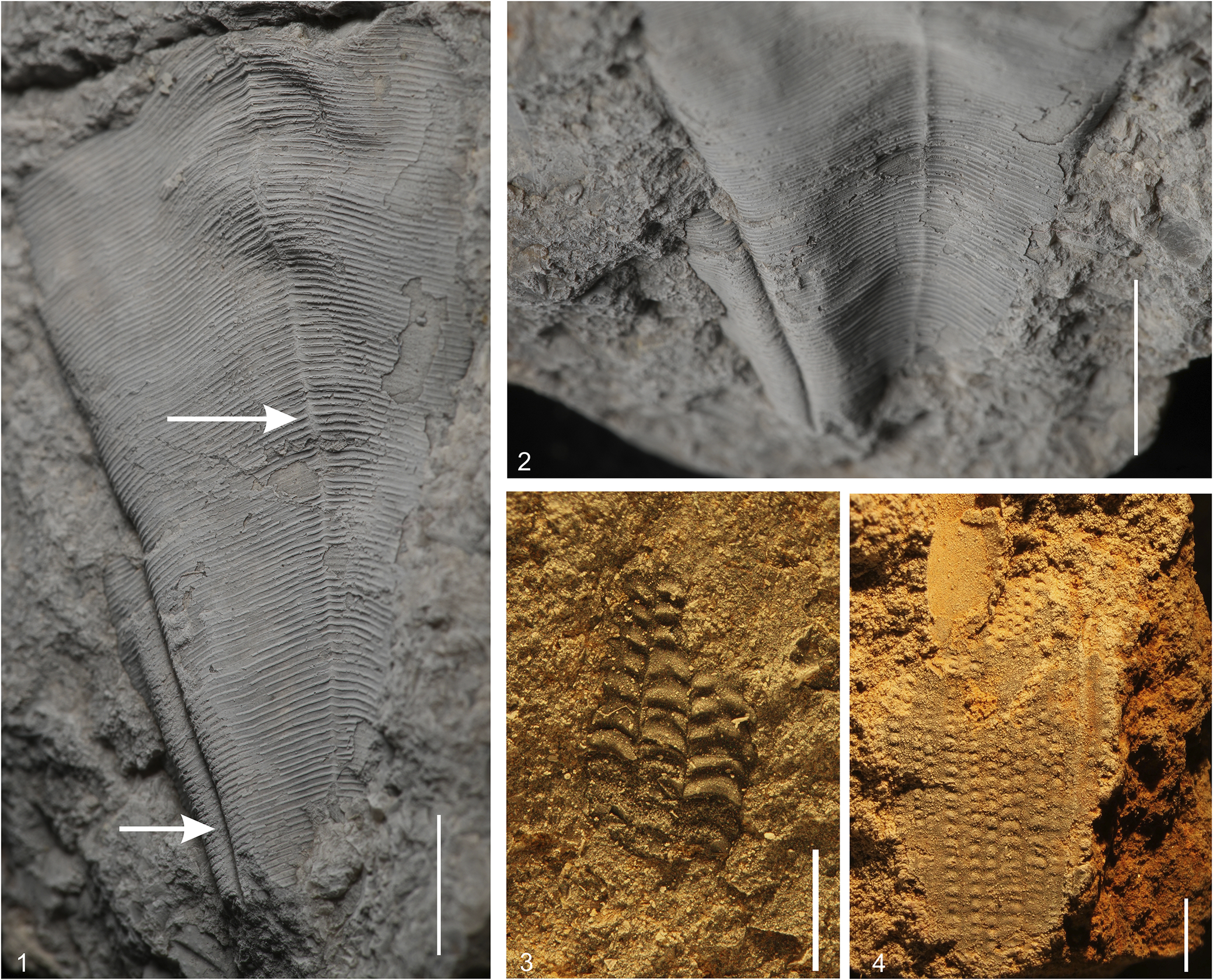
Figure 3. Long description
Error
Reference Bouček1928 Conularia počtai Bouček, p. 86, pl. 5, fig. 14.
Material
NM L 21972 (single incomplete specimen).
Occurrence
Upper Kopanina Formation (Silurian, Ludlovian) at the Dlouhá hora locality, an obsolete inclusive name for localities on Kosov Hill, which is located ~1 km south of the town of Beroun in central Bohemia (Figs. 1, 2). The geographic coordinates of the fossil locality are Lat. 49.9384122N, Long. 14.0541778E.
Description
Single straight, partial periderm, compressed perpendicular to the long axis, exposing most of a single face as well as one of the two corners and a very small portion of the face bounding it on the lower part of its left side. Specimen measures ~23.5 mm in length, ~16 mm in width at the apertural end, and ~5 mm in width at the broken apical end, which is exposed and does not exhibit an apical wall (schott). Apertural edge of the most complete face gently and smoothly arcuate and thus, possibly, corresponding to the original oral margin of that face. Apical angle ~36°, although slightly smaller in the approximate apical half of the specimen. Periderm thin (< 0.1 mm), evidently missing the exteriormost microlamellae, approximately twice as thick at the transverse ribs than in the interspaces, which are approximately twice as wide as the transverse ribs. Corners marked by narrow but deep sulci. Corners and facial midline not thickened and lacking internal carina(e). Facial midlines outwardly folded to form a low, rounded (transversely), continuous longitudinal ridge that is approximately as wide as the corner sulci. Faces crossed by fine, gently bell-curve-shaped, trochoidal transverse ribs, 5 or 6 per mm, which parallel the apertural margin. There are ~110 transverse ribs on the most complete face, on which nearly all of them cross the midline ridge without interruption or diminution, forming an obtuse angle measuring ~170–175°. A few of the transverse ribs terminate at the midline ridge, being present on only one half of the face. Transverse ribs terminating or greatly diminished in height in the corner sulci. Crests of the transverse ribs mostly eroded, although in some places, they display the subcircular bases of minute, widely separated nodes. Interspaces do not preserve interspace ridges, displaying instead coarse oblique wrinkles.
Remarks
In addition to Galliconularia cf. G. azaisi, the Ludlovian Kopanina Formation has also yielded Conularia proteica Barrande, Reference Barrande1854 and Metaconularia solitaria (Barrande, Reference Barrande1867) (Mergl, Reference Mergl2023; Van Iten, unpublished observations on specimens in the collections of the National Museum of the Czech Republic in Prague). The single known Bohemian specimen of Galliconularia occurs together with an unidentified rhynchonelliform brachiopod in a small piece of sparry calcite. The counterpart of this specimen was evidently not collected or has been lost. This is unfortunate because the crests of the transverse ribs on the part have been mostly eroded to form shallow secondary furrows, and thus the outermost microlamellae (Ford et al., Reference Ford, Van Iten and Clark2016) might no longer be present over the whole of the part. This is especially critical for interpretations of the anatomy of the interspaces, which instead of showing regular interspace ridges, display irregular oblique wrinkles. Features interpretable as the bases of minute, widely spaced nodes are present in some places, and in all other respects the Bohemian specimen falls within the range of variation of the French specimens. Nevertheless, because of the incompleteness of the single Bohemian specimen, the present identification must be provisional. However, should additional, more complete specimens be discovered, and should it be confirmed that they are conspecific with Galliconularia azaisi from France, then the paleobiogeographical and evolutionary implications of such a determination will be highly interesting (see discussion below). Moreover, the name Galliconularia “azaisi” would then be a junior synonym of Conularia “poctai,” so that the correct species name would be Galliconularia poctai for the specimens from Bohemia and the Montagne Noire.
Genus Glyptoconularia Sinclair, Reference Sinclair1952
Type species
Conularia gracile Hall, Reference Hall1847 from the Upper Ordovician (Katian 1/2) of the eastern USA (northeastern Iowa/southeastern Minnesota and east-central New York State) and eastern Canada (western Saint Lawrence River Valley, Québec).
Glyptoconularia sp. indet.
Material
NM L 69189–69191 (three fragments, all preserved in siliceous nodules).
Occurrence
Middle–Upper Ordovician (upper Darriwilian–lowermost Sandbian) Dobrotivá Formation (Figs. 1, 2); field to the east of the village of Malé Přílepy, most likely the lower to middle parts of the formation as indicated by the lithological character of the host concretions and by the presence in the same field of fossils typical only of the Dobrotivá Formation. The geographic coordinates of the fossil locality are Lat. 50.0114197N, Long. 14.1384153E.
Description
Three very small fragments from three different individuals. Fragments measure ~1.6–5 mm in length parallel to the original long axis of the periderm and display from 3–15 longitudinal files of very short, closely spaced (5–7 per mm), arcuate transverse ridges (corrugations). Boundaries between adjacent files marked by a low, very narrow elevation.
Remarks
The Malé Přílepy site is known for its relatively rich faunal assemblage, featuring clearly identifiable species typical of the upper Darriwilian–lowermost Sandbian Dobrotivá Formation. Unlike other sites with siliceous concretions—where, due to erosion and agricultural activity in the fields, concretions from both the Dobrotivá and Šárka formations are often found together—there is no doubt here that this is exclusively the Dobrotivá Formation. The lithological character of the concretions hosting the Glyptoconularia fragments also differs from that of concretions in the Šárka Formation.
In addition to Glyptoconularia sp. indet., the Dobrotivá Formation has also yielded Pseudoconularia klouceki Bouček, Reference Bouček1928 and multiple species in the genus Archaeoconularia Bouček, Reference Bouček and Schindewolf1939 (Bouček, Reference Bouček1928; Bruthansová and Van Iten, Reference Bruthansová and Van Iten2020). Glyptoconularia, with its highly distinctive, chain-mail-like ornament (Van Iten, Reference Van Iten and Landing1994; Van Iten et al., Reference Van Iten, Gutiérrez-Marco and Cournoyer2022), is arguably the most autapomorphic genus of conulariid. The very short, straight or adaperturally arching transverse ridges, arrayed in well-defined longitudinal files, might represent greatly modified transverse ribs. Similarly, the subtle ridges bounding the files might be homologous at some level to the interspace ridges of conulariids like Reticulaconularia Babcock and Feldmann, Reference Babcock and Feldmann1986, in which the interspace ridges line up across the transverse ribs. At present, there are just two described species, namely Glyptoconularia gracilis Hall, Reference Hall1847 from the Upper Ordovician (Katian) of cratonic North America and Glyptoconularia antiatlasica Van Iten, Gutiérrez-Marco, and Cournoyer, Reference Van Iten, Gutiérrez-Marco and Cournoyer2022 from the Middle Ordovician (Darriwilian) of the central Moroccan Anti-Atlas. Owing to their fragmentary state, the Bohemian specimens cannot be identified to species level. Together, though, they preserve enough of the periderm to justify their assignment to Glyptoconularia. Moreover, the stratigraphical provenance of the specimens is established unequivocally by the petrological characteristics of the host siliceous concretions and by the presence at the same locality of clearly identifiable invertebrate species typical of the Dobrotivá Formation.
Significance of the discoveries
The present two discoveries extend the stratigraphic and/or paleogeographical ranges of two of the rarest conulariid genera in a paleontologically distinctive part of Europe that has long been famous for its conulariids, which range collectively from the Lower Ordovician (Tremadocian) to the Middle Devonian (Givetian) (e.g., Barrande, Reference Barrande1867; Bouček, Reference Bouček1928, Reference Bouček and Schindewolf1939; Mergl et al., Reference Mergl, Ferrová and Frýda2016; Bruthansová and Van Iten, Reference Bruthansová and Van Iten2020; Bruthansová et al., Reference Bruthansová, Bruthans, Van Iten, Rak and Schweigstillová2022, Reference Bruthansová, Bruthans, Schweigstillová and Van Iten2024; Mergl, Reference Mergl2023; Mergl and Kraft, Reference Mergl and Kraft2023). Furthermore, these discoveries illustrate very clearly a fundamental principle of sampling, namely that the magnitude of the uncertainty in estimates of the ranges of fossil species is inversely proportional to sample size (Foote and Miller, Reference Foote and Miller2007). The discovery of Galliconularia in the upper part of the Silurian System also shows that this genus survived the End Ordovician Mass Extinction Event, which therefore appears to have had even less of an impact on the taxonomic diversity and morphological disparity of conulariids than previously thought (Van Iten et al., Reference Van Iten, Burkey, Leme and Marques2014). Again, future discoveries of additional specimens from Bohemia could confirm that they are conspecific with Galliconularia azaisi from the Lower Ordovician of France. The paleogeographical range of the genus is extended from the southern Montagne Noire, then a part of Core Gondwana (Ballèvre et al., Reference Ballèvre, Martínez Catalán, López-Carmona, Pitra, Abati, Schulmann, Martínez Catalán, Lardeaux, Janousek and Oggiano2014; Lefebvre et al., Reference Lefebvre, Álvaro, Casas, Ghienne, Herbosch, Harper, Lefebvre, Percival and Servais2023), to a peri-Gondwanan area (Prague Basin) that was situated hundreds of km to the east of the Montagne Noire (Torsvik and Cocks, Reference Torsvik, Cocks, Harper and Servais2013). However, in the Ordovician, the two regions were part of the same, high-latitude biogeographical Mediterranean Province (Spjeldnæs, Reference Spjeldnæs1961; Havliček, Reference Havlíček1989; Gutiérrez-Marco et al., Reference Gutiérrez-Marco, Sa, Garcia-Bellido and Rabano2017; Kraft et al., Reference Kraft, Linnemann, Mergl, Bruthansová, Laibl and Geyer2023), so faunal exchanges between them are not totally surprising. Likewise, the discovery of Glyptoconularia in the Middle–Upper Ordovician of the Prague Basin, although not extending its temporal range (Van Iten et al., Reference Van Iten, Gutiérrez-Marco and Cournoyer2022), does lengthen its known paleogeographical distribution near and along the margin of South Polar Gondwana (Fig. 4). Furthermore, it diminishes somewhat the otherwise striking taxonomic distinctions between the Ordovician conulariid faunas of Bohemia and cratonic North America (see, e.g., Van Iten and Vyhlasová, Reference Van Iten, Vyhlasová, Webby, Droser and Paris2004). Then, too, strong similarities between Late Ordovician faunas from Bohemia and Morocco have been repeatedly demonstrated for several other groups, e.g., brachiopods, bryozoans, echinoderms, and trilobites (see Havliček, Reference Havlícek1970, Reference Havlíček1971; Destombes et al., Reference Destombes, Hollard, Willefert and Holland1985; Jiménez-Sanchez and Villas, Reference Jiménez-Sánchez and Villas2010; Lefebvre et al., Reference Lefebvre, Nohejlová, Martin, Kašička, Zicha, Gutiérrez-Marco, Hunter, Álvaro, Lefebvre, Van Roy and Zamora2022). It is therefore logical to find occurrences of the conulariid genus Glyptoconularia in these two regions of the Mediterranean Province. Moreover, given the extreme rarity of macroscopic specimens of Glyptoconularia, it might prove worthwhile to process carbonate (and other) rocks for microscopic fragments of the genus in Middle–Late Ordovician (and younger) formations of other, tropical or subtropical terranes, including Australia, Avalonia, Baltica, and Siberia, which lay between Laurentia and eastern Gondwana or along the paleoshoreline of the supercontinent (Fig. 4). This procedure has yielded minute fragments of Glyptoconularia from rock units in which the genus has not been found as macroscopic specimens (Van Iten et al., Reference Van Iten, Fitzke and Cox1996).
Middle–Upper Ordovician paleogeographical map (~456 Ma) showing the distribution of Glyptoconularia Hall, Reference Hall1847 in cratonic North America, South Polar Gondwana (Morocco), and the Prague Basin. Base map modified from paleogeographical map number 79 of Scotese (Reference Scotese2021). Aval, Avalonia; Aus, Australia; B (yellow), Middle–Late Ordovician (Dobrotivá Formation) locality in the Prague Basin of Bohemia (Czech Republic); Balt, Baltica; L (black), Late Ordovician localities in cratonic North America (from left to right, Upper Mississippi River Valley, east-central New York State, westernmost Saint Lawrence River Valley, Québec); Laur, Laurentia; M (red), Middle Ordovician (Taddrist Formation) locality in the central Anti-Atlas of Morocco; SA, South America; Sib, Siberia.
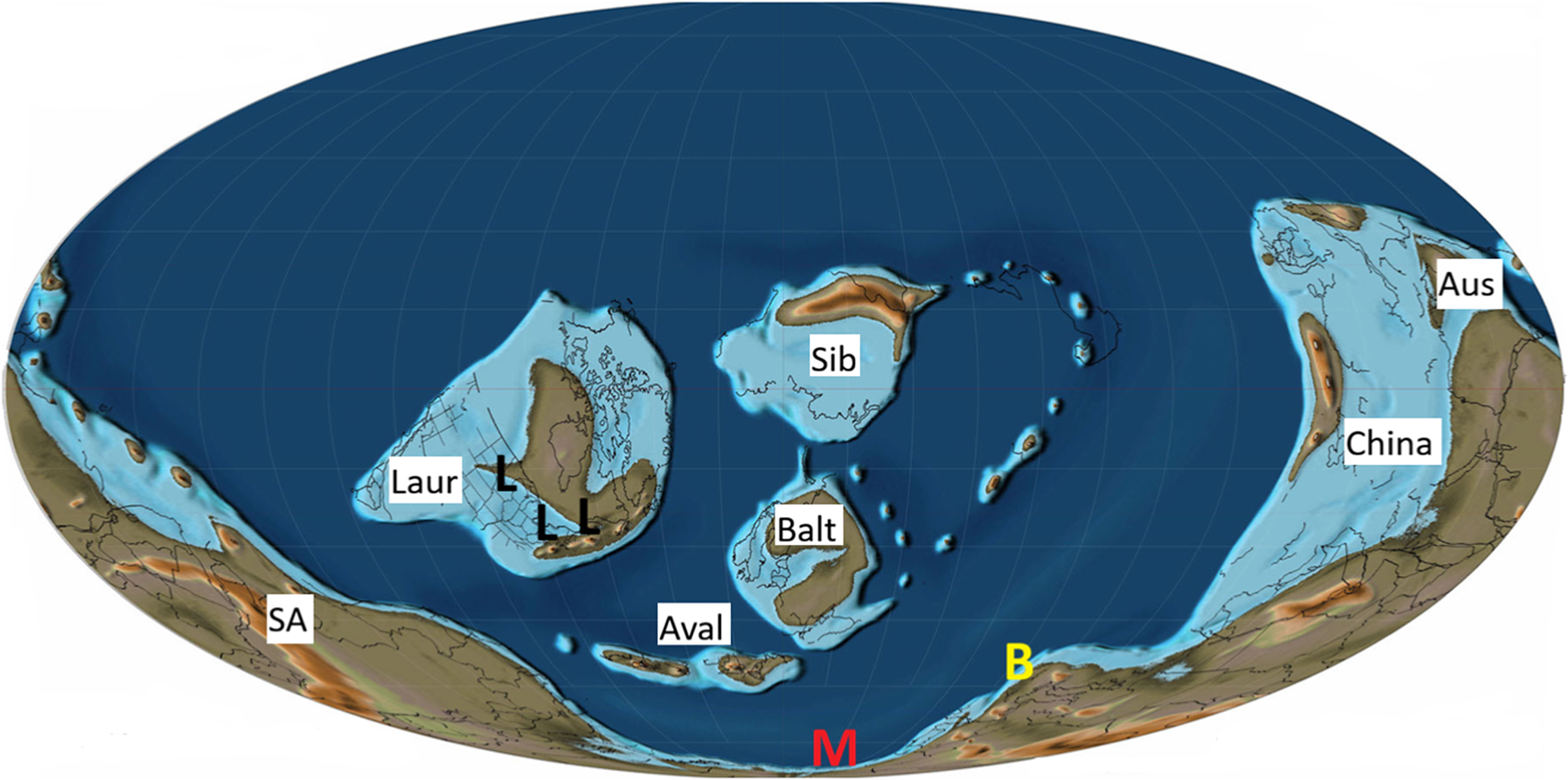
Figure 4. Long description
Starting at the southwest, S A is labeled on the continent. Moving northeast, Laur is marked centrally with two black L symbols indicating Late Ordovician localities. Southeast of Laur, Aval is labeled. Balt is northeast of Aval, with Sib further north. To the east, Aus and China are labeled. Along the southern margin, a red M marks the Middle Ordovician locality in Morocco, and a yellow B marks the Middle to Late Ordovician locality in the Prague Basin. The map shows continental outlines, shallow marine areas in blue, and brown landmasses. Glyptoconularia distribution is indicated by colored locality markers.
Acknowledgments
The authors thank editor R. Elias and reviewers O. Vinn and G. Young for their corrections of and constructive comments on the original version of our manuscript. HVI and EW thank C.R. Scotese for sending them the link to his set of paleogeographic maps for ArcGIS. This study was financially supported by the Hanover College Faculty Development Committee (HVI) and by the Ministry of Culture of the Czech Republic through the DKRVO 2024–2028/2.I.c, National Museum, 00023272 (to JB).
Competing interests
The authors declare none.



