

Introduction
Many studies of income in old age deal with the likelihood of poverty among elderly people relative to younger age groups, and address such questions as how many of the old are poor, and how many of the poor are old. They have found that since the mid-1970s income levels in old age have generally improved, at least in many developed societies, alongside the development of pension systems (Casey and Yamada Reference Casey, Yamada, Rein and Schmèahl2004; Smeeding Reference Smeeding, Binstock and George1990). Smeeding, Rainwater and Burtless (Reference Smeeding, Rainwater, Burtless, Danziger and Haveman2001) 's study of Organisation for Economic Co-operation and Development (OECD) member countries based on the Luxembourg Income Study showed that 13 of 17 had experienced a decrease in relative poverty rates among older people since the late 1970s. Casey and Yamada (Reference Casey and Yamada2002), from a study of old-age income in nine OECD countries, found that those who had not yet stopped working, regardless of pension entitlement, had the lowest risk of being in the lowest income quintile. When the absence of work-related expenses, access to private pensions and assets and intra-household transfers (or inter-generational support) were taken into account, however, the transition from work to retirement seemed to result in only a modest fall in material wellbeing. Their overall conclusion was that, while income does fall with age, older people are not substantially less well off than those of working age, with the exception of women living alone. From a comprehensive literature survey of 11 international comparative studies of poverty, income distribution and age, which covered some 44 countries around the globe, Whitehouse (Reference Whitehouse2000) concluded that older adults are proportionally represented, or even under-represented, among the poor. He also found that older people's incomes were typically around 80 per cent of those of the population as a whole, and that the percentage increased through the 1980s and 1990s. In sum, a reduction of the relative poverty rate among older people has been achieved in many countries.
Older people, however, are very diverse. Bardasi and colleagues' studies of the United Kingdom case found that occupation has an important association with poverty risk in later life (Bardasi and Jenkins Reference Bardasi and Jenkins2002; Bardasi, Jenkins and Rigg Reference Bardasi, Jenkins and Rigg2002). For example, compared to those working in managerial, clerical occupations, personal and protective services, those in a craft occupation had a much higher risk of low income in old age, regardless of how long the individual had worked. It is commonly understood that work history or duration influences an individual's entitlements to occupational and personal pensions and the accumulation of savings which, in turn, protect against low income in old age. Indeed, membership of an occupational pension scheme has been found to be associated with a marked reduction in the probability of low income both before and after retirement (Bardasi, Jenkins and Rigg Reference Bardasi, Jenkins and Rigg2002). This may be because most jobs with occupational pension schemes are relatively well paid. Arthur (Reference Arthur2003) also found that financial circumstances after leaving work appear to be shaped predominantly by prior financial circumstances, i.e. work history and past earnings during working life.
As for older women, almost all studies have demonstrated their relatively vulnerable situation (e.g. Jonsson Reference Jonsson, Littlewood, Glorieux, Herkommer and Jonsson1999; Lister Reference Lister2002; Williamson and Smeeding Reference Williamson and Smeeding2004). Women's often intermittent work histories result in insufficient pension entitlements and, in turn, a higher risk of low income in later life. This is especially true in Korea, where the gender role division between male breadwinner and female homemaker and carer was strong among today's older people. Seok and Lim's (Reference Seok and Lim2007) secondary analysis of data from the Living Profile and Welfare Service Needs of Older Persons national survey of 2004 found that older women's poverty rate was 10 percentage points higher than men's, that their average income was only about a third of men's, and that older women depended greatly on public assistance and private transfers compared to their male counterparts. Any analysis of income variations in later life must take into account the gender gap. Unlike older people in other countries who have seen their relative incomes improve, in Korea older people still record a disproportionately high poverty rate. Choi and Ryu (Reference Choi and Ryu2003) found that in 2000 about a third of those aged 65 or more years were in relative poverty (although a slightly lower proportion was in absolute poverty), and that their poverty risk was three to four times higher than that of children and the working-aged.
The Korean literature on retirement and income in old age highlights the distinctive composition of income among older people, in particular the importance of private (i.e. intra-family) transfers (e.g. Choi Reference Choi2007; Kim Reference Kim1998; Kim et al. Reference Kim, Kim, Mo, Park, Won, Lee and Jo1999; Seok Reference Seok2000). Many studies have argued that this is a result of the relatively late development of a national pension scheme; it was introduced about two decades ago and there have been old-age pension full beneficiaries only since 2008. Corporate pension schemes also began only very recently, in 2006, when they optionally replaced Corporate Retirement Benefit schemes. Thus people have been relying on private resource-pooling for old-age income after retirement, mainly through intra-family transfers. Phang et al. (Reference Phang, Shin, Kim and Shin2004: 105–9) found that every third person aged 50 or more years was receiving financial support from her/his family members, and that the ratio increased with age. Although these studies acknowledge that this private income source in old age will lose importance as time passes and an increasing burden is borne by public old-age income security schemes, family members nonetheless are still an important source for support in later life.
The living arrangements of older people remain a significant influence on the risk of poverty in later life. Choi and Ryu (Reference Choi and Ryu2003: 153) found that absolute poverty rates were markedly lower among those who co-resided with working household member(s). From 2000 National Survey of Household Income and Expenditure data, they found that nearly 60 per cent of those aged 65–74 years lived with one or more working-age household members and their poverty rate was just over 16 per cent, much lower than the 68 per cent among those living with non-working age members (under 18 years, frequently grandchildren), or the 46 per cent of those living as a couple without others. Their relative poverty risk (the ratio of a group's poverty rate to the total poverty rate) was also the lowest (0.49) among all types of household. Choi and Ryu concluded that co-residence with economically-active family/household members was a dominant influence on the risk of poverty in old age in Korea. By contrast, they found no systematic relationship between poverty in old age and the presence of a spouse. Kim and Cho (Reference Kim and Cho2006: 19–24) also found that labour earnings, either one's own or the household members', were an important income source. In fact, in 2000 earned income accounted for nearly three-quarters of the total for households headed by a person in their early sixties, and even for older heads it accounted for more than half. It is notable that a high contribution (nearly 74%) from earned income characterised household heads aged 60 or more years that lived with adult children.
More attention has recently been given to older people's labour-force participation as a source of income and, by extension, a factor in lowering the poverty risk. Choi and Ryu (Reference Choi and Ryu2003) found that the poverty rate, as well as the relative poverty risk, among older people in paid work was about half that of the non-working elderly. The so-called ‘activation’ of older people has also been used as a pretext for ‘active ageing’ in many welfare states, although the principal goal is financial sustainability (OECD 2000). For a country like Korea, that has rapid population ageing and is at an early stage of developing old-age income security, raising older people's participation in work is a fiscal necessity.
Many studies have used comparative cross-sectional and longitudinal data to compare older people's income before and after retirement but few have detailed the dynamics of the changes. This study reported in this paper attempts to fill this gap.Footnote 1 The first section of the paper describes the quantitative data and the sampling design. It also defines ‘low income’ as a measure of economic wellbeing of individual retirees. The following two sections present a series of longitudinal analyses of the prevalence of low incomes around the time of retirement. The fourth section reports a multivariate logistic regression analysis of the probability of low income after retirement, which assesses various factors associated with income change after retirement including personal, household, and/or job-related characteristics. The paper concludes by summarising the findings and presenting suggestions for future research.
Data and definitions
This study uses longitudinal data from the first nine waves of the Korean Labour and Income Panel Study (KLIPS) covering 1998–2006. KLIPS drew up an equal probability sample of households from seven metropolitan cities and urban areas in eight provinces using the sampling frame for the 1995 Korean census. The number of sampled households was 5,000, and they had over 13,000 household members aged 15 or more years. The sample was designed to be representative of the adult urban population. Up to Wave 9 in 2006, KLIPS maintained a relatively high sample retention rate (77%) (see KLIPS homepage www.kli.re.kr/klips). In most waves, KLIPS has conducted additional surveys on particular issues, and that of 2003 asked people aged 50 or more years about career jobs, retirement and later life. The analysis sample for this paper was constituted by 580 respondents (294 men, 286 women) to the 2003 Additional Survey that retired during 1998–2005. Those who had never been in the labour market or who retired before 50 years were excluded, as were those aged 70 or more years in 2006 (because almost all had retired completely from the labour market).
Retirement has been defined in various ways (e.g. Kohli and Rein Reference Kohli, Rein, Kohli, Rein, Guillemard and van Gunsteren1991; Kweon Reference Kweon1996: 43–4; Quinn and Burkhauser Reference Quinn, Burkhauser, Binstock and George1990: 318), but here is specified as separation from one's main lifetime employment (rather than using 60 or 65 years as an age cut-off). Only a few previous studies have included the early retired (e.g. Bardasi, Jenkins and Rigg Reference Bardasi, Jenkins and Rigg2002; Disney, Grundy and Johnson Reference Disney, Grundy and Johnson1997; Rein and Stapf-Finé Reference Rein, Stapf-Finé, Rein and Schmèahl2004). Retirement, once described as ‘the institutionalisation of the life course’ (Kohli Reference Kohli, van den Heuvel, Illsley, Jamieson and Knipscheer1992: 93), is becoming ever more diverse, or as Guillemard and van Gunsteren (Reference Guillemard, van Gunsteren, Kohli, Rein, Guillemard and van Gunsteren1991: 383) put it, ‘deinstitutionalised’ or ‘destandardised’. Some people retire early, while others continue to work beyond the state pension age. Some cease work but return a few years later. It is therefore important to regard retirement as a process and to recognise various retirement trajectories rather than treat it as a one-time event. Retirement can be indexed using objective criteria such as reduced working hours or earnings, or by the commencement of pension payments. Alternatively one can use subjective judgements based on self-assessment. Many studies of retirement use an age criterion or cut-off (e.g. 60 or 65 years), mainly because it is often linked to the payment of pensions, but chronological age is meaningless when few people receive old-age pensions – in Korea in 2005, less than one-quarter of the population aged 60 or more years received any old-age or retirement pension.Footnote 2 Retirement can also be defined by complete labour-force withdrawal or by departure from a career job or main lifetime employment. In order to observe the relationship between retirement and income prospects in later life, and the effect of post-retirement work in particular, this study's marker of retirement is departure from one's main job after 50 years of age.Footnote 3
For analytical purposes, the economic wellbeing of individuals is here measured as personal income adjusted for household income (e.g. Chae Reference Chae1992; Förster and d'Ercole Reference Förster and d'Ercole2005; Jeong and Kim Reference Jeong and Kim2007; Oxley et al. Reference Oxley, Burniaux, Dang and d'Ercole1999). An individual's income is measured by the equivalised real current net household income of his or her household (‘income’ for short). Household income is defined as the sum of net cash income from all sources after tax deductions. It includes earnings from employment and self-employment, investment and savings income, rent and investment income from real estate, social insurance benefits including pensions, unemployment benefits, compensation benefits for industrial and other accidents, all cash benefits from the government, and intra-family transfers. To take account of differences in household size, total household income is divided by the square root of household size (equivalence-scale elasticity 0.5). This method has been used in many recent OECD publications, as well as by other Korean analyses of income and equality (e.g. Chae Reference Chae1992; Förster and d'Ercole Reference Förster and d'Ercole2005; Jeong and Kim Reference Jeong and Kim2007; Kim Reference Kim2008).
In sum, the income concept used here is that of disposable household income adjusted for household size. The household income is thereby scaled to the individual, with the assumption that there is a pooling of resources and so economies of scale in living expenses need to be taken into account. For real income comparisons, figures have been adjusted to 2005 consumer prices using the National Statistical Office's Consumer Price Index (see www.kosis.kr). ‘Low’ income is defined as half the median of the distribution of equivalent individual incomes among those aged at least 15 years. The ‘half-median’ income criterion is often used as a common measure for a relative poverty rate. Being a ‘relative’ measure, it changes in value over time with the growth in real incomes.Footnote 4
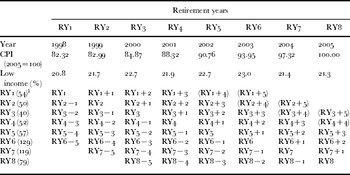
Table 1 presents the longitudinal data that have been analysed. The nine KLIPS waves provided comparable income transition data for eight consecutive years (1998–2005). The retirement year of each individual was identified and labelled as RYx. Incomes in the years leading up to the retirement year (Ryx−5 to Ryx−1) and in those following (RYx+1 to RYx+5) were then examined wherever possible. An individual can have up to eight years of income data between Ryx−5 and RYx+5. For example, 54 people retired in 1998 and they could have income data for up to five years after retirement, but not for the years before retirement, while those who retired in 2001 (RY5) had data from RY5−4 to RY5+3. Following this process, we would, ideally, have 580 cases in total for all RY. The sample size was not identical for each year and there were missing data, so that the available observations for the various RYs range from 527 to 234. Because of the relatively few cases (<200), RYx+4 and RYx+5 were omitted from the analyses.
Longitudinal data for the analysis of retirement and income, Korea, 1998–2005

Notes: 1. Numbers in parentheses refer to available observations for each retirement year. RY: retirement year. CPI: consumer price index. ‘Low income’ is defined as below the half-median of the income distribution of the population each year, where ‘income’ is current net household income, adjusted for household size (e=0.5).
The incomes of the retired: the longitudinal evidence
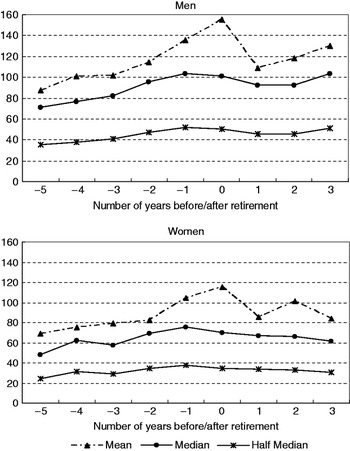
The mean age of retirement for both men and women in the analysis sample was 57.7 years. Figure 1 shows the way in which household income of those who retired changed in the years before and after. To obtain this picture, each individual's income history was arranged around the retirement year (RYx) to create a common retirement year. Figure 1 shows an ‘average’ picture of what happened to income in the years surrounding retirement.Footnote 5 For both men and women, mean income rose steadily until the retirement year, although at a faster rate for men, and then dropped abruptly in the following year. This is partly a function of the unique age-based or number-of-years-served wage system in Korea: wages generally rise with the number of years at one workplace, especially in large companies (Jung and Cheon Reference Jung and Cheon2001), which for many occupations leads to the oldest workers receiving the highest incomes. Men's annual income rose continuously from KRW 1,020,000 in RYx−3 to a peak of KRW 1,550,000 in the retirement year, and then fell to KRW 1,090,000 in RYx+1. Interestingly, men's income in the post-retirement years rose again after one year. The median and half-median incomes followed the same pattern, except that they peaked in the year before retirement; and both the reduction after retirement and the recovery in the following years were less marked than with mean income. The half-median income increased steadily, from KRW 360,000 in RYx−5 to a peak at KRW 520,000 in RYx−1, and decreased to KRW 460,000 in RYx+1 and in RYx+2. Then it rose again up to RYx+3 – the rising trend continued until RYx+5 but is not plotted because of the small number of observations. The fluctuation in women's income was negligible in comparison with men's; their post-retirement income, unlike men's, tended to decrease with time.
Income by year relative to retirement year, Korea 1998–2005.

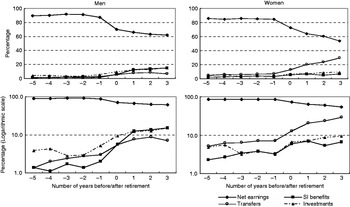
The data indicate different circumstances around the time of retirement. On the one hand, a regular employee with higher income may face an abrupt drop in income upon retirement but somehow retain the ability to increase their income in later years – perhaps by finding a bridge job, or from sources other than earnings such as investments and social insurance benefits. On the other hand, an individual with a low income before retirement does not change that state by retirement: most need to keep working to maintain their income, in which case it hardly changes. Figure 2 presents a breakdown of income around the retirement year using the ‘mean of the share’ method. This shows the relative shares of each income source (cf. Chang and Lee Reference Chang, Lee and Chang2008: 20–1). For both men and women, retirement from a career job meant a drop in the earnings' share, although they did not cease entirely. In men's case, the fall was from 88 per cent in RYx−1 to 70 per cent in the retirement year and to 66 per cent in RYx+1. The lower diagrams are of the same data series but on a logarithmic scale to bring out the subtle gender differences. For men, social insurance benefits and income from financial and real estate investments rose from RYx−2 onwards, largely making up for the loss of earnings. In particular, the proportion of social insurance benefits nearly doubled each year, from 2 per cent in the year before retirement to nearly 13 per cent in the year following retirement. On the other hand, for women, public and private transfers rose as a proportion of income by more than four times, from 7.2 per cent in the year before the retirement to 21 per cent in the year following retirement, and to nearly 30 per cent by RYx+3.
Composition of income by year relative to retirement year.

Apart from these small but notable changes after retirement, the important role of earnings did not disappear until the last year of available observations, i.e. three years after retirement. In RYx+3, 62 per cent of total household income for men, and 54 per cent for women, was still from earnings. This finding contrasts with the pattern found for studies of retirees in Western countries that the earnings share drops abruptly upon retirement, with alternative sources such as pensions and benefits filling most of the gap (for the British case seeBardasi, Jenkins and Rigg Reference Bardasi, Jenkins and Rigg2002: 140–2). The different trajectory in Korea may partly be because older people's rate of co-residence with other family members remains relatively high and their earnings sustain the household's income. Chang and Lee (Reference Chang, Lee and Chang2008: 17) warned that comparisons that do not take co-residence into account will give a biased estimate of the earnings share. In each of the KLIPS's eight waves, one-generation households, i.e. individuals or couples only, were between 20 and 27 per cent of the total (around 5,000), while two-plus generation households accounted for the rest (Nam et al. Reference Nam, Seong, Lee, Choi and Shin2007: 52–6). At the eighth wave (2005), one-person households accounted for 14.3 per cent, one-generation households for 12.5 per cent, and two- or three-generation households for as high as 73 per cent. With this in mind, household members' working status (rather than partner's as is usual in Western studies) was included in the multivariate analysis as an explanatory variable.
An alternative explanation is that older people continued working after retirement. The age of retirement from career jobs is relatively low (mean 54 years, according to Phang et al. (Reference Phang, Shin, Kim and Shin2004: 60) from the KLIPS 2003 Additional Survey), but Korean workers' actual age of retirement, when they completely exit the labour force, is 68 years (OECD 2004: 80). Chang and Lee (Reference Chang, Lee and Chang2008: 40) concluded that older people in Korea rely on earnings because of the lack of public income transfers and the belated development of a Korean pension system. Indeed, every third person in the analysis sample worked after retirement from their career. In the case of men, post-retirement workers accounted for about 46 per cent.
Changes in the prevalence of low income
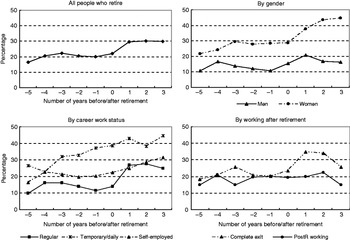
Evidence about changes in the incidence and changes in prevalence of low income over the years before and after retirement is presented in Figure 3. The top left graph shows the percentage of all the retired whose income was less than the half-median level, plotted from five years prior to retirement until three years after. For five consecutive years until retirement, around 20 per cent had ‘low income’. Between the year immediately before retirement and the year after, the prevalence increased from about 20 to nearly 30 per cent. After retirement, the prevalence of low income among retirees stabilised at around 30 per cent. This confirms that being retired associated with a higher probability of falling into the low-income group.
Low-income prevalence in the years around retirement.

The top right graph shows the gender differences. It reveals that women were much more vulnerable than men to having a low income after retirement. Prior to retirement, women were more than twice as likely as men to have a low income, and three years after retirement the differential had increased to nearly triple the male rate (16% versus 45%). The bottom left graph provides breakdowns by work status before retirement. Individuals were classified into three groups by their career work status: regular employment, irregular or non-standard (temporary and daily) employment, and self-employment. Among those who had been regular employees, a relatively low percentage had low income prior to retirement. Retirement for this group brings an abrupt change in status, and associated with a large increase in the probability of falling into the low-income group in the year immediately after retirement. Unusually, the prevalence of low incomes among regular employees in RYx+1 was even higher than for the self-employed, but in later years the prevalence of low incomes among former regular employees was always lower than for all other pre-retirement work statuses. The prevalence of low incomes of temporary or daily workers increased steadily and gradually throughout the observation period, and was not greatly affected by the event of retirement. One-third of them were already below the half-median level three years prior to retirement, and the percentage increased steadily to a peak at 45 per cent three years after retirement. The formerly self-employed experienced a similar gradual trend, although the prevalence of low income in this group was much lower than among former irregular employees.
Last but not least, the bottom right graph contrasts the experiences of those that did and did not work after retirement. For the post-retirement workers, retirement itself did not entail any specific changes. The percentage of those with a low income was stable, at around 20 per cent, and even dropped to below 15 per cent three years after retirement. For non-workers after retirement, on the other hand, the prevalence of low incomes increased by 11 percentage points between the retirement year and the year after. As well as gender, career history, and working status after retirement, a wide range of personal, household and other job-related characteristics associated with the probability of becoming poor following retirement.
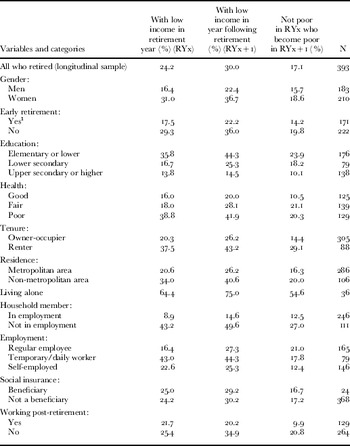
Table 2 presents these characteristics, and shows for various groups the variations in the prevalence of low incomes in the retirement year and the following year. The figures are for the 183 men and 210 women for whom there were data for both the year of retirement (RYx) and the following year (RYx+1).Footnote 6 Individuals were classified by age at retirement, education and health; by housing tenure and whether any co-residing household member(s) had employment; and also by their career job and current working status. From the table, it is clear that women faced a higher risk of low income than men. This is not a new finding – there is a well-established literature on the ‘feminisation of poverty’ in later life (e.g. Jonsson Reference Jonsson, Littlewood, Glorieux, Herkommer and Jonsson1999; Lister Reference Lister2002; Pierson Reference Pierson2001; Seok and Lim Reference Seok and Lim2007).
Low-income prevalence among retired persons, Korea, 1998–2005

Notes: 1. Early retirement refers to retirement before average mandatory retirement age 57 years. All variables refer to status in the retirement year, except post-retirement work status. The second and third columns indicate the percentage of individuals in each group whose income is below the half-median of the income distribution. The fourth column indicates the percentage of those in each group who were not poor in the retirement year but who become poor in the following year.
There was a strong association between age of retirement and the probability of becoming poor after it: those who retired before the mandatory retirement age of 57 years had a low prevalence of incomes below the half-median levels in both the retirement and the following year. The risk of becoming poor after retirement among those who were not poor at retirement was also low, at 14.2 per cent, when the average prevalence for all retired persons was 17.1 per cent, while for those who retired at or over the mandatory retirement age of 57 it was nearly 20 per cent. By contrast, nearly 30 per cent of those who retired at the mandatory retirement age or later were already poor in their retirement year, and the percentage rose thereafter.
Early retirement is not always voluntary, but we must recognise the particular situation of Korea, where for various reasons early retirement tends to indicate a relatively good job. First, many small workplaces do not have a retirement age. According to the KLI Workplace Panel Survey, in 2002 around half of the firms with less than 30 employees did not have mandatory retirement ages, whereas around 70 per cent of firms with 100 or more employees did (cited in OECD 2004: 95). Second, those who opt for early retirement are likely to have been regular employees, because few irregular workers have the option (in many cases, they ‘quit’ or are laid off and find another job but do not ‘retire’), while self-employed persons tend to retire late (most that retire early can manage financially without working). Favourable early retirement benefits may also be part of the explanation: for a few years following the Asian financial crisis of 1997, early retirement benefits were the norm rather than an exception, especially for civil servants and regular employees of large companies.
The analysis reported here is for the period after the 1997 crisis, during which most regular employees retired earlier than the mandatory retirement age and were compensated with considerable early-retirement benefits, so that their financial standing was better than those of irregular workers and the self-employed. In addition, the relatively young National Pension scheme made its first full old-age pension payments only in 2008, while in 2005 less than 3 per cent of the those aged 60+ had generous occupational pensions (author's calculation from Korea National Statistical Office 2006). Apart from the tiny proportion with generous occupational pensions, ‘taking my pension’ was not an incentive to retire for most older workers. In these circumstances, early retirement generally implies an advantaged situation even if it is involuntary.
Park (Reference Park2000) argued that the Korean labour market offers such limited and low-quality job opportunities for older workers that those who lose jobs in their late fifties and early sixties tend to be discouraged, and with a few exceptions among higher-level professionals and managers they exit the labour market completely rather than seek post-retirement jobs. She called this ‘downward labour adjustment’ or the ‘marginalisation of older workers’: most regular workers tend to retire and exit, while temporary or non-wage workers and the self-employed tend to keep working, mainly because most of the jobs available to older people are low quality (cf. Park Reference Park2001, Reference Park2003a, Reference Park2003b: chapter 4). In these circumstances, educational level or previous work experience are irrelevant to the likelihood of working in old age, which contrasts with the situation in countries with more advanced economies, where higher education levels associate with a raised probability (e.g. Smeaton and McKay Reference Smeaton and McKay2003). From this, we can posit that those old people who continue to work after the mandatory retirement age in Korea are likely to be those who are driven by financial needs, whereas relatively well-off persons retire early. This phenomenon is also consistent with the structural factor of limited demand for older workers.
Higher education level associated with a low increase in the prevalence of low incomes (Table 2). Health too was closely related to the change, with those in good health recording only half the risk of becoming poor as compared to those with poor or fair health. Poor health associated with a high probability of having a low income, both at the time of retirement and thereafter. Among those who were not poor at the onset of retirement, however, the effect of ‘poor health’ differed little from that of ‘fair health’: only good health seemed to matter. Home-owners had lower rates of low-income incidence than renters. It turns out that among those who were not poor in the retirement year, renters had the highest incidence of entering poverty (the share increased by nearly 30 per cent). This negative relationship between home-ownership and poverty in old age was documented for five OECD countries by Williamson and Smeeding (Reference Williamson and Smeeding2004). The presence of employed family members in the household associated with markedly lower chances of being poor, whereas living alone associated with a large increase in the percentage of retirees with low incomes.
Living in a metropolitan area or in non-metropolitan urban areas was included to see whether any regional factor had an influence. It was expected that the opportunities for older workers would be greater in rural areas following industrialisation and urbanisation, and that the differential would affect an individual's risk of poverty. Table 2 indicates, however, that there was a higher poverty rate among non-metropolitan (relatively rural) residents, which confirms Choi and Ryu's finding (Reference Choi and Ryu2003), but the difference in the increased incidence of low incomes as between metropolitan and non-metropolitan residents was statistically insignificant in the year following retirement.
As for career effect, it appears that regular employees faced a relatively high chance of becoming poor after retirement, while the prevalence among poor irregular workers and self-employed persons was broadly stable. The abrupt change in the working status of regular employees associated with an abrupt decrease in income, but many temporary and daily workers were already poor before retirement, leaving little room to become poorer. No meaningful association between social insurance benefits and low-income prevalence was found, which reflects the small number of beneficiaries in the sample but also correctly reflects the Korean reality. Having paid work after retirement had a strong negative association with low incomes. Over the retirement transition, 10 per cent of working retirees became poor, less than half the level among non-workers.
In summary, poverty among retirees was closely associated with the living arrangement (living alone or without any working household members), having been irregular workers, poor health, low schooling, and low assets (not being a home-owner). These factors did not change greatly after retirement. Among those who were not poor at the time of retirement, it was the retirees with low assets and low schooling and who lived with no other working household member(s) or by themselves that recorded a relatively high prevalence of low income in the following year, indicating that these three were the most important factors for low-income entry in retirement. At the same time, working in retirement, the presence of working household member(s), good health and higher educational background were buffers against low income after retirement. In other words, in Korea, to avoid becoming poor in retirement it seems essential to have paid work.
The probability of becoming poor after retirement: multivariate analysis
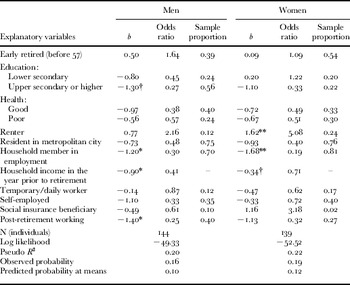
This section presents the results of a multivariate logistic regression that examined the effects of various individual, household and job-related characteristics on the probability of becoming poor, i.e. of falling below the half-median level, in the year following retirement (RYx+1), conditional on not being poor in the retirement year (RYx). The main objective is to show the effect of post-retirement working status (working or not) on the level of income after retirement. The results for men and women are in Table 3. It shows the untransformed coefficients as well as the odds ratios (OR) for low-income entry after retirement (RYx+1). Positive coefficients (OR>1) imply a positive association with increases in the probability of low-income entry, while negative coefficients (OR<1) imply a negative association. For the estimation of the model, all the explanatory variables refer to the retirement year except, obviously, post-retirement working status. The explanatory variables are from the section above, except that ‘living alone’ cases were included in ‘household member not in employment’. Additionally, the equivalised income was added as a control for the potentially high correlation between the level of income in two succeeding years. For this purpose, the logarithm of income during the year previous to retirement (RYx−1) is used instead of that of retirement year (RYx), because the former is believed to capture more reliably the final working year's earnings (it avoids the problem of short earning years).
Logistic regression of probability of low income among retired people, Korea, 1998–2005

Notes: All explanatory variables are categorical except household income. The reference categories are: retired at 57 or later, has elementary or lower educational qualifications, fair health, owner-occupier, resident in non-metropolitan areas, household member(s) not in employment, regular employee as career and not working after retirement.
Significance levels:† p<0.10, * p<0.05, ** p<0.01.
The statistically significant associations differed somewhat for men and women. Working status in retirement turned out to be the factor that most influenced the probability of low-income entry among men: holding all other variables constant, men in work had odds of becoming poor (i.e. falling below the half-median income in the reference year) that were 75 per cent lower. Whether another household member had employment was also important; it reduced the odds of becoming poor by almost 70 per cent. Therefore, paid work, either of the retiree or of a household member (very often adult children), turned out to be the most important buffer to poverty in later life for any male retiree.
For a woman, it was her household members' working status that most mattered: living with working household member(s) reduced the odds of falling into poverty by 81 per cent holding all other variables constant. Unexpectedly the effect of having paid work in retirement was statistically insignificant, while being a home-owner (a proxy for household wealth) was the most influential factor. A renter's risk of poverty was over five times higher than that of home-owners. The estimated coefficient of this factor had the same expected positive sign among men, but was not statistically significant.
For both sexes, household income in the year prior to retirement associated with a decrease in the probability of becoming poor following retirement. For each standard deviation increase in the log household income in the year prior to retirement, the odds of falling into poverty were 0.54 times lower holding all other variables constant (not reported in the table). For women, the odds were 0.65 times lower (p<0.1). In sum, retirees from a higher-income household tended to have a lower risk of falling into poverty after retirement, as one expects. An interesting point, however, is that the influence of household income in previous years (including one's own earnings) was less than that of own or household members' working status after retirement. Higher educational level also decreased the risk of poverty: upper secondary or higher level associated with a reduced probability of low-income entry among male retirees, with their odds of becoming poor lowered by a factor of 0.27. The high education effect, however, was only marginally significant (p<0.1) for men and insignificant for women.
The estimated coefficients for the effect of working career had the expected direction, with a relatively high probability of falling into poverty among regular workers (the reference category) compared to temporary/daily workers or the self-employed, particularly among men, although the differences were not statistically significant. The direction of the coefficient for early retirement was unexpected, however, with a positive relationship between early retirement and low-income entry. This may be because early retirees included not only those who retired early with occupational pensions but also many without. An interaction between early retirement and being a member of an occupational pension scheme would have shown the more direct effect of early retirement, but low sample sizes precluded a formal analysis: only seven women received any social insurance benefits. To conclude, it has been shown that in Korea, being in paid work is an important substitute for the immature system of state income protection and the lack of an old-age income safety net, particularly among men. Work is also important for women in the sense that co-residence with working household members (either husbands or adult children – mostly sons) is an important factor in reducing their risk of poverty in retirement.
Summary and conclusions
Many studies of older people and their income characteristics in Korea have focused on income composition or income inequality in old age, mainly using cross-sectional data. Many have used an age criterion to define older people, and consequently have missed certain income dynamics around the time of actual retirement, particularly among young retirees. This paper has added to our understanding by examining the changes of income during the years before and after retirement, with retirement being defined as separation from long-term career. Longitudinal data from the first nine waves of the KLIPS were used for the analysis. The main findings are straightforward. There was a higher probability of ‘low income’ among the retired, and women had a higher risk of entering into this income group after retirement; so too did non-standard workers as compared with regular employees, and non-workers in retirement compared to post-retirement workers.
The effect of career job status disappeared when it was included in the multivariate analysis. At the same time, participation in the labour force (so-called bridge jobs) turned out to be highly effective in lowering the poverty risk among male retirees. For women, household asset wealth and living arrangements mattered more. Co-residence with working members in the same household was important for both men and women. From this, it can be concluded that involvement in paid work, either by oneself or by household member(s), buffered against the risk of low income in later life. This simply reflects the fact that Korea has still a long way to go to build up social security programmes for old-age income maintenance. Continuous involvement in the labour force or dependency on working families will remain unavoidable alternatives until there is an effective and sustainable public old-age income security scheme.
This study has some limitations. The KLIPS was the only available data source but it was not ideal. KLIPS samples the adult population aged 15 or more years residing in urban areas, and is not representative of older people in the nation as a whole. This means that a sub-sample had to be selected, unavoidably resulting in a lower sample size and limiting the number of sub-groups that could be analysed. For example, it was not possible to create sub-groups by work status in post-retirement. Furthermore, the analysis has been limited to those residing in urban areas, and one must recognise that including the rural population might have produced a different picture. These limitations are unavoidable when using secondary data. A dataset specialising in older people would be more useful. Another way of proceeding would be to use a qualitative study as a complementary data source. For example, asking older people, both working and non-working and of different work status in post-retirement, about their experiences and feelings, or about their own assessments of retirement and income in later life, would provide fuller information.
Acknowledgements
The research reported in this paper was conducted as part of my doctoral project, for which I received generous support from the Swire Educational Trust.