I. Introduction
The ongoing European Union (EU) plant protection Commission Regulation EC No 1107/2009 (PPP Reg)Footnote 1 introduced many changes from the previous Directive 91/414/EEC.Footnote 2 One major change was the implementation of a new category of active substances: the low-risk substances.Footnote 3 Their specific status is defined in Article 22 of the PPP Reg, which allows an initial approval for fifteen years by way of derogation from Article 5 as described and published online only recently.Footnote 4 The specific status can also be granted during renewal of an approved active substance. Corresponding specific market authorisations are defined by Article 47(1). After approval, low-risk active substances shall be listed separately in Part D of Regulation EU No 540/2011.Footnote 5 Upstream, the criteria of this specific status are defined in Annex II, but the status is only granted during approval or renewal. Downstream, only the low-risk plant protection products are allowed to use the term “authorised as a low-risk plant protection product in accordance with Regulation (EC) No 1107/2009” in their advertisements. This term cannot be used as a claim on the label of the plant protection product (Article 66).
II. Material and methods
1. Regulation analysis
The EU Pesticides DatabaseFootnote 6 was used to detect low-risk substances and the status (approved, non-approved, removed, withdrawn) of each active substance. Corresponding linked Implementing Regulations attached to each active substance were found using the same method and cross-verified with Implementing Regulation (EU) 540/2011. The EU law database for Eur-Lex was also used to track each Implementing Regulation publication.Footnote 7
2. Low-risk substance approval pathway
Low-risk substance applications do not exist since low-risk status is only granted in draft proposals voted on at the Standing Committee on Plants, Animals, Food and Feed (PAFF Committee).Footnote 8 Regular application as an active substance is compulsory.
3. Potential low-risk substance list
The Commission (Directorate General for Health and Consumers; DGSANCO) organised a working group in 2017 in order to refine previously defined criteria for low-risk substances. This work was later published updating Annex II point 5 of Regulation (EC) No 1107/2009, and it provided a list of potential low-risk substances from already-approved active substances.Footnote 9 Since no direct transfer or granting of the defined list was acknowledged at that time, the transfer operation to low-risk status was determined to be finalised during individual active substance renewals.
III. Results
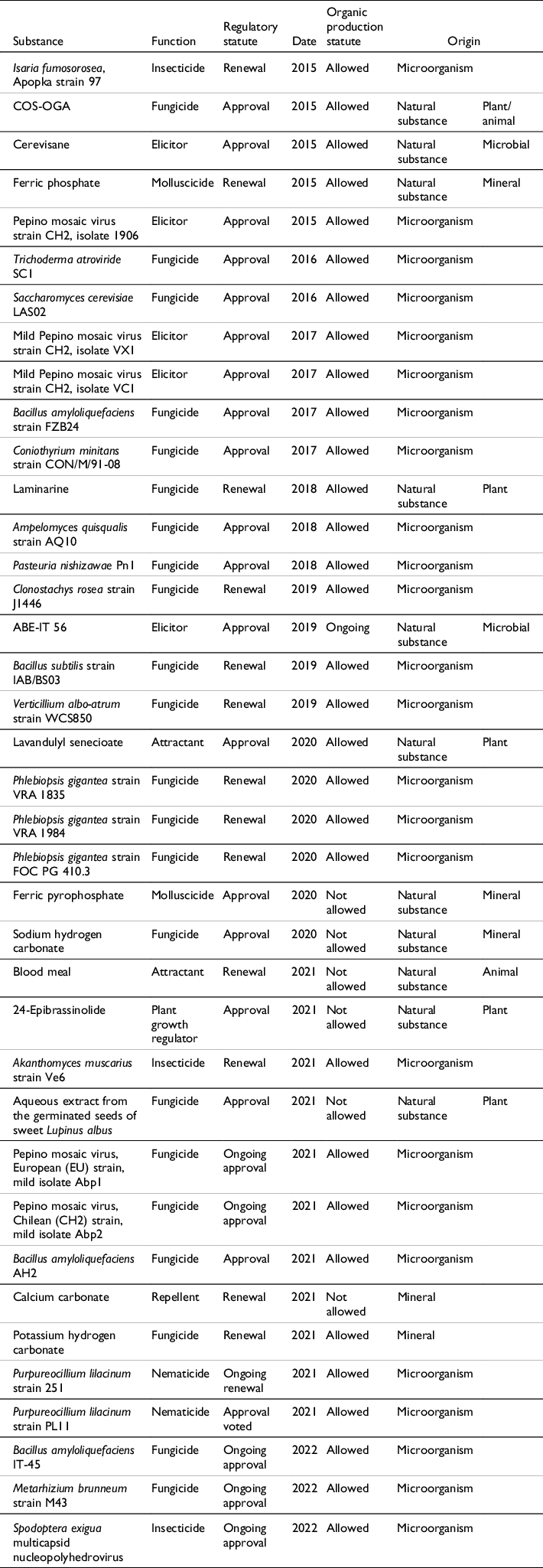
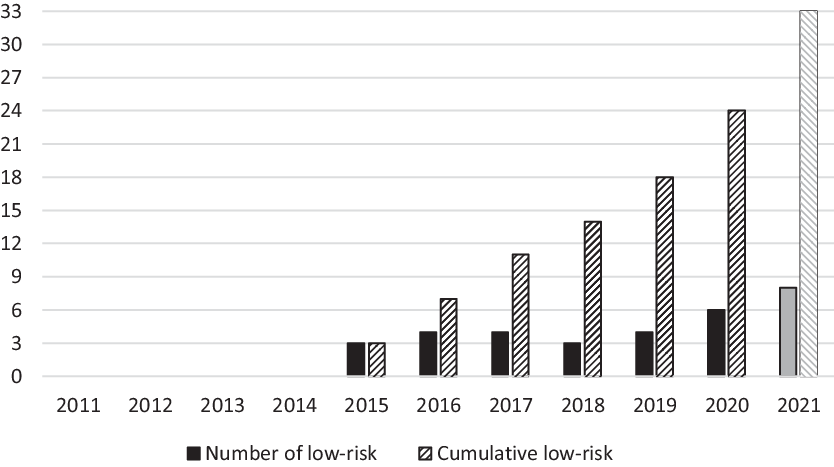
The first low-risk substance, Isaria fumosorosea strain Apopka 97, was granted by a renewal in 2015.Footnote 10 Later, approvals of new active substances as low-risk were voted for. Natural substances comprise COS-OGA,Footnote 11 cerevisane,Footnote 12 ABE-IT 56,Footnote 13 lavandulyl senecioate,Footnote 14 ferric pyrophosphate,Footnote 15 sodium hydrogen carbonate,Footnote 16 24-epibrassinolideFootnote 17 and germinated seeds of sweet Lupinus albus.Footnote 18 Microorganisms include Pepino mosaic virus strain CH2 isolate 1906,Footnote 19 Trichoderma atroviride SC1,Footnote 20 Saccharomyces cerevisiae LAS02,Footnote 21 mild Pepino mosaic virus strain CH2 isolate VX1,Footnote 22 mild Pepino mosaic virus strain CH2 isolate VC1,Footnote 23 Bacillus amyloliquefaciens strain FZB24Footnote 24 and Pasteuria nishizawae Pn1.Footnote 25 Renewals of substances from Part A (or Part B) of Implementing Regulation (EU) 540/2011Footnote 26 into Part D has occurred for ferric phosphate,Footnote 27 laminarinFootnote 28 and blood mealFootnote 29 as natural substances, together with Coniothyrium minitans strain CON/M/91-08,Footnote 30 Ampelomyces quisqualis strain AQ10,Footnote 31 Clonostachys rosea strain J1446,Footnote 32 Bacillus subtilis strain IAB/BS03,Footnote 33 Verticillium albo-atrum strain WCS850,Footnote 34 Phlebiopsis gigantea strain VRA 1835, Phlebiopsis gigantea strain VRA 1984, Phlebiopsis gigantea strain FOC PG 410.3Footnote 35 and Akanthomyces muscarius strain Ve6Footnote 36 as microorganisms. All of these are biocontrol agents (BCAs),Footnote 37 and most of them are allowed in organic production (OP) since all microorganisms (not from genetically modified organisms (GMOs)) are automatically allowed, except for herbicides, although no herbicide is a low-risk active substance at this time.Footnote 38 Details of entry into Part D,Footnote 39 dates and BCA origins together with the OP status of all twenty-nine of the approved low-risk substances are given in Tables 1–6. Ongoing processed qualifications (up to thirty-four of them) are also included (Fig. 1).
Characteristics of approved low-risk substances.

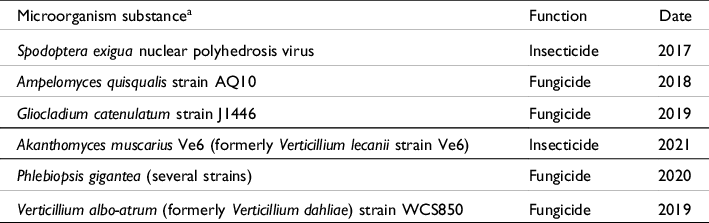
Evolution and characteristics of potential low-risk substances from the 2018 list: microorganisms renewed as low-risk.

a Directly allowed in organic production.
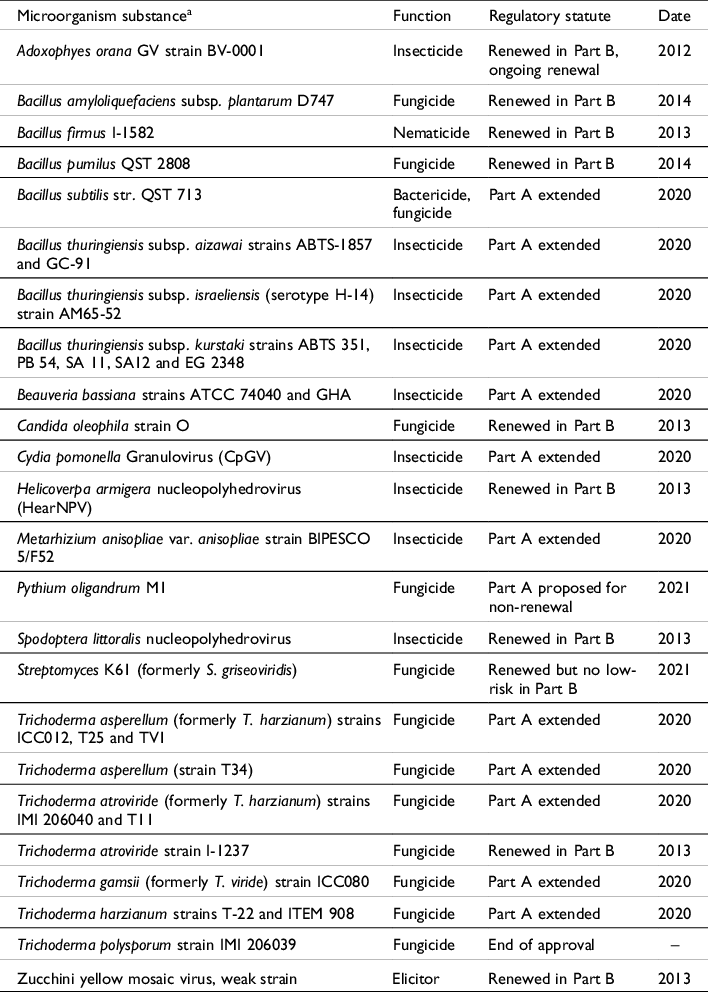
Evolution and characteristics of potential low-risk substances from the 2018 list: microorganisms still not low-risk.

a Directly allowed in organic production.
Evolution and characteristics of potential low-risk substances from the 2018 list: natural substances renewed as low-risk.

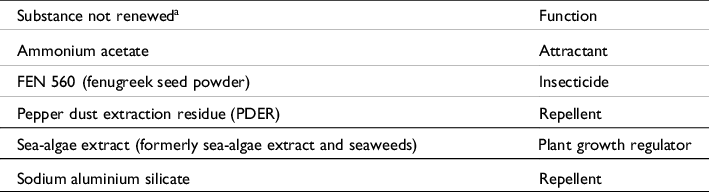
Evolution and characteristics of potential low-risk substances from the 2018 list: potential low-risk natural substances not renewed.

a End of approval.
Evolution and characteristics of potential low-risk substances from the 2018 list: natural substances still not low-risk.

Evolution of low-risk substances since 2011.

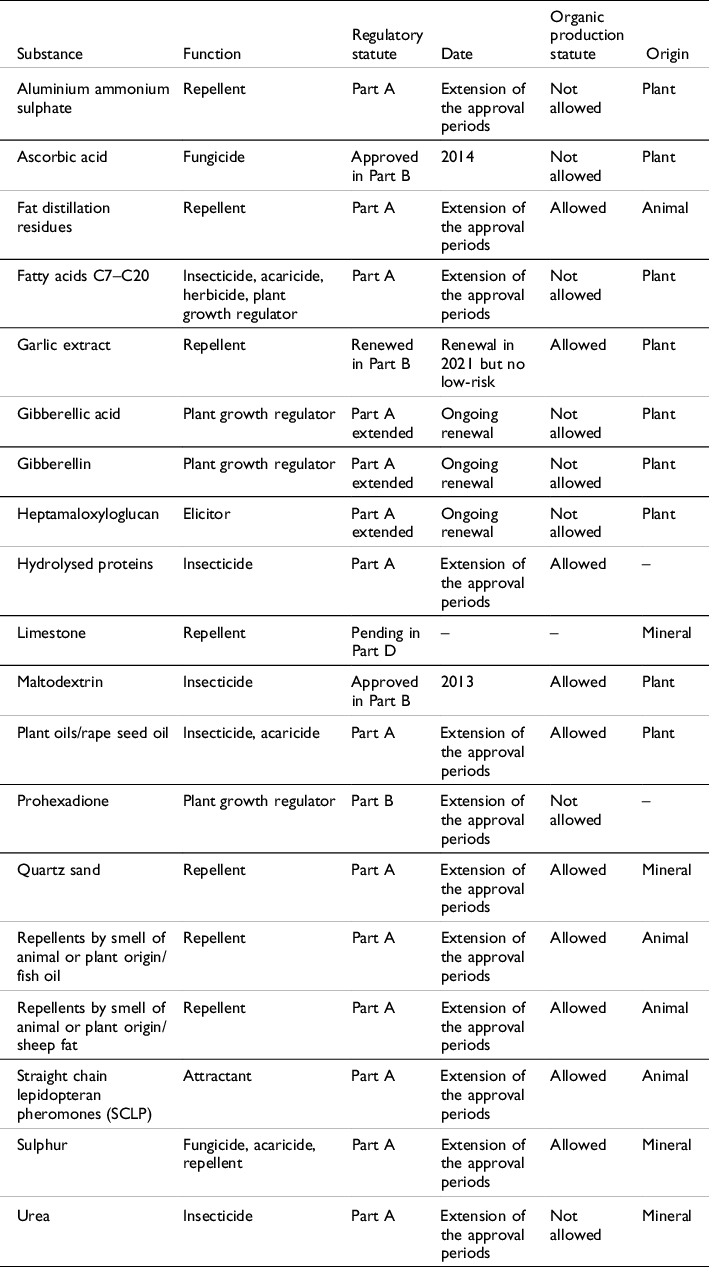
The list of potential low-risk substancesFootnote 40 from the substances listed in Part A (or Part B) was later published in 2018. This list of substances has been partially processed during renewals but was not followed in its entirety as garlic was not proposed as low-risk during voting at the PAFF Committee in December 2020 and was only renewed in Part B (instead of Part D) of Implementing Regulation (EU) 540/2011.Footnote 41 Later, Streptomyces K61 (formerly S. griseoviridis) was also not renewed as low-risk, although it was proposed at low-risk in the first instance.Footnote 42 These results are shown in Tables 2 and 3 for microorganisms and natural substances.
Moreover, of the approved potential low-risk substances, seven (five natural substances and two microorganisms) were not supported for renewal by applicants and ran out of approvalFootnote 43 (ie ammonium acetate, FEN 560 (fenugreek seed powder), pepper dust extraction residue (PDER), sodium aluminium silicate, sea-algae extract (formerly sea-algae extract and seaweeds), Trichoderma polysporum strain IMI 206039 and Spodoptera exigua nuclear polyhedrosis virus). Furthermore, initial potential low-risk substances could be non-renewed after re-evaluation (ie Pythium oligandrum M1).Footnote 44
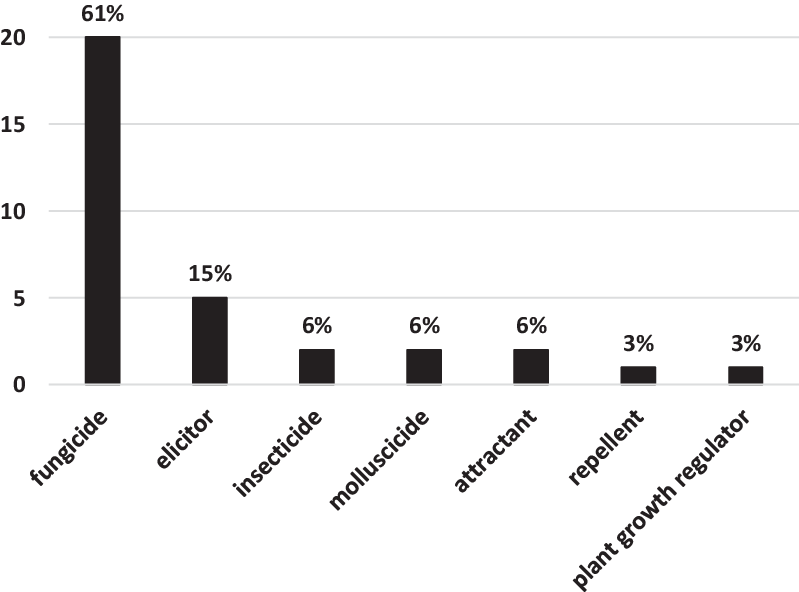
Of these thirty-three approved low-risk substances, most of them are fungicides (n = 19; 61%) (Figure 2), with second place going to elicitors (n = 5; 15%) and only a few (n = 1 or 2; 3% or 6%) insecticides, molluscicides, attractants and plant growth regulators.
Functions and distribution of approved low-risk substances.

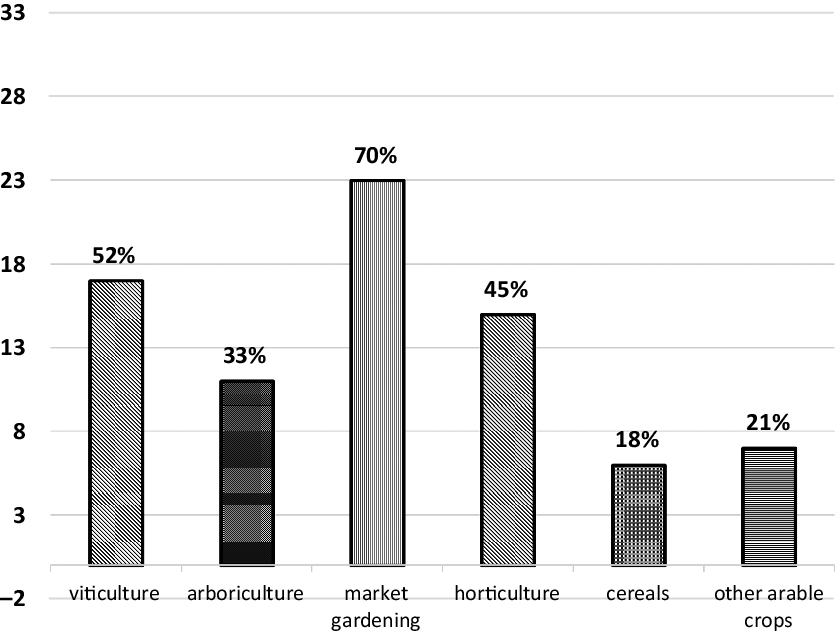
Following on from the function analysis, an analysis of the effective usages of low-risk substances is also important. The distribution of crop usages for approved low-risk substances shows that field usages are not the main use domain for low-risk substance (only 18% and 21% for cereal and other arable crops, respectively). Low-risk BCAs are mainly usable for market gardening (70%) and viticulture (52%), as is shown in Figure 3. Thus, all crops are impacted, even if field crops have fewer low-risk active substances to protect them despite the fact that they represent large areas or even a high percentage of all crops.
Crop usages and distribution of low-risk substances.

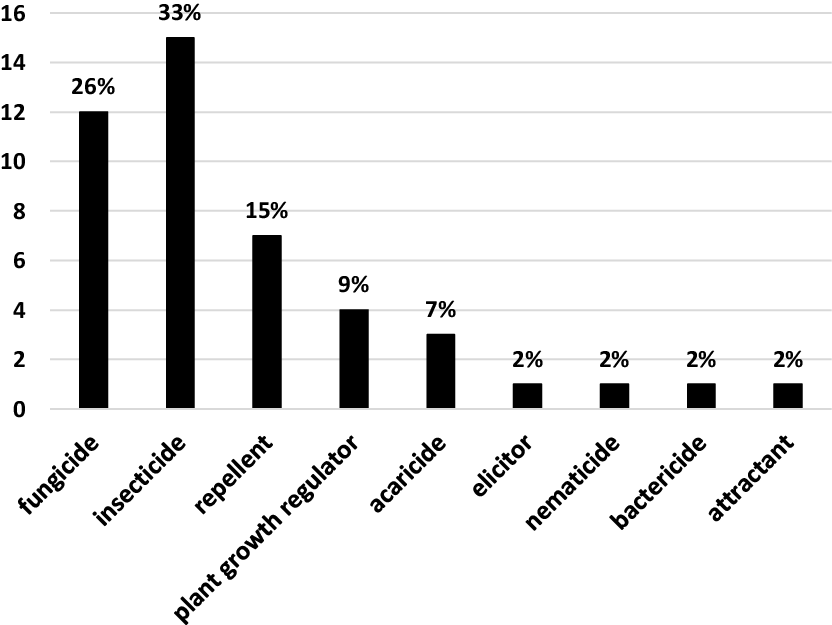
The same analysis may be done for potential low-risk substances. Of these twenty-nine remaining substances, most of these are fungicides (n = 15; 30%) (Figure 4), with second place going to insecticides (n = 15; 30%) and only a few acaricides, molluscicides, attractants, plant growth regulators, elicitors, nematicides, bactericides and herbicides.
Functions and distribution of potential low-risk substances.

IV. Discussion
The implementation of low-risk substances is a slow and complicated process,Footnote 45 since potential low-risk substances from the initially described list of approved active substances were only considered during renewal after ten or more years of approval and not immediately after publication of the Commission notice in 2018 concerning potential low-risk active substances. In fact, the status of the corresponding listed substances was not rapidly and directly modified to low-risk.
Therefore, only thirty-four low-risk substances are currently effectively approved, corresponding to twenty (62%) microorganisms and fourteen (38%) natural substances, despite the concept being voted in twelve years ago in 2009, and up to thirty-five or more will be effectively approved in 2021 (Table 1). Only thirteen low-risk substances were renewed (seven microorganisms and six natural substances), and twenty were newly approved (twelve microorganisms and eight natural substances) as low-risk in Part D (Table 1).
Nevertheless, twenty-nine potential low-risk substances are still approved as active substances in Parts A or B (from an initial fifty-seven active substances) with no low-risk status. This illustrates the slow pace of the implementation of low-risk substances, as only renewal time was considered for potential low-risk substances. The direct qualification of low-risk status could expand the low-risk substances number to seventy-five, but the legislator did not choose to take such an approach. However, many active substances from the list of potential low-risk active substances are under renewal procedures, ongoing for vote (ie Purpureocillium lilacinum strain 251)Footnote 46 or recently granted (ie Akanthomyces muscarius strain Ve6, 24-epibrassinolide, germinated seeds of sweet Lupinus albus and Bacillus amyloliquefaciens AH2, Pepino mosaic virus, EU strain, mild isolate Abp1, Pepino mosaic virus, CH2 strain, mild isolate Abp2 and calcium carbonate),Footnote 47 together with ongoing initial approval (ie Purpureocillium lilacinum PL 11).Footnote 48
Approximately fifteen new applications for microorganisms are pending with similar profiles that could be granted a low-risk status (eg Bacillus spp.), especially groups of active substances ordinarily included in Annex IV with no maximum residue limits (MRLs).Footnote 49 Indeed, most of the thirty-three approved low-risk substances (n = 29; 88%) have their MRLs assigned to Annex IV of Regulation EC No 396/2005, and the latest approved substances may also be qualified later with this status. The consequence of this could be that only existing (approved) substances without MRLs or potentially without MRLs at the time of approval might be more easily qualified as low-risk substances.
In fact, more biocontrol agent (BCA) applications have been submitted since the constant and significant decrease in allowed chemical active substances, increasing the panel of potential low-risk substances. However, constant reports are showing the difficult level of access of BCAs to this status, making this status almost a Holy Grail.Footnote 50 Nevertheless, Figure 1 illustrates a constant increase in low-risk active substances, although a direct transfer of potential could trigger a boost to this category (Figure 2). In fact, the focus on more low-risk active substances should not only consider the number of substances, but also the corresponding new functions, modes of action or expanded product types (Figure 3).
1. Plant protection product-level considerations
Approval as low-risk substances is one step in the process, but later market authorisations are require to generate low-risk products. This step officially takes 120 days (Article 47), but unfortunately, in fact, the average real delay is significantly longer.Footnote 51 This point should be improved in order to respect the PPP Reg and to increase the number of low-risk product implementations in fields. However, recent approvalsFootnote 52 of active substances or proposalsFootnote 53 as low-risk substances are encouraging.
The BCAs and, of course, particularly the low-risk products have regularly been considered as exhibiting lower efficiency than plant protection products from chemical active substances,Footnote 54 but these criticisms, as far as they are founded, become obsolete and questionable in light of the drastic reduction of active substances, mainly chemicals. In view of their lower efficiency, the risks associated with these BCAs, particularly in terms of eco-toxicity, are clearly lower.Footnote 55
2. Organic plant protection considerations
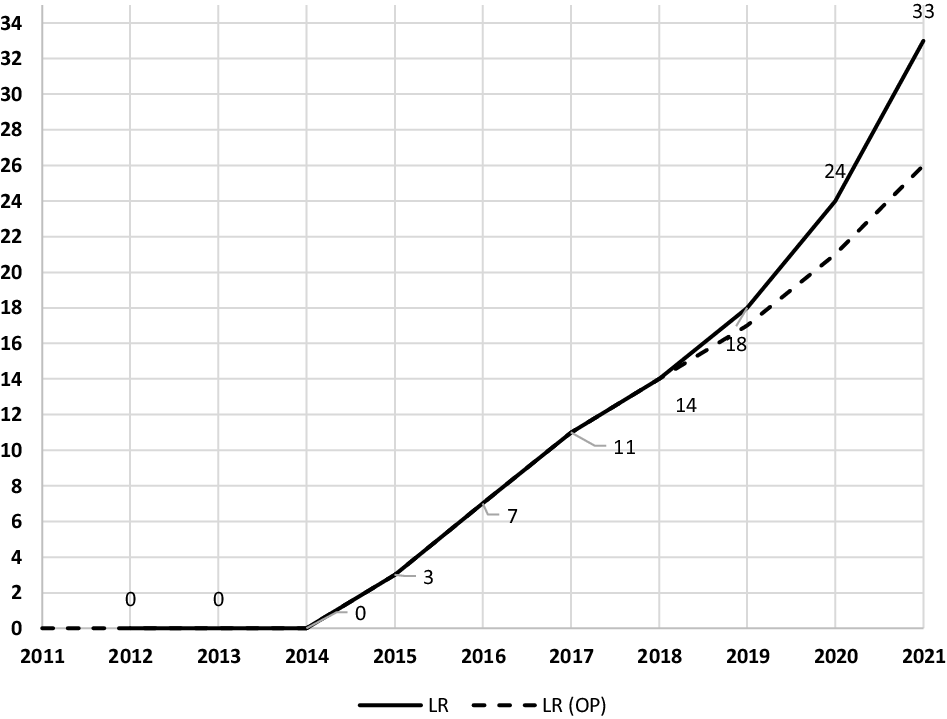
In terms of the characteristics of and interest in these low-risk substances, inclusion in the plant protection annex of the Organic Regulation is also an issue. While low-risk microorganism substances are automatically allowed in OP (except for GMOs), natural low-risk substances (from plant, mineral, animal and bacterial origin) must apply with an individual inclusion request dossier to be allowed in OP.Footnote 56 Inclusion in the OP plant protection annex is almost always achieved for every low-risk substance (except for herbicides), with twenty-six of the thirty-three (79%) low-risk substances authorised in OP (Figure 5 & Table 1). Similarly, thirty-four of the forty-three potential low-risk substances from the 2018 list are already allowed in OP (Tables 3 & 6). Figure 5 shows a recent shift in OP because many natural substances have recently been approved as low-risk substances and have not yet applied for inclusion in OP or have not yet been validated by the Regulatory Committee on Organic Production (RCOP).Footnote 57 Note that the latest Expert Group for Technical Advice on Organic Production (EGTOP) report validated the substance ABE-IT 56,Footnote 58 which should later become allowed in OP. This slow process cannot be sped up, as applications of natural substances for OP, instead of direct inclusion for microorganisms, are compulsory and at the national level before evaluation by EGTOP in case of national endorsement. The latest approved low-risk substances, for instance, could not be directly taken into consideration by self-referral at the EGTOP level, although this was suggested at the EU level, and even less automatically validated in OP plant protectionFootnote 59 (except for herbicide uses) in Annex I.Footnote 60 However, in the recent “PPP” Annex I of OP, low-risk natural active substances have been listed in subcategory 2 separately from other active substances (in subcategory 4), while low-risk microorganisms (listed in Part D of Regulation EC No 540/2011) have been listed in subcategory 3 with other microorganism active substances. This development of low-risk natural active substances in OP indicates a specific consideration, although the inclusion process is very similar to that of other active substances. This distinction and favourable position, together with the specific interest in low-risk active substances for OP already described previously,Footnote 61 may also represent a strong signal for new inclusions. Only four low-risk natural active substances are currently listed, not taking into consideration the transfer to a low-risk substance seen in the recent potassium hydrogen carbonate renewal. This acknowledgement in OP plant protection is also of economic importance for BCA manufacturers, as 10% of the surface of Europe is already under OP rules.Footnote 62 Research programmes are currently underway at Institut Technique de l’Agriculture Biologique (ITAB) to consider the earlier application to OP for recently approved low-risk natural active substances or those undergoing ongoing approval in order to reduce the delay between approval and OP validation.
Evolution of low-risk substances (LR) included in organic production (OP).

In fact, all low-risk active substances, except for herbicides and plant growth regulators, can and should apply for an OP plant protection insertion since automatic inclusion (of low-risk active substances) has not been validated; there are no challenges in this category for function or crop usages with respect to the selection of low-risk substance applications.Footnote 63 However, all low-risk microorganisms are automatically listed in Annex I, Part 3 of Implementing Regulation (EU) 2021/1165,Footnote 64 and virtually all low-risk natural substances that have been proposed have been validated in Annex I, Part 2, such as laminarin, COS-OGA,Footnote 65 cerevisaneFootnote 66 and ABE-IT 56.Footnote 67 For BCA companies managing low-risk active substance, this specific goal of allowing such natural substances in OP could also be an economical consideration in order to increase possible sales, as 10% of the land surface in the Europe is under OP rules and needs specific allowances.Footnote 68 As a matter of fact, the organic sector is constantly triggering these applications, although the final inclusion choice is a Member State decision based on the EGTOP evaluation. At present, inclusion dossiers for the latest approved low-risk active substances are in the process of being put together.
V. Conclusions and perspectives
The evolution of low-risk substances, despite showing a regular increase, is slow, and the benefit of this status has not been fully exploited through the conversion of the entire list from 2018 of potential low-risk substances, with twenty-nine active substances being approved but still without this status. Such an adoption would represent a big step towards partially rectifying the lack of usage diversity of low-risk active substances. Although 2021 will again, following on from 2020 (Figure 5), grant a significant number of low-risk substance statuses, this progress will lead to only a small proportion (n = 35; 7.8%) of the maximum number of active substances being approved by the end of 2021 (estimated at 450). This is also not sufficient to impact positively the expansion of BCAs and the reduction of the Harmonised Risk Indicators, two of the pillars of Directive 2009/128/EC.Footnote 69 In conclusion, the direct transfer of potential low-risk substances would also remove the distortion of concurrence between recently approved low-risk substances and substances listed in 2018 and approved only a few years before but that will have to wait for their renewal ten years hence, such as Bacillus pumilus QST 2808 or maltodextrin. This approach to processing and converting the twenty-nine latest potential low-risk active substances may be a coherent application of the Green Deal,Footnote 70 and furthermore, the possible improvement of the PPP RegFootnote 71 may also trigger a better approval process for low-risk substances as de novo active substance candidates. This massive conversion would also increase the visibility of low-risk active substances (from 7.5% to up to 14% of the active substances) and low-risk plant protection product availability, as well as reduce criticisms regarding pesticides and pesticide regulation.Footnote 72 In particular, this conversion would increase the available function diversity of the low-risk active substances and reduce the significant proportion of fungicides in the low-risk active substance category. Ongoing and further modification to Annex II of the PPP RegFootnote 73 for microorganisms and the proposal of granting a low-risk status for many ongoing microorganisms are positive signs for visibility, together with high number of low-risk active substances in 2021 (n = 10; +40%).Footnote 74
Finally, all of these levers being orientated in the same direction could strengthen the perception of the low-risk status amongst prescribers, users, operators and customers, thus opening up a wider range of usages and thus reaching even more targets. Ultimately, this should be coupled with the encouragement of BCA applications, even an initial application as low-risk, and a real and specific evaluationFootnote 75 of BCAsFootnote 76 should be organised during the ongoing update of the PPP RegFootnote 77 at the EU level, ten years after its implementation.
Acknowledgements
The authors would like to thank Dr Trevor M. Fenning of Forest Research (UK) for providing helpful advice on the editing and writing of the manuscript.
Financial support
The authors wish to thank the French Ministry of Ecology (MEDDE; CP ITAB PNPP V14 26-11-10, 2010-12). This work on active substances was supported by the Office Français de Biodiversité (Biocontrôle 2012-2013; XP-BC 2017–2019; BiocontrôleExpansion 2019–2021).
Competing interests
The authors declare none.