INTRODUCTION
Legumes are of great importance for organic agriculture, mainly because they capture nitrogen (N) from the atmosphere and benefit soil fertility. Lentil (Lens culinaris Medik.) is one of the oldest grain legumes. In Greece, lentil cultivation dates back to 6000–5000 BC (Hopf Reference Hopf, Milojcic, Boessneck and Hopf1962). Lentil is currently cultivated as a non-irrigated crop and the average yield obtained is c. 1·1 t/ha (Hellenic National Statistical Service 2005). Lentil cultivation has increased in recent years, largely due to consumers’ interest in the crop for its nutritional quality and also lentil, being a legume crop, is considered to be an important factor in rotation systems with cereals (Muehlbauer et al. Reference Muehlbauer, Summerfield, Kaiser, Clement, Boerboom, Welsh-Maddux and Short2002) and N reduction programmes.
The development of organic agriculture has raised the demand for varieties well adapted to organic farming systems (Lammerts van Bueren et al. Reference Lammerts van Bueren, Struik, Tiemens-Hulscher and Jacobsen2003; Wolfe et al. Reference Wolfe, Baresel, Desclaux, Goldringer, Hoad, Kovacs, Loschenberger, Miedaner, Östergärd and Lammerts van Bueren2008). Most of the varieties presently cultivated in organic agriculture were developed from high-input breeding programmes and adapted to conventional farming systems. Comparative trials between conventional and organic systems, however, indicated that these varieties exhibit lower yield and decreased adaptability under organic systems (Stanhill Reference Stanhill1990; Porter et al. Reference Porter, Huggins, Perillo, Quiring and Kent Crookston2003; Ryan et al. Reference Ryan, Derrick and Dann2004; Jones et al. Reference Jones, Clarke, Haigh, Pearce and Wolfe2010). The environment of selection is critical when breeding for organic farming systems. One of the key issues for breeders involved in such programmes is whether selection can either be performed directly under the organic environment (direct selection) or whether selection within conventional programmes could satisfy the demands of organic agriculture (indirect selection). References related to direct v. indirect selection are contradictory. Indirect selection was predicted to be either as efficient (Atlin & Frey Reference Atlin and Frey1989; Burger et al. Reference Burger, Schloen, Schmidt and Geiger2008; Lorenzana & Bernardo Reference Lorenzana and Bernardo2008), more efficient (Calhoun et al. Reference Calhoun, Gebeyehu, Miranda, Rajaram and Van Gikhel1994) or less efficient (Ceccarelli et al. Reference Ceccarelli, Grando and Hamblin1992; Sinebo et al. Reference Sinebo, Gretzmacher and Edelbauer2002; Brancourt-Hulmel et al. Reference Brancourt-Hulmel, Heumez, Pluchard, Beghin, Depatureaux, Giraud and Le Gouis2005; Murphy et al. Reference Murphy, Campbell, Lyon and Jones2007; Ghaouti & Link Reference Ghaouti and Link2009) than direct selection in the target environment. Therefore, the adaptability of varieties among different environments is of great value for indirect selection.
Studying the response of lentil varieties to organic and conventional farming systems, Vlachostergios & Roupakias (Reference Vlachostergios and Roupakias2008) concluded that the grain yield obtained depends on the variety's response in each environment and recognized two adaptability types: those with specific and those with broad adaptability. In addition, Malhotra et al. (Reference Malhotra, Singh, Bhullar and Sethi1971) observed that some lentil varieties produced higher yields under high-input environments, while others better-than-average yields under poor environments but failed to exploit better environmental conditions.
The object of the present study was to investigate the adaptability of 20 lentil varieties developed under conventional breeding programmes to organic farming systems under five environments.
MATERIALS AND METHODS
Plant material
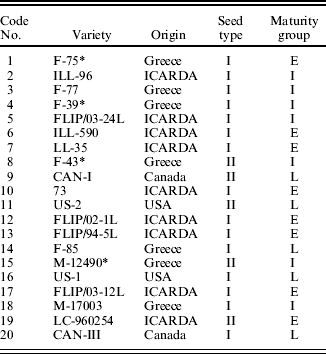
Twenty lentil varieties (Table 1) selected from a germplasm collection maintained at the Fodder Crops and Pastures Institute (FCPI), Larissa, Greece were grown under conventional and organic farming systems. All varieties evaluated were developed under conventional breeding and originated from genetic material from Greece, ICARDA, Canada and USA. Varieties were screened using random amplification of polymorphic DNA (RAPD) and proved to be genetically distinct from each other (Vlachostergios et al. Reference Vlachostergios, Mavromatis, Korkovelos and Roupakias2006). Two types of lentil varieties were used: small-seeded (Type I) and large-seeded (Type II). Small-seeded varieties are those with a mean seed weight <50 mg, while large-seeded varieties are those with mean seeds weight >60 mg. There is also an intermediate lentil type (Type III), with mean seed weight between 50 and 60 mg, but these were not used in the present work. The sowing rate was adjusted to provide 160–170 plants/m2 for small-seeded lentils and 150–155 plants/m2 for large-seeded lentils.
Variety origins and types
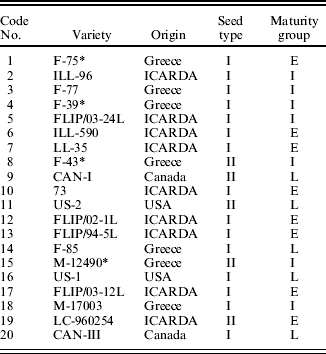
* A released cultivar.
ICARDA: International Centre for Agricultural Research in the Dry Areas, Syria.
Seed type: I small seeded, II large seeded.
Maturity group: E: early, I: intermediate, L: late.
Locations and experimental design
Field experiments were established at the central farm of the Fodder Crops and Pastures Institute (FCPI) in Larissa, Greece (39°36′N, 22°25′E) during three consecutive growing seasons (2005–2007), and at the farm of Aristotle University (AUTH) near Thessaloniki, Greece (40°32′N, 22°59′E) during two consecutive growing seasons (2006–2007). This results in five ‘environments’, each a site–year combination, viz: Environment 1 (Envt 1) was at FCPI in 2005, Envt 2 at FCPI in 2006, Envt 3 at AUTH in 2006, Envt 4 at FCPI in 2007 and Envt 5 at AUTH in 2007. Environments had different climatic conditions and soil properties (Table 2).
Precipitation recorded and soil characteristics of the trial fields

OM: organic matter.
* Olsen P.
Lentil varieties were grown in a randomized complete block within three organic and three conventional fields under each site–year (environment). Individual plots (4 m2) consisted of five rows spaced 0·25 m apart and 4 m long. All plots in each replication were separated by 1 m buffer zones and replications were separated by 2 m buffer zones. The organic and conventional experiments were located c. 300 m apart at FCPI and 250 m apart at AUTH. Soil properties and microclimatic environment were more or less similar for organic and conventional fields within each environment (Table 2).
Cultivation practices
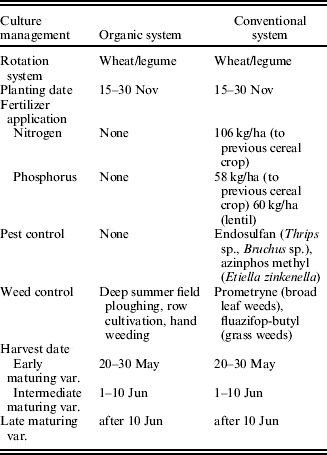
Cultivation practices are presented in Table 3. The organic fields at FCPI have been certified since 2006. Varieties were harvested by hand and threshed using a Wintersteiger plot combine. The harvested area was 3 m2 per plot, as only the three central rows were harvested. Grain yield was adjusted to a moisture content of 130 mg/g fresh weight (FW).
Summary of crop management for organic and conventional systems

Statistical analysis
The experiment was analysed as a split-plot. Systems (organic or conventional) were main plots and varieties were sub-plots within systems. Partitioning of sum squares treatment (SSTRMT) was applied to study the effect of each variance component. Ranks were assigned to genotypes for grain yield and Spearman's rank correlation coefficient (Rs) was calculated. The computer program MSTAT version 1.2 (Michigan State University, East Lansing, MI, USA) was used to conduct the analysis of variance and the comparison of means. Direct selection was defined as the selection applied in the target environment. Indirect selection was defined as the selection applied in a system other than the target environment.
RESULTS
Variance component effect
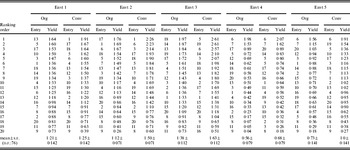
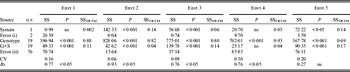
Under the conventional farming system, the mean grain yield over the 20 varieties was 3, 34, 18, 21 and 37% more than under the organic farming system for Envts 1–5, respectively (Table 4). Significant differences in grain yield between systems were observed in Envts 2, 3 and 5, but not in Envts 1 and 4 (Table 5). Significant differences between lentil varieties (P<0·001) were detected in each of the five environments, while genotype⊆system interactions (GSI) were also highly significant in Envts 1, 2, 3 and 5 (P<0·001; Table 5). Partitioning of the treatment sum squares (SSTRMT) indicated that genotype was the main source of variation (0·69–0·93 of the total variation), followed by the farming system (0·002–0·14) or GSI (0·04–0·17; Table 5). Coefficients of variation (CV) ranged from 0·06 to 0·30 among the five environments (Table 5). The relatively high CV value observed Envt 4 was attributed to a serious infection of Fusarium oxysporum f. sp. lentis.
Rank order and grain yield (t/ha) of 20 lentil varieties in organic or conventional systems in five environments

Split plot analysis of variance and proportion of the sum of squares (SSTRMT), coefficient of variation (CV) and Spearman's rank correlation (Rs) for each environment

Ranking
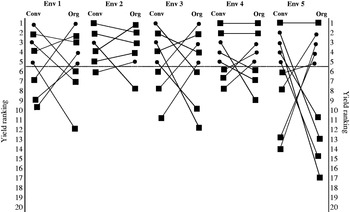
In all environments, a positive rank correlation between yields in the conventional and organic system, ranging from 0·27 to 0·93 (Table 5), was observed. The rank correlation was significant for Envts 1–4 (P<0·05), but not in Envt 5. Alterations in the ranking of the top five varieties were observed under both farming systems (Fig. 1). Minor ranking differences were observed in Envt 2, whereas major differences were seen in Envt 5. Listing the top five varieties in the conventional and organic system in each environment showed that only two were common in Envt 1, four in Envt 2, two in Envt 3, three in Envt 4 and one in Envt 5 (Table 4 and Fig. 1). Variety 9 (CAN-I) was the lowest producer in 6 out of 10 environment–system combinations, while variety 11 (US-2) was the next lowest producer in 8 out of 10 environment–system combinations and lowest in one.
Alterations in the rank order of the top five yielding varieties under organic and conventional systems for each environment. Varieties were ranked in descending order from 1 (highest yield) to 20 (lowest yield). For the top 5 varieties in each system, ▪——▪ shows reciprocal movement of ranking order (i.e. the cvar ranked 2nd under conventional farming in Envt 1 moved to 3rd under organic farming and vice versa), whereas •——▪ shows any cvar whose ranking moved from among the top 5 to below the top 5.

Direct and indirect selection
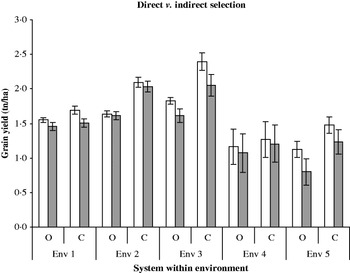
The differences in the mean grain yield among the top five varieties under both farming systems subjected to direct and indirect selection are given in Fig. 2. Direct selection under conventional systems produced yields 11, 3, 14, 5 and 17% higher than the yields resulting from indirect selection for Envts 1–5, respectively. Similarly, direct selection in organic systems produced yields 6, 1, 12, 8 and 29% higher than the yields resulting from indirect selection for Envts 1–5, respectively. In Envt 1, when the target system was conventional farming, direct selection produced significantly (P<0·1) higher yields than indirect selection. Similarly, in Envt 3, when the target was organic farming, direct selection produced significantly (P<0·1) higher yield than indirect selection (Fig. 2). Finally, no significant differences were observed between direct selection and indirect selection under Envts 2, 4 or 5 for both farming systems. The data presented in Fig. 2 are not biased, since highly significant GSI were observed (Table 5).
Direct v. indirect selection for grain yield (t/ha) under organic and conventional systems within environments. White columns: direct selection (mean yield of the top five varieties in the target culture system); grey column: indirect selection (mean yield of the top five varieties under the opposite system, when grown under the target system). The bars represent the ±s.e. (n=5). O: organic system; C: conventional system.

DISCUSSION
The higher yields observed under conventional systems in all environments (Tables 4 and 5) are probably due to higher levels of phosphorus (P) inputs and pest control than in the organic systems. The experimental fields had low levels of P (Table 2) and thus the application of P fertilizer in the conventional fields was expected to increase the final yield performance. In addition, it was estimated that the application of pesticides resulted in 15–40% less pest damage under the conventional management (data not shown). Thus, the conventional farming system produced 3–37% more grain yield than the organic farming system in the five environments (Table 4).
Small-seeded lentil varieties ranked higher than the large-seeded ones under both farming systems and therefore were selected in the top five (Table 4). The exception was the large-seeded variety 9 (LC-960254), which ranked among the five highest yielders in Envt 3 under both farming systems and generally exhibited a stable yield performance, near or above the middle of the rank order. The rest of the large-seeded varieties (8, 9, 11 and 15) ranked among the low-yielding varieties and therefore were not selected. Variety no. 6 indicated a stable performance under the conventional farming system, as it was among the five high yielders over environments (Table 4). A corresponding variety for the organic farming systems was not identified.
Partitioning of the treatment sum squares (SSTRMT) indicated that the genotype was the main source of variation in all environments (Table 5). The contribution of the genotype to the total experimental variation ranged from 0·69 to 0·93; such values indicate strong genetic differences between the varieties studied. The highest contribution of the genotypic effect was observed in Envt 4. This could be attributed to the fact that the genotypes in this environment were seriously infected by the fungus F. oxysporum f. sp. lentis. Fusarium wilt, as a soil-borne disease, cannot be controlled even in conventional systems, because field applications are not practical due to the cost and technical difficulty of incorporating chemicals into the soil during the growing season (Bayaa et al. Reference Bayaa, Erskine and Singh1997; Stoilova & Chavdarov Reference Stoilova and Chavdarov2006; Taylor et al. Reference Taylor, Lindbeck, Chen, Ford, Yadav, McNeil and Stevenson2007). Consequently, in Envt 4, the main trait affecting the yield performance was the level of resistance to the disease and therefore no differences in GSI were observed. Thus, GSI for yield were significantly different in four out of the five environments. The variance that could be explained by GSI ranged from 0·04 to 0·17 of the total (Table 5). These results suggest that genotypes performed differently under organic and conventional systems. Similarly, Jones et al. (Reference Jones, Clarke, Haigh, Pearce and Wolfe2010) concluded that the selection of wheat cultivars under conditions of high agrochemical inputs selected for cultivars that yielded well under high-input conditions and which also performed relatively better in non-organic compared to organic systems. However, in these lentil trials, the proportion of the treatment sum squares accounted for by GSI was not high enough to suggest that separate breeding programmes are required. Furthermore, although significant GSI were detected, some of the high-yielding varieties under the conventional system were also high yielders under the organic system (Table 4). Under these circumstances, separate breeding programmes for organic agriculture seem to be of no value. This is further supported by the high genotypic rank correlations (Rs) observed for yield in four (Envts 1–4) out of the five environments. Nevertheless, in one environment, Envt 5, the rank correlation between the two systems was very low (0·27) and so indirect selection is not a reliable predictor of high-yielding varieties for organic farming systems. Interestingly, in Envt 4, which was seriously affected by fusarium wilt, the two highly resistant varieties were those that ranked 1st and 2nd across the two farming systems without ranking alterations.
The main question to be answered is whether the top varieties bred under the conventional system have the appropriate adaptability when cultured under the organic culture system. Although Spearman's index was high for Envts 1 and 3 (Table 5), considerable ranking alterations were observed among the top five varieties (Fig. 1). However, according to Murphy et al. (Reference Murphy, Campbell, Lyon and Jones2007), plotting ranks could accentuate the changes if there are no yield differences among the top five varieties when subject to direct and indirect selection in both systems. Murphy et al. (Reference Murphy, Campbell, Lyon and Jones2007) observed both significant ranking alterations and yield differences among the top five varieties when subject to direct and indirect selection, and reported considerable evidence for direct selection to the organic environment. In the present research, the evidence for direct selection of organic environments was not so clear. Direct selection in organic systems produced yields 6, 1, 12, 8 and 29% higher than the yields resulting from indirect selection for Envts 1–5, respectively. However, direct selection resulted in significantly higher grain yields than indirect selection in only one out of the five comparisons (Envt 3; Fig. 2). Therefore, the majority of the results indicated that varieties relatively suitable for organic agriculture could be identified after the evaluation of varieties developed from conventional breeding programmes in an organic environment.
However, another parameter that should be taken into account in deciding whether the breeder should apply direct or indirect selection is the number of different varieties among the top five selected under each of the two systems. In Envt 5, for example, although no significant differences between direct and indirect selection were detected, only one out of the top five varieties selected under each environment was common (Fig. 1). In contrast, in Envt 2, four out of the five varieties selected in each environment were common. This illustrates that even when other parameters (e.g. GSI, Spearman's index, differences on yield between direct and indirect selection) indicate no need for separate breeding programmes, the number of different varieties among the top ones selected within systems is an extra and a critical point that could help the breeder to decide whether separate breeding programmes are advisable or not for organic farming systems. It is generally accepted that organic agriculture is concerned not only with yield but also with several other important characteristics (Löschenberger et al. Reference Löschenberger, Fleck, Grausgruber, Hetzendorfer, Hof, Lafferty, Marn, Neumayer, Pfaffinger and Birschitzky2008). Working with maize, Lorenzana & Bernardo (Reference Lorenzana and Bernardo2008) concluded that high-yielding cultivars for organic systems can be largely developed by screening conventional inbreds or hybrids for their performance under organic systems, but testing and selection under organic conditions is required for other traits. Lammerts van Bueren (Reference Lammerts van Bueren2002) and Lammerts van Bueren et al. (Reference Lammerts van Bueren, Struik and Jacobsen2002) elaborated a general organic ideotype with desired traits for organic agriculture. It is possible, then, that lentil varieties selected under organic environments could incorporate certain traits (i.e. early growth, appropriate root system for competitive P uptake, competition ability against weeds, resistance to soil-borne diseases, pests, etc.) that make them more suitable for organic agriculture than the one selected under conventional environments.
In conclusion, the demands of organic agriculture for yield performance could be partially satisfied by varieties developed under conventional breeding programmes. The yield performance, however, is expected to be maximized from varieties bred under organic conditions.
Financial support from the National Agriculture Research Foundation of Hellenic Ministry of Agriculture is gratefully acknowledged.