

This chapter summarises the findings from across the previous chapters and attempts to discuss both the ‘region’ status of the Arctic and what the Arctic is a case of in terms of security dynamics, regionality, and security regions. First, it evaluates the relevance and usefulness of security regions theories – the RSCT in particular – in unpacking Arctic security relations. Before turning to what the Arctic is a case of, and how we can better understand the circumpolar regional security dynamics, it is worthwhile considering why the Arctic has increasingly been described as an RSC or even just as a coherent region in terms of security issues. Thereafter it takes a look at what these findings mean for the study of security regions and RSCs more broadly. It concludes with an emphasis on state-centric small-scale SRSCs, which can roughly be conceptualised as circles of overlapping spatial and security domains (i.e., a Venn diagram), before musing about the increasing relevance of maritime ‘regions’ in security considerations.
Security Regions and the Poor Arctic Fit
Is the Arctic a region? The short answer is most likely yes, because that is the way it is described and referred to in everything from encyclopaedias to historical documents around the world. Whether it is or not also depends on whom you ask and your object of reference. A natural scientist studying changes to sea ice texture or the movements of the beluga whales would draw a line zigzagging across the top of the globe, defining the Arctic region according to climatic criteria. If you ask a political scientist, on the other hand, the answer to whether the Arctic constitutes a region would depend on whether that scientist studies Arctic political developments such as the Arctic Council (then the answer tends to be yes) or traditional security questions such as NATO–Russia relations (then the answer tends to be no, although that might have changed in recent years depending on where that person sits).
If, however, you ask a foreign minister from one of the eight Arctic states they would tend to define the Arctic as a region in order to achieve certain political goals. These goals seemed to, at least up until Russia’s full-scale invasion of Ukraine in 2022, revolve around regional cooperation, expanding governance mechanisms, and portraying the Arctic as an ‘exceptional’ or sheltered part of the world in terms of state security interactions. Others point to a shared identity and culture among the Arctic states – Canada, the Kingdom of Denmark, Finland, Iceland, Norway, Russia, Sweden, and the United States. Their geographical proximity and common Arctic interests, along with contributions from Indigenous Peoples, enhance the region’s ‘northern’ identity (e.g., Penikett Reference Penikett2017).
This book does not intend to give a definite answer concerning whether or not the Arctic is a region because that answer inevitably varies. Instead, for the purpose of being able to answer another question which is at the heart of so-called geopolitics – What is the chance of conflict between states in the Arctic? – the focus in this book has been on security dynamics amongst the Arctic states (and non-Arctic states) and whether – as it often is portrayed – the Arctic is a security region.Footnote 1 As outlined in Chapter 2, the concept of security regions – merging security dynamics with a regional outlook (as defined, at least partially, by geography) – as well as securitising acts across that spatial domain, provides a theoretical approach from which to examine the contemporary Arctic and approximate an answer to the conflict question.
Moreover, despite not being listed in the seminal framework for analysis published by Barry Buzan and Ole Wæver in 2003, the Arctic is increasingly described as a security region or an RSC. In a review of that 2003-book, Gunhild Hoogensen Gjørv argued that the framework’s omission of the Arctic space was problematic, as it was an example of a spatial domain that did not fit with neatly categorising the world into security regions (Hoogensen Reference Hoogensen2005). More recently, arguing for the existence of an Arctic RSC has gained prominence as scholars and policymakers examine the region’s somewhat distinct security dynamics (Exner-Pirot Reference Exner-Pirot2013; Tüysüzoğlu Reference Tüysüzoğlu2021; Sadurski Reference Sadurski2024).
The argument has been that states within the Arctic region exhibit a substantial degree of security interdependence. Non-traditional security issues such as climate change, resource development, environmental concerns, and new shipping routes present shared security challenges necessitating cooperation, or at least interaction, among Arctic states (Padrtová Reference Padrtová2017; Sadurski Reference Sadurski2024). In addition, the argument is that security dynamics in the Arctic are converging, influenced by factors such as climate change, melting sea ice, and the potential for increased economic activity, which in turn has the potential to create a RSC (Lanteigne Reference Lanteigne2016), or already has done (Greaves Reference Greaves2019). In turn, scholars argue that the RSCT helps analyse the region’s security environment, highlighting the interplay of cooperation and confrontation among Arctic states (Padrtová Reference Padrtová2017).
There are two dimensions to these analyses: the emphasis on the foreign policy narrative as extensively described in Chapter 3, and the extended or alternative conceptions of security beyond the state or military-oriented one. These two elements at times merge, as Arctic states (primarily the foreign ministries), or other actors such as Indigenous Groups, the Arctic Council, Arctic conferences, or even Arctic scholars create narratives about Arctic issues and (non-military) security concerns.
There is no doubt that environmental concerns on both a local level (say, coastal erosion in Kotzebue, Alaska) and on a global level (say, the impact of Arctic climate change on the Indian monsoon) are serious and real security concerns for, in this instance, people in Kotzebue or India. Similarly, human security concerns are becoming more acute in the Arctic, linked to everything from loss of traditional livelihoods in, for example, Northern Finland and Northern Canada, to safety concerns arising from having cruise ships carrying 4,000 passengers sailing around Svalbard when there is no emergency response system in place for that scale. Along any of these parameters (or sets of non-state-centric security issues), one could conceive of a security complex or security region. This was the premise of Heather Exner-Pirot’s (Reference Exner-Pirot2013) article ‘What Is the Arctic a Case Of? The Arctic as a Regional Environmental Security Complex and the Implications For Policy’.
However, Exner-Pirot’s approach is perhaps more equivalent to region-building or regionalist approaches,Footnote 2 than to an analysis of whether security practices – at least with a state-oriented perspective – truly overlap across the Arctic spatial domain. The focus is not on defining whether the Arctic is a spatial domain where security issues are intertwined, but rather how, and why, Arctic actors are expanding their joint efforts in dealing with environmental concerns and issues.
Emphasising certain pan-Arctic issues in a circumpolar context, such as developing a ‘Polar Code’ for Arctic shipping (Rayfuse Reference Rayfuse, Stephens and David2014; Ø. Jensen Reference Jensen2016), or efforts to reduce black carbon emissions (Arctic Council 2015; Exner-Pirot Reference Exner-Pirot2016), are undoubtedly relevant in region-building approaches when trying to tackle shared challenges across the circumpolar area that are indeed only relevant in a circumpolar context. There is also no doubt that all Arctic states – even Russia – have eventually come to recognise over the last three decades that their interests align and that there are positive-sum elements to be gained from cooperation, alongside the mere effects of cooperation in and of itself on creating relations, trust, and confidence. All the Arctic states’ foreign policy statements started to emphasise the Arctic as a unique and special place for international affairs, governed by cooperation and the Arctic Council’s role as the primary forum for Arctic matters (Reference Heininen, Everett, Padrtová and ReissellHeininen et al. 2020). In other words, region-building has been taking place, and still is – to some extent – even after the limited contact between Russia and the other seven states.
Also, there is perhaps no doubt (anymore) that the overarching and most menacing security threat to society, and thus also to states as the constructs they are, is climate change writ large. The emergencies, famine, domestic unrest, migration, health issues, and economic catastrophe that follows from a 2100-perspective will put tremendous pressure on state structures, and will in many instances across the globe, and perhaps also in the Arctic, lead to the reconfiguration and even collapse of some states in their current form. Still, the question is: Do Arctic states practice this concern, or in the language of Buzan and Wæver, do they engage in securitisation of this (or these) issue(s), to the extent that this security ‘problem’ is interlinked across the Arctic (but does not extend beyond)? Arguably not.Footnote 3 If the premise for a security region is that it comes into being by securitising acts amongst actors (here states) within more or less the same geographic space, there also needs to be some level of urgency, or at least hierarchy and priority, concerning the issues that are securitised.
Although environmental and climate change issues dominate much of the Arctic conversation in both the big Arctic conferences, in Arctic states’ policy documents, and in Arctic Council deliberations, these issues are not always framed as region-specific, nor are they always framed as security issues. Moreover, the climate change dimension is inherently non-regional, in the sense that the Arctic states themselves emphasise that ‘emissions causing the Arctic to warm faster do not originate in the Arctic – they are the result of collective emissions of industries and energy systems in the rest of the world’ (Varteressian Reference Varteressian2024). That is also the argument used by the likes of China, the EU, India, and the UK when engaging in Arctic issues, for example, the EU arguing that ‘Climate action is of particular importance to the Arctic, given the immense knock-on effects of Arctic warming. The legislative proposals under the European Green Deal (EGD), will be at the heart of the EU’s Arctic engagement’ (European Commission 2021).Footnote 4
We might desire that environmental or human security concerns, which are found in a pan-Arctic context, dominate the eight states’ security outlook and interactions. This is not the same as saying that the geographic region that defines (climate) security matters for the eight states that are partially located above the Arctic Circle is the whole circumpolar area. In turn, this is also not the same as constituting central acts in a security region or a RSC.
Arctic state’s foreign ministers – at least up until 2022 – could talk all they wanted about the Arctic as a region of shared security concerns or interests, or an exceptional space for state-to-state and people-to-people cooperation. However, we are not talking about a RSC if the ministers of defence or chiefs of defence from the same states simultaneously contradicted such notions by highlighting their considerable divergence in how they viewed the Russian threat in the Arctic and related responses. Bluntly put, it is not enough to only listen to what the mouth is saying, we also need to see what the hands (or, in this case, the military) are doing.
Examining states’ security-oriented actions in terms of resource expenditure, activity, and – gradually since 2014 – political statements, paints a different picture. This has been outlined in this book by looking at, for example, where NATO member state-led, or NATO-led, military exercises have taken place; where Russia has been modernising and investing in military capabilities; or how Norway and the USA (despite being the ‘superpower’) focus on different parts of the Arctic when they emphasise security concerns or develop military or security strategies for their respective Arctic territories.Footnote 5
A state’s concern with its security, namely its survival, focuses first and foremost on its immediate geographic surroundings and the nearby states. The quote from Canadian military official Riviere that any land invasion would become a rescue operation (Fridtjof Nansen Institute 2024a) perhaps best illustrates the divergence between security conceptions in an Arctic context.Footnote 6 Canada does face airborne, and perhaps naval, concerns emanating from the Arctic parts of Russia (Lasserre and Têtu Reference Lasserre and Têtu2016), but arguably not more, and probably less, than the UK does (Depledge, Kennedy-Pipe, and Roger Reference Depledge, Kennedy-Pipe and Roger2019; Depledge and Østhagen Reference Depledge and Østhagen2021) – a non-Arctic state.
An equivalent example would be the idea of a European security region, where states’ security practices and concerns cannot in any meaningful way be disentangled from each other. However, when looking at the security practices of some states in Europe, for example Spain, Greece, or Finland, these showcase the opposite. Whereas Spain is the primary example of a European NATO-member unwilling to reach a 3.5 per cent defence spending target, Finland is currently revamping its armed forces to a degree not seen for decades. Greece is similarly focused on military spending, but due to a completely different set of security issues emanating not from a shared border with Russia (as in the case with Finland), but its proximity to the instability emanating from parts of the Middle East. As with the Arctic example, ‘Europe’ as a label for a security region is much too wide and in lack of specificity, despite rhetoric coming from the political leaders from all the three mentioned countries arguing for a joint European approach and joint security interests.
In essence, what descriptions of ‘the Arctic’ or ‘Europe’ in terms of security and geopolitics tend to ignore are the fundamental lessons of geography and of accuracy concerning the space in question. Whether the discussions are on pan-Arctic/region-wide security and politics,Footnote 7 on specific actors in the Arctic,Footnote 8 or framed as handbooks exploring aspects of this region,Footnote 9 the works tend to lack specificity regarding which part of the related area is in question. Instead, the Arctic, or Europe for that matter, is made use of more as a concept or an idea that frames the scholarly work in question and attracts attention, whereas the actual object of study is not really the Arctic, but one part of this rather immense territorial and ocean space.Footnote 10
The problem in much of the work leaning on notions of the Arctic as a coherent space for security matters is that state security interests and defence issues are decentralised. Arctic-wide studies are, for the most part, concerned with the ‘softer’ dimensions of security, or security politics. Descriptions and discourses of contemporary or near-contemporary political, climatic, and/or economic events and dynamics are laid out. The examples or key pieces of evidence used are, to a great extent, the same as those outlined here – at least in Chapter 3: the Russian seabed flag planting, the Ilulissat declaration, the emergence of the Arctic Council as a primary forum with observers and a permanent secretariat, efforts to tackle shared concerns such as the Central Arctic Ocean agreement, and the ups and downs when it comes to the notion of an Arctic exceptionalism. Military concerns, investments, and activities do not figure prominently, if at all, in these analyses.
However, state security in a strict sense means also examining the role of the armed forces, the military, and the actions, statements, and descriptions of the ministries or departments of defence. These tend to get limited attention in studies looking at circumpolar security dynamics especially when attempting to see whether the RSC framework, or the security region category writ large, fits.
Although heavily inspired by the RSCT,Footnote 11 the approach in this book, described in Chapter 2, adds a couple of tweaks or limitations to the RSC model. These tweaks are based on the attempt here at linking works on state security, historic and contemporary studies of the influence of geography on international affairs, and wider regionalist and security regions debates. A key deviation from the RSCT is an exclusive focus on states and their security practices – defined as threat perceptions, interests, policies, and actions. Another is being explicitly attentive to how the security dynamics that we inherently are interested in uncovering and understanding operate at different levels of analysis that in turn influence each other; these are constrained by both constructed and material factors including – especially – the geographic dimension.
For example, when looking at the global or international dynamics that have a direct security impact on the Arctic, unpacking NATO–Russia interactions in the European parts of the Arctic hinges on the concrete steps taken by Russia and NATO member states to ensure their own security in that geographic domain. Although this is in essence the core of security (for states) – military exercises, positioning, and operations to either deter, or prepare for, outright conflict – these developments and examples are seldom part of descriptions of the Arctic in the works highlighting the fit with the RSCT, or works that describe ‘Arctic geopolitics’ as a regional affair either implicitly or explicitly. Military security has become decentralised in favour of other security approaches to the extent that it does not even figure in the analyses anymore, at least not in the pan-Arctic studies. Paradoxically, Arctic states are simultaneously investing in military assets at levels not seen since the end of the Cold War.
On the other hand, scholars that do work on military and defence questions seldom lean on the RSCT or other comprehensive theories of regions, region-building, and security complexes to explain the multitude of Arctic security dynamics.Footnote 12 For them, such a scope is arguably too broad to be able to produce relevant insights for a more traditional security-oriented audience, as the link to useful studies of potentially practical relevance becomes paramount. As put by David Auerswald (Reference Auerswald2022), ‘All security is local’.Footnote 13 Examples of military studies related to the Arctic, or more accurately specific parts of the Arctic, abound. Several have been utilised here, for example, Depledge (Reference Depledge2020) examining where states perform military exercises; Åtland, Nilsen, and Pedersen (Reference Åtland, Nilsen and Pedersen2022, Reference Åtland2024) exploring the change in Russian NOTAMs in the Barents Sea; Wegge et al. (Reference Wegge2023) and Auerswald (Reference Auerswald2022) on national defence policies; Kjellén (Reference Kjellén2022) on the changes to the Russian Northern Fleet; Lackenbauer (Reference Lackenbauer2013a) on the Canadian Rangers; or Lajeunesse and Choi (Reference Lajeunesse and Choi2022) on the presence of Chinese submarines in parts of the Arctic.
These works heavily inform the chapters here looking at Arctic security practices where the military component of security practices is apparent. What such works sometimes lack, however, is linking, for example, China’s Arctic rather generic and toothless policy initiative from 2018 to increased US military attention given to Arctic security, which in turn might lead to military exercises in North Norway and then spur Russia to perform symbolic acts on Svalbard. In fairness, the goal of these studies is not to provide a holistic examination of security dynamics across all of the Arctic spatial domain. Still, for the purpose of this book, we cannot conceive of Arctic geopolitics and answer the question of whether or not the Arctic is a coherent security region, without taking into account both (1) the ‘softer’ or overarching political developments that tend to be absent from military or security studies, and (2) the changes and developments in states’ military approaches and activities related to (parts of) the Arctic.
Is, then, the Arctic a security region in terms of state security practices (e.g., stated concerns, interests, approaches, focus, threat perceptions, and securitising acts), where interactions amongst the units (states) cannot be analysed without taking into account the other units? As already outlined here, the short answer is no. For that, the Arctic is too vast geographically and the security practices of the states that make up the Arctic are only marginally aligned. Naturally, Finnish, Norwegian, Swedish, and partially Russian security practices are intertwined and entangled to the extent that they cannot meaningfully be analysed independently of each other. They also share the same immediate geographic space. The same goes for Canadian and Greenlandic (Danish) security being interlinked with the USA. But these dynamics do not sufficiently overlap and influence each other. Through the examination in this book of the different levels of security dynamics taking place on a regional level, global level, and national level, it is clear that the central security issues are either grounded at a global level or at a national level.
In essence, the author of this book concluded already in 2021 that ‘the Northern European and North American security domains are only marginally aligned’ (Østhagen Reference Østhagen2021b: 68). That still holds true in terms of defence issues and state security practices. However, what that analysis got wrong, or lacked, was a limited appreciation of the interlinkages between security regions and regionalism,Footnote 14 between material objects and practices, and between socially constructed interactions and institutions. It is the combination of these dynamics, across levels, and defined by geography that is what we must try to grasp.
If we take the securitisation approach seriously and attempt to unpack which issues dominate the discourse (and actions) of states within a regional space, the impact of forums that are the product of region-building – such as the Arctic Council – must also be taken into account. For example, it can be argued that up until 2014 Arctic NATO member states were wary of overstating their security concerns about Russia in an Arctic setting because they did not want to negatively impact other forms of softer Arctic cooperation and they wanted uphold the discourse and ideas surrounding ‘exceptionalism’. Foreign ministries and defence ministries do talk to each other, at least sometimes. Although that approach was, to some extent, a charade – masking an increasing divergence between military investments and exercises and foreign policy statements – we must still include it when unpacking regional dynamics concerning Arctic states’ security. Ignoring it, and only looking at – for example – defence strategies and military operations, also does not capture the full picture.
The problem is how to measure, describe, or distinguish between words and actions while not assuming that the security traits of a region, or a state, are something inherent just ‘waiting to be discovered’ (Allen, Massey, and Cochrane Reference Allen, Massey and Cochrane1998: 2). It is also important to take into account that there are certain characteristics or geographic facts – such as the existence of an ocean – that are difficult to ignore when discussing the same issues. In other words, we must pay attention to both state discourse and security actions by the same states, considering the apparent divergence between the foreign and defence ministries in particular, when examining security practices.
If we consider the two dimensions arguing against conceiving of the Arctic as a security region – geography and state practices – and combine them with the regionalisation or region-building efforts as outlined throughout this book, a slightly different picture emerges. As has been showcased, political and region-building efforts – which the Arctic is an example of – can have an impact on state practices concerning security. And as more critical and nuanced conceptions of geography and geopolitics have taught us, the way geographic characteristics define politics and in turn are being used to define politics, is not a constant, but can change. It is the interplay between these different things that ultimately becomes the totality of regional security dynamics.
To highlight this interplay, take, for example, the Norway–Russia maritime dispute that was resolved in 2010, two years after the Norwegian and Russian foreign ministers shared vodka and watched a football match aboard an icebreaker in the port of Murmansk. For more than four decades, from 1977 until 2010, one central security concern for Norwegian decision makers in Oslo was how to avoid possible Russian challenges to, and escalations over, the unclear jurisdiction and sovereign rights in the relatively large disputed area in the Barents Sea (Stabrun Reference Stabrun2009). However, in 2010, the two states agreed to an extensive maritime boundary, hailed as a ‘new era’ in their relations (V. L. Pettersen Reference Pettersen2010), removing a significant liability in Norway’s security and defence policy. Part of the reason behind this agreement was the broader Arctic ‘spirit of cooperation’ which emerged in the period 2005–2010, coinciding with Gahr Støre as the Norwegian foreign minister building personal relations with Lavrov as the Russian foreign minister (Gahr Støre Reference Støre2010a; Lavrov and Gahr Støre Reference Lavrov and Gahr Støre2010; Gahr Støre Reference Støre2008: 45–55).
Those relations, and the broader context of Russia’s desire to affirm the primacy of the Law of the Sea regime in the Arctic and ‘tidy up its spatial fringes’ (Moe, Fjærtoft, and Øverland Reference Moe, Fjærtoft and Øverland2011: 158),Footnote 15 impacted the ability of the two states to reach an agreement. Today, such an agreement would be impossible due to the tense security relations between Norway and Russia, but at the time, the wider intangible region-building approaches and the dynamism of circumpolar affairs had a concrete impact on security concerns and practices for the related Arctic states. This example highlights the interplay of the geographically bounded state security concerns, the way they were interpreted and changed with the 2010 agreement, and how that agreement was a result of both bilateral-specific efforts and regional Arctic-wide developments.
However, that is not the same as arguing that Norway’s or Russia’s security practices are tied up primarily in a circumpolar or pan-Arctic context, namely that the ‘Arctic region’ is the determining outlet for security interactions and practices concerning those two states writ large. Instead, these security practices take place at a much smaller and geographically bounded space, that is the Barents Sea regional domain – at least for Norway. Russia, on the other hand, operates in a range of different smaller security subregions ranging from the Barents SRSC to the Beringia SRSC and everything in between.
In other words, although the Arctic does not constitute a coherent RSC or a security region, Arctic-wide issues and developments still matter for Arctic states and their security practices. However, if we want to get more specific about the linkages between geography, state security, and regional practices, it makes more sense to scale down to a subregional dimension and examine parts of the Arctic and how they do indeed constitute spatial locales of particular relevance to the security of the participatory states.
There Is No Arctic ‘Security Region’, but Why Does That Matter?
It seems reasonable to conclude that Arctic states’ security practices are not primarily defined by, or operate across, the whole circumpolar region. They did not before Russia’s full-scale invasion of Ukraine in 2022, and they have not since. One could argue that US security practices do, given the USA’s centrality in both North American, North Pacific (to the extent this is different from the former), and European Arctic security issues, but this has little to do with the regional overlap of practices and threats, and everything to do with the USA’s position as a global superpower.
Looking to the security practices by the other Arctic states over the last two decades, even including the regional ‘superpower’ Russia, and the defence posture that follows, the Northern European and North American security regions are only marginally aligned, if even at all. Security concerns related to Russia as perceived by the other seven Arctic states also do not sufficiently converge, nor does Russian actions and security practices. Canada and Finland, for example, have varying threat perceptions and operate in different security geographies. Russia also does not treat the Arctic seven as one coherent block, despite narratives from the Russian Ministry of Foreign Affairs since 2022.Footnote 16 Instead, Russia sees its vast Arctic coastline as segmented into different theatres of operation, the most prominent ones being the Barents/North Atlantic one and the Beringia/North Pacific one, which align with the two SRSCs discussed above. This contradicts arguments that the Arctic is a current or emerging security region – it is simply too vast and inaccessible to fit the various definitions of a spatial domain where security practices sufficiently overlap and intertwine.
Given that there are in fact many ‘Arctics’ with varying characteristics and differing security dynamics, why does the idea of the Arctic as a political space for understanding state security practices persist? In some ways, the Arctic states (specifically their foreign ministries) have become victims of their own success. The deliberate branding of the Arctic as one coherent space where all eight states could engage on soft diplomacy issues such as dealing with local effects of climate change and producing good scientific data, with even Russia deeming circumpolar affairs as ‘exceptional’ (Devyatkin Reference Devyatkin2023), must partly be seen as a response to international attention and pressure as described in both Chapters 3 and 4. This was especially related to actors such as China and the EU wanting influence over Arctic governance processes that Arctic states preferred to manage themselves. Narratives matter, including in foreign policy.
At the same time, there was probably a genuine belief amongst Arctic foreign ministers and their diplomats that the subregional military and security trends that were developing could be overcome, or at least be mitigated, by pan-Arctic cooperation. In other words, a belief existed that region-building could eventually make defence security concerns less relevant (as in the case of the EU). The Arctic Council, as the foremost expression of this belief, was even nominated for the Nobel Peace Prize in 2019 and 2022 (Jonassen Reference Jonassen2022). In a way, it seems almost like the Arctic states’ foreign ministries and diplomats were trying to avoid facing the defence developments that took place in various parts of the Arctic by upholding the notion of the Arctic as a political region, when security practices instead highlighted a different reality.
Even in 2008 – when Arctic coastal states foreign ministers gathered in Greenland and declared the primacy of regional cooperation (The Ilulissat Declaration 2008) – an apparent divergence had emerged between the foreign policy rhetoric and aspirations concerning cooperation and exceptionalism and state security practices by the same actors. Arctic states had already begun investing in, and preparing for, more military activity and possible tension in the northern subregions. Despite highlighting shared interests in regional cooperation, upholding the Law of the Sea regime, and promoting climate and research action, the same states (albeit different parts of the state organisational structures) were preparing for more military activity in their immediate geographic spaces.
Finally, perhaps there was, and still is, a lack of knowledge about ‘the other’ side, namely what actually occurs in dynamics between Russia and Norway (and other NATO states) in the North Atlantic, or what the other parts of the Arctic look like. Few Canadians have set foot in the Canadian North, let alone Norwegians or Swedes. Probably more Norwegians have been to Malaga or Lisbon, than to Kirkenes or Longyearbyen – northern towns in the same country a mere two- or three-hour flight away. As Greaves (Reference Greaves2019) argues citing Ken Coates et al. (Reference Coates, Whitney Lackenbauer, Morrion and Poelzer2008: 55): ‘The Arctic’s inaccessible terrain, vast distances, cold weather, and sea ice also helped deter military aggression and prevent some inter-state conflicts, such as allaying concerns of a Soviet ground invasion of northern Canada during the Cold War.’Footnote 17 This, however, is not actually the case in the European Arctic. Here, instead, Greaves is talking about the Canadian Arctic, albeit extrapolating to make it relevant for the whole Arctic region. Fundamentally, it is in this transition from one Arctic experience to the wider Arctic region that some of the errors occur, at least in terms of describing defence and state security practices.
Instead, when unpacking regional – in this case Arctic – security issues and dynamics, it helps to be specific about what the object of examination is. If we ask what the security concerns, interests, and actions by Arctic states amount to, the answer depends on which state and what territory is in play. As shown here, the Arctic security concerns of Norway and the USA are widely different. Or, to make the comparison less lopsided; the same goes for Canada and Finland. This in turn speaks to the difficulties of concluding that the Arctic truly is a coherent security region, not only in terms of security practices, but also in the way we conceive of and describe the North.
However, in contrast to the pan-regional perspective, or the global perspective, the approach argued for here does not lend itself to quick generalisation about ‘a new Cold War’ or an ‘Arctic exceptionalism’. In this approach, a statement such as ‘China has strong military interests in the Arctic, including trying to get a nuclear-armed submarine up into Arctic waters’ (Tatlow Reference Tatlow2024b) lacks relevance and even validity, because it lacks specificity about geography: Which Arctic waters, where, and why? The devil, or in this case a Chinese submarine, is in the detail.
Why and how do these conclusions matter? The need for accuracy when discussing geopolitics in specific parts of the world is not only an academic endeavour; it also enables us to better understand the chance of conflict erupting or taking place in the Arctic. For that enquiry, the discussion here over the region label holds certain lessons. The fundamental one is that the answer depends on (1) which part of the Arctic we are discussing, and (2) what issue we are looking at.
For example, the likelihood of conflict in the Barents SRSC could be linked to both unintended and intended escalation in the Barents Sea, on the border between Russia and Finland or Norway in the North, or on or around the Svalbard archipelago between Norway and Russia. The likelihood of escalation is still relatively low but has increased considerably since Russia’s full-scale invasion of Ukraine in 2022, linked to miscalculation and deliberate disruptive acts by Russia. None of this is necessarily resource- or climate-linked or has anything to do with China.
In the Beringia SRSC, the chance of an outright standoff between US naval or coast guard forces and a joint Chinese–Russian naval exercise that disrupts Alaskan fishers has also risen considerably, especially as security dynamics are likely to continue on current trajectories.Footnote 18 The second US Trump presidency from January 2025 adds a further disruptive and unpredictable element to these security dynamics, given that it was the first Trump administration that started using also the Arctic as an arena to challenge China’s global ambitions and posture.
Some, on the other hand, argue that focusing on the Pacific-side of Arctic security issues – as highlighted in the US Department of Defense’s Arctic Strategy from 2024 – is a mistake by the USA, as the real threat lies in the European Arctic, emanating from Russia (Bekkevold and Hilde Reference Bekkevold and Sigurd Hilde2024). However, that ignores the fundamental point made in this book, namely the importance of these SRSCs and the evolving security dynamics in them, going beyond the general Arctic connotations that in essence fail to accurately describe the specific concerns across all the different parts of that vast space. This book also argues against evaluating which Arctic SRSC faces the most immediate security threats: security dynamics are inherently different in different subregions and might change rather rapidly (as both the Barents and Beringia SRSCs show).
Furthermore, the framework employed in this book holds relevance for understanding other issues that tend to attract attention to geopolitics in the Arctic. Looking at, for example, territorial claims, it is fundamental to reiterate that no territorial disputes remain in the Arctic region. No land border between any of the eight Arctic states is in dispute and no Arctic state is currently claiming another Arctic state’s territory for historic reasons or to protect an ethnic minority.Footnote 19 However, a dispute is likely to emerge over extended continental shelf rights in the Arctic Ocean between Canada, the Kingdom of Denmark, and Russia (and to some extent the USA).
Yet if we take the subregional approach seriously, it becomes apparent that the SRSC that these claims take place in – the geographic domain around the North Pole – holds limited relevance when discussing state security practices. The distances to population centres, military base structures, or just any territory where states can operate from, alongside the limited – if any – commercial or strategic value of this space, means that this potential dispute will hold limited consequences, if any, for state security practices. The dispute might lead to symbolic posturing, diplomatic efforts, and/or pandering to domestic audiences with statements about ‘protecting’ Arctic interests and the like (e.g., Staalesen Reference Staalesen2023b). That is, however, nowhere near the level and intensity of the security dynamics we see developing in the Barents and Bering SRSCs with military operations, exercises, and political escalation.Footnote 20
Similarly, other Arctic issues can be better understood through the SRSC lens presented here. One is NATO’s Arctic role. As discussed in Chapter 4, with seven Arctic states as members of the NATO alliance, there are increasing discussions about either a joint NATO Arctic command or a NATO Arctic policy (Mottola Reference Mottola2023; Jouan Reference Jouan2024; Babikian and Nesheiwat Reference Babikian and Nesheiwat2024; Odgaard Reference Odgaard2024). The primary assumption presupposed by an apparent need for a NATO Arctic command, or even a joint NATO Arctic policy, is that the Arctic is a region where NATO security interests are more or less coherent. As shown, this is arguably not the case. Arctic NATO members do not operate in the same geographic space, nor agree on NATO’s potential roles in the North. NATO is also not a unitary actor that coordinates the Arctic states’ security practices, despite Russian rhetoric to the contrary.
The need for accuracy when discussing security affairs and the role of the NATO defence alliance in the Arctic is thus central. Developments in the North Pacific present growing security concerns for the US, but NATO’s role in that area is limited, whereas US–Canadian collaboration is necessary. Conversely, NATO plays a crucial role in the security of the Nordic states in the European Arctic. This is not due to decisions from Brussels HQ or because NATO members such as Portugal or Greece are identified as essential security contributors. Instead, NATO serves as a framework through which the USA, along with certain northern states such as the UK, France, and Germany, engages with Nordic security issues, beyond their individual interests in mitigating threats from the Russian Kola Peninsula. One might be critical of military exercise activity in the Arctic, or what policy choices Arctic states make when it comes to their security alignments and guarantees. Yet to shorthand it all under a ‘NATO’ bracket not only fails to capture the complexities of what NATO actually is and does, but it also falls into the Russian rhetorical trap of describing everything done by Western states as a coordinated plot by NATO.
Based on these premises, beyond establishing an ‘Arctic Command’ (Mottola Reference Mottola2023; Palmer and Gosnell Reference Palmer and Gosnell2024), there are still some things that NATO can do more of when it comes to the Arctic. This in turn underscores the relevance of the subregional approach that this book argues for. Misinformation and lack of knowledge abound within the NATO organisation, and amongst NATO member states, when it comes to the Arctic. Even NATO’s own ‘brain’ (Allied Command Transformation) highlights that ‘The Arctic region carries significant strategic interest: maritime routes, resource access, climate conservation, and territorial claims, the High North is an important priority for NATO’ (NATO 2023b). Discounting the vagueness concerning lumping unspecified resources, routes, and ‘territorial claims’ together, the fact that the Arctic and the High North are used interchangeably, showcases a lack of understanding by the authors of that article. As already highlighted, there is a clear and purposeful distinction between the Arctic and the High North, proposed by NATO member states. That there is one, and why, is probably not fully understood across the thirty-two NATO member states, nor by everyone in NATO Brussels HQ.
While it is clear that Canada and the USA through NORAD and USNORTHCOM must align their Arctic-related security awareness with JFC Norfolk (which all the Nordic states have joined),Footnote 21 this does not necessarily call for the establishment of a joint Arctic Command. In fact, given that the security concerns of the European Arctic are interlinked with what happens in the Baltic region, Norfolk coordination with NATO Command JFC Brunssum, responsible for the Baltics and NATO’s Eastern flank, is equally vital. In other words, the subregions help pinpoint the divergence between Arctic NATO member countries, and also showcase the interlinkages with, for example, the conceived Baltic SRSC – stepping beyond vague statements about ‘the Arctic’.
A third example and a looming issue in Arctic security affairs concerns China’s role and presence. Again, as has been showcased here with the difference in focus from Norway and the USA, looking at SRSCs better captures the nuances of China’s Arctic endeavour. In a Barents SRSC, China does play a role as it continues to enhance its cooperation with Russia, which in turn has subregional expressions such as the BRICS plans for a Svalbard research station, or Chinese interests in investing in European Arctic infrastructure for its Belt and Road Initiative. However, the security practices that emanate from China and its interactions with the Arctic states in that space are limited, despite calls to investigate what China is doing on Svalbard (G. Johnsen Reference Johnsen2024), or fears of general Chinese ‘hybrid’ operations in the area.
In the Beringia SRSC, however, as described in the previous chapters, other dynamics are at play. To what extent these Chinese operations (still primarily jointly with Russia) will increase in scope and effect, in turn also eliciting reactions from the USA, is unclear. Geography comes into play, as China can utilise a perceived strategic link from the East China Sea all the way to the Sea of Okhotsk and the Bering Sea in order to showcase capabilities, but also signal to the USA if there are signs of escalation concerning Taiwan or even the Philippines and activity in the South China Sea. This is thus a crucial geographic space to watch as, or if, security relations between China and the USA deteriorate further.
Being mindful of the different Arctic SRSCs can also provide accuracy to our understanding of other actors external to the region and their related interests. For example, the EU has for decades been developing both an Arctic policy and a narrative about its Arctic relevance. However, as argued by Raspotnik and Stepien (Reference Raspotnik and Stepien2023), more spatial awareness in its policy approaches might be a more fruitful and less friction-causing way to apply its EU policy. Focusing on close-to-home, namely the European Arctic where two of its member states are located above the Arctic Circle, might prove more effectful for its policy. But it might also provide a lens for analysts to better understand what influences EU-Arctic-policymaking in Brussels and its related implications.
The same can be said for India. India is the world’s largest state in terms of population numbers and could start rivalling China along a range of economic, political, and security parameters in the span of a few decades. For India, as an aspiring Arctic actor, some uncertainty abounds when it comes to Arctic security and geopolitics, however. Decision makers in New Delhi must conceive of India’s Arctic footprint along different issue areas, levels of political dynamics, and specific geographic parts of the Arctic. Its role in terms of investments, research activity, and even a military footprint will possibly be different in the North Pacific and Beringia SRSC, than in the European Arctic and Barents SRSC.
Finally, the subregional approach also helps us when studying the linkages between climate change, the Arctic, and security dynamics. There is undoubtedly an overarching link between the Arctic and climate change, as the region signifies everything from global warming to humanity’s relationship with nature. And climate change will assumedly only lead to more direct state security concerns in the future, also in the Arctic. Too often however, climate change and its various Arctic effects are used to highlight the relevance and importance of the region, but the actual causal linkages with the object of study are not clearly spelled out. In many instances, climate change is often a contextual factor with limited direct bearing on the question at hand, at least when we examine geopolitics and (military) security relations in the Arctic.Footnote 22
Put differently: Is ice melting a factor behind Russia’s military build-up? Is ice melting a factor leading to concerns about resource governance? Is ice melting prompting Chinese interests? Or, conversely, would a reversal of the melting of sea ice in the Arctic lead to a reduction in Russia’s military investments? Would we see fewer military exercises in the North Atlantic and/or North Pacific? Would China be less eager to invest in LNG facilities? Would the EU be less interested in developing a role in the region? The answer to these questions is not a straightforward yes or no, but how we use climate change and particularly ice melting as a contextual or causal factor is often not made clear in Arctic security studies.
Being specific, again, about which part or which country in the Arctic we are discussing, and with regard to what issue, is crucial here. In many instances, although climate change is obviously important in the Arctic – both spurring attention and being a pretext for actors to get involved – it is not necessarily the primary driver of the state security practices and related geopolitical tensions we see emerging in the different parts of the Arctic. In other instances, such as when it comes to spurring geopolitical interest from the United Arab Emirates, or challenging current regional fisheries management organisations in areas in or close to the Arctic, climate change is an obvious driver of the issue at hand. Subregions can again be a more relevant lens, or frame, to explore the issue of climate change and its linkages to security practices (i.e., geopolitics).
The argument here is not that these Arctic SRCSs are bound to end up as more conflictual spaces, nor that they have inherent dynamics that cannot be superseded by regional constructs, impact of world events, or changes in the actors themselves. The argument is instead that we need to take another look at the map when we attempt to ascribe certain security dynamics across vast geographical spaces. Sometimes, such dynamics do transcend the limitations of immediate geography. Most of the time, however, they do not.
Lessons for the Study of Security Regions
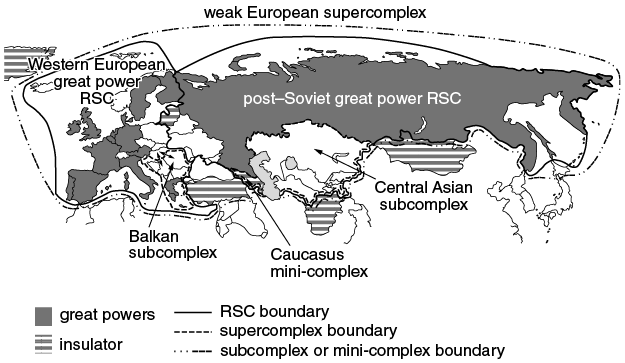
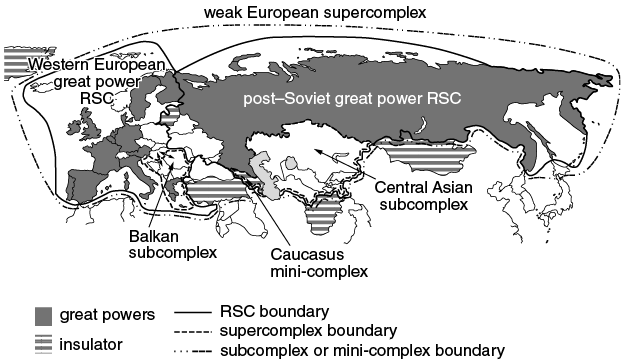
Returning to Buzan and Wæver, separating the world into RSCs and focusing on the map of Eurasia in Figure 8.1 – which a considerable part of the Arctic spatial domain belongs to – can help illustrate the point. In it, it seems apparent that what has been highlighted as a separate SRSC in the European Arctic is just an extension of a wider Western European RSC. As argued by Greaves (Reference Greaves2019), the Barents SRSC or the European Arctic is ‘simply the northern zone of the broader European RSC’.
Map of the European RSCs. From Buzan and Wæver (Reference Buzan and Wæver2003: 350).
However, from the review and discussion so far in this book, it seems plausible to argue that Spain’s security, or ‘military security’, practices have limited consequences, if any, for Poland, Norway, or Estonia. Perhaps in other fields certain actions and practices might have a wider impact, such as a joint EU policy to manage migrant flows from North Africa or putting in place a Western sanctions regime targeting Russia. However, by grouping all such practices under the larger umbrella of securitisation and securitising acts, the boundaries of the respective regions become blurry and in essence subject to the boundaries of those very acts – which in and of themselves often hinge not on geographic or spatial concerns, but on ideas of regionality and political cooperation. In turn, ‘the Arctic’ or ‘Western Europe’ says little about where states in that space operate in terms of security practices.
The core premise of this book is that if we want to comprehend what states actually do, where they send their armed forces, and where they feel insecure and even threatened, most of those practices revolve around geographic proximity to other states and shared borders and boundaries. There is a reason why Switzerland can allow itself to spend only 0.76 per cent of its GDP on defence and remain ‘neutral’ in security affairs (O’Neill Reference O’Neill2024), whereas Estonia, Norway, and Bulgaria have all joined NATO and spend 3.43 per cent, 2.2 per cent, and 2.18 per cent respectively on defence (Falkenek Reference Falkenek2024). Or, in an Arctic case, why Canada – at least before the return of US President Trump in 2025 – was spending 1.37 per cent, struggling to reach the 2 per cent target (Penney Reference Penney2024). These are highly simplified examples – of course states’ considerations of security, defence spending, and neutrality hinges on a range of factors, from historic context to domestic politics. Still, geography matters – more than is often taken into consideration when discussing international security.
There are naturally also a whole range of security issues that can heavily influence states’ security posture and security practices but are not necessarily conditioned by geography and other states. The French military engagement in its former colonies across Africa, Asia, and South America is one example. Another is the considerable wave of terrorism attacks across European countries such as Belgium, France, Spain, and the UK in the 2000s and 2010s, as a non-state non-territorial security concern that dominated much of state security practices and led to actions in everywhere from Afghanistan to Syria and Iraq.
The argument here is not that these issues are irrelevant. Instead, the argument is that we also cannot ignore the fundamental importance of the security practices that revolve around geographic proximity between states. Despite idealistic notions of an end to territorial conflict and border wars in the 1990s, today we see that is still where a lot, if not most, of states’ security posture, resources, and concerns materialise.
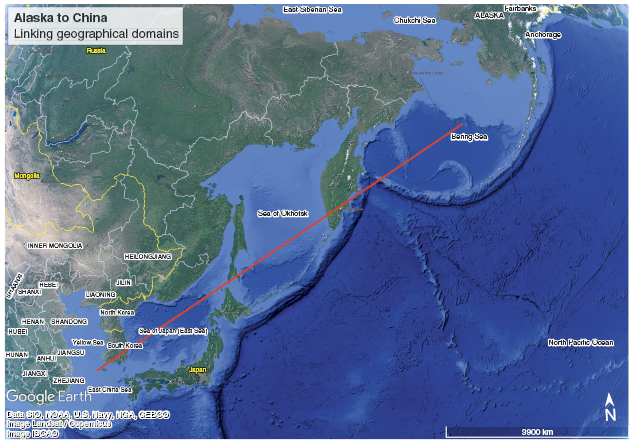
The Arctic SRSCs make clear the continued centrality of geography in determining states’ security practices. The USA, despite being the global superpower, cannot ignore the confines of the North Pacific and the Bering Sea. In that domain, the USA must engage with Russia in some way or another, as it also did during the Cold War. Changes in climate, ice conditions, fish stock movement and abundance, as well as technology, impact that domain, making Russia–USA security interactions brittle. The addition of China there also emphasises the (relative) proximity between various SRSCs. As highlighted in Figure 8.2, the Bering SRSC is located relatively close to a SRSC that can be conceived around the Kuril Islands and the Sea of Okhotsk, which in turn interlinks with a SRSC that could be conceived around Japan and South Korea. China has also argued that part of its increased naval activity off the coast of Alaska must be seen in response to the US presence in the East and South China Seas. This is not an example of decoupling geography and security concerns; it is instead an example of seeing various geographic domains as interlinked.
A line drawn from Alaska to China. Made with Google Earth.
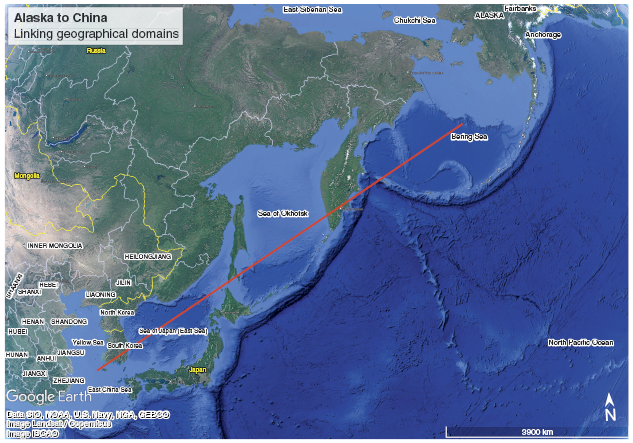
This linkage underscores how the concept of SRSCs must be seen as overlapping geographically bounded spatial domains, which have their own security dynamics based on proximity between states and state practices but must nevertheless also be conceived of as linking with other nearby SRSCs. Similarly, in the European context, the Barents SRSC has direct overlap and interlinkages with the Baltic SRSC, although these retain their distinctly separate dynamics. The central focal points of these SRSCs are geographic spots where states intersect and interact with each other, either over borders on land or boundaries at sea, and the immediate surrounding areas.
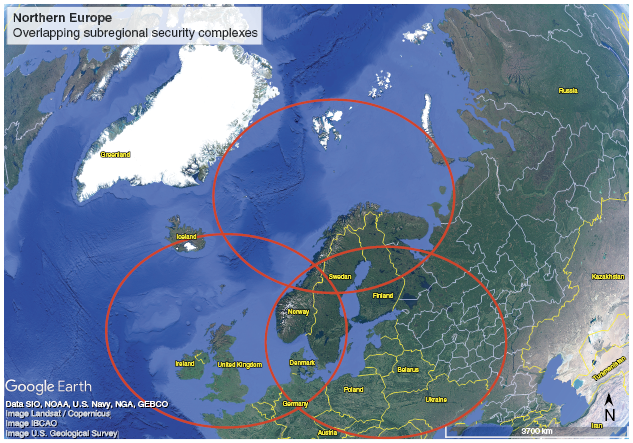
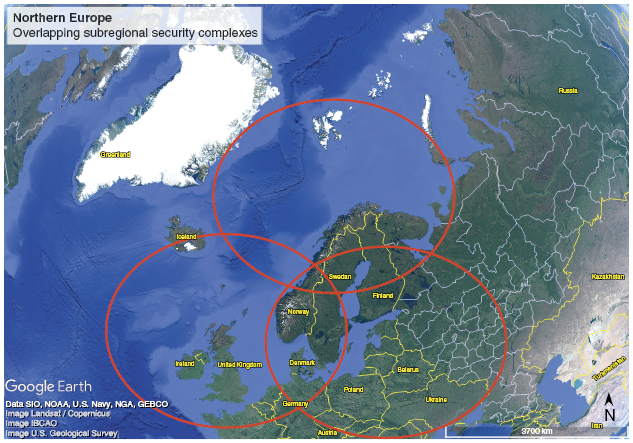
Thus, states typically find themselves in several SRSCs at once, with varying degrees of intensity concerning their security practices and dynamics. It is therefore relevant to envision a Venn diagram of overlapping security SRSCs, as displayed, albeit rudimentarily, in Figure 8.3. These Venn diagram circles are a starting point for analysis. What in turn might prove fruitful is identifying the exact limitations and boundaries of each, and also how, and why, some overlap, but others perhaps do not.
A Northern Europe of overlapping SRSCs. Made with Google Earth.
Latvian security practices, for example, have considerable bearing on Polish and Belarussian security practices but limited influence on Norwegian ones. But a large-scale security issue or escalation in the Baltic domain will also impact Russian and Norwegian calculations in the Barents Sea. Spanish–Moroccan security interactions and practices, however, have little bearing on either of these domains, unless the security issue at hand takes on scaled-up characteristics (such as Spain invoking article four or five of the North Atlantic Treaty) which inherently then decouples the issue from what is in focus here – the dynamics emanating from constraints and state interactions in geographical subregions.
From this examination of the Arctic SRSCs, some key lessons for theorising about regions and security practice thus emerge. This does not only concern the RSCT, but will inevitably refer to that theoretical framework, given its centrality in unpacking security regions. The approach here is not to evaluate the RSCT or make use of it to explain the Arctic in the twenty-first century. Instead, the approach here has been to lean on the conceptualisations and ideas of the RSCT, as well as other approaches to security regions, region-building, geopolitics, while retaining a specific focus on the state and its security practices.
First, the subregions that emerge have centred on explaining state security practices where they coalesce, ignoring other subregional domains not dominated by security considerations, and also shedding the shackles of the pan-region-wide scope. Although the framework in this book is sympathetic to trying to unpack ‘patterns of enmity and amity’, including the ‘mixture of history, politics, and material conditions’ (Buzan and Wæver Reference Buzan and Wæver2003: 47), this notion is arguably too broad in scope.
Instead, Buzan’s state-centric definition of a RSC from 1983 might be a better fit (Buzan Reference Buzan1983: 106): ‘a group of states whose primary security concerns link together sufficiently closely that their national securities cannot reasonably be considered apart from one another’. The emphasis is thus less on how international or systemic structures define the parameters for state security at a given regional level, and more about how the regions are defined by states and their security practices (so-called bottom-up), although these processes are obviously reconstitutive. It therefore becomes essential to include the domestic, or national, level and security perspective, and give more weight to geography and just how quickly states lose their ability to project force without great expense. Security practices of states are consequently something local, seldom something global.
This does not mean that the geography of regions is an absolute limitation that locks the surrounding states into predetermined patterns of behaviour. We also cannot predict the trajectory of these dynamics and relations going forward based on geography alone. This is where this book markedly deviates from traditional analyses of geopolitics. For example, Chinese–Russian relations in the Bering Sea/North Pacific showcase how we must understand the interlinkages between geography (Russia and the USA in shared maritime space in the Bering Sea) and other dimensions of security amongst states, namely security dynamics at various levels or scales, and the relevance of the intangible elements in Arctic ‘regionalism’.
The increase in joint exercises by China and Russia, in 2024 taking on both an airborne and a coast guard element alongside the naval one, must be understood as a direct consequence of increased general cooperation between the states in general after 2014 which has a limited geographic rationale. In 2014, Western states sanctioned Russia and cut various forms of military collaboration in response to Russian actions in Ukraine, while they had – led by the USA – been pivoting towards containing China from around 2010 (e.g., Canrong Reference Canrong2016). The increase in scale of collaboration between Russia and China must be linked to further deterioration in relations with the West after Russia’s invasion of Ukraine in 2022. What happens on the global or systemic level naturally will impact subregional expressions of security practices.
Furthermore, the symbolic elements of operating in the Arctic, as exemplified by the Chinese Coast Guard’s fanfare about reaching the Arctic Ocean in 2024 (McCarthy Reference McCarthy2024), as well as the increased symbolic elements of Russian–Chinese cooperation in the Arctic (e.g., Stensdal and Heggelund Reference Stensdal and Heggelund2024), are drivers of Chinese security practices in this subregion. That in turn spurs US attention to Arctic security issues (as exemplified with the DoD Arctic Security Strategy from 2024). There is, in other words, an interplay between political and region-building conceptions of the Arctic, how certain parts of the Arctic such as the Beringia SRSC become expressions of global security dynamics, and the limitations and opportunities defined by geography in those very same spatial domains. This interplay is what constitutes the regional security dynamics (or an RSC) taking place in much smaller geographical domains – the SRSCs – than what is normally used to refer to regions, namely North American security dynamics or Pacific security dynamics.
Second, a consequence of recentring the state and downscaling the scope is that security regions can overlap, or states can participate in several simultaneously by virtue of their geography. Great powers (i.e., states with relatively more recognised capacity than their peers) operate,Footnote 23 as highlighted by much of the security regions literature, in several security regions by virtue of either overlay – when they dominate the region to the extent that no local patterns exist – or penetration – when they align with actors in the region and assert influence. However, great powers also participate in SRSCs by virtue of their geography and can arguably belong to several simultaneously.
Although Buzan and Wæver (Reference Buzan and Wæver2003: 46) appreciate this through their notions of overlay and penetration – that is, ‘[s]maller states will usually find themselves locked into an RSC with their neighbours, great powers will typically penetrate several adjacent regions, and superpowers will range over the whole planet’ – they arguably neglect that states can belong to several regions at once – at least when operating with scaled-down SRSCs as the primary focus. Moreover, most states are small powers (e.g., Baldacchino and Wivel Reference Baldacchino and Wivel2020). Studying their security concerns, overlaps, and regional linkages provides a more accurate approach to international studies, given that the emphasis is on understanding state behaviour and actions. Thus, this framework does not operate under the assumption that the SRSC boundaries are firm and mutually exclusive. SRSCs bleed into each other and overlap. Scaling down regions provides a more accurate and empirically oriented picture of security dynamics and – crucially – security concerns of the participating states.
Third, this also links to a point concerning the notion of security regions as the ‘primary’ spatial or regional domain for security practices. In the approach here, they do not have to be. In fact, defining what the primary spatial domain for any given state is opens a Pandora’s box of subjective evaluations and fluctuations depending on how you measure security interests and practices, where geographic spatial domains are delineated, and temporality. This is not to say that certain SRSCs do not hold more clout than others in defining the security practices of participating states, but to highlight one as primary might be a futile process of limited and rapidly expiring analytical value.
For example, in the case of Norway, it is clear from both political rhetoric and security practices ranging from military investments to exercises that the High North, or the Barents SRSC, is the most dominant spatial domain for that state’s security practices. However, Norway cannot discount other nearby SRSCs (see Figure 8.3), such as what we could conceive of as a North Sea/UK-centred SRSC, or the nearby Baltic SRSC. These hold importance in Norwegian security practices, albeit not with the same significance as the Barents one.
The USA, in the case of the Beringia SRSC, is in a different position. For that state, when focusing on its geographic space and near abroad, other more immediate security concerns and in turn subsequent practices can most likely be identified along parts of the border with Mexico, or historically, in its relations with Cuba across the Straits of Florida, or even Canada to the north-east. Developments on the border between the USA and Mexico around the Gulf of Mexico have little bearing on the Beringia SRSC however. The point here is that states often take part in several SRSCs by virtue of their geography and their relations with the bordering or proximate states, and making the existence of a subregion contingent on being the primary one for all participating states is a futile effort.
In summary, where this study deviates from traditional approaches to security regions and RSCs, is the scale of the ‘regional’ and where to place the emphasis as a starting point of analysis. This is due to a focus on the state and its security practices as the primary referent object. If state security practices are the starting point, the RSC becomes something much smaller and immediate, defined (and limited) by geography. Furthermore, subregional dynamics must be conceived in relation to the international system, the broader region, and the national dynamics. The question is to what degree a SRSC is influenced by dynamics at those various levels, and how in turn the SRSC enables and limits state security practices. Finally, a focus on SRSCs not only opens up the possibility of, but hinges on, these spatial security domains being at least partially overlapping. In turn, this should provide for a more accurate assessment of the linkages between security, geography, and the regional spatial domain.
Maritime Regions as a New Frontier?
Lastly, a few words about maritime space and oceans are pertinent here, given that the Arctic comprises one relatively large maritime space, and that the security subregions identified and examined are also framed around seas. The approach put forth here does not posit that subregions must coalesce around maritime space. However, there are some interesting trends that this book also fits into when it comes to the study of maritime regions, security dynamics, and geopolitics.
Several trends are making (coastal) states increasingly concerned with maritime space, sovereign rights, and notions of upholding sovereignty at sea.Footnote 24 Whether this is due to drivers related to climatic changes, resource potential, reimagined social relations with the ocean (J. Anderson and Peters Reference Anderson and Peters2014; Steinberg Reference Steinberg2001), or increased polarisation in global governance discussions depends on both the maritime domain in question and on which actor we examine. In any case, the result is the same, namely that enclosed or semi-enclosed maritime domains such as the Arctic Ocean, the Black Sea, the Caribbean Sea, the Mediterranean Sea, or the South and East China Seas are receiving increased attention as spatial containers for all those mentioned drivers.
As Christian Bueger, Elizabeth Mendenhall, and Rebecca Strating put it in their edited volume The Politics of Global Ocean Regions (Reference Bueger, Mendenhall, Strating, Bueger, Mendenhall and Strating2025, 1), ‘despite their fundamental importance to international relations, our understanding of how ocean spaces are politically organised remains surprisingly limited’. Jacobsen, Wæver, and Pram Gad (Reference Jacobsen, Wæver, Gad, Jacobsen, Wæver and Gad2024a, 337) reflect, in their work on Greenland in Arctic security, that the RSCT might hold relevance in understanding security dynamics across other regional maritime domains, although they argue for retaining a focus on land as the domain where security interactions are the most intense.
Based on the examination of the Arctic, and its security subregions, in this book, the approach remains agnostic to the centrality of the oceans, or the maritime domain, in terms of security dynamics. There is no doubt that territory, and related border conflicts and disputes, has been, and continues to constitute, the primary security issue for many states. When states have unclear or disputed borders, that domain is a continuous source of friction. The conflict between China and India in the Himalayas, the conflict between Colombia and Venezuela along their Caribbean-facing border, or the conflict over where to delineate territory in Western Sahara exemplify the contemporariness of conflict surrounding borders on land (Tir and Diehl Reference Tir and Diehl2002; A. Rosen Reference Rosen2015).
Inherently, it is the ability of states to interact across geographical space that makes border regions particularly contentious. Land is one of the most valuable assets for a state, both in terms of function and in terms of symbolism. Therefore, so-called patterns of enmity and amity are dominated by border issues, or historic relations across those borders, such as that between Latvia and Russia, or Mexico and the USA. Even where borders are settled and have been so for a long time, they can be a source of contention, especially when relations between bordering states change due to issues that may or may not be related to the border at all. However, more and more border disputes are settled (Reference Schenoni, Goertz, Owsiak and DiehlSchenoni et al. 2020).
That in turn leaves maritime domains, where states are in relative proximity with each other, and might even dispute maritime boundaries, jurisdiction, and sovereign rights (Østhagen Reference Østhagen2021c). The various maritime parts of the Arctic are examples of this, although the Arctic Ocean writ large is actually an outlier in a global context since most maritime disputes are settled there. An interesting question is whether there are certain characteristics with state interactions in the maritime domain that differ markedly from those characteristics on land (Reference Nemeth, Mitchell, Nyman and HenselNemeth et al. 2014). The oceans have generally been seen as the antithesis of land – opposite and inherently different – or as a void (Steinberg Reference Steinberg2001). Maritime space and its value for states have been defined as inherently functional. That may make it seem tempting to equate the value and importance of maritime space (and subsequent disputes over such space) to the functional value of that space (D. M. Johnston Reference Johnston1988).
However, in some instances, it might be said that maritime disputes are coming to resemble traditional territorial conflicts on land (Østhagen Reference Østhagen2021c; Mendenhall Reference Mendenhall2018). Especially in bilateral relations that are already fraught, as with Colombia–Venezuela or Norway–Russia (over Svalbard), maritime disputes may prove to hold latent conflict potential. However, the maritime domain has certain characteristics that nevertheless keeps it separate from the terrestrial domain. John Mearsheimer (Reference Mearsheimer2001: 84) deemed it ‘the stopping power of water’. There are geographical barriers that hinder prolonged interactions between the actors concerned. Maritime boundaries and sovereign rights are also a construct of international law, and (coastal) states seem to depend on the Law of the Sea regime while also wanting to apply the regime to their own advantage (Mendenhall Reference Mendenhall and Paul2019). Also, what we are discussing regarding states and maritime space is sovereign rights to resources in the water column or on the seabed, not exclusive rights to the entire maritime ‘territory’ in question.
At the same time, as this focus on SRSCs brings forth, the immediate geography where state security practices coalesce might revolve around a maritime domain. Whereas a border on land provides a fixed and often well-guarded point of contact, which – as in the case of Norway/Finland and Russia in the Arctic – leads to a relative stasis in relations and activity over that space, the maritime domain is a much more ‘fluid’ space. States cannot deny passage through their EEZs or even hinder military activity such as large-scale exercises; they may only deny actors’ access to marine resources and apply environmental regulations in their maritime zones.
Also, as the Barents SRSC showcases, the access of Russian research vessels to the Norwegian EEZ, the FPZ, and the shelf rests on UN Convention on the Law of the Sea Article 246 (United Nations 1982), where ‘the coastal State should normally grant its consent’ except in a few specific circumstances Reference Woker, Schartmüller, Dølven and Blix(Woker et al. 2020: 2). Thus, the burden of proof concerning Russian vessels conducting illegal activities in Norwegian waters, including in the FPZ, lies with the Norwegian authorities – which is diplomatically and administratively strenuous. If tensions were to mount even further between NATO and Russia at large, it is also likely that Russia could decide to engage in so-called hybrid warfare in or around Svalbard. Concern in Norway over the activities of Russian trawlers and research vessels in Norwegian waters is already prevalent (Juul Stensrud and Østhagen Reference Østhagen2024).
Such security concerns, which in turn spur security practices and impact the general security dynamics between actors within that specific geographic space, are not relevant across all ocean space. More than 70 per cent of the globe is ocean. Instead, it is where states are located in geographic proximity to each other across restricted maritime space that interactions might be of relevance to security practices. Enclosed or semi-enclosed maritime spaces, or spaces where state boundaries at sea congregate, are particularly interesting in this regard. Not all such spaces are necessarily dominated by security practices of the nearby states, but they have the potential to be. The most relevant spaces around the world seem to be the Arabian Sea, the Arafura Sea, the Bay of Bengal, the Black Sea, the Caribbean Sea, the Caspian Sea, the East and South China Seas, the Gulf of Guinea, the Sea of Japan, the Persian Gulf, and the Red Sea/Gulf of Aden, in addition to the Barents and Bering Seas.
As showcased in both the Barents and the Bering Seas, uncertainty over sovereign rights, jurisdiction, under-the-threshold operations, and even military exercises close to territorial waters of the opposing state lead to heightened security concerns, in turn impacting (and constituting) the Barents and Beringia SRSCs. The maritime space thus becomes a spatial domain that states utilise in order to signal and, possibly, escalate tension, without engaging in direct conflict. Whereas escalation on land along a fixed border might entail direct involvement of military units, at sea softer means can be deployed, such as coast guard vessels firing water cannons, or even a fishing trawler that ‘accidently’ damages seabed infrastructure (Ondraskova, Berzina, and Arts Reference Ondraskova, Berzina and Arts2024).
At the same time, due to the fluidity of the maritime space, as well as the characteristics of ocean-based resources and activities, there is also room for collaboration. Whereas bilateral cooperation with a neighbouring state across a land border might be difficult to initiate if security relations are tense, certain maritime tasks, such as search and rescue, environmental protection and response, and management of transboundary marine resources, not only suggest collaboration, but are sometimes dependent on it. Moreover, for delimitation in the maritime domain, both states may have valid legal claims to a given area, in which case it becomes a matter of ‘reasonable sacrifice such as would make possible a division of the area of overlap’ (Weil Reference Weil1989: 91–92) or even sharing – as with oil and gas resources or a joint fisheries zone. The Barents and the Bering Seas are again examples of this, where both Norway and the USA initiated cooperation with the USSR in the 1970s, and later expanded this with Russia in the 1990s and 2000s, in order to manage everything from overfishing to increased maritime traffic.
As Michael Byers terms it (2019), there are certain spatial domains that are ‘cold, dark, and dangerous’, which in turn might prompt states to cooperate with each other for positive-sum benefits, regardless of negative security interactions elsewhere or over other issues. Although the ‘cold’ and ‘dark’ elements may vary depending on which sea or ocean we examine, the maritime domain in general might in fact be exactly such a space that allows low-level forms of cooperation amongst states that may find it difficult to engage in other forms of cooperation, geographically bounded or not. Not only is the Arctic Ocean (or the various SRSCs) an example of this, we can, for example, find similar examples in Southeast Asia (Beckman et al. Reference Beckman, Ian Townsend-Gault, Davenport and Bernard2013; Midford Reference Midford, Tim and Krista2015; Simon Reference Simon2012; Mishra Reference Mishra2017).
Perhaps there are certain elements when it comes to the ocean that makes the potential for low-level disputes, as well as low-level forms of collaboration, relatively high. These concluding remarks of this chapter therefore suggest looking not only at security subregions in general, but also interactions related to security and security practices in these smaller or geographically bounded maritime spaces.

 Open access