INTRODUCTION
The coexistence of especially vivid and distressing intrusive memories alongside an inability to recollect other details of the traumatic experience is generally considered among core features of posttraumatic stress disorder (PTSD) in both clinical (DSM-5, American Psychiatric Association, 2013) and cognitive models (e.g., Brewin, Gregory, Lipton, & Burgess, Reference Brewin, Gregory, Lipton and Burgess2010; Ehlers & Clark, Reference Ehlers and Clark2000). Consequently, numerous experimental investigations have targeted memory functioning in PTSD. Among main findings, these studies emphasized the importance of assessing memory functioning in PTSD with regard to the emotional valence of the stimuli. Indeed, whereas memory in PTSD is generally impaired for neutral or positive stimuli (e.g., Golier, Yehuda, Lupien, & Harvey, Reference Golier, Yehuda, Lupien and Harvey2003; Zeitlin & McNally, Reference Zeitlin and McNally1991), it appears to be preserved or even enhanced for negative or trauma-related materials (e.g., Golier et al., Reference Golier, Yehuda, Lupien and Harvey2003; Tapia et al., Reference Tapia, Clarys, Bugaiska and El-Hage2012, Tudorache et al., Reference Tudorache, El-Hage, Tapia, Goutaudier, Kalenzaga, Bouazzaoui and Clarys2019; Tudorache, Goutaudier, El-Hage, & Clarys, Reference Tudorache, Goutaudier, El-Hage and Clarys2020). This enhanced memory functioning for threatening information found in experimental settings echoes the hypermnesis associated with traumatic reminiscences. However, both clinically and experimentally, debates remain regarding the explanations for these memory biases.
Memory dysfunctions in PTSD have usually been linked to inefficient processing on other cognitive domains, such as attention. Attention allocation plays a significant role in the effective encoding of both neutral and emotional information (e.g., Pottage & Schaefer, Reference Pottage and Schaefer2012). In PTSD, attention appears to be preferentially allocated to threatening information (e.g., Cisler et al., Reference Cisler, Wolitzky-Taylor, Adams, Babson, Badour and Willems2011; Felmingham, Rennie, Manor, & Bryant, Reference Felmingham, Rennie, Manor and Bryant2011). This increased attention allocation may have favored the processing of these information, resulting in an enhanced memorization of threat-related stimuli at the expense of encoding other types of stimuli. Nevertheless, attentional biases have frequently been associated with difficulties in disengaging from threatening stimuli, rather than an improved detection of them (e.g., Bardeen & Orcutt, Reference Bardeen and Orcutt2011; Schönenberg & Abdelrahman, Reference Schönenberg and Abdelrahman2013). Difficulties in inhibiting the processing of trauma-related information have thus become an additional explanation for memory biases in PTSD.
Recently, investigations of memory inhibition for threatening information were conducted in association with Remember/Know (R/K) recognition tasks. The R/K procedure (Tulving, Reference Tulving1985) was developed to experimentally distinguish between two memory systems: the episodic memory and the semantic memory. The episodic memory involves the ability to mentally relive the encoding of an event by recollecting the associated contextual information. By contrast, the semantic memory is involved in the retrieval of general noncontextualized knowledge. In short, these two memory systems respectively distinguish the ability to remember from the ability to know something. In the R/K procedure, participants are typically requested to specify whether their memory retrieval is a Remember (R) or a Know (K) type. An R response reflects the ability to recollect the stimulus together with contextual details from the encoding (e.g., associated items, mental images, thoughts, personal memories induced by the stimulus). By contrast, a K response reflects an exclusive recall of the stimulus. Thus, alongside the separation of these two memory systems, the R/K paradigm offers the possibility to integrate reviviscence (i.e., the impression of reliving an event through particularly vivid memories) and contextualization (i.e., the ability to locate a memory into its encoding context) into the experimental assessment of memory. Interestingly, both these aspects have been described among key characteristics of traumatic memories (e.g., Brewin et al., Reference Brewin, Gregory, Lipton and Burgess2010; Ehlers & Clark, Reference Ehlers and Clark2000). Prior R/K investigations in PTSD have revealed that patients with PTSD provide fewer R responses than control participants for neutral information (Tapia et al., Reference Peirce2007), but more R responses for negative (Tapia et al., Reference Tapia, Clarys, Bugaiska and El-Hage2012) or trauma-related stimuli (Tudorache et al., Reference Tudorache, El-Hage, Tapia, Goutaudier, Kalenzaga, Bouazzaoui and Clarys2019, Reference Tudorache, Goutaudier, El-Hage and Clarys2020). According to these findings, memory biases in PTSD may be attributed to an enhanced reviviscence of the encoding context for threatening information.
Previous studies have hypothesized that R/K alterations in PTSD could result from memory inhibitory deficits for threatening information. However, contrary to expectations, the findings point towards preserved memory inhibition abilities for trauma-related words and inhibitory deficits for the memorization of positive, neutral, and generally negative words. These findings were found for both controlled (i.e., directed forgetting effects; Tudorache et al., Reference Tudorache, El-Hage, Tapia, Goutaudier, Kalenzaga, Bouazzaoui and Clarys2019, Reference Tudorache, Goutaudier, El-Hage and Clarys2020) and more automatic inhibitory processes (i.e., negative priming effects; Tudorache et al., Reference Tudorache, Goutaudier, El-Hage and Clarys2020). Accordingly, memory functioning in PTSD appears to be characterized by preferential processing of threatening information, at the expense of other information. Thus, instead of inhibitory deficits, cognitive and memory alterations in PTSD are more likely be explained by a preferential allocation of cognitive resources to the procession of threatening materials.
Resources allocation theories are based on the postulate of limited availability of cognitive resources for information processing (e.g., Kahneman, Reference Kahneman1973). In this context, the preferential allocation of cognitive resources to the processing of trauma-related information leaves few resources available to process other types of information. An advantage of this theory is that it explains both the enhanced processing of trauma-related information in PTSD and the associated deficits for other types of information (e.g., Stanford et al., Reference Stanford, Vasterling, Mathias, Constans and Houston2001). Therefore, a preferential allocation of cognitive resources to the encoding of threatening information is consistent with the creation of more elaborate and vivid memories, leading to an increase in R responses. However, while this theory is frequently used to explain findings in PTSD, only a few studies have directly investigated it, and none have examined its relevance regarding R/K memory biases.
Cognitive costs and resources allocation are usually studied using dual-task procedures. Basically, these procedures involve asking participants to perform two tasks simultaneously. One of them, considered secondary, is intended to capture the cognitive resources necessary to perform the primary task. In this context, performance drops in the primary task are reflective of its dependence on the availability of cognitive resources. Regarding R/K assessments in healthy participants, dual-task procedures have generally resulted in impaired R responses, whereas K responses remained relatively unaffected (see, for instance, Yonelinas, Reference Yonelinas2002, for a review on R/K procedures). As a consequence, R responses have been associated with a greater reliance on the availability of cognitive resources during the encoding, whereby the necessary encoding strategies can be initiated. Accordingly, the increased production of R responses for trauma-related stimuli in PTSD is consistent with an increased allocation of cognitive resources to the processing of trauma-related stimuli, at the expense of other information.
Despite a long-lasting literature on memory biases in PTSD, the mechanisms behind are still poorly understood. The present study is the first attempt to investigate the reallocation of cognitive resources as an explanation for R/K memory biases in participants with posttraumatic stress symptoms (PTSS). To this end, we investigated the impact of a depletion of cognitive resources during the encoding on R/K biases in participants with high PTSS. Based on the findings that better encoding leads to an increase in R responses, we expected the depletion of encoding resources to reduce R responses for trauma-related words in participants with high PTSS, without affecting R responses for positive, neutral, and generally negative words. By contrast, leaving cognitive resources relatively intact should replicate previous findings of increased R responses for trauma-related words.
METHOD
Participants
For this investigation, participants were recruited among undergraduate students who had experienced at least one traumatic event (meeting DSM-5 Criterion A for PTSD) in their lifetime, evaluated by the Life Events Checklist (LEC; Gray, Litz, Hsu, & Lombardo, Reference Gray, Litz, Hsu and Lombardo2004). Among the 100 respondents, 43 were excluded from analyses following the exclusion criteria listed below. Exclusion criteria were a score between 20 and 32 on the Posttraumatic Stress Disorder Checklist for DSM-5 (PCL-5; Blevins et al., Reference Blevins, Weathers, Davis, Witte and Domino2015), a score above 32 without reaching one of criteria A-F for PTSD, an absence of traumatic exposure (criteria A), reporting a comorbid psychiatric diagnosis (e.g., bipolar disorder, substance-related disorders, schizophrenia spectrum, and other psychotic disorders, major depressive disorders), the use of psychoactive medications, and/or a history of physical injuries that might have an impact on findings (e.g., head injury). The exclusion of participants with a PCL-5 score between 20 and 32 was done to avoid including participants with partial criteria for PTSD in the control group. In addition to these criteria, two participants were excluded from analyses for presenting forward span scores (Wechsler, Reference Wechsler2008) below 5, suggesting an inability to perform the high load secondary task during the encoding.
Selected participants were divided into two groups, based on their reported symptoms of PTSD on the PCL-5 (Blevins et al., Reference Blevins, Weathers, Davis, Witte and Domino2015). The group with high levels of PTSS (labelled PTSS+) was composed of 25 participants (23 women and 2 men). Inclusion in the PTSS+ group required a total score at the PCL-5 superior to the cut-off score of 32 for potential PTSD (Ashbaugh et al., Reference Ashbaugh, Houle-Johnson, Herbert, El-Hage and Brunet2016; Weathers et al., Reference Weathers, Litz, Keane, Palmieri, Marx and Schnurr2013) and reaching DSM-5 Criteria A, B, C, D, E, and F (APA, 2013). At the opposite, the control group (labelled PTSS–) was composed of 32 participants (24 women and 8 men) presenting low levels of symptoms at the PCL-5 (i.e., total scores <20). No participant reported a previous diagnosis of PTSD. Regarding trauma exposure, the 25 PTSS+ participants mainly reported having experienced or witnessed physical or sexual assaults (n = 13), followed by the violent or unexpected death(s) of relatives or severe human suffering (n = 8), motor vehicle accidents (n = 3), and fire (n = 1). The 32 PTSS– participants mainly reported having experienced or witnessed sudden violent or unexpected death(s) of relatives or severe human suffering (n = 11), followed by motor vehicle accidents (n = 7), physical or sexual assaults (n = 7), and life-threatening illnesses or injuries (n = 7).
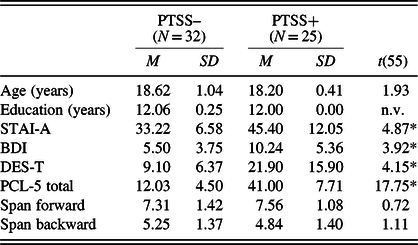
Groups presented significant differences on depressive symptoms, as assessed with the Beck Depression Inventory (BDI; Beck & Beck, Reference Beck and Beck1972), dissociative symptoms, as assessed with the Dissociative Experience Scale Taxon (DES-T; Waller, Putnam, & Carlson, Reference Waller, Putnam and Carlson1996), and anxiety symptoms, as assessed with the State scale of the State-Trait Anxiety Inventory (STAI-State; Spielberger, Reference Spielberger1983). The groups did not differ significantly on either age or span scores and almost all participants reached the same education level. Participants’ characteristics are set out in Table 1. Participation in the study was voluntary. All participants gave their written informed consent and there was no compensation for taking part. Recruitment and testing procedures were conducted in accordance with ethical guidelines of the Declaration of Helsinki.
Descriptive statistics for age, education level, clinical scales and span scores for the two groups

Note. * p < .001; n.v.: not enough variance for analysis; M: Mean; SD: Standard Deviation.
Measures
The LEC (Gray et al., Reference Gray, Litz, Hsu and Lombardo2004) is a 17-item scale that assesses exposure to potential traumatic events. The first 16 items present the most commonly experienced events, while the final item allows respondents to add other potential traumatic events. Each item is rated on a 4-point scale (1 = Happened to me, 2 = Witnessed it, 3 = Learned about it, and 4 = Does not apply). Gray et al. (Reference Gray, Litz, Hsu and Lombardo2004) reported adequate psychometric properties.
The PCL-5 (Blevins et al., Reference Blevins, Weathers, Davis, Witte and Domino2015) is a 20-item self-administered measure assessing 20 PTSD symptoms listed in the DSM-5 (APA, 2013). For each item, respondents indicate the extent to which they were bothered by the symptom in the previous month on a 5-point Likert scale (ranging from 0 = Not at all to 4 = Extremely). Total scores range from 0 to 80, with higher scores indicating elevated symptoms severity. A cut-off score of 32 is considered reasonable when screening for potential PTSD (Ashbaugh et al., Reference Ashbaugh, Houle-Johnson, Herbert, El-Hage and Brunet2016; Weathers et al., Reference Weathers, Litz, Keane, Palmieri, Marx and Schnurr2013). Additional interpretations could be obtained using DSM-5 criteria with a symptom rated as 2 or higher considered endorsed. Ashbaugh et al. (Reference Ashbaugh, Houle-Johnson, Herbert, El-Hage and Brunet2016) reported overall good psychometric properties (α = .94).
The short version of the BDI (Beck & Beck, Reference Beck and Beck1972) is a 13-item self-administered measure assessing the following depressive symptoms: depressed mood, pessimism, sense of failure, lack of satisfaction, guilt, self-hate, self-harm, social withdrawal, indecisiveness, distorted body image, work difficulties, fatigue, and loss of appetite. For each symptom, respondents rate severity from 0 to 3. Total scores range from 0 to 39. Beck, Rial and Rickels (Reference Beck, Rial and Rickels1974) reported good overall psychometrics (α = .78–.97).
The DES-T (Waller et al., Reference Waller, Putnam and Carlson1996) is an 8-item self-administered measure of pathological dissociation. For each item, respondents rate the extent to which they have experienced the described dissociative state (from 0% = Never to 100% = Always). The total score is usually obtained by averaging percentages for individual items, with higher scores indicating elevated dissociation. Waller et al. (Reference Waller, Putnam and Carlson1996) estimated adequate reliability (α = .78).
The STAI-State (Spielberger, Reference Spielberger1983) is a self-administered 20-item questionnaire assessing current anxiety symptoms. Respondents rate their experiences on a 4-point Likert scale (from No at all to Very much). High scores indicate elevated anxiety. Barnes, Harp and Jung (Reference Barnes, Harp and Jung2002) reported overall good psychometric properties.
Span tests were extracted from the Digit Span subtest of the fourth version of the Wechsler Adult Intelligence Scale (WAIS-IV, Wechsler, Reference Wechsler2008). The forward and backward span tests used in the present study were designed to, respectively, assess short-term and working memory spans. In the forward span test participants have to say back growing sequences of numbers, whereas in the backward span test the sequences should be recalled in reverse order. Two different series of numbers were presented for each sequence length. Test ended when participants failed to recall both series. Spans scores used in the present study represented the number of digits from the longer correctly recalled sequence.
Materials
For the primary memory task, 112 emotional words were selected from databases containing norms for the emotional valence of French words or studies that had assessed their trauma relevancy (Bonin et al., Reference Bonin, Méot, Aubert, Malardier, Niedenthal and Capelle-Toczek2003; Messina, Morais, & Cantraine, Reference Messina, Morais and Cantraine1989; Monnier & Syssau, Reference Monnier and Syssau2014; Tudorache et al., Reference Tudorache, Goutaudier, El-Hage and Clarys2020; Vikis-Freibergs, Reference Vikis-Freibergs1976). Words were divided into two equally sized lists that were counterbalanced to serve alternately as words to encode and distractors for the recognition task. Each list was composed of 14 positive (e.g., humor, kindness), 14 neutral, (e.g., flag, classical), 14 negative (e.g., jealousy, barrier), and 14 trauma-related words (e.g., suffering, panic). Sub-lists of different emotional valences were controlled and balanced for word length (number of letters) and frequency (Lexique 3.01; New et al., Reference New, Pallier, Ferrand and Matos2001).
The secondary task was operationalized by randomly generating sequences of letters and numbers. According to pre-tests, the high load condition was composed of sequences of 6–7 items, whereas the control low load condition only included 3–4 items. For the encoding phase, half of the words for each emotional valence were associated with low load sequences and the other half with high load sequences. Four pseudo-random encoding sub-lists were created to avoid more than two successive repetitions of the same load condition or emotional valence, and to counterbalance words’ order and words associated with each load condition. For the recognition phase, the encoded words were presented in a random order, among the 56 unstudied distractors in the second list.
Procedure
After receiving general information about the aims of the study and the methodology, participants gave their informed written consent and completed LEC and PCL-5 scales. Except for the clinical screening scales and span tests, the entire protocol was computerized using PsychoPy 1.2 (Peirce, Reference Peirce2007). Instructions for the memory task were both presented on the computer screen and detailed orally. Both the encoding and recognition tasks were preceded by training trials on unstudied words.
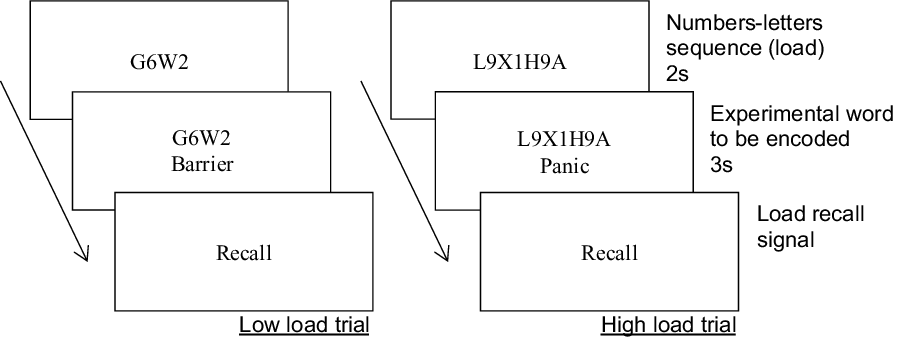
For the encoding task, instructions indicated that words would be displayed in association with sequences of letters and numbers. For each trial, participants were instructed to memorize the sequence for an immediate recall after its presentation and to memorize the word for a final memory test. For ensuring that participants will not preferentially allocate their attention to words, each trial began with the presentation of the sequence of numbers and letters, followed by words after 2 s. Words were presented below the sequences in the center of the screen, both remaining on the screen for 3 additional seconds. Each trial ended with the presentation of the word “recall”, giving the signal to orally recall the numbers-letters sequence (see Figure 1 for an illustration of the encoding task). The experimenter rated the recall as “correct” or “incorrect” on an additional keyboard.
Low and high load encoding trials. Note. For each trial, participants were instructed to memorize the numbers letters sequence for an immediate recall after its presentation and to memorize the word for a final memory test.

The recognition phase was separated from the encoding by a 5-minute retention interval, during which span scores and socio-demographic information were collected.
The R/K recognition procedure started with a training phase on the 15 words presented in the encoding training phase and the 15 unstudied distractors. In the test phase, the 56 studied words and the 56 distractors were presented in random order. For each word, participants first had to indicate whether the word had been presented during the encoding phase. Secondly, for each recognized word, participants had to categorize the recognition, using A, B, or C answers. A and B answers respectively reflected the ability or inability to recollect contextual details from the encoding. Associations between the encoded words and mental images, personal memories, emotions or other items were among the factors considered for an A answer. Finally, considering that B answers are preferentially chosen whenever there is a doubt about recognizing the word (Gardiner & Conway, Reference Gardiner, Conway, Challis and Velichkovsy1999), we added a C answer to avoid unreliable B responses and directly reflect uncertainty about the presence of the word during the encoding. A, B, and C answers respectively reflected R, K, and Guess (G) responses in the R/K paradigm. To ensure accurate categorization, A, B, and C responses had to be justified during the training trials, by reporting associated contextual items in the case of an A answer (e.g., reporting that the word elicited specific thoughts, feelings, mental images or personal memories) by stating that no such elements were elicited at the encoding for a B answer (i.e., the sole remembering of having seen the word), and by confirming uncertainty about the presence of the word during the encoding phase for C answers (i.e., reporting a vague impression of having seen the word). The experiment ended with the completion of the remaining clinical scales (i.e., STAI, BDI, DES-T) and a complete debriefing about the aims of the study.
Analyses
In accordance with the independent R/K procedure (IRK; Yonelinas & Jacoby, Reference Yonelinas and Jacoby1995), K responses were computed independently from R responses by considering the proportion of K responses for trials without R responses [K responses/(number of trials – R responses)]. Dependent variables were the number of correct answers on the concurrent secondary task (i.e., the recall of letters-numbers sequences), the proportion of correct recognitions overall, and the proportion of R responses and IRK scores for correctly recognized words for each valence and secondary task load. Given that G responses were only included to improve the quality of K responses and that their proportion was judged to be too low, they were not analyzed.
Four 2 (group: PTSS+ vs. PTSS–) × 2 (load: low vs. high) × 4 (valence: positive, neutral, negative, trauma-related) analyses of variance (ANOVAs) were conducted on dependent variables. Group was treated as a between-groups factor, whereas valence and load were treated as within group factors. Analyses were conducted using JASP 0.14 software (JASP Team, 2020).
RESULTS
Secondary Task Performance
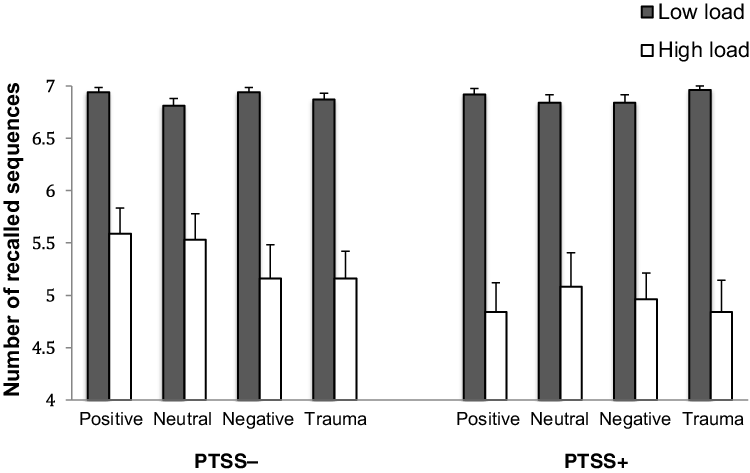
The analysis conducted on the number of recalled sequences of letters and numbers only revealed a significant main effect of load, F(1, 55) = 127.27, p < .001, ηp 2 = .70, reflecting enhanced amounts of errors in the high than in the low load condition, both groups considered. The analysis revealed no significant main effects of either group, F(1, 55) = 1.85, p = .18, ηp² = .03, or valence, F(3, 165) < 1, and no significant interactions between either group and load, F(1, 55) = 1.92, p = .17, ηp² = .03, valence and group, F(3, 165) < 1, valence and load, F(3, 165) = 1.39, p = .25, ηp² = .02, or valence, group and load, F(3, 165) < 1. Results for the number of recalled sequences of numbers and letters according to group, load, and valence are provided in Figure 2.
Means (and standard error bars) for the number of recalled sequences.

Total Recognition Scores
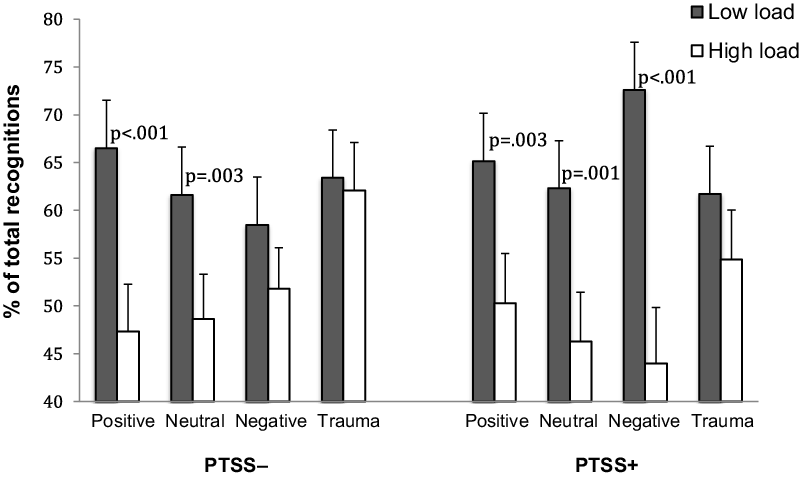
The analysis conducted on total recognition scores revealed no significant main effect of group, F(1, 55) < 1, suggesting comparable recognition scores between groups. There was a significant main effect of load, F(1, 55) = 48.79, p < .001, ηp² = .47, supported by decreased recognitions in the high than in the low load condition, both groups considered. No significant interaction emerged between group and load, F(1, 55) = 2.93, p = .09, ηp² = .05. There was no significant main effect of valence, F(3, 165) = 1.57, p = .20, ηp² = .03, and no significant interaction between valence and group, F(3, 165) < 1. However, significant interactions emerged between load and valence, F(3, 165) = 4.07, p = .008, ηp² = .07, and between all three variables, F(3, 165) = 3.15, p = .027, ηp² = .05. Planned comparisons revealed that PTSS– participants exhibited a significant effect of load for positive, t(212) = 4.39, p < .001, d = .77, and neutral words, t(212) = 2.96, p = .003, d = .53, as opposed to negative, t(212) = 1.53, p = .13, d = .27, and trauma-related words, t(212) < 1. PTSS+ participants presented this significantly reduced performance in the high load condition for positive, t(212) = 3.00, p = .003, d = .61, neutral, t(212) = 3.23, p = .001, d = .61, negative, t(212) = 5.77, p < .001, d = 1.12, but not for trauma-related words, t(212) = 1.38, p = .17 d = .27. Results for total recognition scores according to group, load, and valence are provided in Figure 3.
Means (and standard error bars) for the percentages of total recognition scores.

Type R Recognitions
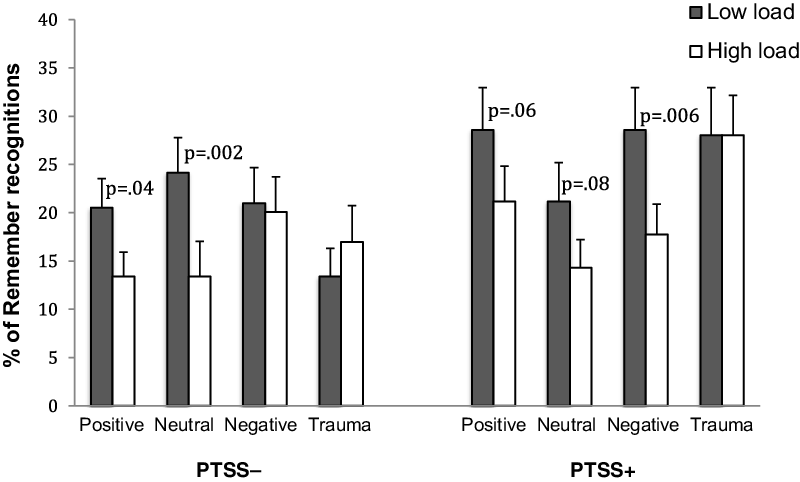
The analysis conducted on R recognition scores revealed no significant main effect of group, F(1, 55) = 2.64, p = .11, ηp² = .05, suggesting that both groups produced similar amounts of R responses. There was a significant main effect of load, F(1, 55) = 11.68, p = .001, ηp² = .17, supported by a reduced amount of R responses in the high than in the low load condition. There was no significant interaction between group and load, F(1, 55) < 1. There was no significant main effect of valence, F(3, 165) = 1.10, p = .35, ηp² = .02, but a significant interaction emerged between valence and group, F(3, 165) = 3.69, p = .013, ηp² = .06, with the PTSS+ group producing more R recognition responses than the PTSS– group for trauma-related words, t(130) = 2.92, p = .004, d = .68, as opposed to positive, t(130) = 1.80, p = .07, d = .59, neutral and negative words, both t(130) < 1. Additionally, there was a significant interaction between load and valence, F(3, 165) = 3.49, p = .017, ηp² = .06, supported by significant differences between loads for positive, t(215) = 2.77, p = .006, d = .41, neutral, t(215) = 3.34, p < .001, d = .48, and negative words, t(215) = 2.23, p = .027, d = .27, as opposed to trauma-related words, t(215) < 1. Despite the non-significant three-way interaction, F(3, 165) = 1.34, p = .26, ηp² = .02, planned comparisons were conducted in order to compare the effect of cognitive load on R responses for trauma-related words versus other valences. These comparisons revealed that PTSS– participants presented a significant difference between loads for positive, t(215) = 2.05, p = .04, d = .46, and neutral words, t(215) = 3.07, p = .002, d = .53, as opposed to negative, t(215) < 1, and trauma-related words, t(215)=1.02, p = .31, d = .19, whereas PTSS+ participants presented a significant reduction of R responses in the high load condition for negative words, t(215) = 2.75, p = .006, d = .58, and reduction trends for positive, t(215) = 1.88, p = .06, d = .37, and neutral words, t(215) = 1.74, p = .08, d = .40, but no significant decrease emerged for trauma-related words, t(246) < 1. Additionally, PTSS+ participants produced more R responses than PTSS– participants for trauma-related words in both low, t(222) = 2.85, p = .005, d = .71, and high load conditions, t(222) = 2.16, p = .03, d = .53, while no other valence produced significant differences between groups. Results for R recognition scores according to group, load and valence are provided in Figure 4.
Means (and standard error bars) for the percentages of R responses.

IRK Scores
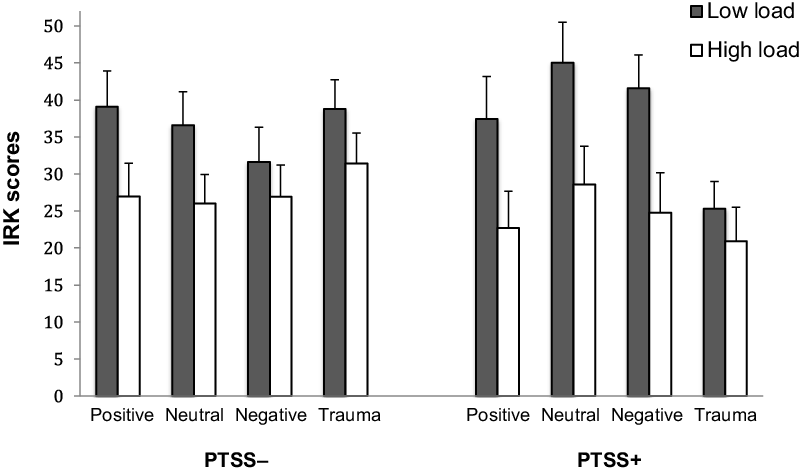
Analyses conducted on IRK scores revealed no significant main effect of group, F(1, 55) < 1. There was a significant main effect of load, F(1, 55) = 30.46, p < .001, ηp² = .36, supported by reduced IRK scores in the high than in the low load condition. No significant interaction emerged between load and group, F(1, 55) = 1.26, p = .27, ηp² = .02. There was no significant main effect of valence, F(3, 165) = 1.00, p = .39, ηp² = .02, but a significant interaction emerged between valence and group, F(3, 165) = 3.89, p = .01, ηp² = .07, with the PTSS– group producing more K responses for trauma-related words, t(136) = 2.20, p = .03 d = .70, than the PTSS+ group did, as opposed to positive, t(136) < 1, neutral, t(136) = 1.00, p = .32, d = .23, and negative words, t(136) < 1. Finally, there were no significant interactions between either valence and load, F(3, 165) = 1.11, p = .34, ηp² = .02, or between all three variables, F(3, 165) < 1. Results for IRK scores according to group, load and valence are provided in Figure 5.
Means (and standard error bars) for IRK scores.

DISCUSSION
The present study investigated the allocation of cognitive resources in relation to PTSS during the encoding of a R/K recognition task. We expected the increased production of R responses for trauma-related stimuli in PTSD to result from an increased allocation of cognitive resources to the encoding of these stimuli, at the expense of other information. Accordingly, we expected the depletion of cognitive resources during the encoding to reduce R responses for trauma-related words in PTSS+ participants, while unaffecting R responses for other stimuli.
Regarding memory functioning, our results confirmed prior studies having assessed R/K biases in PTSD (Tapia et al., Reference Tapia, Clarys, Bugaiska and El-Hage2012; Tudorache et al., Reference Tudorache, El-Hage, Tapia, Goutaudier, Kalenzaga, Bouazzaoui and Clarys2019) or in relation to PTSS (Tudorache et al., Reference Tudorache, Goutaudier, El-Hage and Clarys2020). Indeed, PTSS+ participants specifically produced more R responses for trauma-related words than PTSS– participants. Considering that R responses depend on associations between the encoded stimuli and contextual information, these findings may reflect enhanced associative processes during the encoding of trauma-related stimuli. One typical explanation is that the symptomatic intrusions of personal traumatic memories and associated features (e.g., emotions, sensations, images) could have provided numerous associative cues for trauma-related stimuli, thereby contributing to their enhanced encoding and increasing the probability to obtain R responses during recollection.
Regarding the manipulation of cognitive resources, PTSS+ participants exhibited, as expected, an increased production of R responses for trauma-related words when most resources were available. More surprisingly, this effect was also found with depleted resources. Thus, this result contradicts the hypothesis whereby memory biases in the disorder depend on an increased allocation of cognitive resources to the encoding of trauma-related information. With regard to trauma-related words, overloading cognitive resources at the encoding neither impaired the production of R responses nor the performance on the secondary task in PTSS+ participants. By contrast, R responses for the other types of words exhibited at least impairment trends with depleted resources. Therefore, overloading cognitive resources negatively impacted R responses in the PTSS+ group, but only for non-trauma-related information. In addition to R responses, these effects appeared even more significant on overall recognition scores. As the performance for the secondary task was unaffected by the presence of trauma-related words, these findings cannot be explained by a trade-off favoring the encoding of the words at the expense of the number-letter sequences.
The present findings contradicted the hypothesis of an increased allocation of cognitive resources to the encoding of trauma-related words in PTSS+ participants. Instead, this encoding seems to benefit from an increased processing efficiency. Thus, memory biases in PTSD might emerge from an increased automaticity in the encoding of trauma-related information. Explanations can once again be found in PTSD symptomatology. As pointed out in cognitive models (e.g., Brewin et al., Reference Brewin, Gregory, Lipton and Burgess2010; Ehlers & Clark, Reference Ehlers and Clark2000), trauma-related cues can easily trigger and be associated with personal traumatic memories. Responding to automatic rather than controlled processes, this phenomenon could have favored the memorization of trauma-related stimuli by the engagement of relatively effortless associative processes during the encoding. By contrast, associating contextual information with positive, neutral, and negative words would depend to a greater extent on the availability of cognitive resources. Given that resources might be limited in PTSD (e.g., Honzel, Justus, & Swick, Reference Honzel, Justus and Swick2014), this interpretation is consistent both with findings revealing a preserved memory functioning for trauma-related information and with reports of memory deficits for other types of stimuli.
Several limitations should be considered as far as present findings are concerned, one of which is the small sample size. Replications with larger effectives are needed to confirm findings and possibly to strengthen the effects and trends found in our study. A further limitation may have been the absence of a clinical diagnosis of PTSD. Although the cut-off score on the PCL-5 for inclusion in the PTSS+ group followed recommendations, the fact remains that patients suffering from clinical PTSD may present enhanced amounts of symptoms as well as enhanced limitations in daily functioning, which would potentially interfere to greater extents with cognitive functioning. Moreover, in the present study, trauma-related words have been selected in order to reflect most commonly encountered traumatic experiences. Although this was done in accordance with prior studies, word relevance may have varied across participants. In addition, the overrepresentation of women in our samples might have impacted our findings. While this is consistent with the increased prevalence of PTSD in women (e.g., APA, 2013), and is usually found in PTSD studies, it is possible that cognitive biases have been influenced by gender. Regarding methodological choices, this study was designed to compare extreme groups in terms of PTSD symptoms. Despite its benefits, this approach also has some limitations, including the exclusion of participants with partial PTSD criteria and symptoms. Further studies could benefit from more continuous approaches, or the inclusion of intermediary groups, making it possible to assess the impact of different PTSD profiles on cognitive biases. Finally, some results diverge from expectations. For instance, while overloading cognitive resources impaired overall memory scores and R responses as expected, it also affected K responses. Usually, dual-task procedures have been found to impair R responses without affecting K responses (e.g., Gardiner & Parkin, Reference Gardiner and Parkin1990). These discrepancies might be explained by an increased resources depletion in our high load condition than in prior studies, thereby affecting even less resources-dependent memory processes, as reflected by K responses. Furthermore, our results also revealed that PTSS– participants exhibited preserved R responses for trauma-related words in the high load condition. However, this preservation can be explained by the reduced proportion of R responses for trauma-related words in the low load condition. Indeed, PTSS− participants presented similar amounts of R responses for trauma-related words in low load condition to R responses for other valences in the high load condition. This reduced amount of R responses in the PTSS– group can be explained by a trade-off between R and K responses for trauma-related words. Although these findings need further investigations, they do not necessarily contradict interpretations for PTSS+ participants.
CONCLUSION
In conclusion, our study replicated the increase in R responses for trauma-related stimuli in PTSS+ participants. However, our findings suggest that, contrary to other stimuli, memory functioning for trauma-related words in PTSS+ participants is relatively independent from the availability of cognitive resources. Indeed, the depletion of cognitive resources during the encoding was found to impair memory for non-trauma-related information, while memory for trauma-related stimuli remained unaffected. Regarding memory biases reported in PTSD, these findings suggest that resources limitations in PTSD may have contributed to memory deficits for non-trauma-related stimuli. By contrast, even in a context of depleted resources, the increased automaticity and consequently the decreased cognitive cost associated with encoding processes for trauma-related information would preserve their memorization. Taken together, our findings suggest that memory biases in PTSD may be supported by an increased memory efficiency for trauma-related information.
FINANCIAL SUPPORT
This work was supported by a French regional grant (Poitou-Charentes thesis grant); and by a collaborative researches grant between Tours and Poitiers (ARC, 2014). The sponsors provided essentially material support and had no involvement in scientific, editorial, or publishing choices.
CONFLICTS OF INTEREST
The authors have nothing to disclose.