INTRODUCTION
There are limited studies on the fauna of the Iranian coast and barnacles are not exempt in this regard. Previous studies on barnacle fauna of the area are limited to Gruvel (Reference Gruvel1902), Nilsson-Cantell (Reference Nilsson-Cantell1938), Stubbings (Reference Stubbings1961), Jones (Reference Jones1986) and Utinomi (Reference Utinomi1969). The latter work is the most comprehensive study on material collected primarily from the subtidal zone during the ‘Danish Expedition’ in Iran. Stubbings (Reference Stubbings1961) reported and described Chthamalus malayensis from Kuwait which was listed by Southward & Newman (Reference Southward and Newman2003) under Chthamalus cf. challengeri. Jones (Reference Jones1986) recorded C. malayensis and a new species of Euraphiinae as Euraphia sp. from Kuwait with a brief description of both species. According to Southward & Newman (Reference Southward and Newman2003), Chthamalus spp. material from the western Indian Ocean, including the Red Sea and the Persian Gulf, Somali, Kenya and also Pakistan, have unclear taxonomic status and belong to the challengeri subgroup and therefore, were grouped under C. cf. challengeri.
The family Chthamalidae has exhibited much taxonomic instability and many cirripedologists have tried to find concrete characters and methodologies towards a better taxonomic arrangement. Therefore, each re-examination of material from this group resulted in an alteration of their taxonomic position (see Conrad, Reference Conrad1837; Nilsson-Cantell, Reference Nilsson-Cantell1921; Newman & Ross, Reference Newman and Ross1976; Dando & Southward, Reference Dando and Southward1980; Foster & Newman, Reference Foster and Newman1987; Poltarukha, Reference Poltarukha1996, Reference Poltarukha1997). Recently several workers have attempted to shed light on the phylogeny of this group (Pannacciulli et al., Reference Pannacciulli, Piyapattanakorn, Bishop, Hawkins and MacLean2005; Tsang et al., Reference Tsang, Chan, Wu, Ng, Chatterjee, Williams and Chu2008; Wares et al., Reference Wares, Pankey, Pitombo, Daglio and Achituv2009).
The main objective of the present study was to consider the chthamalid barnacles of the Persian Gulf and Gulf of Oman from a taxonomic and geographical distribution point of view and to try and shed more light on to the current knowledge on Iranian barnacles. Based on the unresolved taxonomic status and presence of ambiguities in the material from the north-west Indian Ocean (see Southward & Newman, Reference Southward and Newman2003) and because of personal communication with the late Professor A.J. Southward, more material from adjacent regions (Oman, Yemen and the Red Sea) was included in the comparative study of the genus Chthamalus. In addition, based on collected material from the entire Iranian coast, the other dominant chthamalid species, genus Microeuraphia, was found to be a new record for Iranian waters. It is described based on new material throughout the entire geographical range in Iranian waters.
MATERIALS AND METHODS
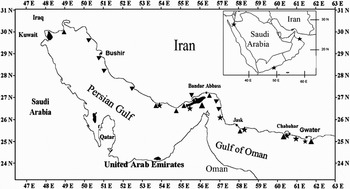
Adult specimens that had naturally settled on different fixed and floating substrates were collected from the supralittoral and upperlittoral zones of rocky shores, mangrove trees and other hard coastal habitats. In total 23 sampling localities from the Persian Gulf and Gulf of Oman were visited from 2004 to 2009 (Figure 1). In addition specimens were collected from three external localities including the Gulf of Aqaba, Gulf of Aden and Gulf of Oman (Figure 1, upper right).
Localities where Chthamalus barnesi (*) and Microeuraphia permitini (▾) were found.

The 70% ethanol preserved materials are deposited at the Zoological Museum, University of Tehran (ZUTC) and some representatives in the crustacean section, Senckenberg Museum, Frankfurt (SMF). In addition, other comparative conspecific and congeneric material, provided as a gift or loan, from other regions, were included in the current study. The material loans were obtained from the Florida Museum of Natural History (UF) and Western Australian Museum (WAM). Some specimens were dissected and the hard parts, after cleaning with bleach and water, were studied under light microscopy. Trophi and cirral appendages were examined under light and scanning electron microscopy. The scutum and tergum of the specimens were mounted on microscope slides using glycerine jelly and the trophi and cirral appendages using Euparal®.
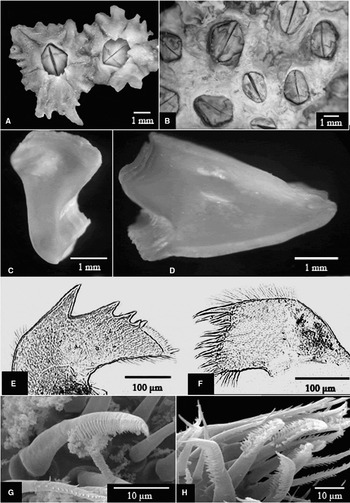
Chthamalus barnesi (A) non-eroded specimens; (B) clustered and eroded individuals; (C) tergum; (D) scutum; (E) mandible; (F) maxilla; (G) serrate setae on cirrus I; (H) serrate setae on cirrus II.

MATERIAL EXAMINED
ZUTC Cirri-1135 (Jask, Gatan, 25°58′N 57°15′E), ZUTC Cirri-1136 (Gwater Bay, 25°08′N 61°27′E), ZUTC Cirri-1137 (Jask, 25°41′N 57°53′E), ZUTC Cirri-1138 (Chabahar, Ramin, 25°16′N 60°44′E), ZUTC Cirri-1139 (Gavbandi, 27°02′N 53°16′E), ZUTC Cirri-1140 (Chabahar Bay, 25°19′N 60°37′E) and SMF-34731 (Gavbandi, 27°02′N 53°16′E).
COMPARATIVE MATERIAL
ZUTC Cirri-1242 (C. barnesi from Yemen, Khalf, Mukalla, leg. A. Nasher), ZUTC Cirri-1236 (C. barnesi from Qurm Beach, Muscat, Oman, leg. G. Paulay), ZUTC Cirri-1237 (C. barnesi from Gulf of Aqaba, Red Sea, leg. Y. Achituv), UF 7784 Arthropoda (C. barnesi Qurm Beach, Muscat, Oman), ZUTC Cirri-1244 (C. montagui from Cornwall, England, leg. A.J. Southward), ZUTC Cirri-1246 (C. challengeri from Wakayama, Japan, leg. A.J. Southward), ZUTC Cirri-1245 (C. malayensis from Shark Bay Australia, leg. A.J. Southward) and ZUTC Cirri-1268 (C. malayensis from Taipei County, Taiwan leg. B.K.K. Chan).
The main characters of specimens from different regions agree with the original description of Chthamalus barnesi by Achituv & Safriel (Reference Achituv and Safriel1980). In this paper, based on new material from different localities throughout its current distribution range, redescription is given by presenting only the variations in characters.
REDESCRIPTION
Largest specimens are 10 mm carino-rostral diameter, orifices almost kite shape (Figure 2A). The individuals with a wider orifice belong to material from dense clusters showing cylindrical shells (Figure 2B).
Shell: externally almost light grey and sometimes pink to brown; internally white or yellow (upper part) and purplish brown (lower part).
Tergum: (Figure 2C) rather narrow, upper part wider than lower bearing four developed depressor muscle crests. Articular furrow wide and suture between tergum and scutum zigzag (Figure 2A & B).
Scutum: (Figure 2D) elongated and triangular, tergal margin with deep and wide articular furrow, tergo-occludent corner with marked depression. Both articular and adductor ridges developed; adductor muscle pit long and shallow. Lateral depressor muscle pit distinct with no crest.
Mandible: (Figure 2E) fourth tooth bidentate, basal comb with rows of 16–23 short spines (25–30 in Red Sea material) and 2–4 stout large spines at lower angle.
Maxilla: (Figure 2F) with rather shallow notch, upper and lower clusters of spines with two large, plus 3–4 small and 7–8 large, plus a series of small spines, respectively. Upper and lower parts of maxilla are setose.
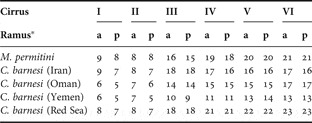
Based on material from the Red Sea, Iran, Oman and Yemen coasts, the cirrial segments and their variations in segment numbers are listed in Table 1.
Number of segments in cirri of Microeuraphia permitini and Chthamalus barnesi.

*, maximum observed number in material; a, anterior ramus; p, posterior ramus.
Cirrus I: anterior ramus (with 6–9 segments) longer than posterior (usually with 5–7 segments), no conical spines on inner side of basal segments. Some specimens with 1–2 finely pectinate setae on terminal segment of posterior ramus (Figure 2G).
Cirrus II: anterior ramus (with 5–8 segments) longer than posterior (usually with 5–7 segments), both rami with finely pectinate setae without basal guard on terminal segments (Figure 2H).
Cirri III–VI: rami almost equal in size, each with 6–7 pairs of long setae on first segment and 4–5 pairs on other segments, with variety of segment numbers in different geographical regions (Table 1).
Habitat: the species is restricted to the supralittoral zone of rocky shores and jetties, occasionally on mollusc and barnacle shells above the barnacle Amphibalanus amphitrite and oyster Saccostrea cucullata belts. The specimens were observed as single individuals (Figure 2A) or dense clusters (Figure 2B). It appears that members of C. barnesi prefer exposed shores and contribute to dense populations.
Geographical distribution: during the present study, the individuals of C. barnesi were observed and collected on rocky coastal areas of the visited localities (Figure 1). Additional comparative material was collected from the Red Sea, Gulf of Aden and Gulf of Oman (Muscat).
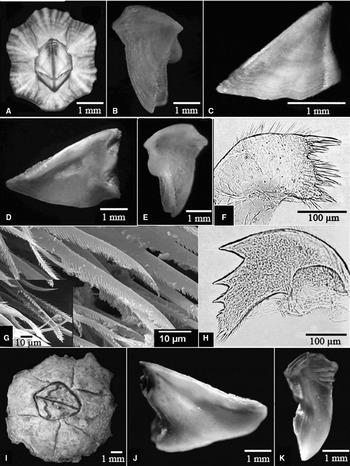
Microeuraphia permitini (A–H) and M. depressa (I–K). (A) Non-eroded specimens; (B) external view of tergum; (C) external view of scutum; (D) internal view of scutum; (E) internal view of tergum; (F) maxilla; (G) serrate setae on cirrus II; (H) mandible; (I) external view; (J) scutum; (K) tergum.

MATERIAL EXAMINED
ZUTC Cirri-1122 and Cirri-1123 (Minab, Bandar-Kolahi 27°02′N 56°51′E), SMF-34730 (Minab, Bandar-Kolahi 27°02′N 56°51′E), ZUTC Cirri-1124 (Bandar-Lenge, Mahtabi, 26°48′N 55°19′E), ZUTC Cirri-1125 (Genaveh, Bandar-Rig, 29°28′N 50°37′E), ZUTC Cirri-1126 (Bandar-Kong, 26°36′N 54°54′E), ZUTC Cirri-1127 (Bandar-Abbas, 27°16′N 56°15′E), ZUTC Cirri-1128 (Jask, 25°35′N 58°02E), ZUTC Cirri-1129 (Bandar-Khamir, 26°28′N 55°35′E), ZUTC Cirri-1130 (Minab, Kohestak, 26°48′N 57°01′E), ZUTC Cirri-1131 (Bushir, 28°49′N 50°54′E), ZUTC Cirri-1132 (Bushir, Golestan, 28°14′N 52°16′E), ZUTC Cirri-1133 (Mahshahr, 30°28′N 49°11′E), ZUTC Cirri-1134 (Gavbandi, 27°02′N 53°16′E), ZUTC Cirri- 1235 (Nayband, 27°23′N 52°39′E) and ZUTC Cirri 1255 (Tis, Chabahar Bay, 25°19′N 60°37′E).
COMPARATIVE MATERIAL
ZUTC Cirri-1239 (Microeuraphia depressa from Mediterranean Sea, leg. Y. Achituv), ZUTC Cirri-1266 (M. withersi from Starfish Bay, Hong Kong, leg. B.K.K. Chan), WAM C27260 (M. withersi from north-western Australia, Point Cleaverville).
REDESCRIPTION
Largest specimens about 13 mm in carino-rostral diameter, basis purely membranous, conical shells with six thin, smooth or regularly ribbed fragile plates. Seams are simple and straight and orifice is diamond or hexagonal (Figure 3A). External coloration is light to dark brown (sometimes greenish brown or rarely grey), internal coloration is orange to brown.
Opercular plate: suture between opercular plates straight (Figure 3A) or in some eroded specimens zigzag with no tendency to fusion.
Tergum: (Figure 3B & E) punctuated internally, with 2–4 depressor muscle crests, externally with a marked groove alongside the scutal margin, upper part wider than lower, scutal margin sinuous, articular ridge at upper half of margin, bearing upper and lower furrow, lower articular furrow wide and deep in eroded specimens, carinal margin convex, basal margin from sinuous to straight in non-eroded and eroded specimens, respectively.
Scutum: (Figure 3C & D) externally tergal margin with a submarginal groove, in fresh specimens this resembles a white stripe, punctuated internally, longer than wide, tergal margin sinuous with distinct articular ridge at upper half of margin bearing upper and lower furrows, lateral depressor muscle pit lacking crests, and sometimes deep in eroded individuals, adductor pit long and rather deep with fine ridge, no rostral pit, basal margin not straight.
Mandible: (Figure 3H) tridentate, third tooth in some specimens with one to two small spines dorsally, basal comb with rows of fine spines (6–8 per row) bearing 1–3 stout spines after third tooth and 2–4 large spines at lower angle.
Maxilla: (Figure 3F) with two large and 2–3 small spines above the notch, 6–7 medium spines in medial cluster and a series of small spines in lower angle, upper and lower parts setose.
Cirrus I: (Table 1) anterior ramus (with 7–9 segments) longer than posterior (with 6–8 segments).
Cirrus II: (Table 1) anterior ramus (usually with 7 segments) longer than posterior (usually 6–8 segments), both rami with finely pectinate setae on terminal segments (Figure 3G).
Cirri III–VI: rami almost similar and equal in size with different number of segments (Table 1), first segment of each cirri with four and others with three pairs of long setae.
Habitat: the specimens were found in different localities from the Persian Gulf and Gulf of Oman (Figure 1) restricted to the mid-littoral, high-littoral and rarely the suppralittoral zone. Settlement was observed on different substrates such as rock, jetties, leaves, stems and aerial roots of mangroves, mollusc shells and floating material such as plastic objects. This species was also found on shells of Amphibalanus amphitrite, Tetraclita rufotincta and rarely on clusters of Chthamalus barnesi. Specimens were almost always found on sheltered and semi-sheltered shores and rarely from exposed shores, where they were found hidden in crevices or tide pools.
DISCUSSION
The two chthamalid species of the region are compared with other material using published data from descriptions or examination of preserved or fresh material from other regions.
CHTHAMALUS BARNESI
According to Newman & Ross (Reference Newman and Ross1976) and Newman (Reference Newman and Grasse1996), material with a six plated shell, quadridentate mandible and complex setae on second cirrus belong to the subfamily Chthamalinae and genus Chthamalus. Dando & Southward (Reference Dando and Southward1980) and Southward & Newman (Reference Southward and Newman2003) divided the stellatus section of Chthamalus into four subgroups: challengeri, fissus, stellatus and malayensis, mainly based on the presence or absence of conical spines on cirrus I and basal guard on the complex setae of cirrus II (Figure 4G & H). Previously, C. malayensis was recorded by Stubbings (Reference Stubbings1961) and Jones (Reference Jones1986) from Kuwait, Persian Gulf. But, Southward & Newman (Reference Southward and Newman2003) regarded the Stubbings material, other collected specimens from Sri Lanka (Nilsson-Cantell, Reference Nilsson-Cantell1938), C. barnesi (Achituv & Safriel, Reference Achituv and Safriel1980), C. stellatus (Stubbings, Reference Stubbings1936) and other unpublished materials from Pakistan, Bahrain and the Red Sea as the C. cf challengeri subgroup. In the present study materials from the Iranian coast were compared based on discriminative key characters for challengeri and malayensis subgroup. According to Dando & Southward (Reference Dando and Southward1980) and Southward & Newman (Reference Southward and Newman2003), among Chthamalus groups, species with an absence of conical spine on cirrus I and complex setae without basal guard on cirrus II, belong to ‘C. challengeri’ group. While, individuals with a conical spine on cirrus I and basal guard on complex setae of cirrus II and also the presence of 6–13 teeth on the mandible basal comb belong to the C. malayensis group. Due to the record of C. malayensis by Stubbings (Reference Stubbings1961), these materials were considered as C. cf. challengeri by Southward & Newman (Reference Southward and Newman2003). Therefore, the record of C. malayensis from the Persian Gulf (Jones, Reference Jones1986) is also referable to C. barnesi. It is interesting to note that Chthamalus malayensis was recently investigated using ecological and molecular data (Tsang et al., Reference Tsang, Chan, Wu, Ng, Chatterjee, Williams and Chu2008) and the material was found to belong to three separate clades, possibly distinct species. The C. challengeri group includes eight described species, namely: Chthamalus sinensis, C. antennatus, C. dalli, C. moro, C. challengeri, C. montagui, C. barnesi (Southward & Newman, Reference Southward and Newman2003) and C. neglectus (Yan & Chan, Reference Yan and Chan2004). In the present study C. malayensis from Shark Bay Australia and from Taipei County, Taiwan, were studied. The materials show key characters of the C. malayensis subgroup. Thorough examination of the material from the Iranian coasts for the above discriminative characters revealed their belonging to the C. challengeri group. The taxonomic characters of Chthamalus material in the present study agree with those of C. barnesi from Sinai, Red Sea. Other members of this species were also collected from throughout its geographical range from the Red Sea, Gulf of Aden, Gulf of Oman and the Persian Gulf based on collection of fresh specimens. The Persian Gulf invertebrate fauna is heavily influenced by larval transport by oil tankers via fouling organisms and ballast water and barnacles are notoriously among these animals. Therefore, as it was suggested by Southward & Newman (Reference Southward and Newman2003), material from other localities in the Indian Ocean need comparison with C. barnesi. In this study, such comparative materials were provided from the Red Sea, Yemen, Oman and the border of Pakistan with Iran at Gwater Bay.
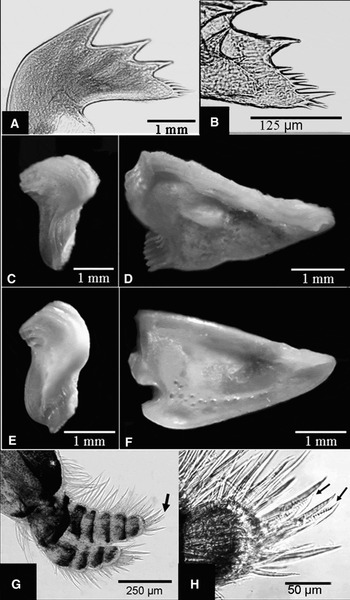
(A) Mandible of Microeuraphia withersi (from Western Australia); (B) basal comb of mandible in M. withersi (from Hong Kong); (C) tergum in Chthamalus challengeri; (D) scutum in C. challengeri; (E) tergum in C. montagui; (F) scutum in C. montagui; (G & H) cirrus II in C. malayensis, arrow heads show complex setae.

Due to extensive ambiguities in the chthamalid barnacles of the Indian Ocean (Southward & Newman, Reference Southward and Newman2003; Tsang et al., Reference Tsang, Chan, Wu, Ng, Chatterjee, Williams and Chu2008) material from Iran, Oman, Yemen and the Red Sea are compared with other available members of other species groups to confirm its belonging to the subgroup. Only their key differences, based on material comparison or descriptions given in the relevant taxonomic literature, are mentioned.
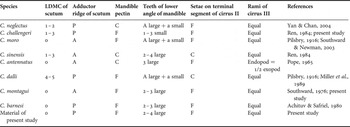
Material in the present study was compared with other species of the challengeri subgroup and their key characters are tabulated (Table 2), but additional discriminative characters are given in the following.
Morphological comparison of all species of Chthamalus challengeri group members with material of present study.

LDMC, lateral depressor muscle crest; A, absent; P, present; C, coarse; F, fine.
In C. moro, compared to material in the present study, there is no depression towards the tergo-occludent corner of scutum and the tergal margin is straight (see figure 10 B & C in Southward & Newman, Reference Southward and Newman2003).
In C. neglectus Yan & Chan (Reference Yan and Chan2004), the scutal margin of the tergum is almost straight (figure 2 B& D in Yan & Chan, Reference Yan and Chan2004) while our material (from the entire range of the species) shows a deep articular furrow.
In C. challengeri from Japan (Figure 4C & D) the general shape of tergum and scutum is similar to C. barnesi (Figure 2C & D).
In C. montagui Southward Reference Southward1976, material from England was compared with that of the present study. The tergum shows no marked discriminative characters (Figure 4E). The articular furrow of the scutum is narrow and rather shallow and located at the basi-tergal angle (Figure 4F).
Comparative examination of material in the present study with others (Table 2) revealed these all belong to C. barnesi.
Achituv & Safriel (Reference Achituv and Safriel1980) noted that C. barnesi almost always selects sheltered and semi-sheltered shores in the Gulf of Aqaba and Gulf of Suez, attached to rocks and mangrove trees. In contrast, most material in the current study was collected from exposed shores and no specimen was found on mangroves.
This extensive survey of Iranian waters revealed only C. barnesi present as the member of the genus Chthamalus in the Persian Gulf and Gulf of Oman. Southward & Newman (Reference Southward and Newman2003) grouped C. malayensis of Stubbings (Reference Stubbings1961) in the challengeri group; therefore, the material of Jones (Reference Jones1986) also belongs to C. barnesi. Unpublished molecular phylogeny data show material from the Persian Gulf and Sinai (Egypt) Red Sea are grouped together as C. barnesi (Achituv, personal communication).
MICROEURAPHIA PERMITINI
Poltarukha (Reference Poltarukha1997) presented a discriminative key for three genera of the subfamily Euraphinae. The genus Caudoeuraphia with one representative is easily recognized by the presence of a caudal process. The other two genera, namely Euraphia and Microeuraphia, are distinguishable by marked differences. In Euraphia, there is a tendency for shell base calcification, fusion of tergum and scutum, and serration of the upper edge of the second and third mandible teeth. In contrast, members of the genus Microeraphia show a membranous basis, no fusion of the scutum and tergum and smooth mandible teeth. In other related works (Foster, Reference Foster1974; Laguna, Reference Laguna1985, Reference Laguna1987; Foster & Newman, Reference Foster and Newman1987) there are clear definitions and descriptions of discriminative characters for the Euraphinae. Based on these definite characters, materials of the present study belong to the genus Microeuraphia.
Previously eight species of Microeuraphia were described including:
M. imperatrix (Pilsbry, Reference Pilsbry1916); M. eastropacensis (Laguna, Reference Laguna1985); M. rhizophoraei (De Oliveira, Reference De Oliveira1940); M. aestuarii (Stubbings, Reference Stubbings1963); M. apelloefi (Nilsson-Cantell, Reference Nilsson-Cantell1921); M. permitini (Zevina & Litvinova, Reference Zevina and Litvinova1970); M. depressa (Poli, Reference Poli1791); and M. withersi (Pilsbry, Reference Pilsbry1916).
A comparison of characters provided by Poltarukha (Reference Poltarukha1997) for the subfamily Euraphinae with the material in the present study reveal its morphological affinity only with M. permitini, M. withersi and M. depressa. In the following, the key characters of these last three species are compared with material from the Iranian coast.
Based on geographical data presented by Poltarukha (Reference Poltarukha1997), distributions of these three species are also closer than the others to the Iranian material. Therefore, material of Microeuraphia collected from different localities in the Persian Gulf and the Gulf of Oman were compared with these three species only. Regarding general shell morphology material from the present study is similar to M. withersi, but the basal comb of the mandible in M. withersi is distinctly different showing about eight equally distanced slender spines (Figure 4A & B). This agrees well with the original description (figure 91a of Pilsbry, Reference Pilsbry1916). In contrast our material is composed of 1–3 stout spines after the third tooth, and has rows of small and 2–4 long spines (Figure 3H).
The shell in M. depressa is depressed and smooth and the suture between the tergum and scutum is zigzag (Figure 3I—an eroded specimen). There is no lateral depressor muscle pit in the scutum (Figure 3J). The tergum is rather long (Figure 3K) but this is wide in the upper half in M. permitini (Figure 3E).
Based on a comparison of our materials with M. permitini by Poltarukha, 2010 (personal communication) and published descriptions (Zevina & Litvinova, Reference Zevina and Litvinova1970; Poltarukha, Reference Poltarukha1997), the material in the present study belongs to M. permitini, but there are some minor inter-population differences.
According to the original description of M. permitini, the shell is thick and the external coloration is dirty white or greenish, while this is brown and the shell is fragile in Iranian Microeuraphia.
A closer look at the short description by Jones (Reference Jones1986) on specimens from Kuwait, in the Persian Gulf under Euraphia sp. shows that this is clearly also M. permitini. Interestingly, M. permitini material shows close similarity to the Stubbings (Reference Stubbings1961) description and drawing of C. malayensis from the Persian Gulf, but no specimens of C. malayensis were observed in the present study in which 23 localities from Gwater Bay at the border of Pakistan to Arvand Estuary at the border of Iraq were comprehensively visited. As mentioned earlier in Southward & Newman (Reference Southward and Newman2003), C. malayensis grouped in the C. challengeri group and therefore, there is a need for re-examination of the Stubbings (Reference Stubbings1961) material.
In conclusion, there are two chthamalid barnacles in the Iranian coastal regions of the Persian Gulf and Gulf of Oman. These are C. barnesi and M. permitini. Both species are new records for Iranian waters and the former is also found in the Red Sea, Gulf of Aqaba, Ethiopia (Achituv & Safriel, Reference Achituv and Safriel1980), Oman and Yemen (present study). It also seems that material from the Persian Gulf (Bahrain), Red Sea and North Arabian Sea (Karachi, Pakistan) studied by Southward & Newman (Reference Southward and Newman2003) also belong to this species. So far, M. permitini is recorded from the Persian Gulf (Jones, Reference Jones1986; present study), Gulf of Oman (present study), the Red Sea (Zevina & Litvinova, Reference Zevina and Litvinova1970; Poltarukha, Reference Poltarukha1997) and Madagascar (Poltarukha, Reference Poltarukha1997). In the present study both C. barnesi and M. permitini were found at the border with Pakistan (Gwater Bay). In this region, the former species was dominant with gregarious settlement on rocks. The latter species was observed with higher density and gregarious settlement at sheltered localities in the Persian Gulf. But, this species mostly shows patchy settlement on hard substrates and rocky areas in the Gulf of Oman and individuals were found hiding among other barnacles or in the crevices and sheltered sides of hard substrates. This might be due to the softer nature of its membranous basal attachment and brittle shell which possibly does not allow successful settlement in active wave zones in the Gulf of Oman. In comparison, C. barnesi, also with a membranous basis, is characterized by a thicker shell and gregarious settlement and hence stronger attachment is provided on seaward hard substrates. It seems M. permitini is not restricted to localities visited in the present study and should be found in adjacent countries, at least Pakistan and Oman. Therefore, in order to show eastward and southward geographical distribution of C. barnesi and M. permitini, using morphology and molecular data, it is suggested to plan an intensive sampling for chthamalid barnacles with a closer look at localities on the coasts of Oman, Yemen, the entire Red Sea coast, Pakistan and even east India. This will provide a clear distribution map for these species and also help to map the eastward distribution of C. barnesi and M. permitini in the north-western Indian Ocean.
ACKNOWLEDGEMENTS
This study was supported by a grant from the Ministry of Science, Research and Technology of Iran. Some research facilities were provided by the office of research affairs at the Universities of Tehran and Hormozgan. We acknowledge the help and support of the late Professor A.J. Southward with specimens, papers, invaluable comments and encouragement. We are indebted to Professor Y. Achituv and Professor W.A. Newman for providing specimens, help with literature and their advice during our study on Iranian barnacles. Special thanks goes to Professor M. Türkay for his hospitality at Senckenberg Museum, encouragement and facilitating safe transfer of material collected from the Red Sea to Iran. We express our gratitude to Dr A. Nasher for providing us with material from Yemen. We also thank Dr D. Jones and Mrs M. Titelius (Western Australian Museum), Dr G. Paulay (Florida State Museum) for material loans. The help of Professor O.P. Poltarukha for support with relevant literature and final confirmation of M. permitini material is gratefully acknowledged. We would like to thank the anonymous referees for their useful comments. The help of Dr C. Tudge on several occasions, including English editing and useful comments on the manuscript is acknowledged. Field collection help was provided by Mr A. Kazemi and Mr R. Naderloo. We also thank Mr Rezaie and Mr Hashemi from the SEM units, at the University of Tarbiat Modarres and University of Tehran, respectively. The authors thank Miss R. Sheybani and Mr O. Mirshamsi-Kakhki for final preparation of figures.