Introduction
The minerals of the hydrotalcite supergroup belong to a large family of layered double hydroxides (LDH) that comprises natural and synthetic compounds. The LDH crystal structure consists of alternating metal hydroxide layers formed by octahedra, in which cations of the metal M (uni-, di- or trivalent) are surrounded by OH groups, and a water–anion component that occupies the interlayer space (Rives, Reference Rives2001; Evans and Slade, Reference Evans, Slade, Duan and Evans2006; Britvin, Reference Britvin and Krivovichev2008; Krivovichev et al., Reference Krivovichev, Yakovenchuk, Zhitova and Krivovichev2012; Mills et al., Reference Mills, Christy, Génin, Kameda and Colombo2012a; Zhitova et al., Reference Zhitova, Pekov, Chukanov, Yapaskurt and Bocharov2020). To date, the hydrotalcite supergroup includes 46 minerals. Fourty-three of them, including several questionable species, are mentioned in the most recent nomenclature report for the hydrotalcite supergroup (Mills et al., Reference Mills, Christy, Génin, Kameda and Colombo2012a). Since that time, four new species have been described [akopovaite (Karpenko et al., Reference Karpenko, Zhitova, Pautov, Agakhanov, Siidra, Krzhizhanovskaya, Rassulov and Bocharov2020), dritsite (Zhitova et al., Reference Zhitova, Pekov, Chaikovskiy, Chirkova, Yapaskurt, Bychkova, Belakovskiy, Chukanov, Zubkova, Krivovichev and Bocharov2019), erssonite (Zhitova et al., Reference Zhitova, Chukanov, Jonsson, Pekov, Belakovskiy, Vigasina, Zubkova, Van and Britvin2021) and luidongshengite (Yang et al., Reference Yang, Gibbs, Schwenk, Xie, Gu, Downs and Evans2021)]; whereas jamborite was redefined as a mineral species which does not belong to the hydrotalcite supergroup (Bindi et al., Reference Bindi, Christy, Mills, Ciriotti and Bittarello2015). Here we report on a new member of the supergroup, kaznakhtite (pronounced kǝz nah tait; Cyrillic – казнахтит), named after its type locality – Kaznakhtinskiy ultrabasic massif, Ust’-Koksinskiy District, Altai Republic, SW Siberia, Russia. On a lower hierarchical level kaznakhtite belongs to the hydrotalcite group (Mills et al., Reference Mills, Christy, Génin, Kameda and Colombo2012a), in which representatives typically have a 3 : 1 ratio of divalent and trivalent cations М 2+ : М 3+ in octahedral layers. For the case of kaznakhtite, Ni and Co are the species-defining divalent and trivalent cations, respectively, while CO32– anion and water molecules occur in the interlayer space.
Both the new mineral and its name (symbol Kzt) have been approved by the Commission on New Minerals, Nomenclature and Classification of the International Mineralogical Association (IMA2021-056, Kasatkin et al., Reference Kasatkin, Britvin, Krzhizhanovskaya, Chukanov, Škoda, Göttlicher, Belakovskiy, Pekov and Levitskiy2021). The holotype specimen is deposited in the collections of the Fersman Mineralogical Museum of the Russian Academy of Sciences, Moscow, Russia with the registration number 5727/1.
Occurrence and mineral association
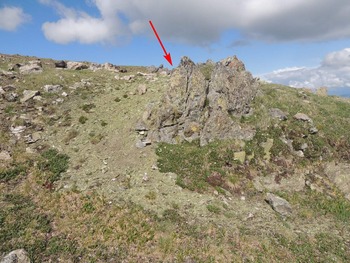
Specimens containing the new mineral were collected in July 2019 by one of the authors (V.V.L.) at the Kaznakhtinskiy ultrabasic massif, Ust’-Koksinskiy District, Altai Republic, SW Siberia, Russia. The exact locality (50°14'22''N, 86°30'25''E) is ~2 km to the west of the headwaters of the Kyzyl-Uyuk creek, the right tributary of the Kaznakhta river (Fig. 1).
Kaznakhtinskiy massif. The red arrow indicates the exact place where specimens with kaznakhtite were collected. Summer 2019. Photo: V.V. Mukhanov.

The Kaznakhtinskiy ultrabasic massif is located at Terekta (Terektinskiy) Range which is a part of Russian Gorny Altai, on the watershed between the Kaznakhta river and Kyzyl-Uyuk and Kara-Uyuk creeks. It occupies an area up to 2 km long and 0.4 km across and represents a nearly vertical lens in shape accompanied by a series of small, steeply-inclined lenses (Kuznetsov, Reference Kuznetsov1958). Geologically, the Kaznakhtinskiy massif is confined to the Kaznakhta ophiolite zone of the Terekta Ridge (northern branch of the Terekta ophiolite belt, Gorny Altai) and is associated with the thrust-sheet zone of the steep Charysh–Terekta deep fault. The Kaznakhta ophiolite body is composed of weakly metamorphosed volcanic–sedimentary rocks of the Baratal formation and various serpentinites. The northern part of the Kaznakhta ophiolite body is composed of chrysotile–lizardite serpentinites which contain inclusions of peridotites, shales, limestones, rodingites and rodingitised porphyrites. The southern zone of the body includes serpentinites of mostly antigorite composition, as well as dunites and granodiorites. The age of the serpentinites was determined as Carboniferous, and for some bodies it is presumably Cambrian. According to views on the tectonics of the Terekta Range region, in the early Cambrian and Carboniferous this was an area of complex subduction and collisional processes (Tatarinov et al., Reference Tatarinov, Sapozhnikov, Prokudin and Frolova1985; Zhitova et al., Reference Zhitova, Pekov, Chukanov, Yapaskurt and Bocharov2020).
The Kaznakhtinskiy massif is well known for occurrences of chromium-rich minerals of the hydrotalcite group, and is where stichtite was first found and is the most abundant. It composes ~5–20% of the volume (visual estimate) of chrysotile–lizardite serpentinites in the northern zone of the Kaznakhta ophiolite body (Tatarinov et al., Reference Tatarinov, Sapozhnikov, Prokudin and Frolova1985; Rychkov and Rychkova, Reference Rychkov and Rychkova2015; Zhitova et al., Reference Zhitova, Pekov, Chukanov, Yapaskurt and Bocharov2020). Recently, woodallite, Cr-rich pyroaurite and Cr-rich iowaite have also been reported. They are characterised by large variations in chemical composition and, together with stichtite, here they form a complex solid-solution system (Zhitova et al., Reference Zhitova, Pekov, Chukanov, Yapaskurt and Bocharov2020). Thus, kaznakhtite is the fifth member of the hydrotalcite group found at this locality.
Kaznakhtite is associated closely with chrysotile, lizardite, stichtite, dolomite, heazlewoodite, brucite and Cr-bearing minerals of the spinel group (chromite, manganochromite, Cr-rich magnetite and Cr-rich magnesioferrite).
General appearance and physical properties
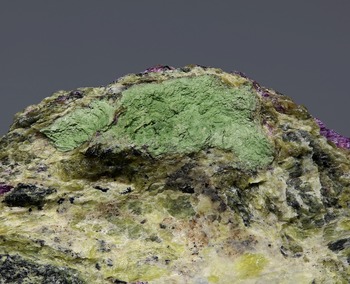
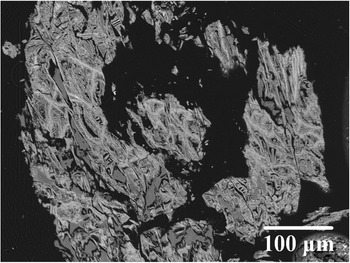
Kaznakhtite occurs as very fine grained, powdery aggregates forming flattened lenses up to 1.5 cm × 0.5 cm and veinlets up to 1 cm long and up to 1 mm thick in altered ultramafic rock composed of chrysotile, lizardite, stichtite and dolomite. Kaznakhtite aggregates are composed of very tiny platy grains up to 0.01 mm across (Figs 2 and 3). The new mineral is light green, transparent in tiny grains and translucent in aggregates. It has an earthy lustre, white streak and laminated fracture. Its tenacity is not determined because of the earthy character of aggregates, however, by analogy with other hydrotalcite-group minerals, we could suggest that kaznakhtite particles are flexible and not elastic. The mineral has a micaceous cleavage on {001}. The hardness and density of kaznakhtite could not be determined because of the powdery nature of the mineral and its intimate intergrowths with chrysotile and lizardite. Density calculated using the empirical formula is 2.864 g cm–3.
Light green powdery kaznakhtite in fracture of serpentine (composed of intimately intergrown chrysotile and lizardite) with lilac stichtite. Fragment of holotype sample, Fersman Mineralogical Museum registration number 5727/1. Field of view: 3 × 2 cm.

Aggregates of kaznakhtite (white) in cracks of lizardite serpentinite (grey). Polished section. SEM (BSE) image.

Kaznakhtite is optically uniaxial (–), with ɛ = 1.657(3) and ω = 1.676(3) (589 nm). Under the microscope, it is marsh green in thicker grains to colourless in the thinnest grains and weakly pleochroic in greenish hues, ω > ɛ. The Gladstone–Dale compatibility index (Mandarino, Reference Mandarino1981) calculated based on the empirical formula is 1 – (K p/K c) = 0.059 (good).
Spectroscopical studies
Infrared spectroscopy
In order to obtain an infrared (IR) absorption spectrum, a powdered sample was mixed with anhydrous KBr, pelletised, and analysed using an ALPHA FTIR spectrometer (Bruker Optics) in the range of 360–3800 cm–1, at a resolution of 4 cm–1. A total of 16 scans were collected. The IR spectrum of an analogous pellet of pure KBr was used as a reference. The assignment of absorption bands in the IR spectrum of kaznakhtite (Fig. 4) is as follows.
Powder infrared absorption spectrum of kaznakhtite. Wavenumbers of admixed lizardite are given in parentheses.

Bands in the range of 3000–3600 cm–1 correspond to O–H stretching vibrations and the ones at 1572 and 1606 cm–1 to bending vibrations of H2O molecules. The band at 1366 cm–1 is assigned to asymmetric stretching vibrations of CO32– anions. Bands at 857 and 875 cm–1 are due to out-of-plane bending vibrations of CO32– anions (nondegenerate mode) and those at 717 and 728 cm–1 to in-plane bending vibrations of CO32– anions (degenerate mode). Numerous overlapping bands in the range 650–750 cm–1 correspond to librational modes of H2O and OH–. The bands at 533 cm–1 and 424 cm–1 are attributed to Co3+–O and Ni2+–O stretching vibrations, respectively.
X-ray absorption near-edge structure spectroscopy
In order to determine the valence state of Co in kaznakhtite, the Co K-edge X-ray absorption near-edge structure (XANES) spectra of the mineral and Co(II) and Co(III) reference substances have been measured at the SUL-x wiggler beamline of the synchrotron light source at the Karlsruhe Institute of Technology (KIT). Samples were prepared as pellets mixed with cellulose. Spectra were measured in transmission mode using ionisation chambers optimised with gas filling and pressure. A fixed exit Si(111) double crystal monochromator was used for tuning the energy across the absorption edge. The beam was collimated to ~800 μm × 800 μm at the sample position. Energy calibration was performed using the Co metal foil. Pre- and post-edge background subtraction and normalisation were done with ATHENA software in the IFFEfit package (Ravel and Newville, Reference Ravel and Newville2005).
The Co K-edge X-ray absorption edge of kaznakhtite is located at the typical energy of a Co3+OOH reference spectrum and is clearly separated from a Co2+(OH)2 reference spectrum with the absorption edge of the latter at significantly lower energy (Fig. 5). A comparison of the kaznakhtite Co K-edge X-ray absorption spectrum with spectra of Co hydroxides and other reference substances (Fig. 6) confirms the conclusion on the trivalent state of cobalt in kaznakhtite.
Co K-edge XANES spectra of (1) kaznakhtite, (2) heterogenite Co3+OOH from the Democratic Republic of the Congo, and (3) synthetic Co2+(OH)2.

Co K-edge XANES spectrum of kaznakhtite (1) and reference spectra for Co(III) [heterogenite CoOOH from the Democratic Republic of the Congo (2)], Co(II,III) [Co3O4 (3)], and Co(II) [Co(OH)2 (4), CoSO4 (5), and CoCO3 (6)] compounds.

Chemical composition and chemical properties
Sixteen electron-microprobe analyses were carried out with a Cameca SX-100 electron microprobe (wavelength dispersive spectroscopy mode with an accelerating voltage of 15 kV, a beam current on the specimen of 4 nA and a beam diameter of 10 μm). Peak counting times (CT) were 20 s for all elements; CT for each background was one-half of the peak time. The raw intensities were converted into concentrations using X-PHI (Merlet, Reference Merlet1994) matrix-correction software. H2O and CO2 were not determined directly because of the paucity of pure material. The presence of CO32– anions, OH– groups and H2O molecules as species-defining constituents in kaznakhtite is shown conclusively by the structure and IR spectroscopy data. The presence of CO32– is also confirmed by chemical test.
Analytical data and standards used are given in Table 1. Contents of other elements with atomic numbers higher than that of beryllium are below detection limits. The empirical formula calculated on the basis of the sum of all metal cations = 8 atoms per formula unit is (Ni5.54Mg0.47Zn0.02)Σ6.03(Co3+1.83Cr0.11Al0.03)Σ1.97C1.00O2.99(OH)15.84Cl0.16⋅4H2O. The simplified formula is (Ni,Mg)6(Co3+,Cr)2(CO3)(OH,Cl)16⋅4H2O. The ideal formula is Ni6Co3+2(CO3)(OH)16⋅4H2O which requires NiO 51.27, Co2O3 18.96, CO2 5.04, H2O 24.73, total 100 wt.%.
Chemical composition of kaznakhtite (wt.%).

* calculated by stoichiometry
S.D. – standard deviation
Kaznakhtite reacts very slowly with cold dilute HCl or HNO3, however, when the acids are heated, it dissolves within a few seconds with effervescence (CO2 release).
X-ray diffraction data and crystal structure
Single-crystal X-ray diffraction studies of kaznakhtite could not be carried out because of the earthy nature and tiny size of its crystals. Powder X-ray diffraction data (Table 2) were obtained from a sample containing ~20 wt.% impurity of lizardite-2H (Fig. 7). The pattern was recorded in Debye-Scherrer geometry by means of a Rigaku RAXIS Rapid II diffractometer equipped with curved (cylindrical) imaging plate detector (r = 127.4 mm), using CoKα radiation (λ = 1.79021 Å) generated by a rotating anode (40 kV and 15 μA) with microfocus optics; exposure time was set to 30 min. The image plate was calibrated against the NIST Si standard. The image-to-profile data processing was performed using osc2xrd software (Britvin et al., Reference Britvin, Dolivo-Dobrovolsky and Krzhizhanovskaya2017). Kaznakhtite is trigonal, space group is R͞3m, a = 3.0515 (3), c = 23.180 (3) Å, V = 186.93 (4) Å3 and Z = 3/8. The non-integer Z value is caused by the presentation of the kaznakhtite formula in the form traditional for hydrotalcite-group minerals and accepted by the IMA–CNMNC (Mills et al., Reference Mills, Christy, Génin, Kameda and Colombo2012a), with 8 metal cations per formula unit. The structural formula of the mineral in a brucite-like sub-cell is (Ni¾Co3+¼)(CO3)1/8(OH)2⋅0.5H2O with Z = 3. A synthetic analogue of kaznakhtite was described by Mendiboure and Schöllhorn (Reference Mendiboure and Schöllhorn1986). It has a powder X-ray diffraction pattern similar to that of kaznakhtite (Table 2). The unit-cell parameters of the synthetic phase calculated using the UNITCELL program (Holland and Redfern, Reference Holland and Redfern1997) are: a = 3.0404(2), c = 23.052(3) Å and V = 184.53(2) Å3.
Rietveld refinement plot of kaznakhtite sample with 22% lizardite-2H 1 impurity.

Powder X-ray diffraction data (d in Å) for kaznakhtite and its synthetic analogue

a The calculated pattern was obtained using the STOE WinXPOW program, based on unit-cell parameters and atomic coordinates taken from the results of Rietveld refinement. The strongest reflections are marked in boldtype.
b Mendiboure and Schöllhorn (Reference Mendiboure and Schöllhorn1986) (ICDD #33-0429), Debye-Scherrer method, CuKα radiation, d = 114.6 mm, visual estimation of intensities.
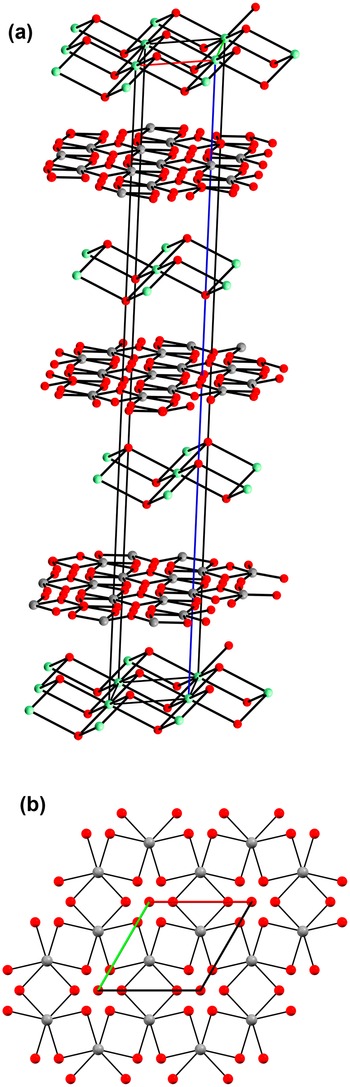
The crystal structure of kaznakhtite was refined based on the powder X-ray diffraction pattern (Fig. 7) using full-profile Rietveld refinement. Among several structural models tested, those of reevesite-3R Ni6Fe3+2(CO3)(OH)16⋅4H2O (De Waal and Viljoen, Reference De Waal and Viljoen1971; Inorganic Crystal Structure Database (ICSD) #107625) and quintinite-3R Mg4Al2(CO3)(OH)12⋅3H2O (Zhitova et al., Reference Zhitova, Krivovichev, Pekov, Yakovenchuk and Pakhomovsky2016; ICSD #134326) gave the best and almost the same fits between calculated and observed profiles. Because the model reported by Zhitova et al. (Reference Zhitova, Krivovichev, Pekov, Yakovenchuk and Pakhomovsky2016) has the higher symmetry (space group R͞3m), it was employed in the final refinement carried out by means of Bruker TOPAS v.5.0 software. We used a 20-order Chebyshev polynomial to describe the complex shape of the background curve (Fig. 7), because this fit was successfully employed in previous crystallographic works dealing with Rigaku RAXIS image-plate data (e.g. Britvin et al., Reference Britvin, Krzhizhanovskaya, Zolotarev, Gorelova, Obolonskaya, Vlasenko, Shilovskikh and Murashko2021). Octahedral cation site occupancy was constrained according to the data of electron microprobe analysis. The occupancies of interlayer carbon and oxygen atoms were adjusted to conform charge-balance requirements imposed by the M 2+/M 3+ ratio equal to 3. The coordinates of the oxygen atom in the brucite-like layer and the carbon atom were freely refined. The isotropic displacement parameters were set to be equal for oxygen and carbon atoms. The crystal parameters and details of Rietveld refinement are provided in Table 3, the fractional atomic coordinates and isotropic displacement parameters are given in Table 4, and selected interatomic bond lengths are listed in Table 5. The 3R stacking of the layers in the kaznakhtite structure is illustrated in Fig. 8a. A projection of the interlayer onto {001} is shown in Fig 8b. The oxygen atoms of the CO3 group are disordered (split) over six symmetrically equivalent positions. Carbonate group positions are populated randomly with an occupancy factor of 0.06. The crystallographic information file has been deposited with the Principal Editor of Mineralogical Magazine and is available as Supplementary material (see below).
Crystal structure of kaznakhtite. (a) General view of the structure approximately parallel to the c axis. The 3R stacking of the interleaving brucite-like and carbonate layers. (b) Projection of carbonate layer onto {001}. The CO3 group is split into six possible symmetrically equivalent positions. Legend: M site (octahedral cations) – pale-green; C – grey; O – red.

Crystal parameters and Rietveld refinement details for kaznakhtite.

Fractional atomic coordinates and isotropic displacement parameters (B iso, Å2) for kaznakhtite.

Selected bond lengths (Å) in the crystal structure of kaznakhtite.

Discussion
Relationship to other species
Kaznakhtite is the eleventh member of the hydrotalcite group within the hydrotalcite supergroup (Mills et al., Reference Mills, Christy, Génin, Kameda and Colombo2012a) after desautelsite, droninoite, hydrotalcite, iowaite, meixnerite, pyroaurite, reevesite, stichtite, takovite and woodallite. Most similar chemically to kaznakhtite are reevesite Ni6Fe3+2(CO3)(OH)16⋅4H2O (White et al., Reference White, Henderson and Mason1967; De Waal and Viljoen, Reference De Waal and Viljoen1971) and takovite Ni6Al2(CO3)(OH)16⋅4H2O (Maksimović, Reference Maksimović1956; Bish and Brindley, Reference Bish and Brindley1977; Mills et al., Reference Mills, Whitfield, Kampf, Wilson, Dipple, Raudsepp and Favreau2012b); kaznakhtite is their Co3+-dominant analogue.
Comblainite Ni4Co3+2(CO3)(OH)12⋅3H2O (Piret and Deliens, Reference Piret and Deliens1980; Mills et al., Reference Mills, Christy, Génin, Kameda and Colombo2012a), has the same species-defining elements as kaznakhtite, however, it has a M 2+:M 3+ ratio of 2:1 and, according to the current nomenclature, belongs to the quintinite group within the hydrotalcite supergroup (Mills et al., Reference Mills, Christy, Génin, Kameda and Colombo2012a). It is well known that the d(001) spacing values of hydrotalcite-type layered double hydroxides are dependent on the charge of the brucite-like layer and thus can be used for determination of M 2+:M 3+ ratio (e.g. Wang and Wang, Reference Wang and Wang2007; Sharma et al., Reference Sharma, Parikh and Jasra2008; Grover et al., Reference Grover, Komarneni and Katsuki2010; Zhitova et al., Reference Zhitova, Krivovichev, Pekov, Yakovenchuk and Pakhomovsky2016). However, this dependence is not yet applicable for the kaznakhtite/comblainite pair, because the available data are very scarce and controversial (Tables 2 and 6). Therefore, the chemically determined Ni:Co ratio of 3:1 and the trivalent state of Co are the only features which unambiguously distinguish kaznakhtite from other hydrotalcite-group minerals (Table 6).
Comparative data for kaznakhtite, reevesite, takovite and comblainite.

a Piret and Deliens (Reference Piret and Deliens1980) gave the unit cell of comblainite in rhombohedral setting with the following parameters: a = 7.796 Å, α = 22.47°, V = 60.7 Å3 and Z = 1.
b Unit-cell parameters were taken from the structural model reported in the ICSD database (ICSD #107625).
Song and Moon (Reference Song and Moon1998) reported on the complete solid-solution between reevesite and its unnamed Co3+-dominant analogue from serpentinised ultramafic rocks of the “Buk-site of the Kwangcheon area in Korea” [Buksite, Gwacheon, South Korea]. The material was described as golden yellow fine-grained aggregates replacing early-formed pecoraite–magnetite–millerite–polydymite assemblages during the advanced weathering processes and was studied by electron microprobe analysis, powder X-ray diffraction and IR spectroscopy. The most Co-rich area gave the composition close to the kaznakhtite end-member: (Ni6.033Mg0.153)Σ6.186(Co3+1.846Fe3+0.055)Σ1.901C0.890S0.061O3(OH)16⋅4H2O. The authors suggested that it is “a new member of the hydrotalcite group”, to which “a new mineral name should be given”, however, its full description and subsequent submission to the IMA–CNMNC for formal approval never followed. Later, this phase was assigned an unnamed mineral code # UM1998-10-CO:CoHNi (Smith and Nickel, Reference Smith and Nickel2007). Taking into consideration the existing data, we are certain that this phase is identical to kaznakhtite. Several synthetic Ni–Co LDH tentatively labelled as ‘comblainite’ may in fact represent kaznakhtite as well (Zhu and Cao, Reference Zhu and Cao2015; Wang and Song, Reference Wang and Song2017; He et al., Reference He, Zhang, Huang, Huang and Chen2018).
Remarks on the origin
The origin of kaznakhtite is clearly related to host ultramafic rocks. These rocks are generally enriched in Ni and Co (e.g. Gülaçar and Delaloye, Reference Gülaçar and Delaloye1976; Herzberg et al., Reference Herzberg, Vidito and Starkey2016) with the Ni/Co ratio from 2 to 30 (Gülaçar and Delaloye, Reference Gülaçar and Delaloye1976). These elements are compatible with primary silicates (olivine > pyroxene) and accessory sulfides and (sulfo)arsenides (Herzberg et al., Reference Herzberg, Vidito and Starkey2016; Hughes et al., Reference Hughes, McDonald, Faithfull, Upton and Loocke2016). Alteration of primary minerals causes a redistribution of these elements; they can be retained in alteration products or can be remobilised by hydrothermal fluids.
Most likely, kaznakhtite has a supergene origin. For its precipitation, high activities of Ni, Co, and CO2 are necessary. It could be formed as a result of interaction of CO2-bearing meteoritic water percolating the ultramafic rocks. Co-bearing heazlewoodite (up to 4 wt.% of Co) found in direct association with kaznakhtite is a possible primary source of nickel and cobalt. They could be also extracted from the host rock. Our chemical analyses show that associated serpentines (lizardite and chrysotile) are Ni-enriched (with NiO content up to 9.1 wt.%). On the other hand, cobalt-rich calcite forms veins ~20 cm thick located directly near the zones of the distribution of stichtite mineralisation in the Kara-Uyuk stream valley (Tatarinov et al., Reference Tatarinov, Sapozhnikov, Prokudin and Frolova1985). This is in line with Song and Moon (Reference Song and Moon1998) who proposed the schemes of formation of reevesite by hydroxylation and decomposition of pecoraite (Ni-dominant serpentine). The presence of Co3+ in kaznakhtite indicates its formation at strongly oxidising neutral to alkaline conditions (Brookins, Reference Brookins1988). The lenticular shape of the kaznakhtite aggregates suggests rather a local source of Co, e.g. from decomposed Co-bearing sulfide such as heazlewoodite.
The association of kaznakhtite and stichtite is noteworthy – they are isostructural but do not form a solid-solution series. The reason lies in the difference of their origin: stichtite is a Ni- and Co-free hydrothermal mineral at this locality (Zhitova et al., Reference Zhitova, Pekov, Chukanov, Yapaskurt and Bocharov2020) whereas kaznakhtite is supergene, and they have essentially a different cationic composition.
Supplementary material
To view supplementary material for this article, please visit: https://doi.org/10.1180/mgm.2022.65
Acknowledgements
We acknowledge four anonymous reviewers, Associate and Structure Editor Elena Zhitova and Principal Editor Stuart Mills for valuable comments. The IR spectroscopy investigation was carried out in accordance with the state task of the Russian Federation, state registration No. ААAА-А19-119092390076-7. RŠ thanks the MUNI/A/1570/2021 research project of Masaryk University for support. The X-ray diffraction study was carried out using the facilities of the Centre for X-ray Diffraction Studies, Saint-Petersburg State University.
Competing interests
The authors declare none.