IntroductionFootnote 1
Concentrating on the important developments of quantum physics associated with atomic and nuclear research, historians have overlooked other significant forces that shaped interwar physics. One major force and a significant cause for the expansion of physics at the period was technology.Footnote 2 It affected research in physics through two main ways. The more willingly acknowledged and easily perceived way was through improved and new laboratory “technics,” i.e. instruments and methods, which transformed experimentation and led to new results in various fields. No less important was the subtler way by which the interests of users and developers of technics directed an increasing share of research to topics that would plausibly help technology, understood here as the knowledge concerning technics.Footnote 3 Interests of users of technics, “technological interests,” channeled physicists to study questions relevant for improving technics of interests to influential users, such as state agencies and corporations. This hidden process often evaded contemporaries and has not received due recognition in the historiography of interwar science.Footnote 4 It is the focus of the present examination.Footnote 5 Although technological interests shaped research in physics to a further extent than in earlier periods, the phenomenon was far from new. Neither did it abate later. On the contrary, their influence had been strengthened and seems today stronger than ever. It is thus important to understand the process by which aims of commercial, social, and military powers of improving technics have shaped research in science. The present article examines this process through a study of one field of interwar physics – piezoelectricity. The field was abruptly transformed from a subject of pure research into applied fields. Moreover, its study promised help in technics of vast stakes to powerful organizations, namely of radio and line telecommunication central to the business of large corporations in the field (for example, the giant American Telephone and Telegraph company – AT&T), to the needs of military arms and to the regulatory function of governments. It is therefore particularly apt for discerning the effect of technological interests.
By the 1920s, society at large and some particular groups established institutions and means for directing scientific research into areas of practical interest. State institutions, such as the German, British, American, and Soviet physics laboratories and a few of the Kaiser Wilhelm Institutes, fostered technology (and thereby technics) by a closer exchange with scientific research. Foundations and states established research funds that often supported areas pertinent to technics deemed relevant for technology. Research laboratories of commercial companies and military arms carried out research in topics of physics pertinent to the technics of their use; and universities, especially in Germany, founded special units for technical physics. Beyond and above this institutional basis stood a general view that science could and should help technology, and thereby technics, a view that directed researchers to deal with such topics.Footnote 6 To conclude that these general forces indeed directed research in physics, we need to study their impact on actual research. In order to evaluate this impact, the present article examines to what extent technological interests embedded in these and other institutes shaped the way scientists studied piezoelectricity, and which other factors, predominently the “inner disciplinary logic” directed the research. In a disciplinary regime “research topics . . . are drawn from within the discipline, and relate both to disciplinary history and inertia and to where disciplinary practitioners perceive the future of their discipline to lie” (Marcovich and Shinn Reference Marcovich and Shinn2012, 38). Scientists choose research questions that extend active realms of research, explore related phenomena and variations on fruitful experiments, increase the precision and enlarge the range of the empirical data, elucidate apparent anomalies and discoveries, and test theoretical predictions (see the introduction to this issue).
To discern the effect of technological interest, I examine the main research topics in interwar piezoelectricity and analyze their connection to disciplinary questions and their relevance to the development of technics of societal interests. My interest is in the practice of researchers rather than in their rhetoric. Although the forces that affected research were general, the historian can track their effect and the mechanism by which they functioned only through their impact on particular individual scientists and research projects. It is through the details of the multi-layered interactions between researchers and the various disciplinary, institutional, economic, social, and cultural forces that we can evaluate their ability to direct research in science. To this end, one needs to examine the content of the experimental and theoretical activity and the researchers’ career paths, to connect the kind of research they carried out with their institutional settings. For this aim, I examine here dozens of scientific studies, hitherto neglected in the historical literature, and a corresponding number of biographical sources regarding the scientists who were involved. Viewing their earlier research and intellectual and institutional connections I assess the main factors that led individual scientists to their choice of research topics, and through that the factors that directed research in the field at large.
It would, of course, be beyond the historian's ability to identify the specific reasons that led each individual to each particular topic. Still, their common paths can indicate the main factors that directed their research. Moreover, the examination of individual paths helps discern the various channels by which technological interests affected the field. Some of these channels were more concrete and easier to find, (e.g., a connection with a corporation with an interest in related devices); some were more elusive. The knowledge that the field might be commercially useful attracted researchers to it also when they did not have direct ties with organizations with stakes in the technics. Through the examination of these particular channels in the case of piezoelectricity, this article identifies forces and processes that directed research towards topics of interests of users of technics also in other scientific fields.
That technological interests directed physics, however, did not make it a part of engineering or an indissociable “technoscience.” The research at the focus of the current examination was regarded as physics, rather than engineering or technology. It was scientific research distinguished from, although connected with, engineering, technological research or “utilitarian regime.” The latter aims at providing knowledge useful for designing and using technics, the former at general knowledge of the phenomena beyond its use in particular technics (e.g. Layton Reference Layton1987, Vincenti Reference Vincenti1990, and Shinn Reference Shinn2008).Footnote 7 For example, the research on the variations in the value of the piezoelectric coefficient of quartz with temperature was part of physics, while the research on particular cuts whose resonance frequency would be stable under changes of temperature was engineering. In accordance with the approach presented at the introduction to this issue, I regard the separation between the two kinds as instructive for our understanding of the different kinds of research, the work, publications and careers of practitioners, and the interactions between science, technology and technics. That the borderline between the two kinds of research was sometimes blurred, does not deny the distinction between them and its significance for the practice of the researchers.Footnote 8
To establish my claim that technological interests shaped physics and not only engineering, I examine studies in the former discipline, using two criteria for classification as either physics or engineering: First, by observing the way contemporaries perceived the different endeavors, e.g. in the journal Science Abstracts (which is not necessarily identical to the way a particular author thought about his work). and second by examining the content of the research according to the abovementioned thematic lines. The two criteria usually led to the same conclusions.Footnote 9 When they differed, I followed my thematic criterion after a more thorough examination. Notice that according to this distinction basic and applied research are together part of science different from engineering (as long as applied does not overlap with engineering research).Footnote 10 Within the realm of physics examined here, technological interests directed research to questions pertinent for technical development that were still legitimate from the disciplinary logic. Otherwise, the studies were regarded as external to physics. Thereby, the interests of the users of the technics shaped the discipline and changed physics not in overt contradiction to its logic but by reordering its priorities.
From Pure to Applicable Research: A Quantitative Effect
Before the First World War piezoelectricity, the generation of electric polarization (or tension) by mechanical strain in crystals and the converse effect of deformation due to voltage differences, was a subject of scientific study, and was used for little known laboratory measuring instruments, but was not employed beyond the laboratory. The research on the phenomenon was very quiet as it was described quite comprehensively by a phenomenological theory suggested by Woldemar Voigt in 1890. The few attempts to provide an explanatory theory did not prompt much research in the field (Katzir Reference Katzir2006). Only a few researchers studied the field; almost all of them worked with either of the two old masters: Voigt and Wilhelm Röntgen. The war changed that. In 1917, the French physicists Paul Langevin invented piezoelectric ultrasonic detection technics, later known as sonar (Katzir Reference Katzir2012). In the aftermath of the war, the American physicists Walter Cady utilized the piezoelectric effect in resonating crystal to control frequency of electronic oscillations. Already in the early 1920s, engineers and physicists had realized the significance of Cady's technics for allowing efficient radio broadcasting, systems for transmitting more conservations on the same material lines, or electromagnetic wavebands in telephony and radio, and connections between such systems. The uses of such technics promised large economic gains for telecommunication corporations, better means of communication for militaries, and ways for coordinating the expanding complicated landscape of telecommunication for the states, as well as new possibilities for small-scale users of radio and for developers of other applications of the nascent electronics (Katzir Reference Katzir2016a).
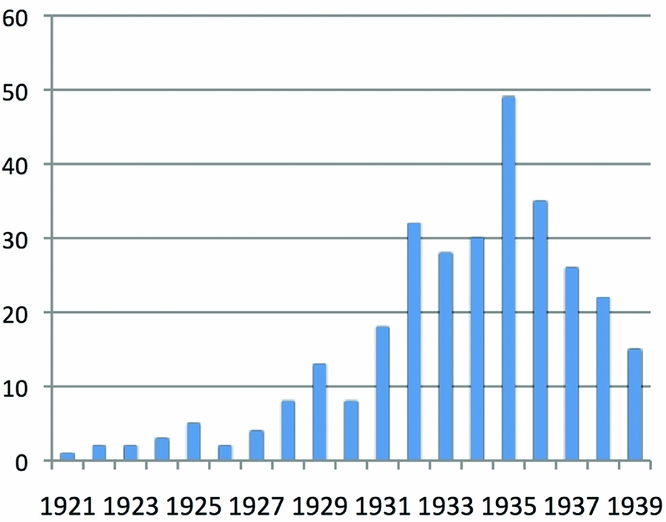
Following its use in crystal frequency control, and in sonar and other devices, research on piezoelectricity dramatically increased. As expected, most attention was directed to its technical uses. Yet scientists and engineers not only exploited it, but also studied its properties at various levels. Their interest in its effect is manifested in the sharp rise in the number of related publications. A 1928 bibliography of piezoelectricity records 208 items for the decade 1919–1928, compared with less than 30 for each of the previous decades. About half of the items in the list examined general properties of piezoelectric crystals and resonators. The other half dealt with piezoelectric instruments and applications (Cady Reference Cady1928). General digests of physics show a similar picture.Footnote 11 The British journal Science Abstracts aimed at covering all publications in physics that appeared in the major European languages. Until 1927, it reported at only a handful of papers in the discipline whose main subject was piezoelectricity, which was still higher than their number before the war. The number of papers rose sharply to 32 in the 1932 volume and to an interwar record of 49 in 1935 (see fig 1).Footnote 12 These papers were written by more than 150 scientists. Scientists working in Germany and the USA were dominant among them (about 45 from each), but there were also quite many from the USSR, France and Japan and a few from Britain and other countries.
Annual number of papers on piezoelectricity, as mentioned in the volumes of Science Abstracts, Section A – Physics.

Moreover, the content of research in the field suggests that it was shaped by corporations and states who were interested in improving technics based on piezoelectricity. At the center of the research stood the vibrator and resonator, which were essential for sonar and frequency control. This was an entirely new research topic. Before WWI, scientists had examined piezoelectricity only in static or semi-static conditions. They began to study vibrations after Langevin suggested using vibrating crystals as transducers between electrical and mechanical oscillations for sonar. During this technological study, Cady had made a few surprising observations of vibrating crystals. Free from the confinements of the utilitarian regime, after ceasefire he embarked on disciplinary research to explore these observations. He discovered that the electric properties of piezoelectric vibrators change abruptly near mechanical resonance.Footnote 13 This discovery enabled the application of resonators for frequency standard and for frequency control units, and therefore their massive practical use. Consequently, their study became potentially useful for technical developments. In particular the research provided guidance for producing resonators more suitable for the needs of wireless communication and telephony; for example, knowing their properties helped to devise resonators whose frequency was more stable under changing temperatures. Yet, as a novel phenomenon, piezoelectric resonance also posed puzzles for physics, questions worth answering according to the disciplinary logic: how can the abrupt electric resonance be accounted for by knowledge and theories of static piezoelectricity and elasticity? What is the mechanism that leads to the phenomenon and how does it fit the known structure of crystals? These and similar questions provided an additional, scientific, reason to study resonance.
Early Research on the Resonator
Cady himself embarked on an extensive study of the piezoelectric resonator with the help of his students at Wesleyan University. He examined the resonator's effect on the electric circuit in the laboratory, and explored ways to account for the observations in terms of electric and elastic theories. In his early publications beginning in 1921, he described the fundamental phenomena of the piezoelectric resonator as observed by its effect on the electric circuit. He suggested a theoretical account of these findings, and discussed their applications for frequency measurement and control. Cady's publications addressed the technical audience who was interested in applying the new findings, and scientists who were interested in extending and securing the knowledge about these findings (Cady Reference Cady1922b). He presented a qualitative explanation and a quantitative account of the phenomena. The latter relied on Voigt's phenomenological theory of piezoelectricity, on the mathematical theory of elasticity, and on techniques from telephone engineering. This use of mathematical, physical, and engineering techniques reflects Cady's interests as well as his resources.
Since this was the first theoretical account of the piezoelectric resonator, Cady chose a relatively simple case of lengthwise vibrations of a thin quartz rod. The vibrations were induced by electricity in the transverse direction (a strain in the y direction due to electric field in the x direction). This simple case allowed him to develop solutions to the equations for the vibrations according to the piezoelectric and elastic theories, which would have been much more complex for a general case. He still had to employ quite a few physical and mathematical approximations to reach solvable expressions (Cady Reference Cady1922a). The problem was not only a simple case from a theoretical and computational point of view but also the one realized in Cady's experiments. Thus it suggested a way of examining the assumptions of the underlying theories. Moreover, it was also the cut employed in the practical devices. The case, thus, suggested practical, empirical, and theoretical advantages. This combination fitted Cady's research. It also characterizes much of the early research on the piezoelectric resonator beyond the Wesleyan laboratory.
In the following years, a few scientists mainly from state and industrial laboratories joined Cady in studying the behavior of piezoelectric crystals beyond their use, while engineers and inventors developed methods for their employment. Notwithstanding the contribution from these laboratories, the first to join the study were three of Cady's MA students (his university did not grant PhDs). One of them Tadashi Fujimoto, Cady's former assistant, made the resonator the subject of his 1927 PhD dissertation at Ohio state university.Footnote 14 Cady's former student and from 1921 colleague, Karl S. Van Dyke (Annon. 1942), joined his former professor's research in 1925.
Van Dyke modeled the resonator's electric behavior near resonance frequency to an electric circuit with capacity (represented by condenser), induction (represented by a coil) and resistance (represented by a resistor). This theoretical electronic circuit produced the same electric effect as the resonator; hence such models were often called equivalent circuits.Footnote 15 Since the resonator was almost always inserted into an electronic circuit, one could analyze its behavior by examining its equivalent electric system using the well-known tools of electronics. Cady had already tried to devise an equivalent circuit but failed. Van Dyke succeeded by adding (magnetic) self-inductance to the capacity and resistance used by Cady, although the resonator does not show any magnetic effect. Clearly, the model was designed, not to present the process inside the crystal, but rather for its effect on the circuit. The equivalent system helped to identify the main properties of the resonator taken as a whole, i.e. without considering its internal constitutes and structure, and also without tracing its behavior to any underlying mechanism (Cady Reference Cady1946, 33–35). These properties made the theory more simple to use in the analysis and design of experiments and devices, than a “dynamic theory,” i.e. a theory that applies piezoelectric, electric, and elastic theories to quartz crystals under high-frequency electric voltage and pressure, like the one suggested by Cady in 1922. Thus, often an equivalent network better answered the needs of technology. Yet, in some cases (like the production of resonators more stable under temperature variation, see below), equivalent systems suggested no help, and the researchers employed dynamic theory. Dynamic theory also provided the required link between the magnitudes of the modeled electric components (i.e. the values of the capacitors and coils) and those of the real quartz resonator (i.e. the values of the piezoelectric, dielectric, and elastic constants). Cady's dynamic theory allowed Van Dyke, for example, to express the equivalent magnitudes in terms of the piezoelectric and elastic properties. In this sense, dynamic theories are basic to equivalent system theories.
With a single exception, the first who embarked on scientific study of the resonator shared Cady's concern in its practical use for wireless communication. Although not all the researchers were directly engaged in improving technics, like the inventor of crystal frequency control. David Dye, at the British National Physical Laboratory (NPL) employed the piezo-resonator in frequency measurement methods, which he learnt directly from Cady who used them in a 1923 international tour to compare a few national frequency standards (Cady Reference Cady1924). Dye developed technics based on these principle for the government's aim of coordinating wireless transmission and for the military services’ interest in improving long distance radio communication (Katzir Reference Katzir2016a, 23–4). In addition to research and development of piezoelectric devices, Dye embarked, like Cady, on an empirical and theoretical study of the resonator. Simultaneously with Van Dyke, he devised an equivalent network (originally different in some details). The network helped to analyze the effects of changing frequency, and surrounding temperature, and the existence of air-gaps of varied widths between the crystal and the electrodes on the electric behavior of the resonator. Experimenting with such variations, Dye extended the realm examined by Cady and his students. The results had some bearing on his design of the resonators for frequency standards. Yet, Dye's research went beyond his direct technical needs; it was directed at gathering general knowledge about the resonator and at a theoretical account of the observed phenomena (Dye Reference Dye1926). At the laboratory of the expanding Dutch company Philips, Balthasar van der Pol developed a similar equivalent network, limited to fewer cases, to facilitate analysis of resonator circuits used for frequency control, which was of technological interest to his corporation. Although van der Pol enjoyed relative freedom to carry in-depth scientific research on questions weakly related to the interests of Philips (Katzir Reference Katzir2016a, 31–6), in this case he engaged in a technological research on the properties of a device. He dwelt neither on the derivation of the equivalent network nor on its relation to the piezoelectric and elastic properties of quartz (Van der Pol Reference Van der Pol1926).Footnote 16
The use of the piezoelectric resonator for frequency standards also attracted the attention of Erich Giebe and Adolf Scheibe, Dye's colleagues at the Physikalisch-Technische Reichsanstalt (PTR) (the German Institute for physics and technology), technical department. In 1925 they invented a method for displaying the resonance frequency of piezoelectric crystals useful as a frequency standard. Their “luminous crystals” produced a luminous discharge in a container filled with rarefied gas due to secondary electric tension induced by the piezoelectric effect at resonance. In contriving the technics Giebe and Scheibe fulfilled one of the missions of their institute, namely providing means for exact laboratory measurements. They continue with a further institutional mission, that of extending extended knowledge relevant to practical technics with an extensive study of resonance phenomena in quartz. In particular, they examined different modes of elastic vibrations, due to different cuts and various crystallographic directions of the electric field. Like most early students of the resonator, they advanced a theoretical explanation for their findings. Their results extended the knowledge regarding piezoelectric resonance and its relations to crystalline structure. At the same time these results, which were published in a physics journal (Giebe and Scheibe Reference Giebe and Scheibe1925b, Reference Giebe and Scheibe1928b), also suggested practical rules for obtaining and manifesting resonance at frequencies higher and lower than those previously attained, technics useful for telecommunication. They described these aspects in journals for technical physics and engineering (Giebe Reference Giebe1926; Giebe and Scheibe Reference Giebe and Scheibe1928a). This combination of scientific and technological benefits fitted the aims of the PTR, although its technical section rarely engaged in basic scientific research (Cahan Reference Cahan1989; Kern Reference Kern1994).
The resonator drew the attention of their colleague at the German major radio company Telefunken, Alexander Meissner, a prominent investigator who had already been involved in scientific and technological research and development at the company since 1907, two years before he earned his PhD in electrical engineering. A prolific inventor, Meissner first applied piezoelectricity for a new microphone in 1923. Yet, it seems that he and his colleagues began research on the resonator only in 1925, probably with the progress of radio technology and the resulting interest of Telefunken in frequency standards and control (on the industrial interest, see Katzir Reference Katzir2016a). Their research led both to patents and to more general publications. Meissner and his colleague, Kurt Heegner, experimented with various circuits for detecting resonance and for frequency control, and studied physical influences on the frequency and characteristics of resonance.Footnote 17
Meissner extended the research to properties of vibrating quartz crystals beyond those directly pertinent to their practical applications. An observation of a mechanical rotation of a quartz specimen led him into a new line of study. Meissner realized that the rotation originated in the production of an asymmetric air blast of uncommon strength by a vibrating crystal of particular dimensions, and found a crystal cut that enhanced the effect. To visualize the effect, he built a small crystal motor, which rotated when the quartz was excited by an electrical high-frequency source. This motor had an instructive rather than a practical use; still it shows Meissner's interest in producing functioning devices from his findings, a common trait among industrial researchers (Reich Reference Reich1983). Moreover, he patented a method to detect resonance by the violent air currents it produces, which was useful in principle, although of no real practical value.Footnote 18
In 1927 Edgar-Pierre Tawil reported on a similar observation of air blast in a study that followed his research on the effect of vibrations on the optical properties of resonating quartz bars. An independent French researcher with his own means probably of Syrian origins, Tawil was attracted to the possible use of piezoelectric quartz resonators to modulate light for the nascent television technics. He began research of physics in 1925 with a related study of double refraction in quartz resonators. Soon he extended his empirical study to other topics of piezoelectricity including vibrating crystals and the electric effect of torsion. Like Meissner, Tawil combined scientific research of the phenomenon with practical suggestions for its use, publishing in scientific journals on his findings and filing patents on his inventions. Unlike Meissner, who contributed to a wide array of fields, Tawil concentrated his intellectual efforts on piezoelectricity. He received the 1931 Henri Becquerel prize for his findings in the field.Footnote 19
Beyond the disciplinary interest in examining the new effect as such, Meissner saw an opportunity to probe the structure of quartz. He identified in his quartz crystals lines that produce stronger sound (the source of the air blast), and assumed that they form the surfaces of the greatest molecular density. Thus, he inferred from the macroscopic sound production the crystalline atomic structure. On one hand he employed this conclusion to suggest a more efficient crystal cut along these surfaces. On the other hand he combined this insight with common assumptions about the structure of quartz and (in a second version) with results from x-ray studies to propose an atomic structure of quartz and mechanism for the appearance of static piezoelectricity. Still his theory, like earlier explanatory account of piezoelectricity (Katzir Reference Katzir2006, 130–6), was speculative and offered only a qualitative account of the phenomena. Moreover, it did not account for the electric effect of torsion, well accounted for by Voigt's phenomenological theory (Meissner Reference Meissner1926, Reference Meissner1927).
Meissner's atomic theory did not provide any kind of instruction for designing more useful resonators. It did not even account for resonance. Viewed outside its context, it thus could be seen as “pure research.” Still it was strongly connected to technological interests. It stemmed from an attempt to improve frequency control technics through a study of vibrating crystals, which led to the discovery and study of an unexpected effect that trigged an inference about the structure of matter. Meissner's research is probably the best example of the connections between the different levels of research; potential utility directed parts of his research, while other parts followed curiosity and a wish to understand nature, albeit with a hope that the findings might be useful in new technics.
Extending the Study of Resonance Phenomena
Early scientific studies of the resonator concentrated on the relatively simple and practical case of lengthwise vibrations. By the late 1920s researchers extended their studies to other modes of vibrations and cuts. Here again, technological and scientific interests met. Examining further modes was interesting from a theoretical point of view, as they involved additional elastic and piezoelectric coefficients, considerations of crystal structure and calculations about their interactions. The research was also useful for technical design. It mapped the properties of various cuts and modes of vibrations leading to empirical rules about them. These rules helped to design crystal cuts and modes of vibrations, more useful for specific goals: resonating at high or low frequencies, which was needed to control frequencies in new devices operating in an expanding spectrum of wavelengths used in radio and telephony; maintaining a stable frequency under temperature variations, which was needed for the exceeding precision required from radio transmitters and for establishing frequency standards for national and corporate telecommunication systems (Katzir Reference Katzir2016a).
In 1925 Van Dyke identified the parameters of his equivalent network for lengthwise vibrations; in 1928 he extended that to thickness vibrations. This more general case, however, was still limited to quartz cut in perpendicular to one of its electric axes and to the optical axis (“Curie cut”) (Cady Reference Cady1922b; Van Dyke Reference Van Dyke1925, Reference Van Dyke1928). Among others, Van Dyke's account did not cover most modes of vibrations used by Giebe and Scheibe for their frequency – standards resonators. As mentioned, in 1928, three years after they had begun using flexural and torsional vibrations they presented a theoretical explanation of the major properties of these vibrators, like the directions of maximal effect, and the variables that influence their resonance frequency. This theory was based on the piezoelectric and elastic phenomenological theories. Yet, although dynamic, the theory remained semi-qualitative, without elaborated mathematical expressions. Five years later, Giebe, now with his co-worker Blechschmidt, presented a quantitative theory for such vibrations, but confined it to elongations of tubes and plates. In 1940, the two researchers suggested a quantitative theory also for torsional vibrations. (Giebe and Scheibe Reference Giebe and Scheibe1928b; Giebe and Blechschmidt Reference Giebe and Blechschmidt1933; Cady Reference Cady1946, 450).
Practical use of specific cuts often preceded theory; dynamic theory was not necessary for their basic use. This was the case with thickness vibrations cut perpendicular to “Curie cut” (x-cut) in quartz, which the physics professor and inventor George W. Pierce introduced for frequency control resonators in 1923. Still, a few researchers thought that quantitative dynamic theory would be helpful for shaping the resonator for their technical needs. This view seems to motivate Issaku Koga, a professor of electrical engineering in Tokyo's institute of technology, who had been working on crystal frequency control for a few years (Katzir Reference Katzir2016a, 29–30). In 1932 he suggested a thickness vibration theory for all crystals and all cuts, accounting also for boundary reflections of elastic waves. The theory was part of a larger research project on characteristics of different modes of vibrations of quartz plates, closely connected to technological interests in their use. Guided by the theory, Koga experimented with various cuts and found one whose resonance frequency is practically independent from temperature. He reported on the cut in 1933 and two years later incorporated it in a new quartz clock of his design (Anon. 1963b, 8–9). Technological interests, thus, played a central role in directing Koga's research, even as his study of thickness vibrations went beyond the needs of technology.
An intent to provide rules for technical improvements seems to be only one among several motivations to develop the dynamic theories. Their authors were also concerned with disciplinary questions of theoretical-mathematical rigor, completeness, and agreement with the observations. Cady extended the theory for a resonator with a gap and damping, and showed how to derive the equivalent electric constants of thickness resonators in 1936. Other contributors with an institutional interest in technology, B. van Dijl from the Radio-Laboratory of the Dutch State-owned telecommunication provider and Rudolf Bechmann from Telefunken suggested, respectively, another mathematical approach and a fuller account of elastic boundary effects in 1936 and 1940. Academic researchers, free from such institutional obligations also contributed. The renown German theoretician Max von Laue was mainly concerned with the challenge the resonator posed for the phenomenological elastic and piezoelectric theories of crystals. He thought that Cady's theory of lengthwise vibrations lacked rigor and suggested an alternative theory in 1925 (Laue Reference Laue1925). Ernest Baumgardt, who worked at Paul Langevin's laboratory mainly on ultrasonics (Le Grand Reference Le Grand1969), explained a divergence between thickness theory and experiment with an assumed additional effect of charge on the elasticity of quartz in 1938. In 1942 A. W. Lawson from Pennsylvania University advanced a more complete mathematical account based on Cady's assumptions (Cady Reference Cady1946, 306–07). Most theoretical studies of the resonator, however, did not elaborate on piezoelectricity but on its elastic aspects.
Dynamic theory seemed to be of interest more for physicists than for developers of practical devices, with a few exceptions like Koga. For example, during 1927–29 Warren Marrison and Fredrick R. Lack at AT&T's Bell Labs developed resonator cuts that were stable under temperature variations. This answered their corporation's needs for a highly precise primary frequency standard, reasonably precise portable frequency standards (for their telephone and radio networks), and for controlling radio transmitters in their wide broadcasting system. Yet, they made little use of mathematical theory. They reasoned from earlier empirical findings on modes of vibrations in quartz and the way different modes depend on temperature instead of deriving preferable modes from a rigorous theory (Marrison Reference Marrison1929; Lack Reference Lack1929; Katzir Reference Katzir2016b, 103–5). Still six years later, their colleague W. P. Mason developed an elastic theory for flexural vibration, probably with the aim of assisting the design of further resonators in a more analytical manner. Experimental studies about modes of vibrations seemed to be more useful for developing efficient resonators for various practical ends, like lower resonance frequency and stability.
Concern about practical cuts directed a few of the early researchers in the field, as clear for example from the work of Giebe and Scheibe. In 1931, Harald Straubel at Jena University relied on empirical means, without resort to theory, to identify “natural directions” of oscillations and demonstrated their correspondence with Young's modulus. He further recommended that practitioners cut quartz according to these “natural directions.” While others were perhaps less explicit, they usually referred to the practical implications of their research on piezoelectric vibration.Footnote 20 Yet, the interest of physicists in the question waned in the early 1930s, perhaps since it seemed of little scientific concern after the main modes were mapped. The properties of different cuts became a subject of engineering research and development aimed at designing new products. Scientists and engineers in industry (Telefunken, Zeiss, AT&T) and in engineering departments (Koga in Tokyo) employed quantitative resonance theory, data, and experiments to develop cuts useful for their needs; they found the abovementioned cuts of practically zero temperature coefficient, cuts of low frequency and others of high frequency resonance (Cady Reference Cady1946, 451–61). A few academic physicists, prominently Harold Osterberg in Wisconsin and Václav Petržílka and August Žáček in Prague, studied related questions in the late ‘30s. They concentrated on what seemed to be open issues, either because the behavior in the laboratory or of devices lacked a satisfactory theoretical account, or due to disagreements about their explanation, or because a specific kind of cuts had not yet been studied. Osterberg, for example, accounted for Lack's finding by analyzing the dependence of temperature coefficient on the modes of vibrations in quartz. Petržílka and Žáček studied torsional vibrations following a controversy over the ability of Voigt's phenomenological theory to account for the static effect and on how to account for the vibrations observed in different cuts (Osterberg Reference Osterberg1936; Petržílka and Žáček Reference Petržílka and Žáček1938).
In addition to the study of modes of oscillations in crystals, researchers studied the effect of external physical conditions on the resonator as a unit. In these studies, they paid little attention to the process inside the crystal, to its particular elastic and piezoelectric constants, and the relations to its metal coating. While the particular crystals in use were important for some studies, the researchers often employed equivalent network formalism. Following the early studies at Wesleyan university and the NPL, physicists studied the effect of temperature, mechanical stress, and the magnitude and frequency of the electrical forces on the resonator. A few studied the effect of air-gaps on the resonance frequency and the influence of the surrounding medium. Others examined related questions like the effect of decrement of the vibrations on their frequency, and the production of heat by vibrations.Footnote 21 The conditions studied were similar to those that affected resonators when they were used for frequency standards and control devices, which required the stability of resonance frequency. Technological intrests, thus, seem to be a decisive force in directing scientific research to these topics. Physicists showed interest in studying the effect of these physical conditions on frequency from the mid-1920s to the early 1930s, but did not pursue it later. As with the study of vibrational modes, they probably deemed the current knowledge of the main effects as satisfactory. During the 1930s, they turned to related questions, like the microscopic displacement of the vibrators applying optical and x-ray methods.
Paths to the Study of the Piezoelectric Resonator
Most of the experimentalists who examined the resonator shared a concern with its technical application. After 1928, their concern did not often follow from a personal engagement with designing devices, but from a general aim and usually a traceable motivation to provide useful knowledge for the developers of piezoelectric technics. Often, it was this concern with applications that led the researchers to piezoelectricity, or formed a major motivation for its study. The profile of the researchers was quite similar to that of the early students of the resonator, with an increase in the share of university scientists. Still the research in national and industrial laboratories continued. Blechscmidt joined Giebe and Scheibe at the PTR; Barret and Howe continued Dawson's research at the American Naval Research Laboratory; Hund, Wright and Stuart began scientific research of the resonator at the USA Bureau of Standards. Bechmann joined Meissner at Telefunken and continued the research after the latter left for AEG. At Bell Labs, Mason and Skellett supplemented the technological research and development of Marrison, Lack, and their associates. Earle M. Terry (already in 1927) and separately Osterberg in Wisconsin and S. Leroy Brown at Texas University joined their colleague Cady at Wesleyan. German professors and their students joined their American colleagues: Wien, Grossmann, Hehlgans, and Straubel in Jena, Wachsmuth, Auer, and Doerffler in Frankfurt. Brown and Terry manifested longstanding interest in high frequency oscillations (Ingersoll Reference Ingersoll1929). Max Wien and his associates in Jena directed much of their research to technical questions, especially regarding high-frequency electric oscillations, Wien's expertise. In particular, they cultivated strong connections with the science-based company Zeiss, the main funder of the natural science faculty at the university, and the founder of its institute for ‘technical physics’ (Gerber, John, and Stutz Reference Gerber, John and Stutz2009). Although primarily an optics manufacturer, Zeiss engaged also in the production of crystal-cuts for frequency control, probably due to its expertise in cutting. The company was closely involved with the research of Harald Straubel, who had assigned a few patents in the field to Zeiss before he became its employee in 1935. Straubel continued cooperation with the university, as a Zeiss employee. The tight relationships benefited also from the high position that Haralad's father, Rudolf, a physicist himself, occupied in the company.Footnote 22
Japan provides another example for the involvement of governmental laboratories and academic institutes in research. Koga began his work on piezoelectricity at the electro-technical institute of Tokyo municipality, and continued at the electrical engineering department of Tokyo's imperial university and at Tokyo's institute of technology (‘Isaac Koga 1899–1982’ 1982). In parallel with Dye, Giebe, and Scheibe, Shogo Namba, who worked on Japan's radio frequency standards at the electro-technical laboratory of the ministry of communication, examined general properties of quartz vibrators (Namba Reference Namba1930) (Annon. 1933). Nishikawa and his associates who confirmed Koga's theory using x-ray diffraction in 1933, worked at Riken – an academic research institute for physics and chemistry (Nitta Reference Nitta and Ewald1962). They did not have a direct interest in frequency control, but one of the main goals of the institute was to provide a scientific basis for fostering technology (Coleman Reference Coleman1990, 229–31, and Ito's contribution to this issue). Another academic site for research was the University of Prague, where the physics professor Žáček, an expert on radio and the measurement of high frequencies, prompted his assistant Petržílka to examine relationships between optic and piezoelectric properties in vibrating quartz in 1931. The next year Petržílka moved closer to answer technological interests with research on high-frequency vibrations of tourmaline crystals at the Heinrich Hertz Institute for vibration research in Berlin, an institute with an explicit interest in frequency control. At this point Petržílka acquired expertise and professional interest in the study of the resonator. Thus, when he returned to Prague as a lecturer of physics, he continued with its study, establishing a local center for studying the resonator by engaging Žáček and younger physicists: L. Zachoval, František Khol, and Franz Krista. The technologically oriented Hertz Institute, thus, pushed Petržílka to study areas of its interest, also after ceasing paying his salary. Yet Petržílka himself found other areas more promising for further research and in 1938 began studying nuclear physics, a move hampered by the closure of the Czech universities by the German occupation.Footnote 23
Still, some of the researchers did not show such an explicit interest in the technical uses of the resonator. Richard Wachsmuth, Frankfurt's experimental physics professor became interested in the subject due to his concern with elastic vibrations. Technical applications seem less prominent in his group's work. Yet, the technical relevance probably helped attain support for the research. For experiments in flexural and transverse vibrations his student, Doerffler, enjoyed support from Notgemeinschaft der DeutschenWissenschaft (NG) the main German research fund and the Helmholtz-Gesellschaft, which was established to promote applied research. The higher prospects of receiving financial support to a technologically relevant study might have directed the student to this research rather than to another work on elasticity (Doerffler Reference Doerffler1930; Kirchhoff Reference Kirchhoff2003). Across the Atlantic, the resonator attracted the attention of Harold Osterberg, who examined its vibrations by an interferometer in his 1931 dissertation in Wisconsin. Osterberg made piezoelectricity his major research area publishing alone and with students about a dozen papers on the resonator. Apparently, the combination of a new sub-field with open questions and their relevance for technology attracted the young physicist, who sought his own niche. He explored questions of some generality, yet many of his studies were relevant to practical applications. Among these were an interferometer examination of quartz cuts that were used in commercial devices (in 1933), the stability of high frequency tourmaline resonators (with John W. Cookson in 1934), and the abovementioned research on zero temperature coefficients. The latter is an example of a study of more general and theoretical character inspired by a technological research. Ernst Lonn's 1937 mathematical solution of the vibrations of crystal plates that was stimulated by findings of Petržílka suggests another example. In the case of Osterberg the connection to technics was not only thematic. Bell Labs lent him quartz plates (Osterberg Reference Osterberg1933, 829). His inclination to technology-oriented research would lead him to abandon the academy for the optical industry in 1939.
Clearly, technical prospects motivated much of the research on the piezoelectric resonator. Yet, the participation of scientists without direct personal or institutional links to the technology suggests that disciplinary concern and sheer curiosity also played a role. I have traced above some of the scientific concerns that researchers had. It is more difficult to trace the effect of the researchers' own curiosity which were personal and did not leave objective traces. Yet, one should not infer from our methodological shortcomings that curiosity was inconsequential. There are a few indications that curiosity motivated scientists and engineers alike, if not all and not always. Their published papers and notebooks show that their research often went beyond apparent scientific or practical questions. Another indication is the enthusiasm conveyed in some passages of their published material. In addition, researchers explicitly referred to their inner interest in the subjects they studied, usually retrospectively when they reflected on their work. Although curiosity sometimes led physicists to issues outside the central disciplinary and technical concerns, it often did not conflict with other motivations. Scientists found intellectual interest also in questions derived from technology. The curiosity and disciplinary concerns in such phenomena like piezoelectric resonance made them more attractive for scientific research, thus facilitating physicists’ move to questions of interest to users of technics.
Studies beyond the Resonator
Although the resonator attracted most attention, the technical application of piezoelectricity led also to an expansion of research on other properties of the phenomenon through three main paths. First, the effort to elucidate resonance triggered the examination of related questions regarding piezoelectricity in static conditions. These were often topics that had already been studied in the pre-applicable phase. Studies of the magnitudes of the piezoelectric coefficient (the ratio between strain and electric polarization in particular crystals and directions) and their variations under changing physical conditions form the prominent example. Second, through its uses and following the discovery of piezoelectric resonance, the phenomenon became better known among physicists. Thus, researchers were mindful of the phenomenon and considered its study when they worked on connected questions, or when they were looking for a proper niche for their research. The stimulation of research due to the better acquaintance with piezoelectricity was a secondary effect of the technological interests in it. Third, the resonator and its theory suggested new methods for measuring and detecting piezoelectric effects. As it is common in disciplinary research, physicists seized the new methods to measure magnitudes determined by other means.
The resonator led to two new measuring techniques. One was the 1925 “powder method” of Giebe and Scheibe: an effective technique to detect the mere existence of the effect in hundreds of minerals, using the electric properties of piezoelectric resonators (Giebe and Scheibe Reference Giebe and Scheibe1925a). The two PTR researchers employed knowledge they acquired in their technological research, i.e. the resonance effect explored for improving frequency standard technics, for scientific aim, i.e. for exploring the structure of ‘non-useful’ crystals. Following their lead, about a dozen scientists employed the method. While Giebe and Scheibe reached their method from the study of electric oscillations, others seized on the efficient method for their research programs on the structure of minerals in physical chemistry, crystallography, and mineralogy.Footnote 24 Here we can perceive the effect of technics as instruments, since the method was an adaptation of practical methods to the laboratory. In the other measuring technique, we can notice the secondary effect of technological interests since it hinged on resonator dynamic theory. A few experimental methods allowed employing the theory to determine piezoelectric coefficients through frequency measurements. Several physicists seized on the technique. A few like Fujimoto and Van Dyke had worked on the resonators, others like Vselold Fréedericksz and his colleagues in Leningrad Physico-Technical institute (LFTI) showed a clear interest in piezoelectricity. While for still others like Angelika Székely from Graz University and her student Berta Nussbaumer, this was the only research related to piezoelectricity (Cady Reference Cady1946, 387–92).
Fréedericksz employed the dynamic method to contest the 1927 experimental conclusions of Leo Dawson from the US Naval Research Laboratory (NRL) according to which quartz main piezoelectric coefficient decreases in value with high temperature. The physicist Albert Perrier from Lausanne university supported the Leningrad group by invoking measurements that he had performed already in 1916. His research was part of a longstanding disciplinary study of phase changes in solids, predating the technological interest in piezoelectricity. Yet, he returned to the question due to the renewed interest in the field that followed its technical use. During the 1930s, physicists continued exploiting the question, measuring the variations of the piezoelectric coefficient with temperature.Footnote 25 An interest in the technology clearly stimulated this research since the resonance frequency of frequency control units was sensitive to the changing value of the piezoelectric coefficient. Dawson studied static piezoelectricity because the NRL was interested in developing crystal frequency control for use in shortwave radio (Anon. 1963; Yeang Reference Yeang2013, 171–175; The Technical Information Division Naval Research Laboratory 1998). The case of Fréedericksz (Frederiks in modern transliteration) is more complicated. In the 1910s he had studied piezoelectricity with Voigt, the doyen of the field. Yet, he resumed its study only after the large-scale application of piezoelectricity. The technical relevance of the effect justified its study at the LFTI, an institute aimed at fostering industrial development through scientific and technological research (Vizgin and Frenkel Reference Vizgin, Frenkel, Balashov and Vizgin2002; Josephson Reference Josephson1991, 104–40).
In examining the variation of the effect of temperature, the Leningrad group measured the absolute value of the quartz piezoelectric coefficient. The value of its major piezoelectric coefficient attracted the attention of quite a few experimentalists from 1927 on, with fourteen determinations of its value up until the beginning of WWII, versus nine in the 35 years before WWI. Quartz was the only crystal actually used for frequency control. It was also the most useful crystal for laboratory examination and drew much attention at the pre-applicable phase of research. Still, while it was the single most determined crystal before WWI, its study predominated the inter-war period drawing more measurements than all other crystals combined. The role of quartz suggested that the study of the exact value of the piezoelectric coefficient and its variations under changing physical conditions originated in an interest in the resonator due to its technical value. A casual remark made by Cady in his comprehensive 1946 textbook Piezoelectricity exhibits the importance of practical applicability for the study of the effect. He dismissed the need to have quantitative information about the constants of specific class of crystals because it “cannot be recommended for piezoelectric applications.”Footnote 26
While physicists in general were better acquainted with piezoelectricity in the 1920s than before, those who had encountered the effect in one given context were still particularly likely to study the field in another context. With their associates, they were responsible for a considerable share of the research beyond the resonator. Some of them were trigged by encounters with the phenomenon in its technological research. This was the case with Cady's early studies of resonance, which followed his experience with vibrations in his war research on sonar. Another group worked in Paris around the inventor of the piezoelectric sonar, Paul Langevin, who began scientific study of piezoelectricity only in the mid 1930s, inspiring also a few junior collaborators including his son and son-in-law.Footnote 27 Apparently, Langevin's experience stimulated research at the nearby laboratory of Charles Fabry at the faculty of science. For example, Ny Tsi-Ze (Yan Jici) examined for his 1927 dissertation static piezoelectricity in quartz, using a crystal specimen cut as an ultrasonic transducer, and enjoying assistant from a commercial company that used it (Société de Condensations et d'Applications Mécanique) (Ny Reference Ny1928). Ny's own experience with piezoelectricity stimulated his further study of the field as a director of the physics institute in Beijing. With Tsien Ling-Chao (Qian Lingzhao) he examined electrification by torsion in a hollow quartz cylinder, in an attempt to elucidate differences between experimental results of Röntgen (1890) and Tawil (1928) and their relations to the phenomenological theory. This opened a small controversy, and, as expected from the disciplinary logic, promoted further research on torsion in quartz by them and their collaborators: Fang Sun-Hung in China, Gibbs with whom Tsien studied in England, and Langevin and Jacques Solomon in Paris. As with other questions related to piezoelectric properties of quartz, the issue of torsion also had practical implications as it was used to generate vibrations, a connection that probably added to the interest in the question. (Ny and Tsien Reference Ny and Tsien1934a, Reference Ny and Tsien1934b).
The laboratory was an additional site for encountering piezoelectricity and another stimulant for its study. Experimentalists employed the vibrator in studying acoustics, especially ultrasonics, and used piezoelectric resonance for exploring the structure of crystals. In the 1930s, piezoelectricity itself attracted the attention of some researchers in the field. A few of them were associated with groups that had already studied piezoelectricity in Jena and in Fabry's laboratory.Footnote 28 This influence of technics through laboratory instrumentation on research is distinct and independent from the power of technological interests. It occurs also when an effect has no use beyond the laboratory.
Notwithstanding the role of its technical applicability, the study of piezoelectricity was stimulated also by developments in other fields of physics. Their effect was strengthened by acquaintance with piezoelectricity, which made scientists aware of its relevancy. The technological interest in piezoelectricity helped to attract several among those who reached the field through this path. A few studies in the 1920s followed Max Born's new atomistic-lattice theory of solids (1915) and the exploration into crystalline structure by x-ray diffraction techniques (1914) (Vigoureux Reference Vigoureux1931, 177–96).With the advances in x-and γ-rays studies, experimentalists in the field explored the influence of radiation on piezoelectricity with no conclusive results.Footnote 29 The power of x-ray diffraction methods to explore the fine structure of vibrating piezoelectric crystals drew a handful of the many experts on these methods to the resonator.
Two cases illustrate the confluence of disciplinary and utilitarian factors in directing physicists to piezoelectricity. In 1931 Gerald Fox and Percy Carr determined the amplitude of vibration of the quartz lattice atoms in resonance, by measuring the intensity of x-rays reflected from the crystal. Fox, who had just become a professor at Iowa, was looking for new research subjects. His former teacher, the x-ray expert James Cork, probably suggested the x-ray diffraction study of resonators, following one of his own studies. From 1932, Fox extended his experimental study of piezoelectricity (always jointly with a junior associate) to other methods and issues like possible causes of breakage and properties of the static effect, which suggests an interest in questions related to practical technics.Footnote 30 In 1938, a similar combination of experience in x-ray methods and an interest in the use of piezoelectric crystals probably led Václav Dolejšek and Miroslav Jahoda to study the variations in x-ray diffraction patterns of quartz due to the effect of static piezoelectricity. Dolejšek was the director of the spectroscopic institute of Prague University, working mainly on x-ray spectroscopy. This research had led him to a study of the crystals used for grating the x-rays for scientific and technological aims. His institute had an interest in the latter, as it hosted the physical research institute of Škoda, the largest industrial company in Czechoslovakia. Piezoelectricity probably attracted his attention also due to the activity of Petržílka's group at the same physics department (Dolejšek and Jahoda Reference Dolejšek and Jahoda1938; Neprašová and Rozsíval Reference Neprašová and Rozsíval1955).
The Sites of Piezoelectric Research
The university was the main site of research beyond the resonator, in places like Frankfurt, Breslau, Vienna, Iowa, Michigan, Austin, Paris and Beijing. Still, piezoelectricity of static effects was studied also in state research institutes like the LFTI and the NRL and in the industrial laboratory of Telefunken. Technological interests played a prominent role in drawing researchers to piezoelectricity also in some of the academic centers, like Paris and Jena. Sonar and its use were central to Langevin's group, and an important context for Ny's early study. Technological relevance and prospects drew Bedeau, Tawil and de Gramont, all connected to Fabry, to the field.Footnote 31 In other places, especially in Germany and the USA one cannot trace an interest in specific technics, but it is still plausible that the technical prospects of the field attracted researchers to its study (see appendix, “Major research centers and their main subjects of study”).
A few individuals engaged in research on piezoelectricity, like Cady, Langevin, Fabry, Petržílka, Fox, and Ny played a central role in directing their (usually junior) colleagues to its study. They created small research centers that were often connected to institutional interest in technology. As the example of LFTI suggests, however, such an institutional interest did not necessarily imply direct research on the resonator, but led also to relevant studies of static piezoelectricity. Moreover, sometimes scientists who began with questions related to technology widened their research to issues quite remote from those of design, or even without any apparent technical implications. These included also researchers working in industrial and governmental institutes (e.g., Giebe and Scheibe, and Meissner).Footnote 32 Notwithstanding, piezoelectric research in national and industrial laboratories, like those of the NPL, NRL, PTR and Telefunken began with an explicit concern to improve practical devices. This was also the case at the engineering department of Tokyo University (research in other engineering schools was usually regarded as contributing to technology rather than to science, and so had at least a similar concern in practical methods).
At the early stage, research at the universities often originated from a particular interest of an individual like Cady, Langevin, and Terry in related technics (Terry reached the subject due to his interest in radio). In subsequent years particular extant connections to technical uses of piezoelectricity waned in importance. A more general inclination towards research relevant to technology seems to be the most important single factor in directing scientists to such studies of piezoelectricity. The view beyond this inclination, namely that academic physics should help technology, was quite common at the time and received official endorsement in policy statements and in material support from foundations and states (Kohler Reference Kohler1992; Katzir Reference Katzir2017). Providing basic knowledge for technical progress was more explicit in a few places like Riken institute in Tokyo (Ito, this issue), the Optic Institute, which Fabry directed (Bigg Reference Bigg2005), and the chair for technical physics in Jena. Still, the idea was shared by scientists in regular physics departments. Quite a few studies in Germany and the US enjoyed financial aid from the NG, the Helmholtz Gesellschaft and the National Research Council (USA), which endorse this view (Kirchhoff Reference Kirchhoff2003; Kevles Reference Kevles1995, 117–154). Commercial companies also assisted research relevant to their technics. Zeiss, AT&T and the Société de Condensations et d'Applicationsmécanique provided funds, crystals and expertise for academic physicists. At least in one case an institute aimed at fostering technology, the Hertz institute for high frequency research, assisted a university scholar, Petržílka, by providing temporary employment. Thereby it strengthened his involvement with questions related to the use of the resonator. Moreover, prospects of employment in such institutes or in industry (an option that Osterberg and Straubel realized) probably encouraged young academics, struggling to secure employment or sufficient income to pursue technologically relevant questions. Hopes to gain material support from commercial and governmental agencies probably encouraged also physicists who reached piezoelectricity from studies of other fields of physics, like Fox, to explore questions connected to its technical uses. It was through these particular connections to technological interests and through the general expectation to support technology that the needs and aims of users of piezoelectric technics directed research in the field.
Conclusions
Almost any study of the resonator, and many studies of static piezoelectricity were of potential value for future technical uses. The studies of the resonator that were regarded as part of physics were interesting from technological and scientific perspectives, as they revealed novel knowledge about the phenomena and knowledge useful for technical design. Studies of the resonator were connected to other issues of piezoelectricity, be they the properties of the static effect, crystalline structure, or ultrasonic effects. Studies aimed at scientific and technological goals were connected and sometimes even combined in one and the same project, and this made research pertinent to technics attractive for aspiring physicists. They could move from studying general properties of the resonators, the motion of atoms in them, and the changes in the value of the piezoelectric constant near critical temperatures, to examining special cuts and their usefulness for particular ends, or the variation of resonance frequency with temperature. When they pursued questions relevant to technology, like the latter, they could publish their results in physics journals and contribute to the discipline, and so advance their career, and open prospects both in academic and industrial research. Physicists could continue with the kind of questions that they usually examined, mainly the (quantitative) effect of varying different physical conditions on a particular magnitude, and maintain their self-image as scientists while answering questions relevant for technology, even when the particular questions did not originate from “the logic of the discipline.” This double use of the studies facilitated the engagement of academic scientists with technologically relevant questions, an engagement driven by particular connections to governmental, public, and commercial institutions aimed at fostering technics (e.g. state and industrial laboratories, scientific funds) and a general societal interest in employing science for material benefits.
That the improvement of practical applications was not the main or the explicit goal of many studies pertinent to applications makes the effect of technological interests on their choice of problems more difficult to trace. As the examples discussed in this article show, usually a combination of a few factors drew scientists to these studies. Yet, in many cases, a concern with improving technics, often connected to telecommunication, played a major role among them. Although it is difficult to determine the effect of particular technological interests in guiding the research of an individual scientist, their overall impact on the research of piezoelectricity is evident. The two central characteristics of the research – the concentration on the resonator and the emphasis on quartz – were pertinent to the practical applications of the effect. Moreover, many studies of the resonator dealt with issues important for the users and developers of frequency standards and control, like the determination of resonance frequency and its thermal stability. While these were interesting questions also from the disciplinary perspective, no comparable research was done on other equally valuable questions that did not have similar technical prospects. For example, scientists paid limited attention to issues like the relationships between piezoelectricity and radiation, or those between the lattice and crystallographic structure of the crystals and their piezoelectric properties. In short, due to technological interests in piezoelectricity, physicists directed their studies to topics relevant to technics rather than to other topics.
The expectations that scientific research would extend and improve knowledge about piezoelectric-based technics, i.e. technology, rather than the possibilities that the technics offered for experimentation directed research in the field into particular topics. Neither piezoelectricity nor technics based on the effect were a “research technology,” i.e. general purpose laboratory technics useful for experiments on various scientific question.Footnote 33 Scientists often chose the field and particular topics in its study because crystal frequency control and sonar, the main technics based on the effect, were highly useful for particular organizations in the industry, the state, and the military. The central role of technological interests in the case of piezoelectricity suggests that they also shaped other scientific fields. Moreover, the channels and factors that allowed organizations with interests in these technics to direct research in piezoelectricity were probably exploited also for advancing other technologies. The channels and factors exposed here are therefore instructive for our understanding of the interaction of scientific research with economic, state, social, and cultural forces at the twentieth century.
Organizations aimed at advancing technology were constitutive in channeling research to related topics. These included, as we saw, state, industrial, and military laboratories, which employed some of the scientists who studied piezoelectricity, and supported others. They were more influential in the early stages of the research, as were a few individual scientists who either encountered the phenomena in WWI military technological research or saw it as relevant for their interests in wireless. Research funds provided material support that encouraged study pertinent to piezoelectric technics more in the latter part of the period. The early stage was critical for creating a basic body of knowledge required to identify the new phenomenon as fruitful and worthwhile for disciplinary study in physics. It also formed a small group of scientists with expertise in the phenomena, and thus with stakes in its further study. With the basic observations, preliminary theories and known technical relevance, the subject became attractive also for disciplinary study by scientists without a former encounter or a special concern in its applications. It also made the phenomenon better known, drawing further researchers to identify its possible theoretical and experimental relevance to their research interests and expertise.
Several factors allowed users and developers of technics to exploit these channels in order to expand and shape research on piezoelectricity. One important factor was the close epistemic connection between scientific and technological issues. In piezoelectricity, as in many other contemporary fields, some questions of technology and physics were very close and even overlapped, a link that provided both those working on technics and on science an incentive to collaborate. The new and strengthened institutions that aimed to foster collaboration between science and technology emerged partly due to this connection and helped to reinforce it. These institutes, including state and industrial laboratories, scientific foundations, and academic institutes aimed at connecting physics and technology, like the chair for technical physics in Jena, the LFTI, and Riken played an important role in directing research to topics related to technics of practical interest. Historians should pay more attention to the last group, namely of academic research institutes, which combined research in technology and physics,Footnote 34 as it has not received due discussion in the secondary literature. Not less important, technological interests directed research related to technical improvements also at ‘regular’ university departments, not by obligation nor by direct material rewards, but by subtler and thus more effective means: by expanding the research in piezoelectricity in general; by suggesting potential material gains from related studies, and more plausibly by suggesting a way to attain recognition, since these topics attracted attention in a larger circle than purely disciplinary topics; lastly and probably most important by the general view that academic research should help answer questions pertinent to technics.
These factors did not depend on the particular properties of piezoelectricity. They, thus, present general strands in society, industry, and science that shaped relevant fields of physics according to technological interests. Moreover, since some of these factors were either new or more powerful in the interwar period than before, it is plausible to conclude that their effect was stronger at the time than earlier, a conclusion supported by other studies, including those presented in this issue.Footnote 35 Interwar physics was less “pure” than often assumed. Its tighter connections to societal powers foreshadowed the strong influence of the state and industry on post – WWII physics (Forman Reference Forman1987). Moreover, the combination of direct, indirect and often subtle ways by which research pertinent to technics became attractive for scientists, in this case, seems to be central to the success of societal interests to channel research in modern physics also at earlier and later periods.
Appendix 1: Major research centers and their main subjects of study
The list includes only centers that either included a larger number of researchers or produced significant works on piezoelectricity during the interwar period. The subjects indicate in a general way only the main research themes studied by each group. Names in bold are central figures in their group. The list includes also researchers who are not mentioned in the text (for more details, see my book manuscript in preparation).
1) USA
a) Academic
i) Wesleyan: Cady, Fujimoto, Hans von R. Jaffe, Van Dyke, Harrison, Powers: Resonators, static determinations
ii) Michigan: Cork, Bertsch: X-ray studies
iii) Iowa: Fox (connected to Cork) with: Carr, Fraser, Hutton, Fink, Underwood, Fredrick: x-ray studies and resonators
iv) Wisconsin: Terry, Osterberg with Cookson, Hestenes: Vibrations and static measurements
b) Governmental and industrial laboratories: Resonators and static measurement
i) Dawson, Barrett and Howe (Naval research laboratory)
ii) Hund and Wright, Wright and Stuart (Bureau of Standards)
iii) Mason, Skellett (Bell labs)
2) Germany
a) Jena (connection to Zeiss): Günther, Grossmann, M. Wien, Hehlgans, Straubel, Becker: Vibrations, effect on light
b) Göttingen: Born, Heckmann, Laue, Gockel, Bormann: Theory
c) Breslau: Lonn, Schaefer, Bergmann, Fues, Ludloff, Müller, Kraefft & Bücks: Vibrating crystals in relations to ultrasonics
d) PTR: Giebe, Scheibe, Blechschmidt: Resonators
e) Telefunken: Meißner and Bechmann, Heegner: Resonators, atomistic theory
3) France
a) Associated with Fabry: Bedeau, Bernard, Yeou Ta, Tawil, Pan, Ny (and later with collaborators in Beijing) de Gramont: Static effects (torsion), effect on light
b) P. Langevin's circle: A. and P. Langevin, Moulin, J. Solomon, Baumgardt, Guerbilsky, Lucas: Static effects and vibrations
4) British
a) NPL: Dye, Vigoureux, Essen: Resonators
b) Gibbs connected to Bragg (lattice structure) and Tsien (a connection to the Chinese group and Thate (resonators)
5) Prague school: Dolejšek, Jahoda, Khol, Petržílka, Žáček, Zachoval: Vibrations, x-ray studies
6) Leningrad school: Andreeff, Fréedericksz and Kazarnowsky, and Michailow, Schulwas-Sorokina, Posnov, Lissütin, Sokoloff, Kjandsky, Eremejew and Kurtschatow: Effect of temperature, resonator theory
7) Tokyo: Fujimoto (connected to Cady), Koga and Shoyama, Namba & Matsumaura, Nishikawa, Sakisaka and Sumoto, Watanabe: Resonators, x-ray studies.
Acknowledgments
I thank Maria Rentetzi and Kijan Espahangizi and the anonymous referees for their useful comments on earlier drafts, and the excellent library of the Max Planck Institute for the History of Science, which helped me to obtain the sources needed for the research. Part of the research was being carried out while I enjoyed a Marie Curie fellowship of the Gerda Henkel foundation, for which I am grateful.