The era in which the Baltimore-Washington Infant Study was conceived was punctuated by several key events, including the discovery of thalidomide's teratogenicity, the concept of multifactorial inheritance, and the 3 Mile Island incident. In the 1960s, Dr Helen Taussig, pioneer of paediatric cardiology and consummate clinician, spoke before the FDA regarding the dangers of thalidomide. By the 1970s, Drs Nora and Nora informed the paediatric cardiology community of a 3% recurrence risk of congenital heart disease.Reference Nora and Nora1 In 1979, the disastrous core meltdown in the 3 Mile Island nuclear power generating station (near Harrisburg, Pennsylvania, United States of America) culminated in the United States Nuclear Regulatory Commission authorising the release of 40,000 tonnes of radioactive wastewater into the Susquehanna River.
With this impetus, epidemiologists and public health-minded paediatric cardiologists of the Baltimore-Washington area undertook a systemic analysis of the impact of proximal environment on birth outcome, specifically complex cardiovascular malformations. To review a map of the Baltimore-Washington Infant Study region (Fig 1), the Susquehanna River empties directly into the Chesapeake watershed. Thus, the principal investigators of the Baltimore-Washington Infant Study had a vested interest in the identification of the baseline prevalence of congenital heart disease, as well as putative environmental influences in the region, which included all live-born infants in Maryland, the District of Columbia, and six counties of northern Virginia from 1981 to 1989.Reference Ferencz, Rubin and McCarter2
Region of the Baltimore-Washington Infant Study.

The search for aetiologic underpinnings of congenital heart disease was embraced by the principal investigators of the Baltimore-Washington Infant Study, including Dr Charlotte Ferencz and the participating clinical paediatric cardiologists in the five tertiary care facilities of Maryland, Washington DC, and Virginia: Dr Joel Brenner (University of Maryland Medical Systems), Dr Lowell Perry (Children's National Medical Center) and Dr. Catherine Neill (Johns Hopkins Hospital). However, the challenge of an epidemiologic analysis of this heterogeneous group of defects was formidable. Previous attempts to categorise cardiac defects had resulted in rearrangements of phenotypic entities, but failed to differentiate aetiology – the primary cause of abnormal development – from pathogenesis – the ways in which structures develop abnormally – and anatomic lesion – the final development of an outcome.
When the Baltimore Washington Infant Study was established in 1980, a primary goal was to generate hypotheses on genetic and environmental risk factors. The fundamental hypotheses of (Fig 2) the Baltimore-Washington Infant Study included the contributions of environmental exposure, exposure route, genetic susceptibility and vulnerable period to birth outcome; among other things, Baltimore-Washington Infant Study highlighted the importance of maternal diabetes in malformations and exposure to organic solvents and pesticides.Reference Loffredo, Wilson and Ferencz3
Fundamental hypothesis of the Baltimore-Washington Infant Study.
Another goal of the Baltimore-Washington Infant Study was to investigate the prevalence of congenital heart disease, which required a robust study design to overcome the significant epidemiologic challenge. In a retrospective article, Christopher Loffredo,Reference Loffredo4 PhD, described these unique challenges. Although congenital heart disease, as a broad category, is the most common birth defect, with a prevalence of nearly one in 100 live births, the variation is infinite. Specific subtypes are rare, as illustrated by the infrequency of common arterial trunk. Survival bias can skew analysis; many patients with congenital heart disease die in utero. Further, symptoms can be subtle and diagnosis can be delayed until well past infancy. Finally, controversy in the nomenclature of congenital heart disease has existed since the inception of the field and persists today.
In order to identify both risk factors and confounding factors, the Baltimore-Washington Infant Study was designed as a collaborative, population-based case–control study to ensure full ascertainment of all cases. The investigators in the Baltimore-Washington Infant Study targeted a fixed geographic area – the entire state of Maryland, the District of Columbia, and six counties in Northern Virginia. There was full ascertainment of all cases, including review of autopsy logs at all 53 area birth hospitals. Cases were infants diagnosed with congenital heart disease by echocardiography, cardiac catheterisation, cardiac surgery or autopsy in the first year of life, and included 4390 live-born infants. Controls were 3572 age-matched live-born infants in the same geographic area. Data collection was via parent interviews and a 60-page questionnaire by which familial, environmental, medical, occupational and socio-demographic data were obtained.Reference Ferencz, Rubin and McCarter2
Tetralogy of Fallot and other outflow tract abnormalities
Among the cases of congenital heart disease identified, there were 642 infants with outflow tract defects: 236 had Tetralogy of Fallot, 60 additional had Tetralogy of Fallot with pulmonary atresia (prevalence 6.74%), 239 had transposition of the great arteries (prevalence 5.4%) and 44 had common arterial trunk (prevalence 1.0%).Reference Ferencz, Rubin and McCarter2 Three findings in this population of infants with Tetralogy of Fallot and common arterial trunk emerged from the data, and certainly impacted clinical management in an era of evolution to early primary repair: these infants were much more likely to be low birth weight, premature and small for gestational age than the cohort of infants with other forms of congenital heart disease, and certainly when compared with a population-based control group.Reference Rubin, Ferencz, Brenner, Neill and Perry5 Moreover, the population of infants with Tetralogy of Fallot and common arterial trunk was more likely to have associated chromosomal and/or non-cardiac organ malformations, impacting their care.
The odds ratio – and prevalence – of low birth weight (defined as <2.5 kg), prematurity and small for gestational age in Tetralogy of Fallot patients was 4.5 (26%), 2.5 (21%) and 5.0 (24%). In Tetralogy of Fallot with pulmonary atresia, the findings were similar, 8.8 (40%), 7.5 (44%) and 4.5 (22%). Common arterial trunk followed the same trend: 3.4 (21%), 3.4 (26%) and 3.66 (18%). In contrast, the control population (n = 3572) and infants with transposition of the great arteries had a prevalence of low birth weight, prematurity and small for gestational age, which were quite similar: 1.0 (7.4%), 1.0 (9.5%) and 1.0 (6.0%).
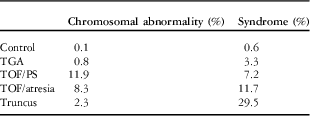
Increasingly, infants with congenital heart disease were recognised to have genetic syndromes. During this transitional period of the 1980s, when case–control acquisition of patients in the Baltimore-Washington Infant Study was accomplished, dysmorphology was about to give way to detection of single gene defects. This burgeoning awareness of the increased risk of non-cardiac malformations, genetic and organ abnormalities in children with congenital heart disease was dramatically borne out by the prevalence of chromosomal abnormalities and clinical syndromes in cases with congenital heart disease versus population-based controls, as well as between various sub-groups of infants with congenital heart disease in the BWIS (Table 1).Reference Ferencz, Rubin and McCarter2 Of note, these data can be considered “pre-molecular era”; presumably, the prevalence of diagnosed syndromes would be much higher with today's ability to look for single-nucleotide polymorphisms, especially for the diagnosis of 22q11 deletion – DiGeorge syndrome. Defined abnormalities in the group with Tetralogy of Fallot, for example, included Trisomy 21 in 18 infants, Trisomy 18 in four, and Trisomy 13 in five.
Aneuploidy and syndromes: TGA and TA (data from the BWIS).
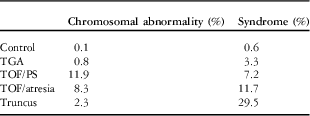
BWIS = Baltimore-Washington Infant Study; PS = pulmonary stenosis; TA = truncus arteriosus; TGA = transposition of the great arteries; TOF = Tetralogy of Fallot.
The rate of associated non-cardiac malformation was also noted to be much higher in common arterial trunk than transposition of the great arteries, and multiple malformations outnumbered single malformations 2:1.Reference Lurie, Kappetein, Loffredo and Ferencz6 Identified malformations varied in prevalence by subtype of transposition of the great arteries. The overall prevalence was 4.6% of patients with transposition of the great arteries who had associated malformations, but the prevalence rose to 6.1% in transposition of the great arteries/intact ventricular septum and fell to 1.5% for transposition of the great arteries/ventricular septal defect. Included among these malformations were pyloric stenosis, kidney agenesis, hypospadias and polydactyly.Reference Lurie, Kappetein, Loffredo and Ferencz6 The prevalence of associated malformations was 9.1% in common arterial trunk, including polydactyly and malrotation.
Today, although it is well known that 20% of congenital heart disease is associated with Mendelian and chromosomal syndromes, a full 80% is non-syndromic. The majority of congenital heart disease is sporadic, lacking a specific aetiology and felt to reflect interaction of multiple factors. Known mutations are rare, including: NOTCH1, JAGGED1, GATA4, MHC6 or TBX5, with each likely accounting for <5% of complex cardiovascular malformations.Reference Ransom and Srivastava7 First, as a brief review, 4.3% of transposition of the great arteries is known to be associated with known syndromes, including Townes–Brocks, Schinzel–Giedion, DiGeorge syndrome, VACTERL, CHARGE, heterotaxy (ZIC3 and CFC1), trisomy 8 and trisomy 18.Reference Goldmuntz, Bamford, Karkera, dela Cruz, Roessler and Muenke8–Reference Melchionda, Digilio and Mingarelli14 In a study of patients with common arterial trunk, McElhinney et alReference McElhinney, Driscoll, Emanuel and Goldmuntz15 found that 40% also had 22q11 microdeletion. No studies to date have implicated any further underlying molecular diagnoses in the estimated 60% of sporadic common arterial trunk.
The clinical implications of these findings are well known to paediatric cardiologists and their genetic colleagues, who define the structural anatomic and molecular abnormalities, and to the paediatric cardiovascular surgeons, anesthesiologists and cardiac intensivists who must manage the often small infant with multiple issues requiring surgical palliation or early repair. Clearly, better understanding leading towards identification and reduction of risk factors leading to premature birth will have a major impact, so too will the search for aetiologies, now with new genetic tools for analysis of sporadic congenital heart disease.
Understanding genetic variability to improve outcomes remains a challenge to the paediatric cardiology community. With greater understanding will come enhanced ability to prognosticate long-term quality of life and neurological outcomes. The past success of the Baltimore-Washington Infant Study highlights the importance of multi-institutional collaboration to assure future progress.
Acknowledgement
The authors would like to acknowledge the participants and authors of the BWIS as listed above.