1. INTRODUCTION
The lack of clarity of the term function (Eckert, Reference Eckert2013; Vermaas, Reference Vermaas2013), coupled with its ubiquitous use in design communication, is a problem that greatly hinders design. Although many design practitioners seem to be unfazed by the term's ambiguity (“There is little evidence that the rich academic debate around function is recognized in industry”; Eckert, Reference Eckert2013), we believe that it causes more problems than most acknowledge, particularly in terms of educating designers and in developing functional and design reasoning abilities.
In this paper we present a model-based theory of functions called the link model. By means of this model, we moreover develop our understanding of the term function and of functional reasoning through five defining statements and through nine mind-sets, useful for both design practitioners and researchers. The lists of defining statements and functional reasoning mind-sets are not complete but comprehensive of the most fundamental functional and design reasoning rules, from the perspectives of the authors. It is through good design reasoning that we are able to build products suitable for their intended uses, in an efficient, reliable way, while making rational decisions about design trade-off.
The link model presented in this paper supports the disambiguation of functions by separating them from the actions and behaviors of the device. It also tolerates two concepts of function: use functions and wirk functions. The position we take with respect to the ambiguity of function is, therefore, a variation of the second response described in (Vermaas, Reference Vermaas2013), proposing two concepts of function to be used in engineering design. The current ambiguity of the term function, focused upon in this Special Issue, is in our view due to the coexistence of different models of functional reasoning such as Weber's property driven design (Weber et al., Reference Weber, Steinbach, Botta and Deubel2004) and Suh's (Reference Suh1990) axiomatic design, between which designers may choose. This ambiguity may also be seen as an academic phenomenon so long as industry does not signal any problems. Yet the authors' argumentation behind this article is to work out “what to tell the students?” We believe there is a need for proper enablers for thinking and reasoning to support the designers' identification, clarification, synthesis, coordination, and so on, and we propose the link model does that.
In the following sections, we explain the theoretical perspective of the link model, its origin, content, and relation to other approaches, before a section arguing for its raison d'être. The proceeding sections then detail important concepts explained by the link model and the supporting mind-sets: distinguishing the “idea with” from the “idea in,” functions from function properties, and finally use functions from wirk functions. Before the concluding remarks, the article closes with a section on “reasoning about functions” and a discussion comparing the link model with the position papers.
2. THEORETICAL PERSPECTIVE
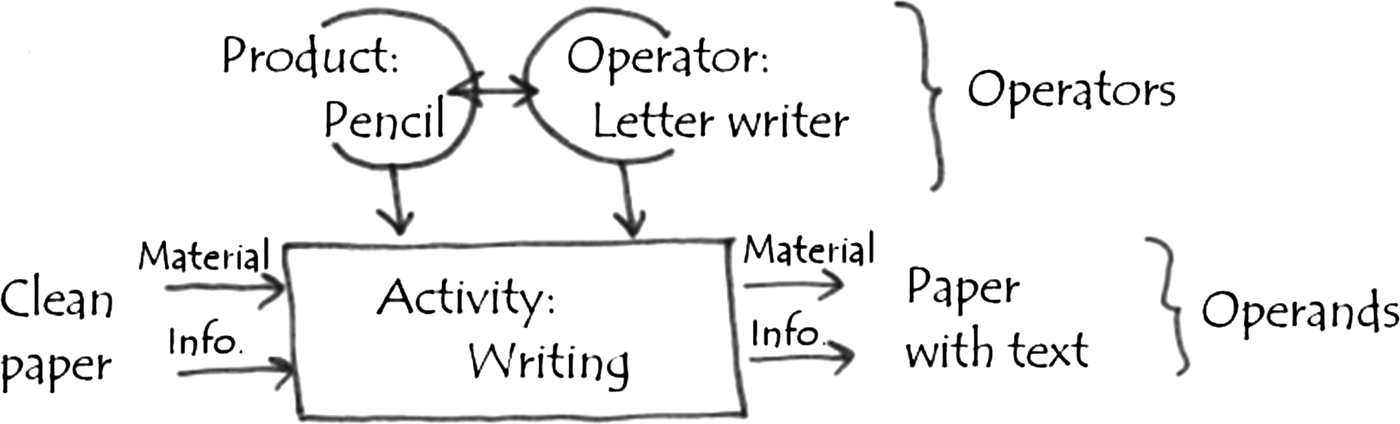
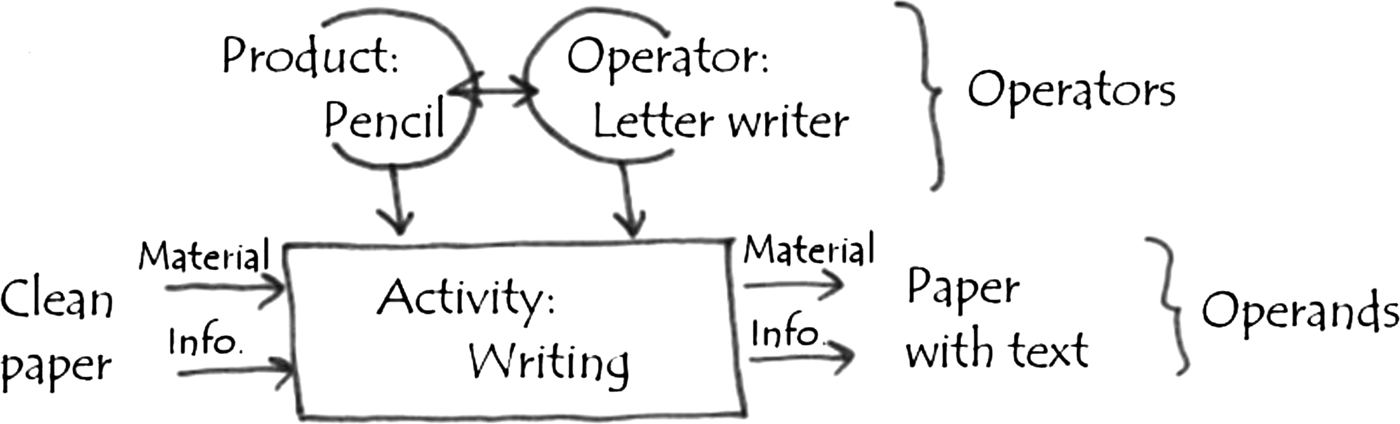
The origin of the link model and its approach to functional reasoning go back to Hubka's dual theories of technical systems and technical processes (Hubka & Eder, Reference Hubka and Eder1988) in which he points out the intimate relationship between products and their use activity. Generally, the use activity will be seen as a technology and the result of the use activity as actually being the satisfier of the human needs related to the product through the transformation of material and information (see Fig. 1).
Hubka's transformation model in simplified form illustrated by the writing activity.
Through his domain theory, Andreasen (Reference Andreasen1980) has made an articulation of Hubka's theories in which the product is seen as three different kinds of systems: a system of activities, a system of organs (function units), and a system of parts. A substantial contribution is the distinction between structural characteristics and behavioral properties, one kind of property being function.
A particular understanding of the term function is developed through five defining statements (DS), DS.1 to DS.5, which lay down the meaning of function in the link model. As can be seen from the model, the authors find that it is required that function be separated into two categories, distinguishing what the product is to be used for (use functions) and how a product works or operates (wirk function). The question could then be asked “What is the commonality between use and wirk functions that gives them the common term function?” In response, we suggest that there is a legitimate viewpoint treating the design of the “use activity” and the “product” as one. In this case, the link between the designed product activity and the user's purpose for the product is made through the functions. Throughout this paper, we refer to the general term of function in this way but are careful to distinguish between use functions and wirk functions wherever appropriate and applicable.
Functions are carried by the structure of products and activities when the product is activated and being used; in Figure 1, the wirk function is the pencil's ability to set a mark, and its use function is the use activity's result: creating written text or forming a line. Functions differ from properties by being active and delivering an effect, influencing “something” in the desired way; this “something” being materials and information in the above example, but it can also be energy or biological objects, which are transformed in an activity.
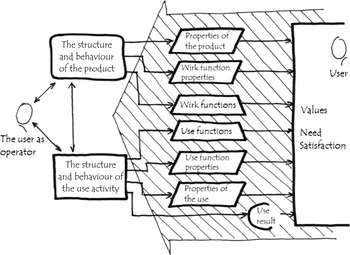
A substantial part, but not all, of functional reasoning may be related to the so-called link model shown in Figure 2, helping to define a function in the following defining statement:
DS.1: A user's perception of need satisfaction and value is based upon the recognition of functions from both the product and its use activity.
The model contains the following choices and reasoning, explained by the writing example in Figure 1:
• The need satisfaction is created by the result of the use activity, producing the written message on paper.
• The value perception is composed by being the owner of the pencil and able to write; the properties and function of the product, the pencil; and the properties and functions of the writing activity.
• The functions related to the product are called wirk functions because they relate to how the product works or more precisely the product's mode of action (originating from the German term Wirkungsweise), in the above case the deposition of graphite onto the paper by means of pressure and friction.
• The functions related to the use activity are called use functions and represent what the operator intends to do with the product, in the above case to write text or draw images onto the paper.
In summary, the link model represents how functions and properties link the product and its associated activities to the value perceived by the user. What the model does not show is the way a composed product realizes the wirk functions through the structuring of the product into patterns of organs (Andreasen & Howard, Reference Andreasen, Howard and Birkhofer2011); this may be articulated by the proposals in the literature for function structure or organ structure and by articulated models of an organ's mode of action, for instance, from the contact and channel model (Albers et al., Reference Albers, Matthiesen and Ohmer2003). The authors believe that the link model should be adopted by the design community as advancement beyond the current functional decomposition or property-driven design models for product development, without overcomplicating the description.
The link model for the product's need satisfaction and creation of user value.

Although this split view of functions seems to have greater support from European design literature than it does from the US literature, in the EU patents are granted only to the technical aspects or the wirk functions that a product exhibits. Conversely, in the United States it is also possible to patent a business concept related to use functions.
3. THE LINK MODEL'S RAISON D'ÊTRE
The domain theory and Hubka's transformation model differs from most design literature by separating the product and its use activity. Most products are not transforming material, energy, information, or biological systems, but they do contribute to activities where these transformations take place. The eye- opening features of Hubka's transformation model is the position of technology, namely, the way the use activity is realized (the writing technology) and the link to need satisfaction (the written message).
The link model makes another major step compared to the state of the art, by unfolding the specter of functions from both the product and the activity (it is the writing activity that put marks on the paper, not the pencil itself), and the specter of properties from both the product and the use activity, making the link to value perception of the user.
A fundamental condition for application of the domain theory of vital importance for the development of the link model is the distinction between characteristics (structural) and properties (behavioral), a view shared by Weber et al. (Reference Weber, Steinbach, Botta and Deubel2004). This approach has not only led to the education of a branch of extremely successful design engineers from the Design & Innovation Innovation Program at the Technical University of Denmark but also provided a theoretic platform on which to build more specific research. For example, its application has yielded great results and impact in both research and industrial support concerning modularization, product families, technology families, and platform approaches (Harlou, Reference Harlou2006; Hvam et al., Reference Hvam and Mortensen2007; Mortensen et al., Reference Mortensen, Hvam, Harlou and Haug2011). The same approach has also yielded success in the research and application of influential research into product/service systems (McAloone, Reference McAloone2007; Matzen, Reference Matzen2009; Tan et al., Reference Tan, Matzen, McAloone and Evans2010).
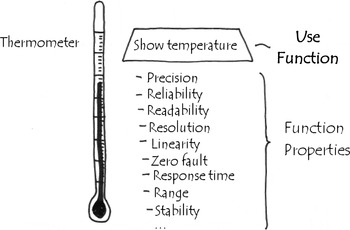
The design activity is normally initiated and goal orientated by a goal formulation articulated by requirements (must be fulfilled) and criteria (indicating what is “better”). The literature is unclear about what concerns functions' role in a goal formulation. Should functions be built into the goal formulation, or is the determination to be left over to the designer? What is actually meant by the often used phrase “functional requirement”? We will not aim for total clarity but only point out that any function is the carrier of a set of functional properties of distinct types related to the quality of the function (see Fig. 3).
The use function and function properties of a thermometer.

In addition to possessing “functions” and “function properties,” a product will also contain general “properties” that are closely related to requirements. A product is normally carrying a broad spectrum of properties; some of these may be relevant to the user's perception of quality, utility, and experience, together with value, and are often articulated as requirements. For example, we may see requirements for a new thermometer design such as a temperature range of –10 to +110°C, a response time of <6 s, a linearity of ±0.1%, and readability of ±0.05°C.
4. IDEA WITH AND IDEA IN
It is important for the designers to respect that the use functions and mode of action they design into their products (idea in) may be different from what the user or operators actually want or do with the product (idea with). The above link model (Fig. 2) makes the important proposition that essentially states that a product cannot be understood separated from its use and that the use functions articulate the use process part of the total functionality.
Thus, we must view both the bike and bicycling as inventions in that both the product and its use carry functions that each allow for original solutions. The first functional reasoning mind-set (MS) is the following:
MS.1: The use activity related to a new, designed product is also a design entity carrying use functions and should be explicitly articulated in terms of what the product and what the user will contribute to the activity.
The aim of functional reasoning is for the designer to maximize the correspondence between his/her imagination about a product's functionalities and how the product is used in an individual deployment situation by the user. This leads to a second functional reasoning mind-set:
MS.2: The product should be designed to ensure that it is operated as intended when being used for its intended purpose, but additional uses of the product should only be limited when the uses are seen to have harmful effects.
As an example of the above mind-set, consider the design of a screwdriver where the length and the thickness of the shaft will deter its use in certain circumstances. For electronic components or plastic-molded housing, screwdrivers with wider stems than heads may be unable to reach into narrow holes in the housing to engage with the screws, whereas thinner stems come at the sacrifice of strength and durability. The designer of the screwdriver must, therefore, envisage the use situation. It may also be the case that screwdrivers are used for other completely different applications such as opening paint cans, which may be considered as an additional benefit with no harmful effect. However, prizing or chiseling harder material may cause the narrow head of the screwdriver to snap, become blunt, or become round. It would, therefore, be desirable to limit these harmful use instances through its design.
5. FUNCTIONS AND FUNCTION PROPERTIES
As can be seen from the link model, a distinction is made between a product's wirk functions and its properties. In many instances, students and practitioners fail to make this distinction, which may lead to poor and unsharpened reasoning, manifesting as unclear requirement specifications, selection criteria, communication, and decision making. For example, the authors see countless specifications and project briefs containing design requirements, such as must be “safe,” “hygienic,” and “patentable” (all properties), then hidden in the same list may be some functions, such as must “direct fluid” or must be “resealable.” More specifically, if you take any two quality function deployment matrixes from different design projects, you will see that they have been applied differently, and in some cases the functions and properties will be grouped together against a separate axis of characteristics. This was summed up in the interview-based study by Eckert (Reference Eckert2013), where it is suggested that “[r]ather than making a distinction between behavior, function, or performance, the engineers at the engine company lumped them all into the term functional requirement.” In order to make this distinction, we propose defining statements 2 and 3:
DS.2: Functions are binary, in that a product or activity either has a particular function or it does not.
In complement to DS.2, we propose that properties may be articulated as a metric (either quantitative or qualitative) by which a product can be evaluated for its performance. Furthermore, each product can be compared, but the performance of a function is in terms of its function properties, leading to DS.3:
DS.3: The quality or goodness of a wirk function is determined by its set of function properties.
To exemplify the differences between functions and function properties, we can consider those of a thermometer (Fig. 3). The important function properties are to be defined by the customers, users, and/or design team, and the tolerances of each decided. The function of “show temperature” is quite different from the functions properties such as “precision” and “linearity,” which can be quantified to describe how well the product is able to deliver the associated function. However, these function properties are quite meaningless without an associated function, prompting the third mind-set:
MS.3: Design may begin with a required function or combination of functions and properties, but desired properties alone will not be sufficient to initiate design.
Much of both design practice and education seems to allow properties and functions to be grouped together in the same category for design descriptions and documentation. Design project proposals are made through design specifications, functional requirement specifications, requirement specifications, design briefs, and performance specifications, all of which tend to lump functions and properties together as a list of requirements. The authors believe this to be fundamentally bad practice. Functional reasoning cannot be used for properties because they require a different pattern of reasoning. Thus, the authors advocate that function and properties should not be confused and listed and treated separately, but both must be reasoned about.
MS.4: The function properties should be attributed to their functions and not listed at the same level as the functions.
By applying the above mind-set, designers will be able to better reason about the products functions and their value. Functions should be listed in terms of their desirability and their properties in terms of target values.
Goal specifications of the desired properties of a product require a different line of reasoning and therefore should be listed separately. Although they may be linked to the various functions and their function properties, a product's actual properties are determined across the means by which various functions are achieved. For example, it is very difficult to pinpoint which function or function property of a car determines “car safety” (a property).
MS.5: Consider product and use properties separately as a second line of reasoning and try to identify, remove/reduce, then optimize the trade-off between the properties and function properties.
How to apply the above mind-set is a question of embodiment design, concerning the distribution of the functions and properties throughout the organ/part structure and the mode of operation/activity–structure.
6. USE FUNCTIONS AND WIRK FUNCTIONS
The link model in Figure 2 describes the link between the value perceived by the user and the structure of the product, and the use activity through a combination of functions and properties. However, the entire picture is somewhat more complex than just function and properties, because some relate to the internal structure of the product (wirk) and some relate to the use activity (use).
Many authors (Pahl & Beitz, Reference Pahl, Beitz and Wallace1984; Stone & Wood, Reference Stone and Wood2000; Hirtz et al., Reference Hirtz, Stone, McAdams, Szykman and Wood2002; Caldwell et al., Reference Caldwell, Chiradeep, Mocko and Summers2011; Chiradeep et al., Reference Chiradeep, Summers, Mocko, Culley, Hicks, McAloone and Howard2011) place the focus of the function concept on the internal workings of the product, where the goal of the research is often to lead to some form or automated synthesis (Howard et al., Reference Howard, Culley and Dekoninck2011). The models presented in Figures 2 and 4 exhibit more design degrees of freedom and point to very important explanations of technology, use function, and use result. Other simplifications compared to our model are pointed out by Dorst and Vermaas (Reference Dorst and Vermaas2005) and Vermaas (Reference Vermaas2013), for instance, when a product's function and its goal are seen to coincide, as proposed by Gero (Reference Gero1990) in his function–behavior–structure model.
Dym and Little (Reference Dym and Little2000, p. 15) make the following interpretation of function of Gero's model:
[D]esign is intended to produce a description of an artefact in terms of its organisation and functioning—its interface between inner and outer environments. Designers are thus expected to describe the shape and configuration of a device (its “organisation”), how that device does what it is intended to do (its “function”), and how the device (its “inner environment”) works (“interfaces”) within its operating (“outer”) environment.
This quotation shows the ambiguousness of the function concept and the product's relation to the environment. We interpret Dym's “function” by help of two function concepts, namely, use functions and wirk functions:
DS.4: Use function is the perception of function that reflects what we want to do with the product for obtaining the wanted use result. Use function is based upon the behavior of the use activity, primarily the technology that is chosen.
DS.5: Wirk function is the function perception that reflects what we want the product to do; it means the effects it will deliver for solving its tasks in the use activity. Wirk function is based upon the product and its organ's behavior, primarily their principles and mode of action.
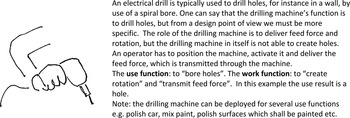
It is not uncommon to make this distinction between concepts of function without having the standard terminology, as demonstrated in a paper by Matthiesen (Reference Matthiesen, Culley, Hicks, McAloone and Howard2011), who points out in his analysis of a handheld nail gun that there is one function for the user: “nailing of metal sheets to metal structures without prior drilling” and then points out that the product has over 500 internal functions to achieve the nailing function. Matthiesen sums this up by stating that “a multitude of functions in the Technical System must be fulfilled in order to fulfill the one function which the customer is ultimately buying.” In this case, it is quite simple to state the single intended main use function as to nail metal structures together. It is, however, a mistake to assume that all products have one single, definable use function. To illustrate the differences between these concepts, we take the example of a handheld drill. Here there is a difference between what the drilling machine itself is able to do and the many possibilities for its application, which is limited in Matthiesen's description of his nail gun (see Fig. 5).
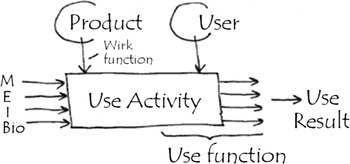
The relationship between use and wirk functions.

The demarcation between what the product is able to do and for what the product is used is essential in Hubka's transformation model that is adapted for Figure 4. This shows how use and wirk functions affect the use result through the use activity and the transformation of material, information, energy, and/or biological objects. Note that the use functions are only activated once the user is involved by applying the wirk functions through a use activity. Thus, the wirk function is within the product, but the use function is created through the user's interaction with the product.
The wirk and use functions of a handheld drill in action.

It is often the case that the use result is known first and the use functions and wirk functions are to follow through development and iteration.
MS.6: When the use of the product is determined, the product goal formulation may be expanded by the wanted wirk functions.
Once the high-level use functions are laid out followed by the high-level wirk functions, the means to achieve these functions can be synthesized in the form of organs and parts, where each organ often contains its own subfunctions, as described in previous literature (Andreasen, Reference Andreasen1980; Andreasen & Howard, Reference Andreasen, Howard and Birkhofer2011). When laying out the high-level functions, it is important to not overconstrain the means for achieving the function through poor formulation, leading to the following mind-set:
MS.7: A basic idea of functional reasoning is to identify necessary effects and wirk functions articulated in a solution neutral form and from here seek solutions or so-called means to each function.
Working out a visual overview of the product's functions is recommended (though uncommon in practice; Alink, Reference Alink2010), such as a function analyses diagram (Aurisicchio et al., Reference Aurisicchio, Eng, Ortíz, ás, Childs, Bracewell, Culley, Hicks, McAloone and Howard2011), though we see it to be important to make the distinction in the representation between the wirk and use functions.
7. REASONING ABOUT FUNCTIONS
In this section, we discuss mind-sets from how to decide which functions should exist within a product to how they should be built in. The following mind-set alone is one of the most contentious mind-sets of all fundamental engineering design prescriptions. Suh (Reference Suh1990) claims that in axiomatic design, functions should be uncoupled from design parameters. Though it is hard to pin down what single design parameter relates to a single function in a real design scenario, the axiom does make theoretical sense in order to make design optimization easier because parameters can be dealt with in sequence. This can be particularly useful for robust design methodology, where we seek to minimize a design's sensitivity to variance in production (Ebro et al., Reference Ebro, Howard and Rasmussen2012). However, the strategy of integrating functions into single components with dependent design parameters can be seen as a form of design elegance with beneficial trade-off.
MS.8: Seek opportunistically to integrate means for functions, if possible and advantageous.
An example that we encounter each mealtime is the nut at the top of a pepper grinder. The torque on this nut (the design parameter) affects two wirk functions: how tight the lid/handle is tightened onto the body and how coarse the pepper grains will be. Axiomatically correct solutions have a separate dial underneath the grinder that controls the coarseness of the grain.
The above example states how use functions can be achieved in a more efficient or elegant manner by integrating wirk functions into the same embodiment. In many cases of incremental design, new use functions are added through the addition or substitution of modules with new wirk functions onto an unchanged underlying platform or architecture (e.g., creating a new app in a smart phone). This can be an extremely effective strategy for providing new products and use functions with minimal design and production change. However, this process must be taken with care and diligence.
MS.9: Product variants must be produced with a strict limitation to the change caused to the product by new modules/subsystems.
The above mind-set is conditionally valid in that is depends on the value assigned to the new use function being included into the design, making it a trade-off problem for the designer. A value should be attributed to the new use function of the new variant in order to justify the design change required. Although many classic products have a main use function with supporting and auxiliary wirk functions, several important modern products are ambiguous in terms of their main function, instead providing value through the ability to house many auxiliary functions. Deciding on a product's dedication versus versatility is an important step in reasoning about use functions. It is, therefore, of great importance to balance product dedication and versatility by deciding whether supporting wirk functions are more valuable than auxiliary functions.
8. DISCUSSION
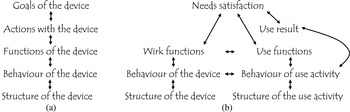
In the position paper by Vermaas (Reference Vermaas2013), functional descriptions are situated in a general reasoning scheme from a device's goal to its structure (represented in Fig. 6a). The link model provides a more detailed scheme by its distinction between wirk and use functions, which can be compared with the reasoning as envisaged by the link model (as shown in Fig. 6b).
(a) Reasoning from a device's goal to its structure (Vermaas, Reference Vermaas2013), and (b) the reasoning as articulated in the link model.

The difference in the reasoning represented by Figure 6b compared to Figure 6a is that the activities made with the device are also seen as carriers of functions. Neither Figure 6a nor Figure 6b shows the internal, functional interactions between organs. The virtue of both the reasoning models in Figure 6 is that they point to reasoning steps; we have to realize the different nature of these steps and that their reasoning patterns differ. The reasoning about goals and actions are necessarily a very open search, based upon imaginations about the unknown product's use in time and space (we may not even know its name), utilizing creativity, associations, experience, and so forth. Functional reasoning here may become a play with language, without any game rules or formalization.
Unlike Vermaas's model, the link model separates use functions from wirk functions, requiring clever reasoning to decide what activities the product will do and what activities the user will do. This is not a pattern or reasoning that could have been identified in the other position paper of this Special Issue, by Eckert (Reference Eckert2013), which creates an empirically based distinction of notations and expressions of function from a product (a pump) that has no user interaction. This example poses problems for Goel's (Reference Goel2013) sixth principle, requiring that functional models be empirically grounded. However, one observed concept of function from Eckert's study is “property of the function” in the “extensional” class. Although this does not appear in the model of Vermaas, the notion of properties are present in the link model and throughout the reasoning outlined in this article.
When considering the above stated mind-sets and the link model against Goel's 15 principles, there is a great deal of alignment with the “how to” principles; however, the notion of the product users is neglected from the 15 principles. In this article a distinction is made between the product's behavior and the behavior of the use activity, but in Principle 11 Goel separates the internal behaviors of the product from those that are in the external environment.
9. CONCLUSION
The ambiguity of the concept of function is difficult to resolve. It is important to bear in mind that functions do not actually exist and are mental constructs always requiring interpretation. In this paper, we have chosen a particular viewpoint on functions and have focused less on the precision of their definition, instead concentrating on how to reason about functions when designing products. Our viewpoint is the link model as proposed in this paper, which has proven success as part of the Technical University of Denmark's Design & Innovation Program over its 45 years of development and teaching.
The authors believe that the link model should be adopted by the design community as advancement beyond the current functional decomposition or property-driven design models for product development.
This paper proposes an important distinction between functions and properties and their great and equal importance for design reasoning. The link model shows how both functions and properties of a product provide the link between the perceived value of the product and its structure and use activity. The model advocates viewing the concept of a function in terms of what can be done with the product in operation (use function) and how the product operates independent of a use case (wirk function), which lays the foundation for powerful reasoning about functions in product design. To be used with the proposed theoretical perspective, the nine mind-sets proposed in this paper are not meant as an exact or definitive list but as some important and overlooked pointers to good design practice.
Thomas J. Howard is an Associate Professor in engineering design at the Technical University of Denmark. He holds MEng and PhD degrees from the University of Bath, where he focused on mechanical engineering and engineering design. Dr. Howard's research interests vary in the areas of design methodology, product development, and innovation, but his main research interest is on the topic of robust design.
Mogens Myrup Andreasen is a Professor Emeritus of product development at the Technical University of Denmark. He holds an MS in mechanical engineering and a PhD in product design, where he formulated his domain theory. Dr. Andreasen's research interests are design methodology, design for X methodology, integrated product development, conceptualization, and applications of the theory of technical systems.