Introduction
Cystic echinococcosis (CE) is caused by a group of cryptic species within Echinococcus granulosus sensu lato (s.l.) including E. granulosus sensu stricto (s.s.) (G1–G3 genotypes), E. equinus (G4 genotype), E. ortleppi (G5 genotype) and E. canadensis (G6–G10 genotypes) (Nakao et al., Reference Nakao, Li, Han, Ma, Xiao, Qiu, Wang, Yanagida, Mamuti, Wen, Moro, Giraudoux, Craig and Ito2007; Thompson, Reference Thompson2008). Human CE due to infection with the metacestode stage of E. granulosus (s.l.) is an important zoonotic infection of major health and socio-economic impact worldwide (Budke et al., Reference Budke, Deplazes and Torgerson2006; Craig et al., Reference Craig, McManus, Lightowlers, Chabalgoity, Garcia, Gavidia, Gilman, Gonzalez, Lorca, Naquira, Nieto and Schantz2007). Conversely, canine echinococcosis is caused primarily by the adult stage of E. granulosus (s.l.) and the disease is usually asymptomatic in canid definitive hosts, even in those animals harbouring large worm burdens. Although canids and ungulates, respectively, serve as definitive and intermediate hosts of E. granulosus (s.l.), dogs and sheep are by far the most important hosts worldwide. Furthermore, infected dogs constitute the major source of CE infection to humans and are known to shed in excess of 8000 eggs per day (Gemmell, Reference Gemmell1990). Detection of infection in dogs has traditionally relied on necropsy or arecoline purgation for assessing Echinococcus worm burdens (Eckert et al., Reference Eckert, Gemmell, Meslin and Pawlowski2001), but it also relies increasingly on the use of coproELISA for the detection of Echinococcus copro-antigens in order to determine prevalence and re-infection rates in dogs (Craig et al., Reference Craig, Gasser, Parada, Cabera, Parietti, Borgues, Acuttis, Aguilla, Snowden and Paolillo1995; Allan & Craig Reference Allan and Craig2006; Moss et al., Reference Moss, Chen, Li, Wang, Giraudoux, Ito, Torgerson and Craig2013).
Molecular genotypic information on Echinococcus isolates from definitive hosts is important for epidemiological and transmission studies, as well as for the planning and surveillance of control programmes (Craig et al., Reference Craig, Rogan and Campos-Ponce2003). Published reports on the molecular characterization of E. granulosus (s.s.) in definitive hosts include those from Asia (Štefanić et al., Reference Štefanić, Shaikenov, Deplazes, Dinkel, Torgerson and Mathis2004; Bart et al., Reference Bart, Abdukader, Zhang, Lin, Wang, Nakao, Ito, Craig, Piarroux, Vuitton and Wen2006a; Zhang et al., Reference Zhang, Bart, Giraudoux, Craig, Vuitton and Wen2006; Ma et al., Reference Ma, Maillard, Zhao, Huang, Wang, Geng, Bart and Piarroux2008; Utuk et al., Reference Utuk, Simsek, Koroglu and McManus2008; Ziadinov et al., Reference Ziadinov, Mathis, Trachsel, Rysmukhambetova, Abdyjaparov, Kuttubaev, Deplazes and Torgerson2008), the Middle East (Al-Qaoud et al., Reference Al-Qaoud, Abdel-Hafez and Craig2003; Parsa et al., Reference Parsa, Fasihi Harandi, Rostami and Sharbatkhori2012), North Africa (Lahmar et al., Reference Lahmar, Boufana, Lahmar, Inoubli, Guadraoui, Dhibi, Bradshaw and Craig2009; Boufana et al., Reference Boufana, Lahmar, Rebaï, Ben Safta, Jebabli, Ammar, Kachti, Aouadi and Craig2014), Europe (Trachsel et al., Reference Trachsel, Deplazes and Mathis2007; Sherifi et al., Reference Sherifi, Rexhepi, Hamidi, Behluli, Zessin, Mathis and Deplazes2011; Xhaxhiu et al., Reference Xhaxhiu, Kusi, Rapti, Kondi, Postoli, Rinaldi, Dimitrova, Visser, Knaus and Rehbein2011) and the Americas (Soriano et al., Reference Soriano, Pierangelli, Pianciola, Mazzeo, Lazzarini, Saiz, Kossman, Bergagna, Chartier and Basualdo2010; de la Rue et al., Reference de la Rue, Takano, Brochado, Costa, Soares, Yamano, Yagi, Katoh and Takahashi2011). In contrast, molecular data on E. granulosus (s.s.) from definitive hosts in Sub-Saharan Africa are limited (Wachira et al., Reference Wachira, Macpherson and Gathuma1990, Reference Wachira, Sattran, Zeyhle and Njenga1993a) compared to data from wild carnivores and domestic and wild herbivores (Wachira et al., Reference Wachira, Bowles, Zeyhle and McManus1993b; Hüttner et al., Reference Hüttner, Siefert, Mackenstedt and Romig2009; Kagendo et al., Reference Kagendo, Magambo, Agola, Njenga, Zeyhle, Mulinge, Gitonga, Mbae, Muchiri, Wassermann, Kern and Romig2014).
The study of the population structure of E. granulosus is important as genetic variation is thought to be related to host infectivity (Thompson & McManus, Reference Thompson and McManus2002). Using DNA extracted from protoscoleces and/or the germinal layer of Echinococcus hydatid cysts retrieved from livestock and human hosts, researchers investigated the genetic diversity of E. granulosus (s.s.) from various regions (Nakao et al., Reference Nakao, Li, Han, Ma, Xiao, Qiu, Wang, Yanagida, Mamuti, Wen, Moro, Giraudoux, Craig and Ito2010; Casulli et al., Reference Casulli, Interisano, Sreter, Chitimia, Kirkova, La Rosa and Pozio2012; Yanagida et al., Reference Yanagida, Mohammadzadeh, Kamhawi, Nakao, Sadjjadi, Hijjawi, Abdel-Hafez, Sako, Okamoto and Ito2012; Konyaev et al., Reference Konyaev, Yanagida, Nakao, Ingovatova, Shoykhet, Bondarev, Odnokurtsev, Loskutova, Lukmanova, Dokuchaev, Spiridonov, Alshinecky, Sivkova, Andreyanov, Abramov, Krivopalov, Karpenko, Lopatina, Dupal, Sako and Ito2013; Boufana et al., Reference Boufana, Lahmar, Rebaï, Ben Safta, Jebabli, Ammar, Kachti, Aouadi and Craig2014, Reference Boufana, Lett, Lahmar, Buishi, Bodell, Varcasia, Casulli, Beeching, Campbell, Terlizzo, McManus and Craig2015). These studies highlighted the distribution of E. granulosus haplotypes and demonstrated the existence of a single lineage for E. granulosus (s.s.) across many geographically isolated regions. In contrast, genetic variation and population structure using E. granulosus DNA derived from adult worms and/or canid faecal samples has, to date, not been investigated very widely (Boufana et al., Reference Boufana, Lahmar, Rebaï, Ben Safta, Jebabli, Ammar, Kachti, Aouadi and Craig2014, Reference Boufana, Lett, Lahmar, Buishi, Bodell, Varcasia, Casulli, Beeching, Campbell, Terlizzo, McManus and Craig2015). Such studies are important in assessing the risk of infection to humans, as the majority of human CE cases are known to be caused by E. granulosus (s.s.) (G1 genotype). In a recent study, 88% of 1661 human CE isolates worldwide, were considered to be caused by E. granulosus (G1 genotype) (Alvarez Rojas et al., Reference Alvarez Rojas, Romig and Lightowlers2014). In the current study we examined the genetic diversity of adult stages of E. granulosus (s.s.) from canid definitive hosts originating from various geographical regions, and compared data generated with that reported for E. granulosus (s.s.) larval stage metacestodes from sheep and human hosts.
Materials and methods
Sample collection
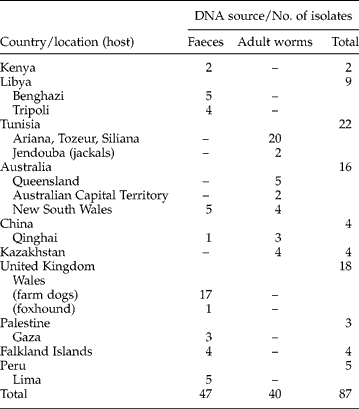
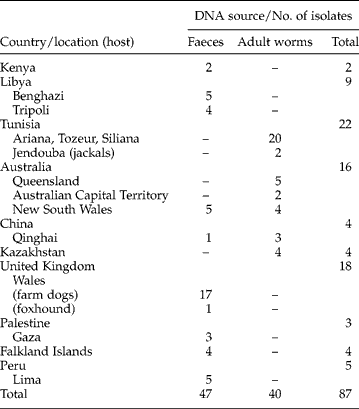
The origins of the 87 E. granulosus isolates used in this study are shown in table 1. Adult tapeworms (n= 40) were retrieved at necropsy from stray and semi-stray domestic dogs and jackals (Canis aureus) from Tunisia (n= 22), dingos (C. familiaris var. dingo) from Australia (n= 11) and owned dogs from China (n= 3) and Kazakhstan (n= 4). In addition, a total of 47 coproDNA isolates were used in this study. This faecal panel included domestic dogs from Kenya (n= 2), Libya (n= 9), China (n= 1), Gaza (Palestine) (n= 3), the Falkland Islands (n= 4), Lima (Peru) (n= 5) (Reyes et al., Reference Reyes, Taramona, Saire-Mendoza, Gavidia, Barron, Boufana, Craig, Tello, Garcia and Santivañez2012), as well as faeces from Australian dingos (n= 5). Faecal samples from Welsh farm dogs (n= 5) from a hydatid study carried out in Powys county, Wales (United Kingdom) between May 2008 and July 2010, and from farm sheep dogs (n= 12) from the Welsh counties of Powys and Gwent collected between July and November 2002 (Buishi et al., Reference Buishi, Walters, Guildea, Craig and Palmer2005) were also included. A foxhound (dog) faecal sample (n= 1) used in this study was collected from an anonymous Welsh hunt in 2011 (Lett, Reference Lett2013). In addition, DNA extracted from sheep hydatid isolates from Benghazi (Libya) (n= 13) and the Falkland Islands (n= 4) were available for this study.
Number and source of Echinococcus granulosus (s.s.) isolates from canid hosts.
Molecular methods
CoproDNA was extracted from faecal samples using the QIAamp DNA stool mini kit (Qiagen, Hilden, Germany) according to the manufacturer's instructions. Genomic DNA was extracted from ethanol-fixed tissue (adult tapeworms, protoscoleces or membranes of an individual hydatid cyst) using the Qiagen DNeasy Blood and Tissue Kit (Qiagen). DNA was used as template to amplify a fragment within the cytochrome c oxidase subunit 1 (cox1, 828 bp) mitochondrial gene, as described previously (Nakao et al., Reference Nakao, Sako, Yokoyama, Fukunaga and Ito2000). Amplified products were sequenced commercially in both forward and reverse directions (Source Bioscience, Nottingham, UK) and chromatograms were examined using FinchTV viewer (Geospiza, Seattle, Washington, USA).
Data analysis
Data analysis was carried out as described previously (Boufana et al., Reference Boufana, Lahmar, Rebaï, Ben Safta, Jebabli, Ammar, Kachti, Aouadi and Craig2014). In brief, sequence alignments were carried out using MEGA version 6 (Tamura et al., Reference Tamura, Stecher, Peterson, Filipski and Kumar2013) and ClustalX2 (Larkin et al., Reference Larkin, Blackshields, Brown, Chenna, McGettigan, McWilliam, Valentin, Wallace, Wilm, Lopez, Thompson, Gibson and Higgins2007) and exported into DnaSP 5 (Librado & Rozas, Reference Librado and Rozas2009). Hapview (Salzburger et al., Reference Salzburger, Ewing and Haeseler2011) was used to generate haplotype networks. DNAML program (PHYLIP) (Felsenstein, Reference Felsenstein1989), which was run from Hapview, was used to construct maximum likelihood trees. Arelquin 3.1 (Excoffier et al., Reference Excoffier, Laval and Schneider2005) was used to calculate the number of haplotypes (hn), haplotype diversities (hd) and nucleotide diversities (πd) as well as to estimate Tajima's D (Tajima, Reference Tajima1989) and Fu's Fs (Fu, Reference Fu1997) in order to examine past population demography and test for neutrality departures. The pairwise fixation index (Fst) was generated in Arlequin to test for genetic differentiation. P values for the multiple pairwise comparisons were adjusted using Bonferroni correction.
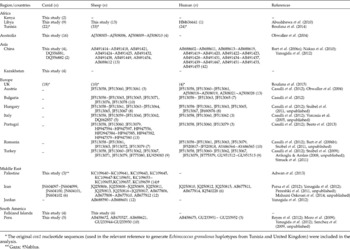
To compare E. granulosus haplotypes from canid hosts with those found in sheep and humans, cox1 mitochondrial nucleotide sequences publically available on the National Center for Biotechnology Information (NCBI) database (www. ncbi.nlm.nih.gov) were downloaded for inclusion (table 2). Nucleotide sequences were grouped by host (canid, sheep and human) and geographical origin according to six broad regions, Africa, Australia, Asia, Europe, the Middle East and South America. All sequences were trimmed to equal length (329 bp), giving a final dataset of 408 E. granulosus cox1 mitochondrial sequences, 95 from canids, 180 from sheep and 133 from humans. Rarefied haplotype richness, standardized to the smallest sample size, was calculated using Contrib 1.02 (Petit et al., Reference Petit, El Mousadik and Pons1998) in order to facilitate direct comparisons between hosts.
Echinococcus granulosus (s.s.) cytochrome c oxidase subunit 1 (cox1) mitochondrial nucleotide sequences used in this study.

n, number of nucleotide sequences.
* The original cox1 nucleotide sequences (used in the relevant reference to generate Echinococcus granulosus haplotypes from Tunisia and United Kingdom) were included in the analysis.
** Gaza; †Nablus.
Results
DNA sequence data
We amplified DNA extracted from adult tapeworms and/or faecal samples of 87 Echinococcus isolates from canids originating from Africa (Kenya, n= 2; Libya, n= 9; Tunisia, n= 22), Australia (n= 16), Asia (China, n= 4; Kazakhstan, n= 4), United Kingdom (n= 18), the Middle East (Gaza, Palestine, n= 3) and South America (Falkland Islands, n= 4; Peru, n= 5). A total of 827 bp within the cox1 gene were analysed for each Echinococcus canid-derived isolate. Using a BLAST search (http:www.blast.ncbi.nlm.nih.gov), E. granulosus (s.s.) was identified from adult tapeworms and faecal samples of all canid hosts included in this study. In addition, sheep hydatid cysts from Libya and the Falkland Islands had a 100% sequence identity to E. granulosus (G1 genotype) (e.g. accession numbers AB688603, AB893250).
Analysis of E. granulosus (s.s.) from canid hosts
Within the 827-bp cox1 nucleotide sequences analysed there were 18 polymorphic sites, 9 were parsimony informative and 9 were singleton variable sites. The overall haplotype and nucleotide diversities for E. granulosus (s.s.) isolates from canid hosts were 0.4405 ± 0.0674 and 0.000958 ± 0.000777, respectively. Similarly, the overall values for Tajima's D ( − 2.26 101) and Fu's Fs ( − 11.8484) were significantly negative (P values ≤ 0.0002 and ≤ 0.0001, respectively), a feature indicative of population expansion.
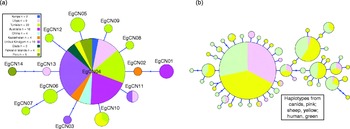
A total of 14 haplotypes (EgCN01–EgCN14) were detected within the 87 canid-derived E. granulosus (s.s.) cox1 mitochondrial sequences (fig. 1a). The frequency of the common haplotype (EgCN04) within the generated star-shaped network was (74.7%; 65/87) and it was 100% identical to the dominant E. granulosus haplotypes described from China (G01: AB491414; 789 bp) (Nakao et al., Reference Nakao, Li, Han, Ma, Xiao, Qiu, Wang, Yanagida, Mamuti, Wen, Moro, Giraudoux, Craig and Ito2010), Iran (Eg01: JQ250806; 1609 bp) (Yanagida et al., Reference Yanagida, Mohammadzadeh, Kamhawi, Nakao, Sadjjadi, Hijjawi, Abdel-Hafez, Sako, Okamoto and Ito2012), Europe (EG1: JF513058; 351 bp) (Casulli et al., Reference Casulli, Interisano, Sreter, Chitimia, Kirkova, La Rosa and Pozio2012) and Tunisia (EgTu01: KM014606; 827 bp) (Boufana et al., Reference Boufana, Lahmar, Rebaï, Ben Safta, Jebabli, Ammar, Kachti, Aouadi and Craig2014). Haplotypes EgCN01–EgCN14 were deposited in the NCBI database under accession numbers KT001395–KT001408.
Haplotype networks generated using cytochrome c oxidase subunit 1 (cox1) mitochondrial nucleotide sequences of Echinococcus granulosus (s.s.) from (a) adult tapeworm isolates derived from canid hosts from various geographic locations; and (b) from adult tapeworms and larval metacestode-stage isolates from sheep and human hosts. Circle size is relative to haplotype frequency. Small circles indicate additional mutational steps.

The diversity and neutrality indices determined for E. granulosus (s.s.) isolates from canid hosts originating from various geographical localities using the cox1 mitochondrial nucleotide sequences are shown in table 3. The haplotype diversity for the cox1 gene was highest in samples of adult E. granulosus from North Africa (including two Kenyan isolates) and lowest in samples from the United Kingdom. The values for Tajima's D were negative for E. granulosus samples from all geographical localities (except Australia), indicating population expansion, but remained significant only for samples from Africa and the United Kingdom. Fu's Fs values were also negative for all populations (except Australia and South America), which indicated further evidence of population expansion, but deviated significantly from neutrality only for samples from Africa. Tajima's D and Fu's Fs were positive for E. granulosus from Australian dingos which suggests that populations may have undergone a genetic bottleneck. Similar positive Fu's Fs values were observed for South American E. granulosus canid populations. No conclusion could be drawn for the diversity and neutrality indices of E. granulosus isolates from Gaza due to the small sample size of the Palestinian isolates (n= 3).
Diversity and neutrality indices for Echinococcus granulosus (s.s.) adult tapeworm isolates from canid hosts originating from various geographical regions using nucleotide data of the cytochrome c oxidase subunit 1 (cox1) mitochondrial gene.

n, number of isolates, hn, number of haplotypes; hd, haplotype diversity; πd, nucleotide diversity; SD, standard deviation.
Significant at *P value ≤ 0.05, **P value ≤ 0.01, ***P value ≤ 0.0001.
Genetic differentiation based on the analysis of the pairwise Fst values for the E. granulosus (s.s.) adult tapeworm isolates from canid hosts originating from different geographical regions are shown in table 4. Generally low, non-significant values were recorded for most pairwise comparisons (following Bonferroni correction), suggesting little genetic differentiation globally.
Pairwise fixation index (Fst) for Echinococcus granulosus (s.s.) adult tapeworm isolates from canid hosts originating from various geographical regions using nucleotide data of the cytochrome c oxidase subunit 1 (cox1) mitochondrial gene.

Non-significant at corrected P value ≤ 0.003.
Comparison of E. granulosus (s.s.) canid-derived haplotypes to those from sheep and human hosts
A total of 408 cox1 nucleotide sequences derived from canid, sheep and human isolates were analysed (tables 2 and 5). The overall haplotype and nucleotide diversities were 0.6631 ± 0.0259 and 0.003618 ± 0.002571, respectively. Within the cox1 nucleotide sequences there were 45 polymorphic sites, 20 of which were parsimony informative.
Diversity and neutrality indices for Echinococcus granulosus (s.s.) isolates from canid, sheep and human hosts using nucleotide data of the cytochrome c oxidase subunit 1 (cox1) mitochondrial gene.

n, number of isolates; hn, number of haplotypes; hd, haplotype diversity; πd, nucleotide diversity; SD, standard deviation. Rs, rarefied allelic richness, standardized to the smallest sample collection (n= 95). Significant at *P value ≤ 0.01, **P value ≤ 0.0001.
Genealogical relationships between E. granulosus (s.s.) isolates by host (canid, sheep, human) originating from Africa, Australia, Asia, Europe, the Middle East and South America are shown in fig. 1b. The generated network was made up of 51 haplotypes, with the most common central haplotype encompassing 56.6% (231/408) of the total number of E. granulosus isolates. The percentage of canid, sheep and human isolates within the dominant haplotype were 32.9%, 41.6% and 25.5%, respectively. A BLAST search showed this dominant haplotype to be 100% identical to that of the common E. granulosus haplotype described by other researchers (Nakao et al., Reference Nakao, Li, Han, Ma, Xiao, Qiu, Wang, Yanagida, Mamuti, Wen, Moro, Giraudoux, Craig and Ito2010; Casulli et al., Reference Casulli, Interisano, Sreter, Chitimia, Kirkova, La Rosa and Pozio2012; Yanagida et al., Reference Yanagida, Mohammadzadeh, Kamhawi, Nakao, Sadjjadi, Hijjawi, Abdel-Hafez, Sako, Okamoto and Ito2012; Boufana et al., Reference Boufana, Lahmar, Rebaï, Ben Safta, Jebabli, Ammar, Kachti, Aouadi and Craig2014). The network was also made up of a smaller number of more highly derived branches of haplotypes, distantly related to the dominant sequence. Within these, the frequency of isolates derived from canids was 7.4% (7/95), which was much lower than those from sheep (30.6%, 55/180) and humans (36.8%, 49/133). These seven canid isolates originated from Australia (n= 3), Asia (China, n= 1; Kazakhstan, n= 1), the Middle East (Iran, n= 1) and South America (Peru, n= 1).
The haplotype and nucleotide diversities for E. granulosus (s.s.) isolates from sheep and human origin were at least double those in canid definitive hosts (table 5). Furthermore, the rarefied allelic richness of E. granulosus derived from canids was also approximately half that shown in sheep or humans, suggesting that these differences in genetic diversity are not purely a reflection of sample size. Tajima's D values were significantly negative for E. granulosus (s.s.) derived from all three hosts, indicating the presence of rare polymorphic sites characteristic of population expansion. The values of Fu's Fs for E. granulosus populations from sheep and humans were twice as high as those from canids, and deviated significantly from neutrality for all host species, also indicating population expansion. The values of the pairwise comparison for genetic differentiation (Fst) of E. granulosus (s.s.) between host species were generally low, but comparisons with canid isolates were highly significant (canid/sheep, 0.02896, P= 0.0008; canid/human, 0.0359, P= 0.0002; sheep/human, − 0.0010, P= 0.5186).
Discussion
In the current study we analysed cox1 mitochondrial sequences from E. granulosus (s.s.) adult tapeworm isolates recovered from dog, dingo, foxhound and jackal (C. aureus) definitive hosts (n= 87) and compared them to published sequence data for the metacestode stage from sheep (n= 180), humans (n= 133) and dogs (n= 8). The occurrence of E. granulosus (s.s.) in canid definitive hosts (dog, red fox, dingo, jackal, wolf) from many locations worldwide has been confirmed via molecular genetic analysis by several researchers (reviewed by Carmena & Cardona, Reference Carmena and Cardona2013; Jenkins et al., Reference Jenkins, Lievaart, Boufana, Lett, Bradshaw and Armua-Fernandezc2014). However, the current study reports the first molecular confirmation of E. granulosus (s.s.) from definitive hosts originating from Gaza and the Falkland Islands. This is also the first attempt to investigate the global genetic variation and population structure of E. granulosus (s.s.) isolates from definitive hosts, although this subject has been explored extensively for the metacestode stage of E. granulosus derived from ungulate and human hosts (Nakao et al., Reference Nakao, Li, Han, Ma, Xiao, Qiu, Wang, Yanagida, Mamuti, Wen, Moro, Giraudoux, Craig and Ito2010; Casulli et al., Reference Casulli, Interisano, Sreter, Chitimia, Kirkova, La Rosa and Pozio2012; Yanagida et al., Reference Yanagida, Mohammadzadeh, Kamhawi, Nakao, Sadjjadi, Hijjawi, Abdel-Hafez, Sako, Okamoto and Ito2012; Sharma et al., Reference Sharma, Fomda, Mazta, Sehgal, Singh and Malla2013; Boufana et al., Reference Boufana, Lahmar, Rebaï, Ben Safta, Jebabli, Ammar, Kachti, Aouadi and Craig2014, Reference Boufana, Lett, Lahmar, Buishi, Bodell, Varcasia, Casulli, Beeching, Campbell, Terlizzo, McManus and Craig2015).
The haplotype network generated using cox1 mitochondrial sequenced data for E. granulosus (s.s.) DNA derived from definitive hosts is consistent with that previously described for the metacestode stage retrieved from sheep and human hosts (Nakao et al., Reference Nakao, Li, Han, Ma, Xiao, Qiu, Wang, Yanagida, Mamuti, Wen, Moro, Giraudoux, Craig and Ito2010; Casulli et al., Reference Casulli, Interisano, Sreter, Chitimia, Kirkova, La Rosa and Pozio2012; Yanagida et al., Reference Yanagida, Mohammadzadeh, Kamhawi, Nakao, Sadjjadi, Hijjawi, Abdel-Hafez, Sako, Okamoto and Ito2012; Boufana et al., Reference Boufana, Lahmar, Rebaï, Ben Safta, Jebabli, Ammar, Kachti, Aouadi and Craig2014, Reference Boufana, Lett, Lahmar, Buishi, Bodell, Varcasia, Casulli, Beeching, Campbell, Terlizzo, McManus and Craig2015) with the dominance of the same E. granulosus centrally positioned haplotype. This finding therefore supports the worldwide common lineage of E. granulosus in canids from all geographical regions studied (i.e. Kenya, Libya, Tunisia, Australia, China, Kazakhstan, UK, Gaza, Peru and the Falkland Islands). It also confirms the absence of phylogeographic structure for E. granulosus (s.s.), as previously reported (Nakao et al., Reference Nakao, Li, Han, Ma, Xiao, Qiu, Wang, Yanagida, Mamuti, Wen, Moro, Giraudoux, Craig and Ito2010). In addition, the very low Fst values observed across this study suggest the absence of genetic differentiation between adult E. granulosus isolates, which is consistent with that reported for isolates of the metacestode stage from ungulates and humans from China (Nakao et al., Reference Nakao, Li, Han, Ma, Xiao, Qiu, Wang, Yanagida, Mamuti, Wen, Moro, Giraudoux, Craig and Ito2010), Europe (Casulli et al., Reference Casulli, Interisano, Sreter, Chitimia, Kirkova, La Rosa and Pozio2012) and the Middle East (Jordan, Iran) (Yanagida et al., Reference Yanagida, Mohammadzadeh, Kamhawi, Nakao, Sadjjadi, Hijjawi, Abdel-Hafez, Sako, Okamoto and Ito2012), but differs from that reported for Peruvian metacestode populations, which were said to be genetically differentiated from E. granulosus populations from China and the Middle East (Yanagida et al., Reference Yanagida, Mohammadzadeh, Kamhawi, Nakao, Sadjjadi, Hijjawi, Abdel-Hafez, Sako, Okamoto and Ito2012).
A combination of higher haplotype and lower nucleotide diversities, similar to those reported for cox1 nucleotide data derived from the metacestode stage of E. granulosus (Nakao et al., Reference Nakao, Li, Han, Ma, Xiao, Qiu, Wang, Yanagida, Mamuti, Wen, Moro, Giraudoux, Craig and Ito2010; Casulli et al., Reference Casulli, Interisano, Sreter, Chitimia, Kirkova, La Rosa and Pozio2012; Yanagida et al., Reference Yanagida, Mohammadzadeh, Kamhawi, Nakao, Sadjjadi, Hijjawi, Abdel-Hafez, Sako, Okamoto and Ito2012; Boufana et al., Reference Boufana, Lahmar, Rebaï, Ben Safta, Jebabli, Ammar, Kachti, Aouadi and Craig2014, Reference Boufana, Lett, Lahmar, Buishi, Bodell, Varcasia, Casulli, Beeching, Campbell, Terlizzo, McManus and Craig2015), was seen in this study. The overall negative values for the neutrality indices (Tajma's D and Fu's Fs) observed in this study for adult E. granulosus (s.s.) were similarly reported for the larval metacestode stage, and signify populations under expansion. Conversely, the positive neutrality indices for the Australian E. granulosus samples indicate intermediate frequency of variant alleles. Additionally, comparatively low haplotypic variation was seen in this study for isolates from Australia and the UK, which may be due to the geographical isolation of these populations and would suggest moderate to limited sharing of haplotypes/alleles. In a recent study, a ‘mainland–island’ hypothesis was suggested to explain the higher genetic diversity in Echinococcus multilocularis populations from central Europe as compared to those from peripheral regions (Davidson et al., Reference Davidson, Romig, Jenkins, Tryland and Robertson2012). However, segregated populations may still share haplotypes as a result of their shared ancestral history, and this was observed in the current study with the occurrence of the main E. granulosus haplotype (EgCN04) in the Australian and UK populations of E. granulosus (s.s.). No similar deductions could be drawn robustly for isolates from Asia and South America, due to their small sample size. We also used publically available sequence data to compare genealogical relationships between E. granulosus by host (95 canid, 180 ungulate, 133 human). The resultant network showed the presence of the common E. granulosus haplotype and the neutrality indices were significantly negative, indicating population expansion and the presence of rare haplotypes.
The interesting finding of this work is the decreased genetic variation exemplified by the low haplotype and nucleotide diversities recorded for the cox1 mitochondrial nucleotide sequences derived from adult worms as compared to those from the metacestode stage from sheep and humans. Echinococcus granulosus is a hermaphrodite organism with predominant self-fertilization occurring in the intestine of the definitive host (Haag et al., 1999; Nakao et al., Reference Nakao, Li, Han, Ma, Xiao, Qiu, Wang, Yanagida, Mamuti, Wen, Moro, Giraudoux, Craig and Ito2010) and massive asexual reproduction in the intermediate mammalian host. Self-fertilization is known to promote homozygosity (Lymbery et al., Reference Lymbery, Constantine and Thompson1997) and as a result genetic variation decreases. In this study we examined genetic variation using a maternally inherited gene (cox1) and thus the observed loss of heterozygosity may not be related to the occurrence of inbreeding, as no recombination is known to occur in mitochondrial genes. According to Lymbery et al. (Reference Lymbery, Constantine and Thompson1997) self-fertilization of Echinococcus occurs through autogamy and geitonogamy, and both these processes are thought to be responsible for the increase in homozygosity within Echinococcus populations (Nakao et al., Reference Nakao, Sako and Ito2003). This is consistent with the low haplotype variation observed in the current study for E. granulosus (s.s.) adult tapeworms derived from canid hosts. Additionally, the discrepancies in haplotypic variation recorded in this study may be due to the relatively short lifespan of the adult worm in canid definitive hosts ( < 1 year) as compared to the lifespan of the metacestode stage, which is usually related to that of the host (sheep/human) and can last for several years (Gemmell, Reference Gemmell1990). This would suggest that the reservoirs of genetic variation within E. granulosus in wild populations are the intermediate rather than the definitive canid hosts. However, to evaluate this further the examination of a larger number of canid hosts over a longer time period is required.
In summary, the current study compared DNA sequence data for the cox1 gene from adult E. granulosus (s.s.) derived from definitive hosts and indicated a much more restricted haplotype profile compared to that published for intermediate (ungulates) and human hosts. It has also been suggested that the biphasic reproduction of E. granulosus may promote reduced genetic variability, even in nuclear genes (Nakao et al., Reference Nakao, Li, Han, Ma, Xiao, Qiu, Wang, Yanagida, Mamuti, Wen, Moro, Giraudoux, Craig and Ito2010). Improved nuclear single-locus genetic markers are needed to investigate further the differences in haplotypic diversities observed in this study.
Acknowledgements
We would like to thank the following individuals for the provision of material used in this study. Anthony Bodell for UK sheep hydatid cysts (School of Environment and Life Sciences, University of Salford, UK); Nick Beeching (Liverpool School of Tropical Medicine, Liverpool, UK), Fiona Campbell (Royal Liverpool and Broadgreen University Hospitals, UK) and Monica Terlizzo (Aintree University Hospital, Liverpool, UK) for the provision of pathology blocks of UK-acquired CE cases; and Waël RebaÏ and Zoubeir Ben Safta (Service de Chirurgie Générale, Département A, Hôpital La Rabta, 1007 Tunis, Tunisia) for hydatid cysts removed from Tunisian CE patients. The use of five farm dog faecal samples from a Welsh hydatid study funded by the Welsh Assembly Government, is gratefully acknowledged.
Financial support
We would like to acknowledge funding, in part, from a Wellcome Trust project (WT #094325/Z/10/Z).
Conflict of interest
None.