1. Polarisation and Pandemic
It has become almost a platitude to say that the 21st century has witnessed increased political and ideological polarisation as well as a surge in populism from both the right and the left. Phrases such as ‘post-truth’, ‘fake news’ and ‘alternative facts’ have become household terms; and after the divisive Brexit campaign in the UK, parents react much more negatively than before if an offspring dares form amorous bonds with an individual from the ‘other’ side of the political spectrum (Guardian, 2016). Conspiracy theories have garnered increased popularity: some of them so bizarre, such as QAnon, that they make far-fetched figments of the medieval imagination seem positively reasonable by comparison.
There are conflicting views on whether recent technological advances, especially in the field of social media, have simply taken the lid off a discourse that hitherto had been confined to the locker room, the staff coffee corner and the dining table, or whether there has actually been a turn for the worse (or at least for the more radical, divisive and inflammatory) in the way people discuss hot topics of the day. In any case, the worldwide pandemic has helped crystallise many of these developments. As well as bringing existing polarisations into sharper relief, it created new ones of its own, such as the one between public health and economic prosperity – dividing people both along and across traditional conflict lines. For example, the Tory ploy of paying 50% of people's restaurant bills during the month of August 2020 would probably have made the laissez-faire Margaret Thatcher turn in her grave: a vivid reminder of the fact that the left–right divide is becoming more multi-dimensional and less focused on the economy than it used to be.
The socio-moral, psycho-moral and economic reverberations of the pandemic led to a proliferation of debates in public media that closely connect – albeit in new and unforeseeable ways – to proverbial debates about values and virtues. As a scholar interested in the role of virtues and character strengths in the good life (Kristjánsson, Reference Kristjánsson2015; Reference Kristjánsson2020), I have found those new debates fascinating, infuriating and intimidating in equal measure. Fascinating because of the way they replicate old debates in new contexts; infuriating in the way they reproduce old fallacies that I thought academic discourse had laid to rest; intimidating because of the immediacy of the practical consequences that acting on some of the more radical normative positions would have for people's daily lives.
Rather than continuing to rant about my own abstract thoughts on social media, as I did quite a lot towards the beginning of the pandemic, I decided to conduct two minor ‘case studies’ of my own, the findings from which inform the remainder of this chapter. Let me first make it clear, however, that I do not claim any strict methodological credibility for those ‘case studies’, and there is good reason why I put them in scare quotes. I did not thematically analyse findings in a systematic manner along qualitative lines, nor did I count statistical beans as a quantitative researcher would. I simply did two things. In Case Study 1, I read carefully through Facebook statuses by my ‘friends’ for a few months insofar as they had to do with reactions to the pandemic and the lockdowns; or more specifically still, insofar as they suggested or recommended any particular states of character and virtue that would help us survive through the ordeal. In Case Study 2, I skimmed through posts written by some of the most outspoken columnists of the Guardian, on the one hand, and the Daily Telegraph, on the other – meant to represent opposing stances on the great political divide – trying to analyse their views in characterological terms. More specifically, I wanted to find out whether only one of the two ‘camps’ represented the stance of virtue, or whether both used virtues as grist for their argumentative mills – simply different virtues or the same virtue instantiated differently. I could obviously have done this in a more scientific way, but I never intended to publish my findings in an academic outlet, so I am happy to designate the ‘results’ reported on below simply as anecdotal evidence, potentially liable to a biased interpretation by myself.
Without wanting to anticipate the findings in too much detail, it will be instructive for readers to know at this juncture that what I found was an unexpectedly strong reliance on character-and-virtue language from all the relevant discursive camps. For someone eager to apply that particular theoretical lens, this must count as a positive finding. Less positive, however, was the general lack of attention paid to one of virtue theory's profoundest problems: how to intellectually and metacognitively navigate and arbitrate conflicts between different virtues. In a nutshell, the meta-virtue of phronesis or practical wisdom (Darnell et al., Reference Darnell, Gulliford, Kristjánsson and Paris2019; Kristjánsson et al., Reference Kristjánsson, Fowers, Darnell and Pollard2021) almost never came up in those discussions, nor was it applied implicitly. What I found, rather, were hordes of people who were ‘excessively good’ (with respect to the ‘golden mean’ of virtue) in a certain domain-specific Aristotelian sense. Before explaining what I mean by this and drawing some relevant conclusions, I need to inform readers briefly about my theoretical commitments and assumptions.
2. Neo-Aristotelian Character in Focus
I work in the Jubilee Centre for Character and Virtues: the world's largest research centre dedicated to the study of character and virtues, from an interdisciplinary perspective of philosophy, psychology and education. Our theoretical basis is neo-Aristotelian (Kristjánsson, Reference Kristjánsson2015), non-politically partisan and non-religious. A lot of our work focuses on character education in schools and in professional ethics education; and philosophically educated readers will understand the advantages of grounding character education in the time-honoured Aristotelian paradigm of virtue ethics, whose resurgence in moral philosophy, post-Anscombe's (Reference Anscombe1958) article, has been phenomenal.
Complementing its philosophical merits are various methodological and practical advantages. A model of character education as the educational incarnation of virtue ethics is grounded in an objective conception of the good life as ‘flourishing’ (Kristjánsson, Reference Kristjánsson2020); it tells a fairly plausible developmental story of how character can be taught, caught and sought (Jubilee Centre, 2017); it incorporates an acute sensitivity to social context and individual variance (Kristjánsson, Reference Kristjánsson2020); and it focuses on gradually developing critical metacognitions as forming an agent's moral (characterological) identity (Darnell et al., Reference Darnell, Gulliford, Kristjánsson and Paris2019). Moreover, such a model lends itself open to constant updates and revisions because of its naturalist assumptions according to which all moral and educational theorising is answerable to empirical research on what makes people tick (Kristjánsson, Reference Kristjánsson2015). The last-mentioned advantage makes neo-Aristotelian character education resonate particularly well with practitioners.
Neo-Aristotelian character education tends to apply a model of character that considers character virtues to fall into four main categories: moral, intellectual, civic and performative (Jubilee Centre, 2017). We can think of those as instrument groups in a large orchestra. However, contrary to various other paradigms of virtue and character education, the neo-Aristotelian model reserves a major role for the ‘conductor’ of the orchestra – in the form of the meta-virtue of phronesis, which makes sure that the orchestra plays in harmony and that no single orchestra group or player, however powerful and competent on its own, overwhelms and overpowers the others. This categorisation is based broadly on Aristotle's own distinction between the moral and intellectual virtues versus technical executive skills, although he did not distinguish as clearly between the moral and the civic virtues. It helps also that this categorisation is in good harmony with millions of contemporary people's self-reported character strengths and virtues which, when factor analysed, tend to fall into three overarching themes: interpersonal or other-directed issues, called Caring; intellectual explorations, called Inquisitiveness; and behavioural control, called Self-Control (McGrath, Reference McGrath2015).
Apart from the growth of interest within philosophy and education, we are also witnessing a retrieval of character and virtue research in psychology (McGrath, Reference McGrath2015; Fowers et al., Reference Fowers, Carroll, Leonhardt and Cokelet2021; Wright, Warren and Snow, Reference Wright, Warren and Snow2021). This retrieval, often referred to as a new ‘science of virtue’ (Fowers et al., Reference Fowers, Carroll, Leonhardt and Cokelet2021), has been spurred on by the advent of so-called positive psychology in general and in particular its research into universal character strengths and virtues (Peterson and Seligman, Reference Peterson and Seligman2004; McGrath, Reference McGrath2015). Defying historic anti-virtue catechisms in psychology (Allport, Reference Allport1937; Kohlberg, Reference Kohlberg1981), positive psychologists have conducted extensive research into the role of good character in the flourishing life (Seligman, Reference Seligman2011) and found surprisingly uniform views, regardless of time and geography, on how living well includes a specific set of (acquired) universal human character qualities. Nevertheless, there are considerable differences in foci and emphasis – and sometimes more substantial differences – between the positive psychological and neo-Aristotelian take on character strengths and virtues, as I explain in the following section.
Recently, the sort of neo-Aristotelian, virtue-ethics-based character education promoted by the Jubilee Centre has come under a heavy attack from a number of UK academics who accuse it of being neoliberal and possibly religiously motivated – and indeed part of a grand, single-network conspiracy to personalise the political (Allen and Bull, Reference Allen and Bull2018; Jerome and Kisby, Reference Jerome and Kisby2019). This may seem fairly odd at first sight because Aristotelian philosophy is often seen as the direct anti-thesis of liberalism (at least the classical type, from Locke to Rawls) and appears to have even less in common with the recent neoliberal outgrowth. However, the polarisation tendency that I described at the outset is simply rearing its ugly head here once again. One of its syndromes is the obsession with the politicisation of all public or academic discourse: seeing any theoretical argument as masking a politically motivated move in a power game. I simply note this line of criticism here without aiming to respond to it directly (cf. Kristjánsson, Reference Kristjánsson2021). Indirectly, however, what transpires from the following section and my first ‘case study’ is that there is no single network of character education operating within the UK at the moment. Rather, there are at least two contrasting approaches to how character virtues are to be valued, prioritised and educated in our quest for the good life.
3. Facebook versus the Queen
The two academic approaches to character virtues that I referred to as competing for allegiance in the UK are on the one hand a positive psychological model, loosely based on Peterson and Seligman (Reference Peterson and Seligman2004) but with a narrower remit, and on the other hand a neo-Aristotelian model (Jubilee Centre, 2017). To summarise and simplify the differences between these models, the first one – which tends to be promoted by organisations such as the CBI (Confederation of British Industry) and at least implicitly adhered to by the civil servants in Whitehall – understands character as encompassing the ‘non-cognitive’ side of personality skills (so-called soft skills), whereas the neo-Aristotelian model understands character in terms of the morally evaluable part of personality. The main substantive focus in the first model is on performance virtues such as grit, resilience and self-confidence and on how those broaden and build personal resources, whereas the second model prioritises moral virtues such as compassion, justice and honesty. Accordingly, the first model considers the main value of the virtues to lie in their instrumental benefits for better behaviour, higher grades and better workplace performance, while the second model highlights the intrinsic value of the virtues for the flourishing life of which they are constitutive (although grades and performance will also supposedly improve as a happy side-effect). Finally, the positive psychological model assumes that the more of each virtue, the better – and that a chain of virtues is as strong as its strongest link – with little or no attention paid to virtue conflicts, trade-offs and adjudications. In contrast, the neo-Aristotelian model assumes that too much of a virtue becomes a vice, just like too little, and that a chain is only as strong as its weakest link – with significant attention being paid to virtue conflicts and how the intellectual meta-virtue of phronesis is needed to critically assess and adjudicate those (Kristjánsson, Reference Kristjánsson2013).
Now, I happen to have more than 2000 Facebook friends, and traumatised and homebound as I was in March-April 2020, at the beginning of the first UK lockdown, I spent an uncharacteristically long time reading through their posts. I guess I was looking for reassurance and advice from them about how to deal with those turbulent times. Eventually, I decided to jot down the character virtues they mentioned: an exercise that I referred to above, somewhat tongue-in-cheek, as my ‘Case Study 1’. To my surprise – given that a disproportionate number of my friends are indeed academic philosophers, many of whom have Aristotelian sympathies – I realised that the virtues mentioned were almost invariably performative ones. The advice proffered was all about keeping one's head above the water; avoiding danger; hanging in there; mobilising one's resources; not feeling too downhearted. Insofar as specific virtue terms were used, they belonged to the familiar ‘resilience’, ‘perseverance’, ‘grit’, ‘calmness’ category, with the Buddhist concept of ‘mindfulness’ often added to the mix.
I felt somewhat disheartened by this, although I am obviously aware of the fact that the language of moral virtue does not come easily to everyone, and there are those who feel that it sounds too touchy-feely and mawkish for modern sentiments. The use of some common virtue terms has indeed declined substantially in ordinary language (Kesebir and Kesebir, Reference Kesebir and Kesebir2012) since the days of Queen Victoria and Jane Austin who would have found it natural and unintimidating. Yet speaking of a queen, the present UK Head of State, HRH Queen Elizabeth, happened to give a televised speech on April 5th, 2020: a rare public address concerning the ongoing Covid-19 pandemic (The Queen, 2020). The address was watched live by an estimated 24 million viewers in the United Kingdom alone. Just like my Facebook friends, the Queen focused on the virtues that are needed to take us through the pandemic, and revealingly her short speech included no fewer than eight virtue terms. Interestingly, six of the eight terms referred to the realm of the moral/civic rather than the psychological/performative: namely selflessness, appreciation, duty, humour, helping others and compassion. Perhaps nobody minds an old lady using terms like this; after all, mawkishness is highly context-and-individuality-sensitive.
In any case, the Queen seemed to have captured the public consciousness better than my Facebook friends, because a poll that the Jubilee Centre conducted of 2,093 adults in the UK, at about the time of the Queen's address, found that people valued care and compassion in others most of all virtues during the crisis (68%), and 55% agreed that the health of today's older generations is more important than long-term economic prosperity of future generations, with only 8% disagreeing (Arthur, Reference Arthur2020). Notably, when repeated a few months later, these numbers had not changed substantially. I cannot offer anything but educated guesses as to why the general public were more willing than my Facebook friends – a ‘sample’ highly skewed towards academics – to mention moral qualities. Perhaps it is easier to tick a box for compassion in an anonymous survey than to mention the term explicitly in a Facebook status. Perhaps the latter is just too ‘uncool’. Or perhaps what we are seeing here is the increasing rift between the chattering classes on the one hand and the general public on the other, about which much recent political discourse has proliferated. If that is the case, Queen Elizabeth seems, as already noted, to have captured the public mood better than my intellectually oriented friends.
I do harbour worries about the recent academic obsession with performative virtues, as encapsulated in the positive psychological model. For one thing, resilience is an amoral trait; it can be the resilience of the repeat offender. More generally, this model psychologises and individualises problems that are often social or collective (e.g. a global pandemic), and it under-estimates the nature of human beings as ‘political animals’, thus severing the link between character and citizenship. I could go on and on, by way of comparison, about the advantages of the neo-Aristotelian model. However, what I want to point out instead at the end of this section is a common lacuna in both the Facebook statuses that I canvassed and the Queen's address to the nation. There was no mention of wisdom anywhere, let alone phronesis or practical wisdom as a metacognitive capacity to make complex moral decisions.
I found this lacuna astounding, especially as the weeks passed during the first lockdown and more scepticism emerged about governmental policies. With the discourse focusing more and more on the trade-off between health (especially the health of the old and vulnerable) and economic prosperity (especially that of younger generations), one could have expected the virtue discourse to change from a focus on individual, domain-specific virtues to meta-level ones. However, I did not notice any such change – at least not among my Facebook friends. I decided, therefore, that I would need a larger lens and another ‘case study’ to cast further light on this issue.
4. Columnists at War – and Virtues ‘Wandering Alone’
As the summer of 2020 turned into autumn and a new lockdown was instigated in the UK, political debates crystallised more clearly into opposing camps and became fiercer. The opposing stances of the ‘typical’ Guardian ‘liberal’ columnists, such as Owen Jones, Polly Toynbee and Jonathan Freedland, coming down on the side of public health, and the ‘typical’ Daily Telegraph ‘conservative’ columnists, such as Sherelle Jacobs, Michael Deacon and Allister Heath, representing the stance of industry and economic health, seemed to me to capture this divide well, and I decided to subject their columns to a more systematic scrutiny for a few weeks in the autumn of 2020 – constituting my ‘Case Study 2’.
I am quite ready to admit that I approached this study with the prejudices inherent in my liberal orientation – albeit of the Millian 19th-century rather than the 21st-century kind – that I happen to share with the majority of academics. My initial working hypothesis was that the Guardian columnists would invoke virtues, whereas the Daily Telegraph ones would concentrate on hard economic values. That prejudiced assumption aside, I did decide to take what these columnists said at face value: namely, as presenting their authentic views, rather than imputing to them any ulterior motives.
My aim was not to evaluate the logical rigour and substantive worth of the views expressed in those columns, but rather to scan them for direct and indirect references to character virtues. And here my initial hypothesis was decisively disconfirmed. To be sure, the Guardian columns teemed with references to compassion and care towards the vulnerable and the need to protect those at all costs. However, the apparent ‘hardness’ of the opposing economic argument for the lifting of all lockdowns was mitigated by the frequent use of virtue language (such as ‘compassion’) and allusions to ‘soft’ emotional values (such as ‘empathy’). In other words, the language of the typical Daily Telegraph column speaking against governmental policy was strewed with compassionate references to the loneliness of the locked-up old, the misery of the furloughed or unemployed middle-aged and the despair of the studies-deprived and desolate young. Much was made of the plight of the 30,000 people who supposedly would die prematurely of cancer because of NHS's exclusive focus on the coronavirus. All in all, the language of both the Guardian and Daily Telegraph columns was steeped in moral language in general and virtue language in particular. The so-called ‘good people’ were apparently not confined to one side of the lockdown debate.
Yet what struck me here, just like in Case Study 1, was the complete elision of any master- or meta-virtue meant to secure a balance between the competing first-level virtues. The only serious exception was in an article by Allister Heath (Reference Heath2020), but in that piece he, so to speak, reverted to type by couching the trade-off between health and wealth in the crude utilitarian terms of a cost-benefit analysis where a monetary value is ascribed to anything, from people's lives (as ‘quality-adjusted-life-years’) to missed birthday parties because of lockdown rules. However, nobody ever brought up wisdom, not to mention phronesis.
As I completed this informal case study, I was reminded of an old work by G. K. Chesterton. Although his text was written from a fairly orthodox Christian perspective, there is a lot to be learned from it in the current intellectual climate, irrespective of one's religious views. ‘A man was meant to be doubtful about himself, but undoubting about the truth; this has been exactly reversed’ (Reference Chesterton1908, chap. 3), Chesterton remarks in a way that seems to anticipate the current era of post-truth coupled with unbridled enhancements of subjective identities. What he says about virtues is no less timely and topical:
The modern world is not evil; in some ways the modern world is far too good. It is full of wild and wasted virtues. When a [moral] scheme is shattered […], it is not merely the vices that are let loose. The vices are, indeed, let loose, and they wander and do damage. But the virtues are let loose also; and the virtues wander more wildly, and the virtues do more terrible damage. The modern world is full of the old […] virtues gone mad. The virtues have gone mad because they have been isolated from each other and are wandering alone (Chesterton, Reference Chesterton1908, chap. 3).
Chesterton goes on to reminisce about a lost system that ‘could to some extent make righteousness and peace kiss each other. Now they do not even bow.’ This is precisely what I found in Case Study 2. The virtues upheld by the Guardian columnists on the one hand and the Daily Telegraph ones on the other did not even bow to one another, let alone kiss or aim for any affective union. The Guardian ones simply celebrated one kind of compassion and their counterparts another kind, along with virtues of righteous indignation and deservingness. These virtues ‘wandered alone’, however, like a group of novice scouts on an excursion without a guide to lead them. The diverse moral values touted seemed to represent a world that is ‘far too good’, to use Chesterton's words, in the sense of being out of balance.
Both my case studies, therefore, led to the same conclusion. There is no shortage in the public domain of arguments drawing on character virtues and the flourishing life. In that sense, MacIntyre's (1998) dictum about most of us being Aristotelians in the way we speak still holds good. However, one core teaching from Aristotle's moral writings seems to have got lost somewhere along the way: the need for phronesis.
5. Can Contemporary Psychology Help Us Out?
It is probably just a coincidence that the journal Psychological Inquiry dedicated its whole second issue of 2020 to the topic of wisdom; this must have been decided long before the pandemic. In any case, it was most opportune, given the lack of attention that both academics and pundits seem to have been giving to the function of wisdom in our stormy times. In this issue, Grossmann and his colleagues (Reference Grossmann, Weststrate, Ardelt, Brienza, Dong, Ferrari, Fournier, Hu, Nusbaum and Vervaeke2020a), who include many of psychology's most prominent wisdom researchers, produced a comprehensive new ‘common’ wisdom model (CWM) – followed by no less than nine critical commentaries and finally a response by some authors of the target article (Grossmann et al., Reference Grossmann, Weststrate, Ferrari and Brienza2020b). In their response, Grossmann and colleagues helpfully related their wisdom model to the ongoing health crisis, presenting it as a contribution from the social and behavioural sciences to addressing the dilemmas caused by the new world-wide challenge, such as health versus wealth.
From an historical and philosophical perspective, previous conceptual work in psychology has been hampered by attempts to reconcile (at best) or elide (at worst) a standard distinction between three discrete historical concepts of wisdom derived from Aristotle: sophia (theoretical wisdom), phronesis (practical wisdom), and deinotes (instrumental wisdom or ‘cleverness’). The new CWM comes in many ways close to phronesis. Pitched as unifying perspectival metacognition and moral aspirations, the CWM seems to align with the phronesis construct that, since Aristotle, has been understood as a meta-virtue driven by moral motivations (Darnell et al., Reference Darnell, Gulliford, Kristjánsson and Paris2019). This potential rapprochement, however, opens up various thorny questions – theoretical as well as practical – about a potential competition, or at least division of labour, between wisdom, as understood in the CWM, and phronesis.
To cut a long story short, I do consider the CWM a game-changer in the field of wisdom research in psychology (see Kristjánsson et al., Reference Kristjánsson, Fowers, Darnell and Pollard2021). It is not only that, as a neo-Aristotelian, I am enamoured of the way in which the wisdom construct in psychology has now been realigned with practical wisdom in a broadly Aristotelian sense; what is more generally appealing about this development is how timely it is, given the current challenges the world faces, and how directly it addresses a serious lacuna in academic and public discourse. On top of this, the target article introducing the CWM (Grossmann et al., Reference Grossmann, Weststrate, Ardelt, Brienza, Dong, Ferrari, Fournier, Hu, Nusbaum and Vervaeke2020a) happens to constitute a tour de force of psychological scholarship, characterised by a deft handling of voluminous bodies of literature and a no-nonsense conciliatory spirit that is rare in academia.
All that said, it is the philosopher's prerogative to be curmudgeonly, and I will exercise that prerogative here. As indicated above, the CWM has two main pillars, ‘perspectival metacognition’ and ‘moral aspirations’ (Grossmann et al., Reference Grossmann, Weststrate, Ardelt, Brienza, Dong, Ferrari, Fournier, Hu, Nusbaum and Vervaeke2020a; Reference Grossmann, Weststrate, Ferrari and Brienza2020b). The CWM does not explain how perspectival metacognition (i.e. contextual higher-order thinking) guides wise action, arguably the central function of wisdom, at least on Aristotle's understanding of practical wisdom or phronesis. But is this lacuna then filled by the other pillar: moral aspirations? From a neo-Aristotelian perspective, the fact that the CWM posits ‘moral aspirations’ as one of the two main pillars of wisdom counts as an extremely positive development, especially given psychology's earlier-mentioned penchant for the performative and instrumental over the moral. It is reassuring, from a neo-Aristotelian perspective, to see the word ‘moral’ appear almost 100 times in the target article on the CWM (Grossmann et al., Reference Grossmann, Weststrate, Ardelt, Brienza, Dong, Ferrari, Fournier, Hu, Nusbaum and Vervaeke2020a). However, the way the concept of ‘moral aspirations’ is unpacked in the article is not as reassuring – at least not from the standpoint of those concerned about finding an action-guiding decision procedure to resolve virtue conflicts and trade-offs, such as those generated by the pandemic.
At the beginning of their target article, Grossmann and colleagues specify moral aspirations in terms of aspirational goals that aim for a balance of self-and-other interests and an orientation toward a shared humanity (Reference Grossmann, Weststrate, Ardelt, Brienza, Dong, Ferrari, Fournier, Hu, Nusbaum and Vervaeke2020a, p. 103). The main difficulty here is that these are vague referents that cry out for elucidation. Instead of providing such an elucidation, the remainder of their (Reference Grossmann, Weststrate, Ardelt, Brienza, Dong, Ferrari, Fournier, Hu, Nusbaum and Vervaeke2020a) article and the (Reference Grossmann, Weststrate, Ferrari and Brienza2020b) rejoinder simply refer back to this specification without deepening it. In one place (Reference Grossmann, Weststrate, Ardelt, Brienza, Dong, Ferrari, Fournier, Hu, Nusbaum and Vervaeke2020a, p. 107), the word ‘prosociality’ is added to the mix, but ‘prosocial’ is not the same as ‘moral’ or an elucidation of it. ‘Prosocial’ is a behavioural concept, and behaviour can be prosocial without being moral (e.g. uncritically and unreflectively following another person's lead to do a good thing) and moral without being prosocial (e.g. showing justified anger which happens to upset and alienate the persons who transgressed in a way that gave rise to the anger). ‘Orientation toward a shared humanity’ and a ‘balance of self-and-other interests’ can also mean a number of different things with radically different moral ramifications. For example, balancing interests could be pursued through a phronesis-guided virtue of justice, through an amoral group-centric ethos, through formal legal rights and duties or through brute social exchange practices. Each of those is different, however, in what one means by ‘balance’ and how one pursues it.
6. How Phronesis May Help
To take stock, I have argued by dint of two ‘case studies’ that the modern world is full of what Chesterton called virtues ‘wandering alone’, and that the lack of virtue integration has been demonstrated vividly via the various dilemmatic trade-offs elicited by the pandemic. I introduced a new psychological model of wisdom that goes some distance in addressing the integration issue, but I then took this model to task for being under-developed with regard to moral motivations and for lagging behind Aristotle's old construct of phronesis.
A sceptic could accuse me of having argued slightly disingenuously here by assuming, without argument, that the intellectual virtue of phronesis does hold the key to the satisfactory adjudication of conflicting virtue injunctions. As a matter of fact, Aristotle himself was not very articulate with regard to either how phronesis develops or how it operates. He tells us that it is learned via teaching and experience (as distinct from the moral virtues themselves that are learned by habituation and emulation). For the rest of the story, he suggests we defer to the ‘natural scientists’ (Aristotle, Reference Aristotle and Irwin1985, p. 181 [1147b5–9]), which is somewhat comical as he was himself the leading scientist of his time, so this is almost like deferring to himself with another hat on. Perhaps he wrote something more about phronesis in one of his treatises known to have been lost, such as the one about child-rearing, but in default of those lost works, an account of phronesis that explains the necessary operations of a bespoke integrative meta-virtue calls for substantial reconstructive work.
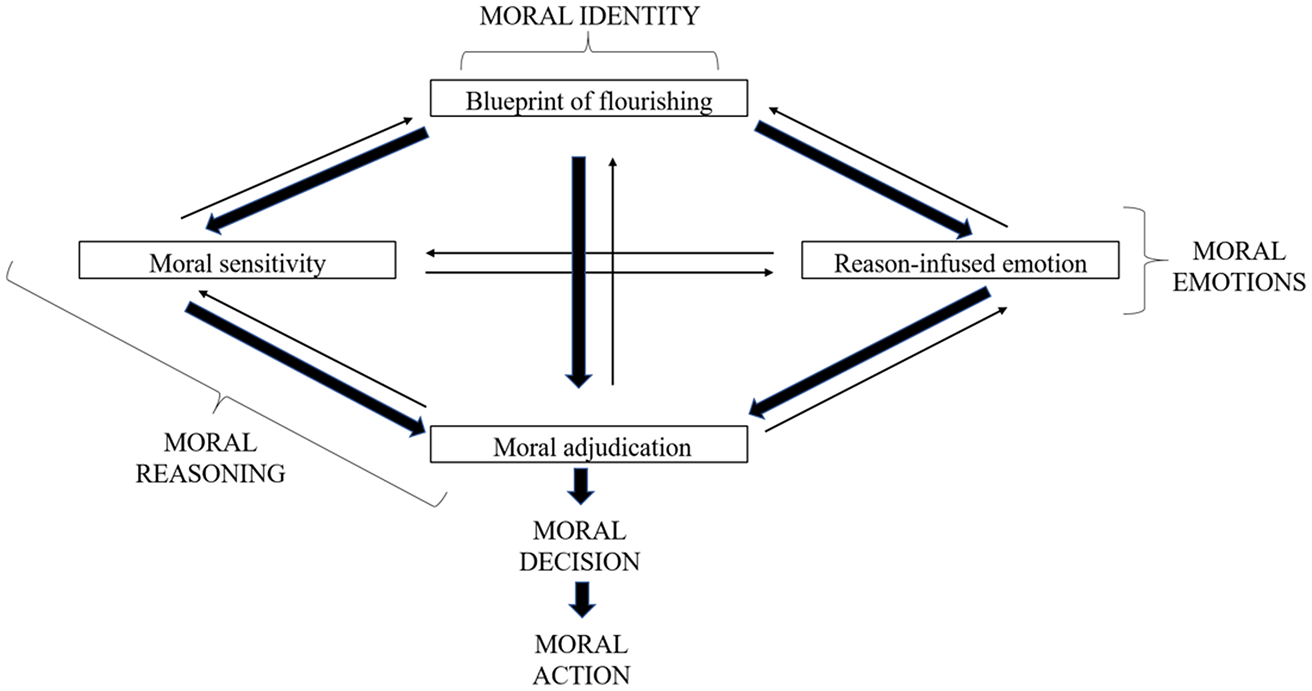
We in the Jubilee Centre for Character and Virtue have been busy with such reconstructive work in the last few years, drawing both on original Aristotelian sources and contemporary work in moral psychology. We have come up with an account of four components making up phronesis and a model of how phronesis negotiates moral decision-making (Kristjánsson et al., Reference Kristjánsson, Fowers, Darnell and Pollard2021). Here are the components, differentiated according to their functions:
Constitutive Function. Phronesis involves the cognitive ability to perceive the ethically salient aspects of a situation and to appreciate these as calling for specific kinds of responses. This ability can be cultivated and should develop into the sort of cognitive excellence that merits the label of ‘practical wisdom’.
Integrative Function. Phronesis integrates different components of a good life, especially in circumstances where different ethically salient considerations, or different kinds of virtues or values, appear to be in conflict and agents need to negotiate dilemmatic space. To return to the case of the Guardian and Daily Telegraph columnists, they all used the virtue term ‘compassion’ a lot. However, compassion can give rise to various intra-virtue and inter-virtue conflicts. As to the former, each virtue contains various components (of perception/recognition, emotion, desire, motivation, behaviour and comportment or style), and those can create internal tensions. Does compassion in this particular case require an emotional reaction only or does it call for direct political action? As to the latter, compassion frequently clashes with other virtues. The standard textbook example is compassion versus honesty. Should we, in this particular case, opt for honest compassion or compassionate honesty – or even relinquish honesty altogether and choose a white lie? Moreover, compassion can clash with other (non-virtue-based) values, like economic prosperity. The integrative function of phronesis is meant to adjudicate such conflicts.
Blueprint Function. The integrative work of phronesis operates in conjunction with the agent's overall sense of the kinds of things that matter for a flourishing life: the agent's own moral identity, her understanding of what it takes if she is to live and act well and her need to live up to the standards that shape and are shaped by her understanding and experience of what matters in life. This function relates to what is called the person's ‘moral identity’.
Emotional Regulative Function. Phronesis both requires and contributes to persons’ emotional wellbeing by helping to bring their emotional responses into line with their understandings of the ethically salient aspects of their situation, their judgement and their sense of what is at stake in the moment. For example, phronesis might show that a person is having an excessive or deficient emotional response, given her construal of the situation at hand, and then help her adjust accordingly by, for instance, giving herself an inner ‘talking to’ or asking herself questions about why she is so upset (or is not upset enough).
So, to flesh this out a bit, the constitutive function helps us to identify a clash within or between virtues. This function is often referred to simply as moral sensitivity. The integrative function orders the conflicting motivations under the guiding light of our conception of the good life – provided by the blueprint function – while the emotional regulative function makes sure that we are not led astray by irrationally powerful emotions, throwing a spanner into the works of intellectual decision-making.
Figure 1 illustrates our overall conceptualisation of phronesis. Notice that we try to couch the components there in a language that will be more familiar to psychologists and ordinary people (fully capitalised words) than the names of the four ‘functions’. Notice also the central role accorded to the blueprint component. While the primary motivation driving phronesis comes externally from the respective moral virtues that feed into it (say, compassion and justice), the blueprint component furnishes it with an internal motivation of its own: the motivation to adhere to one's sense of what flourishing it, or what contemporary psychologists would refer to as ‘moral identity’. Without the central magnet of that blueprint component, all the other components would fall back into their respective heaps.
A Neo-Aristotelian Model of Wise (Phronetic) Moral Decision-Making
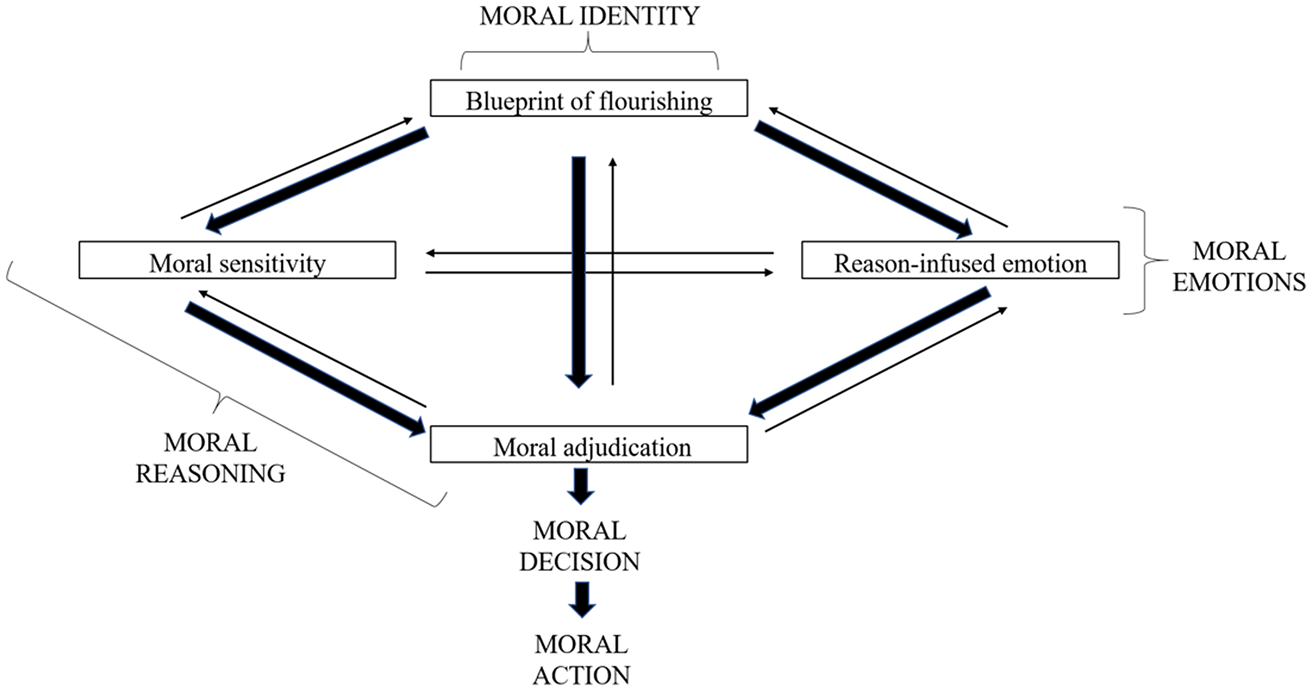
If we situate this in terms of how phronesis is meant to arbitrate in the case of a particular conflict, such as between the value of preserving the health of the old and vulnerable, on the one hand, and, on the other hand, the wellbeing of the young who need to study and work in the time of a pandemic, a well-developed capacity of phronesis helps us first to discern that there is a moral conflict at stake and identify precisely what that conflict is about. The blueprint function makes sure that we deliberate upon the conflict in light of our deepest held values about what we consider to be an overall flourishing life. The emotional regulation function secures the reason-embeddedness of the emotions that guide our motivation to engage with the problem (rather than trying to make our deliberation non-emotional and detached) and finally the integrative function weighs the pros and cons of each action option, through checks and balances, and comes up with a solution. Notice that this model is not a description of an alternative route to how people normally grapple with moral quandaries; rather it systematises what normally (or at least ideally) takes place in such processes and helps us improve the quality of our decision-making my making the steps we need to go through more specific and explicit. Moreover, it reminds us that simply following a single virtue, on a single generalised interpretation, is no royal road to getting things right.
I would not want to be seen to be arguing that the columnists explored in Case Study 2 should have taken us systematically through all the steps in an Aristotelian decision-making model. Obviously, they were bound by much stricter length restrictions than the normal philosophical essayist would be, and their remit is to write polemical and political pieces rather than philosophical reflections. However, I think the preceding paragraph indicates some of the considerations that I would ideally like to have seen grappled with even in a short column, for example in the many that one-sidedly advocated the immediate return of all children to school during the lockdown. Readers will also notice, more specifically, how I would have wanted to see the blueprint and emotional regulations functions dealt with in such an argument, and given my earlier critique of the CWM, why that model would not have been as useful in this regard as the phronesis model, because of its underspecified account of ‘moral aspirations’ and its avoidance of engagement with potentially aberrant (wisdom-undermining) emotions.
If a virtue-based approach to moral life ends up being hopelessly disintegrated without the unifying role of phronesis – as we have seen various examples of during the pandemic with people obsessively pushing specific virtue buttons without concerns for any holistic balance – why has phronesis faded from the public consciousness much more so than many other Aristotelian virtues? Answering that question satisfactorily would be a topic for another occasion. The reasons that come most readily to mind – and which are by no means original – will have to do, on the one hand, with the emergence of a law-like, codified model of morality, which reduces moral decision-making to mere compliance and, on the other hand, the prevalence of cost-benefit solutions to moral quandaries, which reduce moral values to monetary ones, couched in a single currency. The idea of virtue adjudications as critically guided and experientially grounded, but at the same time improvised and unforeseeably context-adjusted, has somehow gone missing in modernity. Our brush with the coronavirus has shown that it is high time to retrieve it: to rehabilitate phronesis and to make it the main pillar of moral education in the 21st century.