Introduction
Lathyrus sativus L. (Fabaceae), commonly known as grass pea, is grown in India, Bangladesh, North America, temperate South America, Ethiopia and East Africa (Yan et al., Reference Yan, Spencer, Li, Liang, Wang, Wang and Li2006; Girma and Korbu, Reference Girma and Korbu2012; Vaz Patto and Rubiales, Reference Vaz Patto and Rubiales2014; Dixit et al., Reference Dixit, Parihar, Bohra and Singh2016). The plant is capable of growing in varying climatic conditions such as areas with low rainfall to the rice-fields containing heavy clay (Lambein et al., Reference Lambein, Travella, Kuo, Montagu and Heijde2019). According to Sammour (Reference Sammour2014), south Asia and east Africa mainly contributes ca. 1.20 million tons grass pea seeds for consumption. Currently, the yield of the crops is increasing per hectare in Ethiopia, Bangladesh and India due to availability of high yielding cultivars (Kumar et al., Reference Kumar, Bejiga, Ahmed, Nakkoul and Sarker2011; Lambein et al., Reference Lambein, Travella, Kuo, Montagu and Heijde2019). The crop is neglected because seeds have a status of causing neurolathyrism due to presence of β-ODAP (β-N-oxalyl-L-α, β-diaminopropionic acid) (Lambein and Kuo, Reference Lambein and Kuo2004, Reference Lambein and Kuo2009). But, Rao (Reference Rao2011), and Singh and Rao (Reference Singh and Rao2013) concluded that β-ODAP could be used for control of Alzheimer's disease and hypoxia through the activation of protein kinase. Lan et al. (Reference Lan, Chen, Sun and Fang2013) patented β-ODAP as a hemostatic agent during surgery. In addition, β-ODAP has properties of wound healing and stopping of hemorrhage (Sharma et al., Reference Sharma, Singh and Singh2018).
Aphis craccivora Koch (Hemiptera: Aphididae) is one of the major pests of legume plants all over the world. The insect is polyphagous in nature and it infests 400 plant species around the globe (Brady and White, Reference Brady and White2013). Both adults and nymphs suck cell sap by stylet penetration from the young leaves, stem tissues, growing tips, flower stalks and pods (Powell and Hardie, Reference Powell and Hardie2001). It causes damage directly by modifying plant metabolism and ingesting plant nutrients. Indirectly, the aphid also serves as a vector of 14 viruses throughout the world. Adult viviparous aphid produces eggs, which develop within the adult aphid and subsequently, gives birth to nymphs alive. Nymphs develop into reproductive adults between 2 and 3 days. Heavy infestation by this insect causes distortion of leaves and stunting of plant, which results in the delay of flower initiation and finally results in reduction of seed yield. Growers apply different insecticides such as malathion 50 EC, endosulfan 35 EC, cypermethrin 10 EC, fenvalerate 20 EC and oxydemeton methyl 25 EC to control this adult viviparous aphid. However, applications of insecticides are not safe to the ecosystem. So, it is necessary to employ alternate control strategies such as baited traps for control of this aphid.
We observed presence of A. craccivora on grass pea plants during field survey in winter (October to February) in West Bengal, India. The occurrence of the grass pea plant as well as the adult viviparous aphid is simultaneous. Both adults and nymphs of A. craccivora suck cell sap from the tender leaves during initial attack. During severe infestation, the adults lay nymphs on the stalks of flowers, and subsequently, both adults and nymphs of A. craccivora suck cell sap from the flowers of grass pea plants. The first physical contact between an adult viviparous aphid and plant occurs when it touches the surface wax of a plant, and therefore, behaviour of the adult viviparous aphid can be influenced by various factors such as epicuticular wax structure as well as chemical composition (Powell et al., Reference Powell, Maniar, Pickett and Hardie1999; Wójcicka, Reference Wójcicka2013). It is well-known that surface wax compounds serve as low volatile cues to locate their host in its microhabitat (Eigenbrode and Espelie, Reference Eigenbrode and Espelie1995; Powell et al., Reference Powell, Maniar, Pickett and Hardie1999; Müller and Hilker, Reference Müller and Hilker2001; Schoonhoven et al., Reference Schoonhoven, van Loon and Dicke2005; Manosalva et al., Reference Manosalva, Pardo, Perich, Mutis, Parra, Ortega, Isaacs and Quiroz2011; Mukherjee et al., Reference Mukherjee, Sarkar and Barik2014; Sarkar and Barik, Reference Sarkar and Barik2014, Reference Sarkar and Barik2015; Malik and Barik, Reference Malik and Barik2015). Shanks and Finnigan (Reference Shanks and Finnigan1970) demonstrated that application of organic solvent (acetone, chloroform, and petroleum ether) extracts from leaves of the strawberry, Fragaria vesca L. on artificial (glass filter paper) surfaces stimulated probing by Chactosiphon fragaefolii (Cockerell) (Homoptera: Aphididae). Alkanes present in epicuticular lipids of Vicia faba L. leaves caused an enhanced movement of the pea aphid, Acrythosiphon pisum (Harris), to feeding sites on the leaves (Klingauf et al., Reference Klingauf, Nöcker-Wenzel and Röttger1978). Powell et al. (Reference Powell, Maniar, Pickett and Hardie1999) examined the role of epicuticular lipids of beans and oats on the stylet penetration activity of the black bean aphid, Aphis fabae Scopoli, and for this, they applied epicuticular lipids (chloroform extract) of oats or pure 1-hexacosanol (predominant in oat extract) on artificial (glass) substrates and recorded that the stylet penetration activity was delayed while bean extract had no such effect, implicating that epicuticular lipids play an important role in early stages of host-plant selection by A. fabae. Adults of Aulacophora foveicollis Lucas (Coleoptera: Chrysomelidae) showed attraction towards a synthetic blend of alkanes, nonadecane, heptacosane and nonacosane, resembling in amounts as present in Momordica cochinchinensis Spreng. flower surface waxes (Mukherjee et al., Reference Mukherjee, Sarkar and Barik2013). Further, adults of A. foveicollis showed attraction towards a synthetic blend of pentadecane, heptacosane, nonacosane, undecanoic acid, lauric acid and nonadecanoic acid, resembling in amounts as present in surface wax of Solena amplexicaulis (Lam.) Gandhi flowers (Karmakar and Barik, Reference Karmakar and Barik2016).
Thus, we first observed through a glass Y-tube olfactometer choice experiment whether one flower equivalent crude surface wax from two cultivars (cv. BIO L 212 Ratan and Nirmal B-1) of L. sativus was attractive to the adult viviparous A. craccivora females. Epicuticular surface wax is mainly comprised of long-chain alkanes and free fatty acids. So, we identified and quantified long-chain alkanes and free fatty acids present in flower surface waxes of two cultivars of L. sativus (cv. BIO L 212 Ratan and Nirmal B-1) through gas chromatography mass-spectroscopy (GC-MS) and GC flame ionisation detection (GC-FID), respectively. We studied the role of individual synthetic alkanes and free fatty acids followed by synthetic blends comparable to the amounts as present in one flower equivalent surface wax of two cultivars (cv. BIO L 212 Ratan and Nirmal B-1) of L. sativus through choice experiments. Further, the role of attractive synthetic blends, comparable to the amounts as present in one flower equivalent surface wax of both cultivars of L. sativus, was studied to observe whether these blends could act as stimulant for nymph laying by adult viviparous females.
Materials and methods
Plants
Lablab purpureus subsp. bengalensis (Jacq.) Verdc. (field bean) plants, growing in the Crop Research Farm (CRF) of the University of Burdwan, were used as a source for collection of adult viviparous A. craccivora females. The females were reared at 22 ± 1°C, relative humidity of 65 ± 10% and a photoperiod of 12 L: 12 D on leaves of field bean plants for three generations to avoid the association of this insect with L. sativus plants, because the association of the adult viviparous aphid with L. sativus plants might cause biasness in choice experiments and viviparity bioassays. Five to seven days old adult viviparous females were taken for choice experiments and viviparity bioassays.
Plant materials
To obtain flowers, plants of BIO L 212 Ratan and Nirmal B-1 cultivars were grown in the CRF of the University of Burdwan during November, 2017. Flowers were harvested in the morning (between 7.30 and 8.30 a.m.) for extraction of surface waxes.
Flower surface wax extraction
Flowers (3 × 60 g BIO L 212 Ratan and 3 × 60 g Nirmal B-1) were used for extraction of surface waxes. One L n-hexane was poured in each group of 60 g flowers for 1 min at 25 ± 2°C for extraction of surface waxes. An extract of light straw color, which is without traces of chlorophyll, was passed through filter paper (Whatman No. 41). The filtrate was evaporated at room temperature to get crude extract. Thirty ml n-hexane were used to dissolve each crude extract obtained from 60 g flowers, and three equal fractions were prepared [each 10 ml n-hexane fraction was ca. 20 g flowers; number of flowers for 20 g BIO L 212 Ratan and Nirmal B-1 were 433 ± 3 and 392 ± 2 (mean ± standard error), respectively]. First, second and third fractions were used as: (i) choice experiments and viviparity bioassays, (ii) identification and quantification of alkanes, and (iii) identification and quantification of free fatty acids, respectively.
Alkanes – identification and quantification
The second fraction of the each flower crude extract was fractioned by Thin Layer Chromatography (TLC) on silica gel G with CCl4 as the mobile phase, and rest of the protocol was adapted from Mitra et al. (Reference Mitra, Sarkar and Barik2017) (see Supplementary material).
Free fatty acids – identification and quantification
The third fraction of the each flower crude extract was dissolved in diethyl ether and passed through filter paper (Whatman No. 41) (Sarkar and Barik, Reference Sarkar and Barik2015). The filtrate was purified by TLC using silica gel G (thickness 0.5 mm) with n-butanol: acetic acid: water (4:1:5; after shaking this mixture, it was placed in a separating funnel to isolate the water, and the water was rejected) as the mobile phase (Mukherjee et al., Reference Mukherjee, Sarkar and Barik2014; Sarkar and Barik, Reference Sarkar and Barik2015), and rest of the protocol was adapted from Mitra et al. (Reference Mitra, Sarkar and Barik2017) (see Supplementary material).
Choice experiments
A glass Y-tube olfactometer (1 cm internal diameter; 5 cm common stem and each arm 5 cm; angle between two arms is 45°) was used for choice experiments. The end of each arm of the Y-tube was connected with a glass-made adapter, and each adapter was attached with a glass vial (1 cm diameter, 3 cm long) consisting of a piece of Whatman No. 41 filter paper (2 × 2 cm2). Air, generated by a pump was passed through hydrocarbon trap, was pushed into each adapter through an inlet tube (75 ml min−1). Teflon tubes were used to connect between each arm of the Y-tube and adapter.
All bioassays were performed in the laboratory at 22 ± 1°C, 70 ± 5% relative humidity (RH), and 150 lux light intensity. Adult viviparous females (5–7 days old) were starved for 4 h before bioassays, but water was provided to keep the air moisture. Females did not show biasness towards the control solvent (petroleum ether) in preliminary bioassays. Test sample (1 ml) and the control solvent (1 ml) were applied to two separate filter paper pieces, and the filter papers were kept in open space to evaporate the solvent before placing them into the glass vials. An adult viviparous female was released through an aspirator into a porous glass vial (1 cm diameter, 3 cm long) (porous glass vial was used to pass out the odor loaded air coming from either surface wax or synthetic compounds or synthetic blends and solvent, which was passing through the arms of the Y-tube) (Das et al., Reference Das, Koner and Barik2019). The porous glass vial containing an adult viviparous female was attached with the stem of the Y-tube and exposed to an odour. The behavior of each adult viviparous female was observed for 2 min, and when a female reached the end of one arm, the female was removed. The choice of the female was recorded as positive response when a female reached the end of the arm through which odor of test sample was flowing, while a negative response was recorded when a female reached to the other end of the arm. A no response was recorded when a female remained in the stem of the olfactometer for 2 min and the female was not used in another test (Mukherjee et al., Reference Mukherjee, Sarkar and Barik2015; Sarkar et al., Reference Sarkar, Mukherjee and Barik2015). Behavioral responses of 60 adult viviparous females were recorded excluding the number of individuals that did not respond towards a test sample. Each adult viviparous female was tested for once throughout all the bioassays. After testing every five females, the olfactometer set-up was thoroughly cleaned with acetone followed by water and dried. Further after testing every five females, the olfacometer set-up was rotated 180° to minimize any position bias.
Choice experiments with adult viviparous A. craccivora females
Bioassay 1: One flower equivalent surface wax vs pure air
Behavioral responses of females to one flower equivalent surface wax of either BIO L 212 Ratan or Nirmal B-1 was tested against the control solvent to observe whether flower surface waxes from both cultivars were attractive to the adult viviparous aphid (Supplementary table 1).
Bioassay 2: One flower equivalent surface wax of BIO L 212 Ratan vs Nirmal B-1
Behavioral responses of females to one flower equivalent surface wax of BIO L 212 Ratan and Nirmal B-1 were tested against each other to observe whether the flower surface wax from a particular cultivar was more attractive to the adult viviparous females compared to the flower surface wax of another cultivar.
Bioassay 3: Individual synthetic compounds or synthetic blends vs pure air
Behavioral responses of females to individual synthetic compounds, comparable to the amounts of individual compounds as present in one flower equivalent surface wax of either BIO L 212 Ratan or Nirmal B-1, were tested against the control solvent to observe the role of individual compounds on the adult viviparous aphid (Supplementary table 2a, b). Further, responses of females to synthetic blends (consisting of those synthetic compounds to which A. craccivora showed behavioral responses or attraction), comparable to the amounts as they were present in one flower equivalent surface wax of either BIO L 212 Ratan or Nirmal B-1 vs the control solvent were performed to observe the role of synthetic blends on the insects (Supplementary table 3). This would help to compare the results obtained in choice experiments of A. craccivora to one flower equivalent surface wax of either BIO L 212 Ratan or Nirmal B-1 against the control solvent.
Bioassay 4: One flower equivalent surface wax of BIO L 212 Ratan or Nirmal B-1 vs individual synthetic compounds or synthetic blends
Behavioral responses of females to one flower equivalent surface wax of either BIO L 212 Ratan or Nirmal B-1 were tested against individual compounds or synthetic blends comparable to the amounts as they were present in one flower equivalent surface wax of either BIO L 212 Ratan or Nirmal B-1 to observe whether synthetic blends could be used in developing a lure to attract the adult viviparous aphid in the field (Supplementary table 4).
Bioassay 5: Comparison of synthetic blends: BIO L 212 Ratan vs Nirmal B-1
A synthetic blend of 3 compounds (1.08 µg nonacosane + 1.56 µg tridecanoic acid + 0.98 µg linoleic acid were dissolved in 1 ml petroleum ether, as the insect showed clear attraction in the Y-tube choice experiments against the control solvent) comparable to one flower equivalent surface wax of BIO L 212 Ratan vs a synthetic blend of 5 compounds (1.60 µg tetradecane + 2.81 µg pentadecane + 0.93 µg nonacosane + 2.10 µg tridecanoic acid + 1.42 µg linoleic acid were dissolved in 1 ml petroleum ether as the insect showed clear attraction in the Y-tube choice experiments against the control solvent), comparable to one flower equivalent surface wax of Nirmal B-1, was tested to find which synthetic blend is most attractive to the insect in lures in the development of baited traps.
Viviparity assays
Adult viviparous A. craccivora females were collected from field bean plants, and females were fed on field bean leaves for rearing in the laboratory for nymph laying. Nymphs were also reared on field bean leaves in the laboratory to get adult viviparous females. Newly emerged (dark brown and abdomen not swollen) females were also fed on field bean leaves for four days prior to nymph laying (shiny black swollen abdomen, three to six nymphs were produced by females for the first time). A glass-made I-tube (I-tube: 10 cm length and 1 cm internal diameter, 0.3 cm diameter hole in the middle of I-tube for release of an adult viviparous aphid) having attached with glass vials (1 cm diameter × 3 cm long) were used for viviparity bioassays. One ml of the test sample and 1 ml of the control solvent were applied to separate filter paper pieces (each filter paper: 2 × 2 cm2) and allowed to evaporate the solvent in open space under laboratory conditions, and these filter papers were separately placed in two glass vials (1 cm diameter × 3 cm long). In preliminary assays, females did not lay nymph on filter papers moistened with the control solvent (petroleum ether). Ten adult viviparous females were used for each experiment excluding the number of females that did not lay nymph. Each female was observed for 6 h after releasing in an I-tube, and when a female laid nymphs for the first time then the numbers of nymphs were recorded and this female was not used in another test. If a female did not lay nymphs within 6 h, it was also not used in another test. We have conducted the following viviparity assays.
Waxed flower vs dewaxed flower
A single flower of BIO L 212 Ratan vs a single dewaxed flower of BIO L 212 Ratan, and a single flower of Nirmal B-1 vs a single dewaxed flower of Nirmal B-1 (for dewaxing of flowers, a single flower was dipped in 20 ml n-hexane for 1 min at room temperature for extraction of surface waxes) were tested to find whether flower surface waxes from both cultivars of L. sativus were acting as stimulant for nymph laying by females.
Flower surface wax vs pure air
One flower equivalent surface wax from BIO L 212 Ratan or Nirmal B-1 vs the control solvent (petroleum ether) was tested to observe whether crude flower surface waxes of both cultivars were acting as stimulant for nymph laying by females.
Flower surface wax of BIO L 212 Ratan vs Nirmal B-1
One flower equivalent surface wax of BIO L 212 Ratan vs one flower equivalent surface wax of Nirmal B-1 was tested to observe whether flower surface wax of a particular cultivar was acting as more stimulant for nymph laying by females compared to another cultivar.
Synthetic blend vs pure air
A synthetic blend of 3 compounds (1.08 µg nonacosane + 1.56 µg tridecanoic acid + 0.98 µg linoleic acid were dissolved in 1 ml petroleum ether, as the insect showed highest attraction in the Y-tube choice experiments against the control solvent) comparable to one flower equivalent surface wax of BIO L 212 Ratan vs the control solvent or a synthetic blend of 5 compounds (1.60 µg tetradecane + 2.81 µg pentadecane + 0.93 µg nonacosane + 2.10 µg tridecanoic acid + 1.42 µg linoleic acid were dissolved in 1 ml petroleum ether as the insect showed highest attraction in the Y-tube choice experiments against the control solvent) comparable to one flower equivalent surface wax of Nirmal B-1 vs the control solvent were performed to observe whether synthetic blends comparable to one flower equivalent surface wax of BIO L 212 Ratan and Nirmal B-1 cultivars were acting as stimulant for nymph laying by females.
Flower surface wax vs synthetic blend
One flower equivalent surface wax from BIO L 212 Ratan vs a synthetic blend of 3 compounds (1.08 µg nonacosane + 1.56 µg tridecanoic acid + 0.98 µg linoleic acid) comparable to one flower equivalent surface wax of BIO L 212 Ratan, and one flower equivalent surface wax from Nirmal B-1 vs a synthetic blend of 5 compounds (1.60 µg tetradecane + 2.81 µg pentadecane + 0.93 µg nonacosane + 2.10 µg tridecanoic acid + 1.42 µg linoleic acid) comparable to one flower equivalent surface wax of Nirmal B-1 were tested to find whether synthetic blends could be used in lures to trap A. craccivora population in crop field.
Synthetic blend comparable to BIO L 212 Ratan vs Nirmal B-1
A synthetic blend of 3 compounds (1.08 µg nonacosane + 1.56 µg tridecanoic acid + 0.98 µg linoleic acid were dissolved in 1 ml petroleum ether) comparable to one flower equivalent surface wax of BIO L 212 Ratan vs a synthetic blend of 5 compounds (1.60 µg tetradecane + 2.81 µg pentadecane + 0.93 µg nonacosane + 2.10 µg tridecanoic acid + 1.42 µg linoleic acid were dissolved in 1 ml petroleum ether), comparable to one flower equivalent surface wax of Nirmal B-1, was tested to find which synthetic blend could be used in lure in the development of baited traps.
Statistical analyses
The data on total amounts of alkanes and free fatty acids, and amounts of individual alkanes and free fatty acids present in flower surface waxes of two cultivars (BIO L 212 Ratan and Nirmal B-1) of L. sativus were subjected to Levene's test for homogeneity of variance followed by Student's t test (Zar, Reference Zar1999). The behavioural responses of adult viviparous A. craccivora females in the Y-tube choice experiments and viviparity assays to the samples were analyzed by a χ2 test, i.e., the probability of scores for the test compound(s) or control solvent is equal to 50% (H0: P = 50%) (Adhikary et al., Reference Adhikary, Mukherjee and Barik2015; Karmakar et al., Reference Karmakar, Mitra and Barik2018).
Results
Flower surface wax in BIO L 212 Ratan and Nirmal B-1 cultivars
The n-hexane extracts from 20 g flowers of BIO L 212 Ratan and Nirmal B-1 revealed 10.53 ± 0.03 and 13.80 ± 0.15 mg (mean ± SE) surface waxes, respectively. In BIO L 212 Ratan, 5.55 ± 0.22 mg alkanes and 2.32 ± 0.21 mg free fatty acids were identified, while 2.66 ± 0.24 mg was unidentified surface wax compounds; whereas in Nirmal B-1, alkanes and free fatty acids represented for 6.37 ± 0.10 and 3.60 ± 0.20 mg (mean ± SE), respectively, with the balance (3.83 ± 0.41 mg) consisting of unidentified surface wax compounds.
Flower surface wax alkanes
The Levene's test (W) for homogeneity of variance indicated that the total amounts of alkanes and individual alkanes present in two cultivars (BIO L 212 Ratan and Nirmal B-1) of L. sativus were homogenous conforming to application of student's t test. Nirmal B-1 has the higher amount of total alkanes compared to BIO L 212 Ratan (table 1). Twenty one and 22 n-alkanes between n-C12 and n-C36 were identified in flower surface waxes of BIO L 212 Ratan and Nirmal B-1, respectively (table 1). Pentadecane (n-C15) was predominant in flower surface waxes of both cultivars, while dotriacontane (n-C32) was in least amount in flower surface waxes of both cultivars (table 1). Tetratriacontane (n-C34) was unique in Nirmal B-1. Octadecane (n-C18) was moderately abundant in flower surface waxes of both cultivars. The amounts of dodecane (n-C12), hexadecane (n-C16), heptadecane (n-C17), hentriacontane (n-C31), pentatriacontane (n-C35) and hexatriacontane (n-C36) were higher in Nirmal B-1 compared to BIO L 212 Ratan; whereas the amounts of pentacosane (n-C25), heptacosane (n-C27) and octacosane (n-C28) were higher in BIO L 212 Ratan compared to Nirmal B-1.
Alkane profile (μg/20 g flower) in flower surface waxes of two cultivars (BIO L 212 Ratan and Nirmal B-1) of Lathyrus sativus

Flower surface wax free fatty acids
The Levene's test (W) for homogeneity of variance revealed that the total amounts of free fatty acids and individual free fatty acids present in two cultivars (BIO L 212 Ratan and Nirmal B-1) of L. sativus were homogenous conforming to application of student's t test. Total free fatty acids were higher in Nirmal B-1 compared to BIO L 212 Ratan (table 2). Twelve free fatty acids from C12:0 to C20:0 were identified in flower surface waxes of both cultivars (table 2). Tridecanoic acid (C13:0) and stearic acid (C18:0) were the most and least abundant, respectively, in flower surface waxes of both cultivars (table 2). Except tridecanoic acid (C13:0), where no significant difference was observed between two cultivars, rest of the identified fatty acids were in higher amounts in Nirmal B-1 compared to BIO L 212 Ratan (table 2).
Free fatty acid profile (μg/20 g flower) in flower surface waxes of two cultivars (BIO L 212 Ratan and Nirmal B-1) of Lathyrus sativus

Choice experiments with adult viviparous A. craccivora females
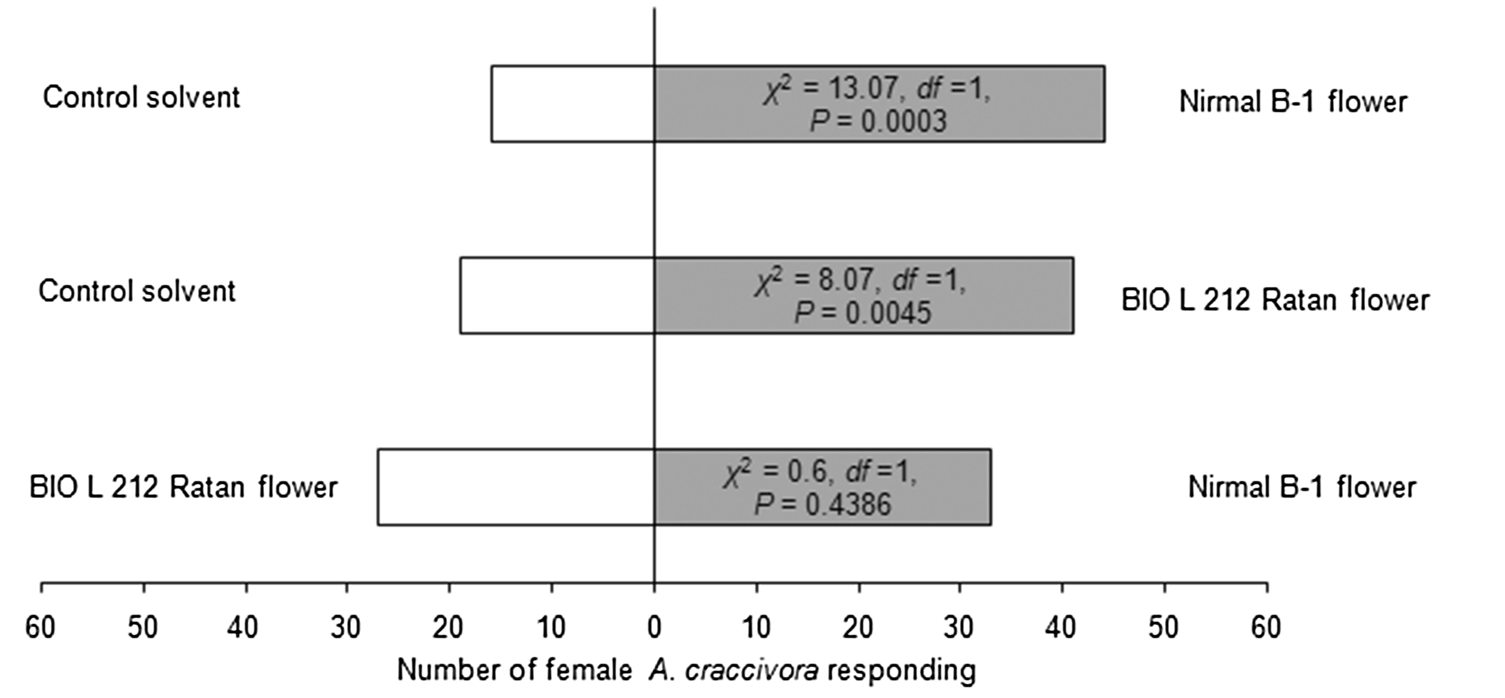
Bioassay 1: Females showed attraction towards one flower equivalent surface wax of BIO L 212 Ratan or Nirmal B-1 against the control solvent (fig. 1).
Behavioral responses of adult viviparous Aphis craccivora females to one flower equivalent surface wax of two cultivars (BIO L 212 Ratan or Nirmal B-1) of Lathyrus sativus against the control solvent (petroleum ether), and one flower equivalent surface wax of BIO L 212 Ratan vs. Nirmal B-1 in Y-tube choice experiments. Behavioral responses of females in choice experiments were analyzed by a χ2 test (H0: P = 50%). Each test was carried out with 60 adult viviparous females.

Bioassay 2: Females showed equal attraction when they were provided one flower equivalent surface wax of BIO L 212 Ratan against one flower equivalent surface wax of Nirmal B-1 (fig. 1).
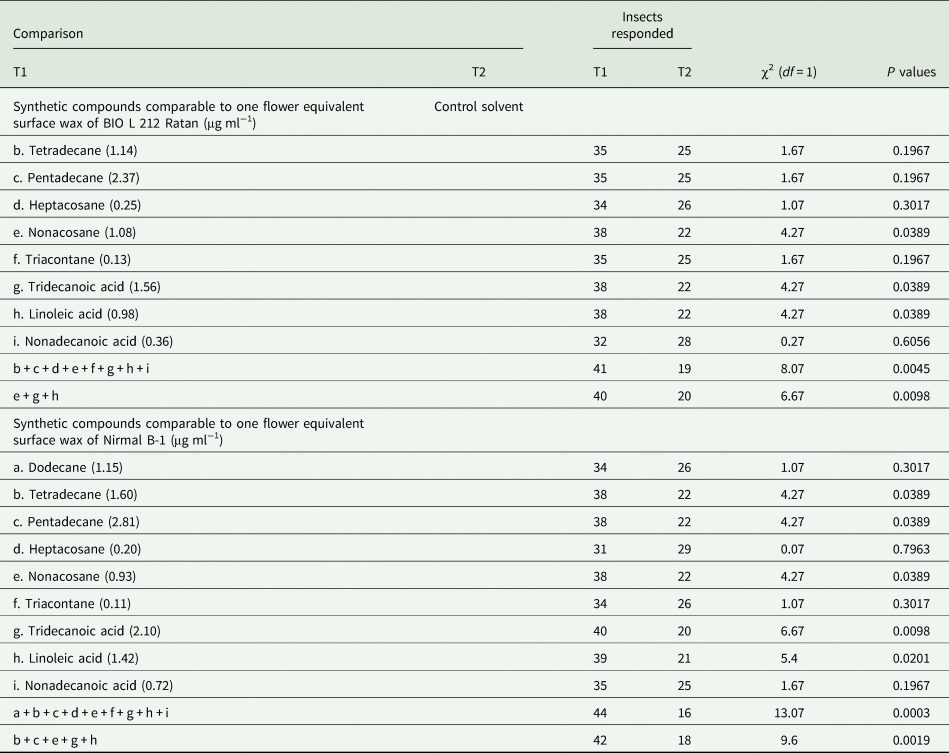
Bioassay 3: Females showed responses to 8 individual synthetic compounds (tetradecane, pentadecane, heptacosane, nonacosane, triacontane, tridecanoic acid, linoleic acid and nonadecanoic acid) among all the identified alkanes and free fatty acids, comparable to the amounts as present in one flower equivalent surface waxes of BIO L 212 Ratan, against the control solvent (Supplementary table 5). Females were attracted to a synthetic blend of above 8 compounds against the control solvent (table 3). The insects were attracted towards 3 individual synthetic compounds (nonacosane, tridecanoic acid and linoleic acid) or a synthetic blend of 3 compounds, comparable to the amounts as present in one flower equivalent surface wax of BIO L 212 Ratan, against the control solvent (table 3).
Behavioral responses of adult viviparous Aphis craccivora females towards individual synthetic compounds or synthetic blends comparable to the amounts as present in one flower equivalent surface wax of BIO L 212 Ratan or Nirmal B-1 of Lathyrus sativus vs. control solvent (Petroleum ether) in Y-tube choice experiments

Behavioral responses of females in choice experiments were analyzed by a χ2 test (H0: P = 50%). Each test was carried out with 60 adult viviparous females.
Females showed responses to 9 individual synthetic compounds (dodecane, tetradecane, pentadecane, heptacosane, nonacosane, triacontane, tridecanoic acid, linoleic acid and nonadecanoic acid), comparable to the amounts as present in one flower equivalent surface wax of Nirmal B-1, against the control solvent (Supplementary table 5). Females showed attraction towards a synthetic blend of the above 9 compounds against the control solvent (table 3). Females were attracted towards 5 individual synthetic compounds (tetradecane, pentadecane, nonacosane, tridecanoic acid and linoleic acid) or a synthetic blend of 5 compounds against the control solvent (table 3).
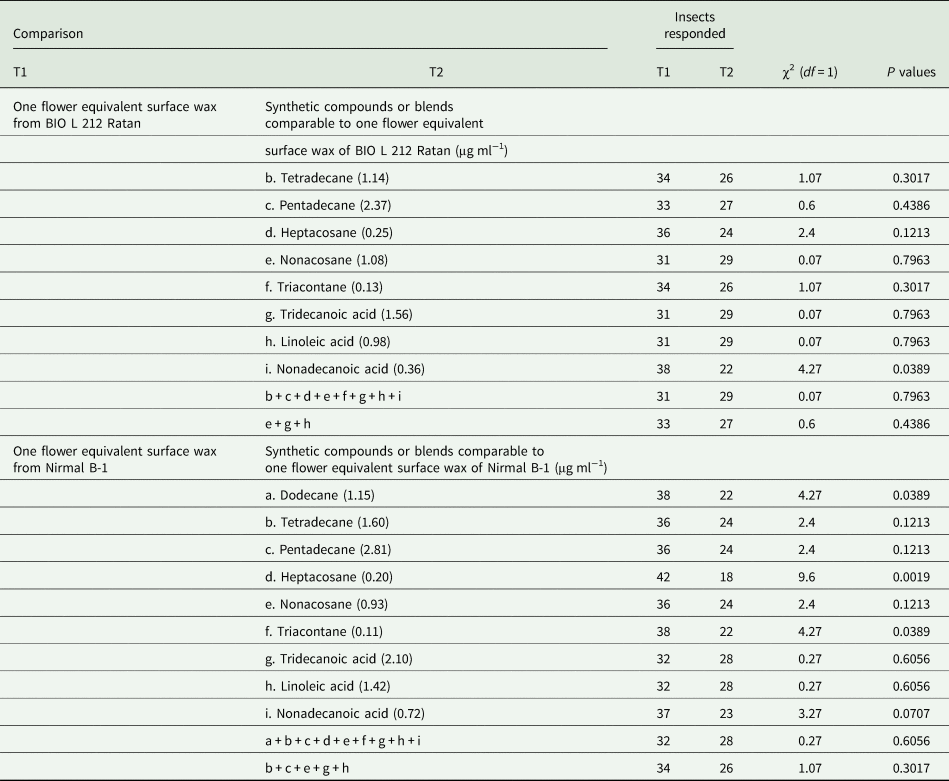
Bioassay 4: Females could not distinguish between one flower equivalent surface wax of BIO L 212 Ratan and a synthetic blend of 8 compounds (tetradecane, pentadecane, heptacosane, nonacosane, triacontane, tridecanoic acid, linoleic acid and nonadecanoic acid) or a synthetic blend of 3 compounds (nonacosane, tridecanoic acid and linoleic acid) comparable to the amounts as present in one flower equivalent surface wax of BIO L 212 Ratan (table 4).
Behavioral responses of adult viviparous females of Aphis craccivora to one flower equivalent surface wax from two cultivars (BIO L 212 Ratan and Nirmal B-1) of Lathyrus sativus vs. individual synthetic compounds or synthetic blends comparable to the amounts as present in one flower equivalent surface wax of BIO L 212 Ratan and Nirmal B-1

Behavioral responses of females in choice experiments were analyzed by a χ2 test (H0: P = 50%). Each test was carried out with 60 adult viviparous females.
Females could not discriminate between one flower equivalent surface wax of Nirmal B-1 and a synthetic blend of 9 compounds (dodecane, tetradecane, pentadecane, heptacosane, nonacosane, triacontane, tridecanoic acid, linoleic acid and nonadecanoic acid) comparable to the amounts as present in one flower equivalent surface wax of Nirmal B-1 or a synthetic blend of 5 compounds (tetradecane, pentadecane, nonacosane, tridecanoic acid and linoleic acid) comparable to the amounts as present in one flower equivalent surface wax of Nirmal B-1 (table 4).
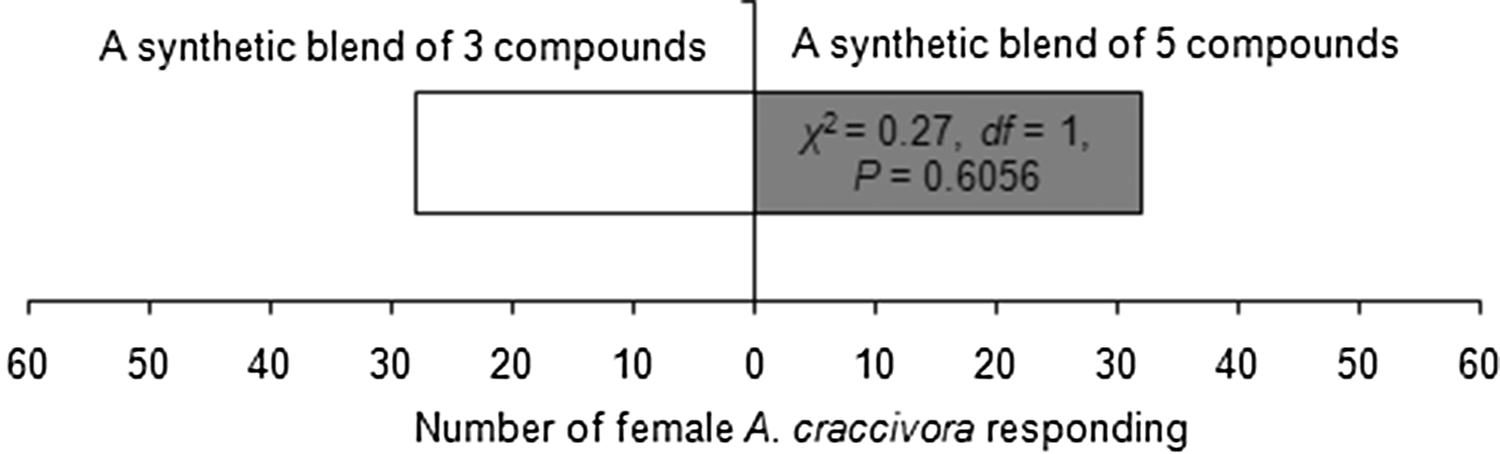
Bioassay 5: Females were neutral when they were provided a synthetic blend of 3 compounds (nonacosane, tridecanoic acid and linoleic acid), comparable to the amounts as present in one flower equivalent surface wax of BIO L 212 Ratan, against a synthetic blend of 5 compounds (tetradecane, pentadecane, nonacosane, tridecanoic acid and linoleic acid) comparable to the amounts as present in one flower equivalent surface wax of Nirmal B-1 (fig. 2).
Behavioral responses of adult viviparous Aphis craccivora females to a synthetic blend of 5 compounds (1.60, 2.81, 0.93, 2.10 and 1.42 µg ml−1 of tetradecane, pentadecane, nonacosane, tridecanoic acid and linoleic acid, respectively) comparable to the amounts as present in one flower equivalent surface wax of Nirmal B-1 cultivar against a synthetic blend of 3 compounds (1.08, 1.56 and 0.98 µg ml−1 of nonacosane, tridecanoic acid and linoleic acid, respectively) comparable to the amounts as present in one flower equivalent surface wax of BIO L 212 Ratan cultivar in Y-tube choice experiments. Behavioral responses of females in choice experiments were analyzed by a χ2 test (H0: P = 50%). Each test was carried out with 60 adult viviparous females.

Viviparity assays of adult viviparous A. craccivora females
(i) Ten females laid 4.0 ± 0.21 nymphs (mean ± SE) on a single BIO L 212 Ratan flower when tested against a single dewaxed BIO L 212 Ratan flower (females did not lay nymph on the dewaxed flower); whereas ten females laid 4.20 ± 0.25 nymphs (mean ± SE) on a single Nirmal B-1 flower when tested against a single dewaxed Nirmal B-1 flower (females did not laid nymph on the dewaxed flower). The above observation revealed that females laid significantly more nymphs on flower surface waxes of both cultivars against dewaxed flowers (BIO L 212 Ratan: χ2 = 40, df = 1, P < 0.0001; Nirmal B-1: χ2 = 42, df = 1, P < 0.0001), suggesting that flower surface waxes of both cultivars acted as stimulant for nymph laying by females.
(ii) Nine females laid 3.30 ± 0.42 nymphs (mean ± SE) on filter papers containing one flower equivalent surface wax of BIO L 212 Ratan against filter papers containing the control solvent (only a single female laid one nymph on the filter paper); whereas ten females laid 4.10 ± 0.18 nymphs (mean ± SE) on filter papers containing one flower equivalent surface wax of Nirmal B-1 against filter papers containing the control solvent (females did not lay nymph on the filter paper). This observation suggested that crude flower surface waxes of both cultivars acted as stimulant for nymph laying by females against the control solvent (BIO L 212 Ratan: χ2 = 30.12, df = 1, P < 0.0001; Nirmal B-1: χ2 = 41, df = 1, P < 0.0001).
(iii) Six females laid 2.10 ± 0.61 nymphs (mean ± SE) on filter papers containing one flower equivalent surface wax of Nirmal B-1 against filter papers containing one flower equivalent surface wax of BIO L 212 Ratan (four females laid 1.20 ± 0.51 nymphs, mean ± SE). This observation revealed that females could not discriminate between surface waxes of two cultivars for nymphs laying (χ2 = 2.455, df = 1, P = 0.1172), suggesting that flower surface waxes of both cultivars were equally acting as stimulant for nymph laying.
(iv) Ten females laid 2.60 ± 0.22 nymphs (mean ± SE) on filter papers containing a synthetic blend of 3 compounds (1.08 µg nonacosane + 1.56 µg tridecanoic acid + 0.98 µg linoleic acid), comparable to the amounts as present in one flower equivalent surface wax of BIO L 212 Ratan, against filter papers containing the control solvent (females did not lay nymphs on the filter paper). On the other hand, ten females laid 3.50 ± 0.17 nymphs (mean ± SE) on filter papers containing a synthetic blend of 5 compounds (1.60 µg tetradecane + 2.81 µg pentadecane + 0.93 µg nonacosane + 2.10 µg tridecanoic acid + 1.42 µg linoleic acid), comparable to the amounts as present in one flower equivalent surface wax of Nirmal B-1, against filter papers containing the control solvent (females did not lay nymphs on the filter paper). This study demonstrated that females significantly laid more nymphs on synthetic blends comparable to the amounts as present in one flower equivalent surface wax of both cultivars against the control solvent (BIO L 212 Ratan: χ2 = 26, df = 1, P < 0.0001; Nirmal B-1: χ2 = 35, df = 1, P < 0.0001).
(v) Six females laid 2.30 ± 0.65 nymphs (mean ± SE) on filter papers containing one flower equivalent surface wax of BIO L 212 Ratan against a synthetic blend of 3 compounds (1.08 µg nonacosane + 1.56 µg tridecanoic acid + 0.98 µg linoleic acid) comparable to the amounts as present in one flower equivalent surface wax of BIO L 212 Ratan (four females laid 1.50 ± 0.62 nymphs, mean ± SE). This study revealed that females were neutral for nymph laying when compared between one flower equivalent surface wax of BIO L 212 Ratan and a synthetic blend of 3 compounds (χ2 = 1.684, df = 1, P = 0.1943).
Six females laid 2.40 ± 0.69 nymphs (mean ± SE) on filter papers containing one flower equivalent surface wax of Nirmal B-1 against a synthetic blend of 5 compounds (1.60 µg tetradecane + 2.81 µg pentadecane + 0.93 µg nonacosane + 2.10 µg tridecanoic acid + 1.42 µg linoleic acid) comparable to the amounts as present in one flower equivalent surface wax of Nirmal B-1 (four females laid 1.80 ± 0.74 nymphs, mean ± SE). This study suggested that females were neutral for nymph laying between one flower equivalent surface wax of Nirmal B-1 and a synthetic blend of 5 compounds (χ2 = 0.8572, df = 1, P = 0.3546).
(vi) Six females laid 2.20 ± 0.63 nymphs (mean ± SE) on filter papers containing a synthetic blend of 5 compounds (1.60 µg tetradecane + 2.81 µg pentadecane + 0.93 µg nonacosane + 2.10 µg tridecanoic acid + 1.42 µg linoleic acid), comparable to the amounts as present in one flower equivalent surface wax of Nirmal B-1, against a synthetic blend of 3 compounds (1.08 µg nonacosane + 1.56 µg tridecanoic acid + 0.98 µg linoleic acid) comparable to the amounts as present in one flower equivalent surface wax of BIO L 212 Ratan (four females laid 1.7 ± 0.70 nymphs, mean ± SE). This study revealed that females were neutral for nymph laying between a synthetic blend of 5 compounds and a synthetic blend of 3 compounds (χ2 = 0.6410, df = 1, P = 0.4233).
Discussion
In the current study, the amount of flower surface waxes was higher in Nirmal B-1 cultivar compared to BIO L 212 Ratan cultivar of L. sativus. Similarly, the amounts of total alkanes and free fatty acids were also higher in Nirmal B-1 cultivar compared to BIO L 212 Ratan cultivar. Twenty one and 22 n-alkanes from n-C12 to n-C36 were detected in flower surface waxes of BIO L 212 Ratan and Nirmal B-1, respectively; while 12 free fatty acids from C12:0 to C20:0 were recorded in flower surface waxes of both cultivars. n-Alkanes and free fatty acids are widespread in flower surface waxes of plants (Mukherjee et al., Reference Mukherjee, Sarkar and Barik2013; Sarkar and Barik, Reference Sarkar and Barik2014; Karmakar and Barik, Reference Karmakar and Barik2016; Malik and Barik, Reference Malik and Barik2016). Twenty n-alkanes from n-C15 to n-C36 and 13 free fatty acids from C12:0 to C22:0 were detected in surface waxes of Polygonum orientale L. flowers, and octadecane and palmitoleic acid were predominant alkanes and free fatty acids, respectively (Malik and Barik, Reference Malik and Barik2016). However, pentadecane and tridecanoic acid were the most abundant alkane and free fatty acid, respectively, in flower surface waxes of both BIO L 212 Ratan and Nirmal B-1 cultivars of L. sativus. But, nonadecane was predominant alkane in seed coat surface waxes of BIO L 212 Ratan and Nirmal B-1 (Adhikary et al., Reference Adhikary, Mukherjee and Barik2014); whereas palmitoleic acid, and palmitic acid and lauric acid were the most abundant free fatty acids in seed coat surface waxes of BIO L 212 Ratan and Nirmal B-1, respectively (Adhikary et al., Reference Adhikary, Mukherjee and Barik2016). The present study revealed that the composition of n-alkanes and free fatty acids in surface waxes of plants might vary between plant species as well as within different cultivars of a plant species including various parts of a plant species (Piasentier et al., Reference Piasentier, Bovolenta and Malossini2000; Dodoš et al., Reference Dodoš, Rajčević, Tešević, Matevski, Janaćković and Marin2015; Wang et al., Reference Wang, Wang, Chai, Li, Hu, Chen and Wang2015; Laila et al., Reference Laila, Robin, Yang, Park, Suh, Kim and Nou2017).
Host recognition by sucking insects begins when the first labial contacts with the surface wax of a plant followed by penetration of stylet through successive tissue layers between the epidermis and the vascular tissues and ultimately feeding (Lei et al., Reference Lei, Van Lenteren and Xu2001). Several reports on the interactions between epicuticular wax and adult viviparous aphid indicated that leaf waxiness could serve as either positive, negative or no effects on the biology of adult viviparous aphid (Powell et al., Reference Powell, Maniar, Pickett and Hardie1999, Reference Powell, Tosh and Hardie2006; Shepherd et al., Reference Shepherd, Robertson, Griffiths and Birch1999; Powell and Hardie, Reference Powell and Hardie2001; Wójcicka, Reference Wójcicka2013, Reference Wójcicka2015). The green peach aphid, Myzus persicae (Sulzer) attacks the glossy genotypes of Brassica, but the cabbage aphid, Brevicoryne brassicae (L.) does not prefer to attack on waxy Brassica genotypes (Thompson, Reference Thompson1963; Way and Murdie, Reference Way and Murdie1965; Stoner, Reference Stoner1990). Short chain fatty acids from C3 to C13 inhibited settling of alate green peach aphids, M. persicae on hosts; whereas long-chain fatty acids from C16 onwards stimulated this behavior (Greenway et al., Reference Greenway, Griffiths and Lloyd1978; Phelan and Miller, Reference Phelan and Miller1982). According to Kennedy (Reference Kennedy, Juniper and Southwood1986), epicuticular lipids played an important role in the selection of suitable oak (Quercus spp.) hosts by aphids. Rovenská and Zemek (Reference Rovenská and Zemek2006) demonstrated that Aulacorthum solani (Kaltenbach) (Hemiptera: Aphididae) laid more nymphs on leaves of non-transgenic potato plants compared to leaves of transgenic plants. A cursory review of literature suggested that long-chain alkanes and free fatty acids are the major constituents in epicuticular waxes of various plant species, and these compounds serve important role in plant-insect interactions such as attractant (Manosalva et al., Reference Manosalva, Pardo, Perich, Mutis, Parra, Ortega, Isaacs and Quiroz2011; Sarkar et al., Reference Sarkar, Mukherjee and Barik2013; Mukherjee et al., Reference Mukherjee, Sarkar and Barik2014; Malik and Barik, Reference Malik and Barik2015; Karmakar et al., Reference Karmakar, Malik and Barik2016; Malik et al., Reference Malik, Mitra and Barik2017) and oviposition stimulant (Udayagiri and Mason, Reference Udayagiri and Mason1997; Parr et al., Reference Parr, Tran, Simmonds, Kite and Credland1998; Grant et al., Reference Grant, Zhao and Langevin2000; Li and Ishikawa, Reference Li and Ishikawa2006; Mitra et al., Reference Mitra, Sarkar and Barik2017). Long-chain n-alkanes and free fatty acids from leaf surface waxes of the Japanese knotweed Fallopia japonica (Houtt.) Ronse Decr. act as oviposition stimulant of the European corn borer Ostrinia latipennis Warren (Lepidoptera: Crambidae) (Li and Ishikawa, Reference Li and Ishikawa2006). In Y-tube olfactometer bioassays, Lema praeusta (Fab.) (Coleoptera: Chrysomelidae) females were attracted towards a synthetic blend of either docosane, tricosane, pentacosane and heptacosane or tridecanoic acid, palmitoleic acid, linoleic acid and arachidic acid resembling the amounts as present in one leaf equivalent surface wax of Commelina benghalensis L. and Murdannia nudiflora (L.) Brenan, respectively (Das et al., Reference Das, Koner and Barik2019).These above synthetic blends also served as oviposition stimulant to L. praeusta females (Das et al., Reference Das, Koner and Barik2019).
In the current study, choice experiments through Y-tube olfactometer and viviparity bioassay results clearly demonstrated that one flower equivalent surface wax of both cultivars (BIO L 212 Ratan and Nirmal B-1) of L. sativus served as short-range attractant and stimulant for nymph laying by adult viviparous A. craccivora females against the control solvent (petroleum ether). But, females could not distinguish between one flower equivalent surface wax of BIO L 212 Ratan and Nirmal B-1, suggesting that one flower equivalent surface wax of both cultivars is equally attractive to the adult viviparous female. However, females were attracted towards a synthetic blend of nonacosane, tridecanoic acid and linoleic acid, and a synthetic blend of tetradecane, pentadecane, nonacosane, tridecanoic acid and linoleic acid resembling in amounts as present in one flower equivalent surface wax of BIO L 212 Ratan and Nirmal B-1, respectively, indicating that adult viviparous A. craccivora females could employ to locate flowers of BIO L 212 Ratan and Nirmal B-1 cultivars in both the qualitative (by different compounds) and quantitative (by a definite ratio of compounds) differences as contact cues. This study revealed that all n-alkanes and free fatty acids present in flower surface waxes of both cultivars were not attractive to the adult viviparous A. craccivora females, which might be due to differences in the volatility of the wax components and those low volatile compounds could not have been sensed by olfactory receptors of the adult viviparous aphid. A synthetic blend of alkanes such as pentadecane, octadecane, nonadecane, heneicosane, tricosane and pentacosane, and a synthetic blend of fatty acids such as myristic acid, palmitic acid, palmitoleic acid and stearic acid resembling in amounts of BIO L 212 Ratan and Nirmal B-1 seed coat surface waxes of L. sativus were attractive to the females of Callosobruchus maculatus (F.) (Coleoptera: Bruchidae) (Adhikary et al., Reference Adhikary, Mukherjee and Barik2014, Reference Adhikary, Mukherjee and Barik2016). Long-chain free fatty acids such as lauric acid, palmitic acid, oleic acid and stearic acid as present in Trifolium pratense L. roots served as short-range olfactory and tactile cues for the Hylastinus obscures (Marsham) (Coleoptera: Curculionidae) (Manosalva et al., Reference Manosalva, Pardo, Perich, Mutis, Parra, Ortega, Isaacs and Quiroz2011). According to Parr et al. (Reference Parr, Tran, Simmonds, Kite and Credland1998), C. maculatus employ free fatty acids for oviposition present in seed coat surface waxes of chickpea and mung bean, and higher amount of free fatty acids in mung bean seed coat surface waxes compared to chickpea influenced higher oviposition on mung bean seeds. They also suggested that an appropriate mixture of fatty acids present in mung bean seed coat surface waxes served as oviposition stimulant to C. maculatus (Parr et al., Reference Parr, Tran, Simmonds, Kite and Credland1998). The current study also corroborates that adult viviparous A. craccivora females employ the specific ratio of compounds present in surface waxes of both cultivars of L. sativus for short-range host-plant recognition as well as stimulant for nymph laying.
The current study summarizes that a synthetic blend of 3 compounds, 1.08, 1.56 and 0.98 µg ml−1 of nonacosane, tridecanoic acid and linoleic acid, respectively, resembling in amounts as present in one flower equivalent surface wax of BIO L 212 Ratan, and a synthetic blend of 5 compounds, 1.60, 2.81, 0.93, 2.10 and 1.42 µg ml−1 of tetradecane, pentadecane, nonacosane, tridecanoic acid and linoleic acid, respectively, resembling in amounts as present in one flower equivalent surface wax of Nirmal B-1 served as short-range attractant and stimulant for nymph laying by adult viviparous A. craccivora females, suggesting that both these blends could be used in lures in baited traps for control of the insect pest in an integrated pest management programme (IPM). Bioassays in a greenhouse to evaluate the behavioural responses of A. craccivora females towards the above synthetic blends are necessary to confirm the results obtained in this study. It is well known that other than alkanes and free fatty acids, surface wax layer of plants contains allelochemicals such as terpenoids, alcohols, aldehydes, ketones, esters, sterols, flavonoids and phenolic substances, which are not analysed in the current study. These compounds might have an effect on the behavioural responses of the adult viviparous aphid, A. craccivora, which could be a future topic of research.
Supplementary material
The supplementary material for this article can be found at https://doi.org/10.1017/S0007485319000531.
Acknowledgements
We thank anonymous reviewers for many helpful suggestions on an earlier version of the manuscript. We are thankful to Prof. Samiran Chakrabarti, ex-Professor, Department of Zoology, University of Kalyani, West Bengal for authenticating the insect. The financial assistance from the DST-SERB, New Delhi, Govt. of India to Anandamay Barik (EEQ/2017/000018) is gratefully acknowledged. We thank to DST PURSE Phase-II for providing necessary instrumental facilities.
Conflict of interest
The authors declare that they have no conflict of interest with any scientist or any firm/agency.