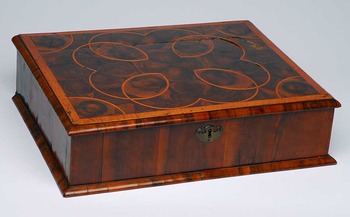
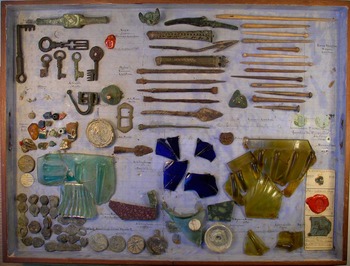
The ‘William Allen box’ was sold at auction in 2007Footnote 1 on behalf of a direct descendant of the collector, purchased by a third party and, after negotiation, acquired by the British Museum, with the generous support of the British Museum Friends and the Caryatids.Footnote 2 The collection appears to be a rare survival of a gentleman's collection of artefacts and curios put together during the Victorian period. This was a time when the rate of discovery of British archaeological sites was accelerating, often facilitated by digging work on the rapidly expanding railway network and new building projects, activities from which this particular collector, like others of the era, is known to have benefited.
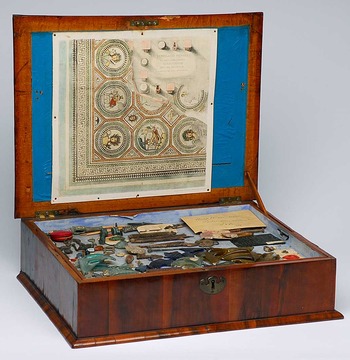
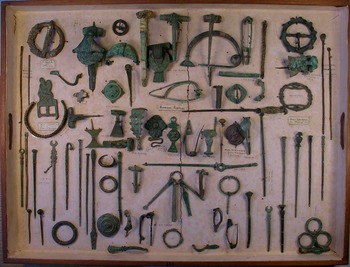
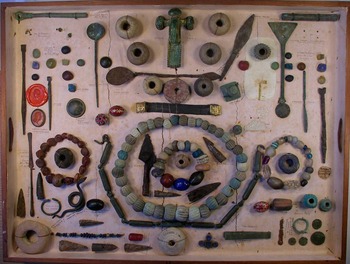
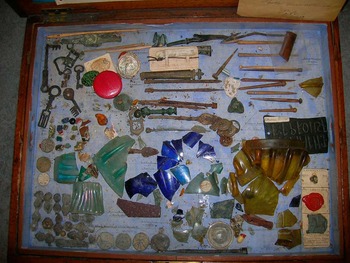
The wooden box, which dates to the late seventeenth century (the William and Mary period), is made of pine and inlaid with a variety of woods, especially walnut, with which it is also veneered (fig 1). Attached to the inside lid is a reproduction of the Seasons mosaic floor discovered at Dyer Street, Cirencester, in 1849, now in the Corinium Museum (fig 2).Footnote 3 Inside are three purpose-made paper-lined trays, numbered I, II and III,Footnote 4 with I at the top and III at the bottom. Trays II and III are lined with a plain white paper, yellow with age, whilst the uppermost tray (I) has a lined paper stained with blue ink.Footnote 5 The trays contain 263 items (some of which are fragments of a single object),Footnote 6 and these are either sewn or glued into position (figs 3–5) or are ‘free floating’ items attached to pieces of card.Footnote 7 Although the collection is quite eclectic, the majority of items are Romano-British. Fortunately, the collector was reasonably meticulous in noting the provenance of items, with findspots and other details carefully inked in by hand adjacent to the objects (often in Latin instead of English, for example, ‘ACI CRINALI’).Footnote 8 One of the commonest findspots cited is ‘Ad Fines’, which we know to be the Roman site of Braughing, Hertfordshire (see below). In fact much of the material comes from southern Britain, particularly from Hertfordshire and the Cambridgeshire Fens (see fig 22). The few foreign findspots associated with the objects are almost all Italian, from Rome and Sardinia or, in the case of a bronze Etruscan plaque, unprovenanced but assignable with some confidence to Etruria (see below).Footnote 9
The ‘William Allen box’. Photograph: © The British Museum

The ‘William Allen box’ before restoration, with its lid open. Photograph: © The British Museum

The bottommost tray of artefacts (marked ‘III’), after conservation, containing cat. nos 2–81. Photograph: © The British Museum

The middle tray of artefacts (marked ‘II’), after conservation, containing cat. nos 90–174. Photograph: © The British Museum

The uppermost tray of artefacts (marked ‘I’), after conservation, containing cat. nos 175–263. Photograph: © The British Museum

The Identity of the Victorian Collector
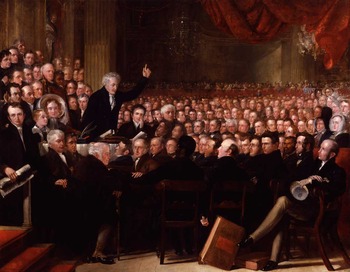
So who collected this material?Footnote 10 Preliminary research conducted by Judith Swaddling established that the box had been handed down through the Allen family. The most well-known members of the family, all devout Quakers, were Stafford Allen, who set up a pharmaceutical business (Stafford Allen & Sons) in the 1830s,Footnote 11 and his uncle, William, a prominent anti-slavery campaigner. Both are represented in Haydon's painting of 1841 in the National Portrait Gallery (fig 6).
Benjamin Robert Haydon's painting, Anti-Slavery Society Convention in 1840 (1841). William Allen, William's uncle, is seated directly below the speaker, whilst Stafford, William's brother, is in the second row down, to the far left of the column, wearing spectacles. Photograph: © National Portrait Gallery

Although the collector was highly likely to have been a member of the Allen family, the only means of determining precisely which family member amassed the collection has had to come from the box itself. The first point of note is that all but one item (cat. no. 242) is annotated with the same hand, so at least it is clear that we are dealing with only one person.
The first clue to the identity of the collector comes from the discovery (or acquisition) dates, which are occasionally written next to the artefact in question. These dated items are set out below in chronological order:Footnote 12
Cat. no. 263 (loose in box): ‘1837.’
Cat. no. 144 (Tray II): ‘From Icklingham Suffolk 1861.’
Cat. no. 103 (Tray II): ‘LONG: LANE: LONDON: 1866.’
Cat. no. 14 (Tray III): ‘AD.FINES. 1866’
Cat. no. 158 (Tray II): ‘SOUTHWARK. 1866.’
Cat. no. 240 (loose in box): ‘Fresco from Herculaneum, 1866.’
Cat. nos 171–174 (Tray II): ‘… found at Salaenae [sic] in 1866.’
No cat. no. (missing object) (Tray I): ‘Found in the “Wickens” at Ad. Fines. 1868.’
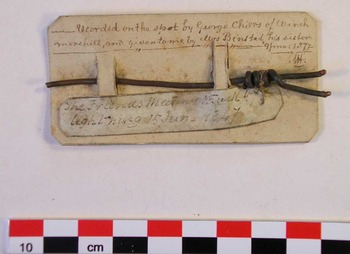
Cat. no. 262 (loose in box): ‘Recorded on the spot by George Childs of Winchmorehill, and given to me by Mrs Binsted, his sister [?] 1872. The Friends Meeting struck by lightning 15 June 1847. WA.’
Cat. nos 83 and 84 (loose in box): ‘Found with many others at Hythe in Kent. 1873’
Cat. nos 86 and 87 (loose in box): ‘Roman key, Fibula, & flint-bead. 1876’
Cat. nos 88 and 89 (loose in box): ‘Plated Roman pendant, found at Morden, Cambs., in 1883.’
Cat. no. 238 (Tray I): ‘From Astwick, Beds … 1890.’
Cat. no. 246 (loose in box): ‘… from Hitchin, Herts., 1892.’
Cat. no. 242 (loose in box). ‘… to become the property of G. Stafford Allen on my death. E.R. Allen 24/3/98.’
As can be seen, the dates span the years 1837–98. Most cluster in the 1860s, with 1866 (referred to in five instances) being a particularly ‘productive’ year. There is further evidence that the 1860s and 1870s were the key period for the collection of most of the material because that is when the assemblages at Croydon, Surrey, Braughing, Hertfordshire, and Hythe (Hayne Hill), Kent, were discovered, all of which are mentioned on labels in the box (see below).
The dates also hint at when the box was physically assembled. Most of the dated items are attached to card and not fixed into any of the trays; only a single item is dated in the uppermost tray (III), four in the middle tray (II) and two in the lowermost (I) (figs 3–5). But the general arrangement of the trays is systematic, and the artefacts seem to have been arranged broadly by type: Tray III consists mostly of brooches and other copper-alloy dress accessories such as pins; Tray II is mostly small non-metallic items such as beads (sometimes in contrived necklaces or bracelets) and tesserae, but also spindle whorls and ironwork, such as arrowheads; Tray I is more varied, but contains all of the bone artefacts, the keys, the fragments of glass vessels and other miscellaneous items, such as cloth seals. Overall, the impression given is that the collector took much more care with Tray III, which would appear to correlate with his particular passion for brooches (see below).
The box is therefore likely to have been created in a single event, rather than over a number of years. Almost all the items physically attached to trays were discovered between 1861 and 1868, and these dates span all three trays. The only exception is the find from Astwick, Bedfordshire (cat. no. 238), dated 1890, which might appear to contradict this pattern, but the object is one of three items attached to a piece of rectangular card so was originally ‘loose’. The card was subsequently glued into the bottom corner of Tray I at a point in time when most of the material had already been positioned, which is clear from the fact that the card overlays one of the annotations, which probably reads ‘Barh[am]’. It is believed, therefore, that the box was assembled after 1868, and – for reasons which will become clear – probably in the early 1870s.
The collector also seems to have changed his strategy halfway through securing the artefacts, switching from sewing in items with thread, the method used for almost all the objects in Tray III, to gluing for some of Tray II and the entirety of Tray I. Perhaps using thread was too time consuming and the owner simply switched to an easier method. This is unfortunate, because the glue invariably failed at a later date and meant that the appearance of Tray I, in particular, was poor and required a considerable amount of conservation (fig 7).
Tray I, prior to conservation. Photograph: © The British Museum

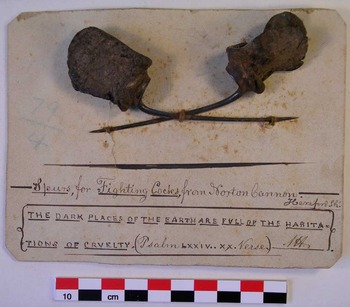
Apart from the evidence of dates, the other clue to the identity of the collector comes from initials and the occurrence of two full names. The two instances of initials are best read as: ‘WA’ (cat. nos 82 and 262; figs 8 and 9). The style of the writing associated with this monogram matches that of the rest of the box, which strongly suggests that ‘WA’ was the principal collector. The two instances of full names are ‘G. Stafford Allen’ and ‘E.R. Allen’, both of which occur in the pillbox containing a silver penny of William i (cat. no. 242; fig 10). Crucially, the handwriting used to annotate the pillbox differs from the rest of the box and, as it is signed by ‘E.R. Allen’, who cannot of course also be ‘WA’, we can at least exclude ‘E.R. Allen’ as the principal collector. As will become clear, this also accords with the box's history.
Cat. no. 82, a pair of cockspurs, annotated with the initials ‘WA’. Photograph: © The British Museum

Cat. no. 262, a piece of wire, annotated with the initials ‘WA’ and the date ‘1872’. Photograph: © The British Museum

Cat. no. 242, a pillbox containing a silver penny of William i (reigned 1066–87). This is the only item that displays a different hand to the rest of the box. Photograph: © The British Museum

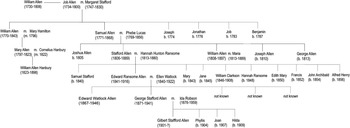
The logical conclusion, therefore, is that most, if not all, of the material was put together by one ‘W Allen’ who collected most of it in the 1860s and 1870s and furnished the box in the early 1870s. William Allen (1770–1843), Stafford Allen's uncle (fig 11), can be dismissed as the collector because he died two decades before the majority of the items were collected (details of his life are well known: he left a number of self-penned accounts of his travelsFootnote 13 and his work with both the Quakers and the anti-slavery convention).Footnote 14 It is conceivable that he may have contributed the Etruscan plaque (cat. no. 225), given that it was first recorded in Dempster's De Etruria Regali in Reference Dempster1723 (see description of cat. no. 225 below), and some of the other items of Italian origin (such as cat. nos 160 and 143 and the Venetian glass beads, cat. nos 106, 107 and 156), but no direct evidence for this has been found. Another candidate is William Clarkson Allen, Stafford Allen's son (1846–1908), but the earliest dated item in the box (the handkerchief, cat. no. 263, with the date ‘1837’) could not have been added by him, for obvious reasons, and the next earliest items would have had to have been acquired when he was a teenager, making it less likely that he made the collection. William Allen Hanbury (1823–98), on the Hanbury side of the ‘Allen and Hanbury’ pharmaceutical business, must also be considered. He was the son of Cornelius Hanbury (1796–1869) and Mary Allen (1797–1823), who died in childbirth. Mary was the only daughter of William Allen (see above) and his first wife, Mary Hamilton.Footnote 15 But the few known details of his life take him away from Britain during the main period when the artefacts in the box were being collected. In fact he spent most of his time abroad, having married a German countess, Maria, in 1861, and he died in Paris in 1898.
Partial Allen family tree

Attention finally settles on Stafford Allen's brother, William (1808–97). Two objects missing from the box,Footnote 16 both of which were annotated ‘Croydon’, are the starting point for his identification as the probable collector. William was known to have acquired all or most of the items in the Croydon hoard of Viking silver found in 1862 (the hoard and its subsequent history are discussed in more detail below by James Graham-Campbell). The second clue is the fact that William's coin collection was auctioned in 1898, a few months after his death.Footnote 17 This led to the brief but significant obituary for William in the Numismatic Chronicle of 1898, written by Sir John Evans, then President of the Royal Numismatic Society:Footnote 18
Although Mr. William Allen, of Sunnyside, Dorking, was not, at the time of his death in October last, a member of the [Royal Numismatic] Society, I venture to say a few words of one who deserved so well of numismatics. He joined the Society in January, 1861, and retired from it in 1874 … He was a diligent collector both of coins and antiquities, and for many years devoted much attention to obtaining specimens of the mintage of the numerous towns in which coins were struck in Saxon times. He had also an extensive collection of Romano-British coins. He was a man of great shrewdness, but also of a most liberal disposition, as I can personally testify, inasmuch as at the time when I was engaged on my ‘Coins of the Ancient Britons’ he most kindly ceded to me the specimens in his collection. He was a respected member of the Society of Friends, and attained to the ripe age of 89 years.
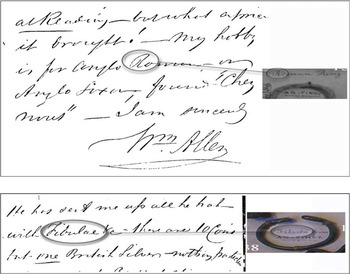
The final confirmation that this is the ‘correct’ William comes in the form of a number of letters written by William to Evans concerning the sale or passing of coins to Evans and other acquisitions and associates of both men.Footnote 19 Crucially, the style of the handwriting of the letters closely matches that of the writing in the box, even though the handwriting in the letters tends to slope more heavily to the right, as might be expected for cursive writing as opposed to the more careful script used for labelling (figs 12 and 13).
Two examples showing how closely the handwriting on one of the letters signed by William Allen to Sir John Evans matches the handwriting on one of the trays in the box

Although William does not mention the box of antiquities directly in these letters, there are a number of references to the purchase of artefacts other than coins. In a letter of 11 November 1864, for instance, when resident at Winchmore Hill, Enfield, north London, Allen states (unfortunately his handwriting is rather difficult to decipher):
At last I have hold of the Peterboro man that has been supplying British coins (I fear) to the late Bishop – he has sent me ago [?] all he had – with Fibulae etc – there are 10 coins but one British Silver – nothing particular in 3rd Brass of Sal: Barb: Orbiana in good condition, I'm familiar [?] with but [?] very poor, several 2nd brass of Nero, Nerva, Domitia & Agrippina, vc [?] poor [?] for [?] If most [?] [?] tribe revealed a & very good long Fibula, several broken ones – one shaped like an S [sketched] …’
Whether or not the last comment relates to the S-shaped piece of copper alloy (cat. no. 81 and fig 3) in the box is impossible to judge.Footnote 20 In another letter of 20 August 1869, when still resident at Winchmore Hill, Allen writes:
I have met with some bronze broochs lately – they were at Sandy in Bedfordshire – but the men [?] – having been told by a Jew pedlar that they were gold, it was long before I could get them, and when I did get them I had to buy heavily for them – they are nearly perfect – but were rubbed and scrubbed, still they are very interesting. One is at your service – about 15 to 18 Inches in diam:Footnote 21 but with a considerable hole in its side which I have repaired after a fashion …
There is a missing object in Tray I annotated as coming from Sandy, Bedfordshire, but no brooches that match this description – nevertheless, this extract clearly demonstrates William's interest in Roman brooches, which make up a large proportion of the box's contents, as does a letter of 1877, by which time Allen had moved to his final home at Sunnyside, Dorking, Surrey, from where he writes: ‘I am much obliged for the Wareham Brooch [??] W. [?] of [?] – consider your [sic] kind in sending it.’
Three earlier letters written by William to John Evans in 1864 unfortunately can no longer be traced.Footnote 22 These are important because they specifically refer to the passing of pieces of the Croydon hoard to Evans (see below). A brief extract from one is, however, provided by Thompson:Footnote 23
The following list of coins from this find is contained in a letter from William Allen to Sir John Evans, dated 25.8.1864: ‘of Aelfred 13 pennies, Eadmund 3 do, Ethelred 7 do, Burgred 61 do’. A few fragments [Oriental?] are mentioned as well as an uncertain coin, described by Allen as ‘a Syracuse penny’, and some broken AR ornaments.
These ‘AR ornaments’ could have included the two silver objects that were originally sewn into the box but subsequently removed (see discussion by Graham-Campbell, below).
When William died in 1897, it seems that the box passed into the hands of his nephews William Clarkson Allen and Edward Ransome,Footnote 24 and thence down through the family. Edward was responsible for the only instance of a different hand in the box, the red pillbox containing a silver penny of William i (cat. no. 242; fig 10). In William's will, both nephews are named as executors of his estate along with a third party, Metford Warner (see below), presumably because William did not have children of his own. The pillbox suggests that it was Edward Ransome who kept hold of the box and passed it on to his son, George, who also provides a link with Richard Allen, through whom the box was sold, because Richard recalls visits to his great-aunt, Ida Robson (1876–1959), George's wife, when they were occasionally allowed as children to view the box.Footnote 25 A close association with the family of his brother Stafford is indeed clear from William's will, for not only are Edward and William Clarkson executors of his estate but he also left money to his brother's other children, Francis (b 1852), John Archibald (b 1854), Alfred Henry (b 1856) and also nieces Jane (b 1845) and a Lucy Ann Lucas, who was not, it seems, a child of Stafford but of another of his brothers, although it has not been possible to establish which (fig 11).
The box was not auctioned with William's collection of coins in 1898 (see note 17), implying that the family decided to retain it as an heirloom, perhaps because it had sentimental value, whereas the coins would perhaps have been viewed as rather more useful for raising capital. In fact this proved to be the case, for the whole of William's coin collection was auctioned over four days, realizing a total of £1,195 5s 6d, the equivalent today of £100,000.Footnote 26
There is no obituary for William in The Friend, the journal of the Quakers, nor any mention in the unpublished Dictionary of Quaker Biography,Footnote 27 so that further details of William's life are difficult to establish. Key questions that remain unanswered are: Why was the box assembled and what purpose did it serve? We do not know the answers, but letters to Evans and census information fill in at least some aspects of William's life. We know that he was born at West Mill, Hitchin, Hertfordshire,Footnote 28 soon after the family moved from Essex, and the provenances of many of his finds suggest he retained strong ties with Hitchin and the family home, which his father, Samuel, continued to occupy until at least 1861.Footnote 29 In 1851, when William was forty-two, he was living in Woodgrange Place (which no longer exists), in Forest Gate, east London.Footnote 30 In the interim he married Maria,Footnote 31 who was born in Gracechurch Street in the City of London, so presumably they met in London. They shared their home with a niece, Emily Jane Darton, and nephew, Frank Darton,Footnote 32 and a servant. In this year the census records William as a ‘Paper stainer employing 40 men’.
By 1861, William had moved to ‘North Villa’, 50 Vicars Moor Lane, Winchmore Hill, Edmonton, north London,Footnote 33 with Maria, who was now forty-eight. He seems to have retired by this stage, as his occupation was noted in the census as ‘retired manufacturer’. The couple shared the house with three servants. The earliest of his letters to John Evans (discussed above) in the Ashmolean Museum archive, dated November 1864, was written at this time, so we know that he was actively collecting material. He is recorded in Kelly's Post Office Directory of 1867 and a rating valuation list of 1870, where his ‘House and garden’ is given a rateable value of £45.Footnote 34
The next information we have for William, from the 1871 census, is unexpected. William and Maria appear in Clevedon, Somerset, residing at 99 Hill Side.Footnote 35 William is here described as ‘Retired manufacturer and landowner’. The reason this is strange is that, by 1872, we know he had moved to his final residence in Dorking (see below). Perhaps the house in Clevedon was a second home, a coastal retreat which William and his wife happened to be occupying on the night of the census, 2/3 April. Or perhaps they had rented the house for a holiday or period of convalescence.Footnote 36
We know that in 1872 the piece of copper wire (cat. no. 262) was given to William by a Winchmore Hill neighbour, one Mrs Binsted, supposedly a piece of lightning conductor from the local Friends’ Meeting House (fig 9). As the date of acquisition is given as 1872, it is tempting to believe that it was presented as a neighbourly parting gift before Allen moved to Dorking. During this time William was also attending the Friends’ meetings at 12 Bishopsgate (known as Devonshire House), as indicated by notepaper annotated with the Friends’ House stamp that he sometimes used when writing to Evans.
So we know that William and Maria moved to Sunnyside, Falkland Grove,Footnote 37 Dorking, Surrey, in late 1872. With regard to this move, William says in a letter to Evans of 25 November 1872:
I have for the last few weeks been busy in moving from Winchmorehill to this place, and consequently all antiquarian matters have been suspended. I hope to feel sufficiently settled after a while to secure the coins [?] and shall be very glad to see you at my new home – which is rather near [?] to some interesting Roman Camps.
From what we can deduce from the date annotations on the box (see above), it is also around this time that William is likely to have assembled the box. Perhaps the move to Surrey provided the impetus for William to organize his collection in this way – a ‘retirement project’ of sorts – although it is possible that he had already assembled the box whilst living in Winchmore Hill, but probably not long before the move.
In the 1881 census, when William was seventy-two and Maria sixty-eight, the couple shared their Dorking home with two servants. William's profession is again described as ‘retired manufacturer’. Ten years later, in 1891, William was a widower, having lost his wife in the interim period,Footnote 38 and was now living with his housekeeper, Elizabeth Coe, and her assistant – the servants recorded in the 1881 census were no longer in his employment.
William died on 31 October 1897 and was laid to rest next to his wife in the Friends’ burial ground at Rose Hill, Dorking, a few hundred metres from the family home at Sunnyside. A plan of the graveyard shows the couple side by side in interments 43 and 50 respectively (fig 14).Footnote 39
Plan of the burial ground at the Friends’ Meeting House at Rose Hill, Dorking. Photograph: © Religious Society of Friends

William Allen, ‘retired paper stainer’
As we have seen, William was described in 1851 as a ‘Paper stainer employing 40 men’ before he retired aged about fifty. This profession links him with the naming in his will of Metford Warner (1843–1930). Warner – also from a Quaker family – was the sole proprietor from 1871 of Jeffrey & Co, one of the most prominent wallpaper manufacturers in Victorian England.Footnote 40 William's precise role within the business is unclear but, from what is known of the changes in the firm's operating name, he was at various times throughout its history a partner or company director. The firm was established in east London at Kent and Essex Yard, 1–9 Whitechapel High Street, in about 1836 as ‘Jeffrey, Wise and Co’ and became ‘Jeffrey & Wise’ in 1839, then ‘Jeffrey, Wise & Horne’ in 1842. Once William – assuming it is he – is named as a partner, the name changes to ‘Horne & Allen’ in 1843, then ‘Jeffrey, Allen & Co’ in 1858.Footnote 41 This coincides neatly with William's move to Forest Gate in east London, presumably in order to be close to his place of work, before 1851 (see above). It is not clear precisely when Allen retired from the firm, although it was sometime between 1851 and 1861, and the naming of Warner in his will would suggest his relationship with the board remained amicable at the very least. (Warner himself had joined the company as a junior partner in the 1860s, having been approached by ‘Jeffrey, Allen & Co’.)Footnote 42 Allen's move to Dorking in 1872 is perhaps related to Warner becoming sole proprietor of the business a year earlier – despite William having been ‘retired’ for some time, he may still have retained some interest in the business in an advisory capacity.
Why the firm underwent so many name changes is unclear, but it might be related to the registration of new designs. For example, in 1847 new patterns were registered by ‘Jeffrey, Allen & Horne’, which, it will be noted, was not a name under which the business itself seemed to have traded.Footnote 43
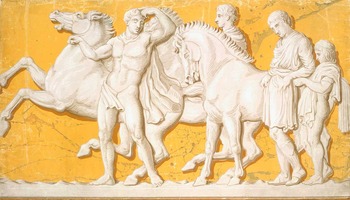
One of the most interesting aspects of William Allen's involvement with the business was a series of designs that the firm displayed at the Great Exhibition of 1851: ‘Jeffrey & Allen's display in the exhibition included machine and hand-printed patterns, large-blocked decorations – such as a frieze based on the Elgin marbles (24 feet long).’Footnote 44
It is now impossible to establish whether William was directly involved in commissioning this design but, given his clear passion for the past, it is an intriguing possibility. Three pieces of the wallpaper survive in the collections of the Victoria and Albert Museum (fig 15).Footnote 45
Section of wallpaper produced by Jeffrey, Allen & Co for the Great Exhibition of 1851. Photograph: courtesy of the Victoria and Albert Museum

The nature of the collection
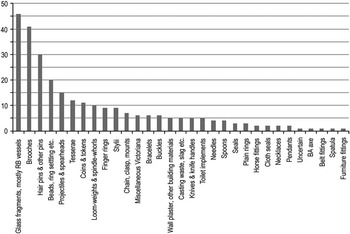
Allen's interest in brooches is clear not only from the letters he wrote to John Evans but also from the box's contents, in which there are forty-one brooches, making up 16 per cent of the total (fig 16). Brooches are only exceeded by the number of glass fragments (forty-six) but these derive from a far smaller number of vessels. Next come hairpins and other pins and needles (thirty) and beads and settings for rings (twenty). There are fifteen projectiles, all likely to be of medieval date, although Allen may have believed them to be Roman. There are twelve tesserae, probably from mosaic floors, and eleven coins and tokens, the inclusion of which is puzzling, given his separate, sizeable coin collection (see above). The rest of the artefact categories are represented by ten or fewer examples.
Histogram showing the number of different types of object in the William Allen box

Notable Items and Annotations in the Box (Arranged Chronologically)
Cat. no. 225: the Etruscan inscription
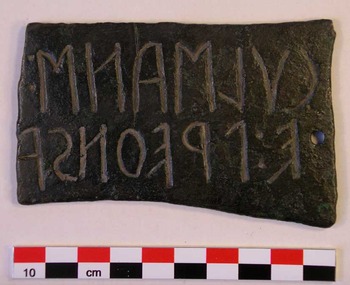
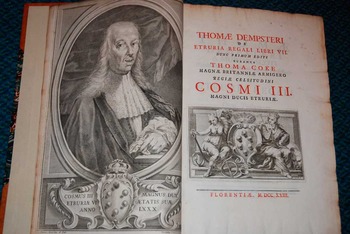
The Etruscan dedicatory inscription is written on part of a bronze plaque, and names the Etruscan deity Culsans, an important god in native Italian religion whom the Romans later equated with Janus (fig 17). Only a small number of such Etruscan bronze plaques survive. The hole at one end of this plaque, which would have borne the rest of the inscription, shows that it was once nailed up, perhaps beside a dedication or forming a dedication in itself. The left part of the plaque is broken away and missing. The inscription reads retrograde ‘Culsans:’ (punctuation mark) then on the second line ‘preonsa’, the meaning of which is unknown.Footnote 46 The plaque is known to have been in the collection of Filippo Buonarotti (1761–1837), great-great-nephew of Michelangelo, in Florence, where it was recorded in Dempster's De Etruria Regali in 1723 (fig 18).Footnote 47 There has been no recorded sighting of the plaque since then, though there is a modern (probably eighteenth- or nineteenth-century) lead copy in the Museum of the Etruscan Academy of Cortona, of which Buonarotti was for some time President. It is possible the plaque passed to England via a member of the Allen family. A possible candidate is William's uncle, William (1770–1843; see above), who, after visiting St Petersburg and Turkey, returned to England in 1820 via the Greek islands and Italy, stopping off in Florence in January of that year.Footnote 48 During his stay in the city, he records receiving a visit from local dignitaries ‘Count Ridolfi, the Marquis Pucci and Ferdinand Tartini Salvatici’ and, on 12 January, ‘Count Bardi, who introduced me to his colleague at the Museum Nesti’, who showed him Galileo's first telescope. But Allen does not make mention of receiving any gifts during this time, although he himself passed on a number of papers concerning his philanthropic work. After Florence, William travelled to Bologna, Modena, Parma, Piacenza, Milan and Turin, leaving Italy on 28 January.Footnote 49 (JS)
Cat. no. 225, the Etruscan bronze plaque. Photograph: © The British Museum

Dempster's De Etruria Regali, published in 1723, included the Etruscan inscription (see fig 17). Photograph: © The British Museum

Cat. no. 175: Enamelled ‘cheek piece’
This is one of a relatively small number of similar objects, dating to the mid-first century bc into the second century ad, made usually of copper alloy but sometimes of iron or antler. The item is a ‘toggle’-like metal bar with a rectangular central perforation with molten glass (‘enamel’) cells; the glass is very degraded but traces are still visible. The sides of the bar are waisted and the terminals flare slightly, although this is more pronounced on other examples. The terminals are decorated with tricorns which are now almost impossible to discern. This type of object is best known from the Polden Hills deposit of metalwork found in 1800 near Bridgwater, Somerset, which included nine such items, including four pairs.Footnote 50
Opinion remains divided as to the purpose of these objects. Although they could have functioned as cheek-pieces for a horse bridle, slotting on to the end of the mouthpiece of a bit, they have never been found in this arrangement.Footnote 51 This has led others to suggest that, instead, they were designed to link the trace leathers on a chariot to the body of the vehicle.Footnote 52 However, Palk argues that these objects are ‘rein stops’, as they strongly parallel similar objects of the late nineteenth century which were used to prevent rein-rings travelling up the reins and interfering with the rider's hands.Footnote 53 At the time of her study, Palk recorded twenty-five examples, and the recent ‘Technologies of Enchantment’ project added a further five (although this study restricted itself to decorated objects).Footnote 54 MacGregor plotted the locations of nineteen of these objects known at the time of writing and suggested a southern and south-easterly distribution;Footnote 55 this continues generally to be the case but new examples have now turned up in Scotland and Wales.Footnote 56 No examples seem to have been recorded from London, so this is apparently the first known from the capital, if the annotation ‘London Wall’ relates to this object rather than to the objects in the tray below. (RH)
Cat. no. 3: A ‘Kragenfibel’
One of the most notable brooches in Allen's collection is a ‘Kragenfibel’ (collared brooch) which depicts a female bust. These objects are rare in BritainFootnote 57 and it has not been possible to find an exact parallel, although there is no particular reason to doubt Allen's annotation that this was one of a number of objects from Braughing (‘Ad Fines’: see below). According to Hattatt, the type is ‘centred on Gaul as well as the Rhineland’.Footnote 58 The strongest parallels for this particular piece are a few similar brooches from the first-century bc oppidum at Titelburg, Luxembourg.Footnote 59 There is one in the Hull CorpusFootnote 60 but the example illustrated is from Bingen Museum.Footnote 61 (RH)
Cat. no. 103: A Roman intaglioFootnote 62
In Tray II there is a splendid ovoid carnelian intaglio, accompanied by a wax impression. It depicts a bust of Apollo, facing right, with laurel wreath and long flowing hair, set within a metal frame, and dates from the period from the second half of the first century to the second century ad. The intaglio is paralleled by a cameo in sard in the British Museum from Constantinople.Footnote 63 Even closer in style, although of first-century bc date, is a carnelian intaglio in the Royal Coin Cabinet in the Hague.Footnote 64 Henig does not include any examples from Britain in his corpusFootnote 65 and no comparable examples are known from London.Footnote 66
The intaglio is annotated ‘LONG: LANE. LONDON: 1866.’ This is probably a reference to Long Lane, Smithfield, in the City of London (as opposed to other ‘Long Lanes’ in London). The intaglio and a ceramic bead (cat. no. 157), similarly annotated, were probably found during the construction of new buildings on the Smithfield Market site, beginning in 1866.Footnote 67 However, it is also possible that the intaglio was found slightly earlier, because other excavations took place in 1865 for the extension of the Metropolitan Railway, which led to the discovery of at least one Roman burial,Footnote 68 and a grave would seem a likely context for both the gem and the bead. (RH)
Cat. no. 31: Garnet-inlaid bird pin
This early medieval pin is likely to be made from silver, although copper alloy is a possibility.Footnote 69 It has a decorative gilt terminal in the shape of a bird of prey with a strongly curved beak, a large round eye inlaid with a garnet, carved in the form of a bull's eye, and an ovoid body filled with interlace ornament. The bird's tail is fan-shaped and also inlaid with a garnet. A zone of grooved ornament decorates the pin shaft adjacent to the bird. While the shaft is fully preserved, it is broken in one place.
There is a small number of pins of various dates with bird elements,Footnote 70 for instance from Bifrons and Otford (both in Kent)Footnote 71 or Scarrington, Nottinghamshire,Footnote 72 but the only close parallel from Britain appears to be a silver-gilt garnet-inlaid pin from the Kings Field, Faversham, Kent.Footnote 73
Although pins like this example are rare in Anglo-Saxon contexts, they are not uncommon on the Continent. It is likely that Anglo-Saxon women wore different hair and veil fashions, which would explain why pins worn on the head and earrings never became popular here; while, conversely, linked pins were worn below the chin or on the upper chest in the seventh centuryFootnote 74 in England but are not found on the Continent.
Pins with a complete bird and associated forms are closely related to bird broochesFootnote 75 and occur in Frankish and in southern German Alamanic and Bajuvar contexts.Footnote 76 They are found singly in female graves and were usually worn more or less horizontally on the right side of the head, with the pointed end towards the back.Footnote 77 This means that the bird looked downwards, as though it was flying, and the decoration only covers the outer side of the pin. It is thought that they were used to fix a head covering or veil,Footnote 78 rather than being directly associated with the hairstyle.Footnote 79 Pins with the head of a bird of prey date to approximately ad 480–530 in France, the Rhineland and in south-western Germany.Footnote 80
That in Anglo-Saxon contexts they are mostly known from Kent is not surprising, as much of the late fifth- to early sixth-century Continental material is found in southern England. A Kentish provenance, as stated by an annotation in the box,Footnote 81 is therefore credible and may be related to antiquarian exploits of the nineteenth century or the extensive brick-earth quarrying or road and railway works taking place at the time. (SM)
The missing items from the Croydon Hoard
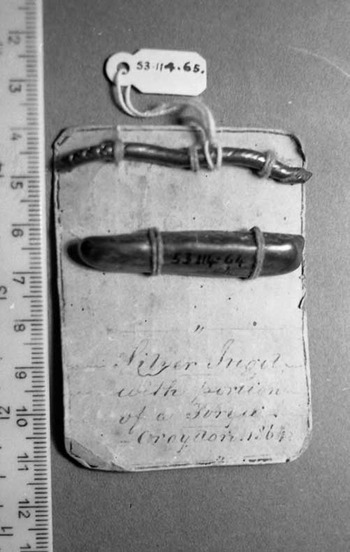
In the top left-hand and top right-hand corners of Tray II are empty spaces for objects annotated as having been found at ‘Croydon’ (‘Pt. of TORQVE’ and ‘SILVER INGOT’ respectively). These ‘missing’ objects can be identified with two pieces of silver bullion, now in the World Museum Liverpool, which are known to have formed part of a Viking-Age hoard found in 1862 near Croydon, Surrey, and to have been in Allen's possession.
In June 1862, workmen constructing the extension of the railway line from Balham to West Croydon, Surrey, chanced upon a Viking-Age silver hoard, consisting of some 250 coins and a few pieces of bullion, the discovery of which was announced by the Revd Henry Christmas in the Numismatic Chronicle for 1862, although earlier reported in August editions of the Croydon Journal.Footnote 82 All accounts agree that the hoard was contained in a linen bag, placed within some sort of stone container, described as ‘a coffin without a lid’. It has been estimated that it was deposited ‘probably in the winter of 872–3’,Footnote 83 with its terminus post quem being the accession of Alfred in April 871. It has been argued that it might have been buried ‘in summer or autumn 872’, given that the so-called ‘Great Army’ of the Danes was based in London for the year 871–2, before moving northwards to bases first at Torksey, Lincolnshire (872–3), and then at Repton, Derbyshire (873–4.)Footnote 84
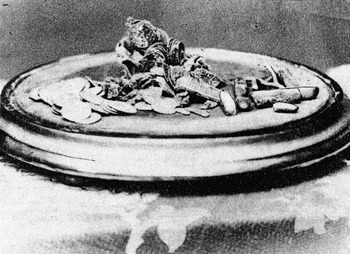
The half-rotten bag, at least 120 coins and seemingly all the pieces of bullion were acquired by William Allen – ‘a figure prominent in the life of Croydon at that period’Footnote 85 – through a local jeweller's shop (fig 19). Allen is known to have sold on over eighty coins to John Evans, most of which are now in the Ashmolean Museum, together with two complete ingots and four pieces of hack-silver, which were first illustrated, as a group, by Corbet Anderson in 1877.Footnote 86 In the Ashmolean catalogue (1909.556–561), these are attributed the date ‘Sept. 1862’, which was, presumably, when Evans thought them to have been found,Footnote 87 given the recorded existence of three letters from Allen to Evans concerning the negotiations, which are dated August to September 1864.Footnote 88 Evans subsequently published a ‘magisterial listing’ of his parcel in the Numismatic Chronicle for Reference Evans1866.Footnote 89
The Croydon hoard on display in a jeweller's shop window in Croydon soon after its discovery in 1862. Photograph: Blunt and Dolley Reference Blunt and Dolley1959, 223

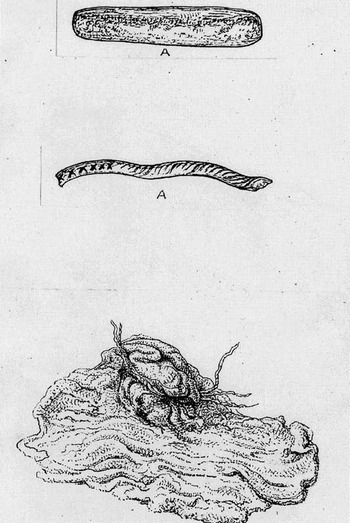
Anderson (Reference Anderson1877) illustrated a further complete ingot and a rod fragment (fig 20), together with the remains of the cloth bag, stating that all three were ‘Now in the possession of Wm. Allen, Esq.’.Footnote 90 The bag is no longer known to exist but the two pieces of silver, sewn onto a characteristic piece of card inscribed in William Allen's hand,Footnote 91 were eventually purchased by the well-known Liverpool collector, Philip Nelson, in the mid-twentieth century (fig 21).Footnote 92
Illustration of the two items likely to have been in the William Allen box, alongside the bag in which the hoard was found (published by Anderson in 1877). Photograph: © The British Museum

The two missing items of the Croydon hoard from the William Allen box, now in the World Museum Liverpool. Photograph: James Graham-Campbell

Neither the bag nor the two pieces of silver bullion were included in the auction of Allen's coins in March 1898 (see above), although the sale also included some medals and books. His Croydon coins were unprovenanced in the sales catalogue, but have been identified as lots 181–96; together these ‘form an entity out of sequence which confirms the theory of a common origin’.Footnote 93
It would seem, therefore, that these two pieces from the Croydon hoard were retained by William Allen after he had parted with the others to Evans. It may, however, be surmised that, at some point after 1887 (when illustrated by Anderson, as being in his possession) and before his death in October 1897, Allen removed them from the box and mounted them together on a card for presentation to some discerning friend and/or collector. Their subsequent history is unknown until Philip Nelson, in the early 1950s, sent a photograph of them to Haakon Shetelig, which was published in Viking Antiquities in Great Britain and Ireland.Footnote 94 (JG-C)
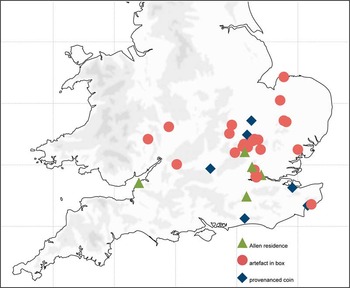
The Provenance of the Box Contents (fig 22)
Artefacts annotated ‘Ad fines’
The vast majority of artefacts with annotated provenances are indicated as originating from ‘Ad Fines’ (fifty-one items).Footnote 95 Although we can confidently identify this with the Roman town of Braughing, Hertfordshire, the Roman name for the site is not known. The spurious nature of the name ‘Ad Fines’ is explained by Rivet and Smith:
On 11 June 1747 the celebrated English antiquary William Stukeley received a letter from Charles Julius Bertram, a teacher of English in the Marine Academy in Copenhagen … a correspondence developed between them. In the course of this Bertram mentioned that a friend of his had in his possession a manuscript of ‘Richard of Westminster, being a history of Roman Britain, which he thought a great curiosity, being an antient [sic] map of the island annex'd’.Footnote 96
Map showing the provenance of the British material in the William Allen box and recorded findspots of his coin collection auctioned in 1898, a year after his death

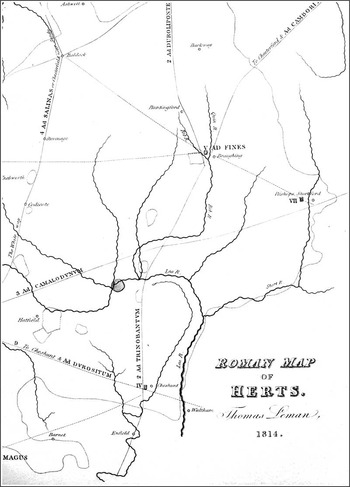
The itinerary became known as the De Situ Britanniae of ‘Richard of Cirencester’ (the ‘Westminster’ attribution was an error on the part of Bertram), and it was published by Stukeley in 1757.Footnote 97 Bertram produced another edition, also with a copy of the map, in the following year. Thus the itinerary entered the accepted body of reference material which those interested in Roman Britain could use as a ‘reliable’ source, which is how William Allen could have substituted the name ‘Ad Fines’ for finds made at Braughing. The source of reference for Allen might perhaps have been Clutterbuck,Footnote 98 which included a map with ‘Ad Fines’ clearly marked (fig 23).
Map published by Clutterbuck (Reference Clutterbuck1815), marking Braughing as ‘Ad Fines’

A large number of artefacts was recovered when the Great Eastern Railway cut through the edge of Wickham Field at Braughing in 1861.Footnote 99 These works also cut through a rectangular portico building which may have been a temple constructed in the first century ad, leading to the discovery of a ‘great many objects’ including ‘perhaps thousands of coins’.Footnote 100 It is known that most of these objects, and other items recovered from Larks Hill, ended up in private collections. Allen, with his strong ties to Hitchin,Footnote 101 would have been well placed to learn of these discoveries. It seems highly likely that he acquired a batch of finds, because in a number of places Allen tied objects into the box, marked the objects ‘X to Y’ (as appropriate) and added the annotation ‘from Ad Fines’. One object in the hands of another private collector is a copper-alloy bowl with inlaid enamel, found in 1861 and given to the British Museum by the Revd Charles Pullar in 1870.Footnote 102 As Partridge notes:
it was not until 1949 that the full significance of these earlier finds became clear, when John Holmes carried out the first controlled excavation in a corner of Wickham Field close to the railway line. Here he found indisputable proof of a Roman town with streets and masonry buildings.Footnote 103
Cat. nos 231–233: ‘Colchester rooms’
Three items in Tray I, all pieces of decorative stone, are annotated ‘Colchester rooms’. Although it is not certain to what this refers, it seems most likely to concern Josiah Parish's excavations of a Roman house at North Hill, Colchester, in February 1865,Footnote 104 generally known as Insula IX. The site came to light when a local man, one Mr Halls, uncovered part of the remains in his garden when ‘double trenching’ to remove the roots of a walnut tree. This led to the discovery of a tessellated pavement and the Essex Archaeological Society was contacted.Footnote 105
It seems that the partial pavement, which was lifted, as well as other finds from the site including ‘fragments of Samian Ware … a Roman stylus … a Roman spearhead… 3 small silver rings … a bronze box’, were ‘preserved … in the Society's Museum in Colchester Castle’, now Colchester Castle Museum. What remains of this mosaic is in the museum's collection.Footnote 106 There is no mention of architectural fragments in the report and the local museum does not have any similar pieces, so it is difficult to know for certain that Allen acquired these objects directly from Mr Halls, which would seem the only means by which he could have come by them. There is, however, a comment at the beginning of Parish's note, which may hint at the passing of some items into private hands:
The Society sought Mr Halls's permission to prosecute the excavation … and the warmest thanks are due to Mr Halls for the very kind and liberal manner in which he allowed his garden to be dug up by the excavators and invaded by a host of curious visitors.Footnote 107
Maybe one of these ‘curious visitors’ was an acquaintance of Allen, or Allen himself.
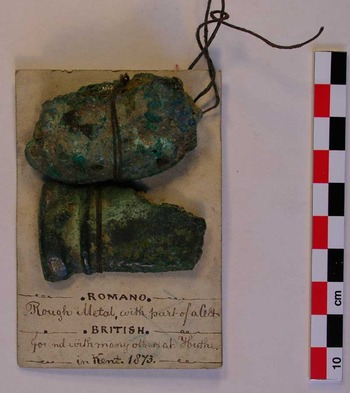
Cat. nos 83 and 84: Hythe, Kent (fig 24)
These two objects are annotated ‘Found with many others at Hythe in Kent, 1873’. They can almost certainly be attributed to a Bronze Age hoard found at Hayne Wood,Footnote 108 Saltwood, Kent, and first reported in The Archaeological Journal.Footnote 109 The hoard was:
discovered during excavations making for the branch line of the South Eastern Railway to Hythe and Sandgate … [the assemblage consists] of celts, swords or daggers, gouges, and a few articles which cannot easily appropriated … of celts there are twenty-one, mostly incomplete.
Cat. nos 83 and 84 from the Hythe hoard, Kent (1873). Photograph: © The British Museum

Earlier in the discussion, the hoard's communicator mentions ‘a number of rough ingots of metal, apparently of copper’. This would suggest that Allen acquired one fragment of a socketed axe (‘celt’) and one of these ingot fragments. In 1938, the hoard was re-assembled at the British Museum and published more fully.Footnote 110 The date of discovery is given as 4 June 1872 and Osborne's note says that ‘Most of the objects came into the possession of the late Mr. W. T. Tournay, while others became the property of Mr. H. B. Mackeson’.Footnote 111 These two collections were eventually passed to HytheFootnote 112 and Folkestone Museums respectively. No mention is made of William Allen and for the purposes of recording the hoard only the two local museum assemblages were reunited for recording and photography.Footnote 113 Neither of Allen's pieces appear in the photograph, which is not surprising; it would seem unlikely that Osborne was even aware that these two pieces were still in private hands. How Allen came by them is unknown.
On the card to which these pieces are attached is the annotation ‘Romano-British’. This misinterpretation of the date of these objects was an error also made by Roach Smith in his Catalogue of the Museum of London Antiquities, published in 1854.Footnote 114 Nevertheless, it is curious that, at the time when William Allen acquired his two pieces, he should repeat the misconception, particularly as his friend John Evans would soon publish his seminal Ancient Bronze Implements (Reference Evans1881) and the Three Age system was by then well established.Footnote 115
The William Allen Box in Context
William Allen's box of antiquities and curios provides an insight into his antiquarian interests and personal convictions, but where does his collection fit in the context of the time when it was assembled?
The first point is that Allen's box and its contents represent only a small part of his antiquities collection. The auction held after his death in 1897 shows that coins and, to a lesser extent, medals were his primary passion, for his numismatic collection dwarfs the 260 or so objects in the box. Over the course of four days, 3,624 coins, 187 medals and 61 books were auctioned (with only a handful of lots withdrawn) by Sotheby, Wilkinson & Hodge at their premises on the Strand (see above). Allen possessed coins covering the whole of British history, including an assemblage of medieval coins from a diverse range of mints and kings. Some of the medals give us a glimpse into other aspects of his business, antiquarian and Quaker life. Lot 611 included medals ‘commemorative of the Abolition of Slavery in the British Colonies, and the Jubilee of the London Missionary Society, 1844’; lot 616 included ‘Corporation of London Medals commemorating the Visit of Princess Alexandra of Denmark to the City in 1863, and the Opening of the New Coal Exchange by Prince Albert in 1849’;Footnote 116 whilst lot 610 had ‘Prince Albert on the Exhibition of 1851’ and lot 615 included the ‘Evans Medal commemorating the Jubilee of the Numismatic Society of London, 1887’. These pieces help to place Allen at the heart of commercial life in the city of London during an extraordinarily prosperous and mercurial period in British history.
Allen was forming his collection at an interesting time in the development of antiquarian studies, too. His closest direct association was with Sir John Evans (1823–1908), with whom he corresponded and to whom he sent coins, and Evans's appreciation of William is clear from his warm obituary (see above). Evans's own collection of about 1,500 objects, spanning the Roman period in Britain to the seventeenth century, remains a core component of the Ashmolean Museum.Footnote 117 It may be the case, although it has not been possible to establish this for certain, that their initial contact came through business. Evans was, after all, a partner in Dickinson & Co, one of the most successful paper manufacturers of the Victorian period, and formed the Paper Makers’ Association in the middle of the nineteenth century,Footnote 118 whilst Allen himself was a partner in a related enterprise, as we have seen. One wonders if the Paper Makers’ Association is where Allen and Evans first made their acquaintance and discovered a mutual interest in antiquarian matters.
William was also a contemporary of Charles Roach Smith (1806–90), although it is not known whether the two men were directly acquainted. Roach Smith's meticulous recording of findspots and principled desire to make his collection available to others through publication (and his own private museum) provides an important context for the compiling of William Allen's box. The British Museum purchased Roach Smith's collection of 5,000 items for £2,000 in 1855,Footnote 119 including over 700 artefacts of the Roman period. Most of Roach Smith's material is from London, and this is perhaps why Allen, despite living and working in London for most of his life, had relatively few artefacts from the capital. Allen instead seems to have turned most of his collecting focus towards his family home in Hitchin and its environs. Even if he was not personally acquainted with Roach Smith, Allen might have been influenced to keep his own notes of provenance and dates of discovery or acquisition by his awareness that other collectors promoted this practice.
The intellectual climate surrounding the collection of British antiquities was in an interesting state of transition at this time. Roach Smith himself ‘had no sympathy’ for a ‘social and educational climate of opinion in Britain … not yet inclined to consider useful the study of the daily life of these anonymous people whose remains formed the mass of the archaeological record’;Footnote 120 for the study of the material remains of Britain was in its relative infancy during the late Victorian period, and many antiquarians effectively ignored British archaeological material in order to focus their intellectual and collecting energy beyond these shores. As MacGregor notes,Footnote 121
In 1851, the year in which the Great Exhibition boosted national pride to unprecedented levels, we find one respected commentator observing that ‘We are absolutely at this time, without any collection that can truly be called British. It is true that we have a British Museum, but in vain will you seek, within the walls of that now gigantic building, any collection of British remains.’
Evans's own collection was bequeathed to the Ashmolean; that of the Revd Bryan Faussett, a well-documented assemblage of artefacts from Anglo-Saxon cemetery sites in Kent, was sold to a private collector who later bequeathed it to Liverpool Museum,Footnote 122 which caused something of a scandal at the time.Footnote 123 But the tide was most definitely on the turn when Roach Smith's collection was purchased, if rather reluctantly, by the British Museum trustees in 1855, and when Augustus Wollaston Franks (1826–97), a contemporary of both Allen and Evans, a friend of the latter and himself a prominent collector, became the very first Keeper of the British Museum's newly formed department of British and Medieval Antiquities and Ethnography.Footnote 124 It seems fitting, therefore, that William Allen's collection should eventually find its home in what is essentially the modern-day equivalent of the same department in the British Museum, called ‘Prehistory and Europe’ in its latest incarnation. It would be nice to think that William himself would be satisfied with this outcome.
Acknowledgements
The acquisition of the box would not have been possible without the considerable efforts of Judith Swaddling, my colleague in the British Museum's Department of Greece and Rome. Judith also contributed a great deal to the initial genealogical work on the Allen family, for which I am heavily indebted. Judith was assisted in her genealogical research by her departmental colleagues, Paul Roberts and Victoria Turner. A considerable amount of cleaning and conservation work was carried out by my colleagues, Philip Kevin and Fleur Shearman. I thank all the members of the Society of Friends who offered advice and assistance, including the staff at the Library of the Society of Friends, particularly Graham Dalling (Warden of the Friends’ Meeting House at Winchmore Hill), Denise Davies (Warden of the Dorking Quaker Meeting) and Josef Keith. Assistance on other aspects of William's life and collection were provided by Christine Edbury, Cathy King and Arthur MacGregor at the Ashmolean Museum, Oxford, Lizzie Mould at Croydon Local Studies and Archives Service, Michael Parry at Sanderson, Gill Saunders at the Victoria and Albert Museum and Christine Woods at the Whitworth Art Gallery, Manchester. The Ashmolean kindly provided transcripts of the letters from Allen to Evans. For advice on items in the box and their provenances I thank Ashley Cooke, of the Nelson Collection, World Museum Liverpool, Hilary Cool (especially for her advice on the glass and other finds), Nina and Philip Crummy and Paul Sealey in Colchester, the late Geoff Egan, of Museum of London Archaeology and latterly of the Portable Antiquities Scheme, James Graham-Campbell, Martin Henig, Ben Roberts and John Smythe (on Bronze Age hoards from Kent) and my British Museum colleagues Chris Entwistle, Ralph Jackson, Ian Jenkins, Jody Joy, Sonja Marzinzik, James Robinson and Gareth Williams.