Introduction
The concept of Parmelia Ach. has changed in the last few decades, starting with acceptance of the name Parmotrema A. Massal. by Hale (Reference Hale1974a), followed by many generic segregations based mainly on the morphological characters of the vegetative thalli and on the chemistry of secondary metabolites (e.g. Hale Reference Hale1974b,Reference Halec, Reference Hale1984, Reference Hale1986, Reference Hale1988, Reference Hale1989; Esslinger Reference Esslinger1981; Krog Reference Krog1982; Elix et al. Reference Elix, Johnston and Verdon1986; Sipman Reference Sipman1986; Elix & Hale Reference Elix and Hale1987; Hale & Fletcher Reference Hale and Fletcher1990; Nash et al. Reference Nash, Hafellner and Common1990; Kurokawa Reference Kurokawa1991; Henssen Reference Henssen1992).
Phylogeny, based on molecular markers, has supported many of the proposed generic concepts, although several morphological characters proved to be homoplasic so that some generic segregations were polyphyletic (Hawksworth et al. Reference Hawksworth, Blanco, Divakar, Ahti and Crespo2008).
When Elix & Hale (Reference Elix and Hale1987) segregated five new genera from Parmelina Hale (Canomaculina Elix & Hale, Myelochroa Elix & Hale, Parmelinella Elix & Hale, Parmelinopsis Elix & Hale and Parmotremopsis Elix & Hale), they included Parmelia lindmanii Lynge in the genus Myelochroa. This was based mainly on the chemical components of the medulla, the centres of distribution, the habitat requirements, the nature and distribution of the cilia, the lobe and rhizine morphology and the size of spores and conidia.
Later, Kurokawa & Arakawa (Reference Kurokawa and Arakawa1997) recognized three groups in Myelochroa, two of them (M. galbina group and M. aurulenta group) characterized by the production of triterpenoids, while the third (M. immiscens group), which includes Parmelia lindmanii, does not produce these secondary metabolites. Moreover, they pointed out that in the third group the species have rather broad irregular lobes with rounded apices, features that could indicate that species belonging to this group could be more closely related to Parmotrema and subsequently transferred them to that genus. This concept, however, has not gained acceptance by other lichenologists (e.g. Hale & DePriest Reference Hale and DePriest1999; Eliasaro & Adler Reference Eliasaro and Adler2000; Spielmann & Marcelli Reference Spielmann and Marcelli2008), because Parmelia lindmanii has many characteristics that are not present in Parmotrema (Spielmann & Marcelli, Reference Spielmann and Marcelli2008).
Parmelia lindmanii closely resembles Parmellinella aff. wallichiana (Taylor) Elix & Hale, an undescribed species previously reported from Brazil as Parmelinella wallichiana by Eliasaro & Adler (Reference Eliasaro and Adler2000). The two species occupy the same habitat and have a similar thallus morphology with irregularly branched lobes, 1·5–3·0 (5·0) mm wide, with rounded apices, simple cilia, up to 0·5 mm long restricted to the axils, upper surface grey to greenish grey, with cylindrical to subglobose isidia, centre of lower surface with simple black rhizinae, medium to pale brown margins, 1·0–4·0 mm wide, naked or papillate, and conidia bifusiform, 5·0–9·0 mm long. The main difference between these two species is the presence of medullar secalonic acids in Parmelia lindmanii instead of salazinic acid that occurs in Parmelinella aff. wallichiana.
The present paper evaluates the phylogenetic relationship of Parmelia lindmanii using the nuclear ITS (nuITS) region of the ribosomal DNA of 31 parmelioid taxa considered by Blanco et al. (Reference Blanco, Crespo, Ree and Lumbsch2006) and Divakar et al. (Reference Divakar, Crespo, Blanco and Lumbsch2006) as being closely related to the genera in which this species has been included and species that are morphologically similar to P. lindmanii.
Materials and Methods
Material
Fresh specimens of Parmelia lindmanii (S. Eliasaro 3131) and Parmelinella aff. wallichiana (S. Eliasaro 3132) were collected from trees growing in the Centro Politécnico, Universidade Federal do Paraná, Curitiba, Paraná State, Brazil. These specimens are deposited in UPCB.
DNA extraction, PCR amplification and DNA sequencing
Samples of freshly collected specimens were cleaned under a stereoscopic microscope and ground in 1·5 ml Eppendorf tubes with sterile plastic pestles (Eppendorf®). Total genomic DNA was extracted according to a modified CTAB method (Cubero et al. Reference Cubero, Crespo, Fatehi and Bridge1999). Dilutions of 1:10 of the DNA-extracts were used for PCR amplification of the ITS regions, including the 5.8S gene of the nuclear rDNA. The fungal-specific primers ITS1F (Gardes & Bruns Reference Gardes and Bruns1993) and ITS4 (White et al. Reference White, Bruns, Lee, Taylor, Innis, Gelfand, Sninsky and White1990) were used to amplify the nuITS rDNA regions.
Amplifications were performed in 30 μl volumes containing a reaction mixture of 6·0 μl 5 × DNA polymerase buffer (Promega®), 7·0 μl H2O, 2 μl dNTPs (5 mM), 1·5 μl of each primer (10 pM), 0·15 μl of Taq DNA-polymerase (5U/μl), 1·8 μl MgCl2 (25 mM) and 10 μl DNA extract (1:10 dilution). The amplifications were carried out in an automated thermocycler (Mastercycler Gradient – Eppendorf) and performed using the following temperature programme: an initial denaturation step at 94ºC for 7 min. and 35 cycles of: 94°C for 45 s., 50°C for 45 s., 72°C for 1·5 min., and a final extension at 72ºC for 6 min.
PCR products were cleaned using QIAquick® spin columns (Qiagen) and quantified on 1% agarose gel stained with ethidium bromide. Both complementary strands were sequenced using the same primers as for PCR amplifications. The sequencing was performed using the DYEnamic ET Terminator Kit (GE Healthcare), according to the manufacturer's instructions. Sequences were obtained after electrophoresis on an ABI PRISM 377 automated DNA sequencer (Applied Biosystems).
Phred software was used as base caller and to assign quality values (Ewing et al., Reference Ewing, Hillier, Wendi and Green1998). The Phrap program was employed to assemble the shotgun DNA sequence data and the Consed program for viewing, editing, and finishing the sequence assemblies (Ewing & Green Reference Ewing and Green1998; Gordon et al. Reference Gordon, Abajian and Green1998). The sequences are deposited in GenBank under accession numbers GQ267190 (Parmelia lindmanii) and GQ267191 (Parmelinella aff. wallichiana).
Data analysis
The new ITS rDNA sequences now obtained, and sequences downloaded from GenBank of representatives of the genera, Parmotrema, Parmelina, Parmelinella, Bulbothrix Hale, Hypotrachyna (Vain.) Hale and Myelochroa (GenBank accession numbers shown in Fig. 1) were aligned using ClustalW included in MEGA 4 (Tamura et al. Reference Tamura, Dudley, Nei and Kumar2007), giving rise to a data set with 34 taxa. The final alignment was manually edited in regions where ambiguity was observed.
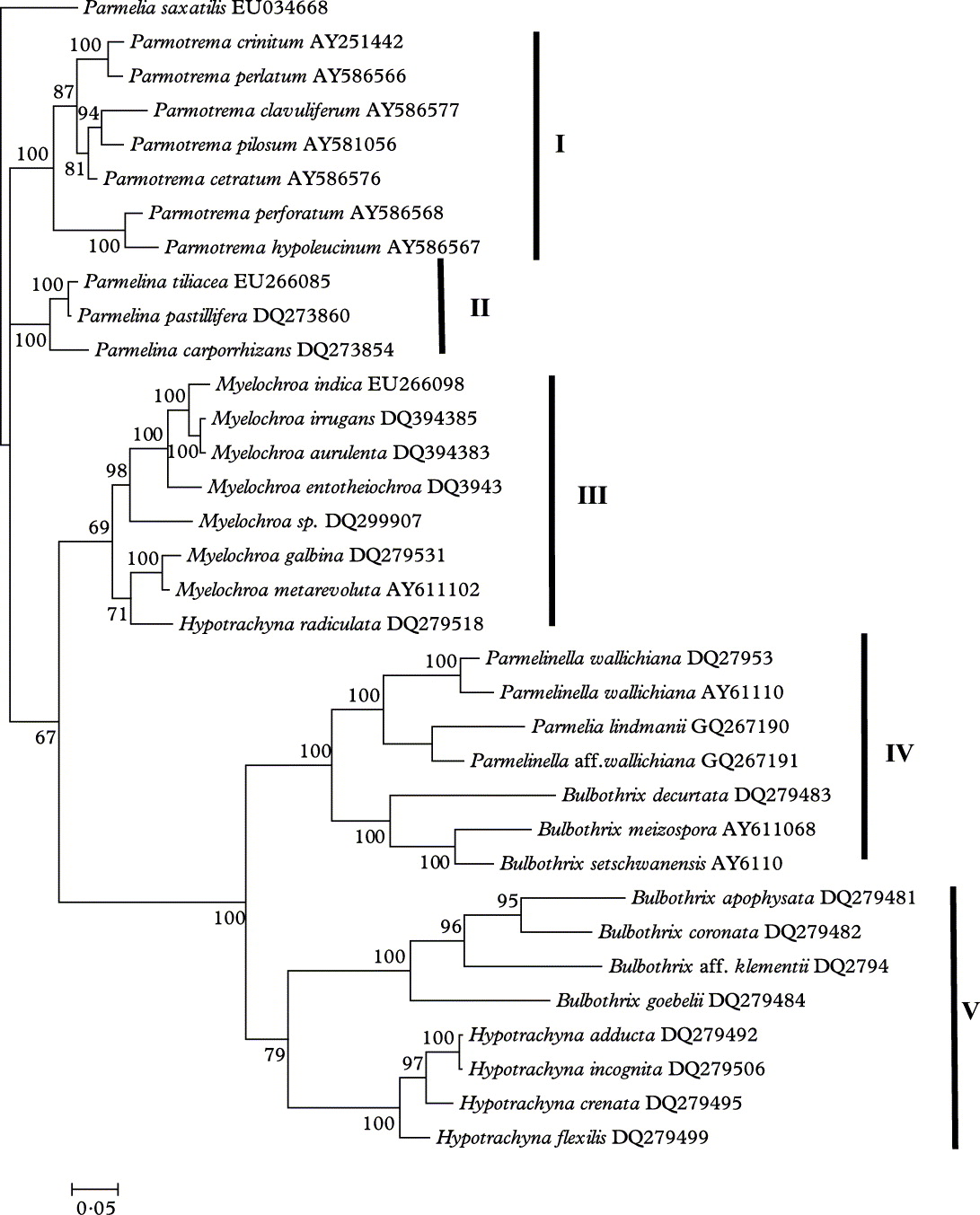
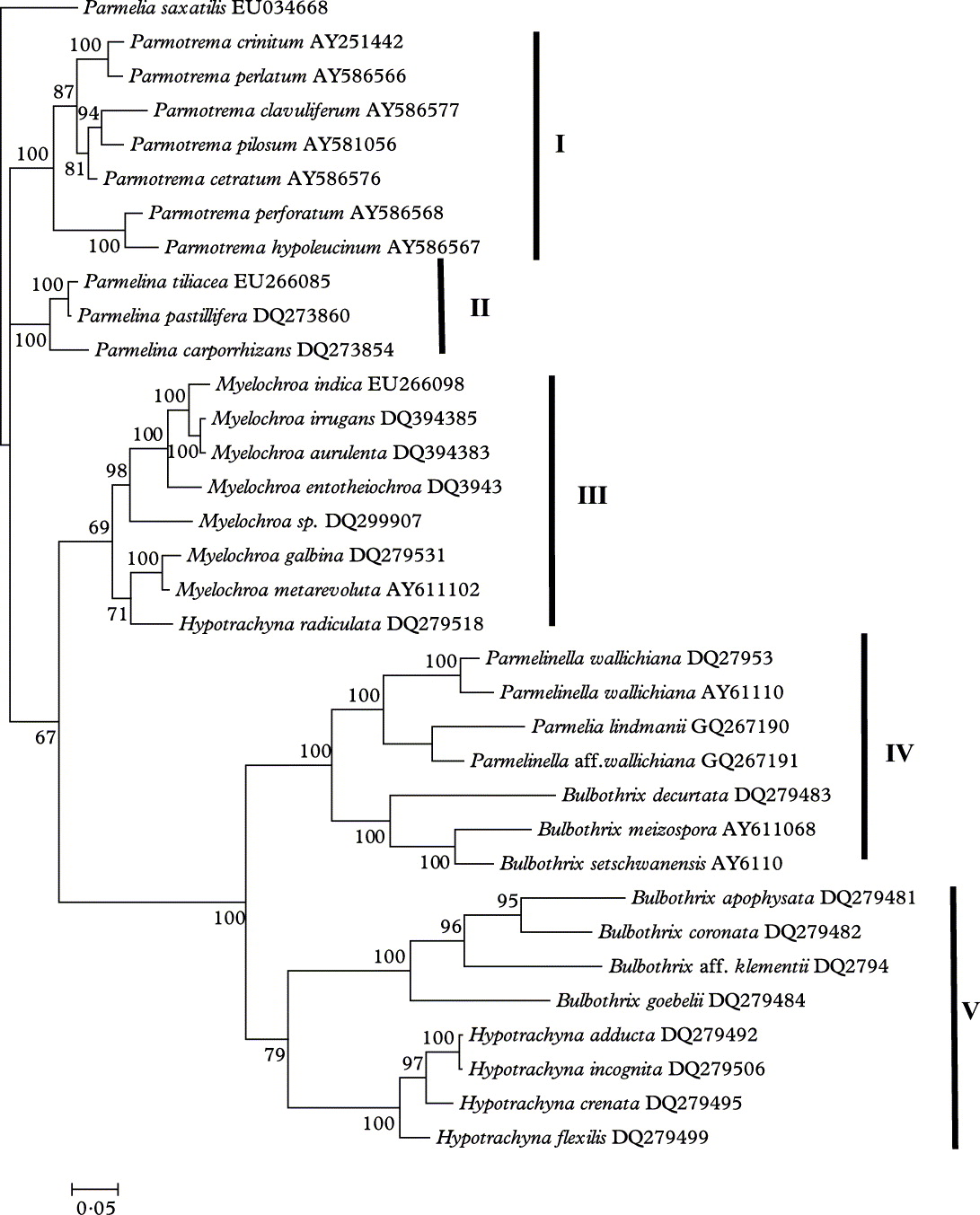
Phylogram inferred from a Bayesian analysis, based on ITS1-5.8S-ITS2 rDNA dataset, using a GTR+I+G model. Numbers at nodes indicate posterior probabilities. The tree was rooted using Parmelia saxatilis as outgroup. Scale bar: substitutions per site.
The alignment was analyzed by Maximum Parsimony (MP) and a Bayesian approach (B/MCMC). The MrBayes 3.1.2 program (Huelsenbeck & Ronquist Reference Huelsenbeck and Ronquist2001) was employed to sample trees. The analysis was performed, assuming the general time reversible model of nucleotide substitution (Rodriguez et al. Reference Rodriguez, Oliver, Martin and Medina1990) including estimation of invariant sites and also assuming a discrete gamma distribution with six rate categories (GTR+I+G). The nucleotide substitution model was selected using the Hierarchical Likelihood Ratio Test (hLRT) and the Akaike Information Criterion (AIC) with PAUP/MrModeltest 2.3 (Nylander Reference Nylander2004).
Posterior probabilities were approximated by sampling trees using the Markov Chain Monte Carlo (MCMC) method. Parallel runs were made with 2 000 000 generations starting with a random tree, using a default temperature of 0·2 and employing four simultaneous chains for each one. Trees were sampled every 100 generations, yielding 20 000 trees, while the first 6 900 were discarded as the “burn-in” of the chain. The remaining trees were joined in one file and a consensus phylogram was calculated showing mean branch lengths using the sumt command in MrBayes. The phylogenetic tree was drawn using the program MEGA 4 (Tamura et al. Reference Tamura, Dudley, Nei and Kumar2007). Posterior probabilities equal to or above 95% were considered strong supports.
A Maximum Parsimony (MP) analysis was performed using MEGA 4 software (Tamura et al. Reference Tamura, Dudley, Nei and Kumar2007). Ten thousand bootstrap replications were performed to assess confidence values for trees. The MP tree was obtained using the Close-Neighbor-Interchange algorithm (Nei & Kumar Reference Nei and Kumar2000) with search level 1 (Felsenstein Reference Felsenstein1985; Nei & Kumar Reference Nei and Kumar2000), in which the initial trees were obtained with the random addition of sequences (10 replicates). All positions containing gaps and missing data were eliminated from the dataset (Complete Deletion option). Parmelia saxatilis was used as outgroup.
Results and Discussion
Our sequences from Parmelia lindmanii and Parmelinella aff. wallichiana were aligned with 32 sequences of parmelioid lichens selected because they are closely related to the genera in which P. lindmanii had been previously included, or because they are morphologically similar.
The final alignment was 486 positions in length with 363 variable characters. A parsimony analysis resulted in 5 most parsimonious trees (tree length = 499 steps, CI = 0·44 and RI = 0·71). One hundred and twenty positions in the matrix were parsimony informative. In the B/MCMC analysis, the likelihood parameters in the sample had the following mean values (variance): likelihood (LnL) = − 4412·80 (± 2·43), base frequencies π(A) = 0·2102 (± 0·0002), π(C) = 0·3060 (± 0·0002), π(G) = 0·2434 (± 0·0002), π(T) = 0·2402 (± 0·0001), rate matrix r(AC) = 0·0895 (± 0·0001), r(AG) = 0·1920 (± 0·0005), r(AT) = 0·1488 (± 0·0003), r(CG) = 0·0461 (± 0·00008), r(CT) = 0·4477 (± 0·0008), r(GT) = 0·0756 (± 0·0001), the gamma shape parameter alpha = 1·365 (± 0·094), and the pinvar = 0·3856 (± 0·0012).
Since the overall topologies of the MP and Bayesian analyses were identical, only the majority-rule consensus tree obtained in the B/MCMC analysis is shown (Fig. 1). The topology recovered in our tree is in agreement with the topology of trees obtained by Bayesian analysis of other loci, such as nuLSU rDNA, mitochondrial SSU rDNA, and the protein coding RPB1 gene (Blanco et al. Reference Blanco, Crespo, Divakar, Esslinger, Hawksworth and Lumbsch2004, Reference Blanco, Crespo, Divakar, Esslinger, Hawksworth and Lumbsch2006; Divakar et al. Reference Divakar, Crespo, Blanco and Lumbsch2006; Crespo et al. Reference Crespo, Lumbsch, Mattsson, Blanco, Divakar, Articus, Wiklund, Bawingan and Wedin2007). The tree shows the same supported relationships between Parmelinella and some species of Bulbothrix and Hypotrachyna, and between Parmelina and Myelochroa demonstrated by Blanco et al. (Reference Blanco, Crespo, Ree and Lumbsch2006) and Divakar et al. (Reference Divakar, Crespo, Blanco and Lumbsch2006).
Five clades were found in our analysis (Fig. 1). The strongly supported clade I includes only the large genus Parmotrema, while clade II includes only species of Parmelina. Clade III includes species of Myelochroa and one species of Hypotrachyna [H. radiculata (Kurok.) Elix]; i.e. all the Myelochroa species that produce terpenes. This result agrees with that of Kurokawa & Arakawa (Reference Kurokawa and Arakawa1997), who considered that Myelochroa would be better characterized if it included only species containing terpenes. Clade V includes species of Hypotrachyna and Bulbothrix and the well-supported clade IV includes those of the genera Bulbothrix, Parmelinella and our sample of Parmelia lindmanii.
Our results showed Parmelia lindmanii and Parmelinella aff. wallichiana clustered within the clade IV that contains the type species of Parmelinella. Three Bulbothrix species (B. decurtata, B. meizospora and B. setschwanensis) also clustered within this clade, closely related to the group of Parmelinella. This clade IV corresponds to clade F of Divakar et al. (Reference Divakar, Crespo, Blanco and Lumbsch2006) and contains species with short simple cilia, up to 0·5 mm, mainly restricted to axils of the lobes, simple rhizines, and baciliform to bifusiform conidia, 5·0-9·0 μm long.
We have now demonstrated that Parmelia lindmanii does not belong to the genus Myelochroa and should be referred as a Parmelinella. However, any nomenclatural modifications should not be made until further molecular analysis has been carried out on clade IV, including sequences from Myelochroa immiscens (Nyl.) Elix & Hale and other species of Parmelinella.
This research was supported by a grant from the Brazilian CNPq foundation (Projeto Universal 2008, no. 477409/2008-3). The authors gratefully acknowledge Dr Eric Smidt for valuable discussions and help with the PAUP/MrModeltest analysis and Dr Phillip A. J. Gorin for improving the English text.