Introduction
Coconut palm, Cocos nucifera L. (Palmales: Arecaceae), also called ‘Tree of Life’ in the Indian Ocean, has a key importance to the livelihoods of farming communities in coastal areas of tropical and subtropical regions in the world (Foale, Reference Foale2003). All parts of the plant are used in different consumption forms. The dried coconut kernel, also called Copra, is a significant cash crop throughout the tropics. The leaves are used to thatch or are woven into baskets, mats and clothing. The trunks are used for construction. The mesocarp is widely used as domestic fuel or as planting medium (Vietmeyer, Reference Vietmeyer1986).
Among the mites that infest coconuts, Aceria guerreronis Keifer (Acari: Eriophyidae) is the only species considered a serious pest. It has been reported from many coconut-growing regions in the Americas, West Africa, Tanzania and, most recently, from the Indian sub-continent, often causing enormous damage (Mariau, Reference Mariau1977; Fernando et al., Reference Fernando, Wickramananda, Aratchige, Fernando, Moraes and Wickramananda2002; Seguni, Reference Seguni, Fernando, Moraes and Wickramananda2002). Despite the variable measures used to control this pest, none has been proven sufficiently effective, making this mite the most intractable coconut pest. Chemicals considered for use are hazardous to either humans (directly or indirectly), pollinators or natural enemies of potentially damaging organisms (Moore et al., Reference Moore, Alexander and Hall1989). Considerable attention is being given to the pathogenic fungus Hirsutella thompsonii Fisher to be used as biopesticide against this pest; however, there is not enough information about the influence of climatic factors on the effectiveness of that pathogen in coconut plantations (Sreerama Kumar & Singh, Reference Sreerama Kumar and Singh2000; Cabrera, Reference Cabrera, Fernando, Moraes and Wickramananda2002).
Aceria guerreronis has been shown recently to be most probably of South American origin (Navia et al., Reference Navia, Moraes, Roderick and Navavajas2005). Classical biological control may, hence, offer a sustainable solution to the problem caused by this pest in regions outside of South America, such as Africa and Asia (Moore, Reference Moore2000; Moraes & Zacarias, Reference Moraes, Zacarias, Fernando, Moraes and Wickramananda2002). Brazil is the largest coconut producer in South America (FAO, 2005) and falls within the likely native home of A. guerreronis. However, to date, little is known about the acarine fauna of coconut palms in that country, in particular the predatory mites associated with A. guerreronis (Santana & Flechtmann, Reference Santana and Flechtmann1998; Gondim & Moraes, Reference Gondim and Moraes2001; Arruda Filho, Reference Arruda Filho2002; Navia & Flechtman, Reference Navia and Flechtmann2002). The present work is part of a multi-institutional project with the broad objective of developing a biological control program against A. guerreronis in Africa and elsewhere. The specific objectives of this study are: (i) to determine the abundance and distribution of A. guerreronis and other phytophagous mites on coconut throughout the major coconut growing regions of northern and north-eastern Brazil; (ii) to determine simultaneously the abundance and distribution of natural enemies associated with A. guerreronis with the aim of identifying potential candidates for introduction into Africa; and (iii to determine the relationship between the predominant vegetation adjacent to coconut palms and climatic factors – temperature, humidity and rainfall – on the presence and abundance of A. guerreronis and associated natural enemies.
Material and methods
Sampling routes and methods
Three collecting routes were initially established through the coconut growing areas in northern and northeastern Brazil, each starting from the city of Recife. Those routes were mapped out to cover, as much as possible, the range of ecological conditions under which coconut is grown in Brazil.
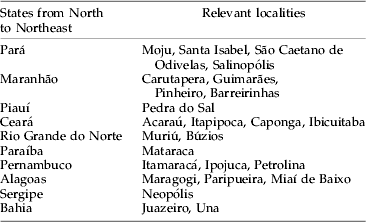
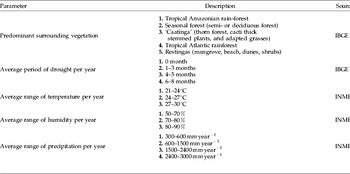
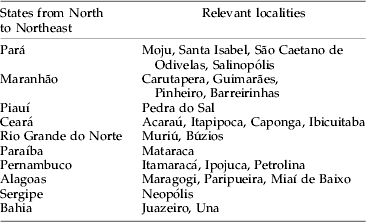
Three surveys were conducted along each of those routes between August 2004 and September 2005; sampled sites were visited once every four months, in an attempt to cover the range of climatic changes during that period. For logistical reasons, an average distance of 50 km between sampling sites was initially set. However, the actual distance between sampling sites varied according to the availability of coconut fields along the routes. In addition, in areas showing high concentration of coconut fields, the distance between sampling sites was reduced to approximately 20 km. After the first survey, some sites were revisited and new fields situated between two previously visited sites were visited at the following sampling occasions. Geographical coordinates at each sampling site were recorded. The most relevant localities are listed in table 1. The sampling sites were sorted in classes established for each of five parameters (table 2) according to information obtained from IBGE (Instituto Brasileiro de Geografia e Estatística; www.ibge.gov.br) and INMET (Instituto Nacional de Meteorologia; www.inmet.gov.br) databases compiled from 1931 to 1999.
Relevant localities visited in nine states in northeastern Brazil and one in northern Brazil during surveys from August 2004 to September 2005.
Description of vegetation and climate-related parameters.

In each site 30, two- to five-months-old, coconuts and 30 leaflets taken from two–four randomly selected palms were collected. In addition, ten branches of inflorescences, bearing male flowers and female flower-buds, and ten recently fallen coconuts (if present) were collected. For logistical reasons, coconuts were cut so that only the part carrying the bracts was collected.
Mite evaluation
Due to time limitation, only 10% of the sampled coconuts were examined in the field. All leaflets were examined directly in the field with hand lenses at 15× magnification. The remaining coconuts and branches of inflorescences were placed in separate plastic bags, stored in cool boxes and transported to the Laboratory of Acarology at UFRPE (Universidade Federal Rural de Pernambuco, Recife) for further processing. Immediately before mite collection, coconut parts carrying bracts were cut in several sections during processing and the bracts were gradually removed. All mites other than A. guerreronis were collected individually with a paint brush and placed in 70% ethanol for later mounting and identification. All specimens of A. guerreronis from each sample (30 coconuts) were brushed into vials containing 10 ml of 70% ethanol.
The numbers of A. guerreronis on fallen and attached coconuts were estimated using a methodology similar to that described by Siriwardena et al. (Reference Siriwardena, Fernando and Peiris2005). A 1:10 dilution of the eriophyids’ suspension was prepared, shaken and an aliquot (1 ml) drawn into a counting chamber. The chamber was similar to the one used by Seaman et al. (Reference Seaman, Goluboff, Barchama and Fisch1996) and consisted of a thick glass slide with a U-shaped trough forming a counting area of 3×2 cm divided into 24 squares. The edges of the trough are raised to support a thinner cover slide. The aliquot was introduced into the chamber with a pipette and was allowed to settle for two minutes before counting. Mites were counted in six of the 24 squares. The number obtained was multiplied by four and the coefficient of dilution (10) to estimate the total number of mites per 30 coconuts. The same counting technique was applied to Tarsonemidae.
All individual mites other than A. guerreronis and Tarsonemidae and a subsample (50 individuals) of the latter two groups were mounted in Hoyer's medium for subsequent identification or confirmation of identification to species level when possible.
Data analyses
The diversity and uniformity of the acarine fauna on coconuts and leaflets were assessed using the Shannon diversity index (H) (Shannon & Weaver, Reference Shannon and Weaver1949) and the Evenness index (E) (Pielou, Reference Pielou1966), respectively. The Shannon index describes the relationship between the number of individuals of each species and the total number of individuals of all species present. It is calculated according to the formula
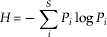
where P i is the number of specimens of species i divided by the total number of specimens of all collected species and S the species richness. H is zero if there is only one species in the system (log 1=0). H reaches its maximum (theoretical maximal diversity) when the individuals are equally distributed among the species present in the system (H max=log S).
The Evenness index describes the uniformity in the abundance of different species prevailing in a given system and is calculated according to the formula

where H is the Shannon index and S is the species richness.
Statistical analyses of mite diversity and abundance was carried out using SPSS 12.0 for Windows (Bühl & Zöfel, Reference Bühl and Zöfel2004). Univariate analyses of variance (ANOVA) were used to compare: (i) the mite diversity and evenness indices among plant parts (attached coconuts and leaflets) and the predominant surrounding vegetation types; (ii) the occurrence and abundance of A. guerreronis and tarsonemids per state; and (iii) the effects of climatic factors on the number of A. guerreronis, tarsonemid mites and the most important predatory mites on attached coconuts. If univariate ANOVAs revealed significance, Bonferroni post-hoc tests were used to separate the means. Log-transformed values of the dependent variables were used in the ANOVAs where needed to correct heterogeneity and/or heteroskedasticity of the variances. Means (±standard error) of untransformed data are presented in the figures. All statistical analyses were conducted at p=0.05 significance level.
Results
Species survey
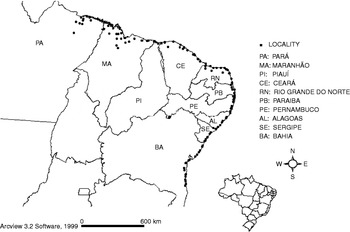
Sampling was conducted in a total of 163 sites in nine states of northeastern Brazil (Alagoas, Bahia, Ceará, Maranhão, Paraíba, Pernambuco, Piauí, Rio Grande do Norte, Sergipe) and one state in northern Brazil (Pará) (fig. 1). A total of 4890 coconuts, 4080 leaflets and 500 branches of inflorescences from 300 palms, as well as 307 fallen coconuts, were examined in this study. Mites were found on attached and fallen coconuts and leaflets but not on the branches of inflorescences.
Sites sampled from August 2004 to September 2005.

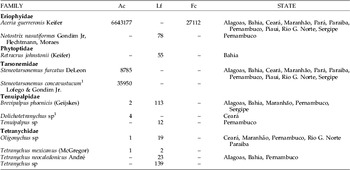
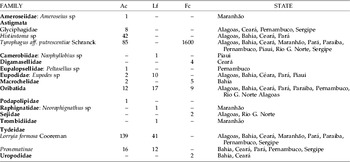
Aceria guerreronis was by far the most abundant phytophagous species on attached and fallen coconuts, followed by the tarsonemids Steneotarsonemus concavustucum Lofego & Gondim Jr and Steneotarsonemus furcatus DeLeon (table 3). No A. guerreronis or tarsonemid mite was found on leaflets. Notostrix nasutiformes Gondim Jr, Flechtman & Moraes was the only eriophyid mite found on leaflets, but this species was not found on coconuts. A few specimens of Tetranychidae and Tenuipalpidae were found on attached coconuts. Mites of the latter two families were, however, the predominant species on leaflets. Among the phytophagous mites listed in table 3, Dolichotetranychus sp (Tenuipalpidae) is the most relevant finding since this is the first report of this genus on coconut in Brazil. Individuals of this genus were collected from attached coconuts sampled in Itapipoca (Ceará), showing no visible damage. Other non-phytophagous mites were also found on coconut palms. The most important species in this group were Lorryia formosa Cooreman (Tydeidae) and Tyrophagus aff. putrescentiae Schrank (Acaridae); the latter was common on fallen coconuts (table 4).
Phytphagous mites found on attached coconuts, leaflets and fallen coconuts of coconut palms in northern and northeastern Brazil.

1 New record in Brazil; Ac, attached coconuts; Lf, leaflets; Fc, fallen coconuts.
Other groups of mites found on attached coconuts, leaflets and fallen coconuts of coconut palms in northern and northeastern Brazil

Ac, attached coconuts; Lf, leaflets; Fc, fallen coconuts.
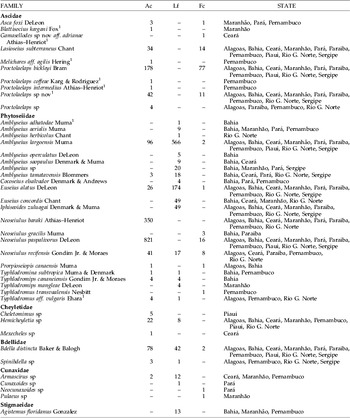
By far the largest numbers of predatory mites found in this study were Phytoseiidae, followed by Ascidae (table 5). Phytoseiids were found on both coconuts and leaflets, whereas ascids were only found on coconuts. The most abundant phytoseiid species was Neoseiulus paspalivorus DeLeon, which was only found on coconuts, followed by Amblyseius largoensis Muma, mainly present on leaflets and, to a much lesser extent, on attached and fallen coconuts. Only two other predatory species, the phytoseiid Neoseiulus recifensis Gondim Jr. & Moraes and Bdella distincta Baker & Balock (Bdellidae), were found on both coconuts and leaflets. Neoseiulus baraki Athias-Henriot was only present on coconuts and was the second most numerous predatory mites on this plant part. The phytoseiids Euseius concordis Chant, Iphiseoides zuluagai Denmark & Muma, Amblyseius operculatus DeLeon and Amblyseius saopaulus Denmark & Muma were exclusively found on leaflets. Neoseiulus gracilis Muma and Typhlodromus transvaalensis Nesbitt were only found on fallen coconuts. Proctolaelaps bickleyi Bram (Ascidae) was found on both attached and fallen coconuts. Overall, P. bickleyi was the most numerous species on fallen coconuts, on which it represented 46% of all predatory mites (table 5).
Predatory mites found on attached coconuts, leaflets and fallen coconuts of coconut palms in northern and northeastern Brazil.

1 New record in Brazil; Ac, attached coconuts; Lf, leaflets; Fc, fallen coconuts.
Species diversity
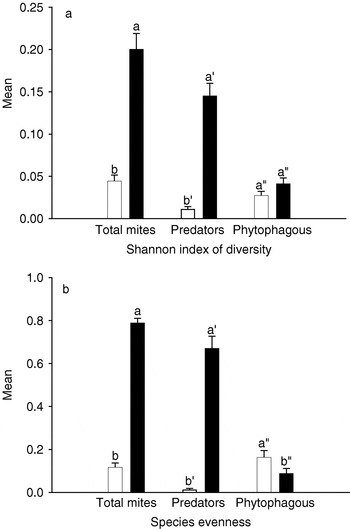
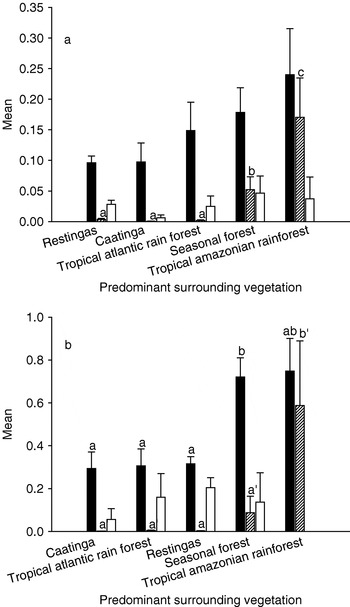
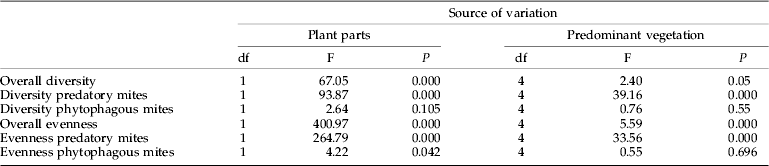
The overall mite diversity according to the Shannon index and species evenness differed significantly between plant parts (table 6). The index was higher on leaflets than on attached coconuts. Similarly, the diversity of predatory mites (as a functional group) was significantly higher on leaflets than coconuts. The diversity of the other main functional group – the phytophagous mites – was similar on coconuts and leaflets (fig. 2a). The highest overall mite diversity was found in the states Pará (0.172±0.06 SE), Alagoas (0.113±0.03 SE) and Maranhão (0.086±0.03 SE), whereas the diversity was the lowest in the states Piauí (0.004±0.01 SE) and Pernambuco (0.006±0.01 SE). Based on the evenness index, the numbers of predatory mites were significantly more evenly distributed among species on leaflets than on coconuts, whereas the evenness of phytophagous mites was higher on coconuts than on leaflets (fig. 2b). The overall mite evenness was the highest in the states Pará (0.484±0.15 SE) and Maranhão (0.255±0.10 SE). Likewise, the evenness of phytophagous mites was highest in these states and lowest in Piauí (0.007±0.01 SE) and Pernambuco (0.009±0.01 SE). Predatory mite diversity and evenness on attached coconuts varied significantly with the predominant surrounding vegetation. In contrast, the corresponding indices of phytophagous mites were not influenced by the predominant surrounding vegetation (table 6). Mite diversity and species evenness were higher in fields surround by tropical Amazonian rainforest and seasonal forest and lower in the type Caatinga (fig. 3).
(a) Mean diversity (±SE) and (b) mean species evenness (±SE) of all mites together, predatory mites and phytophagous mites on (■) leaflets and (□) attached coconuts. Different letters on top of bars indicate significant differences at P<0.05.

(a) Mean diversity (±SE) and (b) mean species evenness (±SE) of (■) all mites together, ( ) predatory mites, and (□) phytophagous mites in dependence of the predominant surrounding vegetation. Different letters on top of bars indicate significant differences at P<0.05 within species; if no letters are given the difference is not significant.

Univariate analyses of variance of the effects of plant parts and predominant vegetation on the diversity of mites on coconut palms in the surveyed areas.
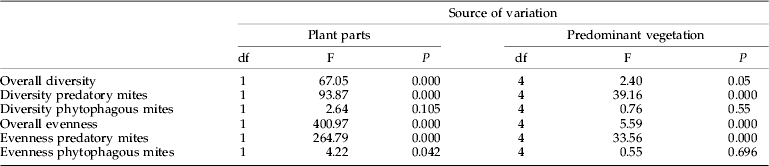
P>0.05 (ANOVA) denote no significant differences within source of variation for the given parameter.
Geographic distribution and influence of predominant surrounding vegetation and climatic factors
Aceria guerreronis
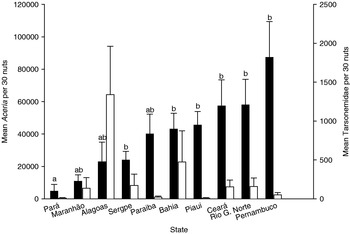
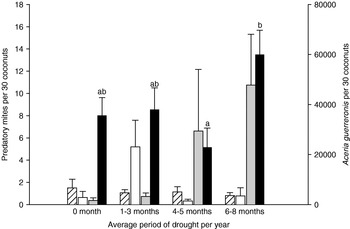
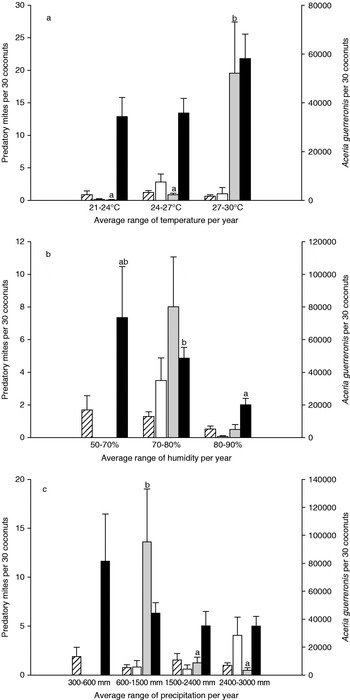
Aceria guerreronis was present in all surveyed states and infestation was recorded in 87% of the sampling sites with on average 40,756±4724 (SE) mites per 30 coconuts (1358±157 SE, mites coconut−1). Differences in the average densities of A. guerreronis were significant among states (df=9, F=4.12, P=0.001). The average number of A. guerreronis per coconut was higher in the state Pernambuco (2909±736 SE, mites coconut−1), followed by Rio Grande do Norte and Ceará (1933±536 SE, mites coconut−1) and Piauí (1518±280 SE, mites coconuts−1) (fig. 4). Maximum infestation was recorded in Ipojuca-Pernambuco with ca. 8000 mites coconut−1. Circa 6000 and 7000 mites coconut−1 were recorded in Acaraú and Ibicuitaba, respectively, both in Ceará, and 4000–5000 mites coconut−1 in Muriú and Búzios (Rio Grande do Norte) as well as in Mataraca in the state of Paraíba. Minimum infestation levels were recorded in the states of Pará (158±139 SE, mites coconut−1) and Maranhão (360±131 SE, mites coconut−1) (fig. 4). Fields in the localities Santa Isabel, São Caetano de Odivelas and Salinóplolis in the state Pará and the localities Carutapera, Guimarães, Pinheiro in the state Maranhão were free of infestation by A. guerreronis. The highest mean densities of A. guerreronis were observed in sites with the following characteristics: dry period of 6–8 months; average annual temperature of 27–30°C; average annual relative humidity of 50–70%; average annual precipitation of 300–600 mm; as well as in periods between the rainy and the dry seasons. The lowest mean densities of A. guerreronis were observed in sites with the following characteristics: dry period of 4–5 months; average annual relative humidity of 80–90%; average annual precipitation of 2400–3000 mm (figs 5, 6a,b,c).
Mean number per 30 coconuts (±SE) of (■) Aceria guerreronis and (□) Tarsonemidae per state. Different letters on top of bars indicate significant differences at P<0.05 within species; if no letters are given the difference is not significant.

Mean number per 30 coconuts (±SE) of (■) Aceria guerreronis and the predatory mites ( ) Neoseiulus paspalivorus, (□) Neoseiulus baraki and (
 ) Proctolaelaps bickleyi in dependence of the average period of drought per year. Different letters on top of bars indicate significant differences at p<0.05 within species; if no letters are given the difference is not significant.

Mean number per 30 coconuts (±SE) of (■) Aceria guerreronis and the predatory mites () Neoseiulus paspalivorus, (□) Neoseiulus baraki and () Proctolaelaps bickleyi in dependence of the average range of (a) temperature, (b) humidity, and (c) precipitation. Different letters on top of bars indicate significant differences at p<0.05 within species; if no letters are given the difference is not significant.

Other phytophagous mites
Infestation by tarsonemids was often associated with that by A. guerreronis. The densities of tarsonemid mites did not significantly differ among states (df=9, F=1.39, P=0.21). Coconut plantations in Miaí de Baixo and Paripueira, in the state Alagoas, had the highest infestation levels by the two tarsonemid species (1339±622 SE, mites coconut−1). Very few specimens of this family were collected in Piauí and Pará (9±7 SE, mites coconut−1) (fig. 4). The average length of drought period significantly affected the densities of tarsonemid mites (df=3, F=3.47, P=0.02).
Predatory mites
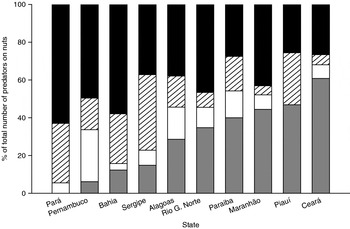
Among the three most abundant predatory mites, N. baraki, P. bickleyi and N. paspalivorus, only the densities of the latter were significantly affected by temperature and precipitation (table 7). Neoseiulus paspalivorus was collected in all states except Pará; with the highest densities per coconut – 7 mites coconut−1 – occurring during the dry season in Caponga (Ceará) and Pedra do Sal (Piauí) (fig. 7). This mite was abundant in localities characterized by six to eight dry months per year, an average temperature of 27–30°C, a relative humidity between 70–80% and precipitation from 600 to 1500 mm year−1 (figs 5, 6a,b,c). In contrast, N. baraki was found in all states except Piauí and was most abundant – 4 mites coconut−1 – in Itamaracá (Pernambuco), Maragogi (Alagoas) and Pitimbu (Paraiba) (fig. 7). The mite was predominant in areas characterised by one to three dry months per year, temperature between 24–27°C, relative humidity between 70–80% and precipitation between 2400–3000 mm year−1 (figs 5, 6a,b,c). Proctolaelaps bickleyi was found in higher numbers in Sergipe and Pará; but, unlike N. paspalivorus and N. baraki, P. bickleyi abundance did not depend on any particular climatic condition (figs 5, 6a,b,c). Amblyseius largoensis was found on coconuts in all states but occurred in relatively higher numbers in Maragogi and Neópolis (Sergipe), although this mite species was predominant on leaflets (table 5). Other species – Proctolaelaps sp nov, Lasioseius subterraneus Chant (Ascidae), B. distincta, N. recifensis and several other species – accounted for 17% of the total number of predatory mites collected on coconuts (table 5).
Proportional distribution of () Neoseiulus paspalivorus, (□) Neoseiulus baraki, () Proctolaelaps bickleyi and (■) other predatory mites per state.

Univariate analyses of variance for the effects of drought, temperature, humidity and precipitation on the abundance of Aceria guerreronis, Neoseiulus paspalivorus, Neoseiulus baraki and Proctolaelaps bickleyi.

P>0.05 (ANOVA) denote no significant differences within source of variation for the given species.
Discussion
Our work shows that A. guerreronis is widely distributed on coconut palms in Brazil, where it is clearly the most important phytophagous mite on attached coconuts. We, furthermore, found that numerous predatory mite species occur on coconut palms. A few of them occur under the bracts of attached coconuts in association with A. guerreronis and seem promising natural enemies of this pest. Our survey revealed N. paspalivorus along with N. baraki, P. bickleyi and Proctolaelaps sp nov, as well as N. recifensis, as predators that deserve further investigations as potential biocontrol agents of A. guerreronis and as potential candidates for introduction into other continents. The diversity of predatory mites was higher on leaflets than on attached coconuts and the predominant surrounding vegetation and climate related factors influenced the occurrence of these predators. Several species of phytophagous and predatory mites were found for the first time on coconut palms in Brazil. Other antagonistic organisms of A. guerreronis, such as fungi, were not found on coconut palms during our survey. However, the emphasis of the present work was placed on predatory mites and only minor attention was given to the detection of entomopathogenic fungi. Fungi of the order Entomophtorales were previously recorded from palms in Brazil (Van der Geest et al., Reference Van der Geest, Moraes, Navia and Tanzini2002), India (Sreerama Kumar et al., Reference Sreerama Kumar, Singh and Gopal2001), Cuba and Mexico (Cabrera, Reference Cabrera, Fernando, Moraes and Wickramananda2002). Only one specimen of the family Ameroseiidae was found on coconut palms during our survey in Brazil. This contrasts sharply with findings from Benin (Koffi Negloh, personal communication), India (Haq, Reference Haq, Halliday, Walter, Proctor, Norton and Colloff2001) and Sri Lanka (Ramaraju et al., Reference Ramaraju, Natarajan, Sundara Babu, Palanisamy, Rabindra, Fernando, Moraes and Wickramananda2002) where ameroseiids are abundant on coconut inflorescences.
The very high number of A. guerreronis and Tarsonemidae on attached coconuts reduced the Shannon index, i.e. the diversity of mites associated with coconut palms in the surveyed areas. Contrarily, the higher evenness index on leaflets indicates uniformity in the repartition of the number of mites among the different species present. The lower number of predatory mites and low mite diversity on coconuts seems to be a consequence of the secluded environment occupied by A. guerreronis under the coconut bracts. Aceria guerreronis and the slightly larger tarsonemid mites seem well adapted to live in such tight spaces, which are not readily accessible to larger herbivorous competitors and/or larger natural enemies. The high diversity and number of potential natural enemies outside the bracts may have been an important selective force for A. guerreronis to move under the bracts. The theory of enemy-free space predicts that selection favours herbivores that escape from their natural enemies by shifting to a novel host plant or a certain site of the original host plant where they are better protected from natural enemies than before (Jeffries & Lawton, Reference Jeffries and Lawton1984). Only morphologically flattened predatory mites were present in high numbers under the bracts. The relatively large size of A. largoensis, B. distincta and P. bickleyi hampers access under the bracts of young coconuts compared to the three Neoseiulus species. The new species of Proctolaelaps may overcome that obstacle because of its smaller size and body shape resembling that of the most common Neoseiulus species found.
Interactions between climatic factors and surrounding vegetation apparently play a key role in the diversity of predatory mites on coconut palms, especially on leaflets, as they may allow the establishment and the development of a larger number of organisms, including mites and plants (Perring, Reference Perring, Fernando, Moraes and Wickramananda2002). High plant diversity in the region of Pará and Maranhão offers suitable conditions for various predatory mites in comparison to the vegetation of the littoral, which is composed of beaches, dunes and shrubs, with strong human influences on the original vegetation. Fields are very contiguous along the littoral from Piauí towards Bahia but isolated in most parts of Pará and Maranhão. Neighbouring vegetation certainly influences the mite fauna in monocultures and may represent a reservoir of beneficial arthropods especially phytoseiid mites, may provide alternative food, or may be a temporal refuge before they move from there to cultivated plants (e.g. Tuovinen, Reference Tuovinen1994; Demite & Feres, Reference Demite and Feres2005; Tixier et al., Reference Tixier, Kreiter, Cheval, Guichou, Auger and Bonafos2006).
The occurrence of A. guerreronis was highly variable in the surveyed areas. Long drought periods and elevated temperature seem to be decisive factors favouring the occurrence and establishment of A. guerreronis. Plant water and nutrition status are widely known to affect the abundance of herbivores and at times their associated natural enemies on coconut palms (Perring, Reference Perring, Fernando, Moraes and Wickramananda2002). Plant water stress could lead to separation of the bracts from the coconut surface and, thus, allow entry of the mites. Although coconut palm tolerates extended drought periods, coconut production is low and the maturation period of young coconuts is prolonged when adequate precipitation or irrigation is lacking (Foale, Reference Foale2003). Young coconuts from fields in areas with dry ambient conditions would be exposed to drought that would allow in turn a better settlement of the mite in dry areas such as Moju (Pará), parts of Maranhão from Barreirinhas to the states Piauí, Ceará and Rio Grande do Norte, as well as in dry regions of Pernambuco (Petrolina) and Bahia (Juazeiro). Moreover, it is negatively affected by heavy rain fall (Mariau, Reference Mariau1969; Zuluaga & Sanchez, Reference Zuluaga and Sánchez1971; Griffith, Reference Griffith, Webb, Knausenberger and Yntema1984). Regular rainfalls probably disrupt the spread and establishment of A. guerreronis in the dispersal phase, washing off mites migrating between bunches and dislodging them onto unsuitable vegetation or places with high incidence of natural enemies (Howard et al., Reference Howard, Abreu-Rodriguez and Denmark1990).
Ambient climatic conditions clearly have an effect on the prevalence and abundance of predatory mites. Our results showed clear trends in the distribution of the most important predatory mites according to the prevailing climatic factors: N. paspalivorus predominates in dry regions; and N. baraki, and especially N. recifensis, predominate in humid regions. This ecological zoning is ascribed to the innate physiological characteristics of each strain and the adaptation to the climatic factors prevailing in the respective regions. The absence of the Neoseiulus species in the driest regions of Moju, Petrolina and Juazeiro indicates their preference for areas in which the direction of the prevailing winds plays a dominant role (littoral climate). There was no trend in the distribution of P. bickleyi and A. largoensis. The former was most common on fallen coconuts, while the latter is apparently adapted to a wide spectrum of ecological conditions as it is a pan-tropical species (Moraes et al., Reference Moraes, McMurtry, Denmark and Campos2004).
Aceria guerreronis is present in all coconut-producing states in Brazil, but its level of incidence is certainly low compared to Africa and Asia. According to regular evaluations conducted by the largest coconut producer in Brazil, in the state of Pará, the average level of incidence of A. guerreronis is about 12% of all coconuts. During this work, the highest levels of incidence of A. guerreronis seemed to occur in the fields that were apparently not properly maintained by growers (Lawson-Balagbo, personal observations).
In this study, we were most interested in identifying natural enemies that could serve as potential candidates for introduction to Africa and elsewhere where A. guerreronis is thought to have invaded. The suspected place of origin of A. guerreronis is the Americas, but the original host plant is still unknown (Navia et al., Reference Navia, Moraes, Roderick and Navavajas2005). The present work was the first of that amplitude conducted on this continent on coconut palms. The present prevailing thought is that the original host of A. guerreronis could be a palm (or some other type of host plant) native to the Americas, from which A. guerreronis switched to coconut palm (Moraes & Zacarias, Reference Moraes, Zacarias, Fernando, Moraes and Wickramananda2002). The mite was reported on other palms of the family Arecaceae since its original description from coconut (Keifer, Reference Keifer1965) – on buds of Lytocaryum weddellianum H.A. Wendl in Brazil (Flechtmann, Reference Flechtmann1989) and queen palm Syagrus romanzoffiana (Cham.) Glassm in California, USA (Ansaloni & Perring, Reference Ansaloni and Perring2002), as well as on fruits of Borassus flabellifer L. in Sri Lanka (Moraes, personal communication) and India (Ramaraju & Rabindra, Reference Ramaraju and Rabindra2002). Surveys were conducted on many native and introduced palms in Brazil but A. guerreronis was never found, not even on the alternative hosts from which it had been reported previously (Gondim et al., Reference Gondim, Flechtmann and Moraes2000; Arruda Filho, Reference Arruda Filho2002; Navia & Flechtmann, Reference Navia and Flechtmann2002). The presumed place of origin of the coconut palm is South-East Asia to the Pacific Islands of Papua New Guinea (Persley, Reference Persley1992; Lebrun et al., Reference Lebrun, Grivet and Baudoin1998), but A. guerreronis has never been reported from these regions. Although some observations have been made on natural enemies associated with A. guerreronis on coconut palms in Colombia, Mexico, Cuba, Puerto Rico, and Florida (Zuluaga & Sánchez, Reference Zuluaga and Sánchez1971; Estébanes, Reference Estébanes1976; Howard et al., Reference Howard, Abreu-Rodriguez and Denmark1990; Rodríguez, Reference Rodríguez1990; Moore & Howard, Reference Moore, Howard, Lindquist, Sabelis and Bruin1996), very little is known about them in these or any other country of the Americas. It would, therefore, be interesting to continue the search for natural enemies on coconut and other palms in other parts of the Americas. Nonetheless, the predominant predators found in our survey on attached coconuts, i.e. N. baraki, N. paspalivorus and P. bickleyi, are the same in American, African and Asian coconut growing regions (Howard et al., Reference Howard, Abreu-Rodriguez and Denmark1990, Moraes et al., Reference Moraes, McMurtry, Denmark and Campos2004; Koffi Negloh, personal communication). At least the former two species seem morphologically adapted to live under the perianth, making them promising natural enemies of A. guerreronis. Life history studies, as well as predation tests, are on the way to evaluate the biocontrol potential of each of the predator species found in this study.
Acknowledgements
The authors thank the climber J.F. de Queiroz for his readiness and excellent work. We thank A. Walzer and K. Fiaboe for the comments on this paper. We are also are grateful to C. Araujo, W. Melo, D. Amorin, F. Rodriguez, G. Vasconcelos, E. Britto, J. de Souza, A. Galvão, A. Reis, students at the laboratory of acarology of UFPRE for their technical support and to the secretariat of UFRPE for the helpful logistic provided during this work. This work was supported by the International Institute of Tropical Agriculture (IITA) through a grant from the Austrian Ministry of Finance and by in-kind contribution from IITA, FEALQ, Fundação de Estudos agrarios Luiz de Queiroz, Piracicaba-Sao Paulo, Brazil and BOKU. This work is part of the PhD thesis of the senior author.