

Autism spectrum disorder (ASD) is a developmental disorder with atypical neural development (Lai, Lombardo, & Baron-Cohen, Reference Lai, Lombardo and Baron-Cohen2014) and is characterised by early childhood onset and lifelong impact on all individuals affected. The key diagnostic features are difficulties in reciprocal social communication and interactions as well as restricted and repetitive patterns of behaviours, interests, and activities (American Psychiatric Association, 2013). According to a 2015 Australian survey, the estimated prevalence of ASD in Australian school age children (5 to 19 years old) was 2.5% (Australian Bureau of Statistics, 2017).
Cognitive–behavioural approaches (CBA) are intervention approaches considered as established practices for children with ASD (National Autism Center, 2015) and interventions using such approaches are variously described as cognitive–behavioural therapy and cognitive–behaviour modification. These approaches have been developed mainly from the integration of cognitive and behavioural theories (Scarpa & Lorenzi, Reference Scarpa, Lorenzi, Scarpa, White and Attwood2013; Thoma, Pilecki, & McKay, Reference Thoma, Pilecki and McKay2015). One of the key principles of CBA is changes in cognition will lead to changes in behaviours and/or feelings (Beck, Reference Beck1967; Dobson & Dozois, Reference Dobson, Dozois and Dobson2010). The basic elements in CBA address both cognitive issues/skills and management of behaviour (Rotheram-Fuller & Hodas, Reference Rotheram-Fuller, Hodas, Flanagan, Allen and Levine2015). Among the wide range of CBA strategies, characteristic ones include problem-solving, cognitive information processing (e.g., cognitive restructuring), coping skills (e.g., relaxation), stress inoculation (e.g., exposure), and self-instruction training (Kaufman, Reference Kaufman, Flanagan, Allen and Levine2015; Meichenbaum, Reference Meichenbaum1977; Scarpa & Lorenzi, Reference Scarpa, Lorenzi, Scarpa, White and Attwood2013).
Cognitive–behavioural therapies are widely practised by mental health professionals (Thoma et al., Reference Thoma, Pilecki and McKay2015). They have often been adopted for typically developing children and children with various psychological disorders in community and school settings (Manassis, Reference Manassis2009; Mennuti, Freeman, & Christner, Reference Mennuti, Freeman and Christner2006; Scarpa & Lorenzi, Reference Scarpa, Lorenzi, Scarpa, White and Attwood2013). When adopted in interventions for children with ASD, they are commonly implemented for managing anxiety and improving social skills (Danial & Wood, Reference Danial and Wood2013; Ho, Stephenson, & Carter, Reference Ho, Stephenson and Carter2015; Manassis, Reference Manassis2009; Mayer, Van Acker, Lochman, & Gresham, Reference Mayer, Van Acker, Lochman and Gresham2009).
Cognitive–behavioural modification has been used for several decades to remediate school-learning-related issues of children with learning disability, emphasising meta-cognitive strategies, and self-management strategies such as self-evaluation, self-monitoring, and self-recording of academic tasks (Ryan, Short, & Weed, Reference Ryan, Short and Weed1986). The same self-management strategies have also been used with students with ASD (Callahan & Rademacher, Reference Callahan and Rademacher1999; Holifield, Goodman, Hazelkorn, & Heflin, Reference Holifield, Goodman, Hazelkorn and Heflin2010; Strain, Kohler, Storey, & Danko, Reference Strain, Kohler, Storey and Danko1994).
Interventions using CBA and targeting anxiety management can be effective for children with ASD who have typical intellectual ability (Danial & Wood, Reference Danial and Wood2013; Ho, Stephenson, & Carter, Reference Ho, Stephenson and Carter2014; Kincade, Reference Kincade2009). Most intervention research studies have been conducted in clinical settings with the interventions implemented by clinicians (Ho et al., Reference Ho, Stephenson and Carter2015). A smaller number of studies on interventions using CBA to improve social skills or cognitive skills of students with ASD in school settings by teaching staff also reported positive outcomes (Bauminger, Reference Bauminger2002; Kenworthy et al., Reference Kenworthy, Anthony, Naiman, Cannon, Wills, Luong-Tran and Wallace2014; Laugeson, Ellingsen, Sanderson, Tucci, & Bates, Reference Laugeson, Ellingsen, Sanderson, Tucci and Bates2014; Schmidt, Stichter, Lierheimer, McGhee, & O’Connor, Reference Schmidt, Stichter, Lierheimer, McGhee and O’Connor2011).
Among CBA interventions for children with ASD, Ho et al. (Reference Ho, Stephenson and Carter2015) identified some common strategies implemented in anxiety programs (e.g., relaxation, calming behaviours, exposure, practice, and homework assignments) and in social skills programs (e.g., teaching emotional functioning, problem-solving, coping self-talk and self-instruction, role-playing, metaphor, practice, and homework assignments). The training of coping skills and self-management included in CBA interventions are particularly relevant to children with ASD because these features were proposed to enhance generalisation and maintenance of intervention effects (Feindler & Ecton, Reference Feindler and Ecton1986), which have long been recognised as difficult to achieve with children with ASD (Rao, Beidel, & Murray, Reference Rao, Beidel and Murray2008; Rincover & Koegel, Reference Rincover and Koegel1975). Feindler and Leibman (Reference Feindler, Leibman, Flanagan, Allen and Levine2015) commented on the advantages of self-management strategies such as self-monitoring in school settings.
The implementation of CBA in school environments with the emphasis on problem-solving, cognitive information processing, and coping skills is considered to be a natural fit (Kaufman, Reference Kaufman, Flanagan, Allen and Levine2015). Rotheram-Fuller and Hodas (Reference Rotheram-Fuller, Hodas, Flanagan, Allen and Levine2015) also suggested some advantages of using CBA with students with ASD within school settings, such as students being available daily, special education teachers being on hand to administer intervention, opportunities to observe student social interaction in natural settings, a greater likelihood of students practising skills outside sessions, and opportunities to include peers in the practice. Ho, Stephenson, and Carter (Reference Ho, Stephenson and Carter2017) conducted a survey to investigate the perspectives and implementation of Australian teachers regarding the use of CBA with students with ASD in support classes. In many respects, teacher perspectives and reported implementation were not fully congruent with extant research evidence. In particular, the survey respondents perceived that such approaches were suitable for students who have both ASD and intellectual disability (Ho et al., Reference Ho, Stephenson and Carter2017), whereas existing research has primarily focused on children with ASD and average or above intellectual ability (Ho et al., Reference Ho, Stephenson and Carter2015).
Moreover, the respondents reported implementing CBA for a range of purposes over and beyond those typically targeted in the research literature for children with ASD (e.g., academic skills, classroom skills, self-management skills, and friendship skills; Ho et al., Reference Ho, Stephenson and Carter2017). Given that evidence of discrepancies has been found between teacher understanding and application of CBA and the evidence-based practices, it is of interest to examine in greater depth the extent to which teacher perspectives are in accord with the broad understanding advocated by researchers.
Other than the survey by Ho et al. (Reference Ho, Stephenson and Carter2017), there is little information about the implementation and perspectives of Australian teachers using CBA with students with ASD, particularly those with comorbid intellectual disability. Further, survey studies are unable to capture in-depth understanding of teacher perspectives and practices. Qualitative research methods are more suitable for investigating the details of teacher perceptions, understanding, and classroom practices. Semistructured interviews were used in the current study to collect information regarding teacher perspectives on and implementation of CBA with their students with ASD and intellectual disability. Specifically, this study was undertaken to answer the following questions:
1. What do teachers understand by CBA and what do they do when they say they are using CBA?
2. Are teacher practices and perspectives regarding CBA in alignment with research evidence?
Method
Participants
In New South Wales (NSW), support classes in regular schools and special schools are segregated education settings enrolling students with disability. Thus, there is a higher probability that teachers in these settings will have had experience in teaching students with both ASD and intellectual disability than teachers in regular classes. The participants were teaching in either ASD-specific support classes or non-ASD-specific support classes in regular schools, ASD-specific special schools, or non-ASD-specific special schools.
Participant recruitment
The ethical aspects of this study were approved by the Macquarie University Human Research Ethics Committee (Approval Ref. No.: 5201500569). Australian teachers having experience in teaching students with both ASD and intellectual disabilities were recruited with the cooperation of the NSW Department of Education and the independent autism services provider, Autism Spectrum Australia (Aspect). Invitations to participate were sent in the third school term of 2015 to 645 schools in NSW (i.e., 21.2 % of all NSW schools in 2015). The invited schools included 635 NSW Department of Education state schools comprising regular schools with support classes and special schools, eight schools operated by Aspect, and two private ASD-specific special schools not affiliated with Aspect.
Thirteen state regular schools agreed to participate. These state schools indicated that altogether they employed 45 eligible teachers (i.e., teaching in support classes and having experience in implementing CBA with students with both ASD and intellectual disability). Information packages, which included an information sheet and a corresponding consent form, were then sent to these schools for distribution to the prospective participants.
Nineteen prospective participants returned signed consent forms, but four of them withdrew later due to difficulties in negotiating interview times. In appreciation of teacher participation and as an incentive, five participants were randomly selected to receive a gift card valued at $100.
Procedure
The first author contacted all 19 teachers, who had consented by phone or email, to arrange the interview, and teachers were offered the options of having the interview via phone, Skype, or in person at their school or the university. Fifteen interviews were arranged and conducted by the first author. Thirteen interviews were completed, and two were incomplete because the teachers were not available to finish the interview.
An interview overview that briefly listed the main questions to be asked was emailed to the participants a few hours before the first author arrived at their school or started the Skype conversation. On the front page of the interview overview and inside the participant information package, a brief definition of CBA was given as follows:
Cognitive –behavioural approaches are intervention approaches based on the principle that changes in cognition will lead to changes in behaviours and feelings. These approaches support students’ behaviours or teach them new skills by examining and intervening with their cognition and behaviours.
Each completed interview took about one to two hours and was recorded. The audio recordings were then transcribed. Transcripts from the audio records were sent to participants for validating the accuracy of information provided. Only data collected in the 13 complete interviews were included for analysis.
Interview Protocol
All interviews were based on a protocol made up of three sections. The first section was used to collect participant demographic information, which gave the background and context to information they provided later.
In the second section teachers were asked to provide two specific examples, one successful and one unsuccessful, of their implementation of CBA with students with ASD who also had intellectual disability. These specific examples were used to help participants to focus on the issues to be investigated. The questions were asked in a general and open manner to encourage participants to provide as much information as they could. Probe questions were also used flexibly as needed to prompt participants to extend or clarify their answers in order to uncover specific information (e.g., purpose of the intervention, organisation of the resources needed for implementation, reasons for using the intervention). Specific questions were asked about the students who received the intervention in the teacher examples.
The third section comprised open-ended questions about participant perspectives and no specific probe questions were used. Open-ended questions included two core questions aimed at gaining an understanding of how participants interpreted CBA, and what they considered were the essential elements in CBA. These two core questions were not provided in the interview overview given to participants and were asked after the other questions. Other questions asked were specifically about CBA implementation in school settings with students with ASD, and participant responses provided further insights into their practices. Before the conclusion of the interview, teachers were asked to supply any additional information not yet given but important for understanding their perspectives or practices. The complete interview protocol is available upon request.
Analysis
Teacher discourses in the interviews formed the data corpus and were analysed using a thematic analysis method taking a critical realist approach (Braun & Clarke, Reference Braun and Clarke2006). To investigate their perspectives and reported practices, reports by interviewees were interpreted directly from the literal meaning of their discourses.
The interview transcripts were coded qualitatively paragraph by paragraph based on a hierarchy of three levels of codes by the first author using Version 11 of the text analysis computer software NVivo (QSR International, 2017). The first two levels of the hierarchy were organisational and based on the structure of the interviews. The first level denoted the three main sections of the interview (i.e., teacher knowledge of and perspectives on CBA, teacher successful implementation examples, teacher unsuccessful implementation examples). Second-level codes related to the individual questions asked under each main section (e.g., purpose of implementing their CBA intervention).
At the third level, the transcripts were reviewed to observe commonalities or differences in order to find recurring themes and create corresponding codes. When recurring themes were identified, relevant interview content was further coded sentence by sentence to these new codes. Possible relationships between responses of each interviewee, across interviewees, or with teacher demographic characteristics were examined. Further, teacher implementation examples in section two were compared to their perspectives expressed in section three to search for consistency between practice and knowledge. The third-level codes were refined continuously by collapsing or expanding existing codes or adding new ones to match the unfolding themes. Common themes that unfolded in the coded transcripts were then summarised for reporting by synthesising codes across different levels and interviewees.
To check the trustworthiness of the content coded and themes extracted from the transcripts, the first author and second author independently prepared a summary of three interviews that were independently coded by both authors. The summary was based on a template prepared by the first author and included the successful example, the unsuccessful example, and participant knowledge and perspectives on CBA. The summaries were compared, and the main ideas summarised by the two authors were consistent with each other.
Results
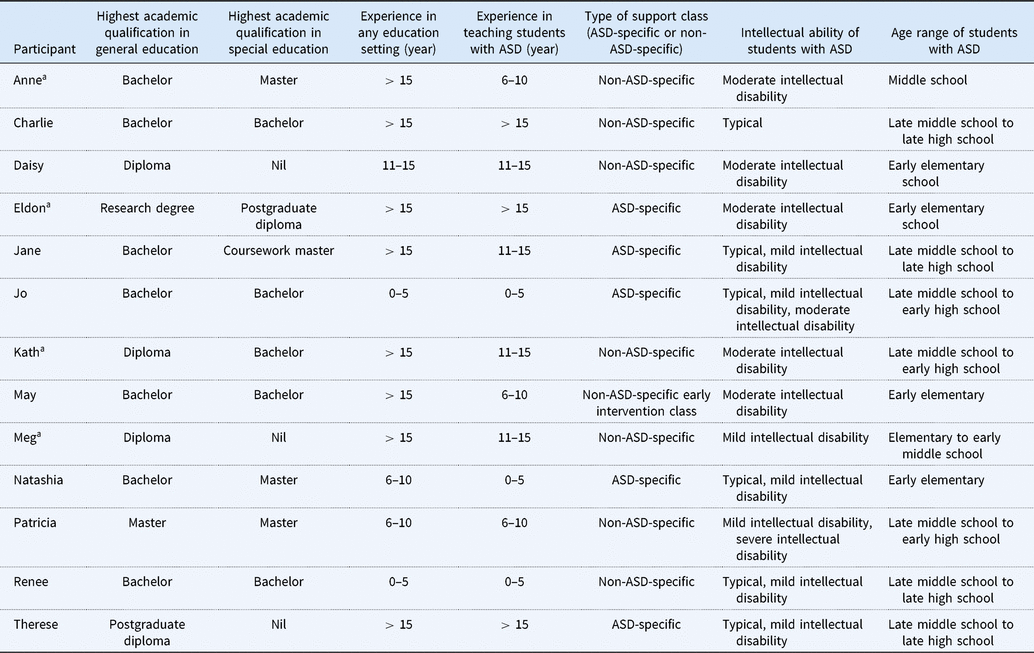
Demographic information is provided in Table 1. All names reported are pseudonyms. All participants were teachers of support classes in regular state schools (n = 8 in non-autism-specific support class, n = 5 in autism-specific support class) and all except one were female. More than half of them (n = 7) had more than 10 years’ experience both in general education settings and in teaching students with ASD. The majority (n = 9) had a bachelor’s degree or above in both general education and in special education.
Participant Demographic Information (N = 13)

Note. ASD = autism spectrum disorder. All participants were teachers of NSW state regular schools.
a Participants also holding an executive position in school.
All students in the implementation examples described by the participants were boys except one (i.e., student in Renee’s successful example), and all were aged from 5 to 17 years, with more students in late primary or early secondary school years than in other years. According to the interviewees, the majority had moderate or mild intellectual disability and both low verbal ability and low social ability.
Several key themes were identified from the coding of the interviews and are addressed in the section that follows. In addition, relevant observations on the absence of expected discourses or practices as well as discrepancies between teacher perspectives and practices are reported.
Understanding of CBA
Limited knowledge
A major theme that emerged from the analysis is that teachers had limited knowledge of CBA. Many interviewees (n = 8) either explicitly stated that they had limited knowledge (e.g., May: ‘My biggest issue is that having that understanding and having that picture of what really CBA is’. Meg: ‘I know I don’t know a lot about official formal strategies’.), requested clarification on what CBA was, or expressed difficulties when answering questions. Lack of teacher education about CBA was frequently (n = 9) raised as an issue and was cited as a factor contributing to unsuccessful interventions by a few teachers. Only a few teachers indicated that they learned the term CBA from their formal education courses (e.g., Jane: ‘I knew about cognitive behavioural therapy from university and I’ve read a little bit about it’.). Some teachers (n = 5) reported learning about CBA strategies from popular presenters in workshops about supporting children with ASD.
The limited teacher knowledge about CBA might also be inferred from how they developed interventions. Teachers did not use or adapt any published CBA-specific programs for children with ASD or refer to any intervention research in the field during their interview. All teachers self-developed their own CBA interventions using a trial-and-error approach (e.g., Daisy: ‘Everything is trial and error’. Patricia: ‘Definitely a lot of trial and error’.) and were inspired often by their own teaching experience (May: ‘So, through my experience, that’s it’.). One teacher (i.e., Anne) used a non-CBA-specific social skills program, Meet Mr Angry Ant, originally developed to support students in special need schools of the NSW Department of Education (J. Jones, Reference Jones2013).
Limited knowledge of key CBA principles
Consistent with limited knowledge of CBA, teachers did not appear to be aware of key CBA principles such as changing student cognition would facilitate changes in their behaviour or emotion. Although many teachers interpreted CBA as including aspects of cognition (n = 8; e.g., Jo: ‘turning a negative approach or thought into being able to, giving the ability to choose a positive one over a negative one’.), only some teachers (n = 6) demonstrated understanding of the link between changes in cognition and changes in behaviour and/or emotion. The principle that changes in cognition facilitate changes in behaviour or emotion was clearly elaborated by only three teachers (e.g., Eldon: ‘We change the way somebody thinks about something, it changes how that makes them feel, and how that makes them feel changes how they respond’.). Only two other teachers considered CBA as relevant to students with ASD in relation to changing student cognition (e.g., Daisy: ‘If they’re coming into the classroom calm and settled with their behaviour, then the thinking is improved, you know, and once the thinking improved, the behaviour. So it’s all about the moulding their thinking’.).
Perception of Application and Reported Practices
Generic practices
A key theme that emerged from teacher reports of their perceptions of appropriate CBA applications was that their descriptions of CBA did not differentiate CBA from generic special education practices. They also did not typically describe features or strategies commonly included in CBA interventions such as problem-solving, cognitive information processing, coping skills, stress inoculation, and self-instruction training. This was consistent with the theme that teachers had limited knowledge of CBA. Features common in interventions for students with special education needs were frequently discussed by teachers and were quoted by some teachers (n = 5) as essential elements of CBA and by other teachers (n = 7) as important factors for CBA to succeed. These features teachers suggested were consistency, clarity, repetition, individualisation, use of visuals, being achievable, being easy to manage, being positive, and using a team approach (e.g., Charlie: ‘They need to be a positive, I think the kids need — it needs to be achievable. I think the kids need to believe they can achieve it’. Meg: ‘I think you have to be clear, firm and give them a good understanding of what you’re expecting of them and give them strategies that they are able to manage’.). Resources generic to any intervention (e.g., money, time, or suitable environment) were sometimes (n = 6) described as being ideal for implementing CBA. When evaluating their CBA implementation, nearly all teachers (n = 12) suggested similar generic intervention features or resources as facilitators or identified a lack of generic resources or other generic school issues as barriers. Very few features that were specific to CBA were discussed.
When teachers provided examples of their CBA intervention practice, all teachers reported adoption of some intervention features common in special education that were similar to features they nominated as essential elements or important factors of CBA application. Three typical strategies for supporting students with ASD were commonly reported as part of CBA intervention including the use of visuals (n = 13; e.g., visual prompts for appropriate behaviours, visuals for indicating emotions, visual timers), social stories (n = 4; e.g., for replacing flapping, for replacing hands in pants, for reducing inappropriate exposing), and strategies to address sensory issues (n = 5; e.g., setting up calming areas, providing sensory toys). A few teachers commented that social stories (n = 1) and use of visuals (n = 2) were effective CBA strategies in their CBA intervention. Less than half of the teachers used any strategies common in CBA interventions for children with ASD (e.g., problem-solving, teaching coping strategies, using metaphor, role-play or drama, or self-management).
Focus on behaviour management
Another key theme was that CBA was primarily concerned with behaviour management. Nearly all teachers (n = 12) expressed this view. Renee interpreted CBA as
It’s just a strategy or approach or a tool that you use with a student to support a behaviour issue that’s going on. So to support a change in a specific behaviour, if that’s what you’re after, or to support getting rid of a specific unwanted behaviour or whatever it may be.
Some teachers either interpreted CBA as equivalent to behaviour management strategies (e.g., Kath: ‘Strategies to adjust behaviour’.) or considered behaviour strategies as essential in CBA. When discussing how CBA was relevant to students with ASD, most teachers (n = 8) explained that it was because students with ASD always have behaviour issues. For example, Natashia said,
We always tend to get some sort of behaviour problem. Students with ASD, I can’t tell you why. It occurs so often with those students but I do know that every single student with ASD will need some sort of cognitive–behaviour approach.
A few teachers described a reward system for appropriate behaviours as the core content of their CBA intervention.
This theme was also illustrated in their reported practices. All teachers, except one, cited improving student challenging behaviours as one of the purposes of their interventions, and all of them used some behavioural strategies (e.g., modelling targeted skills, physical or verbal prompts, phasing out prompts gradually, setting clear behaviour expectations, consequence or reinforcers for behaviours, signing behaviour contract or classroom rules).
Managing student emotions
Addressing emotions was a theme evident in teacher practices but not in their interpretation or perception of the application of CBA. Less than half of the teachers (n = 6) included managing emotion or feelings in their interpretation of CBA (e.g., Natashia: ‘Emotion regulation, understanding emotion and having strategy to cope and their own decision on behaviour’.) or considered CBA being relevant to students with ASD because of their need to learn to identify and regulate their emotions (e.g., Patricia: ‘And if you can teach them to identify how they’re feeling and why, it helps them to regulate themselves from here on in, which makes their behaviour in the classroom better’.).
In contrast, many teachers (n = 10) did include recognition and management of emotions in the interventions they reported as CBA. Teachers mostly used approaches such as matching emotion images to words or actual feelings, verbalising emotion or feelings, and meditation or mindfulness exercises. Coping strategies (e.g., alternative activities, calming items) were implemented by some teachers (n = 6), but more CBA-specific strategies for directly managing emotions were implemented by very few teachers (e.g., alerting student of their emotion elevation, analysing the episode with student afterward, teaching coping statements). Anxiety recognition and anxiety management were only occasionally addressed alongside other basic emotions (e.g., stressed, sad, happy, angry).
Limited address of cognition
CBA interventions should address both cognition and behaviour, but addressing cognition or teaching cognitive skills directly was not a salient feature of teacher practice. Many teachers (n = 8) appeared to be aware that cognition has some role to play in CBA, but very few of them (n = 3) addressed the underlying cognition or cognitive skills in their CBA interventions explicitly. Jane, Jo, and Therese focused on directly changing negative thoughts, inappropriate perspectives, or unhelpful thinking. Three other teachers addressed student cognition in a less direct manner. Kath reminded her student how his behaviour affected others ‘to connect that it [student inappropriate social behaviour] made everyone sad’; Daisy attempted ‘to change their thinking, every day — work then reward, work then reward’; and May aimed ‘to help kids cognitively be able to smell things, and to understand what you can smell and what you can’t smell’.
Other Issues
CBA and other issues of concern to students with ASD
In addition to the themes described previously, further issues relevant to students with ASD were raised by some teachers when describing their perception but by fewer teachers when reporting their practice of CBA. These issues included supporting student learning (n = 7 perceived, n = 0 addressed), supporting student communication (n = 6 perceived, n = 2 addressed appropriate social communication or verbal request), student social skills (n = 5 perceived, n = 3 addressed turn-taking or appropriate expression of dislikes), and student self-management or self-regulation ability (n = 4 perceived, n = 1 addressed self-management with a behaviour self-assessment chart).
CBA interventions and specific student characteristics
Some teachers (n = 6) showed awareness of the relevance of CBA to the characteristics of their students with ASD, and referred to them when discussing factors they considered important for CBA to succeed or that influenced their decision to use CBA. Each of them mentioned only a couple of student characteristics such as cognitive ability, verbal or language ability, age, severity of autism, developmental stage, specific ability, or understanding (e.g., ability to identify emotions, understanding of their behaviour and the consequence, concepts of cause and effect, as Natashia said, ‘The student understands how their own behaviour affects the world around them and the world around them can affect them as well’.). In contrast, almost all (n = 12) teachers cited student characteristics, particularly their limited cognitive ability or understanding and occasionally their ASD traits (n = 3) and anxiety (n = 2), when they evaluated their unsuccessful interventions. When teachers described how they planned, adjusted, or modified their CBA intervention programs to suit specific student characteristics, they did not mention cognitive ability.
Generalisation and maintenance not well recognised
Only Jane, and only when prompted, linked generalisation of intervention effect with the CBA principle that changes in cognition lead to changes in behaviours or emotion. She suggested that students with ASD could generalise learning from her CBA intervention by applying the social skills learned to other aspects of life through the change in their way of thinking. Teachers rarely mentioned observation of generalisation (n = 2) or specific strategies to enhance generalisation when describing their interventions. Overall, only one teacher described using the same set of visuals in and outside the classroom to generalise targeted behaviours (e.g., May: ‘That would be good so we can generalise that. But we do have one in the classroom, we also carry one wherever we go to’.). No teacher mentioned maintenance.
Discussion
The aim of the current interview study was to collect further information about the perspectives of Australian teachers on CBA and their implementation of CBA. The study targeted teachers in segregated settings who had experience teaching students with both ASD and intellectual disability. The larger proportion of participants (n = 8) teaching in non-ASD-specific support classes is consistent with the larger number of this category of support classes provided by the NSW Department of Education (NSW Department of Education, 2018). The majority of participants (n = 9) having more than 10 years of teaching experience is in accord with the general characteristics of the NSW Department of Education teaching workforce (i.e., average length of service being 14.7 years; NSW Department of Education, 2015). This cohort of participants is also comparable to the cohort in the previous survey study on teacher perceptions and use of CBA (Ho et al., Reference Ho, Stephenson and Carter2017) except with more years of experience in teaching students with ASD.
In the earlier survey study, Australian teachers self-reported a reasonable level of CBA knowledge and that they frequently used the CBA strategies suggested in research literature (Ho et al., Reference Ho, Stephenson and Carter2017). So the first research question asked in this study is what teachers understand by CBA and their actual practices of the interventions they considered CBA. Although all teachers participating in the study reported here agreed to be interviewed about their knowledge and practice of CBA, the majority of them had limited knowledge of CBA, and showed limited awareness or application of the CBA principle briefly stated in the participant information package and interview overview (i.e., changing cognition facilitates changes in behaviours and emotions).
Interview participants also appeared to be less than fully aware of practices that are well supported by research. Although NSW special education teachers participating in the recent survey self-reported reasonable levels of knowledge in CBA (Ho et al., Reference Ho, Stephenson and Carter2017), the in-depth exploration through semistructured interviews with teachers suggested actual knowledge may be more limited. In interpreting these findings, it should be noted that in the interviews teachers were asked open-ended questions about their perspectives and practices with no probing on their perspectives and minimal probing on their practices. In the previously reported survey (Ho et al., Reference Ho, Stephenson and Carter2017), however, participants were provided with a range of response options in questions about their knowledge of CBA and the CBA strategies they implemented.
Evidence of limited knowledge of CBA emerged in the interviews and was substantiated by teachers’ open statements to the same effect, reports on limited learning about CBA in formal education courses and professional learning, limited conceptual understanding of the basis of CBA, and reported practices. In fact, when describing CBA, a large majority of teachers did not elaborate on any key principles of CBA including the principle that changes in underlying cognition or cognitive skills facilitate changes in behaviours or emotions. Although CBA is about changing cognition, behaviours, and emotions, some teacher interpretations of CBA either excluded the element of cognition or did not link it to behaviour or emotion.
Two key themes emerged from the teacher reports regarding their perception and practice of CBA: CBA as involving a standard and generic range of practices rather than strategies commonly reported in the literature on CBA, and as being focused on behaviour management. Most teachers participating in the Ho et al. (Reference Ho, Stephenson and Carter2017) survey reported occasional or frequent use of all CBA strategies listed. The interviewed teachers implemented more frequently strategies generic to students with ASD (i.e., use of visuals, teaching emotion knowledge and skills) and less frequently strategies that are more often associated with CBA (i.e., problem-solving, self-evaluation, metaphor, and self-monitoring). Only a few teachers included strategies more often associated with CBA in the intervention programs they described as CBA, and then only a limited number of such strategies. Most strategies included by most teachers in their self-developed intervention programs were those commonly used in special education or for children with ASD in general (e.g., behavioural strategies). Although many teachers also included in their CBA programs two strategies commonly found in CBA interventions for children with ASD, the use of visuals and social stories, these strategies are more often regarded as supporting elements in a comprehensive program rather than central features (Ho et al., Reference Ho, Stephenson and Carter2015).
Consistent with the survey result of Ho et al. (Reference Ho, Stephenson and Carter2017), managing behaviours inside the classroom and managing and teaching about emotion were key themes in the interventions of most interviewed teachers, and a few teachers also addressed issues beyond the scope of existing CBA research for children with ASD (e.g., sensory issues and inappropriate toileting behaviours). Whereas teachers in the survey reported that they frequently aimed at helping students to manage anxiety using CBA, only a couple of interviewees included managing student anxiety in their perspectives about the application of CBA. In the interviews, there are other issues of concern about students with ASD that were discussed by only some teachers and were addressed by very few of them (e.g., learning, communication, social skills, self-management, or self-regulation ability), but survey respondents reported frequently addressing all these other issues, except communication.
Perceptions about the application of CBA held by interviewees were different from the focus in their reported intervention examples. For example, issues such as cognitive functioning and social skills were mentioned but seldom addressed in interventions as described. This may be because the intervention examples provided by teachers only represented two examples (successful and unsuccessful applications of CBA) of their actual CBA practice. On the other hand, emotions were addressed in interventions but not mentioned in perceptions. This may be because addressing emotions was seen as a student need rather than an element of perceived appropriateness of CBA application.
Regarding the second research question as to whether or not teacher practices and perspectives are in alignment with research evidence, the often-cited ‘research-to-practice gap’ in special education (Vaughn, Klingner, & Hughes, Reference Vaughn, Klingner and Hughes2000) was present to some extent in the current study. Overall, the themes that teachers had limited knowledge of CBA and described generic interventions revealed their lack of relevant research knowledge.
The divergence of teacher knowledge or perspectives from the research literature was demonstrated during the interviews in the restricted discussion of the role of cognition and application of one of the key CBA principles that changing cognition facilitates changes in behaviours and emotions (Beck, Reference Beck1967). Further, none of the interviewed teachers discussed, used, or adapted any of the numerous CBA-specific programs that have been researched with children with ASD in school settings and reported in the literature (Bauminger, Reference Bauminger2002; Kenworthy et al., Reference Kenworthy, Anthony, Naiman, Cannon, Wills, Luong-Tran and Wallace2014; Laugeson et al., Reference Laugeson, Ellingsen, Sanderson, Tucci and Bates2014; Schmidt et al., Reference Schmidt, Stichter, Lierheimer, McGhee and O’Connor2011). This may be because they did not know about or did not have access to such programs.
When addressing appropriate application of CBA and describing their own practices, teachers tended to describe generic special education practices and view CBA as primarily relevant to behaviour management. Teachers’ interventions also did not typically include some key strategies characteristic of CBA (i.e., problem-solving, self-instructions, and exposure; Kaufman, Reference Kaufman, Flanagan, Allen and Levine2015; Meichenbaum, Reference Meichenbaum1977). CBA strategies that have been used in interventions targeting children with ASD (e.g., coping statement, modelling, role-playing, use of metaphor, self-monitoring, and home practice; Bauminger, Reference Bauminger2007; Koning, Magill-Evans, Volden, & Dick, Reference Koning, Magill-Evans, Volden and Dick2013; Sofronoff, Attwood, Hinton, & Levin, Reference Sofronoff, Attwood, Hinton and Levin2007) were also seldom reported. Similar to the current observation that almost none of the interviewed teachers explicitly taught self-management, M. L. Jones (Reference Jones2009) also observed that student self-management was not utilised in any classroom during a study investigating the perceptions of novice special educators on research as well as their relevant practices.
Interviewed teachers had different perceptions regarding the application of CBA from typical research applications. Their reported intervention implementation also deviated from research, with few of them focused on the common aims in CBA interventions for children in general (e.g., developing self-management abilities, remediating academic learning, managing anxiety; Kendall et al., Reference Kendall, Robin, Hedtke, Suveg, Flannery-Schroeder and Gosch2005; Little & Kendall, Reference Little, Kendall, Kendall and Hollon1979; Meichenbaum & Goodman, Reference Meichenbaum and Goodman1971; Ryan et al., Reference Ryan, Short and Weed1986) or the principal foci in CBA intervention research targeting children with ASD (i.e., managing anxiety, developing social skills; Ho, Stephenson, & Carter, Reference Ho, Stephenson and Carter2018). With the close relationship between teacher practice and understanding (Devine, Fahie, & McGillicuddy, Reference Devine, Fahie and McGillicuddy2013; Fang, Reference Fang1996), heterogeneity in teacher implementation also reflects different understanding between teachers and researchers regarding what constitutes CBA and when these strategies should be appropriately used.
The suggestion that CBA inherently fosters generalisation and maintenance with the address of underlying cognition is a much-discussed topic in CBA research for children with ASD (e.g., Chalfant, Rapee, & Carroll, Reference Chalfant, Rapee and Carroll2007; Sofronoff et al., Reference Sofronoff, Attwood, Hinton and Levin2007). However, these issues did not perspicuously emerge from the interviews. When explaining their perspectives or describing their practices, none of the teachers cited the proposed potential of CBA in enhancing maintenance or generalisation (Feindler & Ecton, Reference Feindler and Ecton1986). Nevertheless, in this aspect, teachers were similar to researchers, who often give insufficient attention to measuring generalisation and maintenance (Ho et al., Reference Ho, Stephenson and Carter2018).
Five student characteristics have been suggested by Rotheram-Fuller and Hodas (Reference Rotheram-Fuller, Hodas, Flanagan, Allen and Levine2015) as determining the suitability of a CBA intervention for a student with ASD: cognitive abilities, verbal ability, emotion recognition/empathy, perspective taking, and severity of ASD. Only half of the interviewed teachers referred to any of these student characteristics when discussing their perspectives on CBA or when describing intervention planning and implementation. This was despite the students in teachers’ CBA intervention examples having characteristics that might impact on the appropriateness of CBA, such as mild to moderate intellectual disability or below average verbal ability.
Recommendations
CBA is considered an established practice for children with ASD (National Autism Center, 2015) and may be particularly well suited for students with ASD in school settings (Rotheram-Fuller & Hodas, Reference Rotheram-Fuller, Hodas, Flanagan, Allen and Levine2015). Teachers serving students with ASD should therefore be supported to apply these research-based practices. Carnine (Reference Carnine1997) proposed addressing trustworthiness, usability, and accessibility to research-based knowledge in order to bridge the research-to-practice gap. During the interviews, teachers appeared confident that CBA was effective and usable, thus effort should then be put to address the accessibility issues.
Teachers may benefit from more in-depth knowledge and training about CBA either in their formal preservice education courses or in-service courses. Information about CBA provided to teachers should be based on relevant literature and research, covering key principles and their application in promoting self-management and improving academic skills and social skills. Teachers should be informed of the common CBA strategies used with students with special needs (e.g., self-instruction and problem-solving). Emphasis should be placed on the difference between CBA and traditional behavioural approaches and the potential benefits of generalisation and maintenance of treatment effect for students with ASD.
Schoolteachers should be provided with easy access to researched intervention resources. These resources should include published programs trialled in research with students with ASD (e.g., Kenworthy et al., Reference Kenworthy, Anthony, Naiman, Cannon, Wills, Luong-Tran and Wallace2014; Laugeson & Park, Reference Laugeson and Park2014) and, ideally, onsite coaching by experts with knowledge and experience in CBA during school planning, organisation, and implementations of such intervention programs.
Limitations
A number of limitations of this study should be acknowledged. The difference in use of terminology between academics and practitioners is commonly observed (Ebbutt, Worrall, & Robson, Reference Ebbutt, Worrall and Robson2000) and possibly occurred in this interview study. For example, problem-solving was an obvious activity in two teachers’ interventions, but they did not use this term until it was suggested by the interviewer. Consequently, some other relevant information might have been missed or misinterpreted. However, the researcher could rely on only what was said and seek clarification during the interview only when the ongoing discussion suggested that clarification was appropriate.
In this study, only a very small sample of teachers teaching in state school support units was interviewed. Their perspectives and practices thus cannot be regarded as representative of typical teachers who teach students with ASD and intellectual disability. All information collected and analysed in this current study was solely from the verbal discourse of these teachers during their interviews. There was no attempt to verify or validate the data so collected through additional methods such as onsite observation of classroom practices or examination of records. Further, when exploring teacher practices, each of the teachers interviewed was asked to provide only two examples: a successful one and an unsuccessful one. These examples may not fully represent the usual aims and practices of individual teachers in using CBA, but are likely to reflect their general perceptions of CBA.
Some measures to ensure trustworthiness of data (Brantlinger, Jimenez, Klingner, Pugach, & Richardson, Reference Brantlinger, Jimenez, Klingner, Pugach and Richardson2005) were incorporated into the current study, including member checks and independent data coding and interpretation by first and second authors to verify conclusions. Nevertheless, future studies could be further improved by incorporating additional credibility measures, such as external auditors (outside the research team) to examine the researchers’ inferences, or peer debriefing where an expert familiar with the phenomena under investigation provides critical feedback on description, analysis, and results (Brantlinger et al., Reference Brantlinger, Jimenez, Klingner, Pugach and Richardson2005).
Conclusions
Most of the teachers interviewed did not have extensive knowledge of the key principles or the specific features of CBA, describing generic special education strategies rather than strategies commonly used in CBA. Their practices also varied from those documented in research on CBA. At the same time, teachers reported that CBA was not being taught in most general education or special education courses and in-service training. Given that CBA is an established practice, it is suggested that the basic principles of CBA, relevant strategies, and available programs for children with ASD should be introduced to teachers either in preservice or in-service education.