The present study was designed to explore the level of disaster preparedness among families with children with special health care needs (CSHCN) and to educate readers about disaster preparedness for this population. The research questions guiding the present study include the following: How do preparedness levels in families of CSHCN compare to the general population? Is the level of preparedness influenced by the medical needs of the child? Is the level of preparedness influenced by the caregiver level of concern about disaster? Are there other factors present that influence levels of preparedness? The authors hypothesize that families of children with multiple special health care needs are more prepared than families of children who have lesser special health care needs, and that families in which caregiver concern about disaster is high exhibit higher levels of preparedness than families in which caregiver concern is less.
The disaster medicine and public health literature has only recently begun to focus on the special needs of pediatric populations postevent, with large-scale disasters such as hurricanes Katrina and Rita increasing awareness of these issues. Children as a general population present challenging characteristics for disaster response, such as being noncommunicative, anxious, fearful, or simply unable to provide information during a crisis. Approximately 20% of households have CSHCN, including chronic medical conditions such as asthma, autism, diabetes, and cerebral palsy that require ongoing medical treatment.1 CSHCN are particularly vulnerable in disaster situations, challenging rescue and recovery efforts by complicating triage and putting stress on resources.Reference Markenson and Reynolds2Reference Mulligan-Smith3Reference Patton-Levine, Vest and Valadez4 A recent study examining health outcomes of children with chronic conditions after Hurricane Katrina found that children were more likely to present to clinics for issues such as medication refills, experience the emergence of new symptoms, and experience adverse outcomes.Reference Rath, Donato and Duggan5 Parents are not always able to accurately inform physicians about their child's chronic conditions, communicate the child's diagnosis, or provide a correct medication list.Reference Stallwood6Reference Carraccio, Dettmer, duPont and Sacchetti7 Medical needs shelters are burdened with caring for medically needy populations and providing care for the accompanying family members and caregivers.
Until recently, pediatric patients have in general been overlooked in disaster planning. To effectively manage pediatric patients, responders and medical units must consider the physiological, developmental, and emotional differences of children from adult populations.Reference Fendya8 The increased vulnerability of children in disaster situations is highlighted through frameworks for creating regional pediatric preparedness networks, which stress the importance of pediatric-specific disaster plans for medical personnel.Reference Ginter, Wingate and Rucks9Reference Cicero and Baum10 In addition, the needs of children often are underrepresented in training disaster medical assistance teams, even though children may comprise up to 85% of the victims of a disaster depending on the location of the event.Reference Mace and Bern11
A significant concern postdisaster, particularly when devastation occurs across a large geographic area, is the lack of a medical home. A medical home provides continuous and comprehensive family-centered care, offering families an established partnership among health care services providers.12 Populations that are evacuated from highly damaged areas and find themselves without a medical home are more likely to seek medical attention for chronic conditions, thus limiting the availability for resources to be distributed to those with critical needs.Reference Millin, Jenkins and Kirsch13
Although disaster preparedness is an important component of any family's emergency plan, disaster preparedness for families with CSHCN is even more important. The Department of Homeland Security, the American Red Cross, the American Academy of Pediatrics, and the Federal Emergency Management Agency encourage residents to assume personal responsibility for a period of 3 days following a disaster, without assistance from federal, state, or local authorities. Guidelines include 4 areas of preparedness: becoming informed about potential disasters in the geographic area, preparing a disaster response plan for sheltering in place and evacuating, developing a disaster communication plan, and constructing and maintaining a personal disaster survival kit. Even with national and local media campaigns such as the Ad Council's Ready America and the Alabama's Department of Public Health's Get 10, most families are not adequately prepared.1415 Current surveys indicate that less than one third of the public has a basic family emergency plan, and two thirds of the public, including parents of school-aged children, report feeling unprepared for a disaster.Reference Redlener, Abramson, Stehling-Ariza, Grant and Johnson1617Reference Kubicek, Ramirez, Limbos and Iverson18
METHODS
Participants
Recruitment of participants occurred through the Children's Hospital of Alabama at the University of Alabama at Birmingham between August 2007 and July 2008. A convenience sample of caregivers (parents and guardians) presenting to the emergency department or outpatient medical clinics was obtained. Participants were required to have living in their home a child with a special health care need, which was defined as the use of daily medication, an electrical medical device (eg, nebulizer, home ventilator), or a wheelchair. Caregivers were excluded from participating if they were unable to answer verbal questions, were non-English speaking, did not have a permanent domicile, and did not have access to a landline telephone or cell phone for follow-up contacts. During the initial recruitment period, 148 potential participants were screened by inquiring about their willingness to participate in the study, and, if they agreed to participate, were provided further information and completed an informed consent form. Three people who were screened declined to participate, resulting in a sample of 145. This study obtained approval from the institutional review board at the University of Alabama at Birmingham.
After acknowledging participation, caregivers completed a 2-page-long questionnaire that included basic demographic information and a preexisting measure on disaster preparedness. All of the participants received educational material on at-home disaster preparedness. Caregivers were also selected randomly by days of the week to receive a 3-day personal disaster kit donated by the local disaster management agency. Alternate-day distribution was used because the supply of donated disaster kits was limited. These kits were distributed after completion of the survey so as not to bias the results. During callbacks, families were asked whether they had received a personal disaster kit.
Research Design
This project is part of a larger longitudinal pretest–posttest group design exploring family preparedness and evaluating effectiveness of education on disaster preparedness. Follow-up telephone interviews were conducted 45 to 60 days after the initial contact to assess the effectiveness of the interventions in increasing baseline levels of preparedness. Because the present study explored pilot data derived from answers to research questions related to baseline preparedness, follow-up and intervention effectiveness data are not discussed here. Although there are threats to internal and external validity with this design, the pretest–posttest experimental design provides several opportunities to assess levels of preparedness. In addition, although the presence of a control group is necessary to claim a true experimental design and would strengthen validity, it was decided that even a minimal educational intervention was preferred to the absence of intervention or placebo intervention.
Measures
The present study adapted a previously published survey assessing personal disaster preparedness.Reference Blessman, Skupski and Jamil19 The authors added items related to a pediatric population with health care needs; these included items related to caregivers having a copy of their child's medical plan.
RESULTS
Participants
Participants in the study included 145 caregivers presenting to the emergency department or medical clinics of Children's Hospital of Alabama at the University of Alabama at Birmingham who had a child exhibiting a special health care need. The participants were 86.9% women and 13.1% men, with 72% designating themselves as head of household. The majority of participants lived in single-family homes (72.5%) as opposed to apartment buildings (20%), and most had at least a high school education (97.3%), with 52.9% reporting some college or postgraduate-level education. The ages of the participants ranged from 18 to 70 years (mean 34.86, standard deviation [SD] 9.57), with the household size ranging from 2 to 8 people (mean 4.25, SD 1.396). Data were also collected on the medical needs of the children, with 39% of children requiring daily medication, 8.5% requiring the use of a nebulizer, 3.5% requiring the use of a wheelchair, and 48.9% reporting multiple health care needs.
Research Question 1: How Do Preparedness Levels in Families of CSHCN Compare to the General Population?
Data were analyzed using SPSS statistical software for Windows version 14.0 (SPSS Inc, Chicago, IL). The first research question explores baseline levels of disaster preparedness among families of CSHCN and compares these levels with general population data. CSHCN raise special concerns in the event of a natural or human-made disaster as a result of the level of care required during potential evacuation or home and/or shelter confinement during recovery efforts. As a result, it is important to assess whether families with CSHCN are prepared at a minimal level. The measure used to assess preparedness examined 16 preparedness indicators. For the purpose of determining baseline or “basic” preparedness, 5 indicators were selected by the authors derived from the current recommendations from the American Red Cross, the Federal Emergency Management Agency, and the American Academy of Pediatrics, reflecting minimum requirements for personal disaster preparedness:
1. Does the family have a written family emergency communication plan in case of disaster?
2. Does the family have an emergency supply kit that can last for 3 days?
3. Does the family have a 3-day supply of stored water for each person living in the household?
4. Does the family have a 3-day supply of nonperishable food stored for each person living in the household?
5. Does the family have a copy of the child's medical emergency plan completed by the child's primary care physician?
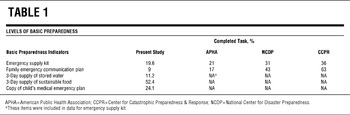
Descriptive statistics were calculated for overall levels of preparedness by exploring preparedness on a 5-point scale, with 0 indicating that none of the above indicators were met, 1 indicating that 1 of the indicators was met, continuing up to 5, indicating that all of the above indicators were met. There was an extremely low level of basic preparedness among the 145 participants (mean 1.16, range 0–5, SD 1.07). To obtain a more detailed view of preparedness, each indicator was also explored through the use of frequency statistics. These statistics tend to support previous literature that overall preparedness levels are low in the general population (Table 1). In comparison to present data on preparedness levels in the general population, however, our data indicate a much lower level of preparedness.
Levels of Basic Preparedness

Research Question 2: Is the Level of Preparedness Influenced by the Medical Needs of the Child?
To determine whether level of preparedness is influenced by the specific medical need of the child, independent samples t tests using the Levene test of homogeneity were conducted comparing means of the 5-point preparedness assessment scale previously mentioned with the variable describing the child's medical need. This variable includes whether the child needs daily medication, a nebulizer, a home ventilator, a wheelchair, or has multiple medical needs. There was no significant difference in preparedness levels among families with children who need daily medication (n = 120, mean 1.16, SD 1.012) as compared with children who do not need daily medication (n = 20, mean 1.35, SD1.387, t 22.497 −0.592, P = .560). There was also no significant difference in preparedness levels among families with children who require the use of a nebulizer (n = 60, mean 1.32, SD 1.20) as compared with children who do not need a nebulizer (n = 80, mean 1.09, SD 0.957), t 110.02 1.217, P = .226) or among families who have children requiring the use of a home ventilator (n = 13, mean 1.31, SD 0.947) as compared with children who do not require a home ventilator (n = 127, mean 1.17, SD 1.084, t 138 0.430, P = .668). Preparedness levels also did not differ significantly among families that had a child needing a wheelchair (n = 27, mean 1.30, SD 0.823) in comparison with children who did not need to use a wheelchair (n = 112, mean 1.15, SD 1.125, t 137 = 0.628, P = .531). Finally, families with children who had multiple medical needs (n = 69, mean 1.16, SD 0.994) were not more prepared than families whose children did not have multiple needs (n = 72, mean 1.19, SD 1.146, t 139 = −0.193, P = .847).
Research Question 3: Is the Level of Preparedness Influenced by the Caregiver Level of Concern About Disaster?
This research question explores whether the caregiver level of concern about the likelihood of natural or human-made disasters affects the level of preparedness. Participants were asked to rate their level of concern about the likelihood of each of the following events occurring in the region in the next 2 years: terrorism, power outage, tornado or severe weather, and outbreak of disease on a 5-point Likert scale from 1, extremely unlikely to 5, very likely. Data were analyzed to explore the correlation between level of concern and level of preparedness (as determined by the 5-point preparedness indicators scale).
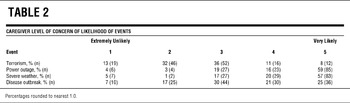
Analysis of the given data suggests that the basic level of preparedness does not correlate with the caregiver level of concern about the likelihood of terrorism (r −0.054, P = .521), the likelihood of a power outage (r 0.071, P = .399), concern about the likelihood of a tornado or severe weather (r 0.028, P = .741), or concern about the outbreak of disease (r −0.112, P = .180). Descriptive statistics indicate that there is some level of concern about the likelihood of such events occurring (Table 2); however, it does not appear that the level of concern correlates with the level of preparedness.
Caregiver Level of Concern of Likelihood of Events

Research Question 4: Are Other Factors Present That Influence Levels of Preparedness?
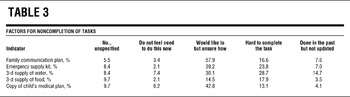
The last research question explores reasons why families have not completed tasks related to preparedness. Respondents were asked to respond to each of the items with a “yes” response or a “no” response, with 5 options including “no, unspecified reason,” “no, I don't feel the need to do this now,” “no, I would like to [complete this task] but am unsure how,” “no, it's hard to complete this task,” and “no, I have done it in the past but have not updated it.” Although answers to this query do not provide insight about specific barriers that may be present, such as financial or logistical barriers, they do provide information that is important to determining resulting levels of preparedness. When asked why respondents were not prepared, the majority of those responding indicated that they would “like to complete the task but were unsure how” for 4 of the 5 indicators to do you have a family communication plan? (57.9%), do you have an emergency supply kit? (39.2%), do you have a 3-day supply of stored water? (30.1%), and do you have a copy of the child's medical plan? (42.8%; Table 3). The majority of those responding “no” to the question about whether they had a 3-day supply of stored food indicated that the reason was because it was “hard to complete the task” (17.9%).
Factors for Noncompletion of Tasks

COMMENT
The purpose of the present study was to explore whether families of CSHCN are prepared for a natural or human-made disaster should one occur and how the level of preparedness compares with general population estimates. The researchers were concerned that, as a population, these families pose a special dilemma for disaster rescue and recovery workers, first responders, and general aid workers postevent. The first question explored levels of preparedness in comparison with other surveys conducted on the public's preparedness levels. The study population data indicate that preparedness levels are actually lower than those in the general population when compared with household surveys completed by the American Public Health Association, the National Center for Disaster Preparedness, and the Center for Catastrophic Preparedness and Response.2021 In fact, data about the preparedness levels of the study population were also lower than the data reflecting homes of preschool children, such as the survey completed in 2007 by the Council for Excellence in Government and the American Red Cross that indicated that 49% of families with preschool-aged children were prepared for a disaster. These results are a cause for concern, given the likelihood that families with CSHCN will face greater challenges than the general population in the aftermath of a disaster.
The second and third research questions hypothesize that families of CSHCN and those caregivers who express concern about the likelihood of a disaster occurring may use those circumstances as a catalyst for engaging in preparedness behaviors. This does seem to be the case because neither of the hypotheses were supported. Although there are no comparison data for CSHCN, the data on concern about likelihood of a disaster are consistent with previous studies, indicating that concern alone does not always translate to completion of preparedness tasks.
The final research question explored other factors that may be associated with low levels of preparedness. When respondents were asked why they had not completed the tasks, the majority indicated that they were willing to complete the task but were not sure what they needed to do. Current research posits that many barriers may be present that impede the execution of preparedness behaviors. These factors include lack of financial resources and lack of time, overdependence on government response, and a lack of knowledge about how to prepare.Reference Redlener, Abramson, Stehling-Ariza, Grant and Johnson16Reference Kubicek, Ramirez, Limbos and Iverson1822 Data from the present study corroborate some of these findings and suggest that mass media messages do not adequately inform citizens about what they need to accomplish in preparedness. This gap indicates an area in which future research may help construct education interventions to address variables that influence the execution of preparedness behaviors. It is also known that families of CSHCN often have competing priorities as a result of the child's medical care and differing abilities. It is important to assist families to evaluate priorities to include aspects of disaster preparedness that will be especially helpful in mediating negative effects postevent.
The limitations of this study include the use of alternate-day random selection for distribution of supply kits, the relatively small sample size, and the use of a subject population that was drawn from a single site. Subjects were selected from families that presented for care at an urban academic pediatric hospital, and the demographics may not be reflective of the population at large.
CONCLUSIONS
Although families in our study acknowledged the risks posed by disasters, few had made plans for the continuity of their child's medical care after a disaster or catastrophic event. Health care and psychosocial support workers are in a unique position to explain to families the patient's vulnerabilities to local hazards including severe weather, flooding, and electrical power loss. Hospital nurses, social workers, and discharge planners are in an ideal position to help families to plan for such an occurrence through the development of a communication and medical plan, because much of the information needed to develop a family communication and medical plan is updated at the time of hospital discharge. Hospital discharge is also a time when families may be receptive to recommendations from hospital staff or social workers to maintain a 3-day reserve of essential medications and a family disaster kit.
Despite multiple high-profile disasters during the past decade, personal preparedness remains stagnant. Families with CSHCN appear to be no better prepared for disasters than other groups in the general population, despite a greater vulnerability to the effects of disasters. There appear to be multiple reasons for the lack of personal preparedness in this group, including competing priorities, financial limitations, and a misunderstanding about the role of government in disaster response. Most of the families in our study perceived the threat of disasters and consequences, including disruption of electrical power and medication supply; however, the perceived threat does not appear to translate into action toward personal preparedness. Health care workers may be instrumental in providing the information that is necessary to correct knowledge deficits and foster actions promoting family preparedness.Reference Stallwood6
Author Disclosures: The author reports no conflicts of interest.