This book provides theoretical linguists in general and researchers within the field of phonology in particular with a ‘comprehensive account of the phonological structures and characteristics of Swedish’ (jacket). The book, which forms part of the publisher's series The Phonology of the World's Languages, constitutes a challenging yet also highly illuminating read for anyone approaching Swedish phonology for the first time. It draws helpful comparisons with other Germanic languages – chiefly with English – without relying too extensively on any single theoretical framework, which makes it particularly useful for new researchers in the field. In this regard, Tomas Riad's work is a substantial and helpful addition to the list of major reference works on Swedish phonology written in English (e.g. Bruce Reference Bruce1977, Bruce & Gårding, Reference Bruce, Gårding, Gårding and Bannert1978, Linell Reference Linell1973, Eliasson Reference Eliasson, Dammel and Nübling2010), as it not only provides an overview of the existing theories with reference to the phonological characteristics and the processes that Swedish has undergone but also offers new analyses and explanations whenever necessary.
Given that the volume covers Swedish phonology from every possible angle, I offer a succinct chapter-by-chapter summary so that the reader can gather a general idea of its outlook and main contents. I conclude with a few additional remarks.
The opening chapter, ‘Introduction: Swedish and the languages of Sweden’, explores the linguistic situation in Sweden and presents a historical overview of the variety on which the book focuses, namely Central Swedish (henceforth CS), which is the closest variety to a national standard. Although Swedish is the majority language inside the Swedish border, the linguistic makeup of the country is not simple. In addition to the five national minority languages – Finnish, Meänkieli, Romani, Saami and Yiddish – there is a large number of immigrant languages (3–5). Swedish spoken in Sweden and Finland can be divided into seven dialect areas according to intonation, the realisation of the lexical word tone as high or low, and the proportions of segmental quantity in stressed syllables. To make things even more complicated, some dialects – the older variety of Gotland Swedish, Jamska, Överkalix and Älvdalska, among others – could be considered separate languages due to the lack of ‘intelligibility to the speakers of the regional standards of Swedish’ (9).
The Introduction also provides the details of some of the most important linguistic resources for Swedish – dictionaries and pronouncing dictionaries, corpora, lexical materials – and summarises the main phonological processes covered in the volume.
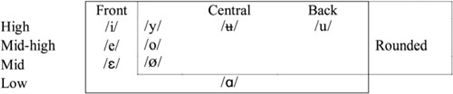
Chapter 2 leads the reader into the book's core subject as it explores the vowel system in CS. As shown in Table 1 (21), the system comprises nine vowel phonemes.
Vowel phonemes in Central Swedish.

In Swedish, ‘the quantity of vowels as monomoraic or bimoraic is a predictable property, hence allophonic’ (17). Thus, each vowel phoneme has two distinct allophones, with the sole exception of /e/ and /ε/, whose short allophones coalesce in stressed syllables. The chapter delves into a detailed description of the various allophonic alternations in the system, providing both diachronic and synchronic insights. Regarding diphthongs, ‘[m]ost Central Swedish long vowels are regularly diphthongised’ (41), except for the various allophonic realisations of phoneme / /, which never diphthongise. As for orthographic diphthongs, there are only three (<au>, <eu>, <ou>/<oa>), which occur almost exclusively in loans and whose phonetic transcription is a matter of debate related to ‘the lack of stability for diphthongs in Swedish’ (43).
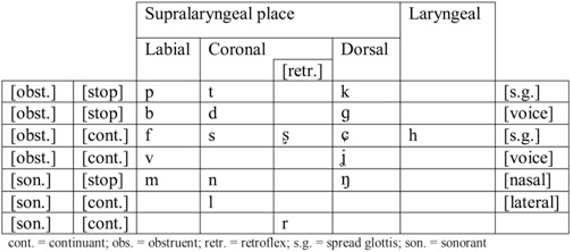
Chapter 3 deals with the eighteen consonant phonemes in CS, included in Table 2 (70).
Consonant phonemes in Central Swedish.
An interesting characteristic of the language is that contrastive quantity resides with the consonants, as they can be moraic or non-moraic – with the sole exception of /h/ and /ɕ/, which are never long and hence ‘cannot occur as mora-bearers in coda position’ (45). The chapter discusses the most salient characteristics of every natural class in the system – i.e. oral stops, nasals, fricatives and liquids – and explores the various realisations of the phonemes in each class.
Chapter 4, ‘Segmental processes’, examines a series of segmental rules which are prosodically conditioned:
• retroflexion, a sandhi process that occurs when the apical articulation of /r/ in some Swedish dialects ‘coalesces with a following coronal consonant, i.e. /s, t, d, n, l/ to [ʂ , ʈ , ɖ , ɳ , ɭ]’ (73).
• Lowering of the long allophones of /ε/ and /ø/ before a tautomorphemic /r/ or a retroflex consonant, a phenomenon which is influenced by morphological and stress factors.
• Centralisation of the short allophone of /ø/ before /r/ and the outputs of retroflexion, which in many speakers leads to the neutralisation of this allophone and the short allophone of /ʉ/, [ɵ].
• Nasal assimilation, whereby the coronal nasal assimilates to the place of articulation of a following segment when the two segments belong in any two morphemes that are placed together.
• G -excrescence, a process which recovers a silent [ɡ] in an <ng> cluster realised as /ŋ/ in order for [ɡ] to become the onset of a syllable.
• Postnasal d-deletion, where /d/ is deleted in a number of contexts involving nasals.
• Assimilation of the phoneme /d/ to a /t/ that is morphologically adjoined to the stem in both moraic and non-moraic positions.
• D -continuization, a reduction rule where /d/ is weakened to [r] in mostly unstressed pronouns and other function words.
• Spread glottis assimilation, whereby a voiced consonantal segment devoices as a result of its assimilation to a preceding or following [spread glottis] segment.
• Egentligen, a name given to the process of resyllabification and change of articulation of certain segments.
• Morpheme-final r-deletion, which takes place when /r/ is dropped in the final position of a morpheme-final unstressed syllable before a non-coronal consonant which begins the next morpheme.
The chapter also covers a number of obsolete segmental rules related to palatalisation, ablaut and umlaut, and regressing spreading of nasality.
Chapter 5 deals with the prosodic word. In Swedish there is, on the one hand, a minimal prosodic word, which is ‘the domain for syllabification’ (118), where stress is obligatory and culminative and constitutes the head of the word. Importantly, the minimal prosodic word, when added a suffix, ‘is also the domain where lexical tone is assigned and expressed’ as accent 1 (125). On the other hand, there is a maximal prosodic word, where word accent is obligatory and culminative. It can coexist with the minimal prosodic word – i.e. compounds – or form a larger unit – i.e. forms containing tonic derivational affixes. The coexistence of more than one stress gives rise to accent 2, whereby an H tone is linked to the main stress postlexically (127).
Chapter 6 analyses the properties of the prosodic foot in Swedish. The chief property of the prosodic foot is stress (there is no evidence for the existence of the foot outside of stressed syllables), which renders it bimoraic – the so-called Stress-to-Weight condition (134). The chapter delves into certain rhythmic principles related to stress assignment and provides a number of tests used to find out which syllable is stressed, including vocative chant.
Chapter 7 discusses a number of prosodic constraints on morphemes and concludes that branching rhymes (VC over Vː) are ‘optimal’ – if not mandatory – in Swedish (152), something which is proven by means of looking at two groups of data, namely hypocoristics and the inflection of certain CV adjectives.
Chapter 8 further explores the correspondence between stress and weight in Swedish, which, unlike English, requires that a stressed syllable be bimoraic – that is, heavy – while unstressed syllables are always light.
In Swedish both vowels and consonants can be short or long, but only vowel length is predictable. As a result, heavy syllables can be formed by one long vowel or by a short vowel and one short consonant – the precondition being that only vowels can constitute syllabic nuclei (160). The chapter examines issues related to vowel and consonant length.
Chapter 9 explores one of the most salient characteristics of Swedish prosody, that is, the existence of accent 1 and accent 2, as well as the criteria used to assign and distinguish them. Accent 1 forms tend to be monosyllabic stems, while accent 2 is typically represented by disyllabic stems. The lexical tone of accent 2 is strongly constrained, as it ‘must associate to the primary stressed syllable’ (183). Conversely, in accent 1 the accentual tones ‘are supplied by intonation’ (183) and may associate to the primary stress syllable. Thus, accent 2 occurs in words that have one poststress syllable – compounds, some derivations – while monosyllables and final stressed forms ‘invariably exhibit accent 1’ (183).
Chapter 10 explores ‘how morphology and phonology interact to determine the placement of stress in morphologically complex forms’, thus proving that ‘morphology is directly involved in the stress system’ (193). Riad proposes an explanation for stress assignment that differs from the theories proposed for Germanic languages in the last three decades, all of which support the idea that stress falls by default on the final syllable if it is closed and on the penultimate syllable otherwise. Outside those two possibilities, all cases are seen as marked and exceptional. The author argues that ‘there is no clear sense of exceptionality being connected with marked forms' (194) and distinguishes four types of roots and derivational morphemes according to their prosodic properties, namely prosodically unspecified, tonic, pretonic, and posttonic morphemes. Various stress assignment rules are discussed in the light of the different types of morphemes explored.
Chapter 11 deals with tone and relies on the statement that ‘tone and the distribution of resultant accent 2 is largely morphologically controlled’ (231). The general rule accounts for the fact that final-stressed words – including monosyllables – can only bear accent 1, while accent 2 occurs in disyllables which contain the relevant suffixes – i.e. syllabic suffixes that attach directly to a stressed monosyllabic root – or roots that are marked for that accent. Under this view, markedness is accounted for. Among the factors that influence accent we find lexical, prosodic and grammatical factors. Riad analyses some conflictive cases, chiefly those cases with anacrusis (i.e. the presence of unstressed syllables before the primary stress), which favours accent 1, and posttonic suffixes, which favour accent 2. He concludes that suffixes show varying degrees of strength and thus may interact with the accent-inhibiting anacrusis in order to either override it or be overridden by it. This phenomenon applies differently in different dialects.
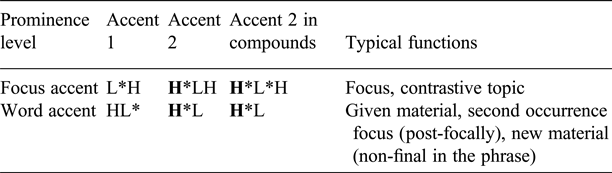
Chapter 12 deals with intonation. There are two levels of prominence, namely word accent – head in the maximal prosodic word – which is the lowest tonally marked prominence level, and sentence accent – head in the prosodic phrase, as seen in Table 3 (254).
Accents and prominence levels in Central Swedish.
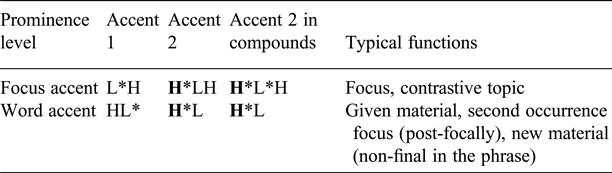
The focus accent, realised as L*H (a rising pitch movement with a low tone on the accented syllable) for accent 1 and H*LH (a fall-rise pitch movement with the initial high tone on the accented syllable) for accent 2, is the head of the prosodic phrase. It is assigned to the rightmost word in an information structurally focused constituent – similar to the placement of the nuclear accent in English. The distribution of focus accents in Swedish has to do with issues related to information structure and syntactic structure, and a few other individual variables. Some patterns are, nevertheless, fairly stable. The author delves into some idiosyncrasies of the system regarding accent, such as the existence of the initiality accent (IA) and final boundary tones. The final part of the chapter deals with the intonation hierarchy in order to close with a number of illustrations of the concepts explained above.
Chapter 13 explores the makeup of syllabic onsets and nuclei as well as initial and final clusters. As a general observation, Swedish tolerates complex onsets and codas. Regarding onsets, the insertion of a glottal stop in stressed vowel-initial syllables is not obligatory – unlike in German. Turning to syllable nuclei, all syllables must have a vowel as their nucleus, which favours the insertion of epenthetic vowels between two consonants, the latter of which must be a coronal liquid – except for /r/ – or nasal, when the preceding consonant is a non-sonorant segment. The syncopation of the epenthetic vowels takes place when vocalic endings or linking vowels are added to the word in question – but syncopation does not take place with non-coronal segments. The chapter provides explanations for the various consonant clusters observed in onsets and codas, and presents a table with the distribution of vowels in stressed and unstressed positions.
Finally, Chapter 14 provides complete lists with the correspondences between graphemes and phonemes, and between phonemes and graphemes, introducing examples that illustrate each of the possibilities covered in the given lists.
Following this summary, I would like to add two remarks. Firstly, although the book claims to be ‘theory neutral’ (jacket), every now and then it uses tools borrowed from autosegmental phonology and Optimality Theory. Regarding the latter, the informed reader would no doubt benefit from a general ranking of the constraints identified for Swedish phonology, as well as a constraint-based comparison with other Germanic languages, which would make the contrastive view more systematic. Secondly, although this is neither a textbook nor a pronunciation manual, the non-native reader would greatly benefit from audio-demonstrations of the examples presented – an Internet site could easily store them – particularly those that deal with tonal accents.
To conclude, the book presents a significant achievement regarding both its scope and the wealth of theoretical and empirical detail covered. It is an essential read for anyone interested in Swedish phonology and, by extension, the phonology of Scandinavian and Germanic languages.