The clinical outcomes and overall prognosis for CHD have improved dramatically over the last decades due to considerable improvement in diagnostic modalities as well as interventional approaches. Reference Larsen, Olsen, Emmertsen and Hjortdal1 The focus is shifting towards the long-term outcomes in CHD with the growing adult population outnumbering the paediatric population. Reference Warnes, Liberthson and Danielson2 In adults, the most commonly diagnosed CHD is the atrial septal defect, where large defects with haemodynamic impact undergo surgical or transcatheter closure, and small asymptomatic defects typically are left unrepaired. Reference Stout, Daniels and Aboulhosn3–Reference Brida, Chessa and Celermajer6 The small, unrepaired atrial septal defects are generally viewed as a benign lesion without impact on the long-term outcome of the patient’s life; however, recent studies challenge this belief. In a novel Danish nationwide, register-based study investigating late outcomes in small, unrepaired atrial septal defects, with the majority spontaneously closed, the adult patients had more chronic disease and a markedly reduced life-span, with an average of only 63 years, when compared with the general population. Reference Udholm, Nyboe and Karunanithi7 The most common cause of death is heart failure. From another national register-based study, Nyboe et al Reference Nyboe, Karunanithi, Nielsen-Kudsk and Hjortdal8 furthermore notice an increased mortality already noticeable in the 5th decade in adults with an atrial septal defect diagnosis. Recent clinical studies have also demonstrated unfavourable results in small, unrepaired atrial septal defects, such as poorer functional capacity as well as markedly lower 6-minute walking test when compared with healthy peers. Reference Udholm, Nyboe and Karunanithi7,Reference Udholm, Rex, Eckerstrom, Onat, Nyboe and Hjortdal9 Although other adverse outcomes, such as a higher mutation burden, Reference Nielsen, Nyboe and Ovesen10 have been established in this group of adults with small, unrepaired defects, the mechanisms for these recent findings remain unclear. Therefore, adults with small, unrepaired atrial septal defects were invited for further studies using MRI scans to examine atrial and ventricular volumes, morphology and function at rest and during exercise.
Methods
Ethics
The protocol of this study complies with The Danish Data Protection Agency (j.no. 1-16-02-633-15), the Regional Research Ethics Committee (j.no. M-2015-197-15) and with the ethical guidelines of the 1975 Declaration of Helsinki, revised in 2008. Each participant gave informed and written consent prior to participation in consistency with Danish law.
Study population
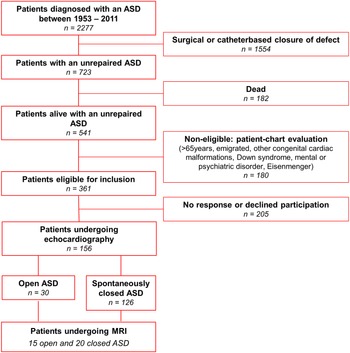
The patient population consisted of adults with a small, unrepaired atrial septal defect and was part of a nationwide, descriptive Danish study, DANASD, identifying all Danish patients with a small, unrepaired and haemodynamically insignificant atrial septal defect as identified through the Danish National Patient Registry. Reference Udholm, Nyboe and Karunanithi7,Reference Nyboe, Olsen, Nielsen-Kudsk, Johnsen and Hjortdal11,Reference Nyboe, Olsen, Nielsen-Kudsk and Hjortdal12 The defect was deemed as “small” per the discretion of the physician evaluating the patient at the time of diagnosis as well as the fact that the defect remained unrepaired at time of study participation. Inclusion criteria for patients were a verified, unrepaired atrial septal defect and age between 18 and 65 years. Exclusion criteria consisted of other congenital cardiac defects (except patent ductus arteriosus), persistent foramen ovale, pulmonary arterial hypertension, Eisenmenger syndrome, significant cardiac or pulmonary diseases, pregnancy, or missing patient chart. As part of two other studies, patients had undergone echocardiography Reference Udholm, Nyboe and Karunanithi7 as well as upright bicycle exercise testing Reference Brida, Chessa and Celermajer6 prior to being included in the current MRI study. Data from these two studies were included in this study in order to give further details on the patient population. From the echocardiographic data, unrepaired atrial septal defects were eventually divided in to either open or spontaneously closed defects. A random sample of patients in both groups was invited for MRI, according to allotted slots available in the time period. In Figure 1, a flowchart depicts the inclusion process. In total, four groups were invited for participation in the MRI study: adults with unrepaired, open defects, adults with unrepaired, spontaneously closed defects, and two groups of healthy controls, respectively, matched on age and gender. The healthy controls were recruited through flyers and announcements on the official webpage www.forsoegspersoner.dk and included ad hoc to match with patients on gender and age. Control subjects were excluded on the same grounds as the patients.
Flowchart illustrating inclusion process for adults with small, unrepaired atrial septal defects. ASD: atrial septal defect.

Magnetic resonance imaging
Scans were carried out with a 1.5 T Philips Achieva dStream whole-body scanner equipped with 40 mT/m gradients, a slew rate of 180 mT/m per ms, software release R517 using an 18-cm surface coil and spine coil array. ECG triggering was performed using an integrated four-electrode ECG system and respiratory rate was monitored with an air-filled belt fastened around the participant’s waist. First, standard scout images of the heart and greater vessels were achieved in the transaxial, coronal, and sagittal direction followed by single-shot planning with an interactive MRI platform in order to locate the four-chamber view using clinical MRI guidelines. During three breath holds, five cine images were produced of the four-chamber view, from which biventricular and atrial short-axis stacks were planned with slices being placed parallel to the mitral and tricuspid valve in end-diastole, respectively. Biventricular- and atrial short-axis scans were performed using a cine balanced steady-state-free precession sequence with kT-blast acceleration under breath holds covering the apex of the ventricle to the top of the heart with a slice thickness of 4 mm, a field-of-view of 320 × 304 mm, and a matrix of 164 × 162.
In order to assess the defect, and confirm echocardiographic-based status of being open or spontaneously closed, five slices of long-axis four-chamber views that covered the region of the fossa ovalis were obtained in all patients. Standard phase-contrast technique was used in determining defect status in a four-step process establishing the optimal view for direct en-face scan of the interatrial septum. Reference Thomson, Crowley and Heitner13 Flow measurements were performed in the pulmonary and systemic circulation by using a real-time phase-contrast sequence. For the systemic circulation, a transverse view of the ascending aorta was applied by placing an orthogonal plane at the upper edge of the aortic bulb approximately 2 cm above the aortic valve. For the pulmonary circulation, the pulmonary artery was visualised and an orthogonal plane was placed just above the pulmonary valve and proximal to the bifurcation, producing a transverse view of the proximal pulmonary artery. Scans were performed initially at rest followed by continuous exercise with free breathing as described below. Real-time scans comprised 170 consecutive, phase-contrast flow acquisitions without electrocardiographic triggering (each lasting 81 ms, giving a frame rate of 12.2 frames/second) with velocity encoding varying from 170 to 290 cm/second depending on exercise level. Order of scans was randomised for the entire group of participants, ensuring equal amounts of scans starting with either the aorta or the pulmonary artery.
Bicycle protocol
The MRI bicycle protocol has previously been described in detail and the applied methodology for cardiac output assessment validated. Reference Heiberg, Asschenfeldt, Maagaard and Ringgaard14–Reference Hjortdal, Emmertsen and Stenbog16 Participants were positioned on an MRI-compatible ergometer bicycle (MRI cardiac ergometer, Lode, Groningen, The Netherlands) that was mounted on the MRI table. In order to minimise movement during exercise, shoulder restrainers were used and feet were strapped to the ergometer pedals while ensuring that knee joint extended maximally at 30°. Heart rate was monitored by standard electrocardiography monitoring system and by pulse oximetry (Nonin 7500FO pulse oximeter with a fibre optic sensor cable 8000FC-30). Scans commenced at rest, without pedalling. Following initial scans, workload protocol was started at 25 W and lasted for 2 minutes and 15 seconds where after it gradually increased by 25 W every 75th second. Participants maintained a pedalling speed at 60–70 rounds/minute, with the ergometer regulating the workload, and the test continued until exhaustion was reached.
Data analyses
Volume measurement of the atria and ventricles were performed by a blinded, independent observer (NB) using the Medviso Segment Software. In all slices, the outline of the endocardium was manually traced, including trabeculation and papillary muscles as part of cardiac chamber volumes for better reproducibility. Reference Winter, Bernink and Groenink17,Reference Sievers, Kirchberg, Bakan, Franken and Trappe18 This approach was also recently applied in examining biventricular volumes and morphology in young adults with unrepaired ventricular septal defects. Reference Maagaard, Heiberg and Eckerstrom19 Cardiac volume measurements included end-diastolic and end-systolic volumes, minimal and maximal atrial volumes, stroke volume, and ejection fraction. These were automatically calculated by the software and were subsequently indexed to body surface area, by using the Du Bois formula. Right ventricular trabeculation was subjectively evaluated by the two independent observers (NB and MM).
Flow measurements at rest and during exercise were performed offline, using in-house produced software (Siswin version 0.9 © 2008). By using an elliptical, region-of-interest tool, contours of the ascending aorta, and the pulmonary artery were traced manually by one blinded observer (MA). From each flow sequence, heart rate and cardiac output were calculated as mean values, with the latter defined as mean blood flow across the scanning plane calculated by mean forward flow subtracted mean retrograde flow. The indirect assessment of the open defect was performed by calculating the shunt ratio as the mean cardiac output from the pulmonary artery relative to the mean cardiac output from the ascending aorta. The amount of blood flow through the open shunt was calculated as the difference in mean flow between the pulmonary artery and ascending aorta. For the bicycle test, exercise intensities were grouped into five intervals and defined by the percentage of each individual’s maximal workload: rest (=0%), very low (>0% <25%), low (≥25% <50%), moderate (≥50% <75%), submaximal (≥75% <100%), maximal (=100%).
Intra- and inter-observer variability
Reproducibility was assessed by measuring right ventricular end-diastolic volume, left ventricular end-diastolic volume, left maximal atrial volume, and right maximal atrial volume in five randomly chosen patients. For intra-observer variability, the scans were analysed twice with more than a month between the first and second analysis by the primary observer (NB). For inter-observer variability, the scans were assessed by two independent observers (NB and SU).
Correlation analyses
Correlation analyses were applied between measured cardiac volumes and the previously determined peak oxygen uptake. Reference Udholm, Rex, Eckerstrom, Onat, Nyboe and Hjortdal9 Regarding flow measurements, associations were tested between maximal systemic and pulmonary cardiac indices and chamber volumes as well as peak oxygen uptake. For the open defects, correlation was tested between current shunt ratio and exercise capacity.
Endpoints
Our primary endpoints were right ventricular end-diastolic volume at rest as well as aortic cardiac index during exercise. Secondary endpoints were shunt ratio and retrograde flow of the pulmonary artery, measured during exercise, as well as left ventricular end-diastolic volumes and biventricular stroke volume indices at rest.
Statistical Analyses
Continuous, normally distributed data were reported as means with standard deviations and non-parametric data were reported as median with 95% confidence interval. Normally distributed data was tested using the unpaired Student’s t-test with either equal or unequal variance, which was tested using the variance-comparison test as appropriate. For the non-parametric data, the Mann–Whitney-Wilcoxon rank sum test was applied. Curves of cardiac indices, retrograde flows, and shunt ratio during exercise between patients and controls were tested by applying two-way ANOVA. Statistical significance was defined as a p-value < 0.05. Inter- and intra-observer agreements were tested using the Intraclass Correlation Coefficient calculated with a two-way mixed model for absolute difference between measurements as described by Shrout and Fleiss. Reference Shrout and Fleiss20 A number of single measures were chosen from random participants from both groups, with two predefined raters, looking for absolute agreement. Correlation analyses were applied using Pearson’s sample correlation r. Statistical analyses and drawing of plots were performed using StataIC 11.2 (StataCorp LP, College Station, TX, USA) and GraphPad Prism 7 (GraphPad Software, La Jolla, CA, USA).
Results
Study population
Participants were included from May 2017 to July 2018 at Aarhus University Hospital, Denmark. A total of 15 patients with open atrial septal defects and 20 patients with spontaneously closed atrial septal defects were included along with 15 and 20 matched controls, respectively. MRI reconfirmed an open defect in 15 cases as well as a spontaneously closed defect in 20 cases, all secundum type atrial septal defects.
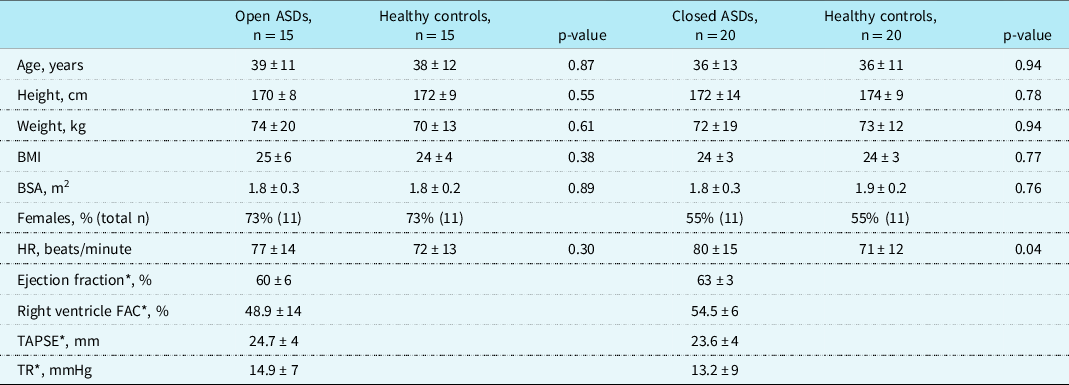
Participant demographics are shown in Table 1 with no differences between patients and controls. In Table 1, echocardiographic data have been added for all patients, who recently underwent transthoracic echocardiography as part of another study. Reference Udholm, Nyboe and Karunanithi7 Regarding prescription medication, four patients with open defects and two controls used anti-hypertensives, with none among the spontaneously closed defects. One patient with an open atrial septal defect used acetylsalicylic acid, whereas no one in the other groups used anticoagulants. None of the participants used anti-arrhythmic medication. Of the 15 patients with small open defects, eight subsequently underwent percutaneous closure following MRI examinations, mostly due to dilation of the right heart chambers as evaluated on echocardiography per the discretion of the cardiologist (JENK).
Demographics and clinical data on patients with an unrepaired open or spontaneously closed ASD and healthy controls.

Data presented as mean ± standard deviation, medians with (total ranges) or percentages with (total numbers). ASD: atrial septal defect; BMI: body mass index; BSA: body surface area; FAC: fractional area change; HR: heart rate; n: numbers; TAPSE: tricuspid annular plane systolic excursion; TR: tricuspid regurgitation.
* Transthoracic echocardiographic data on patients as part of another study. Reference Udholm, Nyboe and Karunanithi7
Two patients with open atrial septal defects, later closed percutaneously, were excluded post hoc from the following bicycle test due to poor image quality and subsequently failure to analyse blood flow satisfactorily during increasing exercise levels. This resulted in phase-contrast scans during the bicycle exercise test from 13 patients with open defects along with 13 controls, matched on age and gender, as well as scans from 13 patients with spontaneously closed defects and 13 matched controls.
Magnetic Resonance Imaging
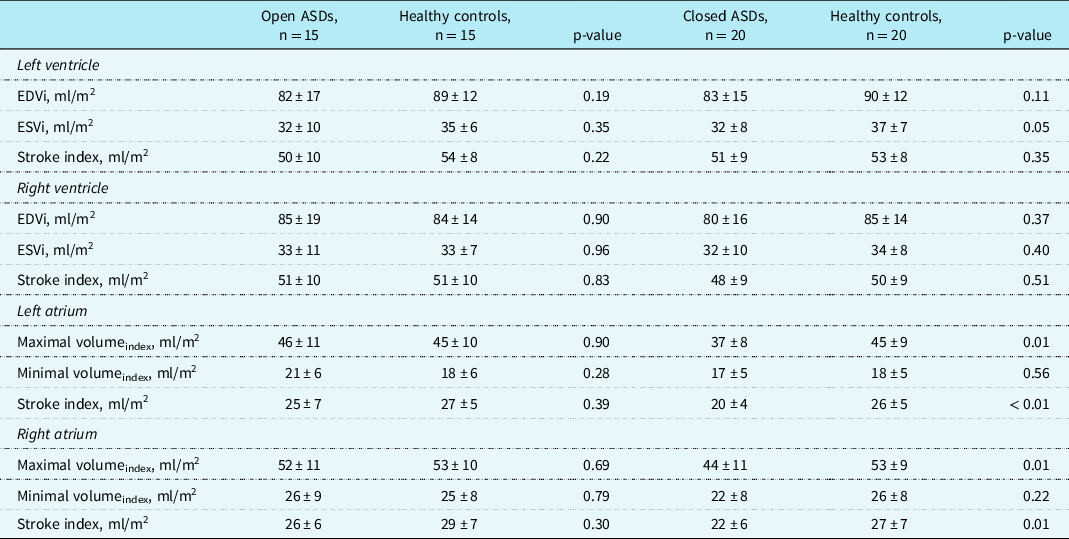
Volume measurements on participants are presented in Table 2. Overall, open atrial septal defects demonstrated no differences in biventricular or atrial volumes and function as well as right ventricular trabeculation compared with controls. Patients with a spontaneously closed atrial septal defects displayed slightly lower left atrial stroke index compared with controls, with all volumes being within normal ranges.
Volume measurements in patients with unrepaired open or spontaneously closed ASD and healthy controls.

Data presented as mean ± standard deviation. ASD: atrial septal defect; EDVi: end-diastolic volume index; ESVi: end-systolic volume index; n: numbers.
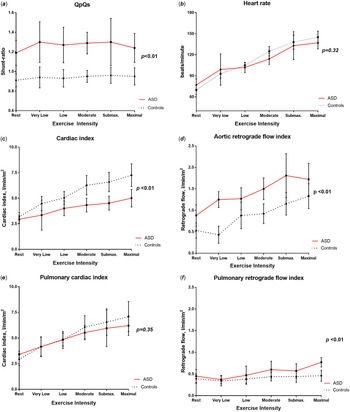
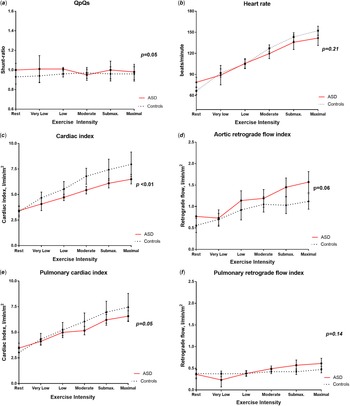
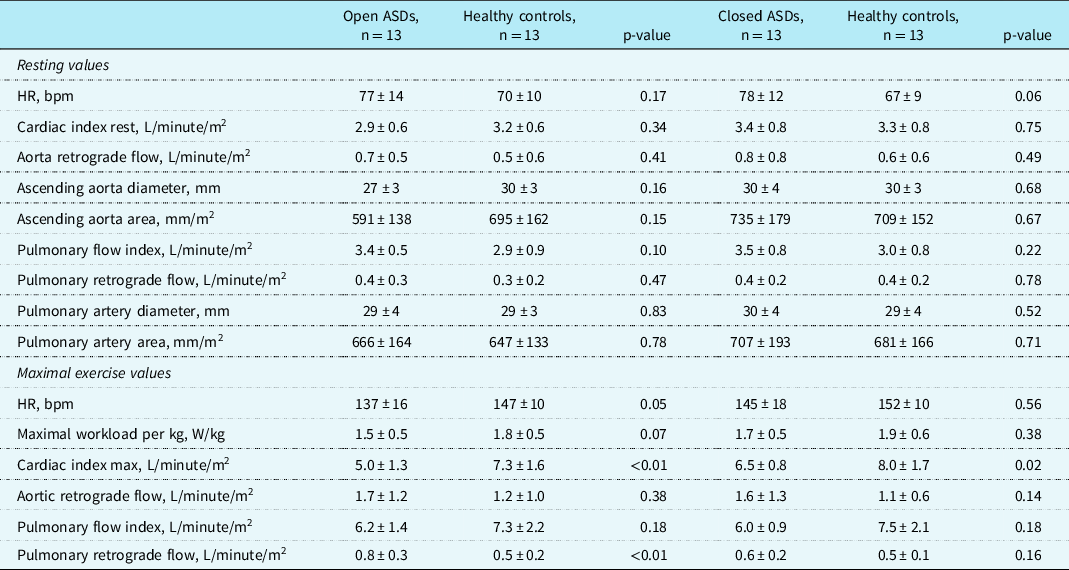
In Table 3, the flow measurements at rest and during exercise are presented for all groups undergoing the exercise test. There were no differences in heart rate or work load between the groups. Blood flow measurement and corresponding heart rates during the exercise test are displayed for open defects and matched controls in Figure 2, and spontaneously closed defects and their controls in Figure 3. Patients with an open defect had a mean shunt ratio of 1.2 ± 0.2 with blood flow of 0.9 ± 0.9 L/minute through the open defect at rest. At maximal exercise levels, the shunt ratio remained unchanged at 1.2 ± 0.2, whereas the mean flow through the defect had increased to 2.1 ± 1.8 L/minute, p < 0.01. From rest to exercise, open defects achieved an increase in cardiac index of 76 ± 21% whereas matched controls demonstrated 131 ± 48% increase in cardiac index, p < 0.01. At the end of the test, open defects reached 31% lower cardiac index than their controls. The flow index through the pulmonary artery was comparable at maximal levels, but patients demonstrated a reduced increase in flow from rest to maximal exercise, 82 ± 29%, as compared with their controls, 147 ± 55%, p < 0.01. Retrograde flow through the pulmonary artery differed significantly at maximal exercise levels and open atrial septal defects increased pulmonary backflow from rest to maximal exercise with 109 ± 74% compared with controls 27 ± 46%, p < 0.01.
Blood flow measurements and corresponding heart rates for adults with small, open atrial septal defects and healthy, matched controls during supine exercise. ASD: atrial septal defect.

Blood flow measurements and corresponding heart rates for adults with spontaneously closed atrial septal defects and healthy, matched controls during supine exercise. ASD: atrial septal defect.

Values from MRI exercise test on patients with unrepaired open or spontaneously closed ASD and healthy controls.

Data presented as mean ± standard deviation. ASD: atrial septal defect; bpm: beats pr minute; HR: heart rate; n: numbers.
For the spontaneously closed defects, cardiac index at maximal exercise levels was 18% lower than their matched controls, p = 0.02, with patients demonstrating an increase in cardiac index of 95 ± 44%, as compared with their controls, 144 ± 45%, p = 0.01. Pulmonary flow was comparable between spontaneously closed defects and their controls during exercise. Comparing adults with open and spontaneously closed atrial septal defects, open defects had a 22% lower maximal cardiac index, p < 0.01, but with comparable increases from resting to maximal exercise levels, p = 0.18. Pulmonary flow did not differ between patient groups.
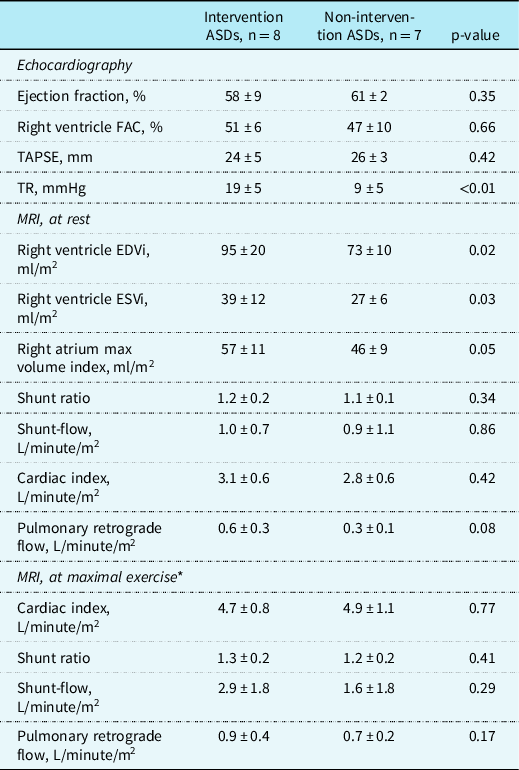
As a sub-analysis, data from patients with open atrial septal defects were evaluated depending on whether the patient underwent defect closure following study participation or not. As expected, patient who later underwent closure demonstrated poorer results, with significantly higher tricuspid regurgitation and larger right ventricular end-diastolic and end-systolic volumes compared with open defects not qualified for intervention. Results are shown in Table 4.
Echocardiographic and MRI measurements on patients with unrepaired open ASD that were deemed candidate for defect-closure.

Data presented as mean ± standard deviation. ASD: atrial septal defect; FAC: fractional area change; TAPSE: tricuspid annular plane systolic excursion; TR: tricuspid regurgitation. Transthoracic echocardiographic data on patients as part of another study. Reference Udholm, Nyboe and Karunanithi7
* Exercise scans from two patients in the group undergoing intervention following study participation were excluded due to poor image-quality.
Correlation analyses
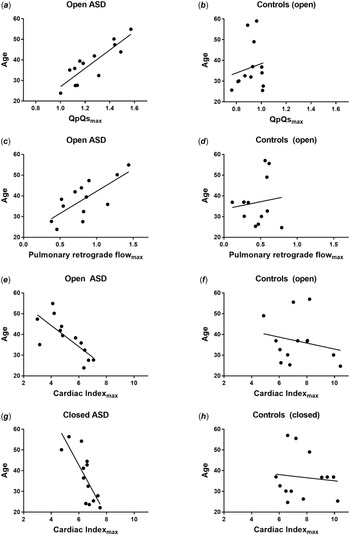
For the volume parameters, positive correlations were found for open atrial septal defects between previously reported VO2peak Reference Udholm, Rex, Eckerstrom, Onat, Nyboe and Hjortdal9 and end-diastolic volume index of left ventricle (r = 0.79, p < 0.01), but not for their controls (r = 0.66, p = 0.10). From the flow measurements, a positive correlation was revealed between maximal retrograde flow index in the pulmonary artery and right ventricle end-diastolic volume index (r = 0.71, p ≤ 0.01) for open defects, but not controls (r = 0.02, p = 0.97). Furthermore, a positive correlation was seen between maximal retrograde flow index in the pulmonary artery and larger right atrial minimal volume (r = 0.68, p = 0.04) for open defects, but not controls (r = −0.67, p = 0.15). Regarding the shunt ratio, a strong correlation was seen between the shunt ratio at maximal exercise levels and the age of the patients with open defects, r = 0.84, p < 0.01. Similarly, age was positively correlated with retrograde flow in the pulmonary artery during maximal exercise (r = 0.64, p = 0.02) and inversely with maximal cardiac index (r = −0.61, p = 0.04) for open defects, but not controls (r = 0.06, p = 0.83, and r = −0.29, p = 0.35). An inverse relationship was seen between a lower shunt ratio and a higher peak oxygen uptake in the open defects (−0.60, p = 0.04), but not the controls (r = 0.06, p = 0.87). For the spontaneously closed atrial septal defects, an inverse relationship was demonstrated between age and maximal cardiac index (r = −0.61, p = 0.02), but not the controls (r = −0.09, p = 0.78). Figure 4 displays the relationship between age and haemodynamic findings in patients with open and spontaneously closed atrial septal defects as well as their, respectively, matched controls.
Correlation between age and shunt ratio, pulmonary regurgitation and cardiac index at maximal exercise levels for patients with open and spontaneously closed atrial septal defects and healthy, matched controls. ASD: atrial septal defect; QpQs: shunt ratio.

Inter- and intra-observer correlations
The observer variability demonstrated good agreement between inter- and intra-observer measurements. Right ventricular end-diastolic volume demonstrated an Intraclass Correlation Coefficient of 0.98 for the intra-observer variability and 0.76 for the inter-observer variability, left ventricular end-diastolic volume showed 0.84 for the intra-observer and 0.62 for the inter-observer variability.
Discussion
This is the first study to investigate haemodynamic properties in a homogenous group of small, unrepaired atrial septal defects during physical exercise using MRI. The most important finding is a 31% and an 18% lower maximal cardiac index in the open defects and in the spontaneously closed defects as compared to their healthy peers. This is in line with recently published findings of reduced functional capacity in small unrepaired defects. Reference Udholm, Rex, Eckerstrom, Onat, Nyboe and Hjortdal9 The functional capacity is often used as a marker of the degree of impact of the atrial septal defect, and recently, an impaired exercise capacity was added to the list over recommendations for defect closure according to the latest ACC/AHA guidelines. Reference Stout, Daniels and Aboulhosn3 Interestingly, reduced functional capacity has been demonstrated regardless of the small unrepaired defect being open or spontaneously closed. Studies on the potential effect on exercise capacity from closure of small, asymptomatic defects in adults remain to be performed.
One explanation for the inability to increase cardiac index during dynamic exercise and for the lower functional capacity could be a disrupted left ventricular function. In an exercise study, Giardini and colleagues tested adults with atrial septal defects before and 6 months after device closure with echocardiography and upright bicycle test and found that an improved left ventricular volume loading and thereby increased output was directly correlated with improved peak oxygen uptake. Reference Giardini, Donti and Formigari21 This can however not be the only explanation as both lower peak oxygen uptake Reference Udholm, Rex, Eckerstrom, Onat, Nyboe and Hjortdal9 and reduced maximal cardiac index are also seen in the spontaneously closed defects.
Another possible explanation for the inability to properly increase the cardiac output and failure to reach equal exercise capacities as healthy peers may be that the patients with open defects are not able to reduce the pulmonary vascular resistance during exercise equally as in their matched controls. The natural response to exercise in the pulmonary system, as in the systemic circulation, is vasodilation and vascular recruitment causing a drop in pulmonary vascular resistance. Reference Merkus, de Beer, Houweling and Duncker22 Perhaps, adults with a small left-to-right interatrial shunt may be unable to appropriately facilitate this response. In large, haemodynamic left-to-right defects, the pulmonary hyperperfusion causes vascular damage and dysfunction resulting in pulmonary vasculature becoming hypertrophic with a consequential increase in resistance. An indication of this hypothesised inability to decrease pulmonary resistance as induced by mounting exercise levels may be reflected in the increasing pulmonary retrograde flow seen in open atrial septal defects, but not their controls. This finding mimics that of previous results in similar MRI exercise studies investigating left-to-right shunts. In these studies on young adults with small, unrepaired or surgically closed ventricular septal defects, identical retrograde flow patterns of the pulmonary artery were described along with an inability to increase cardiac output to the same extend as healthy controls, irrespective of defect being open or closed. Reference Maagaard, Eckerstrom, Heiberg, Asschenfeldt, Ringgaard and Hjortdal15,Reference Asschenfeldt, Heiberg, Ringgaard, Maagaard, Redington and Hjortdal23
Little is known about the effect of exercise on the shunt ratio in adults with small, open atrial septal defects. In this study, the shunt ratio does not change markedly throughout the exercise test, whereas blood flow through the shunt clearly increases with a mean difference of 1.1 ± 1.5 L/minute in flow left-to-right from rest to maximal exercise levels. Haemodynamic properties of open defects have previously been investigated during heart rate increase, with varying results. In a study from 2017 by Stephensen et al, a group of large and small atrial septal defects underwent MRI at rest and during dobutamine-induced stress. Reference Stephensen, Steding-Ehrenborg and Thilen24 They find a slight decrease of absolute blood flow through the shunt and a decrease in shunt ratio during stress, which is explained by a larger increase in aortic cardiac output relative to the pulmonary blood flow. This differs from our findings where a slightly larger increase is seen in the pulmonary system, but no significant change in shunt ratio during exercise. This may be explained by the nature of dobutamine being primarily an inotropic drug, whereas supine bicycle exercise with physical exhaustion provides a cascade of actions difficult to mimic through medication and probably affects the systemic venous return differently. In two older studies conducted five decades ago and using cardiac catheterisation during exercise, the shunt ratio was found to be decreasing with mounting exercise, but Bay et al showed at the same time an increase in absolute blood flow through the shunt with increasing exercise Reference Bay, Abrahamsen and Muller25 whereas Nielsen and colleagues revealed a decreased shunt volume during exercise. Reference Nielsen and Fabricius26
In this study, half of the open defects ended up undergoing defect closure following study participation mainly due to right ventricle dilation as estimated on echocardiography. As the haemodynamics during exercise is also changed in the rest of the patient group with open defects, closure in all would perhaps seem a logical decision. It is impossible to know whether earlier closure could have prevented the current findings as we do not know when the changes started or progressed, whether the changes are permanent or reversible or if closure might normalise the conditions. The latter is not very plausible, as adverse findings are likewise present in the group with spontaneously closed defects, although not to the same degree. Furthermore, in a large register-based study from 2018 on 2277 adults with unrepaired and repaired atrial septal defects with a median follow-up time of 18.1 years, increased mortality was found in all patients when compared to the general population – also in patients whose defects were closed before the age of 18 years. Reference Nyboe, Karunanithi, Nielsen-Kudsk and Hjortdal8 On the other hand, in a cohort study from 2019, 608 adults were followed after defect closure at a tertiary centre with a median follow-up time of 6.7 years and were found with comparable survival to that in the general population. Reference Brida, Diller and Kempny27 Nevertheless, this could in part be due to a degree of selection bias in surgical candidates, as patients with important pulmonary disease or left ventricular disease were excluded and a more proactive approach was assumed in offering closure for prognostic reasons prior to signs of cardiac decompensation and ensuing overt symptoms. Although the current study is not able to identify who should have their defect closed, another important message is however clearly underlined – the necessity of follow-up, as a seemingly innocent defect found in childhood could develop and cause cardiac abnormalities, exercise impairment and other abnormal findings in adulthood. Importantly, none of the current patients were monitored in any organised follow-up programme and all were diagnosed with a small, insignificant and unrepaired atrial septal defect previously in life. Although patients are just around 40 years of age when examined in this study, an age-related factor was already evident when analysing the haemodynamics during exercise. In the open defects, increasing age was associated with increasing pulmonary retrograde flow as well as a greater shunt ratio at high exercise levels along with an inverse association with decreasing cardiac index during maximal exercise. Interestingly, a similar pattern of inverse relationship was even noted between increasing age and reduced cardiac index at maximal exercise levels for patients with spontaneously closed defects, but not their controls. It would be highly interesting to repeat studies investigating functional exercise capacity in 10–20–30 years in order to determine potential accelerated worsening of exercise capacity in atrial septal defect patients compared with their healthy peers.
The majority of patients with atrial septal defects are usually discharged from follow-up when they reach their teens if they are asymptomatic and without signs of volume or pressure overload. This is still the overall acknowledged management of patients with simple defects in many countries although newest guidelines recommend life-long follow-up. Reference Stout, Daniels and Aboulhosn3 In a recent study, outcome of adults with congenital heart disease are compared according to patients being either managed by dedicated trained cardiologists or by general adult cardiologists. Reference Cordina, Nasir Ahmad and Kotchetkova28 In this, Cordina et al note a great difference in the management and further stresses that the period where the patients change from paediatric care to adult outpatient centrers is of particular importance in securing a consistent follow-up as lapse of care may be linked with late morbidity and mortality. This is further emphasised in a recent review by Brida et al, where adults with atrial septal defects in particular require and benefit from follow-up in specialised centres throughout life as some of the small open defects, initially without changes to the right side of the heart, may develop problems over time. Reference Brida, Chessa and Celermajer6 In line with this, in a Danish register-based study, these small unrepaired atrial septal defects, not followed in any specialised centres, were found to demonstrate more chronic diseases in adulthood when compared with the general population. Reference Udholm, Nyboe and Karunanithi7 Most noticeably, adults with small unrepaired defects, deemed as insignificant at time of diagnosis, were found to have a markedly reduced average life-span of 63 years with the most common cause of death being non-ischaemic heart failure.
Limitations
A number of pitfalls when quantifying flow and volumes using MRI could potentially limit the validity of the study results. Particularly, quantification of the ventricles and the atria can be complex due to challenges identifying the endocardial border and defining the planes when evaluating ventricular volumes, and reproducibility can therefore be low. In order to improve reproducibility, papillary muscles and trabeculation were included as part of the ventricles as this has been found to increase reproducibility. Reference Winter, Bernink and Groenink17 Furthermore, inter- and intra-observer variability analyses demonstrated good agreements between measurements.
During the exercise test, the velocity encoding sensitivity was carefully considered prior to the test in collaboration with our MRI physicist. The velocity encoding sensitivity was adjusted appropriately so that the highest velocities likely to be encountered within the ascending aorta and pulmonary trunk were comprised. Set too high the quality of the images and data could decline, and set too low velocity aliasing can instead occur with flows faster than the set limit and thereby not being appropriately represented in the data. Reference Lotz, Meier, Leppert and Galanski29 Still, some noise must be anticipated with phase-contrast scans conducted in real time. The calculated mean flow holds both random negative and positive pixels due to noise and the mean sum will thereby be reliable, whereas pure forward or retrograde flow potentially could include too much random positive or negative pixels caused by noise. This may explain some of the retrograde flow of the aorta and pulmonary artery seen in all participants during the exercise test. Still, the open defects have larger retrograde flows of the vessels during exercise compared with healthy peers which cannot be owed only to noise. Finally, it is impossible to know whether the increased retrograde flow noted in the pulmonary artery is due to increased resistance in the pulmonary circulation during exercise, increased insufficiency of the pulmonary valve or something else altogether. It is not the same as pulmonary regurgitation as this is considered a valvular abnormality. But it cannot be rejected that the patients also have increased pulmonary regurgitation as a result of increased pulmonary retrograde flow and potential increased pulmonary exercise resistance. Exercise echocardiography could possibly clarify further on this in patients with atrial septal defects.
Conclusion
Adult patients in their late 30s, previously diagnosed with a small open or spontaneously closed atrial septal defect, demonstrated a markedly lower cardiac index compared with their healthy peers. Patient with open defects exhibited higher retrograde flow in the pulmonary artery with increasing exercise compared with healthy controls. These findings may partly explain the lower functional capacity demonstrated previously. Although the defect did not warrant closure at the time of diagnosis, these novel findings suggest that long-term outcome in small unrepaired atrial septal defects are neither simple nor event-free. Furthermore, half of the open defects underwent defect closure following study participation. With these latest results adding to the growing pool of evidence of the long-term burden of a small atrial septal defect, we believe it essential to focus on organising follow-up programmes for adults with simple cardiac congenital defects to optimise “whole-of-life” care for this growing, ageing population.
Acknowledgements
The authors warmly thank research secretary Jette Breiner for her highly valuable contribution and greatly acknowledge Zarmiga Karanunathi, MD, PhD, for her administrative support in the preparation of the manuscript.
Financial support
This work was supported by the Karen Elise Jensens Foundation, Aase and Ejner Danielsens Foundation, and Helga and Peter Kornings Foundation.
Conflicts of interest
None.