INTRODUCTION
The European species of the scleractinian family Dendrophylliidae include some of the most colourful corals in these waters, with white, orange or yellow polyps and coenenchyme (with the exception of the green-brownish polyps of Balanophyllia europaea due to its symbiosis with zooxanthellae), and they are characteristic members of their benthic communities when they are present. One of the distinctive genera in this family is Dendrophyllia Blainville, 1830.
The genus Dendrophyllia includes colonial forms usually with a distinct three-dimensional structure, supporting important communities in circalittoral areas (Zibrowius, Reference Zibrowius1980; Aristegui et al., Reference Aristegui, Brito, Cruz, Bacallado, Barquin, Nuñez and Perez-Dionis1987). The structure of these communities is still scarcely known, as is the biology of these coral species, like those formed by Dendrophyllia ramaea (Linné, 1758). Other species such as Dendrophyllia cornigera (Lamarck, 1816) are present in coral communities currently under special international attention, namely those living at the border of the continental shelf, mainly formed by Lophellia pertusa (Linné, 1758) and Madrepora oculata Linné, 1758 (see Zibrowius, Reference Zibrowius1980; Mastrototaro et al., in press, for example).
Zibrowius & Brito (Reference Zibrowius and Brito1984) described the last Dendrophyllia species in the north-eastern Atlantic, Dendrophyllia laboreli, based on material from several localities off West Africa (from Ghana to the Canary Islands), the northernmost known localities up to that time being ‘Rio de Oro, Occidental Sahara’ on the continent, and Gran Canaria and Fuerteventura in the Canary Islands. The records in this archipelago subsequently included other islands such as La Gomera or La Palma (Brito & Ocaña, Reference Brito and Ocaña2004).
In 1998, H. Zibrowius and P.J. López-González carried out a littoral sampling trip throughout the Strait of Gibraltar within the surveys of the ‘Fauna Ibérica IV’ project, coordinated by the Museo Nacional de Ciencias Naturales in Madrid. One of the results of that diving survey was the discovery of two young colonies of Dendrophyllia laboreli in La Caleta (Cádiz). These were the first colonies found in European waters. Recently, within a general benthic survey programme sponsored by the Regional Environmental Council of the Government of Andalucía in southern Spain (Consejería de Medio Ambiente, Junta de Andalucía) since 2004, the species has been located in different sampling stations of the Gulf of Cádiz and Strait of Gibraltar. The presence of this species off the Andalusian Atlantic coasts was mentioned in a short note in the Red Book of Andalusian Invertebrates (López-González et al., Reference López-González, Gómez, Arroyo, Moreno, Barrajón, Barea-Azcón, Ballosteros-Duperón and Moreno2008), while waiting for more complete descriptions of the material collected, the environments where this coral species was observed, and their possible biogeographical implications. In this Red Book, the species was included in the category ‘DD’ (Data Deficient) evaluated using IUCN criteria (2001), a category dedicated to those species susceptible to the impact of human activity, but about which we have scarce or incomplete knowledge concerning their true distribution and biology in Andalusia (southern Iberian Peninsula).
More recently (November 2009), thanks to a bilateral research programme on littoral benthic cnidarian of the University of Seville in Spain and the Univeristy of Ibn Zohr in Agadir (Morocco), an important population of Dendrophyllia laboreli was found in Taghazout (Agadir, Morocco).
All these findings show that this scleractinian coral is well represented along the Atlantic Moroccan coast, the north coast of the Gulf of Cádiz and the Strait of Gibraltar.
The aim of this report is to update and enlarge the known distribution of this species to define its northernmost limits of distribution, thus adding a new species to the list of European fauna. The material examined for this study is deposited at the Museo Nacional de Ciencias Naturales in Madrid (MNCN), the reference collection of the Consejería de Medio Ambiente, Junta de Andalucía (CMA-JA), and the hexacoral reference collection of the research group ‘Biodiversidad y Ecología de Invertebrados Marinos’ of the University of Seville (BEIM-CRH).
SYSTEMATICS
Material examined
MNCN (2.04/1095), La Caleta (Cádiz, Spain), 36°31.48′N 6°18.39′W, 9 m depth, 5 August 1998, coll. H. Zibrowius and P.J. López-González, two colonies. BEIM (CRH-100) Punta Caimán (Huelva, Spain), 37°6.16′N 7°19.75′W, 22 m depth, 31 October 2007, coll. G. Gómez and M.C. Arroyo, one colony. CMA-JA (no code), Isla de Sancti Petri (Cádiz, Spain), 36°22.489′N 6°13.344′W, 15 m depth, 22 September 2008, one colony. BEIM (CRH-101), Taghazout (Agadir, Morocco), 30°32.64′N 9°43.70′W, 15 m depth, 14 November 2009, coll. P.J. López-González, C. Megina and N. Tamsouri, six colonies.
Other material observed and photographed underwater, but not collected: El Saladillo (Algeciras Bay, Cádiz, Spain), 36°6.47′N 5°24.58′W, 25 m depth, 26 September 2009, more than 20 colonies observed. Punta Carnero (Algeciras Bay, Cádiz, Spain), 36°4.45′N 5°24.59′W, 25 m depth, 8 July 2009, two colonies observed. Sancti Petri (Cádiz, Spain), 36°22.489′N 6°13.344′W, 15 m depth, 22 September 2008, more than 20 colonies observed. Punta Carnero (Algeciras Bay, Cádiz, Spain), 36°4.53′N 5°25.4′W, 27 m depth, 10 November 2009, ten colonies observed. Mazagón (Huelva, Spain), 37°1.21′N 6°47.18′W, 17 July 2007, 29 m depth, one colony observed. Punta de la Barra (Huelva, Spain), 37°6.26′N 7°19.79′W, 6 May 2008, 22 m depth, one colony observed. G. Gómez, M.C. Arroyo and M. Fernández-Casado (personal observations).
REMARKS
Morphological and chromatic remarks
The examined material agrees with the original description given by Zibrowius & Brito (Reference Zibrowius and Brito1984). The colonies collected in southern Spain and Atlantic Morocco (Figure 1) are up to 28 mm in height and 26 mm in diameter, with a relatively reduced number of polyps (between 3 and 10) with the typical 48 septa in four cycles (C1 to C4). As most of the colonies examined have 3 or 4 polyps, the primary polyp was easily differentiated. The polyps have a circular or compressed ellipse outline. This morphology and general colonial development is also coincident with that described by the original authors for the material known from what was at that time the northernmost distributional limit (Canary Islands). This material was also commented on by Brito & Ocaña (Reference Brito and Ocaña2004). As shown in Zibrowius & Brito (Reference Zibrowius and Brito1984: Pl. II, figures 13–19) for the type colony, this species can have up to 51 polyps, in colonies of 51 mm in diameter and 43 mm in height. Such large colonies have not been found in the northern latitudinal areas of distribution established in this paper.
Dendrophyllia laboreli. (A, B) Collected living colonies from Taghazout; (C) living colony from Punta Caimán, Huelva; (D, E) skeletons of the two colonies collected in La Caleta, Cádiz; (F) detail of a coralite from the colony in D.

Dendrophyllia laboreli also shows some chromatic patterns, which are more variable in the southern areas of its general distribution. In the examined material from southern Spain and Atlantic Morocco, the coenenchyme of all colonies was orange in colour (clearer in Spanish localities) with yellowish tentacles. This chromatic pattern coincides with that observed in colonies collected from the Canary Islands (Brito & Ocaña, Reference Brito and Ocaña2004). According to Zibrowius & Brito (Reference Zibrowius and Brito1984), those colonies collected from the Cape Verde area to Ghana were red, yellow, orange, reddish-yellow, even rose violaceous or dark red, with a yellow-orange or yellow oral disc.
Ecological remarks
In the newly cited localities, the colonies were generally found on flat rocky bottoms with a strong sedimentary dynamic, high amount of suspended particles, an abundant sediment deposition over the rocks, and an elevated resuspension. The benthic assemblages are mainly dominated by the animal component, often modular organisms with an elevated tridimensional structure such as gorgonians, or by axinelid sponges. The occurrence of algae is limited, mainly represented by incrusting calcareous forms. This seems to be a typical habitat for this species (Zibrowius & Brito, Reference Zibrowius and Brito1984; Brito & Ocaña, Reference Brito and Ocaña2004).
In shallower localities, or more illuminated environments, Dendrophyllia laboreli has also been reported in grooves in rocks, or on overhangs (Zibrowius & Brito, Reference Zibrowius and Brito1984), mainly in the southern part of its distributional area. In the Strait of Gibraltar, it can also be found forming small populations in typical circalittoral coralligenous habitats.
The species is locally abundant in Taghazout (Morocco). Among the European localities, it seems to be uncommon in the westernmost Atlantic localities (from Cadiz city to Huelva) tending to be locally abundant towards the Strait of Gibraltar (Algeciras Bay). The latter observations confirm the well established presence of this species off the European coasts.
Regarding its vertical distribution, it has being recorded from 1 to 70 m deep (Zibrowius & Brito, Reference Zibrowius and Brito1984), the shallowest occurrences being from southern locations. In the northernmost African locations it had not being reported over 40 m. The new findings also enlarge these limits up to 15 m in northern African localities (Taghazout) and up to 9 m in the European localities (La Caleta, Cádiz).
Biogeographical remarks
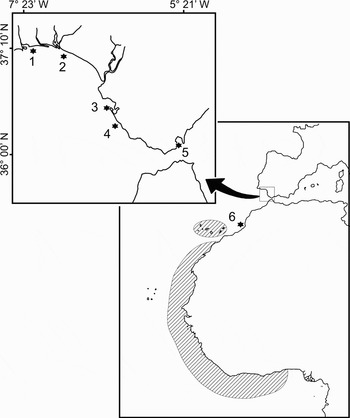
As previously mentioned, after the original description of Dendrophyllia laboreli, the area of distribution of this species was considered to be restricted to eastern Atlantic African waters between Ghana and the Canary Islands. With the present findings, the species is now also considered part of the Atlantic European fauna, as well as at the threshold of the Mediterranean Sea (Algeciras Bay in the Strait of Gibraltar) (Figure 2).
Known distribution of Dendrophyllia laboreli. Striped area: previous data from Zibrowius & Brito (Reference Zibrowius and Brito1984), and Brito & Ocaña (Reference Brito and Ocaña2004). The asterisks are the present records: 1, Punta Caimán and Punta de la Barra; 2, Mazagón; 3, La Caleta; 4, Sancti Petri; 5, Algeciras Bay (Saladillo and Punta Carnero); 6, Taghazout.

In the 1990s a great sampling effort was carried out in the Strait of Gibraltar (especially at the Algeciras Bay and Tarifa Island transect) by the Marine Biology Laboratory of the University of Seville. In those years, most of the evaluations and identification of the benthic marine fauna from this particular biogeographical point were performed (the first two authors of this contribution participated actively in this research programme). In that extensive field research, Dendrophyllia laboreli was not detected despite its bright colour and the several dives carried out at some of the stations in which we are now recording the species.
These facts are in agreement with either a recent arrival of Dendrophyllia laboreli to the European coast or a notable expansion of previously existing very small or cryptic populations, possibly facilitated by global warming. The latter hypothesis, however, is unlikely given the sampling effort applied to this area.
A recent arrival of this species could have been human mediated, given the intense maritime traffic between the Canary Islands and the south-western Iberian Peninsula, or a natural expansion of its distributional range to the north, in a scenario of climate change. The seemingly discontinuous distribution that would support an artificial introduction (Bouderesque & Verlaque, Reference Bouderesque and Verlaque2002) could be due to the lack of information on the marine fauna of Atlantic Morocco.
On the other hand, the limited variability of the colour pattern of populations in the Iberian Peninsula (exclusively orange-yellow) in comparison with the southernmost populations, is in agreement with a recent expansion of the species to the north, but does not conclusively tip the balance between the two competing hypotheses. An artificial introduction would involve a reduction in the phenotypic diversity, as an effect of the reduction in the genotypic diversity, associated with a ‘founder effect’ (Duran et al., Reference Duran, Giribet and Turon2004). However, all northern populations, including those in the Canary Islands and those in the Agadir region exhibit the same reduction in the colour pattern variability. Newly formed populations naturally spreading northward from this part of the original population would also present these phenotypic characteristics. To choose between these hypotheses would need further molecular research.
Although Dendrophyllia laboreli can be considered a non-native species according to the current lists of species in European waters, and its recent presence could have been facilitated by the current scenario of global climate change, it may be erroneous (according to our current knowledge) to consider this species as an invasive one and a major threat to the local biodiversity.
The term ‘invasive species’ is reserved for those which adversely affect the habitats they enter ecologically, environmentally or economically. The evaluation of some characteristics, such as fast growth, asexual or rapid reproduction, the ability to live off many different food types and sources, or tolerance of a wide range of environmental conditions, have to be considered to predict a determined level of invasiveness.
In general, Dendrophyllia laboreli does not fall into the category described by the above diagnostic behaviour of an invasive species, whether we consider it as an introduced species or a recent-colonist (Eno et al., Reference Eno, Clark and Sanderson1997). Apparently this coral shows similar growth rates and feeding behaviour to its congeners, no indications of asexual reproduction have been observed and it is present in environments similar to those in which the species was described off the African coasts. Moreover, the species has not been observed in densities that could enter into dramatic competition with other benthic organisms. It is clear that more information is necessary concerning the ecology of this species in the northern limits of its distribution here reported.
A completely different case is that illustrated by the invasive Oculina patagonica de Angelis, 1908. In recent decades the presence of this coral species has been reported in the Mediterranean (Zibrowius, Reference Zibrowius1974, Reference Zibrowius1980; Bitar & Zibrowius, Reference Bitar and Zibrowius1997), and in this case the coral shows an aggressive behaviour that involves competing for the available space by growing over other benthic invertebrates (Zibrowius & Ramos, Reference Zibrowius and Ramos1983) and showing surprising asexual reproductive processes (Kramarsky-Winter et al., Reference Kramarsky-Winter, Fine and Loya1997). Although Dendrophyllia laboreli could be a new species for European waters, its presence can apparently not be considered aggressive for other species.
ACKNOWLEDGEMENTS
We thank Helmut Zibrowius (Station Marine d'Endoume, Marseille) for his helpful comments and especially for the sampling trip carried out during August 1998 within the framework of the Spanish Project Fauna Iberica IV, where the first two colonies of Dendrophyllia laboreli collected in European coasts were detected. Eduardo Fernández Tabales (Consejería de Medio Ambiente, Junta de Andalucía) and Diego Moreno Lampreave (Egmasa) provided sampling and ecological information concerning D. laboreli in the southern Spanish littoral within the general plans of The Management and Conservation of the Marine Environment of the Consejería de Medio Ambiente (Junta de Andalucía).
This research has been partially financed by the DGICYT project Fauna Ibérica IV (PB 95-0235) and the PCI project A/021669/08 (Spanish Agency of International Cooperation—MAEC).