Coagulase-negative staphylococci (CNS) have become the predominant mastitis pathogens in several countries (Nevala et al. Reference Nevala, Taponen and Pyörälä2004; Pitkälä et al. Reference Pitkälä, Haveri, Pyörälä, Myllys and Honkanen-Buzalski2004; Tenhagen et al. Reference Tenhagen, Köster, Wallmann and Heuwieser2006). CNS mastitis is especially common during the first lactation (Myllys, Reference Myllys1995), but is frequently encountered also during subsequent lactations (Jarp, Reference Jarp1991; Taponen et al. Reference Taponen, Simojoki, Haveri, Larsen and Pyörälä2006). CNS mastitis is usually subclinical or mildly clinical (Jarp, Reference Jarp1991; Taponen et al. Reference Taponen, Simojoki, Haveri, Larsen and Pyörälä2006) but affects milk quality by increasing milk somatic cell count (SCC). Elevated milk SCC during early lactation in primiparous cows may decrease their milk production until the end of lactation, although the SCC itself normalizes soon after the beginning of lactation (De Vliegher et al. Reference De Vliegher, Barkema, Stryhn, Opsomer and de Kruif2005). The epidemiology of CNS mastitis is still unclear, although a number of studies have been conducted to identify the reservoirs of CNS. CNS have been isolated from different body sites of cows, heifers and calves, from udder secretions and milk and the cow environment (Devriese & Keyser, Reference Devriese and De Keyser1980; Boddie et al. Reference Boddie, Nickerson, Owens and Watts1987; White et al. Reference White, Harmon, Matos and Langlois1989; Trinidad et al. Reference Trinidad, Nickerson and Alley1990; Matos et al. Reference Matos, White, Harmon and Langlois1991; Matthews et al. Reference Matthews, Harmon and Langlois1992). In earlier studies, CNS were identified using phenotypic characteristics. New identification methods based on molecular biology enable investigations at strain level and comparison of strains from different sources.
Our aim, using CNS species identification methods based on phenotype (API Staph ID 32 test) and a 16 and 23S rRNA RFLP library, and strain typing with pulsed field gel electrophoresis (PFGE) was 1) to identify the species of CNS isolated from the following extramammary sites: perineum skin, udder skin, teat apices and streak canals of lactating dairy cows, milk from mastitic quarters, and samples from teat cup liners and hands of the working staff of the research dairy herd of the University of Helsinki; and 2) to compare CNS species and strains isolated from mastitic milk with CNS species and strains isolated from other sites.
Materials and Methods
Sampling
A random sample, comprising half of the approximately 70 lactating cows of the dairy herd of the University of Helsinki, was selected for the study. Cows were housed in a stanchion barn and milked twice a day. They were sampled in December 1999 (31 cows) and again in January 2002 (35 cows). Swab samples were taken from perineum and udder skin, teat apices and streak canals. Samples were also taken from the hands of herd staff members and from liners of the teat cups washed normally after milking. All swab samples and streak canal samples are later termed extramammary samples. The herd had a low bulk milk SCC, the annual average being about 140 000 cells/ml.
Perineum, udder skin and teat apices of cows, hands of the staff members and teat cup liners were sampled using sterile swabs (Technical Service Consultants Ltd, Heywood, UK). Streak canals were sampled with ultrafine sterile swabs (Deltalab S.A, Barcelona, Spain). For every sample a test tube with 4 ml of phosphate-buffered rinse solution containing sodium citrate was used. Prior to sampling, swab heads were moistened in the rinse solution. For skin samples, the swab was rotated on the skin 360° or more. For streak canal samples, teat apices were first cleaned with cotton moistened with antiseptic solution. The ultrafine swab was carefully inserted 2–3 mm into the distal end of the streak canal and rotated 360°. After taking the sample, the swab was broken off into the test tube containing rinse solution and the test tube was placed on ice for immediate transport to the laboratory.
Bacterial analyses
The test tubes were shaken and 100 μl of rinse solution of every tube was spread onto a selective Staphylococcus medium 110 agar plates supplemented with 0·05 g sodium azide/l, which inhibits growth of competing skin microbiota without inhibiting Staphylococcus species (Difco TM Staphylococcus medium 110, Becton, Dickinson and Company, Sparks MD, USA) (White et al. Reference White, Matos, Harmon and Langlois1988). Plates were incubated at 37°C for 24 h. After incubation, 1–5 colonies were selected from each plate with bacterial growth based on dissimilar colony morphology and pigmentation. From plates with more bacterial growth, more colonies were picked up than from plates with less growth, but on the whole selection of colonies was random. Colonies were transferred onto blood agar plates and further incubated at 37°C for 24 h. The colonies were then identified as staphylococci based on catalase reaction, Gram staining, microscopy, lysostaphin susceptibility and lysozyme resistance. CNS were distinguished from Staph. aureus using a Slidex test (Slidex Staph-Plus, bioMérieux, Marcy l'Etoile, France). Results were confirmed later using the API Staph ID 32 test and ribotyping. CNS isolates were frozen (Protect Bacterial Preservers, Technical Service Consultants Ld., UK) and stored at −80°C.
Number of samples
In 1999, 144 extramammary samples were collected and a total of 220 CNS colonies were isolated and stored. CNS were isolated from 25 of the 31 samples taken from perineum skin, from all 31 samples taken from udder skin, from all 30 samples taken from teat apices, but only from 5 of 30 samples taken from streak canals. Both hands of four herd staff members were sampled, and CNS were isolated from all hands. Fourteen teat cup liners were sampled, but only one CNS colony was isolated from one liner. If several colonies isolated from the same sampling site later appeared to be of the same CNS species and pulsotype, they were reported as the same finding.
In 2002, 150 extramammary samples were taken, and a total of 343 CNS colonies were isolated and stored. CNS were isolated from 29 of the 35 samples taken from perineum skin, from 32 of 35 samples taken from udder skin, from 30 of 35 samples taken from teat apices, but only from 5 of 35 samples taken from streak canals. Three of the four hands of two staff members sampled yielded CNS growth. None of the six teat cup liners sampled supported CNS.
In the dairy herd of the University of Helsinki, whenever a quarter showed clinical signs of mastitis or increased SCC was detected with the California Mastitis Test, a milk sample was taken and sent for bacterial analysis to the National Veterinary and Food Research Institute, Finland. During 1998–2002, CNS isolated from milk samples collected from subclinical and clinical mastitis in the dairy herd of the University of Helsinki and identified using the standard procedure (Hogan et al. Reference Hogan, González, Harmon, Nickerson, Oliver, Pankey and Smith1999) as CNS in the National Veterinary and Food Research Institute, Finland, were frozen (Protect Bacterial Preservers) and stored at −80°C. In total, 69 CNS isolates from intramammary infections were stored.
Phenotyping
In 2003, all the stored CNS originating from samplings in 1999 and 2002 and from mastitis samples in 1998–2002 were cultured on blood agar and identified at the species level with an API Staph ID 32 test (bioMérieux, Marcy l'Etoile, France) and the Software apiweb (https://apiweb.biomerieux.com). Isolates with API results of >90% probability were assigned species names, and the others were classified as Staphylococcus spp.
Selection of isolates for genotyping
All isolates of mastitis origin, except isolates from multiple samples from the same quarters were ribotyped. Isolates from extramammary samples, identified by the API Staph ID 32 test as one of the CNS species detected also among mastitis isolates, regardless of the probability of the API Staph ID 32 result, were also ribotyped. In addition, a selection of isolates of extramammary origin, with different API identification results, were ribotyped. In total, 217 isolates of the total number of 577 isolates from extramammary sites were ribotyped. For ribotyping, the CNS isolates were re-cultured on blood agar and bacterial DNA was isolated using the Easy-DNA™ Kit for genomic DNA isolation (Invitrogen Life Technologies, Carlsbad CA, USA).
A total of 109 isolates in seven ribotype clusters, including isolates both from mastitis and extramammary sites, were further studied using PFGE to establish whether the same pulsotypes could be found in mastitis and extramammary sources.
Ribotyping
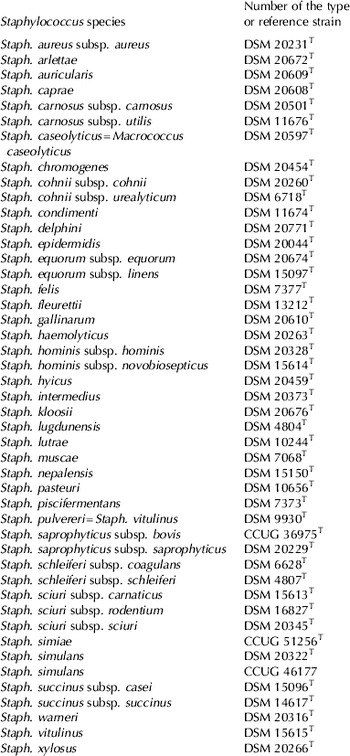
Restriction endonuclease treatment of 3 μg of DNA was done using HindIII restriction enzyme, as specified by the manufacturer (New England Biolabs, Hitchin, UK). Oligonucleotide probes targeting the 16 and 23S rRNA encoding genes were used as described by Ragnault et al. (Reference Ragnault, Grimont and Grimont1997). Restriction endonuclease analysis, genomic blots and hybridization of the membranes were done as described by Björkroth & Korkeala (Reference Björkroth and Korkeala1996). HindIII ribopatterns were compared with the corresponding patterns of 46 type and reference strains (Table 1). For numerical analysis, ribopatterns were scanned using a Hewlett Packard (Boise ID, USA) ScanJet 4c/T scanner and analysed using the BioNumerics 4.6 software package (Applied Maths, Kortrijk, Belgium). The similarity between all pairs was expressed by Dice coefficient correlation and UPGMA clustering was used for the construction of the dendrogram. Based on the use of internal controls, pattern optimization and band position tolerance of 1·7 and 0·7, respectively, were allowed.
Staphylococcus type and reference strains used in the comparisons of ribotype patterns

PFGE analysis
Bacterial DNA for PFGE typing was digested with SmaI restriction enzyme according to Salmenlinna et al. (Reference Salmenlinna, Lyytikäinen, Kotilainen, Scotford, Siren and Vuopio-Varkila2000). PFGE was conducted using the procedures of Murchan et al. (Reference Murchan, Kaufmann, Deplano, de Ryck, Struelens, Zinn, Fussing, Salmenlinna, Vuopio-Varkila, El Solh, Cuny, Witte, Tassios, Legakis, van Leeuwen, van Belkum, Vindel, Laconcha, Garaizar, Haeggman, Olsson-Liljequist, Ransjo, Coombes and Cookson2003). PFGE fingerprints were analysed with BioNumerics 4.6 software package (Applied Maths, Kortrijk, Belgium). PFGE fingerprints up to three band shifts were considered closely related and of the same pulsotype.
Results
CNS species in extramammary sites
API tests identified with >90% probability only 116 (52%) of the 220 swab samples collected in 1999 and 205 (60%) of the 343 swab samples collected in 2002. The predominant species was Staph. equorum, followed by Staph. sciuri, Staph. saprophyticus and Staph. xylosus.
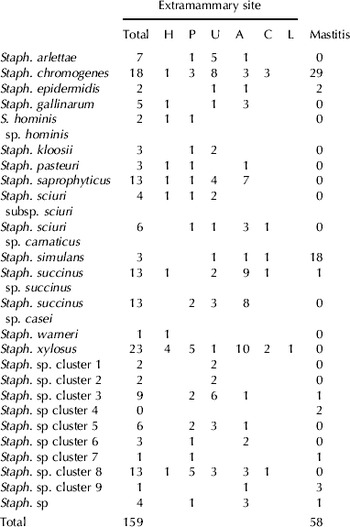
In the numerical analysis of ribopatterns, the extramammary isolates were distributed in 24 clusters. Fifteen ribotype clusters with pattern similarity of 71–94% contained a type strain and were considered species-specific. The majority of isolates, 91 out of 159, were placed in clusters including the type strains of Staph. succinus (sp. succinus and sp. casei) (26), Staph. xylosus (23), Staph. chromogenes (18), Staph. saprophyticus (13) and Staph. sciuri (sp. sciuri and sp. carnaticus) (10). Staph. chromogenes may be slightly overrepresented because all isolates identified as Staph. chromogenes in API testing were selected for ribotyping. The distribution of species did not differ between the isolates collected in 1999 and 2002, and results were thus combined (Table 2).
The distribution of CNS species identified with ribotyping in samples collected in 1999 and 2002 from the perineum (P) and udder skin (U), teat apex (A) and streak canal (C) of lactating cows and hands of staff (H), and teat cup liners (L) of the research dairy herd of the University of Helsinki, and in mastitic milk samples collected from the same herd in 1998–2002

CNS species in mastitic milk samples
Eighty-four percent of mastitis isolates were identified with >90% probability in API Staph ID 32 tests. The most common species were Staph. chromogenes (37%) and Staph. simulans (35%).
Most mastitis isolates were placed in two clusters, including type strains of Staph. chromogenes (50%) and Staph. simulans (31%) and were thus considered as Staph. chromogenes or Staph. simulans. The rest of the mastitis isolates were distributed in six clusters, of which four did not include any type strain (Table 2).
Strain typing with PFGE
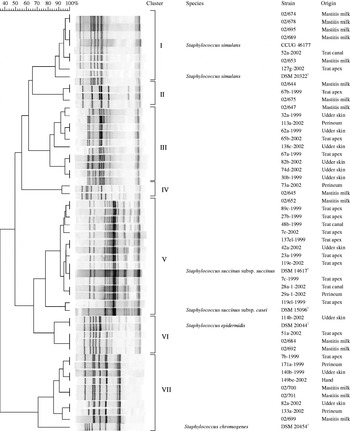
Seven ribotype clusters, including type strains of Staph. chromogenes, Staph. simulans, Staph. epidermidis, Staph. succinus subsp. succinus and three unidentified clusters, contained isolates both from mastitis and extramammary origin (Fig. 1). Isolates in these clusters were further typed with PFGE.
A sample of isolates in CNS ribotype clusters containing isolates both from bovine mastitis and skin origin. The samples were collected in 1999 and 2002 from the perineum (P) and udder skin (U), teat apex (A), teat canal (C), and mastitic milk of lactating cows and hands of staff (H) of the research dairy herd of the University of Helsinki, and from mastitic milk samples collected from the same herd in 1998–2002.

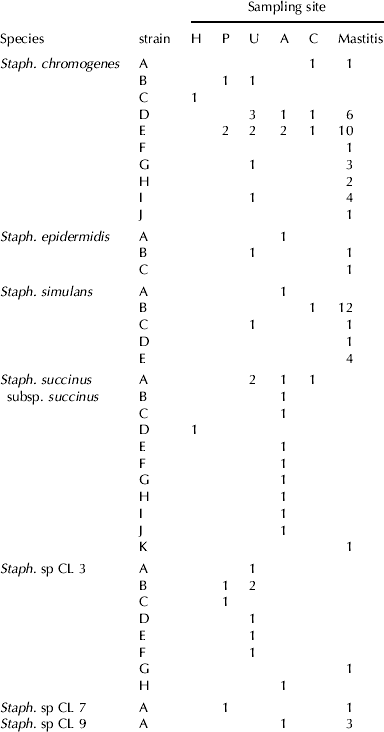
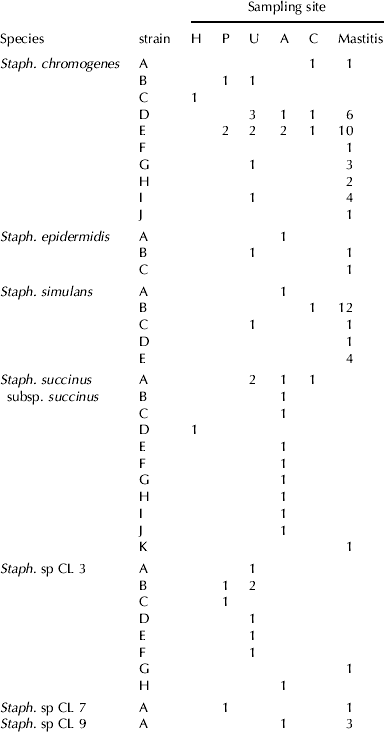
The same pulsotypes of Staph. chromogenes, Staph. simulans, Staph. epidermidis and Staph. spp. were detected both in mastitic milk samples and in extramammary samples. In total, 10 different Staph. chromogenes, and 5 different Staph. simulans pulsotypes were detected. Five Staph. chromogenes and two Staph. simulans pulsotypes were present both in mastitic milk and in extramammary samples, mainly on the udder or teat skin. The same pulsotypes in mastitic milk and extramammary samples were found also in other clusters (Table 3).
The distribution of CNS strains, typed by PFGE, from CNS species identified with ribotyping in samples collected in 1999 and 2002 from the perineum (P) and udder skin (U), teat apex (A) and streak canal (C) of lactating cows and hands of staff (H) of the research dairy herd of the University of Helsinki, and in mastitic milk samples collected from the same herd in 1998–2002
Discussion
CNS are commonly considered to be teat skin opportunists that normally reside on the teat skin and cause mastitis via ascending infection through the streak canal (Radostits et al. Reference Radostits, Gay, Hinchcliff and Constable2007). Our results indicate that not all CNS species fit well with this definition. Some species were common in the extramammary sites but very rarely caused mastitis, and may be skin residents or contaminants of environmental origin. CNS species predominating in the extramammary samples, Staph. equorum, Staph. sciuri, Staph. saprophyticus, and Staph. xylosus, were not isolated from milk samples. Staph. succinus subsp. succinus, common in extramammary samples, was isolated from one milk sample only. The pulsotype of that isolate was, however, different from any of the numerous pulsotypes among the extramammary isolates. Three unidentified ribotype clusters contained a few isolates both from milk and extramammary samples. In two of these clusters, only one of the pulsotypes was shared with milk and extramammary isolates. The third cluster was, like the Staph. succinus subsp. succinus cluster, a heterogenous group, and the pulsotype of the milk isolate was different from those of the extramammary isolates. Staph. chromogenes was the most common species causing mastitis but was also frequently isolated from extramammary sites. Five of the ten pulsotypes were isolated both from milk and other sites, which confirms the role of Staph. chromogenes as a typical skin opportunistic mastitis pathogen.
Our results agree with those of earlier studies relying on phenotypic species identification methods. Devriese & De Keyser (Reference Devriese and De Keyser1980) found that the distribution of CNS species in milk samples and on teat skin of dairy cows differed: Staph xylosus, Staph. sciuri and Staph. haemolyticus predominated in the samples obtained from teat skin and teat apices. Three other species, Staph. epidermidis, Staph. chromogenes, Staph. simulans and a group of unidentified staphylococci termed group M were frequently isolated from milk samples. The same was shown in the study of Trinidad et al. (Reference Trinidad, Nickerson and Alley1990), where seven different species of staphylococci were recovered from teat canals, but not from mammary gland secretion samples. Matos et al. (Reference Matos, White, Harmon and Langlois1991) reported the predominant CNS species in cow bedding and environment to be Staph. xylosus, Staph. sciuri and Staph. saprophyticus. The same species were frequently isolated from haircoat, nares, teat skin and other sites on the cow (Devriese & De Keyser, Reference Devriese and De Keyser1980; Boddie et al. Reference Boddie, Nickerson, Owens and Watts1987; White et al. Reference White, Harmon, Matos and Langlois1989). These CNS species are common in extramammary sites and were reported in several studies as sporadic isolates in milk samples from mastitic quarters (Aarestrup & Jensen, Reference Aarestrup and Jensen1997; Waage et al. Reference Waage, Mørk, Røros, Aasland, Hunshamar and Ødegaard1999; Taponen et al. Reference Taponen, Simojoki, Haveri, Larsen and Pyörälä2006).
Staph. chromogenes seems to be adapted both to conditions on the skin and in the udder. In many studies Staph. chromogenes has been reported to colonize heifers in particular. Staph. chromogenes was recovered from the skin of the teat apices, teat canals and mammary glands of unbred heifers as early as at 10 months old (Boddie et al. Reference Boddie, Nickerson, Owens and Watts1987; De Vliegher et al. Reference De Vliegher, Laevens, Devriese, Opsomer, Leroy, Barkema and de Kruif2003). Staph. chromogenes was also frequently found to colonize other body sites, including nares, hair coat, vagina and teat canal of heifers (White et al. Reference White, Harmon, Matos and Langlois1989). Recovery of Staph. chromogenes from the teat apex and other body sites increases with increasing age of the heifers (White et al. Reference White, Harmon, Matos and Langlois1989; De Vliegher et al. Reference De Vliegher, Laevens, Devriese, Opsomer, Leroy, Barkema and de Kruif2003). In the study of De Vliegher et al. (Reference De Vliegher, Laevens, Devriese, Opsomer, Leroy, Barkema and de Kruif2003), 20% of heifers had at least one teat apex colonized by Staph. chromogenes but this was not associated with intramammary infections with the same agent. Staph. chromogenes is, however, the most common udder pathogen associated with mastitis in heifers (Trinidad et al. Reference Trinidad, Nickerson and Alley1990; Fox et al. Reference Fox, Chester, Nickerson, Pankey and Weaver1995) and in cows during their first lactation (Matthews et al. Reference Matthews, Harmon and Langlois1992; Rajala-Schulz et al. Reference Rajala-Schultz, Smith, Hogan and Love2004; Taponen et al. Reference Taponen, Simojoki, Haveri, Larsen and Pyörälä2006).
The second common CNS species isolated from mastitis in our study, Staph. simulans, was isolated from extramammary sites only three times, once from udder skin, once from the teat apex, and once from the streak canal, which may be an indication of Staph. simulans being a specific mastitis pathogen. One of the five Staph. simulans pulsotypes predominated, and was also isolated from one teat canal. It is, however, possible that Staph. simulans from the udder contaminated the teat canal or the skin, rather than vice versa. In accordance with our results, only a few Staph. simulans isolations from extramammary samples, mainly from teat canals, have been reported (Devriese & De Keyser, Reference Devriese and De Keyser1980; Boddie et al. Reference Boddie, Nickerson, Owens and Watts1987; Trinidad et al. Reference Trinidad, Nickerson and Alley1990). In studies in which CNS isolates originated from clinical or subclinical mastitis from the field, the predominant CNS species was usually Staph. simulans (Jarp, Reference Jarp1991; Waage et al. Reference Waage, Mørk, Røros, Aasland, Hunshamar and Ødegaard1999; Taponen et al. Reference Taponen, Simojoki, Haveri, Larsen and Pyörälä2006). This may mean that Staph. simulans tends to cause more severe mastitis than most other CNS species, although significant differences in clinical characteristics between CNS species have not yet been detected (Jarp, Reference Jarp1991; Taponen et al. Reference Taponen, Simojoki, Haveri, Larsen and Pyörälä2006). Rather et al. (Reference Rather, Davis and Wilkinson1986) reported that Staph. simulans, similarly to Staph. aureus, but in contrast to other staphylococci, in bacterial cultures from milk samples was often present in pure culture with heavy growth, indicating the specific ability of this species to cause mastitis.
CNS strains from milk and extramammary sites have, to our knowledge, previously been compared only by Thorberg et al. (Reference Thorberg, Kühn, Aarestrup, Brändström, Jonsson and Danielsson-Tham2006). In that study, the same Staph. epidermidis strains were found both in bovine intramammary infections and the milkers' hands in two herds with a high incidence of CNS mastitis, indicating that Staph. epidermidis intramammary infections may be of human origin. Of the three Staph. epidermidis pulsotypes detected in our study, one was isolated both from mastitis and udder skin. The only CNS species isolated both from mastitis and from milkers' hands were Staph. chromogenes and Staph. succinus subsp. succinus. The isolates from the hands were, however, of different pulsotypes than the mastitis isolates.
Conclusions
The predominant CNS species in extramammary sites were seldom isolated from mastitis milk samples, if at all, but they may occasionally infect the udder. Staph. chromogenes was common both as a skin resident and as a cause of mastitis. The same pulsotypes were isolated both from milk and from extramammary sites, confirming the role of Staph. chromogenes as a skin opportunist. Another common mastitis pathogen, Staph. simulans, was almost absent from the extramammary sites, indicating this species to be a specific udder pathogen in contrast with other CNS. The origin of CNS mastitis may thus vary, depending on the CNS species. However, more knowledge is needed before species-specific guidance for preventive measures of CNS mastitis can be given.
We thank Taina Lehto and Erja Merivirta for excellent technical assistance with API and ribotype analyses. Financial support from the Walter Ehrström Foundation, Suomen Meijeriyhdistys ry, and Mercedes Zachariassen Foundation is gratefully acknowledged.