Introduction
Legitimacy, defined as “people's beliefs about the right of justice institutions to hold power and influence” (Jackson et al. Reference Jackson, Hough, Bradford, Kuha, Meško and Tankebe2015, 2), has progressively attracted the attention of psychologists, criminologists, and sociolegal scholars. Since Tyler's (Reference Tyler1990) seminal work Why People Obey the Law, there has been “an explosion in legitimacy research” (Tankebe Reference Tankebe2013, 104), with procedural justice taking the forefront in explaining people's perception of legitimacy toward legal authorities, and legitimacy, in turn, promoting cooperation with legal authorities such as the police and the courts.
Although procedural justice and legitimacy have been receiving increased interest in different societies around the world (Reisig and Lloyd Reference Reisig and Lloyd2009; Tankebe Reference Tankebe2009; Hasisi and Weisburd Reference Hasisi and Weisburd2011; Jackson et al. Reference Jackson, Bradford, Hough, Kuha, Stares, Widdop, Fitzgerald, Yordanova and Galev2011; Kochel, Parks, and Mastrofski Reference Kochel, Parks and Mastrofski2013;), most empirical evidence is derived from Anglo-American contexts, especially from the United States, the United Kingdom, and AustraliaFootnote 1 (Sunshine and Tyler Reference Sunshine and Tyler2003; Hinds and Murphy Reference Hinds and Murphy2007; Reisig, Bratton, and Gertz Reference Reisig, Bratton and Gertz2007; Tyler and Fagan Reference Tyler and Fagan2008; Gau and Brunson Reference Gau and Brunson2010; Tyler, Schulhofer, and Huq Reference Tyler, Schulhofer and Huq2010; Jackson et al. Reference Jackson, Bradford, Hough, Myhill, Quinton and Tyler2012; Murphy and Cherney, Reference Murphy and Cherney2012; Bradford Reference Bradford2014) where the legal system has evolved naturally and legal authorities are said to reflect the values and norms of the majority of the citizens whom they govern. There is a paucity of research that measures public perceptions of legitimacy toward legal authorities in hybrid legal systems, such as that of postcolonial Hong Kong, where the legal system was initially transplanted and many values of the legal system may not be the same as those of the local population (Tamanaha Reference Tamanaha2001).
It is important to examine legitimacy in such contexts because legitimacy is said to be comprised of the dual constructs of obligation to obey and moral alignment (Jackson et al. Reference Jackson, Bradford, Hough, Myhill, Quinton and Tyler2012, Reference Jackson, Bradford, Stanko and Hohl2013; Hough, Jackson, and Bradford Reference Hough, Jackson, Bradford, Tankebe and Liebling2013; Tyler and Jackson Reference Tyler, Jackson, Tankebe and Liebling2013, Reference Tyler and Jackson2014). Obligation to obey refers to the belief that legal authorities have a right to dictate behavior and that obedience to the authorities' directives is the proper and just response. Moral alignment refers to the belief that legal authorities conduct themselves in ways that are consistent with the public's values and sense of morality (Jackson et al. Reference Jackson, Hough, Bradford, Kuha, Meško and Tankebe2015). It is in this second construct, of moral alignment, where tensions may arise with respect to legitimacy in hybrid legal systems because many laws and legal institutions were originally imposed on the local population and their values and principles may not be aligned with those of the public.
Procedural justice theory offers a solution. It is asserted that a primary antecedent by which legal authorities improve their moral alignment and legitimacy with the public is being perceived to act in procedurally just ways (Tyler and Jackson Reference Tyler, Jackson, Tankebe and Liebling2013). In other words, the more the public considers legal authorities to behave in procedurally just ways, the more they regard the authorities as wielding legitimate power.
The purpose of this study is to examine whether procedural justice is positively associated with the legitimacy of the justice system and moral alignment with the courts in the context of postcolonial Hong Kong. When the courts are perceived to act in procedurally just ways, are legitimacy and moral alignment with the courts bolstered in the mind of the public? Moreover, this study tests whether the public's perception of the legitimacy of the courts is positively associated with the public's willingness to cooperate with the courts.
Constructs of Legitimacy
Legitimacy is said to be achieved when (1) people believe that they have a positive obligation to defer to the legal authority in question; and (2) people feel that there is a degree of moral alignment between the authority and themselves. Jackson and colleagues (Reference Jackson, Bradford, Stanko and Hohl2013) argue that obligation and moral alignment are separate but connected psychological states.
Drawing on the work of Max Weber (Whimster Reference Whimster2004), Tyler (Reference Tyler2003, 308) conceptualized legitimacy as “a quality possessed by an authority, a law, or an institution that leads others to feel obligated to obey its decisions and directives” (emphasis added). Therefore, obligation has been considered a defining component of the conceptualization of legitimacy over the past two decades of psychology, criminology, and sociolegal research (Tyler and Jackson Reference Tyler, Jackson, Tankebe and Liebling2013). The dimension of obligation to obey reflects what psychologists term the internalization process of values. This means that people feel obliged to obey legal authorities not because the authorities or the law are entirely aligned with everyone's sense of right and wrong, but because there is a recognition that society has given authorization to certain agencies to wield power, and that it is right in itself to obey such authorized authorities (Kelman and Hamilton Reference Kelman and Hamilton1989; Tyler and Jackson Reference Tyler, Jackson, Tankebe and Liebling2013). To measure obligation, survey-based questionnaires in legitimacy studies have typically asked respondents whether they should obey authorities even when they did not agree with them, and how much trust and confidence they have in legal authorities (Sunshine and Tyler Reference Sunshine and Tyler2003; Reisig, Bratton, and Gertz Reference Reisig, Bratton and Gertz2007).
In recent years, this conceptualization of legitimacy has faced increasing criticism for its narrow focus on obligation and its questionable applicability outside Western contexts (Resig and Lloyd 2009; Tankebe Reference Tankebe2009; Martin Reference Martin2013). Bottoms and Tankebe (Reference Bottoms and Tankebe2012), for instance, argue that legal authorities do not distinguish between whether citizens obey them out of self-interest, affection, or other motives. They contend that some people obey the authority in question because they believe that the authority is legitimate, whereas others offer their obedience for other non-normative reasons. For social scientists, it is difficult to tell whether obedience is derived from a feeling of obligation to defer to a legitimate authority or from a sense of powerlessness to challenge the de facto power holder (Bottoms and Tankebe Reference Bottoms and Tankebe2012, 148). Tankebe (Reference Tankebe2009) argues that in Western liberal democracies, (voluntary) obligation to obey legal authorities is based on normative commitments and some shared moral values. In other societies, obligation is not a choice, and obedience to the directives of legal authorities is based on fear rather than legitimacy.
Beetham (Reference Beetham1991) proposed shared values as an underlying dimension of legitimacy. Beetham (Reference Beetham1991, 17) asserts that “power is legitimate to the extent that the rules of power can be justified in terms of beliefs shared by both dominate and subordinate.” Beetham (Reference Beetham1991, 69) further explained: “Without a common framework of belief … the powerful can enjoy no moral authority for the exercise of their power … and their requirements cannot be normative binding ….” Shared values have been operationalized in recent years as a moral alignment between the public and legal authorities (Jackson et al. 2013, Reference Jackson, Hough, Bradford, Kuha, Meško and Tankebe2015).
It is contended that people defer to legal authorities and abide by the law when there is a sense of moral alignment with the legal authority. Moral alignment serves to strengthen the bond between citizens and the legal institution (Jackson et al. Reference Jackson, Bradford, Stanko and Hohl2013). People therefore justify the existence of the legal authority in question, and defer to it, when it is seen to enact and defend the general moral values, beliefs, and norms that they themselves share (Suchman Reference Suchman1995; Jackson et al. Reference Jackson, Bradford, Hough, Kuha, Stares, Widdop, Fitzgerald, Yordanova and Galev2011, 2012, 2013). Moral alignment is considered as the main normative justification for the authorities' exercise of power (Jackson et al. Reference Jackson, Bradford, Hough, Myhill, Quinton and Tyler2012). Measurements of moral alignment have usually asked respondents whether they feel that the values of legal authorities are aligned with their own values. This reconceptualization of legitimacy, which incorporates moral alignment to the existing construct of obligation, has been adopted by Hough (Hough, Jackson, and Bradford Reference Hough, Jackson, Bradford, Tankebe and Liebling2013), Jackson (Jackson et al. Reference Jackson, Bradford, Hough, Kuha, Stares, Widdop, Fitzgerald, Yordanova and Galev2011, Reference Jackson, Bradford, Hough, Myhill, Quinton and Tyler2012), and Tyler himself (Tyler and Jackson Reference Tyler, Jackson, Tankebe and Liebling2013).
However, as noted, there are societies where the legal system was initially imposed on the local populace; therefore, the legal authorities may not have the same shared values as citizens (Tamanaha Reference Tamanaha2001). This is the case in former colonies. Procedural justice is claimed to be a primary antecedent for legal authorities, such as the courts, to bolster their legitimacy in the mind of the public.
Procedural Justice and the Courts
The groundbreaking aspect of procedural justice theory is that people's evaluations of legitimacy toward legal authorities are primarily shaped by assessments of procedural justice, measured by how fairly people perceive they are treated by the authority in question (Sunshine and Tyler Reference Sunshine and Tyler2003; Tyler Reference Tyler2003, Reference Tyler2006). When the public considers that legal authorities treat individuals fairly, the legitimacy of the legal authorities is strengthened in the mind of the public (Tyler Reference Tyler2007).
Procedural justice is measured by the evaluation of how much participation legal authorities grant individuals, the perceived trustworthiness and neutrality of the authorities, and whether the authorities treat people in a dignified and respectful manner. This is because by treating people in a procedurally just manner, the authorities are conveying a message that the individual, even individuals who have committed wrongdoing, are still valued members of society, thereby bolstering identification with the authorities. This leads to people's internalization of the norms, rules, and laws that the legal authorities are enforcing (Fagan and Tyler Reference Fagan and Tyler2005).
The American Bar Association Model Code of Judicial Conduct echoes the same factors that underlie procedural justice theory. For instance, Canon 1 states: “A judge shall uphold and promote the independence, integrity, and impartiality of the judiciary, and shall avoid impropriety and the appearance of impropriety.” Furthermore, Canon 2 maintains: “A judge shall perform the duties of judicial office impartially, competently, and diligently” (ABA 2011). The Code stresses that all these help the courts to promote public confidence in the judiciary (ABA 2011, Rule 1.2).
Procedural justice is also said to be associated with enhancing people's sense of moral alignment with legal authorities. When authorities are perceived to be treating individuals in a procedurally just manner, they are able to instill a greater sense of shared values and moral purpose in the public. This likewise heightens individuals' identification with the authorities as well as providing moral validity to the authorities' power (Tyler and Jackson Reference Tyler, Jackson, Tankebe and Liebling2013). The Hong Kong Guide to Judicial Conduct notes that “In the modern world, a perception that judges are remote and out of touch with their community would not inspire and may undermine public confidence in the Judiciary and the administration of justice” (Hong Kong Judiciary 2004, paragraph 3).
Legitimacy has also been linked to utilitarian benefits. Numerous studies have found a direct correlation between people's perception of legitimacy and their willingness to cooperate with the police (Hinds and Murphy Reference Hinds and Murphy2007; Sunshine and Tyler Reference Sunshine and Tyler2003; Tyler and Fagan Reference Tyler and Fagan2008; Gau and Brunson Reference Gau and Brunson2010; Murphy and Cherney Reference Murphy and Cherney2012). While it has received less attention compared with policing studies, legitimacy has been found to be associated with confidence in the courts (Casper, Tyler, and Fisher 1988; Tyler Reference Tyler2001, 2007) and also with compliance with the law (Tyler Reference Tyler1990; Murphy, Tyler, and Curtis Reference Murphy, Tyler and Curtis2009; Jackson et al. Reference Jackson, Bradford, Hough, Myhill, Quinton and Tyler2012).
For instance, Gibson (Reference Gibson1989) sought to determine whether the local legislature, local judges, and the US Supreme Court can encourage US citizens to tolerate an unpopular minority's political demonstration. It was found that all three authorities' decisions to allow the demonstration had similar impacts on the citizens' voluntary compliance with, and tolerance of, the demonstration. The Supreme Court was able to garner greater compliance with the decision. Tyler and Rasinski (Reference Tyler and Rasinski1991), in a reanalysis of Gibson's (Reference Gibson1989) data, contended that procedural justice has an indirect effect on people's acceptance of the Supreme Court's decisions through the positive effect that procedural justice has on people's perception of the Supreme Court's legitimacy.
Citing several US studies, Tyler (Reference Tyler2001) noted how the public's trust and confidence in the courts depended more on their subjective evaluations of the fairness of the procedures that the courts used to derive their decisions and wield their powers than on instrumental concerns that citizens may have, such as legal costs and unsatisfactory outcomes of court decisions. In other words, procedural justice is more valued compared with instrumental factors. These studies, however, operationalized legitimacy as obligation only and did not take into account moral alignment. Tyler and Sevier's (Reference Tyler and Sevier2013) more recent study did include moral alignment as a construct of legitimacy. They measured public attitudes toward the courts drawing on a US sample. In particular, they measured public views on whether the courts act in procedurally just ways, whether the courts reach a correct verdict, and whether the courts sentence appropriately. It was found that the strongest influence on public legitimacy was perceptions of procedural justice, followed by verdict accuracy and sentence appropriateness.
In an observational study of courtroom interactions in Australia, Mack and Roach Anleu (Reference Mack and Anleu2010) identified five types of judicial demeanor: welcoming and good-natured; patient and courteous; routine and businesslike; impatient and rushed; and harsh, condescending, and rude. They argue that both impartiality and engagement by judges can enhance perceptions of legitimacy. However, this study only highlighted and summarized instances of judicial behavior that are characterized as being procedurally just and does not directly measure the relationship between procedural justice and public perceptions of legitimacy toward the courts.
The Present Study
Hong Kong presents a novel context in which to study legitimacy and cooperation with the legal authorities, particularly with the courts. Hong Kong is not just another city in China but a place with a unique history and legal jurisdiction. After its handover to the People's Republic of China in 1997, Hong Kong was given the status of a special administrative region under the “one country, two systems” framework, by which Hong Kong enjoys a high degree of autonomy and a separate legal system distinct from that of Mainland China. For many, Hong Kong has been renowned as a place where East meets West. It is also known as a city with good law and order and it possesses a legal system that abides by the rule of law. In the past decade or so, there has been a strong emphasis on the need to safeguard judicial independence in Hong Kong. For instance, the recent controversy in which Beijing issued a White Paper stating that judges need to be “patriotic” led to an outcry by the public and the legal profession as being an encroachment on Hong Kong's independent judiciary (Hong Kong Bar Association 2014). Indeed, with respect to the legal system, there is strong resistance to any interference by China (Lo Reference Lo2012).
Because of the ceding of Hong Kong to Britain by China in 1841, Hong Kong adopted a transplanted legal system, namely, the English legal system. In the early years of colonial rule, Britain transplanted English law and court structure, along with a colonial form of policing (Ho and Chu Reference Ho and Chu2012), and applied it to both expatriates and the local Chinese population (Supreme Court Ordinance No. 15 of 1844 and No. 3 of 1873). In the 1960s, it was reaffirmed under Hong Kong law that English law was to be applied in Hong Kong (Application of English Law Ordinance 1966). Nowadays, it can be said that Hong Kong operates a hybrid legal system, and it has assumed many of the inherited common law values as its own over the years. In this sense, there exists a “common law of Hong Kong” (Ip Reference Ip2014, 7).
The rule of law and the independent judiciary is regarded as a major “gift” from Britain to Hong Kong, and is an essential feature of the perseverance of the high degree of autonomy from Mainland China (Chan Reference Chan1997, 567). In posthandover Hong Kong, the courts have been consistently viewed by the public as the most trustworthy political institution. The courts are rated more favorably compared with the civil service, the legislature, and the executive branch of the Hong Kong government (Tam Reference Tam2013, 85–87). In particular, the courts are seen to be protectors of fundamental rights and the rule of law in postcolonial Hong Kong, and citizens have been encouraged to resort to the courts to address their grievances and pursue their interests (Tam Reference Tam2013). Nonetheless, there are drawbacks in Hong Kong's legal system (Chan Reference Chan1997).
Hong Kong's legal system closely resembles the English legal system, and for many local inhabitants the courts have been regarded as a foreign institution (Hsu Reference Hsu1992; Lau Reference Lau1997). The former Chief Justice of Hong Kong, Sir Ti-liang Yang, the first Chinese to hold the office of Chief Justice in Hong Kong, even openly questioned the general public's sentiments toward the common law and its institutions, as he remarked in 1992, five years before Hong Kong's handover to China:
[Our] law is still an alien thing imported from a country [the public] know hardly anything about, written in a language they do not understand, expressing concepts they probably find outlandish and perhaps even immoral or unjust. The transplantation of the English law on to Chinese soil has therefore only been partially successful. (emphasis added, cited in Lau Reference Lau1997, 130)
As a British colony, decisions on Hong Kong appeal cases to the Privy Council were binding on Hong Kong courts under the doctrine of precedent. Even for non-Hong Kong appeal cases, Privy Council and House of Lords decisions, lacking compelling reasons that they were inapplicable in the local circumstances, were often regarded as strong persuasive authorities that the Hong Kong courts would have invariably followed (Lo and Chui Reference Lo and Chiu2012). The English common law and court system in Hong Kong remained in force after Hong Kong's handover to the People's Republic of China (Article 8 of the Hong Kong Basic Law). After the handover, Hong Kong was free to develop its own common law. However, the decisions of the Privy Council, the House of Lords, the newly created Supreme Court of the United Kingdom, and the English Court of Appeal are still viewed as persuasive authorities, and, without good reasons to diverge, it is likely they would be followed by the Hong Kong courts (Lo and Chui Reference Lo and Chiu2012).
Given that throughout its colonial history and up to the present day, the population of Hong Kong (which currently stands at over 7 million) has been predominately ethnically Chinese (over 90 percent), the local population for the most part felt detached from the courts (Zhao Reference Zhao1997).Footnote 2 The language barrier played a significant role because judges had to communicate with defendants and witnesses through interpreters (Ng Reference Ng, Gaylord, Gittings and Traver2009). Even with the development of legal bilingualism in Hong Kong, where Chinese (orally Cantonese) could be used in court proceedings, there is not a Chinese common law (Ng Reference Ng2011) and the use of Chinese predominately operates in the lower courts, called the Magistrates' Courts (Department of Justice 2011).
To date, studies about public perceptions toward legal authorities and the law in Hong Kong have not really taken legitimacy into account (Vagg et al. Reference Vagg, Bacon‐Shone, Gray and Lam1995; Kennedy and Chow Reference Kennedy and Kui‐Foon Chow2009). One exception is a recent study that looked at perceptions of procedural justice in lawyer-client interactions by young offenders, youths at risk, and students in Hong Kong (Chui and Cheng Reference Cheng2015). That study found that, overall, students had more understanding about defense lawyers' roles and a more favorable impression of fairness demonstrated by lawyers in lawyer-client interactions. It was also found that a higher perception of fairness in lawyer-client interactions was positively associated with a better perception of legitimacy toward the justice system as a whole.
Another exception is Cheng's (Reference Cheng2015) recent work on prosecutors and procedural justice. In that study, it was found that the more that the public regarded prosecutors to act in procedurally just ways, the more that they perceived the criminal justice system to be legitimate. Perceptions that prosecutors behave in procedurally just ways also positively correlated with an increased sense of moral alignment with the criminal justice system in the mind of the public. In turn, the public is more willing to cooperate with legal authorities and to comply with the law. That study focused exclusively on prosecutors, especially on the role of prosecutors as ministers of justice and guardians of the public interest. It argues that for prosecutors to fulfill their roles as ministers of justice, they should be perceived by the public to perform their duties in a manner that is aligned with their sense of morality and values. The present study focuses on the underresearched area of the courts and examines the tensions of legitimacy and moral alignment in the context of a postcolonial legal system where the institutions, namely, the judiciary, were initially transplanted, and argues that procedural justice is a primary way for the courts to alleviate such tensions and enhance their public legitimacy. In this way, it will be demonstrated that procedural justice theory is applicable to different legal institutions.
Data and Methods
The relatively small, concentrated, and homogeneous nature of the population of Hong Kong allows for the survey of a sample that is reflective of “the public.” Telephone interviews were conducted with a random sample of adults (eighteen years old and above) by using a computer-assisted telephone system (CATS) in the summer of 2014. Data collection was conducted by the Centre for the Advancement of Social Sciences Research (CASR) at the Hong Kong Baptist University. The most recent telephone directory provided the sampling framework for CATS, which draws on fixed-line telephone numbers in Hong Kong. CATS is a computer system that quickly generates the various questions of the questionnaire on a computer screen for trained interviewers to read out over the phone and to quickly input responses into the system. In this way, the questionnaire can be administered more effectively. In sum, 374 surveys were completed with a response rate of 70 percent.
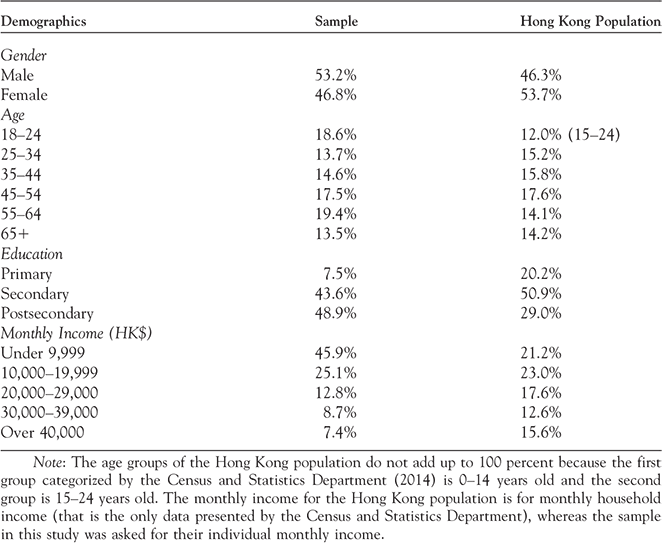
The demographics of the sample compared with the Hong Kong population are presented in Table 1. Using the most recent census data collected in 2013, the sample generally resembled the Hong Kong population (Census and Statistics Department 2014). There are, however, several exceptions. It should be noted that males were slightly overrepresented, as were those with postsecondary education. In a similar fashion, those with only a primary school education were underrepresented in the sample. In terms of monthly income, it would appear that those with the lowest level of monthly income, that is, under HK$9,999 (approximately US$1,428) were overrepresented in the sample and that those with the highest level of monthly income, that is, over HK$40,000 (approximately US$5,714) were underrepresented in the sample. A possible reason for this discrepancy is that the Hong Kong Census and Statistics Department measures and presents household monthly income only, whereas this study asked about individual monthly income. Given the difference in measures, Table 1 illustrates that the monthly income of the sample tends to be lower than that of the Hong Kong general population. All participants are ethnically Chinese.
Demographics of the Sample Compared with the Hong Kong Population

| Demographics | Sample | Hong Kong Population |
|---|---|---|
| Gender | ||
| Male | 53.2% | 46.3% |
| Female | 46.8% | 53.7% |
| Age | ||
| 18–24 | 18.6% | 12.0% (15–24) |
| 25–34 | 13.7% | 15.2% |
| 35–44 | 14.6% | 15.8% |
| 45–54 | 17.5% | 17.6% |
| 55–64 | 19.4% | 14.1% |
| 65+ | 13.5% | 14.2% |
| Education | ||
| Primary | 7.5% | 20.2% |
| Secondary | 43.6% | 50.9% |
| Postsecondary | 48.9% | 29.0% |
| Monthly Income (HK$) | ||
| Under 9,999 | 45.9% | 21.2% |
| 10,000–19,999 | 25.1% | 23.0% |
| 20,000–29,000 | 12.8% | 17.6% |
| 30,000–39,000 | 8.7% | 12.6% |
| Over 40,000 | 7.4% | 15.6% |
Note: The age groups of the Hong Kong population do not add up to 100 percent because the first group categorized by the Census and Statistics Department (2014) is 0–14 years old and the second group is 15–24 years old. The monthly income for the Hong Kong population is for monthly household income (that is the only data presented by the Census and Statistics Department), whereas the sample in this study was asked for their individual monthly income.
Measures
The measures were formulated based on past studies on procedural justice and legitimacy. The wording of some of the items was changed to measure the courts and judges as opposed to the police, which, as noted, were the primary focus of the extant literature (Sunshine and Tyler Reference Sunshine and Tyler2003; Reisig, Bratton, and Gertz Reference Reisig, Bratton and Gertz2007; Tankebe Reference Tankebe2009, Reference Tankebe2013; Jackson et al. Reference Jackson, Bradford, Hough, Myhill, Quinton and Tyler2012). In addition, some wording was also changed to specifically mention Hong Kong.
Legitimacy and Moral Alignment
Legitimacy was measured by ten items that corresponded to the two constructs of obligation and moral alignment. Respondents were asked to rate their agreement with ten statements on a five-point Likert-type scale, ranging from 1 = strongly disagree to 5 = strongly agree. The statements for obligation (the traditional conceptualization of legitimacy) were: (1) “You should try to obey the law even if it goes against what you think is right,” (2) “The law helps to protect the interests of people like you,” (3) “In general, our laws make Hong Kong a better place,” (4) “Overall, you are confident in the courts,” and (5) “You should accept the decisions made by the courts even if you think they are wrong.” To capture the second dimension of legitimacy, three items were used to measure moral alignment with the courts. Again, respondents were asked to rate their agreement on a five-point Likert scale. The statements for moral alignment with the court were: (6) “Judges usually make decisions that are consistent with my own ideas about what is right and wrong,” (7) “Judges can be trusted to make decisions that are right for the people of Hong Kong,” and (8) “My own ideas about right and wrong usually agree with the law.” The three items for moral alignment with the courts (Items 6 to 8) were combined to form a moral alignment index (α = 0.717; mean = 3.555; SD = 0.843). All the items together were combined to create a legitimacy index (α = 0.710; mean = 3.680; SD = 0.603).
Procedural Justice
Procedural justice was measured with four statements: (1) “Judges listen to all sides in a case,” (2) “Judges treat everyone with dignity and respect,” (3) “Judges treat everyone fairly,” and (4) “Judges give honest explanations for their decisions.” Participants were asked to indicate their agreement with these statements on a five-point Likert-type scale ranging from 1 = strongly disagree to 5 = strongly agree. The four items were combined to create a procedural justice index (α = 0.781; mean = 4.186; SD = 0.694).
Cooperation with the Courts
Because this study is interested in measuring what influences public cooperation with the courts, cooperation served as the dependent variable. Cooperation was operationalized by using three items. The three statements were: (1) “I am willing to help provide information to the court to help with a case,” (2) “I am willing to serve as a witness in court,” and (3) “I am willing to serve as a juror.” Participants were asked to indicate their agreement with each statement on a five-point Likert-type scale ranging from 1 = strongly disagree to 5 = strongly agree. The three items were combined to create a “cooperation with the courts” index. The composite score of cooperation with the courts was calculated by taking the mean of the scores of the three items (α = 0.737; mean = 4.172; SD = 0.647).
Control Variables
The variables of gender (1 = male), age, level of education (from primary school to tertiary education), and monthly income served as control variables.
Results
Ordinary least square (OLS) regressions were performed to test the additive effects of the public's perceptions of procedural justice by the courts on the legitimacy of, and moral alignment with, the courts. Further OLS regressions were performed to test the additive effects of legitimacy, and moral alignment, with the public's willingness to cooperate with the courts. Variance inflation factor (VIF) was used to determine whether multicollinearity was a problem. The highest VIF was 1.512, demonstrating that multicollinearity was not an issue (Montgomery, Peck, and Irving Reference Montgomery, Peck and Vining2012).
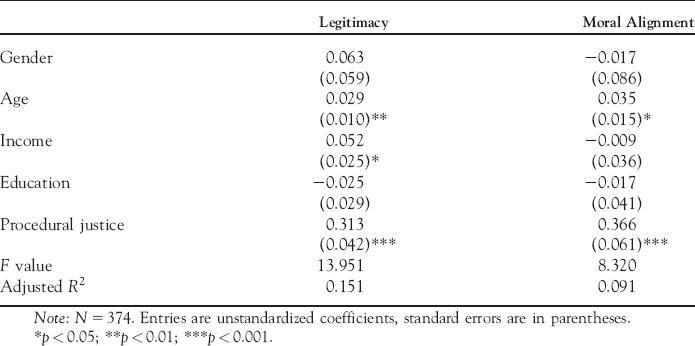
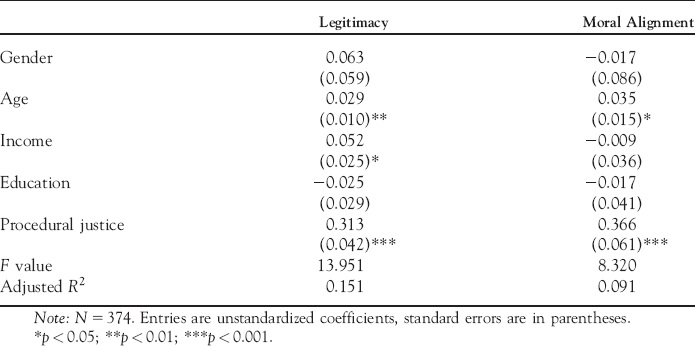
The first two regressions tested the relationship between procedural justice and legitimacy. In the first regression model, procedural justice was included along with the control variables to test its correlation with legitimacy (see Table 2). As can be seen from the results, age and income were found to be significant factors. The older the respondents were and the more income they had, the more legitimate they perceived the courts to be (B = 0.029; p < 0.01 and B = 0.052; p < 0.05, respectively). However, it was procedural justice that was found to be the most statistically significant factor that correlated with legitimacy. The more the public deemed the courts to act in procedurally just ways, the more they considered the courts to be legitimate (B = 0.313; p < 0.001). In sum, the results demonstrated strong support for procedural justice theory.
Effects of Procedural Justice on Legitimacy and Moral Alignment
| Legitimacy | Moral Alignment | |
|---|---|---|
| Gender | 0.063 | −0.017 |
| (0.059) | (0.086) | |
| Age | 0.029 | 0.035 |
| (0.010) ** | (0.015) * | |
| Income | 0.052 | −0.009 |
| (0.025) * | (0.036) | |
| Education | −0.025 | −0.017 |
| (0.029) | (0.041) | |
| Procedural justice | 0.313 | 0.366 |
| (0.042) *** | (0.061) *** | |
| F value | 13.951 | 8.320 |
| Adjusted R 2 | 0.151 | 0.091 |
Note: N = 374. Entries are unstandardized coefficients, standard errors are in parentheses.
* p < 0.05;
** p < 0.01;
*** p < 0.001.
In the second regression model, procedural justice was included along with the control variables to test its correlation with moral alignment (see also Table 2). Age was found to be a significant variable as the older the respondents were, the more they considered the courts to possess values that are aligned with their own (B = 0.035; p < 0.05). Once again, procedural justice was found to demonstrate the most statistical significance (B = 0.366; p < 0.001). The results strongly support the notion that the more the public perceives the courts to act in procedurally just ways, the more it regards the courts as having values that are aligned with its own.
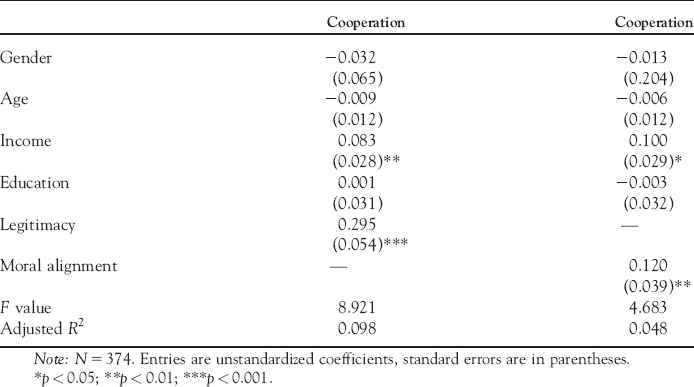
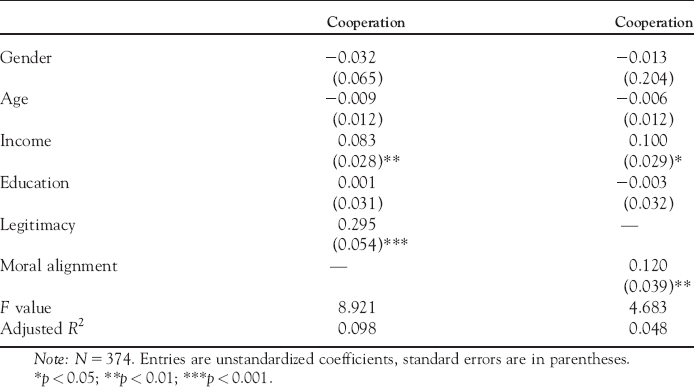
The next set of regressions examined the effects of legitimacy on the public's willingness to cooperate with the courts (see Table 3). Legitimacy was included with the control variables to test its correlation with cooperation. As predicted by procedural justice theory, legitimacy was positively associated with cooperation, meaning that the more the public considered the courts to be legitimate, the more it was willing to cooperate with the courts (B = 0.295; p < 0.001). Income was also found to be statistically significant, as higher income correlated with a greater willingness to cooperate with the courts (B = 0.083; p < 0.01).
Effects of Legitimacy and Moral Alignment on Cooperation with the Courts
| Cooperation | Cooperation | |
|---|---|---|
| Gender | −0.032 | −0.013 |
| (0.065) | (0.204) | |
| Age | −0.009 | −0.006 |
| (0.012) | (0.012) | |
| Income | 0.083 | 0.100 |
| (0.028) ** | (0.029) * | |
| Education | 0.001 | −0.003 |
| (0.031) | (0.032) | |
| Legitimacy | 0.295 | — |
| (0.054) *** | ||
| Moral alignment | — | 0.120 |
| (0.039) ** | ||
| F value | 8.921 | 4.683 |
| Adjusted R 2 | 0.098 | 0.048 |
Note: N=374. Entries are unstandardized coefficients, standard errors are in parentheses.
* p<0.05;
** p<0.01;
*** p<0.001.
Lastly, moral alignment was separated and included with the control variables to test its effect on cooperation (see also Table 3). Again, income was found to be significant as there was a positive relationship between the level of income and the willingness to cooperate with the courts (B = 0.100; p < 0.05). Moral alignment was discovered to be a significant factor. The more the public deemed the courts to behave in ways and possess values morally aligned with its own, the more it was disposed to cooperate with the courts (B = 0.120; p < 0.01).
Discussion and Conclusion
As the study of legitimacy becomes increasingly globalized, there is a need to formulate a multidimensional model of legitimacy that can be applied across different societies (Tyler and Jackson Reference Tyler and Jackson2014). This study has extended the study of legitimacy to the postcolonial Hong Kong Chinese context, and it has empirically tested the relationship between procedural justice, legitimacy, and the public's willingness to cooperate with the courts. More specifically, this study examined the relationship between procedural justice and moral alignment, and asked whether procedural justice is likely to strengthen the moral alignment between the public and the courts. The results confirm that procedural justice is a primary way for the courts to bolster not only their legitimacy, but also their moral alignment with the public. Both legitimacy and moral alignment were demonstrated to enhance public willingness to cooperate with the courts.
This relationship is particularly important for legal systems where the initial institutions, laws, and norms were transplanted from a foreign jurisdiction and the values of the legal system may not really reflect the values of the general population. For such legal systems, such as former colonies, procedural justice is a way for legal authorities to alleviate tension related to values between legal institutions like the courts and the public. This study complements the previous studies in Hong Kong on lawyer-client interactions and the public's perceptions of prosecutors and legitimacy. Although each study contributes to the study of procedural justice and legitimacy in its own way, overall, the findings provides a strong case that procedural justice theory is applicable to different legal institutions and that when legal authorities are perceived to act in procedurally just ways, the legitimacy of the legal system is bolstered.
In terms of practical implications, the courts should be mindful to act in procedurally just ways in their daily operations. This would entail treating individuals with courtesy and respect, ensuring that various parties are given ample opportunities to participate in the proceedings, and demonstrating the fact that judges are impartial and competent when performing their duties. Virtually all court hearings in Hong Kong are open to the public. Moreover, members of the media consistently report court cases to the general public. Therefore, how judges behave has resonating effects.
It is appreciated that considerable efforts must be made to ensure that judges act in procedurally just ways. In many jurisdictions, the courts are tasked with going through long daily case lists, especially in the lower criminal courts (Mack and Roach Anleu Reference Mack and Anleu2007). In Hong Kong specifically, there have been recent concerns about the shortages of judges that may lead to further delay in the courts (Reyes Reference Reyes2014). For cases to proceed expediently, the courts are likely to deal with defendants in an impersonal manner. The courts have been criticized for being overly bureaucratic, with commentators asserting that there is a McDonaldization of the justice system, referring to the idea that the justice system operates like a fast-food restaurant (Bohm Reference Bohm2006).
However, enhancing the legitimacy and moral alignment toward the courts can lead to long-term benefits. Both legitimacy and moral alignment were found to be positively associated with willingness to cooperate with the courts. It is important for the legal system to have the public's cooperation in order to run effectively and efficiently. Legal authorities, for example, require the public to provide them with information, take the stand as witnesses, and serve as jurors in court (Kaukinen and Colavecchia Reference Kaukinen and Colavecchia1999). Without the assistance of the public, it would take even longer to deal with cases.
Besides the factors of legitimacy, one variable that stood out in influencing public cooperation with the courts was income. In examining the factors that affect people's propensity to report crime to the police, Goudriaan, Lynch, and Nieuwbeerta (Reference Goudriaan, Lynch and Nieuwbeerta2004) found that high-income victims are more likely than their low-income counterparts to report property crime. The authors posited that this may be due to the fact that the value of the items stolen from high-income victims tends to be greater, and that the items are probably insured, and therefore there is a greater incentive to report crimes to the police. A similar line of reasoning can be applied to why high-income individuals are more disposed to cooperate with the courts. Those of higher income may have experienced having their (higher-valued) property stolen or know about friends' and family members' victimization experiences; they are, therefore, more willing to testify in court in order to retrieve their property and see that justice is done. Regrettably, this study did not ask participants about the types of crime they have encountered. It could be that different segments of the population have dealings with different types of crime and law, and that cooperation varies depending on what the participants have experienced. Future studies should take types of crime experienced into account in measuring legitimacy and cooperation.
Several other limitations of this study need to be acknowledged. The outcome variable of cooperation with the courts measured people's intended cooperation in the future and not people's actual cooperation. The model of legitimacy in this study cannot be generalized to actual cooperative behaviors, but rather to a reported willingness to cooperate. Longitudinal studies would help shed light on the causality of legitimacy on people's actual cooperation with the courts and other legal authorities. Additionally, this study surveyed the general public in Hong Kong and not just individuals who have had direct experience of the courts. Future studies should measure the perceptions of witnesses, victims (especially victims of different types of crime), and defendants to test the salience of procedural justice theory in hybrid legal systems. Nonetheless, this study shows that public perception of how much the courts act in a procedurally just way has major implications for the legitimacy of, and public cooperation with, the courts.
This study extended the applicability of procedural justice theory and the reconceptualization of legitimacy, which incorporates moral alignment, into the Hong Kong postcolonial context. Bottoms and Tankebe (Reference Bottoms and Tankebe2012, 145) correctly point out that “the importance of procedural justice arises because of the existence, in all social contexts … of strong shared values about the importance of justice, especially procedural justice, in the actions of law enforcement officials.” This study broadens this notion to the courts as well. Through treating individuals in a procedurally just manner, legal authorities such as the courts are able to communicate to individuals that they are valued and respected, thereby promoting the shared values between the public and legal authorities (Jackson et al. Reference Jackson, Bradford, Hough, Myhill, Quinton and Tyler2012; Murphy and Cherney Reference Murphy and Cherney2012; Bradford Reference Bradford2014) even when the laws and legal institutions were initially imposed on a local population from a foreign jurisdiction.