Introduction
Vasovagal syncope is the most common cause of paediatric syncope episodes, and 15% of children suffer from syncope at least once during childhood or adolescence.Reference Xu, Jin, Du and Liao1 Syncope occurs when the brain undergoes transient hypoperfusion, resulting in a sudden loss of consciousness and postural tone. The mechanisms of vasovagal syncope include autonomic nervous dysfunction, reflex vasodilation, vasomotor dysfunction, and genetics.Reference Zhu, Bian and Lv2 Despite not causing death and being generally considered benign, recurrent vasovagal syncope can adversely affect the quality of life. Likewise, frequent syncope may limit psychological and physical functioning.Reference Zhu, Bian and Lv2,Reference Xu, Jin and Du3 On the other hand, episodes of syncope are a severe concern for families. The non-pharmacological approaches of increasing fluid and salt intake, exercising, and avoiding predisposing situations are practical in 70% of patients, but syncope episodes still occur in 30% of cases.Reference Xu, Du and Jin4 Furthermore, pharmacotherapy, cardiac pacing, and nonpharmacologic measures have been suggested. Due to the role of vasodilation in its pathogenesis, peripheral alpha-agonists have been proposed to diminish recurrent syncope.Reference Brignole, Moya and de Lange5
A selective alpha-agonist, midodrine hydrochloride, increases peripheral resistance and prevents venous pooling by constricting arterioles and veins.Reference Brignole, Moya and de Lange6,Reference Kaufmann, Saadia and Voustianiouk7 Furthermore, midodrine does not affect the central nervous system, as it does not cross the blood–brain barrier.Reference Kaufmann, Saadia and Voustianiouk7–Reference Logan and Witham9 There are few studies on pharmacological treatments to prevent recurrence in paediatric patients with vasovagal syncope recurrence.Reference Xu, Jin and Du3,Reference Bagrul, Ece, Yılmaz, Atik and Kavurt10 Therefore, in the present study, we aimed to investigate midodrine hydrochloride usage and its efficacy in preventing recurrent vasovagal syncope in children and adolescents.
Material and methods
We retrospectively examined data from patients with syncope admitted to the Department of Pediatrics at University and Research Hospital from 2015 to 2022, using diagnostic algorithms to determine syncope aetiology. The ethical approval was obtained from the local ethical community number on 8/12/2022. Diagnosis for the Vasovagal syncope is mainly based on typical medical history and by exclusion of other possible causes. Of the 44 patients included in the study, 38 were female (86.4%), and 6 were male (13.6%). The age criterion for inclusion was between 6 and 18 years. The mean age at the time of the first clinic visits and the initial diagnosis of vasovagal syncope Vasovagal syncope was 12 years (range: 6–18 years).
Inclusion and exclusion criteria
To exclude other causes, detailed physical examination, electrocardiography, echocardiography, biochemical and metabolic scanning, and in case of suspicion of the arrythmias, rhythm Holter and exercise test were performed. We don’t routinely use Tilt table testing for the diagnosis of Vasovagal syncope. A total of 14 patients were excluded from the study due to ECG abnormalities. These included first-degree atrioventricular block (n = 3), bradycardia (n = 6), unifocal ventricular extrasystole (n = 1), prior supraventricular tachycardia ablation (n = 3), and Wolff—Parkinson—White syndrome (n = 1). Additionally, 12 patients presented with clinical comorbidities and were followed primarily for conditions such as acute rheumatic fever with associated valvular disease, diabetes mellitus, and epilepsy. Some of the patients have electroencephalography and cranial MRI in previous clinical research. We excluded patients whose syncope had been previously diagnosed with another cause. We also excluded patients who were using any medication that other than midodrine to prevent the recurrence of vasovagal syncope. In the retrospective analysis of these patients, 44 had received non-pharmacological treatment but had experienced three or more episodes of syncope over at least six months and had subsequently begun treatment with midodrine were included.
Diagnostic workup
Syncope evaluation begins with a focused history, physical examination, orthostatic vitals, and ECG, which together identify the aetiology in most cases. The history differentiates reflex, orthostatic, and cardiac causes through prodromes, triggers, and event context, whereas the ECG detects conduction abnormalities or arrhythmic substrates. When the initial assessment remains nondiagnostic, prolonged monitoring, especially via an implantable loop recorder, offers the highest diagnostic yield. Neuroimaging or EEG is reserved only for cases with features suggesting seizures or neurological pathology.
Treatment protocol
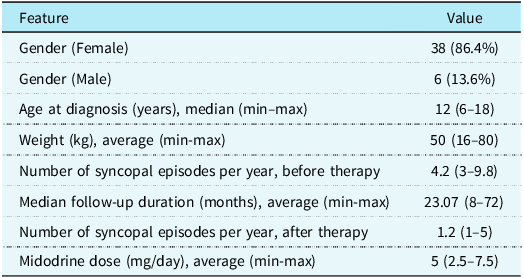
The mean dose of midodrine was 5 (2.5–7.5) mg/day; in total, 17 patients received midodrine treatment at a dose level of 2.5 mg/day (2.5 mg once a day), 15 of them received a 5 mg/day (2.5 mg twice daily) treatment, and 2 of them received 7.5 mg/day. mg/day (2.5 mg three times daily) (Table 2).
Statical analysis
Each variable in the study was described using descriptive statistics. Statistical results were expressed as means and standard deviations, while categorical variables were summarised as frequencies and percentages. The data were analysed using IBM Corp.’s SPSS Statistics version 22.0 for Windows software (Armonk, NY, USA). Statistical significance was defined as a p-value of less than 0.05. The absence of a control group precluded a comparative analysis.
Results
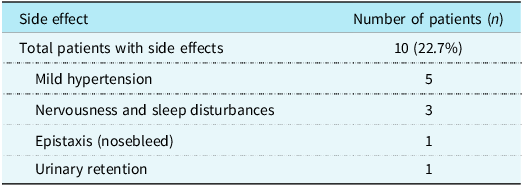
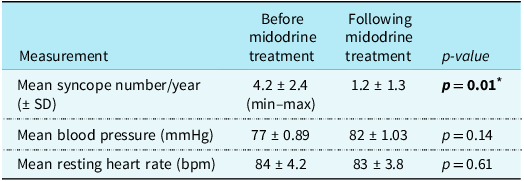
Of the 44 patients included in the study, 38 were female (86.4 %), and six were male (13.6 %). The mean age of the first application to the clinic and the first diagnosis of Vasovagal syncope was 12(6–18) years. Before initiating pharmacological treatment, the mean ± SD frequency of syncope episodes was 4.2 (range: 3–9.8) episodes per year. The mean follow-up period after midodrine initiation was 23.07 (8–72) months. After the treatment, the mean number of syncope episodes per year decreased to 1.2.Reference Xu, Jin, Du and Liao1–Reference Brignole, Moya and de Lange5 The demographic and clinical characteristics of the patients are demonstrated in Table 1 in detail. The mean dose of midodrine was 5 (2.5–7.5) mg/day; in total, 17 of the patients received treatment of midodrine at a dose level of 2.5 mg/day (2.5 mg once a day), 15 of them received a 5 mg/day (2.5 mg twice daily) treatment, and 2 of them received 7.5. mg/day (2.5 mg three times daily) (Table 2). We observed side effects of midodrine therapy in only 10 patients (22.7%). The most frequent adverse effect was mild hypertension (n = 5). Other side effects included nervousness and sleep disturbances (n = 3), epistaxis (n = 1), and urinary retention (n = 1). Importantly, no patients exhibited ECG abnormalities attributable to midodrine. Furthermore, none of the syncopal episodes observed in our patient cohort were related to cardiac arrhythmias. The mean number of syncope episodes per year has meaningfully decreased after midodrine therapy (p = 0.01). However, no statistically significant change was observed in the mean blood pressure and heart rate measured before the initiation of the midodrine treatment and in the sixth month of the treatment (p = 0.14, p = 0.61, respectively) (Table 3).
Features of the children with recurrent syncope episodes in the patient group

Side effects observed during midodrine therapy

Comparison of clinical features of the patients before and following the midodrine therapy

* p < 0.05, Student T-test.
Discussion
Vasovagal syncope is usually considered a benign symptom in both childhood and adulthood. It is unclear what causes vasodilation, hypotension, and bradycardia, but sudden sympathetic suppression is the underlying mechanism. There is no specific diagnostic test, and diagnosis is solely based on clinical signs and symptoms, eliminating other causes of syncope.
An integral part of the initial treatment for vasovagal syncope involves providing adequate information to the patient about the contributing factors to the syncope. These factors include the patient’s awareness of prodromal symptoms, avoiding prolonged standing, rapid changes in position, exposure to hot environments, and dehydration. Several nonpharmacological treatment methods include increased fluid and salt intake, physical exercise, and counter-pressure manoeuvres.Reference Salim and Di Sessa11,12 There are, however, many patients who continue to experience syncope episodes despite these measurements. Additionally, there is a need for additional treatment approaches when frequent recurrences result in an increased risk of traumatic injury. Some retrospective and prospective studies on children and adolescents compared the placebo group with patients suffering from Vasovagal syncope receiving fludrocortisone and sodium intake, increasing water and salt intake, receiving conventional treatment, or receiving metoprolol, suggesting that no meaningful difference was observed between the groups.Reference Salim and Di Sessa11
Since orthostatic intolerance is primarily accompanied by decreased vasoconstriction and increased venous pooling, midodrine’s properties are ideal for improving the response to orthostatic stress. As a result, midodrine increases blood volume, which results in a tendency to treat or prevent hypotension. In addition, midodrine will increase systolic and diastolic blood pressure if administered to patients with decreased blood pressure. Midodrine is beneficial in patients suffering from orthostatic hypotension, paroxysmal orthostatic tachycardia, and vasovagal syncope.Reference Kaufmann, Saadia and Voustianiouk7 An analysis of 26 children with recurrent vasovagal syncope treated with midodrine revealed that midodrine could serve as first-line therapy for recurrent syncope episodes. The group receiving midodrine had a syncope recurrence rate of 22% during the follow-up period, while the group receiving conventional nonpharmacological treatment had a recurrence rate of 80%. Compared with those receiving conventional treatment, patients who took midodrine treatment were significantly more likely to be effective with the tilt test and remain syncope-free (p = 0.03 and p = 0.023, respectively). The study included patients at an initial dose of 2.5 mg/day of midodrine, but a low dose was administered as a starting dose.Reference Qingyou, Junbao and Chaoshu13 It should be noted that similar results were obtained in our study with approximately twice the number of patients. Despite the absence of a placebo or control group, we could compare midodrine’s efficacy with pre-and post-treatment. In the present study, tilt table tests were not used. Instead, other tests for aetiology were conducted, and a diagnosis of vasovagal syncope was determined through a medical history and the elimination of other causes of syncope.
A peripheral vasoconstrictor alpha-agonist, midodrine, increases peripheral vascular resistance and reduces venous pooling by increasing peripheral vascular resistance. Following oral administration, midodrine rapidly metabolises into desglymidodrine, the active ingredient.Reference Samniah, Sakaguchi, Lurie, Iskos and Benditt14,Reference Sheldon, Faris and Tang15 A consequence of its effects on alpha-adrenergic receptors in the veins is vasoconstriction. Desglymidodrine does not pass through the blood–brain barrier and has little or no central nervous system effect. Compared to beta-adrenergic receptors, which primarily mediate cardiac inotropic effects, midodrine has little cardiostimulatory or arrhythmic effect on normal hearts.Reference Kaufmann, Saadia and Voustianiouk7,Reference Perez-Lugones, Schweikert and Pavia16
Due to its properties, midodrine is suitable for treating orthostatic intolerance, primarily caused by an increase in venous pooling and decreased vasoconstriction. As a result, it tends to increase blood volume as a treatment or prevention of hypotension. Midodrine also increased systolic and diastolic blood pressure in patients with decreased blood pressure. It has been established that midodrine is beneficial to adults suffering from orthostatic hypotension, paroxysmal postural tachycardia, and vasovagal syncope.Reference Sheldon, Faris and Tang15,Reference Romme, van Dijk, Go-Schön, Reitsma and Wieling17
Most commonly, non-pharmacological interventions treat vasovagal syncope in clinical practice in the first line.Reference Vaddadi, Corcoran and Esler18 Our study applied pharmacological treatment only after patients had experienced three recurrent syncopes after using non-pharmacological treatments, such as consuming excessive fluids and salt and performing counter-pressure manoeuvres. The side effects of midodrine are pretty mild. Previous studies have reported a low incidence of supine hypertension, headaches, pilomotor reactions, and gastrointestinal symptoms.Reference Sheldon, Faris and Tang15 In the STAND Trial 27 conducted in the Netherlands, when the patients were compared regarding side effects, those who received a placebo reported more side effects than those who received midodrine treatment, which is quite interesting.Reference Romme, van Dijk, Go-Schön, Reitsma and Wieling17 In the group receiving midodrine, headaches, cold sensations, and nausea were reported; in the group receiving a placebo, headaches and fatigue/loss of energy were observed.Reference Romme, van Dijk, Go-Schön, Reitsma and Wieling17
Desglymidodrine is a highly bioavailable active metabolite of midodrine, a “prodrug.” In this regard, there are several advantages. Prodrugs enter the body as partially active agents, minimising the possibility of adverse effects on the gastrointestinal system.Reference Sheldon, Faris and Tang15 Due to its inability to cross the blood–brain barrier, midodrine does not stimulate the central nervous system. As a result, there is no potential for abuse.Reference Romme, van Dijk, Go-Schön, Reitsma and Wieling17 Our results indicated that administering midodrine to children with vasovagal syncope who had not responded to non-pharmacological treatments was safe and effective. The present study did not show any side effects other than mild symptoms. We observed side effects of the drug only in 10 patients (22.7%), each with mild side effects (hypertensionReference Brignole, Moya and de Lange5, nervousness and sleep,Reference Xu, Jin and Du3 epistaxis,Reference Xu, Jin, Du and Liao1 urinary retention,Reference Xu, Jin, Du and Liao1 and fatigue.Reference Xu, Jin, Du and Liao1 We also observed that midodrine therapy significantly decreased syncope recurrence from 4.2 (±2.4) times a year to 2 (±1.3) (p = 0.01). These results were obtained from 23.07 (8–72) months of follow-up, a significantly more extended follow-up period than previous studies.
Five patients (46%) reported that their symptoms were gone after taking 7.5 mg/day. One patient discontinued midodrine treatment due to side effects, and another still had syncope episodes despite taking midodrine. Four patients showed significant improvements.Reference Sra, Maglio and Biehl19 In our study, dose escalation was applied to some patients; however, the standard and mean therapeutic dose was 5 (2.5–7.5) mg/day. There were ten cases (22.7%) among our patients in which a dose increase was required. Increasing the dose resulted in an improvement in these patients’ syncope attacks. Based on our study, this dose seems the most effective and sufficient. We suggest that syncope recurrence may be prevented with different dosages in some patients, but further investigation is necessary to confirm this claim. There are valuable randomised and double-anonymized studies on the midodrine effect, although they were conducted in an adult population. There has been limited research on vasovagal syncope in paediatrics, especially in adolescence, and results may differ from those obtained in adults. Consequently, we believe our study makes a valuable contribution to the literature.
Study limitations
This study is notable because it analysed a comparative number of Vasovagal syncope cases that were followed up and treated in our clinics for quite a long time. However, this study has various limitations due to the small number of cases, the lack of a double-anonymized study, the lack of comparison with a placebo, and the fact that the diagnosis was only an exclusion diagnosis. Vasovagal syncope varies considerably in its clinical severity. The results of our study suggest that midodrine treatment was quite effective in children, even though clinical improvement may not depend on the medication. In our study, however, most patients received the medication after the symptoms began to appear, so we cannot present information on the effectiveness of preventing Vasovagal syncope. Also, tilt table testing was not included because its role in assessing treatment response in paediatric syncope is limited and inconsistent in prior studies; this was acknowledged as the final study limitation.
Conclusion
Children with resistant Vasovagal syncope who do not respond to conventional non-pharmacological orpharmacological treatments can benefit from midodrine, which has few side effects. A dose of 5 mg of midodrine may be sufficient for children. Of note, none of the syncopal episodes observed in our patients were related to cardiac arrhythmias. The role and effectiveness of midodrine in treating recurrent vasovagal syncope in children will need to be determined through extensive, double-anonymized, placebo-controlled prospective studies.