Introduction
In recent years, interest in the prevalence, course, and etiology of mental disorders in later life has grown, commensurate with current demographic aging. Late-life anxiety is highly prevalent, surpassing the incidence rate of depression and other mood disorders (Bryant et al., Reference Bryant, Jackson and Ames2008). Elderly anxiety disorder predicts increased physical disability, memory difficulties, decreased quality-of-life, increased service utilization, and mortality (Carrière et al., Reference Carrière2013). Sub-threshold anxiety symptoms that do not satisfy anxiety disorder criteria are also important in older adults, given their association with distress and medical illness such as coronary heart disease, limited mobility, and interference with daily activities (Wetherell et al., Reference Wetherell, Roux and Gatz2003; Mehta et al., Reference Mehta2007). Although growing evidence suggests that, in the absence of treatment, anxiety symptoms are unlikely to fully remit (Schuurmans et al., Reference Schuurmans2005), it is estimated that approximately 70% of older adults with mood and anxiety disorders do not use mental health services (Byers et al., Reference Byers, Arean and Yaffe2012). Therefore, identifying anxiety in the elderly individuals is a concern for clinicians. Furthermore, identifying high-risk patients, and improving the management of such individuals, could increase well-being in older people.
In previous studies, the prevalence rate of late-life anxiety ranges between 1.2% and 52.3% (Bryant et al., Reference Bryant, Jackson and Ames2008). In longitudinal studies, the rate of incident anxiety and persistent anxiety was between 4.3% and 19.4% (de Beurs et al., Reference de Beurs, Beekman, Deeg, Van Dyck and van Tilburg2000; Chou et al., Reference Chou, Mackenzie, Liang and Sareen2011) and 16.3% and 58.6% (de Beurs et al., Reference de Beurs, Beekman, Deeg, Van Dyck and van Tilburg2000; Schuurmans et al., Reference Schuurmans2005), respectively. Factors associated with elderly anxiety disorder or symptoms have been investigated in several cross-sectional and longitudinal studies, with equivocal results. Poor physical health and social support (living alone and/or infrequent social contact), socio-demographic variables (female gender, lower education status), and recent stressful life events are associated with anxiety disorder or symptoms (de Beurs et al., Reference de Beurs, Beekman, Deeg, Van Dyck and van Tilburg2000), as are chronic physical disease and functional limitation (de Beurs et al., Reference de Beurs, Beekman, Deeg, Van Dyck and van Tilburg2000; Smit et al., Reference Smit, Comijs, Schoevers, Cuijpers, Deeg and Beekman2007). However, the association between anxiety and chronic disease and functional limitation was not supported by a previous longitudinal study (Schuurmans et al., Reference Schuurmans2005). In a recent review, biological (chronic disease, functional limitation), psychological (personality traits, inadequate coping strategies, previous psychopathology), and social (reduced social network, stressful life events) factors were all associated with anxiety disorders and symptoms in elderly patients (Vink et al., Reference Vink, Aartsen and Schoevers2008), but chronic disease and functional limitation were only cross-sectionally associated with anxiety. However, the studies included in the cited review, similar to other, subsequent longitudinal studies, were mainly conducted in Western countries. Only two previous studies on late-life anxiety in Asian countries (Vietnam and India; Prina et al., Reference Prina, Ferri, Guerra, Bryane and Prince2011; Leggett et al., Reference Leggett, Zarit, Nguyen, Hoang and Nquyen2012) have appeared; these employed cross-sectional design and a limited range of predictors and culture-specific measures. Anxiety disorder is among the most common mental disorders in adult Asian population (Demyttenaere et al., Reference Demyttenaere2004). In one study, anxiety disorder (6.2%) was rated as the second-most prevalent mental disorder among Korean adults (Cho et al., Reference Cho2007), who exhibited a slightly higher prevalence compared with other East-Asian countries (2.5–5.3%; Demyttenaere et al., Reference Demyttenaere2004). Therefore, a comprehensive, longitudinal study on late-life anxiety in Asian countries is required to identify whether the risk factors for anxiety are similar to or different from those of Western countries.
Using data from a longitudinal community study of an older Korean population, we herein estimated the prevalence, incidence, and persistence of anxiety symptoms over a two-year period, and investigated associated psychosocial factors.
Methods
Study overview and participants
This analysis is a component of a prospective community-based study of late-life psychiatric morbidity carried out in Gwangju, South Korea between 2001 and 2003. The study has been outlined previously (Kim et al., Reference Kim2013). At baseline, community dwellers aged ≥65 years living within two geographic catchment areas (one urban and another rural) were systematically surveyed using national registration lists, and were subsequently invited to participate. No particular inclusion/exclusion criteria were applied. All participants were approached for follow-up after two years (mean value ± SD interval: 2.4 ± 0.3 years). Anxiety was evaluated at both baseline and follow-up; all other data were gathered at baseline. All participants for all examinations provided written informed consent; moreover, we obtained written informed consent from the family members of participants with moderate-to-severe cognitive impairment. The Chonnam National University Hospital Institutional Review Board granted ethical approval.
Anxiety
The community version of the Geriatric Mental State Schedule (GMS-B3) together with diagnostic algorithm, the Automated Geriatric Examination for Computer-Assisted Taxonomy (AGECAT) were used to estimate baseline and follow-up anxiety (Copeland et al., Reference Copeland, Dewey and Griffiths-Jones1986). These are structured diagnostic instruments used extensively in international epidemiological research on older age population. Anxiety patients were defined as having the AGECAT scores of ≥3, intended to correspond to clinical levels of anxiety warranting clinical intervention. AGECAT scores of 1 or 2 were considered indicative of sub-threshold anxiety, which would not routinely warrant drug intervention, but was considered meaningful due to its association with disability in elderly adults(Prina et al., Reference Prina, Ferri, Guerra, Bryane and Prince2011).
Demographic, socio-economic, and clinical characteristics
Data on the demographic, socio-economic, and clinical characteristics potentially associated with anxiety symptoms were collected (Vink et al., Reference Vink, Aartsen and Schoevers2008). The following variables were included in the analyses: demographic factors such as age, gender, living area (rural or urban), and marital status (married or unmarried); socio-economic factors, including years of education, housing status (owned or rented), past occupation (manual or non-manual), current occupation (employed or not), monthly income (more or ≤ US$200), stressful life events, and social support deficits, and clinical factors, such as the number of chronic medical illnesses, physical inactivity, depression, insomnia, cognitive function, and drinking problem. Home-based interviews were conducted, in which data were obtained primarily from participants and corroborated, where possible, by caregiver reports to provide more accurate information. The following stressful life events over the past year (previously recognized as affecting late-life mood and anxiety disorder; Prince et al., Reference Prince, Harwood, Blizard, Thomas and Mann1997) were evaluated: serious illness (self or close relative), bereavement (immediate family member or other relative or close friend), marital separation, end of a relationship, problem with a close friend or relative, and theft or property loss. To calculate total scores, positive responses were summed and divided into four groups (0, 1, 2, 3+). Social support deficits were estimated using the following six binary variables (Prince et al., Reference Prince, Harwood, Blizard, Thomas and Mann1997): living alone, seeing a relative for less than once a month, seeing a friend for less than once a month, having no close friends, seeing a neighbour for less than once a month, and having no close neighbours. Items were summed and classified into four groups (0, 1, 2, 3+). The following common, generally chronic medical illnesses were considered (Lindesay, Reference Lindesay1990): arthritis or rheumatism; eyesight problems; hearing difficulty or deafness; persistent cough; breathlessness, difficulty in breathing or asthma; high blood pressure; heart disease or angina; gastric or intestinal problems; faints or blackouts; paralysis, weakness or loss of power in one leg or arm; and skin disorders such as pressure sores, leg ulcers, or severe burns. The number of illnesses was summed and classified into four groups (0, 1, 2~3, 4+). Daily physical activity was estimated by measuring both work and leisure activities, with “sedentary lifestyle” serving as a binary variable. Depression was also assessed using the GMS-B3 (Copeland et al., Reference Copeland, Dewey and Griffiths-Jones1986) with computerized algorithm (AGECAT); clinically relevant depressive symptoms were quantified using AGECAT scores on the basis of the conventional ≥3 confidence level, as per the anxiety assessment. Insomnia was assessed by the following questions, which were used in the previous publication (Kim et al., Reference Kim, Stewart, Kim, Yang, Shin and Yoon2009): (i) Do you experience any difficulties falling asleep?; (ii) Do you experience any problems remaining asleep, including early waking?; (iii) How often do you experience these problems per week?; and (iv) How long have these problems persisted? Using these questions, insomnia was characterized as difficulty in initiating or maintaining sleep for ≥3 nights per week for at least one month. The Mini-Mental State Examination (MMSE) was used to measure cognitive function (Folstein et al., Reference Folstein, Fostein and McHugh1975), with participants subsequently divided into three groups on the basis of their scores (−20, 21~24, 25+). In terms of lifetime alcohol consumption data, problem drinkers were classified as males taking more than 14 drinks per week, and females taking more than seven drinks per week, based on consumption during the previous three months (National Institute of Alcohol Abuse and Alcoholism, 1995).
Statistical analysis
Considering the importance of sub-threshold anxiety later in life, a single category labeled as “anxiety symptoms,” which combined anxiety cases and sub-threshold anxiety, was analyzed in our study, consistent with previous studies (Wetherell et al., Reference Wetherell, Roux and Gatz2003; Prina et al., Reference Prina, Ferri, Guerra, Bryane and Prince2011). Three dependent variables – “prevalence,” “incidence,” and “persistence” – were included in analyses. The prevalence of baseline anxiety symptoms was estimated. We defined “incidence” as the rate of anxiety symptoms at follow-up in those without baseline anxiety symptoms, and “persistence” as the rate of anxiety symptoms at follow-up in those with baseline anxiety symptoms. Univariate analyses of the three outcome measures were initially performed, followed by multivariate logistic regression models after adjusting for potentially relevant factors (p < 0.05 in χ 2 tests) in the previously unadjusted analyses, to assess independent association with the three dependent variables. In the interest of including a broader significance cut-off for inclusion in the multivariate analysis and thereby allowing for “negative” confounding, multiple comparison testing was not considered in the analyses. Additional sensitivity analyses were performed to investigate the risk factors of anxiety patients separately. Analyses were performed using the SPSS for Windows software package (version 21.0; IBM Inc., New York, USA).
Results
Recruitment, follow-up, and anxiety symptoms
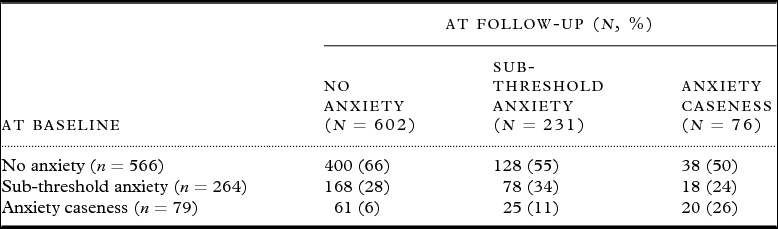
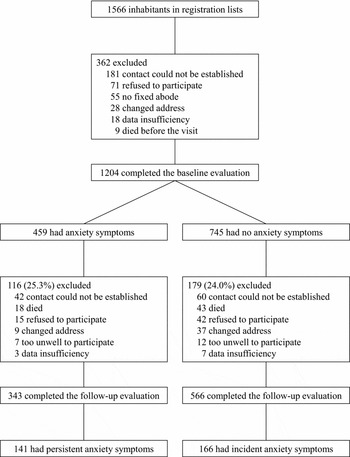
The recruitment process and anxiety symptom rates are summarized in Figure 1. We found no difference between participants (n = 1,204) and non-participants (n = 362) in terms of age (mean value ± SD, 72.2 ± 5.9 years and 72.4 ± 6.6 years, respectively; p = 0.302) or gender (58% female of participants and 62% female of non-participants) at baseline. Anxiety symptoms (both anxiety cases and sub-threshold anxiety) were present in 459 (38.1%) participants. At follow-up, 909 (75.5%) participants were re-examined. Compared with participants who were not analyzed at follow-up (n = 295), the data from the analyzed participants (n = 909) did not exhibit baseline differences in terms of age (mean value ± SD, 72.4 ± 5.7 and 73.0 ± 6.9 years, respectively; p = 0.394), gender (58% female of follow-up participants and 59% female of no follow-up participants; p = 0.711), or prevalence of baseline anxiety symptoms (39.3% and 37.7%, respectively; p = 0.626). A total of 307 (33.8%) of the 909 followed-up participants experienced anxiety symptoms two years after baseline evaluation (thus at the time of follow-up). Changes in anxiety symptoms during follow-up are presented in Table 1. Anxiety symptoms were observed in 166 (29.3%) of the 566 followed-up participants without baseline anxiety symptoms, and persisted in 141 (41.1%) of the 343 followed-up participants with baseline anxiety symptoms. Anxiety cases were present in 108 (9.0%) participants. Anxiety developed in 56 (6.7%) of the 830 followed-up participants without baseline anxiety, and they persisted in 20 (25.3%) of the 79 followed-up participants with baseline anxiety.
Changes in anxiety from baseline to follow-up (n = 909)

Flow diagram for baseline recruitment and sample follow-up.

Univariate associations with anxiety symptoms
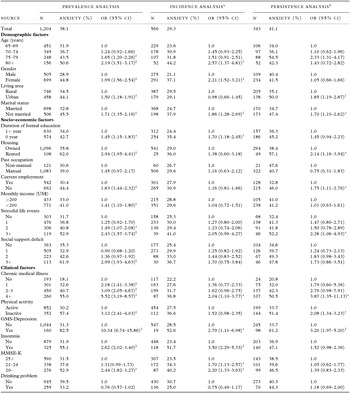
Table 2 shows the associations determined by univariate analysis between baseline characteristics and anxiety symptoms. The baseline factors significantly correlated with prevalent anxiety symptoms were increased age, female gender, urban residence, unmarried status, no previous education, rented housing, not in current employment, lower monthly income, increased number of stressful life events and social support deficits, higher number of chronic medical illnesses, physical inactivity, depression, insomnia, and lower cognitive function. Incident anxiety symptoms (in participants without baseline anxiety symptoms) were significantly associated with the following subsequent features: older age, female gender, unmarried status, no previous education, increased number of chronic illnesses, depression, insomnia and lower cognitive function. Variables associated with anxiety symptoms persistence (for participants with baseline anxiety symptoms) included urban residence, unmarried status, rented housing, not in current employment, increased number of stressful life events and physical disorders, physical inactivity, and depression at baseline.
Univariate associations of baseline characteristics with prevalent, incident, and persistent anxiety

Notes: aSample restricted to participants with no anxiety symptoms at baseline.
bSample restricted to participants with anxiety symptoms at baseline.
WHODAS = World Health Organization Disability Assessment Schedule; GMS = Geriatric Mental State schedule, MMSE-K = Mini-Mental State Examination – Korean version.
*p < 0.05;†p < 0.01; ‡p < 0.001.
Multivariate associations with anxiety symptoms
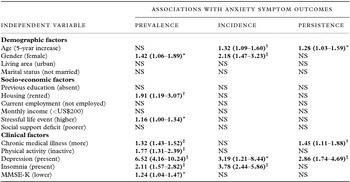
Multivariate associations between baseline characteristics (simultaneously entered into regression models) and anxiety symptoms, derived from logistic regression models, are summarized in Table 3. Baseline anxiety symptoms were significantly associated with female gender, rented housing, higher number of stressful life events and chronic medical illnesses, physical inactivity, depression, insomnia, and lower cognitive function after adjusting for all covariates. Older age, female gender, depression, and insomnia were significantly associated with incident anxiety symptoms after adjusting for all potential covariates. Persistent anxiety symptoms were significantly predicted by older age, chronic medical illnesses, and depression after adjusting for all covariates.
Multivariate associations with prevalent, incident, and persistent anxiety. Data are ORs (95% CIs)

Notes: The categories in parentheses are the comparator categories.
MMSE-K = Mini-Mental State Examination – Korean version.
*p < 0.05; †p < 0.01; ‡p < 0.001.
Sensitivity analyses of baseline characteristics and anxiety cases
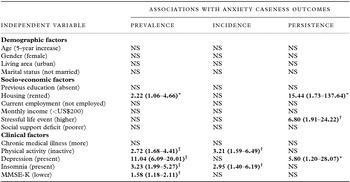
Univariate associations between baseline characteristics and anxiety cases exhibited baseline features identical to those associated with anxiety symptoms such as older age, female gender, urban residence, unmarried status, no previous education, rented housing, not in current employment, lower monthly income, increased number of stressful life events and social support deficits, higher number of chronic medical illnesses, physical inactivity, depression, insomnia, and lower cognitive function. Incident anxiety cases were significantly associated with physical inactivity and insomnia. Variables associated with persistent anxiety cases included urban residence, increased number of social support deficits, and depression at baseline. Table 4 describes adjusted associations derived from logistic regression models between baseline characteristics (simultaneously entered into regression models) and anxiety cases. Baseline anxiety cases were independently associated with rented housing, physical inactivity, depression, insomnia, and lower cognitive function. Incident anxiety cases were predicted by physical inactivity and insomnia, whereas persistent anxiety cases were predicted by rented housing, higher stressful life events, and depression. In summary, factors associated with anxiety cases were similar to those associated with anxiety symptoms, although the number of significantly associated factors was reduced commensurate with lower statistical power.
Multivariate associations with prevalent, incident, and persistent anxiety caseness. Data are ORs (95% CIs)

Notes: The categories in parentheses are the comparator categories.
MMSE-K = Mini-Mental State Examination – Korean version.
*p < 0.05; †p < 0.01; ‡p < 0.001.
Discussion
The major finding of this two-year longitudinal community study of older people was that the prevalence, incidence, and persistence rates of anxiety symptoms (both anxiety cases and sub-threshold anxiety) were 38.1%, 29.3%, and 41.1%, respectively, compared with 9.0%, 6.7%, and 25.3% for anxiety patients. Furthermore, baseline anxiety symptoms were independently associated with female gender, rented housing, greater number of stressful life event and medical illnesses, physical inactivity, depression, insomnia, and lower cognitive function, whereas incident anxiety symptoms after two years were predicted by older age, female gender, depression, and insomnia; persistent anxiety symptoms were predicted by older age, chronic medical illnesses, and depression. The rate of late-life anxiety in South Korea was similar to those found in Western studies, and Korean elderly individuals with risk factors, such as rented housing and physical inactivity, which were first evaluated in South Korea, are more likely to be anxious.
Anxiety symptoms were highly prevalent in our sample; the rate was in line with previous studies conducted in Western countries (Smit et al., Reference Smit, Comijs, Schoevers, Cuijpers, Deeg and Beekman2007; Prina et al., Reference Prina, Ferri, Guerra, Bryane and Prince2011). In terms of the baseline prevalence of anxiety symptoms, a recent systematic review reported that prevalence of anxiety disorder in community samples ranged between 1.2% and 15%; but the prevalence of symptoms was markedly higher, ranging between 15% and 52.3% (Bryant et al., Reference Bryant, Jackson and Ames2008). Incident and persistent anxiety rates have been reported in previous longitudinal studies to be between 4.3% and 19.4% (de Beurs et al., Reference de Beurs, Beekman, Deeg, Van Dyck and van Tilburg2000; Chou et al., Reference Chou, Mackenzie, Liang and Sareen2011) and between 16.3% and 58.6% (de Beurs et al., Reference de Beurs, Beekman, Deeg, Van Dyck and van Tilburg2000; Schuurmans et al., Reference Schuurmans2005), respectively. In spite of relative scarcity of data on late-life anxiety (compared with depression), previous studies have suggested consistently that anxiety is more prevalent than mood disorders (Byers et al., Reference Byers, Arean and Yaffe2012), although the prevalence declines with age (Forlani et al., Reference Forlani2014). Our results indicate that Korean elderly individuals experience anxiety symptoms as frequently as do Caucasians. However, considering the low prevalence of mental illnesses (including anxiety disorder) in the adult Korean population, based on a Korean epidemiological study (Cho et al., Reference Cho2007), our data suggest that Korean elderly individuals are relatively more likely to suffer from anxiety symptoms than Caucasians, although direct comparisons are impossible because of differences in the study design. The result can be partially explained by the fact that South Korea has the highest elderly poverty rate among the countries of Organization for Economic Cooperation and Development (OECD) due to rapid aging population and an immature pension system (OECD, 2013).
Baseline depressive symptoms were associated with incident and persistent anxiety symptoms after two years, and with baseline anxiety symptoms. An association between depressive and anxiety symptoms has been consistently reported in cross-sectional studies. There are several plausible mechanisms underlying the correlation between anxiety and depressive symptoms: First, anxiety and depression are highly comorbid in later life; in previous studies, between 23% and 84% of elderly individuals with a primary diagnosis of depression also experienced anxiety, and 25–54% of those with a primary diagnosis of anxiety also suffered from depression (Prina et al., Reference Prina, Ferri, Guerra, Bryane and Prince2011). Furthermore, the co-occurrence of anxiety and depression is frequently associated with increased severity and a more persistent course of disease (Andreescu et al., Reference Andreescu2007). According to such data, depression might be a risk factor for the occurrence and persistence of anxiety symptoms during two-year follow-up. Second, certain criteria of depression (e.g. sleep, appetite, and concentration disturbances) are also common to anxiety. Thus, elderly individuals experiencing depressive symptoms should be closely monitored and offered appropriate treatment, considering their prospective association with the occurrence and persistence of anxiety symptoms (in addition to the fact that depressive symptoms are distressing in and of themselves).
Baseline anxiety symptoms were independently associated with female gender, rented housing, higher number of medical illnesses, physical inactivity, insomnia, and lower cognitive function. Our cross-sectional associations are similar to those reported in a previous review (Vink et al., Reference Vink, Aartsen and Schoevers2008). Rented housing, a rarely examined variable that serves as a proxy for low socio-economic status (e.g. low income), was associated with baseline anxiety symptoms in prior studies (van Zelst et al., Reference van Zelst, de Beurs, Beekman, Deeg and van Dyck2003).
Older age, female gender, and insomnia predicted anxiety symptoms after two years, whereas older age and chronic medical illness predicted anxiety persistence during the two-year period. Female gender was strongly and consistently associated with the incidence of anxiety in the elderly individuals in previous longitudinal studies (de Beurs et al., Reference de Beurs, Beekman, Deeg, Van Dyck and van Tilburg2000; Chou et al., Reference Chou, Mackenzie, Liang and Sareen2011). Females appear to be more prone to anxiety, attributed to genetic and biological factors (such as hormonal changes) and to psychological and social factors (World Health Organization, 2001). Females may also experience greater stress associated with social roles and exhibit higher degrees of interpersonal sensitivity and emotional involvement when facing life's adversities. Data on the association between older age and anxiety incidence and persistence are equivocal. Numerous cross-sectional studies have suggested that anxiety prevalence decreases in older age groups (Forlani et al., Reference Forlani2014), but no such association was reported in several longitudinal studies in spite of the existence of univariate associations between older age and anxiety (de Beurs et al., Reference de Beurs, Beekman, Deeg, Van Dyck and van Tilburg2000; Smit et al., Reference Smit, Comijs, Schoevers, Cuijpers, Deeg and Beekman2007). In contrast with the findings of Western countries, Korean elderly adults are more likely to experience the occurrence and persistence of anxiety symptoms as they get older. In our present study, insomnia predicted both present and incident anxiety symptoms in elderly individuals. To the best of our knowledge, this is the first report of the longitudinal association between insomnia and anxiety symptoms later in life. In previous studies on adult populations, insomnia increased the risk of future anxiety in line with our data (Neckelmann et al., Reference Neckelmann, Mykletun and Dahl2007). Insomnia is common in older adults, with prevalence rates of 20–40% (Liu and Liu, Reference Liu and Liu2005). Considering the role of insomnia in predicting anxiety later in life, insomnia in elderly individuals should not be considered as part of the normal aging process; rather efforts should be made toward detection and management thereof. Our results contrast with those of a previous review (Vink et al., Reference Vink, Aartsen and Schoevers2008) that found chronic medical illness to be associated with baseline and persistent anxiety. We postulated that chronic medical illness might precipitate concern regarding loss of independence later in life, thereby leading to anxiety symptoms and their persistence (Schulz et al., Reference Schulz, Heckhausen, O’Brien, Manuck and Jennings2000). However, chronic illness was not associated with an increased incidence of anxiety symptoms in the present study (both of which were highly prevalent in our sample).
Our study is the first to define factors predicting the incidence and persistence of anxiety symptoms in an older Asian cohort. The prevalence, incidence, and persistence of anxiety symptoms in our cohort were high, similar to the studies conducted in Western countries. Furthermore, Korean elderly adults who live in rented housing and who are less active physically are more likely to be anxious; neither of these factors was evaluated in previous Western studies. Moreover, we used standardized assessment scales; our follow-up rate of 75.5% was adequate, and participants who were followed up did not differ from those who were not followed up with respect to the risk factors of interest. However, our study also had several limitations. First, anxiety measurement was limited in nature, and specific anxiety subtypes were not distinguished, limiting the inferences that can be drawn from our data. Furthermore, the GMS diagnostic instrument is less well validated in the context of anxiety assessment than dementia or mood disorder assessment (Copeland et al., Reference Copeland, Dewey and Griffiths-Jones1986). Nevertheless, the GMS has proven to be useful in characterizing the psychopathology of anxiety, including at sub-threshold levels (Prina et al., Reference Prina, Ferri, Guerra, Bryane and Prince2011). Second, data on general physical health and insomnia were evaluated based on self-report measures. Medical records, including information regarding mental health treatment, were not available, and certain factors, such as personality traits, were not included in the evaluation. However, numerous other risk factors were evaluated, with the determinants of anxiety symptoms identified via multivariate analyses. Further studies evaluating multidimensional risk factors are required because anxiety is a complex disorder (Blay and Marinho, Reference Blay and Marinho2012). Third, we did not consider multiple comparisons in the analysis, which may increase the chance of type I error. However, we feel that it is an acceptable practice to include a broader significance cut-off for inclusion in multivariate analysis to allow for “negative” confounding (i.e. which obscures rather than exaggerates the effects). Finally, our prospective analysis considered anxiety symptoms to be an “incident” outcome – i.e. absent on one occasion and present on another. Such an approach has only a limited ability to reflect anxiety trajectories (although the approach is commonly used in epidemiological research); for example, episodes occurring and then disappearing between examination points would not be included in the analysis, which might result in underestimation of anxiety incidence and persistence.
In conclusion, anxiety symptoms are common in later life. As depressive symptoms are associated with increased risks of both incidence and persistence of anxiety, effective detection, diagnosis, and treatment of depression are all clearly important to reduce anxiety in elderly populations. Based on these findings, further study is needed to examine the reciprocal relationship between anxiety and depression in later life. Furthermore, particularly close monitoring of female, older age, and insomniac patients is required due to their increased risk of incident anxiety symptoms. Clinicians and community-based social service providers should seek to identify patients with anxiety, although further research is required on the most feasible, effective, and acceptable interventions.
Conflict of interest
Dr. J-M Kim has received research support from the Ministry of Health & Welfare and National Research Foundation of Korea. Drs. H-J Kang, K-Y Bae, S-W Kim, I-S Shin, and J-S Yoon report no additional financial or other relationships relevant to the subject of this paper.
Description of authors’ roles
Drs. H-J Kang and J-M Kim conducted the data analysis and drafted the paper. Drs. K-Y Bae, S-W Kim, I-S Shin, and J-S Yoon Yoon helped to analyze the data, draft the paper, and revise it critically. All authors approved the final version of the paper to be published.
Acknowledgments
This study was supported by a grant of the Korean Health Technology R&D Project, Ministry of Health & Welfare, Republic of Korea (HI12C0003).