Deliberate self-harm (DSH) is commonly defined as the intentional, direct and non-suicidal destruction of one's body tissue (Favazza, Reference Favazza1998; Gratz, Reference Gratz2003). Typically, DSH behaviours include cutting, burning, scratching and head banging (Skegg, Reference Skegg2005). Cutting is the most common DSH behaviour (Young, Van Beinum, Sweeting, & West, Reference Young, Van Beinum, Sweeting and West2007), although it rarely occurs without other milder behaviours also being reported (Latimer, Covic, Cumming, & Tennant, Reference Latimer, Covic, Cumming and Tennant2009). DSH appears to be common across both clinical and non-clinical populations, with prevalence rates ranging between 4% and 82% in clinical inpatient populations (Briere & Gil, Reference Briere and Gil1998; Darche, Reference Darche1990; Favazza, Reference Favazza1998; Hurry, Reference Hurry2000; Nock & Prinstein, Reference Nock and Prinstein2004) and between 12% and 68% in non-clinical community populations, including secondary and tertiary students (Croyle & Waltz, Reference Croyle and Waltz2007; Latimer et al., Reference Latimer, Covic, Cumming and Tennant2009; Lloyd-Richardson, Perrine, Dierker, & Kelley, Reference Lloyd-Richardson, Perrine, Dierker and Kelley2007; Ross & Heath, Reference Ross and Heath2002).
Although risk factors have been a focus of much research in this area (Skegg, Reference Skegg2005), less is known about the functions of DSH (Klonsky, Reference Klonsky2007), which may differ at both initiation and maintenance stages (Muehlenkamp, Reference Muehlenkamp2005). A four-factor model (Nock & Prinstein, Reference Nock and Prinstein2004, Reference Nock and Prinstein2005) suggests two dimensions, automatic and social functions of DSH. ‘Automatic-negative’ functions reduce affective states (i.e., tension, distress, anger) while ‘automatic-positive’ functions generate affective states (i.e., to feel something; dissociation reduction). ‘Social-negative’ functions escape unpleasant interpersonal encounters (i.e., punishment) and ‘social-positive’ functions gain attention or a reaction from others.
The most commonly examined functions of DSH across studies include: affect regulation, self-punishment, anti-dissociation or feeling-generation, anti-suicide, interpersonal influence, interpersonal boundaries and sensation-seeking functions (Klonsky, Reference Klonsky2007); of these, affect regulation — efforts to reduce negative mood or arousal (Gratz, Reference Gratz2003) — has been the most studied and endorsed function across different populations (Klonsky, Reference Klonsky2007). These findings suggest multi-functional purposes of DSH, as proposed by both Nock and Prinstein (Reference Nock and Prinstein2004) and more recently by Klonsky and Glenn (Reference Klonsky and Glenn2009).
Subsequently, a new scale, the Inventory of Statements About Self-Injury (ISAS), was developed using a sample of 235 college students (Klonsky & Glenn, Reference Klonsky and Glenn2009) to broaden the measurement of DSH functions. In addition to the seven functions of DSH identified in the literature (Klonsky, Reference Klonsky2007), a further six functions were included: marking distress, autonomy, peer bonding, revenge, self-care, and toughness. Initial psychometric examination identified two factors (interpersonal and intrapersonal functions; Klonsky & Glenn, Reference Klonsky and Glenn2009) that were consistent with the two dimensions (social and automatic functions) originally proposed by Nock and Prinstein (Reference Nock and Prinstein2004, Reference Nock and Prinstein2005). Specifically, the intrapersonal factor included the following five function domains: affect regulation, anti-dissociation, anti-suicide, marking distress, and self-punishment. The interpersonal factor included eight function domains: autonomy, interpersonal boundaries, interpersonal influence, peer bonding, revenge, self-care, sensation seeking, and toughness. Authors reported high alpha coefficients for the interpersonal and intrapersonal factors: 0.87 and 0.80 respectively. Surprisingly however, the self-care function loaded on the interpersonal rather than the intrapersonal factor, as was expected by the authors. Recent psychometric evaluation by the authors (Glenn and Klonsky, Reference Glenn and Klonsky2011) found test–retest correlations of 0.82 and 0.60 for the interpersonal and intrapersonal factors respectively, based on a sample of 51 university students who reported self-harming behaviours across two time periods 12 months apart.
Given the potential usefulness of the ISAS in the comprehensive assessment of DSH functions, a further psychometric examination of this scale is warranted. As the scale was initially developed with a non-clinical, specific subcommunity population (university/college students in the United States), it seems essential to examine its application in different populations: clinically, socially and geographically. The target population for the current study were youth who self-identify as engaging in DSH, and are members of online social networks’ DSH peer support groups. The reason for this selection is threefold: (1) DSH concentrated sample; (2) international sample; and (3) representation of increasing online social networks. While those who engage in DSH are primarily in adolescence and early adulthood, and as such most likely to seek help from their peers (Ciarrochi & Deane, Reference Ciarrochi and Deane2001; Eberhardt, Reference Eberhardt2007; Fortune & Hawton, Reference Fortune and Hawton2005; Orygen Youth Health, 2004), the majority of adolescents, according to a recent study, do not access DSH online sites (Muehlenkamp, Walsch, & McDade, 2010). It will therefore be illuminative to examine DSH in those who do access those sites as they may be a specific DSH subpopulation who are more likely to seek help and subsequently treatment.
Therefore, the aim of the current study was to assess the psychometric properties of the ISAS, and specifically in relation to the scales: (a) two factorial model (Klonsky & Glenn, Reference Klonsky and Glenn2009); and (b) its compliance to the principles of measurement through fit of the data to the Rasch measurement model (Pallant & Tennant, Reference Pallant and Tennant2007).
Method
Participants
Members of DSH groups on the online social networks, Facebook and MySpace, were recruited based on the inclusion criteria of (1) being over 18 years of age, and (2) having engaged in DSH in the last 12 months.
Measures
An online questionnaire was administered to gather the participants’ demographic (age, gender, level of education, country and ethnicity) and mental health treatment information, as well as the following measures:
The Inventory of Statements About Self-Injury (ISAS; Klonsky, Reference Klonsky2008). The ISAS includes 12 items to assess DSH behaviours and 39 items to measure 13 function domains. The ISAS assesses the frequency, onset and duration of individuals’ DSH, the associated pain and context of their DSH, and the duration of their urges prior to engaging in DSH. The 13 function domains of DSH assessed by the ISAS are each measured using three items, with the scores for each item ranging from 0 (not relevant) to 2 (very relevant); the summation of the three items forms the score for each function, ranging from 0 to 6. Klonsky and Glenn (Reference Klonsky and Glenn2009) reported that the ISAS consists of two factors: interpersonal functions and intrapersonal functions, that have good internal consistency (α = 0.88 and 0.80 respectively).
The Psychiatric Diagnostic Screening Questionnaire (PDSQ; Zimmerman, Reference Zimmerman2002): The PDSZ is a 126-item yes or no self-report measure that screens for the presence of 13 DSM-IV-TR Axis 1 diagnoses, including mood disorders, anxiety disorders, eating disorders, substance use disorders, somatoform disorders, and psychosis. Each of these diagnoses is assessed by multiple questions that are added to a total score, with higher scores indicating greater pathology. These total scores are then compared with recommended cut-off scores contained in the PDSQ manual, to determine if the individual meets criteria for a clinical or subclinical diagnosis. The PDSQ is a well validated and reliable scale and has been used extensively (Kobak et al., Reference Kobak, Skodol, Bender, Rush, First and Blacker2008; Magruder, Sonne, Brady, Quello, & Martin, Reference Magruder, Sonne, Brady, Quello and Martin2005).
The McLean Screening Instrument for Borderline Personality Disorder (MSI-BPD; (Zanarini, et al., Reference Zanarini, Vujanovic, Parachini, Boulanger, Frankenburg and Hennen2003). The MSI-BPD is a 10-item scale that assesses whether individuals meet the DSM-IV-TR criteria for borderline personality disorder (BPD), with scores of 7 and above indicative of BPD (Zanarini et al., Reference Zanarini, Vujanovic, Parachini, Boulanger, Frankenburg and Hennen2003). It is reported to have a good internal consistency (Cronbach alpha coefficient = 0.74) and good test–retest reliability (Spearman's rho = 0.72), as supported by other studies (Klonsky & Glenn, Reference Klonsky and Glenn2009; Sansone, Barnes, Muennich, & Wiederman, Reference Sansone, Barnes, Muennich and Wiederman2008). In the present study, the Cronbach's alpha was 0.74.
Procedure
Ethical approval was obtained from the relevant Human Research Ethics Committee. Six Facebook- and MySpace-based DSH groups allowed the advertisement for this study to be placed on their members’ discussion boards. Data collection was limited to a 2-month period, with the online survey system allowing each participant to access the survey once only.
Data Analyses
Statistical analyses were conducted using the Statistical Package for the Social Sciences (SPSS Version 17.0; Arbuckle, Reference Arbuckle2008) and Rasch analysis by RUMM2020 (Andrich, Sheridan, & Luo, Reference Andrich, Sheridan and Luo2007). SPSS was used to examine the descriptive properties of the demographic and clinical variables, together with internal consistency (using coefficient alpha). Exploratory Factor Analysis (EFA) of the two-factor model reported by Klonsky and Glenn (Reference Klonsky and Glenn2009) was undertaken in SPSS, given the inconsistent loading of the self-care function reported by the scale authors (Klonsky & Glenn, Reference Klonsky and Glenn2009). Concurrent validity was examined through the association between the two factors and the presence or absence of BPD.
Rasch analysis was then conducted to examine whether the ISAS met the Rasch model expectations, which are consistent with a probabilistic form of additive conjoint measurement (Van Newby, Conner, & Bunderson, Reference Van Newby, Conner and Bunderson2009). Where data meet these expectations, this enables an interval scale latent estimate to be derived, something not available from other IRT models (Lord, Reference Lord1975; Reise & Waller, Reference Reise and Waller2009). The process of fitting data to the Rasch model involves considering the quality of the ISAS's items, including individual item fit, a test of the unidimensionality of the ISAS's interpersonal and intrapersonal factors, the ISAS's performance across groups (i.e., gender, age, educational level), and examination of the ISAS's reliability and targeting to the sample. A good Rasch model fit is indicated with a non-significant chi-square interaction statistic that shows no deviation from model expectations, item and person summary fit statistics with a mean of 0 and standard deviation of 1, individual item non-significant chi-square fit statistics (Bonferroni adjusted) and individual item and person residuals within the range of +/−2.5. The latter would indicate if the pattern of responses made by individuals was consistent with the Rasch model expectations and the pattern of responses made by other individuals. The scale's invariance across groups is indicated with a non-significant ANOVA of the residuals, and unidimensionality is supported if an independent t test on separate estimates for each respondent is significant in less than 5% of cases. In addition, a breach of the assumption of local independence is tested by the presence of correlations among the item residuals above the level of 0.2. Where local dependency is observed, items are summed together into ‘testlets’ in order to absorb the dependency (Wainer & Lewis, Reference Wainer and Lewis1990). Cronbach's alpha and the Person Separation Index (PSI) are also assessed as indictors of scale reliability. The unrestricted or partial credit form of the Rasch model was used (Masters, Reference Masters1982).
Results
Participants Demographic and Clinical Profile
Of those who consented (n = 263) to participate in the study, 201 individuals completed the survey. Those 201 participants ranged in age from 18 to 50 years old (mean = 23.77, SD = 6.58) and were predominantly female (91%). Almost half (46%) were at or had completed university, followed by 12 years of schooling (35%), college or technical and further education (12%), and 10 years of schooling (6%). The participants predominantly came from the United States (38%), the United Kingdom (36%), Canada (9%) and Australia (8%). The majority of participants were Caucasian (88%).
All participants reported engaging in DSH within the last 12 months, with the mean age of onset for DSH being 13.64 years (SD = 4.38). The most commonly endorsed means of DSH were cutting (99%), wound interfering (78%), banging or hitting (72%), severe scratching (70%) and burning (63%). Less endorsed means of DSH included biting (51%), carving (50%), pinching (44%), pulling hair (39%), rubbing skin against rough surfaces (35%) and sticking self with needles (34%).
In this group of participants, 96% met criteria for one or more Axis I subclinical or clinical disorders as indicated by PDSQ scores, and 69% met criteria for Axis II subclinical or clinical BPD, based on MSI-BPD scores.
Overall, over half (54%) were currently receiving treatment for mental health issues, 32% were receiving treatment specifically for DSH, and 44% were currently on medication for their mental health disorder/s. Over one fifth (21%) of participants were receiving all of the aforementioned treatments, while 41% were receiving treatment for mental health issues and were on medication, 29% were receiving treatment for mental health issues and DSH, and 21% were receiving treatment for DSH and were on medication. The mean total score for the ISAS was 26.24 (SD = 9.90). For the MSI-BPD, the mean total score was 7.44 (SD = 2.30), with an acceptable scale internal consistency as indicated by Cronbach's alpha of 0.74. Both of these mean scores were considerably higher than those reported in the scale authors’ studies (ISAS mean of 14.3, SD = 13.3; MSI-BPD mean of 4.83, SD = 2.64). The intrapersonal functions were highly endorsed as indicated by the mean score of 3.42 (SD = 0.99), unlike the interpersonal functions with a mean score of 0.82 (SD = 0.86). While the mean score for the intrapersonal functions was considerably higher than reported in the scale authors’ study (mean = 1.70, SD = 1.40), the mean score for the interpersonal function was similar (mean of 0.70, SD = 1.00).
ISAS Two Factor Model
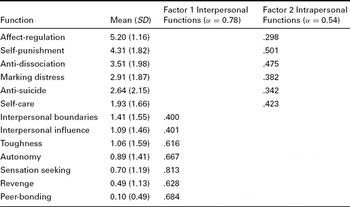
An Exploratory Factor Analysis (EFA) was conducted using Principle Axis Factoring (PAF), requesting a two-factor solution (interpersonal and intrapersonal). Thus, the 39 items of the ISAS, presented as 13 function domains, were subjected to PAF with a Promax rotation. Inspection of the correlation matrix revealed that most coefficients were above 0.3. The Kaiser-Meyer-Oklin value was 0.77, exceeding the recommended value of 0.6, and the Barlett's Test of Sphericity was statistical significant (< .001), supporting the factorability of the correlation matrix. Constraining the factor extraction to two factors, as per the scale authors’ solution, 41.5% of the variance was explained, with the interpersonal factor explaining 28.9% of the variance. The items (domains) loaded as expected onto the intrapersonal and interpersonal factors (Table 1), with some minor cross-loading below the value of 0.2 (not shown). Those two factors correlated at 0.42, which represents a moderate correlation and some overlap between the two factors while still being distinct.
Principal Axis Factor of the two factor model with Promax rotation

Note: Alpha coefficient scores above are based on 13 function domains rather than all 39 items.
Only the function ‘self-care’ did not load as reported in Klonsky and Glenn's (Reference Klonsky and Glenn2009) study, but was consistent with the scale author's original expectations. However, the Cronbach's alpha based on the 13 function domains across the two factors (α = 0.78, 0.54) was quite low for the intrapersonal factors. A further examination of coefficient alphas was undertaken with the scale's individual items, rather than the 13 function domains. In these circumstances, the internal consistency of the intrapersonal scale (including self care) was 0.77, and the internal consistency of the interpersonal scale was 0.87, which was similar to Klonsky and Glenn's (Reference Klonsky and Glenn2009) findings.
ISAS Rasch Measurement Model
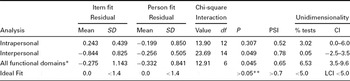
The data from each subscale were then fitted to the Rasch model. To address local dependency within the clusters of three items that made up each functional domain, the data were fitted as testlets; that is, three items summed together to represent the 13 function domains. Following this, both the interpersonal and intrapersonal functions demonstrated adequate fit to the Rasch model, with strict unidimensionality (Table 2), and satisfied the assumption of local independence.
Fit of the ISAS Functional Items to the Rasch Model

Note: * Presented as three testlets (two from intra personal); **Bonferroni adjusted LCI = lower confidence interval.
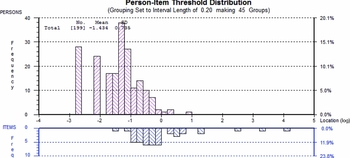
The reliability for the interpersonal function was acceptable (α = 0.78) however had a mean logit estimate of -1.431 (whereas a perfectly targeted scale would show a mean logit estimate of zero), so it appears that it is not targeting this sample (Figure 1). That is, there is a floor effect in this sample, although the item spread is quite broad (six logits). The hierarchical ordering of the interpersonal functions indicated that interpersonal boundaries and toughness were the most relevant functions for participants, while peer bonding was the least relevant function.
Interpersonal domain person-item distribution.

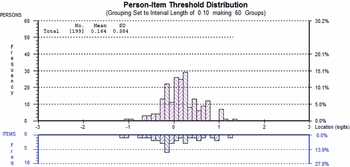
In contrast, the reliability for the intrapersonal functional domain was quite low (α = 0.52), possibly due to the narrow targeting range (only two logits); that is, all behaviours are tightly clustered, but a mean logit estimate of 0.164 indicates almost perfect targeting (Figure 2). The most commonly endorsed functions were affect regulation and self-punishment. This latter domain was the only function which demonstrated differential item functioning, in this case by gender, with females endorsing it significantly more. The least endorsed intrapersonal function was self-care, which was rarely affirmed as relevant in this study's sample. No differential item functioning was found for age, education or country across the two functions.
Intrapersonal domain person-item distribution.

Concurrent validity of the interpersonal and intrapersonal functions of DSH was supported by their significant association with the BPD diagnosis, with higher scores on intrapersonal and interpersonal components corresponding to the presence of a BPD diagnosis (Mann Whitney U = 3220.00, p = .008; 2966.00, p = .001 respectively), similar to Klonsky and Glenn's (Reference Klonsky and Glenn2009) findings.
Discussion
To our knowledge, this is the first independent evaluation of the psychometric properties of the ISAS (Klonsky & Glenn, Reference Klonsky and Glenn2009). Specifically, the aim of the study was to replicate the two-factor solution proposed by the scale's authors, and then further examine those factors using Rasch analysis in a DSH sample of members of online peer support groups.
Key Findings
There are four key findings in this study. First, the ISAS two-factor model comprising interpersonal and intrapersonal functions was supported. Second, the self-care function in this study aligned as an intrapersonal function, as was theoretically expected but not found in the original study (Klonsky & Glenn, Reference Klonsky and Glenn2009). Third, Rasch analysis further confirmed the two-factor model and their unidimensionality, thus giving an opportunity for an interval scale conversion when required. Fourth, the two-factor model was supported in a quite extreme DSH population, which Favazza (Reference Favazza2006) refers to as a ‘deliberate self-harm syndrome’ group that engages in repetitive DSH, self-identifies with the DSH behaviours, and is particularly in need of intervention. These findings therefore support the robustness of ISAS and its theoretical basis.
A limitation of the ISAS was found in its internal consistency, as indicated by alpha coefficients. When assessed based on all 39 items, alpha coefficients were acceptable. However, when assessed on the triplets of items that make up the 13 function domains, thus controlling for local dependency (across 39 items, which tends to inflate alpha coefficients), the intrapersonal factor's alpha was quite low. This may be due to the nature of the sample, patterns of responses, or the number of items (Ponterotto & Ruckdeschel, Reference Ponterotto and Ruckdeschel2007). Further examination across different samples is required to determine if the reliability of the intrapersonal factor, based on domains rather than individual items, is indeed problematic.
For clinical purposes, it would be more useful if the scale could be reliably used as a measure of the 13 function domains of DSH, as studies suggest that the successful treatment of mental health disorders involves determining what is initiating and maintaining an individual's problems, and then devising individualised cognitive behavioural treatment that specifically addresses those factors (Nezu, Nezu, & Lombardo, Reference Nezu, Nezu and Lombardo2004). By providing individuals who engage in DSH with adaptive coping strategies that substitute for the functions that DSH serves for them, this may provide them with motivation to move away from DSH. This is particularly pertinent in relation to intrapersonal functions, which dominate DSH behaviour. For example, for individuals who endorse the affect-regulation function of DSH, it has been suggested that emotion regulation and distress tolerance skills may be useful (Allen, Reference Allen1995; Brown, Williams, & Collins, Reference Brown, Williams and Collins2007; Slee, Arensman, Garnefski, & Spinhoven, Reference Slee, Arensman, Garnefski and Spinhoven2007). For individuals who endorse the marking distress function of DSH, it has been found that reinforcing the assertive expression of emotions may be useful (Allen, Reference Allen1995; Crowe & Bunclark, Reference Crowe and Bunclark2000); while for individuals who endorse the sensation seeking function of DSH, it has been suggested that developing opportunities for excitement, relaxation and pleasure may be useful (Allen, Reference Allen1995).
Study Limitations
These findings, nonetheless, must be considered in relation to this study's limitations. These include its reliance on self-report assessment without a clinical confirmation, and targeting a very specific sample (members of online social networks’ DSH peer support groups) with findings that may not generalise to more heterogeneous clinical and non-clinical DSH populations. Furthermore, the predominantly female sample would render the power low to detect Differential Item Functioning for gender.
The high indication of psychological disorders and prevalence of BPD suggests an extreme concentration of individuals who engage in DSH and may have, or perceive themselves to have, multiple mental health problems. If they identify themselves by their DSH behaviours, such as ‘cutter’ or ‘burner’, they may indeed have greater pathology (Muehlenkamp, Reference Muehlenkamp2005). However, without a full diagnostic clinical interview, it is not possible to confirm, or dispute, their clinical profile.
Study Strengths
It is likely that this sample over-endorsed the indicators of psychopathology and intrapersonal functions. However, given that the original two-factor model was replicated in this study, it is a testament to the ISAS's strength. Furthermore, fit of the data to the Rasch model showed the ability of the scale to deal with extreme scores. This is particularly important when working with samples that, as part of their clinical profile, may over-endorse some features (i.e., intrapersonal functions) but not others (i.e., interpersonal functions).
In fact, the pattern of DSH behaviours and functions in this sample was not found to be skewed (e.g., over-endorsed) even on the intrapersonal functions (Figure 2). In addition, the Rasch model offers a valuable contribution to testing the validity of responses and samples. It can provide a good indication of unusual response patterns that are inconsistent with the Guttman probabilistic ordering (Guttman, Reference Guttman, Stouffer, Guttman, Suchman, Lazarsfeld, Star and Clausen1950). However, in the current study, all the individuals displayed a response pattern that was consistent with the Rasch model expectations and with each other.
Another important attribute of the Rasch measurement model is that the estimate of item difficulty is independent of the distribution of persons, and the latent estimate of person ability is independent of the set of items taken (Wright & Douglas, Reference Wright and Douglas1977). This is a consequence of the separation of person and item parameters in the Rasch model, reflecting its notion of specific objectivity (Rasch, Reference Rasch, der Kamp and Vieck1967). Estimates of item difficulties and the ratio of item difficulties across pairs of items have the property of invariance across persons. This invariance is consistent with fundamental measurement requirements (Bond & Fox, Reference Bond and Fox2007). Therefore, the Rasch model makes no assumptions about the distribution of persons.
Thus, satisfying these properties has a number of implications for scales such as the ISAS when they meet Rasch model expectations. The raw (ordinal) score is a sufficient statistic, thus a simple summed score will suffice, but a transformation to interval scaling is also available if required. The calibration of item difficulties, including the ratio of difficulties between items, is independent of the sample of persons chosen for that calibration. This, together with the fact that the items were almost entirely free of Differential Item Functioning (DIF) for age and educational level, suggests that this hierarchical ordering of item difficulty will be robust across different samples. The item hierarchy is reflective of the relevance of various functions to DSH behaviour. These attributes, therefore, reflect the strengths of the ISAS scale. Notwithstanding the limitations identified, this study confirmed the ISAS's two factor model with both factor analysis and the Rasch measurement analysis.