Introduction
Zygocotyle lunata is a paramphistomid trematode and is one of two species in the family Zygocotylidae (Jones, Reference Jones, Jones, Bray and Gibson2005). Freshwater snails act as first intermediate hosts and this parasite is usually associated with Helisoma spp. in North America (Schmidt & Fried, Reference Schmidt and Fried1997; Klockars et al., Reference Klockars, Huffman and Fried2007; Fried et al., Reference Fried, Huffman, Keeler and Peoples2009), but Ostrowski de Núñez et al. (Reference Ostrowski de Núñez, Spatz and González Cappa2003) demonstrated its association with various species of Biomphalaria in South America. Zygocotyle lunata cercariae are released from their snail hosts and encyst on various substrates in the aquatic environment, including the shells of aquatic invertebrates, vegetation and inanimate objects. In nature the metacercarial cysts are often consumed inadvertently by avian and mammalian hosts. Such hosts become infected when the metacercarial cysts excyst within the digestive tract and later migrate to the caecum or colon where this digenean resides (Fried et al., Reference Fried, Huffman, Keeler and Peoples2009).
Few studies have provided information on the physical and chemical factors that affect both the encystment and excystment of Z. lunata. Peoples & Fried (Reference Peoples and Fried2008) tested the effects of various chemical agents on the encystment of Z. lunata cercariae and modelled their study on previous work done on Echinostoma caproni by Peoples & Fried (2007) and by Ashrafi et al. (Reference Ashrafi, Valero, Massoud, Sobhani, Solaymani-Mohammadi, Conde, Khoubbane, Bargues and Mas-Coma2006) on Fasciola hepatica. The present study extends the work of Peoples & Fried (Reference Peoples and Fried2008), by testing new substrates suitable for cercarial encystment and also by examining chemical and physical factors that are detrimental to cyst viability. The efficacy of encystment using various substrates not tested previously was also examined, i.e. how fast it took for complete encystment to occur on the various substrates used in our laboratory.
This parasite has an almost global distribution and is present in both tropical and temperate zones. Numerous mammalian and avian species serve as natural definitive hosts of Z. lunata, as discussed in Fried et al. (Reference Fried, Huffman, Keeler and Peoples2009). Although no reports of human infections are available, this parasite serves as a potential zoonotic in both tropical and temperate zones. Relative to the potential of this parasite as a human pathogen is information on food marinades that may, or may not, be able to kill the encysted metacercariae on vegetation. Hence, the role of certain marinades as cidal agents for this trematode is considered in this paper.
Materials and methods
Maintenance of infected snails
Naturally infected Helisoma trivolvis snails were collected from a farm pond in Northampton County, Pennsylvania, USA, as described in Schmidt & Fried (1997). Snails were determined to be patently infected based on the emergence of Z. lunata cercariae into artificial spring water (ASW). Two or three infected snails were placed in aerated Mason jars containing 700 ml of ASW and maintained at 23 ± 1°C. Snails were fed a mixture of boiled romaine lettuce and TetraMin™ (TetraWerke, Melle, Germany), and the cultures were changed two or three times per week.
To obtain cercariae for encystment studies, snails were isolated individually in an 8.5-cm diameter fingerbowl containing 70 ml of ASW as reported in Peoples & Fried (Reference Peoples and Fried2008). The fingerbowls were placed about 10 cm below an incandescent 60 W lamp to obtain a temperature of about 28°C, which is optimal for cercarial emergence of this species. Snails typically released 10–50 cercariae within 1 h of isolation. Cercariae were collected with a pipette and used within 1 h of their release. Observations were made at 15 min intervals to determine how long it took the cercariae to detach their tails and fully encyst upon the tested substrates. Ten to 24 cercariae were used for each trial, depending on how many cercariae were released during the 1 h snail isolation. Metacercarial cysts were collected 24 h after encystment and placed in vials containing 10 ml of Locke's 1:1 solution and maintained at 4°C for various lengths of time. Some of these encysted metacercariae were subsequently chemically excysted to test for cyst viability.
Solutions and substrates used for encystment
Peoples & Fried (Reference Peoples and Fried2008) tested the effects of various solutions on the encystment of Z. lunata and found that ASW was the most effective medium. For this reason, we used ASW as the solution for our cercarial encystment trials and varied the substrates upon which the larvae could encyst. Such substrates included polystyrene plastic multiwells, Styrofoam™, glass Stender dishes, polystyrene Petri dishes, lipid-coated (with forehead lipids) Petri dishes, aluminium foil, cheesecloth, and both Biomphalaria glabrata and H. trivolvis live snails and shells.
A block of Styrofoam™ was prepared with 24 tapered openings drilled in it, each with a depth of 40 mm and width of 16 mm. Each opening was filled with 2.5 ml ASW. One cercaria was placed by pipette in the centre of each opening in the Styrofoam™ block and observed at 15 min intervals for encystment. Aluminium foil squares, 6 cm × 6 cm, were cut and bent to fit the individual wells of a plastic multiwell chamber. Each well was filled with 2.5 ml of ASW. One cercaria was placed in each aluminium-coated well and encystment was observed at 15 min intervals. Cheesecloth squares, 6 cm × 6 cm, were cut and set up similarly as described for the aluminium foil trial.
Ostrowski de Núñez et al. (Reference Ostrowski de Núñez, Spatz and González Cappa2003) demonstrated that several species of Biomphalaria in South America can serve as a first intermediate host of Z. lunata. In the USA, Z. lunata larvae infect Helisoma snails. Such snails serve as the first intermediate host of Z. lunata and also provide a substrate for cercarial encystment. Therefore, we tested preference for either live B. glabrata or H. trivolvis for cercarial encystment and also if the shells of either of these snail species were preferred for encystment. In the first design, one live snail of each species was tethered to the bottom of a polystyrene plastic Petri dish 5 mm apart using Krazy glue™ (Elmer's Products, Inc., Columbus, Ohio, USA), and the dish was filled with 2.5 ml of ASW. In the second design, shells of both species were tested in a similar way. One cercaria was placed in each dish by pipette, equidistant from the two snails, and observations on encystment preference were made at 15 min intervals.
Physical treatments and marinades used to test excystment
Potassium permanganate (KMnO4) is widely used in the Middle East as a preventative for killing metacercariae of fasciolids attached to vegetables. Peoples & Fried (Reference Peoples and Fried2007) tested the effects of various physical treatments and marinades on the viability of E. caproni metacercarial cysts. Such marinades included vinegar, Italian salad dressing, lemon juice, Worcestershire sauce, sucrose solution, salt solution and acetic acid. The present study assessed the detrimental effects of three different concentrations of KMnO4, several marinades, long-term storage and the exposure to various temperatures on the viability of Z. lunata cysts. The effects of marinades and temperature on the excystment of Z. lunata metacercarial cysts using 20 cysts per trial were studied.
Excystment of metacercariae from encystment trials
To test the viability of Z. lunata metacercarial cysts after encystment on various substrates, cysts were chemically excysted using acid–pepsin pre-treatment and a trypsin–bile salts–cysteine (TBC) medium at 41°C as described by Saxton et al. (Reference Saxton, Fried and Peoples2008).
Results
Encystment substrates
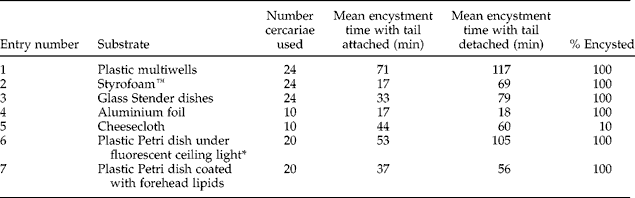
Results of the numerous substrates tested for cercarial encystment, i.e. plastic and glass dishes, Styrofoam™, aluminium foil, snail shells and cheesecloth, can be found in table 1. All but cheesecloth allowed for 100% encystment within 4 h of cercarial release. The time of mean encystment was fastest with Styrofoam™ and aluminium foil as encystment substrates. Encystment times were recorded for encystment with both the tail attached and detached. Larvae were considered to be completely encysted when the tail was detached from the outer cyst wall. Encystment with the tail still attached represents a preliminary stage of encystment and was not considered complete until the tail detached.
Substrates that allowed for the encystment of Z. lunata cercariae at 28°C*.
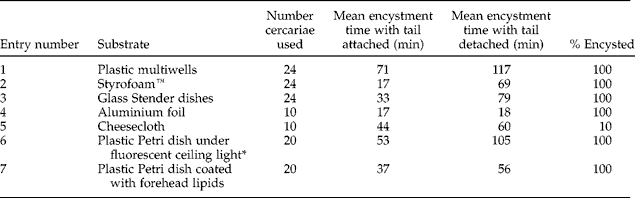
* The plastic Petri dish maintained under a fluorescent ceiling light was studied at 24°C.
With regard to the preference of Z. lunata for live B. glabrata or H. trivolvis snails, Z. lunata encysted either on or close to Helisoma snails in four of five trials. Zygocotyle lunata preferred the empty H. trivolvis shells to B. glabrata shells in all five trials.
Excystment of metacercariae from encystment trials
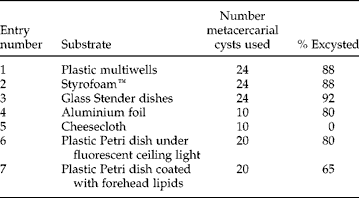
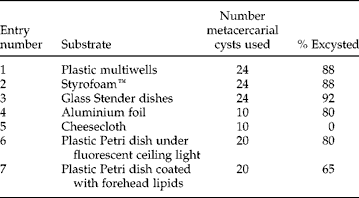
As mentioned earlier, of the substrates tested for cercarial encystment, all but cheesecloth allowed for 100% encystment. The cysts from these trials were excysted chemically and these results are presented in table 2. Saxton et al. (Reference Saxton, Fried and Peoples2008) reported that a normal range of percentage excystment for a Z. lunata cyst is about 60–80%. Percent excystation in the current study ranged from 0% on cheesecloth to 92% on glass Stender dishes. Metacercariae that encysted on plastic multiwells and Styrofoam™ showed 88% excystment, while cysts that had formed on aluminium foil and in the Petri dishes under fluorescent ceiling light showed 80% excystment. Zygocotyle lunata cysts that encysted on live B. glabrata and H. trivolvus snails showed only 40% excystation while cysts from B. glabrata and H. trivolvus shells showed 20%. The Petri dish coated with forehead lipids yielded 65% excystment.
Excystment of Z. lunata metacercarial cysts from encystment studies on various substrates.
Excystment of cysts treated with marinades and exposed to various temperatures
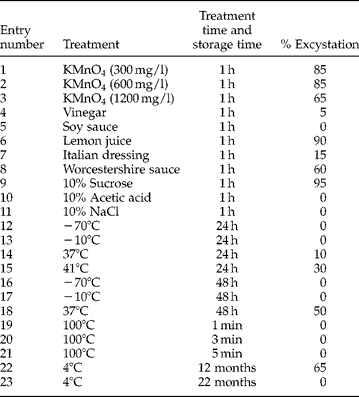
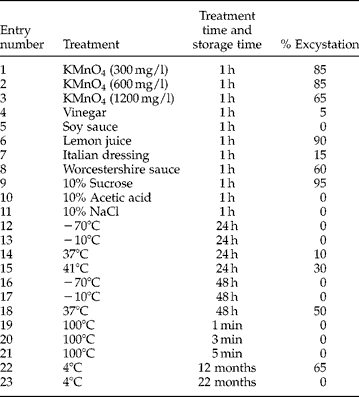
Numerous physical and chemical factors were tested to kill cysts, and their capacity to do so was determined by the subsequent inability of cysts to excyst within a chemical excystment medium. Vinegar, Italian salad dressing, soy sauce, and 10% solutions of sucrose, acetic acid and sodium chloride were the most detrimental, as seen in table 3. Cysts treated with vinegar showed 5% excystment while soy sauce killed all of the treated cysts. Freezing and boiling of cysts also killed them. The time period in which the metacercarial cysts were stored also impacted excystment. Cysts stored for 2 years were not viable, but those stored for 1 year gave 65% excystment. Several marinades, such as lemon juice, sucrose solution, Worcestershire sauce and various concentrations of KMnO4, had little impact on excystment. Those treated with lemon juice showed 90% excystment and cysts treated with sucrose showed 95% excystment, the highest percentage of all cysts chemically or physically treated.
Effects of marinades and temperature on the excystment of Z. lunata metacercarial cysts. In each excystment trial 20 metacercarial cysts were used.
Discussion
Various strengths of KMnO4 killed E. caproni cysts (Peoples & Fried, Reference Peoples and Fried2007), but not F. hepatica cysts (Ashrafi et al., Reference Ashrafi, Valero, Massoud, Sobhani, Solaymani-Mohammadi, Conde, Khoubbane, Bargues and Mas-Coma2006). KMnO4 is used in some parts of the world to kill metacercarial cysts (Ashrafi et al., Reference Ashrafi, Valero, Massoud, Sobhani, Solaymani-Mohammadi, Conde, Khoubbane, Bargues and Mas-Coma2006). Results with Z. lunata were in accord with those on F. hepatica in that KMnO4 treatment was not effective against Z. lunata cysts. As in the E. caproni study, vinegar was cidal to the cysts of Z. lunata. Many marinades did not kill the cysts of Z. lunata, as was the case with E. caproni. Therefore the choice of a marinade will often determine whether that food substance will be cidal to cysts. It should be noted that marinades are used based on what people enjoy rather than their effectiveness in preventing parasitic infection.
The Z. lunata cyst is long lived, as shown by Fried & Wilson (Reference Fried and Wilson1981), and can survive and remain infective in Locke's solution at 4°C for at least 1 year. Observations from the current study indicate that Z. lunata cyst survival is limited to less than 2 years.
Whether texture or colour of substrate is a factor in encystment of Z. lunata is not known. Both Styrofoam™ and aluminium foil elicited rapid encystment of Z. lunata and these substrates differ considerably from each other in both colour and texture. Further studies are needed to determine the factors involved in the choice of encystment surfaces for this paramphistomid.
We are not certain why cheesecloth is an unsuitable medium for encystment of this trematode. The open weave in cheesecloth leaves a number of small holes in this substratum. Perhaps these holes interfere with the ability of the cecaria to encyst on this surface.
Speed of encystment with and without the cercarial tail of Z. lunata has probably added survival value for this trematode. Thus, cysts that form early can conserve energy stores possibly useful for later excystment and infection. A mean encystment time of 17 min with tail attachment on both Styrofoam™ and aluminium foil attests to the rapid encystment of this species on those substrates.
Preference studies for encystment on snail surfaces of both live snails and shells is of interest in that H. trivolvis, an intermediate host of Z. lunata in the USA, is preferred over several species of Biomphalaria. As shown by Ostrowski de Núñez et al. (Reference Ostrowski de Núñez, Spatz and González Cappa2003), certain species of Biomphalaria, but not B. glabrata, are intermediate hosts of Z. lunata. Thus, natural hosts of Z. lunata seem to provide a better surface for encystment than does B. glabrata, which is not a natural intermediate host.
Natural intermediate hosts of Z. lunata provide a good surface for encystment. Yet, in vitro excystment results on cysts obtained from these hosts were not as good in comparison to excystment from other surfaces. Possibly, such well-formed cysts from the snail hosts are more resistant to the artificial conditions of a chemical excystation medium and would show better excystation results if studied in experimental definitive hosts.