Introduction
Adverse childhood experiences (ACEs), such as abuse, neglect, and family problems, are linked to an increased risk of developing depression (Hughes et al., Reference Hughes, Bellis, Hardcastle, Sethi, Butchart, Mikton and Dunne2017), as well as with greater severity of depressive symptoms and worse response to antidepressant treatment (Nanni, Uher, & Danese, Reference Nanni, Uher and Danese2012). ACEs have also been associated with elevated biomarkers of systemic inflammation, such as C-reactive protein (CRP) (Baumeister, Akhtar, Ciufolini, Pariante, & Mondelli, Reference Baumeister, Akhtar, Ciufolini, Pariante and Mondelli2015; Iob, Lacey, & Steptoe, Reference Iob, Lacey and Steptoe2019). In addition, meta-analyses have indicated that depressed individuals tend to exhibit increased levels of inflammation both in the brain and peripherally (Enache, Pariante, & Mondelli, Reference Enache, Pariante and Mondelli2019; Haapakoski, Mathieu, Ebmeier, Alenius, & Kivimäki, Reference Haapakoski, Mathieu, Ebmeier, Alenius and Kivimäki2015). In light of these findings, inflammation has been proposed as a plausible psychobiological mechanism through which stress exposure might be translated into biological risk for depression (Danese & Baldwin, Reference Danese and Baldwin2017).
Different lines of research suggest that both depression and inflammation are influenced by a combination of genetic and environmental risk factors (Bienvenu, Davydow, & Kendler, Reference Bienvenu, Davydow and Kendler2011; de Craen et al., Reference de Craen, Posthuma, Remarque, van den Biggelaar, Westendorp and Boomsma2005). Recently, genome-wide association studies (GWASs) have successfully identified several single-nucleotide polymorphisms (SNPs) that may contribute to the pathophysiology of depression and inflammation (Howard et al., Reference Howard, Adams, Clarke, Hafferty, Gibson, Shirali and McIntosh2019; Ligthart et al., Reference Ligthart, Vaez, Võsa, Stathopoulou, de Vries, Prins and Slagboom2018). However, the effect size of individual genetic variants was considerably lower than initially anticipated in relation to risk prediction. Polygenic scores (PGS), defined as a weighted sum of risk alleles carried by an individual (Euesden, Lewis, & O'Reilly, Reference Euesden, Lewis and O'Reilly2015), arguably provide a better approach to capturing the cumulative genetic contribution to a condition by combining numerous trait-associated genetic variants (Wray et al., Reference Wray, Lee, Mehta, Vinkhuyzen, Dudbridge and Middeldorp2014). Certain individuals seem to be more vulnerable to the negative impact of ACEs owing to their specific genetic makeup (Caspi, Reference Caspi2003). Genetic factors might therefore interact with ACEs to increase the risk of depression and chronic inflammation beyond their combined individual effects. Such gene-environment (G × E) interactions might also underlie the observed ‘hidden heritability’ of mental disorders (Assary, Vincent, Keers, & Pluess, Reference Assary, Vincent, Keers and Pluess2018). Hence, accounting for the interplay between ACEs and genetic factors could help to enhance the prediction of mental health outcomes.
Numerous studies have investigated the interplay between early-life stress and specific genetic variants that have been linked to depression, such as the serotonin transporter polymorphism (5-HTTLPR). However, the results have been largely inconsistent across studies, with meta-analyses providing both support for and against the proposed G × E interactions (Culverhouse et al., Reference Culverhouse, Saccone, Horton, Ma, Anstey, Banaschewski and Bierut2018; Karg, Burmeister, Shedden, & Sen, Reference Karg, Burmeister, Shedden and Sen2011). Importantly, these studies have solely focused on specific genetic variants found in candidate genes involved in the neurobiology of depression, thereby ignoring the highly polygenic nature of complex human traits. Although research regarding the polygenic nature of mental disorders is relatively new, it has already provided some evidence showing larger associations between psychosocial stress and depression among participants with a higher PGS of depression (Colodro-Conde et al., Reference Colodro-Conde, Couvy-Duchesne, Zhu, Coventry, Byrne, Gordon and Martin2018). In contrast, one study found that depressed individuals who were exposed to severe childhood trauma had a lower PGS of depression than other cases or controls (Mullins et al., Reference Mullins, Power, Fisher, Hanscombe, Euesden, Iniesta and Lewis2016). Others have found evidence for additive (i.e. independent) but not interactive associations of ACEs and PGSs with depression (Lehto et al., Reference Lehto, Hägg, Lu, Karlsson, Pedersen and Mosing2020; Peyrot et al., Reference Peyrot, Van der Auwera, Milaneschi, Dolan, Madden, Sullivan and Sullivan2018).
Even though some evidence for a moderating effect of specific genetic variants linked to inflammation in the association of early-life stress with inflammation and depressive symptoms has been documented (Cicchetti, Handley, & Rogosch, Reference Cicchetti, Handley and Rogosch2015; Cohen-Woods et al., Reference Cohen-Woods, Fisher, Ahmetspahic, Douroudis, Stacey, Hosang and McGuffin2018), G × E associations with psychobiological processes linked to depression, including inflammation, remain largely unexplored. There are virtually no studies which have tested the interplay between ACEs and genetic factors using PGSs of inflammation. Another limitation of the literature concerns the measurement of ACEs. The majority of G × E studies have only assessed individual types of adversity separately or used cumulative risk scores, without considering the potentially different psychobiological effects of distinct types of ACEs (McLaughlin & Sheridan, Reference McLaughlin and Sheridan2016). In addition, most analyses are characterised by the use of cross-sectional measures of inflammation and depressive symptoms which do not provide information about their persistence over time. Depression and inflammation are particularly relevant to older adults since advancing age is linked to upregulation of the inflammatory response, greater risk of cognitive and physical impairments, and diminishing social connections (Gallagher, Kiss, Lanctot, & Herrmann, Reference Gallagher, Kiss, Lanctot and Herrmann2017). Consequently, a better understanding of the interplay between genetic and environmental risk factors linked to depression and its underlying biological processes will help to develop more targeted prevention and treatment programmes.
The aim of the present study was to examine the association of different dimensions of ACEs and PGSs of major depressive disorder (MDD) and CRP with trajectories of depressive symptoms and repeated exposure to high CRP levels in later life. In addition, we aimed to establish whether the relationship of ACEs with inflammation and depressive symptoms was larger among individuals at higher polygenic risk. We tested three main hypotheses: (1) G + E Additive Effects – greater exposure to ACEs and higher PGSs of MDD and CRP would be independently associated with elevated depressive symptoms and CRP; (2) G × E Interaction Effects – the association of ACEs with depressive symptoms and CRP would be moderated by the PGSs of MDD and CRP; (3) ACEs dimensions – distinct ACEs dimensions might have different additive and interactive associations with depressive symptoms and CRP.
Methods
Sample
We analysed data from the English longitudinal study of ageing (ELSA). ELSA is a prospective population-based cohort study of older adults aged 50 years and older living in England which began in 2002 (Zaninotto & Steptoe, Reference Zaninotto, Steptoe, Gu and Dupre2019). Retrospective data on ACEs were collected during the Life History interview in the third wave of the study (2006/07). Depressive symptoms were ascertained on eight occasions from wave 1 (2002/03) to wave 8 (2016/17). CRP measurements were made during the nurse visits in waves 2 (2004/05), 4 (2008/09), and 6 (2012/13). Study members with CRP values >10 mg/L were excluded from the study (N wave2 = 459; N wave4 = 444; N wave6 = 342) since this could reflect current infection or trauma rather than chronic inflammation (Pearson et al., Reference Pearson, Mensah, Alexander, Anderson, Cannon, Criqui and Vinicor2003). For the purpose of this analysis, we created two analytical samples. The first sample was comprised of participants with ACEs, genetic, and depression data on at least one occasion (N = 3428). The second sample included participants with measures of ACEs, genetic data, and CRP on at least one occasion (N = 3343).
Measures
Adverse childhood experiences (ACEs)
Data on ACEs came from the Life History interview that was conducted in the third wave of the study (2006/07). The aim of this module was to collect retrospective information about the participants’ early-life experiences and important events that have occurred in their lives. The ELSA's Life History interview has been used in a number of large-scale ageing studies around the world, such as the Survey of Health and Retirement in Europe (SHARE). Several studies have provided evidence on the validity of the retrospective data contained in the Life History interview in ELSA and SHARE, highlighting the quality and value of such data to investigate older adults’ early-life experiences (Banks, Brugiavini, & Pasini, Reference Banks, Brugiavini and Pasini2020). Further, the retrospective data from the ELSA's Life History interview have been validated against prospectively collected data from the National Child Development Study (Jivraj, Goodman, Ploubidis, & de Oliveira, Reference Jivraj, Goodman, Ploubidis and de Oliveira2020). ACEs inventories similar to that included in the ELSA's Life History interview have also been used in the Health and Retirement Study and the Midlife in the US Study, and they have been shown to have good validity in these populations (Crosswell et al., Reference Crosswell, Suresh, Puterman, Gruenewald, Lee and Epel2020; Danielson & Sanders, Reference Danielson and Sanders2018). In ELSA, numerous studies have used the ACEs data included in our analysis in order to assess the associations of ACEs with various adult outcomes, including cancer risk (Demakakos, Chrousos, & Biddulph, Reference Demakakos, Chrousos and Biddulph2018), risk of miscarriage (Demakakos, Linara-Demakakou, & Mishra, Reference Demakakos, Linara-Demakakou and Mishra2020), menopause (Demakakos, Pashayan, Chrousos, Linara-Demakakou, & Mishra, Reference Demakakos, Pashayan, Chrousos, Linara-Demakakou and Mishra2019), mortality risk (Demakakos, Pillas, Marmot, & Steptoe, Reference Demakakos, Pillas, Marmot and Steptoe2016), stress-related biomarkers (Iob et al., Reference Iob, Lacey and Steptoe2019), cognitive decline (O'Shea, Demakakos, Cadar, & Kobayashi, Reference O'Shea, Demakakos, Cadar and Kobayashi2021), and risk of homelessness (Demakakos, Lewer, Jackson, & Hayward, Reference Demakakos, Lewer, Jackson and Hayward2020). Further details about the Life History interview and the specific questions included in the questionnaire can be found in the related User Guide (Ward, Medina, Mo, & Cox, Reference Ward, Medina, Mo and Cox2009).
From the questions available in the Life History interview, we selected those items representing early-life experiences that are likely to require significant adaptation from the developing child, and that might be important in predicting long-term health and well-being outcomes. This process was informed by the definition of ACEs proposed by McLaughlin and colleagues (McLaughlin, Reference McLaughlin2016), and by earlier work in this and other cohorts as outlined above. We considered 12 different types of ACEs experienced up to the age of 16 years, namely: sexual abuse, physical assault, physical abuse from parents, parent arguments, parent mental illness or substance abuse, parent separation or divorce, maternal bonding, paternal bonding, separation from mother for more than six months, parent death, foster care or adoption, and institutionalisation. For all items, except parental bonding, participants reported whether or not they ever experienced that particular event during childhood. Child−parent relationships were assessed using the seven-item Parental Bonding Instrument (PBI) (Parker, Tupling, & Brown, Reference Parker, Tupling and Brown1979). This questionnaire is designed to retrospectively assess adults’ perceptions of their parents’ parenting styles. Total bonding scores were calculated separately for each parent figure and ranged from zero (highest bonding) to seven (lowest bonding). Following the approach used in an earlier ACEs study in the ELSA cohort (Iob et al., Reference Iob, Lacey and Steptoe2019), we derived two binary measures of low maternal/paternal bonding using a total score ⩾3 (i.e. upper quintile). In the analysis, we compared two different ways of operationalising ACEs. First, we created a cumulative risk score indicating the total number of ACEs reported by the participant. Second, we examined the role of distinct dimensions of ACEs, which were identified in our previous dimensional analysis of ACEs in ELSA (Iob et al., Reference Iob, Lacey and Steptoe2019). These were: Threat (sexual abuse, physical assault, physical abuse from parents), Household Dysfunction (parent arguments, parent mental illness or substance abuse, parent separation or divorce), Low Parental Bonding (poor maternal and paternal bonding), and Loss experiences (separation from mother for more than six months, parent death, foster care or adoption, and institutionalisation). Each dimension was indexed by a dichotomous score representing the presence or absence of at least one type of ACE included in that dimension.
Depressive symptoms
Depressive symptoms were assessed on eight occasions using the 8-item Centre for Epidemiological Studies Depression (CESD-8) scale (Radloff, Reference Radloff1977). At each wave, we calculated the total CESD-8 score representing the overall number of depressive symptoms reported by the participant. The CESD-8 is a validated scale for the assessment of depression in large-scale studies, which has been widely employed in studies of late life depression (e.g. White et al., Reference White, Zaninotto, Walters, Kivimäki, Demakakos, Biddulph and Batty2016; Zivin et al., Reference Zivin, Llewellyn, Lang, Vijan, Kabeto, Miller and Langa2010). It also has good psychometric properties for use in these populations (Andresen, Malmgren, Carter, & Patrick, Reference Andresen, Malmgren, Carter and Patrick1994; Karim, Weisz, Bibi, & ur Rehman, Reference Karim, Weisz, Bibi and ur Rehman2015), and comparable psychometric properties to the full 20-item CESD (Radloff, Reference Radloff1977; Turvey, Wallace, & Herzog, Reference Turvey, Wallace and Herzog1999). A cut-off of 3 or more symptoms is typically used to identify cases of depression. This cut-off was validated against standardised psychiatric interviews in older populations (Turvey et al., Reference Turvey, Wallace and Herzog1999). For the purpose of the present analysis, we used the CESD-8 total scores from the eight time points to derive group-based trajectories of depressive symptoms over time (see Statistical Analyses).
C-reactive protein
As detailed elsewhere (Iob, Lacey, & Steptoe, Reference Iob, Lacey and Steptoe2020), blood samples for the assessment of CRP were collected by study nurses from participants in their own homes across the country. After collection, the blood samples were sent to the Department of Clinical Biochemistry at the Royal Victoria Infirmary in Newcastle (UK), and they were frozen for long-term storage. It took up to two days for the samples to reach the laboratory. Nevertheless, previous studies have provided evidence for the stability of CRP concentrations in blood, both when the blood samples are temporarily stored at room temperature (e.g. 48 hours) and when they are frozen for a prolonged time period (e.g. 11 years) (Aziz, Fahey, Detels, & Butch, Reference Aziz, Fahey, Detels and Butch2003; Doumatey, Zhou, Adeyemo, & Rotimi, Reference Doumatey, Zhou, Adeyemo and Rotimi2014; Sugden, Danese, Shalev, Williams, & Caspi, Reference Sugden, Danese, Shalev, Williams and Caspi2015). Plasma concentrations of CRP were assayed using the N Latex CRP mono Immunoassay on the Behring Nephelometer II Analyser. In the analysis, we used two different CRP outcomes: (1) a binary score indicating high CRP levels (i.e. ⩾3 mg/L) (Pearson et al., Reference Pearson, Mensah, Alexander, Anderson, Cannon, Criqui and Vinicor2003) at wave 4 (high CRP w4); (2) an ordinal variable for chronic inflammation representing repeated exposure to high CRP across waves 2, 4, and 6 (i.e. high CRP on zero, one, two, or three occasions) (high CRP w2–6). Due to the limited number of data points available (3 waves) and low between-individuals variation in CRP levels over time, an ordinal variable indicating repeated exposure to high CRP was better suited than group-based trajectories to measure chronic inflammation.
Polygenic scores (PGSs)
PGSs of major depressive disorder (MDD-PGS) and CRP (CRP-PGS) were constructed using summary statistics from large GWAS meta-analyses of MDD (Howard et al., Reference Howard, Adams, Clarke, Hafferty, Gibson, Shirali and McIntosh2019) and CRP (Ligthart et al., Reference Ligthart, Vaez, Võsa, Stathopoulou, de Vries, Prins and Slagboom2018) with PLINK and PRSice software. We used a single p-value threshold of 1 for both PGSs in order to limit multiple testing, while maximising their potential predictive ability (further details in online Supplementary Methods).
Covariates
All statistical analyses were adjusted for covariates selected based on previous studies in the field and through the use of directed acyclic graphs (DAGs; online Supplementary Figs 1–2). These included: sex, age, childhood socioeconomic factors, use of anti-inflammatory or antihypertensive drugs (CRP models), and antidepressants (depression models). In addition, we controlled for population stratification by including five principal components (PCs). The measurement and coding of the covariates are described in the online Supplementary Methods.
Statistical analyses
Group-based trajectories of depressive symptoms were estimated using latent growth mixture (LGM) modelling. Multinomial logistic regression models were then fitted to examine the associations of ACEs and PGSs with the depression trajectories. Logistic regression (high CRP w4) and ordinal logistic regression (high CRP w2–6) analyses were employed to investigate the associations of the risk factors with CRP. For each outcome, we tested two different models: Model 1 – G + E additive effects of ACEs total score/dimensions, MDD-PGS, and CRP-PGS adjusted for all covariates; Model 2 – G × E multiplicative interaction effects of ACEs total score/dimensions with MDD-PGS and CRP-PGS adjusted for all covariates. Missing data on ACEs, outcome variables, and covariates were estimated using multiple imputation by chained equations (MICE) under the missing at random assumption. Further details about the LGM and MICE analyses can be found in the online Supplementary Methods. We carried out several sensitivity analyses to assess the robustness of the results. First, we calculated E-values for all significant associations of ACEs and PGSs. This enabled us to determine the minimum strength of the association on the risk ratio scale that an unmeasured confounder should have with both the exposure and the outcome to fully explain their relationship (VanderWeele & Ding, Reference VanderWeele and Ding2017). Second, we estimated all associations tested in the main analysis without adjustment for antidepressants and CRP-related medications to understand the influence of these variables. Third, we calculated interaction effects between ACEs and PGSs on the additive scale to measure the extent to which the effect of the two risk factors together exceeded the effect of each factor considered individually (VanderWeele & Knol, Reference VanderWeele and Knol2014). Fourth, we reran all models presented in the main imputed data analysis using the samples of participants with complete data on all variables. Fifth, we examined differences in the characteristics of ELSA participants included in the analytical samples v. those excluded owing to attrition and/or nonresponse, as well as differences between the participants of the analytical samples with and without missing data on key variables. Lastly, in line with recent recommendations for best practices in the analysis of inflammatory biomarkers, we assessed if the associations of ACEs and PGSs with CRP differed according to whether CRP values > 10 mg/L were excluded or included in the analysis (Mac Giollabhui et al., Reference Mac Giollabhui, Ellman, Coe, Byrne, Abramson and Alloy2020). Data management, MICE, and regression analyses were performed in Rstudio 3.4.4. LGM modelling was conducted in Mplus 7. Additive interaction effects were estimated using STATA 16.
Results
Descriptive statistics
The characteristics of the study participants in the observed and imputed data are provided in online Supplementary Table 1. The average age was 70 years (55% female). There was a higher proportion of participants in the highest compared with the lowest wealth quintiles. Nevertheless, people from lower socioeconomic backgrounds were well represented in the sample; the poorest wealth groups (i.e. 1st and 2nd quintile) included 33% of the participants, and 44% of the sample had experienced at least one type of socioeconomic adversity during childhood. The mean number of depressive symptoms in the sample was generally low at all waves but ranged across the full spectrum from zero to eight. At wave 6, 19% of men and 31% of women had clinically significant depressive symptoms (CESD-8 score ⩾3) or were taking antidepressants. This is consistent with the estimated prevalence of depression among older adults in the UK (i.e. 22% in men and 28% in women) (Royal College of Psychiatrists, 2018). 28% of the sample had high CRP levels (i.e. ⩾3 mg/L) at wave 4, and 12% of the sample had high CRP levels at all three waves. Regarding the prevalence of ACEs, around 50% of the sample had at least one ACE, 24% reported one ACE, 13% reported two ACEs, 8% reported three ACEs, and another 6% reported four or more ACEs. The prevalence of the cumulative ACEs score and of individual adversities in the sample (both reported in online Supplementary Table 1) was broadly similar to that found in other representative samples of adults living in England (Hughes, Ford, Kadel, Sharp, & Bellis, Reference Hughes, Ford, Kadel, Sharp and Bellis2020). The prevalence of certain individual adversities was lower in our sample than in the original ACEs study based at Kaiser Permanente's Health Appraisal Clinic in San Diego (Felitti et al., Reference Felitti, Anda, Nordenberg, Williamson, Spitz, Edwards and Marks1998), but both studies show a similar cumulative prevalence of ACEs (e.g. in the Kaiser Permanente ACEs study, 52% of the respondents experienced at least one ACE, and 6.2% experienced four or more ACEs). The observed and imputed values were similar, indicating that the multiple imputation of missing values was conducted appropriately. The MDD and CRP PGSs were not significantly correlated in either analytical sample (Depression sample: r = −0.021, p = 0.213; CRP sample: r = −0.021, p = 0.202).
Depressive symptoms: G + E additive and G × E multiplicative interaction effects of ACEs and PGSs
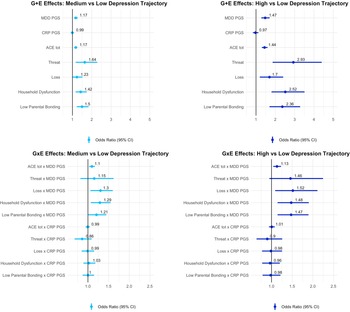
Three depressive-symptom trajectories were identified (see online Supplementary Methods). The mean estimated trajectory for each class is illustrated in Fig. 1. The G + E additive and G × E multiplicative interaction effects of ACEs and PGSs on the depressive-symptom trajectories are illustrated in Fig. 2 and reported in online Supplementary Table 2. The adjusted odds ratios (ORs) represent the Moderate or High depressive-symptom trajectory compared with the Low trajectory. In relation to the G + E additive effects, MDD-PGS was positively associated with the Moderate and High depression trajectories [ORModerateTrajectory = 1.17 (1.08–1.27); ORHighTrajectory = 1.47 (1.28–1.70)], independently of ACEs, CRP-PGS, and other covariates. CRP-PGS was not associated with depressive symptoms. The ACEs total score was positively associated with the Moderate and High depressive-symptom trajectories independently of PGSs and other covariates [ORModerateTrajectory = 1.17 (1.09–1.25); ORHighTrajectory = 1.44 (1.30–1.60)]. All ACEs dimensions were positively related to depressive symptoms. The G × E models revealed positive multiplicative interaction effects of MDD-PGS with the ACEs total score and with each ACEs dimension on both Moderate and High depressive-symptom trajectories, although the interaction with Threat was not significant. G × E multiplicative interactions between CRP-PGS and ACEs were smaller and not significantly related to depression (Figs 2 and 3a; online Supplementary Table 2 for full statistical results).
Estimated trajectories of depressive symptoms (w1–8) from a 3-class solution.
Note. The low depressive-symptom trajectory included individuals with almost zero depressive symptoms at all waves [1558 individuals (45.5%)]. The moderate depressive-symptom trajectory represented participants who consistently reported between 1 and 2 depressive symptoms [1550 individuals (45.2%)]. The high depressive-symptom trajectory included individuals with persistently high depressive symptoms (4+ symptoms) [320 individuals (9%)].

G + E Additive and G × E interaction effects of ACEs and PGSs on depression trajectories.
Note. Sample = ELSA, w1–w8 (N = 3428). Pooled estimates across 20 imputed datasets from latent class growth mixture modelling with multinomial logistic regression analysis. The ORs represent the moderate or high depression trajectory compared with the low trajectory. Associations adjusted for sex, age, childhood socioeconomic position, use of antidepressant medications, and five principal components of population stratification. ACEs = adverse childhood experiences; PGSs = polygenic scores; CRP = C-reactive protein; MDD = major depressive disorder.

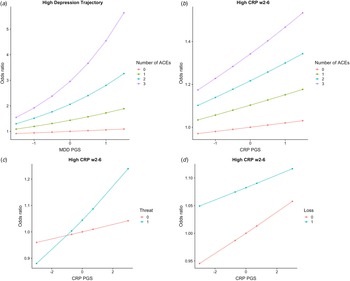
Interaction effects between ACEs and PGSs on high depressive symptoms and high CRP w2–6.
Note. The ORs represent the likelihood of high depression symptoms (w1–8) and repeated exposure to high CRP levels (⩾3 mg/L). Interactions adjusted for sex, age, childhood socioeconomic position, use of antidepressants (depression), anti-inflammatory/antihypertensive medications (CRP), and five principal components of population stratification. ACEs = adverse childhood experiences; PGSs = polygenic scores; CRP = C-reactive protein; MDD = major depressive disorder.

CRP: G + E additive and G × E multiplicative interaction effects of ACEs and PGSs
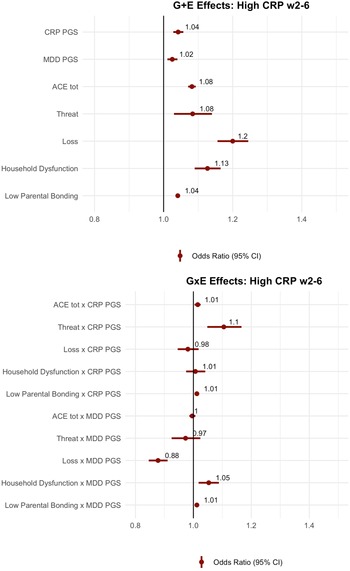
The G + E additive and G × E multiplicative interaction effects of ACEs and PGSs on repeated exposure to high CRP across waves 2, 4, and 6 are illustrated in Fig. 4 and reported in online Supplementary Table 3. The adjusted ORs represent the likelihood of high CRP levels. In the G + E models, CRP-PGS was positively associated with the risk of repeated exposure to high CRP w2–6 [OR 1.04 (1.03–1.06)], independently of ACEs, MDD-PGS, and other covariates. MDD-PGS was also positively associated with CRP [OR 1.03 (1.01–1.04)]. The ACEs total score was positively related to CRP independently of PGSs and other covariates [OR 1.08 (1.07–1.09)]. All ACEs dimensions were associated with increased CRP levels.
G + E additive and G × E interaction effects of ACEs and PGSs on repeated exposure to high CRP w2–6.
Note. Sample = ELSA, w2–w8 (N = 3343). Pooled estimates across 20 imputed datasets from ordinal logistic regression analysis. The ORs represent the likelihood of repeated exposure to high CRP (⩾3 mg/L) across waves 2, 4, and 6. Associations adjusted for sex, age, childhood socioeconomic position, use of anti-inflammatory/antihypertensive medications, and five principal components of population stratification. ACEs = adverse childhood experiences; PGSs = polygenic scores; CRP = C-reactive protein; MDD = major depressive disorder.

The G × E multiplicative models indicated positive multiplicative interaction effects between the ACEs total score and CRP-PGS on repeated exposure to high CRP [OR 1.02 (1.01–1.03)] (Figs 3b and 4). Threat exhibited the largest interactions with CRP-PGS [OR 1.11 (1.05–1.17)] (Fig. 3c). Interaction effects of Loss (Fig. 3d) and Household Dysfunction with CRP-PGS were smaller and nonsignificant. For the G × E effects involving MDD-PGS, we found opposite associations among different ACEs dimensions. Specifically, there was a positive interaction with Low Parental Bonding [OR 1.01 (1.01–1.02)] and Household Dysfunction on high CRP w2–6 [OR 1.05 (1.02–1.09)]. In contrast, the interaction effect with Loss was negatively related to CRP [OR 0.88 (0.85–0.91)]. Lastly, we tested G + E additive and G × E interactive associations of ACEs and PGSs with high CRP at wave 4, which revealed very similar results (online Supplementary Table 3 for full statistical results).
Effect sizes and predicted probabilities
To better understand the substantive significance of the results, we also calculated the effect size of the ORs (Chinn, Reference Chinn2000) and the predicted probabilities of the outcomes according to different values of the risk factors. For depressive symptoms, the effect size of the associations with ACEs and MDD-PGS ranged from small to moderate (moderate depression trajectory: 0.04–0.12; high depression trajectory: 0.09–0.26). The ACEs cumulative score and MDD-PGS had a similar association with depressive symptoms. However, the magnitude of the association with ACEs was more than twice as large as that with MDD-PGS when considering specific ACEs dimensions, such as Threat and Household Dysfunction (online Supplementary Table 2). The predicted probabilities further showed that, when MDD-PGS increased from low (10th percentile) to high (90th percentile), the probability of high depressive symptoms increased by 4 percentage points in men and 11 percentage points in women. In addition, when the ACEs total score increased from 0 to 4 ACEs, the probability of high depressive symptoms increased by 10 percentage points in men and 23 percentage points in women. But the largest increase in the probability of high depressive symptoms was found when accounting for the interaction between ACEs and MDD-PGS. Compared with an individual who had low MDD-PGS and 0 ACEs, the probability of high depressive symptoms for an individual with high MDD-PGS and 4 ACEs was 23 percentage points higher in men and 44 percentage points higher in women (online Supplementary Table 4). Regarding CRP, the effect size of the associations of ACEs and PGSs with repeated exposure to high CRP levels was very small (0.01–0.04) (online Supplementary Table 3). This was also mirrored by the predicted probabilities. For both women and men, the probability of high CRP levels only increased by 2 percentage points when CRP-PGS increased from low to high, and by 4 percentage points when the total number of ACEs increased from 0 to 4. The interaction between ACEs and CRP-PGS had little impact on the risk of high CRP levels. For instance, the probability of high CRP levels for an individual with high CRP-PGS and one or more adversities related to Threat was 14 percentage points higher in men and 12 percentage points higher in women, compared with an individual who had low CRP-PGS and no Threat experiences. The increase in the predicted probability of high CRP was even lower when considering the interaction with the cumulative ACEs score (5% in men and 6% in women) (online Supplementary Table 4).
Sensitivity analyses
The additive interaction effects (online Supplementary Table 6) mirrored those found in the multiplicative interaction analysis (online Supplementary Tables 2 and 3). In addition, we found a positive additive interaction effect between cumulative exposure to ACEs and CRP-PGS on high depressive symptoms, which was not present on the multiplicative scale. The results of the other sensitivity analyses were also broadly consistent with those of the main imputed data analysis (see online Supplementary Results for further details).
Discussion
To our knowledge this is the first study to assess the additive and interactive associations of ACEs and PGSs of MDD and CRP with trajectories of depressive symptoms and repeated exposure to high CRP over a 14-year period in a large population-based sample of older adults. Our analysis revealed several important findings. First, all types of ACEs and MDD polygenic risk were both associated with elevated trajectories of depressive symptoms and increased CRP levels, whereas CRP polygenic risk was only related to CRP. Second, G × E analyses provided evidence for the interplay between ACEs and genetic vulnerability in line with the diathesis-stress model. In particular, the association between cumulative exposure to ACEs and elevated depressive symptoms was larger among participants at higher MDD polygenic risk, with similar interactions across all ACEs dimensions. ACEs cumulative exposure was also more strongly related to CRP in participants at higher CRP polygenic risk. However, these G × E interactions on CRP differed across distinct ACEs dimensions (see ‘Findings regarding CRP’).
Findings regarding depressive symptoms
Depression polygenic risk and cumulative exposure to ACEs were both associated with moderate and high trajectories of depressive symptoms in later life. These results are consistent with previous studies showing that PGSs of MDD were associated with depressive symptoms and clinical diagnosis of depression in young people and adults (Halldorsdottir et al., Reference Halldorsdottir, Piechaczek, Paula Soares de Matos, Czamara, Pehl, Wagenbuechler and Binder2019; Milaneschi et al., Reference Milaneschi, Lamers, Peyrot, Abdellaoui, Willemsen, Hottenga and Penninx2016). Likewise, several studies have suggested that early-life stress may increase the risk of depression during adulthood (Hughes et al., Reference Hughes, Bellis, Hardcastle, Sethi, Butchart, Mikton and Dunne2017). Our analysis extends this body of evidence by showing that both ACEs and MDD-PGS were independently related to individual differences in depressive symptoms and their persistence over time. The results further demonstrated that the interaction between ACEs and MDD-PGS (both on the multiplicative and additive scale) was predictive of moderate and high depressive-symptom trajectories, with similar G × E effects for all ACEs dimensions. Hence, the relationship of ACEs with persistently high levels of depressive symptoms was stronger in people with a high genetic vulnerability for depression. The effect size of the associations of ACEs and MDD-PGS with depressive symptoms ranged from small to moderate. But the interaction between these two risk factors had a substantial impact on the risk of depression (23–43% increased risk). These findings are particularly important to better understand the mechanisms underlying the aetiology of depression. Specifically, they suggest that the role of ACEs in the development of depression might differ according to the individual's genetic makeup, and that people with ACEs and a high genetic predisposition could be at greatest risk of developing depression. Previous studies examining the interplay between depression PGSs and stress exposure have been inconclusive. A number of studies reported positive or negative interaction effects (Colodro-Conde et al., Reference Colodro-Conde, Couvy-Duchesne, Zhu, Coventry, Byrne, Gordon and Martin2018; Mullins et al., Reference Mullins, Power, Fisher, Hanscombe, Euesden, Iniesta and Lewis2016). Others found evidence for additive but not interactive effects (Lehto et al., Reference Lehto, Hägg, Lu, Karlsson, Pedersen and Mosing2020; Peyrot et al., Reference Peyrot, Van der Auwera, Milaneschi, Dolan, Madden, Sullivan and Sullivan2018), which would suggest that ACEs and polygenic risk are two independent risk factors for depression. Possible reasons for these discrepant results could lie in the use of GWASs with low statistical power or in the measurement of stress exposure. In contrast with observational evidence indicating that elevated inflammation may contribute to the pathogenesis of depression (Haapakoski et al., Reference Haapakoski, Mathieu, Ebmeier, Alenius and Kivimäki2015), our results did not provide support for the independent or multiplicative interactive associations of CRP polygenic risk with depressive symptoms. However, our sensitivity analysis revealed a positive interaction effect on the additive scale between CRP-PGS and cumulative exposure to ACEs on depressive symptoms. The latter suggests that polygenic susceptibility to inflammation might increase the risk of depression only among participants with ACEs.
Findings regarding CRP
Our study is the first to investigate interaction effects between ACEs and PGSs of CRP and MDD on systemic levels of CRP. The results presented here indicated that both PGSs independently predicted elevated CRP levels. This result is in line with observational evidence suggesting that the relationship between inflammation and depression might be bidirectional (Lamers et al., Reference Lamers, Milaneschi, Smit, Schoevers, Wittenberg and Penninx2019). ACEs were related to increased CRP levels independently of PGSs. This provides further support for the long-term association of early-life stress with elevated inflammation in adults (Baumeister et al., Reference Baumeister, Akhtar, Ciufolini, Pariante and Mondelli2015). Earlier G × E analyses of inflammation showed that the interaction of specific genetic variants linked to CRP with childhood maltreatment was related to increased CRP concentrations (Cicchetti et al., Reference Cicchetti, Handley and Rogosch2015). In our study, CRP polygenic risk interacted with ACEs cumulative exposure to increase the likelihood of elevated CRP levels. The interaction of ACEs cumulative exposure with MDD-PGS was unrelated to CRP. However, we found differential associations among distinct dimensions of ACEs. For instance, Threat was more strongly associated with inflammation among participants with higher CRP PGS. In contrast, Loss predicted increased CRP levels regardless of the individual's genetic vulnerability to inflammation or even when genetic vulnerability to MDD was low. Similar interaction effects were also present on the additive scale. Thus, certain types of ACEs such as Loss experiences might be linked to inflammation regardless of the individual's genetic vulnerability. This finding is consistent with previous work in this and other cohorts highlighting the importance of parental loss for chronic inflammation (Iob et al., Reference Iob, Lacey and Steptoe2019; Lacey, Pinto Pereira, Li, & Danese, Reference Lacey, Pinto Pereira, Li and Danese2020). However, it is important to note that the effect size of the associations of ACEs and PGSs with CRP levels was only small, and the interaction between CRP-PGS and ACEs had little impact on the risk of high CRP levels. This suggests that the clinical significance of the findings regarding CRP could be limited.
Strengths and limitations
This study benefitted from its use of a large, nationally representative sample of older adults, PGSs of CRP and MDD calculated using large GWAS meta-analyses, repeated measures of depressive symptoms and inflammation, and interaction effects examined on both multiplicative and additive scales. However, ACEs were assessed through a retrospective self-report questionnaire and might be prone to measurement error arising from the participants’ motivations, personality styles, cognitive function, and memory biases. Nevertheless, it has been shown that prospectively and retrospectively collected childhood exposures tend to have similar associations with wellbeing outcomes in adulthood (Jivraj et al., Reference Jivraj, Goodman, Ploubidis and de Oliveira2020). Another limitation concerns the use of a single biomarker of inflammation, although research points to the importance of other inflammatory markers such as interleukins and tumour necrosis factors (Cohen-Woods et al., Reference Cohen-Woods, Fisher, Ahmetspahic, Douroudis, Stacey, Hosang and McGuffin2018). It should also be noted that the CESD-8 does not cover all symptoms included in the diagnostic criteria for MDD set out in the Diagnostic and Statistical Manual of Mental Disorders, Fifth Edition (DSM-5) (e.g. suicidality, changes in appetite or weight) (American Psychiatric Association, 2013). Further, the results presented here are only characterising the older population of England and cannot be directly generalised to other cultures or age groups. Indeed, the epidemiology of depression has been shown to vary across different cultures and stages of the life course (Kessler & Bromet, Reference Kessler and Bromet2013). Lastly, although we controlled for key confounders, causality cannot be assumed since the study is observational. Larger studies testing interactions between ACEs and PGSs in both clinical and population-based samples are needed to strengthen the evidence for the interplay between early-life stress and genetic factors. Future G × E studies should also consider genetic variants associated with other inflammatory markers (Ruotsalainen et al., Reference Ruotsalainen, Partanen, Cichonska, Lin, Benner, Surakka and Koskela2020), assess whether similar results are obtained across different methods and scales to assess ACEs and depressive symptoms, and replicate this analysis in different countries and age groups (e.g. children, young adults). Another important direction for future research is to test whether the interaction between ACEs and genetic factors could predict the direction of the association between CRP and depression.
Conclusion
Taken together, our study supports the notion that exposure to severe stress during childhood and genetic liability are both important risk factors for persistently elevated depressive symptoms and chronic systemic inflammation in later life. Moreover, the results indicated that the combined effect of ACEs and polygenic susceptibility might increase the risk of depression and inflammation beyond the individual effects of these risk factors. Notably, G × E interactions might characterise an important aetiological dimension of depression and chronic inflammation that is associated with differential response to antidepressant medication and psychological therapy. Hence, it is important to assess both ACEs and polygenic risk in order to identify at-risk individuals and design more targeted prevention programmes and personalised treatment approaches based on the individual's characteristics and needs.
Supplementary material
The supplementary material for this article can be found at https://doi.org/10.1017/S0033291721003007
Financial support
Eleonora Iob is funded by the ESRC-BBSRC Soc-B Centre for Doctoral Training (ES/P000347/1). Olesya Ajnakina is jointly funded by the National Institute on Aging and the National Institute for Health Research (NIHR) (NIHR Post-Doctoral Fellowship - PDF-2018-11-ST2-020). The ELSA was developed by a team of researchers based at University College London, NatCen Social Research, the Institute for Fiscal Studies, and the University of Manchester. The data were collected by NatCen Social Research. The funding is provided by the National Institute of Aging (R01AG017644) and a consortium of UK government departments coordinated by the Economic and Social Research Council. The developers and funders of the ELSA and the UK Data Archive do not bear any responsibility for the analyses or interpretations presented here.
Author contributions
All authors contributed significantly to the conception, design, analysis or interpretation of the data and were involved in revising it critically for intellectual context. The final submission of this paper was approved by all authors.
Conflict of interest
None of the authors has any conflict of interest to declare related to the findings of this study.