

Introduction
Students with special needs are being increasingly included in mainstream school settings in Australia (Berlach & Chambers, Reference Berlach and Chambers2010). This inclusion involves both primary and secondary settings. Students who transition between the two settings will experience similar issues as students without disabilities (Forgan & Vaughn, Reference Forgan and Vaughn2000), but for many this time is even more traumatic (Jindal-Snape, Douglas, Topping, Kerr, & Smith, Reference Jindal-Snape, Douglas, Topping, Kerr and Smith2006; Nash & Henderson, Reference Nash and Henderson2010). Alongside the increased inclusion of students with special needs, technology is being used to a greater extent to support these students (Phelps, Graham, & Watts, Reference Phelps, Graham and Watts2011). Technology has the potential to not only assist in the delivery of, and access to, the general curriculum, but may be used as a tool to support students in managing transitions.
An upcoming change in the structure of schooling in Western Australia has prompted schools to consider their transition programs for all students. By 2015, all Year 7 students in the government school sector, who were previously educated in a primary setting, will be moving to middle school/secondary school settings (Department of Education Western Australia, 2012). This change means that students will be making the transition to secondary school at a younger age than has traditionally been the case. The impetus for this restructure is to align with the arrangement present in other Australian states. The independent and Catholic systems initiated this move some time ago, but it will be a significant restructure for the much larger and diverse government sector (Department of Education Western Australia, 2012). As the majority of students with special needs are educated in the government sector, they will also be impacted by this move. With this upcoming change in mind, the authors set about determining a means of providing support using current technology for students with special needs, both before and during the transition process.
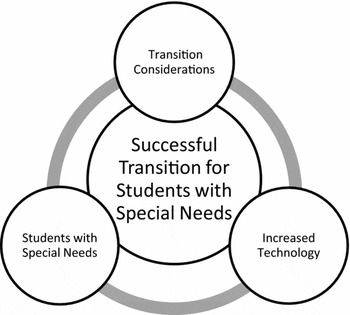
The conceptual framework for this project (see Figure 1) includes an examination of commonly understood transition considerations, the requirements of students with special needs, and the increasing proliferation of technology. Together these provide useful guidelines and potential structures to support successful transition practices for students with special needs. Each of these key areas will be examined further.
Conceptual Framework.

Transition Considerations
Studies of student transition from primary to secondary school have typically been framed around the issue of promoting and maintaining school engagement during the significant early adolescent years (Midgley & Edelin, Reference Midgley and Edelin1998; Roeser, Eccles, & Sameroff, Reference Roeser, Eccles and Sameroff2000). It is important that the academic, social and emotional wellbeing of these students should be at the forefront of transition planning as declines in these areas have been noted by numerous researchers (Dinham & Rowe, Reference Dinham and Rowe2008; Letrello & Miles, Reference Letrello and Miles2003; Midgley & Edelin, Reference Midgley and Edelin1998; Reddy, Rhodes, & Mulhall, Reference Reddy, Rhodes and Mulhall2003; Roeser & Eccles, Reference Roeser and Eccles1998; Roeser, Eccles, & Sameroff, Reference Roeser, Eccles and Sameroff2000). Although for many students the transition from primary to secondary school is straightforward, for others, this move can be problematic and challenge the capacity of some students to negotiate this change. This challenge can then lead to a decline in self-esteem and academic underachievement (Ashton, Reference Ashton2008; Letrello & Miles, Reference Letrello and Miles2003). Students with special needs may be among those who experience additional difficulties in making this transition and may be adversely affected as a result (Jindal-Snape et al., Reference Jindal-Snape, Douglas, Topping, Kerr and Smith2006: Nash & Henderson, Reference Nash and Henderson2010).
Education systems around the world vary markedly, but despite this, remarkable similarity in the features of transition has been noted (Humphrey & Ainscow, Reference Humphrey and Ainscow2006). Transition is widely regarded as a key rite of passage. The differences in the cultures of primary and secondary schools are central to many of the issues with which the students struggle (Ganeson, Reference Ganeson2006). Students are required to move from a familiar setting, where they are likely to spend their time predominantly with a small group of familiar peers and adults, including teachers, administrators and educational assistants, to something vastly different. By its very nature, the secondary school environment is inherently larger (both from the perspective of buildings and school population). It is an unfamiliar environment attended by students from a much wider catchment area (Chedzoy & Burden, Reference Chedzoy and Burden2005; Tobbell, Reference Tobbell2003). This new environment requires many new relationships to be formed. During the course of the school day, students may be required to move from one classroom to another, one subject to another, and be taught by a range of ‘specialist’ teachers. In each class a student may be accompanied by a different group of peers. This new environment may be exceedingly difficult for some students to adjust to, particularly those who have difficulties with organisation and structure (Nash & Henderson, Reference Nash and Henderson2010; Wedell, Reference Wedell2004). It is hardly surprising that students report feeling lost and detached from their new school during the first few months in the different setting (Chedzoy & Burden, Reference Chedzoy and Burden2005; Dinham & Rowe, Reference Dinham and Rowe2008).
It is apparent that the different environment presented by the secondary school necessitates that students with special needs learn in, and become acclimatised to, a very different school culture (Johnstone, Reference Johnstone2001; Pratt & George, Reference Pratt and George2005). They are required to adapt to a range of different teachers, each perhaps with a unique teaching style and different expectations. Students are likely to encounter new subjects not previously studied that require higher order language, literacy and numeracy skills. More sophisticated organisational skills are required in order to manage the many tasks demanded by the secondary school curriculum (Elias, Reference Elias2002; Tobbell, Reference Tobbell2003), an area in which students with special needs often have difficulty (Abikoff et al., Reference Abikoff, Gallagher, Wells, Murray, Huang, Lu and Petkova2013; Cahill, Reference Cahill2008). This difficulty is compounded by the fact that, whereas in primary school they typically had all of their books and other items located in a desk in one room, they may now need to manage a locker and ensure that they have the correct materials for each of their different classes. Higher order time-management skills are required to manage the level of homework and assignments given by various teachers (Dinham & Rowe, Reference Dinham and Rowe2008).
Relationships are a key feature of transition, and making new friends at a new school is frequently cited by students as an area of concern prior to moving (Coffey, Berlach, & O'Neill, Reference Coffey, Berlach and O'Neill2011). Students do not learn in isolation, but rather in a classroom with a teacher and their peers (Ryan & Patrick, Reference Ryan and Patrick2001), and adolescents place great emphasis on these peer relationships (Longaretti, Reference Longaretti2006). The social system of the primary school classroom could be construed as restrictive in terms of a lack of opportunity it presents for students to escape unwanted attention from particular cliques, but it can provide a great deal of security for the students (Pratt & George, Reference Pratt and George2005). The teacher plays a key role in creating a safe and supportive learning environment to assist students with fostering new relationships.
Teachers play a critical role in ensuring that students adjust to their new secondary school environment and successfully meet all of the challenges along the way (Hinebauch, Reference Hinebauch2002; Reddy et al., Reference Reddy, Rhodes and Mulhall2003; Roeser & Eccles, Reference Roeser and Eccles1998; Zimmerman & Arunkumar, Reference Zimmerman and Arunkumar1994). Characteristics generally associated with teacher support include being caring, friendly, understanding and dependable (Ryan & Patrick, Reference Ryan and Patrick2001). By developing classrooms that foster relationship building between students, establishing clear guidelines for behaviour, encouraging cooperation and utilising the students’ strengths, teachers can create a classroom environment conducive to learning and social interaction (Jennings & Greenburg, Reference Jennings and Greenberg2009).
Students With Special Needs
Clearly, the transition from primary to secondary school represents a significant time in the lives of young people. This is no less the case for students with special needs who are also required to negotiate the sometimes difficult move from the more sheltered environment of the primary school to the large and unfamiliar secondary school campus. The impact of transition on students with special needs, however, appears to have been researched to a lesser degree. With the increasing move toward inclusive education, schools need to carefully consider how the transition of all students will be best managed to ensure access and equity for all students (Forlin, Reference Forlin and Forlin2012).
Research indicates that students with special needs experience similar issues during the process of transition to those without special needs (Maras & Aveling, Reference Maras and Aveling2006). The challenges, though, can be magnified for students with special needs (Jindal-Snape et al., Reference Jindal-Snape, Douglas, Topping, Kerr and Smith2006; Maras & Aveling, Reference Maras and Aveling2006; Nash & Henderson, Reference Nash and Henderson2010). Alternative approaches to dealing with the issues may be required, as different special needs may result in different stressors being more conspicuous at particular points during transition. For example, students with severe disabilities, who often have deficits in social skills, may experience a sense of isolation at their new school in contrast to the sense of belonging they felt at their primary school (Carter, Clark, Cushing, & Kennedy, Reference Carter, Clark, Cushing and Kennedy2005). The sense of isolation can be exacerbated at secondary school when the students’ general education peers become more preoccupied with fitting in with their peer group and become less inclined to befriend students with special needs. It should be noted, nonetheless, that although students with special needs may find transition daunting, research found that this is not always the case, and students may equally be excited at the prospect of moving to secondary school (Maras & Aveling, Reference Maras and Aveling2006).
Letrello and Miles (Reference Letrello and Miles2003) indicate that both students with and without special needs approach the move to secondary school with a degree of trepidation. Of particular concern is the size of the school, the presence of older students, finding their way to class and not having sufficient friends. They also found that students indicated that they were enjoying more freedom and had greater access to extracurricular activities, although the rate of participation by students with special needs in these activities was lower. Similarly, Forgan and Vaughn (Reference Forgan and Vaughn2000) found that there were no differences in the manner in which both groups of students viewed the move to secondary school and cited greater independence, changing classes, and meeting new friends as advantages of secondary school. In addition, both groups of students also cited similar reasons for disliking secondary school. These reasons included the increased academic competition at secondary school, feeling victimised by other students and the perception that their teachers cared less for them as people.
Students with special needs who struggle to adapt to their new school may manifest this frustration with inappropriate behaviour, detachment from the new environment, or chronic illness (Maras & Aveling, Reference Maras and Aveling2006). For young people with autism spectrum disorder (ASD), transition may be especially difficult, as adapting to new and unfamiliar environments is a unique feature of ASD. In their study of the transition of students with ASD from primary to secondary school, Jindal-Snape et al. (Reference Jindal-Snape, Douglas, Topping, Kerr and Smith2006) noted that there were many possible supports that could be put in place to ease the transition for these students, but in the majority of cases these arrangements were not followed through. The authors also found that the children were positive about transition and wanted to be meaningfully included in school activities.
Supporting students in their move from primary to secondary school is a particularly important role for school personnel. Given the range of students with special needs who require consideration, it is important that thought be given to the type of supports that can be instituted. It cannot be assumed that the same supports will suit all students with special needs (Maras & Aveling, Reference Maras and Aveling2006). Although some students will adapt alongside their peers without special needs, others will require greater structure in the support provided. Communication between the schools (primary and secondary) and the family is central to successful transition (Carter et al., Reference Carter, Clark, Cushing and Kennedy2005; Maras & Aveling, Reference Maras and Aveling2006). Planning should commence early and support should be continued well after the first day at the new school. The earlier that the students can be prepared for the move, the more likely it is that they will approach the transition with excitement.
It is important that organisational issues are addressed, as these are frequently central to the problems encountered during transition (Akos, Reference Akos2002). Peer support programs, where older students assist their younger counterparts in adapting to the new secondary school, can assist in this regard. Older students can frequently be a source of knowledge, experience and support that helps the transitioning students develop the higher order organisational skills required in secondary school (Coffey et al., Reference Coffey, Berlach and O'Neill2011). Involving students in planning for transition is an important element in augmenting their capacity for self-determination. Shogren et al. (Reference Shogren, Wehmeyer, Palmer, Soukup, Little, Garner and Lawrence2007) showed that student self-determination contributes to a student's knowledge and skills about transition planning. Maras and Aveling (Reference Maras and Aveling2006) recommended that the provision of a special area or private space for the students can reassure both parents and the students that there is a safe haven at the new school, even if it is not accessed. Merlone and Moran (Reference Merlone and Moran2008) report that demystification can be an important tool in overcoming deficits in self-concept and self-efficacy that may impact upon students with learning disabilities. Demystification involves educators working with individual students or small groups to help them develop an understanding of their strengths and weaknesses and how their school or teacher can support them.
Increased Technology
The increasing availability and use of technology in society has led to a number of changes in the way that information can be accessed and manipulated by users (Neyland, Reference Neyland2011). When appropriately supported, students with special needs have many new opportunities to communicate, learn and socialise through the proliferation of such tools as Web 2.0 technologies, portable computers and tablet devices (Martínez, Reference Martínez2011). As technology is now being used for a wide range of purposes, it can also be a potential tool in supporting the transition of students with special needs from primary to secondary settings. Although research has been undertaken in regard to technology and the transition to postsecondary or postschool options (Mull & Sitlington, Reference Mull and Sitlington2003; Wehmeyer et al., Reference Wehmeyer, Palmer, Williams-Diehm, Shogren, Davies and Stock2011), there is little evidence that technology has, or could, be used to support the transition from primary to secondary settings for students with special needs.
Among the many forms of technology available, one that may be of most benefit to school users is that of a mobile-optimised website. A mobile-optimised website caters for users on different electronic platforms, for example, a computer, smart phone, or tablet device, such as an iPad®. When designing a mobile-optimised website, the developer needs to ‘. . . accommodate[e] differing screen-widths, browsers, and processing speeds’ (Ryan, Reference Ryan2011, p. 128). This type of website would allow schools and parents to access the information on any technology available to them, making it more applicable to a wide range of potential users. There is a distinct lack of uniformity in schools in Western Australia in regard to the types of technologies that students have access to or use (i.e., mobile digital devices, such as tablets, laptops, digital audio players, and desktop computers). Limiting the accessibility of the tool to only one type of device would prohibit its use in a broad fashion.
The authors have therefore adopted the mobile-optimised website technology to develop a tool that will be able to be accessed by a wide variety of students with special needs, across a range of settings (i.e., the regular school setting, special education setting and home environment). Examination of technology use for a primary to secondary school transition for students with special needs will enhance the research available in this area, and will potentially encourage further research activity.
Methodology
This project builds on the findings of a prior study on transition of students with and without disabilities from primary to secondary settings in Western Australia (Coffey et al., Reference Coffey, Berlach and O'Neill2011). The initial study worked within an interpretative framework, using surveys and semistructured interviews, to garner insights from students, parents and school staff on all aspects of the transition experience. Further information was sought from some of these participants after the completion of the initial study (with appropriate ethical clearance) in regard to specific areas in which students could be supported by technology during transition. This information was incorporated into planning for the website development. Follow-up interviews were conducted with staff that supported students with special needs, and their suggestions and responses were then used to assist in the development of the current project. Based on this data, a mobile-optimised website is under development to address the areas of need as suggested by the initial research. The website includes information on key areas (i.e., planning, friendships), interactive quizzes, and fields to enter personal data regarding classes and teachers. As technology use is prevalent in most schools in Australia (Attard, Reference Attard2011; Neyland, Reference Neyland2011), this is seen as a potential source of support for students with special needs within the transition process.
The website has been designed to be used by students with the support of either a teacher or a parent (or both). It is designed to be used prior to, and throughout, the transition period. It has even been suggested by staff interviewed for the project that it could be used in an ongoing basis with some students who require more intensive and sustained support once they have transitioned into the secondary school setting.
Procedure: Process of Development
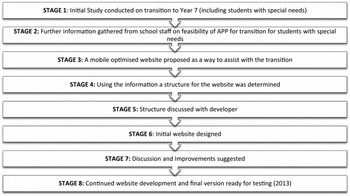
Figure 2 describes the process of development of the mobile-optimised website. Stages 1 and 2 were undertaken in the initial project (Coffey et al., Reference Coffey, Berlach and O'Neill2011). This paper reports Stages 3–7, which involves the development of the website.
Development Process for Mobile-Optimised Website.

Initially, it was anticipated that a software application (known as an app and used on an Apple iPad) would be devised to support students with special needs with the transition process. After discussion with an experienced app and website developer, who was appointed to assist with the technical aspects of development, it was determined that the format and quantity of information required to be accessed would be inappropriate for an app (M. Lander, personal communication, April 30, 2012). The authors wanted to ensure that information and resources were as widely available as possible, therefore a mobile-optimised website was decided upon as an appropriate platform on which to base the project (Stage 3).
Stage 4 required a close examination of suggestions from students, staff and parents and the relevant literature on transition practices for students with special needs to identify the content and structure of the website. It was determined that the students would benefit from information and support in six key areas:
• Getting Ready (preparing for new settings)
• Friendships
• Planning and Organisation
• Cyber Safety
• Frequently Asked Questions
• My Info
During Stage 5 further discussion was held with the website developer and a plan of action formulated. Initial screen shots were developed and approved by the authors (Stages 6 and 7). Further work on the website is continuing and will be concluded in 2013 (Stage 8). Once the work on the website is complete, two secondary schools have volunteered to trial the program. These schools both cater for students with special needs within inclusive classroom settings. One of the schools also has an education support centre, which students may attend for additional support as needed.
The Website Content
In developing the website the focus was squarely on providing information and assistance to the students both prior to and during transition, with support for using the website from parents and teachers (where required). This led to the selection of the six key areas of focus.
1. Getting Ready. Anxiety about the move from the small and more familiar environment in the primary school to a larger, perhaps more impersonal secondary school (Coffey et al., Reference Coffey, Berlach and O'Neill2011) is one aspect of transition that the authors sought to address. This led to the Getting Ready link on the website, which sought to normalise this anxiety through the provision of a Social Story©. By providing an account of the feelings typically experienced by students, the aim was to help them understand that it was normal to feel apprehensive about many aspects of the move. The Social Story was devised by the researchers, utilising the format described by the developer of Social Stories, Carol Gray (Gray, n.d.; Gray, Reference Gray2000; Howley & Arnold, Reference Howley and Arnold2005). The Social Story begins by suggesting that sometimes the move to a new setting may be a little scary, but that there are a lot of good things to look forward to. Links are made to orientation days, a larger number of people, new teachers, different classes and people who can help. The Social Story is accompanied by relevant (generic) pictorial cues. A Social Story is an effective tool as an ‘individual's improved understanding of events and expectations may lead to more effective responses’ (Gray, n.d., para. 2).
2. Friendships. Students frequently cite concern about making new friends as one of their major worries when commencing secondary school (Ashton, Reference Ashton2008; Carter et al., Reference Carter, Clark, Cushing and Kennedy2005; Coffey et al., Reference Coffey, Berlach and O'Neill2011; Ganeson, Reference Ganeson2006). It was therefore most important that the website include some information and advice about how to foster new relationships. Under the Friendships link a fun friendship quiz has been developed for the students to complete and advice is proffered about how to deal with the challenge of making new friends. The friendship quiz contains multiple-choice questions that ask students to identify social aspects such as:
(i) How do you make friends with someone you don't know?
(a) Punch them
(b) Smile at them and say hello
(c) Ignore them and walk the other way
(ii) If I want to make a new friend I can look for someone who . . .
(a) Looks angry
(b) Is smiling
(c) Has their back to me
(iii) What sorts of things would you talk about with new people?
(a) Favourite movies or sport
(b) Chores around the house
(c) Your underpants colours
Other areas addressed in the quiz include something good to do with your friend, what you would do if your friend is being bullied, and how to stay friends. There is feedback for each of the selections, which details how the particular selection may be correct or incorrect. This section also includes information on conflict management, what to do at recess and rules for working with others.
3. Planning and Organisation. Teachers and parents report that the level of organisation required on the part of students is significantly higher at secondary school than during primary school (Akos, Reference Akos2002; Ashton, Reference Ashton2008; Coffey et al., Reference Coffey, Berlach and O'Neill2011). To assist students with the organisational aspects of secondary school a ‘Planning and Organisation’ link is included. This section incorporates information on study skills, homework tips, and discusses timetables and how to read these. Information on how to revise for tests and summarise information will also be contained in this section. For example, with regard to establishing good study skills, the following tips (adapted from NSW Public Schools, 2012) are typical of those that are provided:
(i) Establish a routine timetable by allocating a particular time each day to revise and stick to it.
(ii) Create an environment where there is no noise or people interrupting you.
(iii) Make sure you have a comfortable chair and desk and that there is appropriate lighting. Have everything you need before you start studying.
(iv) Use a schedule to plan for assignments and due dates.
(v) Take good care of your health by eating healthy foods and getting lots of sleep and exercise.
(vi) When you have studied well, reward yourself with watching TV, catching up with friends, or another favourite activity.
(vii) Ask your teachers for help if you need it.
Students are also provided with tips and information on other aspects of planning and organisation. It is envisaged that both parents and teachers will use this section to add to and reinforce the information provided by the school.
4. Cyber Safety. The issue of cyber safety has emerged as a key area of concern for school personnel and parents alike. With the ever-increasing encroachment of technology into the daily lives of students, being able to navigate safely through the cyber world is a necessary skill for students (Commonwealth of Australia, 2011). Without the skills to keep themselves safe in a digital environment, students are open to cyber bullying, attack from cyber predators, and overuse of technology or technology addiction (Daly, Reference Daly2010). Although schools will have particular rules and policies about the use of technology, it is important that students have the opportunity to access information about how to safely use the many tools presented by technology. Guidelines and links to information about staying safe online that can be readily understood by students with special needs have been incorporated in the ‘Cyber Safety’ link. The guidelines suggest appropriate ways for students to maintain their safety while online, and the links guide them to further sources of information. Some of the guidelines include tips such as (examples):
(i) Make sure you have a password that no one can guess and do not give it to ANYBODY!
(ii) Do not give out any information about yourself on the web.
(iii) Do not do anything (put up pictures, look at things you shouldn't) that is wrong or illegal.
(iv) Only let someone be your friend online if you actually know them and they are your friend!
(v) Think about what you are sending to someone else. Would you be upset if someone sent that to you? If yes, then don't send.
(vi) People do not always tell the truth when they are online, so do not believe everything you read.
Some of the sources of further information that are available for students and parents to access include:
• Australian Government site on keeping cyber safe (select for young children, kids or teens) — http://www.cybersmart.gov.au/
• MindMatters is a national mental health initiative for secondary schools — http://www.mindmatters.edu.au
• ThinkUKnow cyber safety educational campaign managed by the Australian Federal Police and Microsoft® Australia — http://www.thinkuknow.org.au
• Budd:e E-Security Education Package activities for students to help raise cyber security awareness — http://www.staysmartonline.gov.au
5. Frequently Asked Questions. Questions that are often asked by students in regard to the secondary setting will be addressed in an ‘FAQ’ link. Questions such as ‘What if I lose my locker key?’ and ‘What if I am late to school?’ will be included and possible answers provided. It is envisaged that students will work through this section with their teachers. Becoming familiar with the particular aspects of the operation of individual schools by providing school-specific responses will assist students to become much more independent in their new school. Further questions and answers will be added to this section as feedback is received from a trial of the website with a small number of schools.
6. My Info. The ‘My Info’ link will be used by students to input specific information about particular subjects, teachers and equipment required for the different classes that they attend. The student will complete fields, either independently or with support, that contain information about their teachers (who they have for each subject, what to bring), key contacts in the school (principal, chaplain, special education coordinator), and school rules that pertain to their school. For example, in the ‘School Rules’ section of the website students will be able to input the rules that they need to follow at their particular school. This information may include advice or rules regarding the use of social networking sites, attendance requirements, and behavioural expectations, etc.
Similarly, students will be able to input information for each of their subject areas. For example, what do they need to bring when they have their ‘practical’ subjects, such as physical education. This information in the My Info section of the site will require the student to sign in and use a password. This personal information will only be available to the student and whoever is supporting them in their use of the website. All other areas of the website are open to all users.
Participants: Next Steps
The website will be available for the pilot study at the beginning of the 2013 school year, when a trial will take place for students who have already made the transition to the secondary school setting. Two schools, with a large number of students with special needs, have already volunteered to be involved in this initial trial phase, and ethical clearance has been obtained. This trial will then inform a larger study that will be undertaken for the next group of transitioning students at the end of the 2013 academic year while they are in primary school, and into 2014 as they commence secondary school in Term 1. These students will be invited to use the site prior to transition to the secondary setting. It is anticipated that a variety of schools in Australia, the United States and Canada will take part in the larger study. All parties involved will be surveyed and interviewed, and perceptions on the use of the website to support transition will be gathered. It is anticipated that the final version of the website will be available free to all users in July 2013, for use with students transitioning into secondary school in 2014.
Conclusion
Although moving from primary to secondary school may be considered a regular feature of formal schooling, students can experience mixed emotions and difficulties as they make this transition. For students with special needs some aspects of this move may be particularly difficult. The degree to which students successfully negotiate this change can influence their future success at secondary school (Reddy et al., Reference Reddy, Rhodes and Mulhall2003). Tools, therefore, that could potentially be of assistance to students are worthy of further investigation. With the use of technology being an integral feature of the education of many children today, its use by students, parents and teachers alike during the transition process would seem to be warranted.
In this paper the authors describe the development process of a mobile-optimised website that will facilitate the transition of students with special needs to secondary school and the upcoming trial of the implementation of the website. The six areas that were identified through prior research and that are addressed by the website are preparation (Getting Ready), friendships (social skills), planning and organisation, cyber safety, frequently asked questions (that students may have about the new setting) and information about classes and teachers, including key contacts (My Info). Focus on these areas and the use of technology is designed to support students with special needs as they transition from primary to secondary settings. Further research will be conducted to determine the efficacy of the mobile-optimised website and to obtain feedback from key stakeholders.
Author note
For further information in relation to the website, please contact the authors Dr Dianne Chambers at <dianne.chambers1@nd.edu> or Dr Anne Coffey at <anne.coffey@nd.edu.au>.