Introduction and historical review
Barrande first described the genus Aristocystites, type species A. bohemicus Barrande, Reference Barrande1887, in his major work on the fossil echinoderms of Bohemia (Barrande, Reference Barrande1887). He listed seven other taxa that he provisionally assigned to Aristocystites (Barrande, Reference Barrande1887, table 2, p. 65) with the comment: “The seven specific names, before which we place a question mark, are applied to incomplete specimens, in which we cannot recognize the existence of the four orifices, that characterize the genus Aristocystites. These forms show, nevertheless, most of the other characters of the type.” The last named, A.? subcylindricus, also had appended ‘Var. de Bohemicus’ as if Barrande was more certain of its close relationship to Aristocystites.
Jaekel (Reference Jaekel1899, p. 339, 351, 356, pl. 3, fig. 10a) described and illustrated for the first time the two ambulacral facets at each end of the elongate mouth in Aristocystites bohemicus. Bather (Reference Bather and Lankester1900, p. 44) regarded Aristocystites “in many respects the simplest echinoderm known,” although he missed the presence of the ambulacral facets. Bather (Reference Bather1919, p. 72) later erected a new genus Hippocystis, with A. subcylindricus as the type species, on the basis that it had horseshoe-shaped diplopores. He specified as the type of A. subcylindricus the original specimen on which Barrande's (1887, pl. 13, figs. 1–4) illustrations had been based. Thus, the formal taxonomy was settled, but unfortunately none of the specimens available to Barrande or Bather was complete. In particular, they each lacked the oral area, which includes critical taxonomic characters (e.g., Kammer et al., Reference Kammer, Sumrall, Zamora, Ausich and Deline2013), such as the number of ambulacra, the number of facets per ambulacrum, and the arrangement of the oral frame and cover plates. The aboral (extraxial) theca only preserves superficial characters, e.g., thecal shape and size, aboral plate arrangement, or distribution of diplopores. These can vary with paleoenvironment, mode of attachment, or growth. Without the oral surface, it is often impossible to tell even which family of directly attached diploporites is represented.
In Reference Prokop1965, Prokop redescribed as Hippocystis sculptus (Barrande, Reference Barrande1887) two specimens that Barrande (Reference Barrande1887, pl. 6, figs. 26–29) originally illustrated as Aristocystites? subcylindricus (figs. 26, 27) and A. sculptus (figs. 28, 29). Among other things, Prokop showed that this species had an oval mouth, from which four food grooves radiated to single ambulacral facets, a zigzag hydropore set in a distinct tubercle, and a conical gonopore entirely within a single plate. This morphology is distinctly different from the oral area of A. bohemicus, the type species of Aristocystites, in which the mouth is an elongate slit with two weak ambulacral facets, one at each end. Paul (Reference Paul2018) proposed the name Prokopius for this genus.
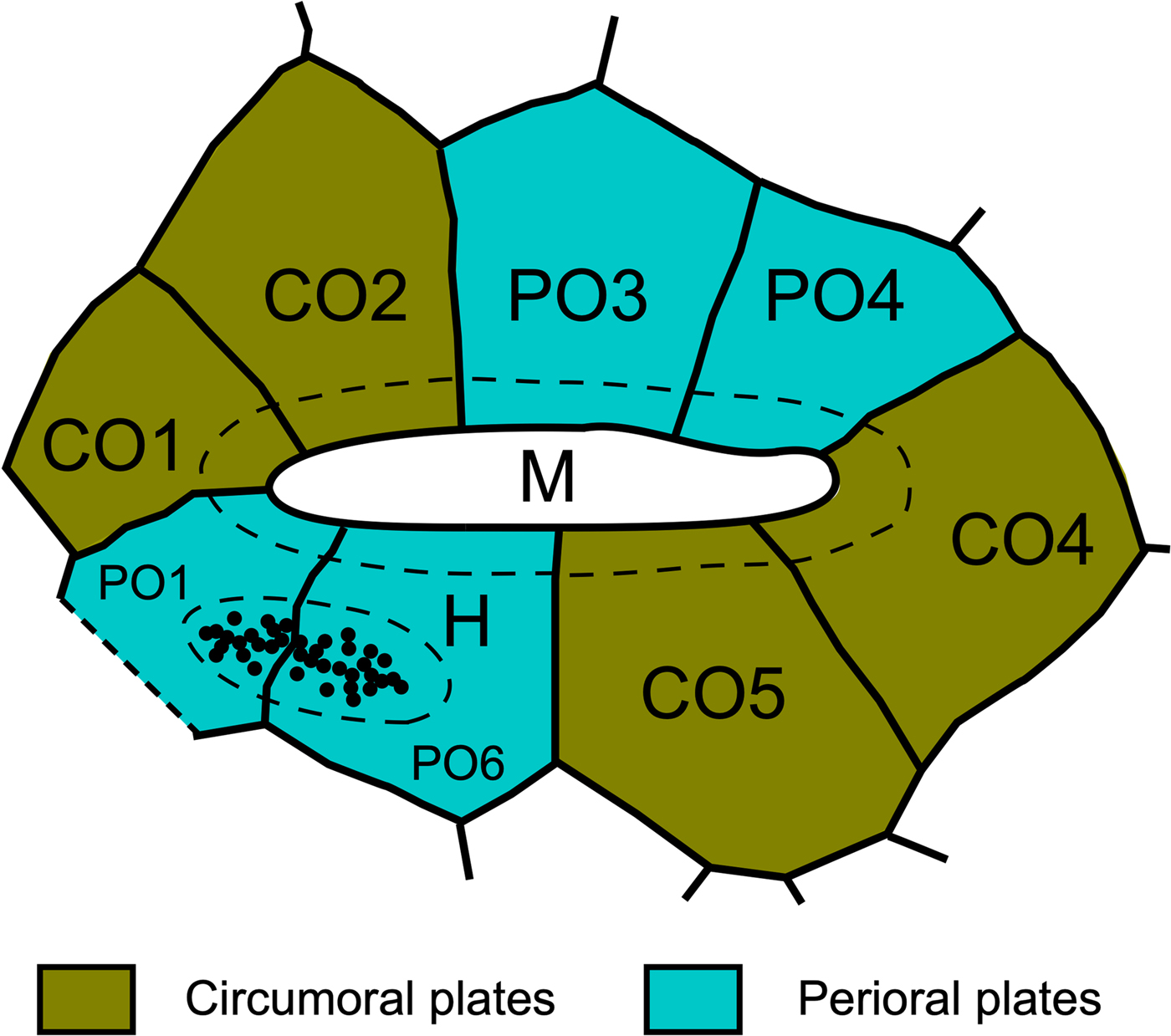
Parsley (Reference Parsley1990) redescribed Aristocystites and described a new species, A. metroi Parsley and Prokop in Parsley, Reference Parsley1990. In addition, Parsley regarded four of Barrande's original species (A. desideratus, A. grandiscutum, A. idealis, and A. rudis) as junior synonyms of A. bohemicus, which he also showed frequently had C- or horseshoe-shaped diplopores. Most importantly, he showed that the elongate mouth was bordered by eight plates (Parsley, Reference Parsley1990, fig. 7.2, p. 286) with two weakly developed facets, one at each end (Parsley, Reference Parsley1990, fig. 6.6, p. 284). These last observations enabled Paul (Reference Paul2017, fig. 7, p. 589) to interpret the homologies of the oral plating in aristocystitid diploporites for the first time (see Fig. 1).
Oral plating in Aristocystites bohemicus Barrande, Reference Barrande1887, type species of Aristocystites Barrande, Reference Barrande1887. Dashed outlines indicate positions of peristome, hydropore, and missing part of PO1. Redrawn from Barrande (Reference Barrande1887, pl. 9, fig. 11) after comparison with original. CO1–CO5 = circumoral plates; h = hydropore; m = mouth; PO1–PO6 = perioral plates.

In the late 1960s, one of us (CRCP) discovered an unregistered specimen of Aristocystites subcylindricus in the National Museum of Natural History, Washington, DC, (USNM), which was essentially complete and showed the oral area and main thecal orifices. This specimen (USNM 436969A; Fig. 2) clearly had an elongate mouth, with no more than two facets, and thus belonged to Aristocystites as Barrande had originally proposed. Aristocystites is the only known aristocystitid genus with just two ambulacral facets, but USNM 436969A is clearly distinct from A. bohemicus, two specimens of which accompany it. Two earlier searches for the critical specimen were unsuccessful, but in May 2018, RLP managed to rediscover it. Here we describe the oral area and main thecal orifices of A. subcylindricus for the first time and compare it with the two previously described species. The new specimen is deemed highly important because its plate sutures are obvious. The plates of both previously described species are smooth, whereas those of the type species, A. bohemicus, are covered with densely developed diplopores and its plate arrangement is often very difficult to determine even in complete examples. Bather (Reference Bather and Lankester1900, p. 43–46) thought that Aristocystites belonged to a primitive group of echinoderms without radial symmetry, and that its indefinite thecal shape and plate arrangement, plus its lack of stem and ambulacra, were primitive generic characters. It is surprising how long it has taken to establish its basic morphology.
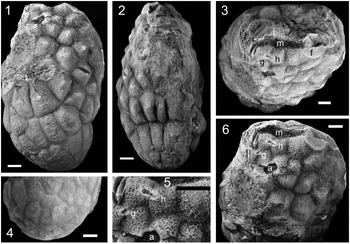
Aristocystites subcylindricus Barrande, Reference Barrande1887, USNM 436969A: (1) posterior lateral view to show swollen plates in irregular circlets and rounded base; (2) B-ray lateral view; (3) oral view to show elongate ambulacral groove, rounded facet (right), hydropore, and gonopore; (4) detail of rounded base of theca; (5) detail of hydropore, gonopore, and diplopores (note that although some diplopores are horseshoe-shaped, many are irregular); (6) oblique posterior lateral view to show relative positions of the mouth, hydropore, gonopore, and periproct. Specimen whitened with ammonium chloride. a = periproct; f = ambulacral facet; g = gonopore; h = hydropore; m = mouth. Scale bars = 5 mm.

Materials and methods
Materials
The key specimens available to us are in the United States National Museum of Natural History (USNM 436969A–D). In addition, latex casts of some of Barrande's original specimens in the National Museum, Prague (NMP) were available through the kindness of Prof. Bertrand Lefebvre.
Locality information
The specimen formed part of a large collection of fossils sold to the USNM by Harrell Strimple in 1954. The only locality information accompanying the specimens (Kaceřov, Czech Republic) relates to one example of Aristocystites bohemicus.
Repositories and institutional abbreviations
The key specimens described herein are in the United States National Museum of Natural History, Washington, DC (USNM). Barrande's original specimens are in the National Museum, Prague, Czech Republic (NMP).
Systematic paleontology
Class Diploporita Müller, Reference Müller1854
Family Aristocystitidae Neumayr, Reference Neumayr1889
Diagnosis
Directly attached diploporites with an elongate oral area surrounded by at least eight plates (four interradial periorals [POO] and four radial circumorals [COO]), and covered by a double biseries of cover plates; with 2–5 ambulacra bearing 1–4 brachioles each; with a large hydropore across the PO1:PO6 suture and often a spout-like gonopore usually within a single plate near the periproct; with thecal plates densely covered with diplopores that are frequently sealed externally by a thin epistereom and sometimes extended into spine-like projections (McDermott and Paul, Reference McDermott and Paul2019).
Remarks
This diagnosis is significantly different from some preceding diagnoses (e.g., Kesling, Reference Kesling and Moore1968, p. S250) largely because the arrangement of plates in the oral area was not previously understood, but also because genera that are now included in the family Holocystitidae were previously included within the Aristocystitidae. All aristocystitid genera in which the oral plating and ambulacra are known have a mouth elongated perpendicular to the oroanal axis and surrounded by eight plates interpreted by Paul (Reference Paul2017, fig. 7, p. 589) as four central, interradial, perioral plates (PO1, PO2, PO4, and PO5) and four distal, radial, circumoral plates (CO1, CO2, CO4, and CO5). In Aristocystites (Fig. 1), only two, weakly developed ambulacral facets occur. Paul (Reference Paul2017, fig. 7.1) interpreted the two ambulacra as B and D under Carpenter's (Reference Carpenter1884, Reference Carpenter1891) system, because the facets were developed on plates CO1 and CO4, which bear these ambulacral facets in diploporite taxa with all five ambulacra present.
Despite the fact that sometimes the facets extend across a plate suture, this interpretation still seems the most likely and is based on two lines of reasoning. First, Oretanocalix Gutiérrez-Marco, Reference Gutiérrez-Marco2000, is an aristocystitid with all five ambulacra and is the least differentiated from other families of directly attached diploporites, which also have five ambulacra. All other Ordovician aristocystitid genera have four ambulacra; ambulacrum A is not developed. This suggests that Aristocystites is the most derived Ordovician aristocystitid in having lost two more ambulacra. It is possible that the two ambulacra represent the combined B + C and D + E ambulacra before they differentiated. In this case, Aristocystites would still be the most derived genus because it had an extremely pedomorphic ambulacral system. However, it seems less likely that in all other Ordovician aristocystitid genera, the paired ambulacra were differentiated, but in Aristocystites they failed to separate.
This argument suggests that Aristocystites had two of the normal five ambulacra but does not settle which. Parsley (Reference Parsley1990, fig. 7.2, p. 286) showed that the mouth in Aristocystites is surrounded by eight plates (Fig. 1). The left facet lies either within plate CO1 or across the PO1:CO1 suture. This position is associated with ambulacrum D in all aristocystitids with four ambulacra. If the facet represented ambulacrum E, it would be associated with plate CO2. Similarly, the right facet is associated with CO4 and represents ambulacrum B in aristocystitids with four ambulacra. If the right facet represented ambulacrum C, it would be associated with CO5. In practice, facets in A. bohemicus are poorly developed and extremely difficult to detect. Even so, in our view, the variations observed do not invalidate the interpretation of which ambulacra they represent.
Genus Aristocystites Barrande, Reference Barrande1887
Type species
Aristocystites bohemicus Barrande, Reference Barrande1887, by original designation.
Diagnosis
Aristocystitids with just two simple ambulacral facets (B and D) at the two ends of the ambulacral groove.
Aristocystites subcylindricus Barrande, Reference Barrande1887
Figure 2
- Reference Barrande1887
Aristocystites subcylindricus Barrande, p. 114, pl. 13, figs. 1–13, 17, 18; non pl. 6, figs. 26, 27 = Prokopius sculptus (Barrande, Reference Barrande1887); nec pl. 13, figs. 14–16, 19–21 = A. bohemicus Barrande, Reference Barrande1887.
- Reference Barrande1887
Aristocystites bohemicus Barrande, pl, 13, figs. 22, 25.
- Reference Barrande1887
Aristocystites desideratus Barrande, p. 109, pl. 20, figs. 1, 2 (as A. desiratus sic).
- Reference Bather1919
Hippocystis subcylindrica, Bather, p. 73.
- Reference Kesling and Moore1968
Hippocystis subcylindrica, Kesling, p. S254, fig. 151.2a–f.
- Reference Parsley1990
Aristocystites desiratus (sic), Parsley, fig. 10.4.
- Reference Paul2018
Aristocystites subcylindricus, Paul, fig. 1, p. 340, fig. 2, p. 341.
Lectotype
The original of Barrande (Reference Barrande1887, pl. 13, figs. 1–4) was selected as type by Bather (Reference Bather1919, p. 73), NMP L10574.
Diagnosis
A species of Aristocystites with highly tumid thecal plates and the gonopore at the junction of three plates, PO1 and two plates below.
Occurrence
The origin of USNM 436969A is unknown. Barrande's specimens came from horizon d4, middle and upper Berounian local stage, upper Sandbian–lower Katian international stages (see Gutiérrez-Marco et al., Reference Gutiérrez-Marco, Sá, García-Bellído and Rábano2017), from Strančice (type locality), Loděnice, and Zahořany, Czech Republic.
Description
Theca elongate, 58 mm high by 36 mm maximum width (Fig. 2.1, 2.2), composed of eight or nine irregular circlets of distinctly tumid plates all bearing numerous, often horseshoe-shaped diplopores, even in parts not directly exposed to sea, e.g., ambulacral facets (Fig. 2.3, right). Aborally, theca rounded, lacking attachment area (Fig. 2.4). Plates apparently of a single generation, reaching 13 mm maximum height (Fig. 2.1, center); thick, with deep sutures between them; polygonal with 4–7 sides. Diplopores covering entire surface of well-preserved plates (Fig. 2.1, 2.3, 2.5), with usually curved C- or horseshoe-shaped peripores, but irregular and S-shaped peripores also occur (Fig. 2.5). Peripores ~ 0.15 mm wide, with perpendicular canals separated by 0.45–0.5 mm.
Oral area elongate perpendicular to line connecting peristome and periproct (Fig. 2.3, m–a). Mouth surrounded by eight plates, three along anterior and posterior margins, two at either end (Fig. 2.3, see also Paul, Reference Paul2018, fig. 1, p. 340). Two plates damaged at left end, as is terminal plate at right end, but it preserves approximately half of ambulacral facet for ambulacrum B (Fig. 2.3, f). Facet originally nearly circular, 7 mm long by ~ 6.5 mm maximum width. Ambulacral groove separating facets 14 mm long by 3.2 mm maximum width, preserving some oral pores at left end.
Hydropore (Fig. 2.6, h) an oblique, elongate pit, swollen at left end, set in raised tubercle 3.5 mm wide across PO1:PO6 suture (Fig. 2.3, 2.5, 2.6). Gonopore (Fig. 2.6, g) crudely triangular (Fig. 2.3, 2.5, 2.6), 0.5 mm across, with weak raised rim reaching 1.8 mm across, set at junctions of PO1 and two plates below. Right hands of lower plates also form part of periproct border.
Periproct (= anus; Fig. 2.6, a) a relatively large, rounded pentagonal opening, 3.5 mm across, surrounded by five plates (Fig. 2.6), appearing (although damaged) to have had weak raised rim originally, especially adorally. Ambulacral and periproctal cover plates not preserved (Fig. 2.3, 2.6).
Remarks
Parsley (Reference Parsley1990) used a flume tank to investigate the likely mode of life of Aristocystites and concluded that it lived recumbent on the anterior face of the theca. The elongate mouth was horizontal with a (presumed) brachiole at either end. Because many examples have a distinct aboral attachment scar, it is likely that Aristocystites initially grew upright and either then grew asymmetrically or fell over onto its anterior side. The brachioles fed from eddy currents on the lee side of the theca, which almost certainly required the mouth to be horizontal with a facet at either end. Thus, it seems that the precise relationship between the horizontal mouth and ambulacral facets on the one hand and the oral plating on the other was not fixed, but a result of individual growth after becoming recumbent. We are indebted to Elise Nardin for pointing out that specimens in the Narodni Museum and Czech Geological Survey collections show variation in the precise plate arrangement. Indeed, it is clear from Barrande's original illustrations that sometimes a plate suture exists at one end of the mouth (e.g., Barrande, Reference Barrande1887, pl. 9, fig. 13, left side of mouth) and, in other examples, a plate lies in the same place (e.g., Barrande, Reference Barrande1887, pl. 9, fig. 3, left side of mouth).
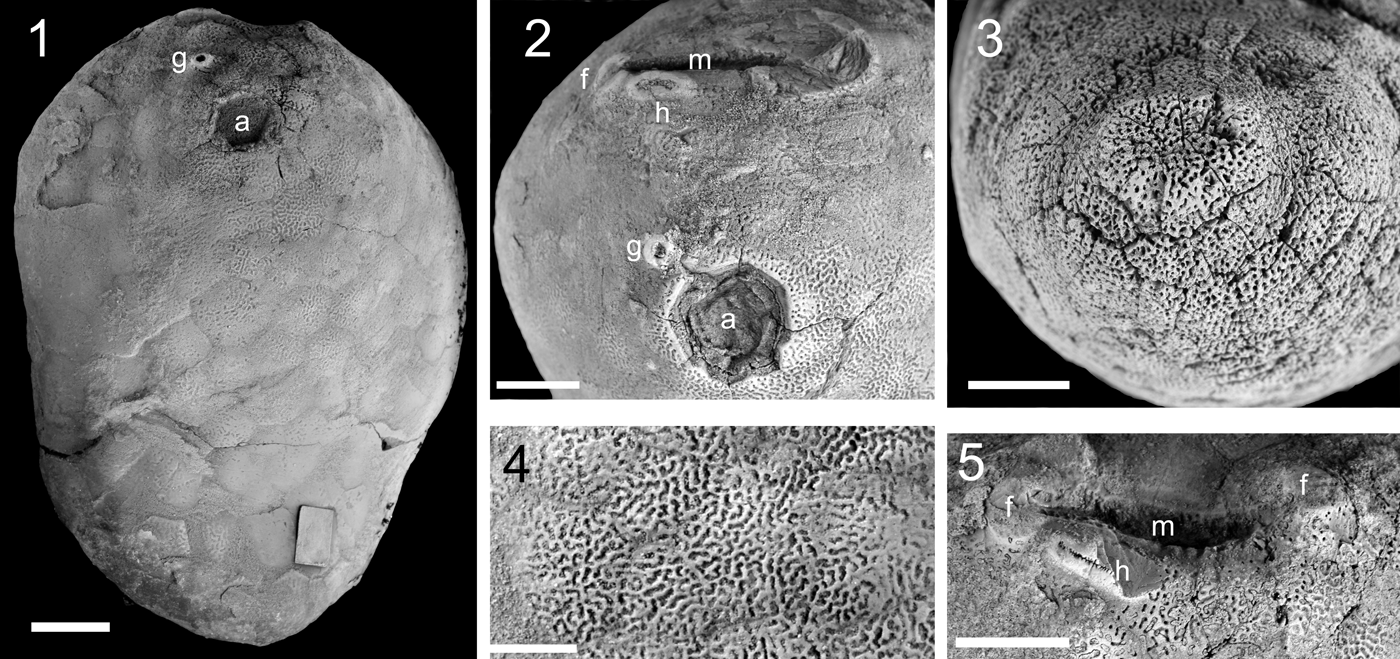
Parsley (Reference Parsley1990) also redescribed Aristocystites, based largely on the type species A. bohemicus. Among other things, he showed that in Aristocystites, the elongate mouth (Fig. 3.2, 3.5, m) is surrounded by eight plates (Parsley, Reference Parsley1990, fig. 7.2, p. 286) with only two ambulacral facets (Fig. 3.2, f), one at either end (Parsley, Reference Parsley1990, figs. 6.6, 6.8, 7.1; Figs. 1, 3.5). The hydropore (Fig. 3.2, 3.5, h) is a complex slit-like structure within a raised tubercle and shared by two of the plates forming the oral frame (PO1 and PO6 herein; Fig. 1). The conical gonopore (Fig. 3.1, 3.2, g) has a circular opening and is quite variable in its position relative to the periproct, from between halfway between the hydropore and periproct (Fig. 3.1), to right beside the periproct margin (Fig. 3.2). Plate sutures are difficult to see, but the gonopore typically appears of lie entirely within a single plate. The periproct (Fig. 3.1, 3.2, a) is bordered by a variable number of plates and has a recessed margin for the insertion of a simple anal pyramid of five to seven plates (Fig. 3.2). All plates are penetrated by numerous irregular diplopores (Fig. 3.4) even in areas that were covered in life, e.g., the attachment area (Fig. 3.3), and some are horseshoe-shaped (Fig. 3.4, left).
Aristocystites bohemicus Barrande, Reference Barrande1887: (1) USNM 436969B, posterior lateral view to show smooth outline and scarcely tumid plates with inconspicuous sutures; (2) USNM 436969C, oblique posterior lateral view to show relative positions of the mouth, hydropore, gonopore, and periproct (note that the gonopore is much closer to the periproct in this specimen); (3) USNM 436969C, aboral view to show attachment area with all plates penetrated by numerous diplopore canals; (4) USNM 436969C, detail of diplopores (note the irregular but often curved diplopores); (5) USNM 436969B, oral view to show elongate ambulacral groove with weak facets at both ends and slit-like hydropore. Specimens whitened with ammonium chloride. a = periproct; f = ambulacral facet; g = gonopore; h = hydropore; m = mouth. Scale bars = 5 mm (1–3, 5), 1 mm (4).

Aristocystites subcylindricus strongly resembles A. bohemicus in having an elongate mouth with a frame composed of eight plates and with two poorly developed ambulacral facets, one at either end (cf. Figs. 2.3, 3.5). It also has an elongate hydropore developed across the PO1:PO6 suture (Fig. 2.3, 2.5, 2.6) as in A. bohemicus (Fig. 3.2, 3.5). Despite Bather's (Reference Bather1919) belief that A. subcylindricus bore horseshoe-shaped diplopores and A. bohemicus had irregular ‘haplopores,’ both species have irregular diplopores that are frequently C-shaped or horseshoe-shaped (cf. Figs. 2.5, 3.4). The main differences between the two species are that A. subcylindricus has tumid plates (Fig. 2.1, 2.2. 2.6), whereas those of A. bohemicus are much smoother (Fig. 3.1, 3.2, 3.4), and that the gonopore in A. subcylindricus is shared between three plates (Fig. 2.5). However, because the position of the gonopore is variable in A. bohemicus and only known in a single example of A. subcylindricus, the significance of the latter difference is uncertain. In addition, the single example of A. subcylindricus in which the plating between the mouth and periproct is known shows only two circlets of plates between the two orifices (Fig. 2.5, 2.6). Several specimens of A. bohemicus show at least three and possibly four circlets between the mouth and periproct (e.g., Barrande, Reference Barrande1887, pl. 9, figs. 2, 4, 6, 10). Finally, both A. bohemicus and A. subcylindricus have diplopore canals penetrating all thecal plates, even those of the attachment area and beneath the ambulacral facets. Many plates are worn revealing the peripore shapes and, in A. bohemicus, frequently obscuring plate sutures.
Aristocystites metroi is larger than both A. subcylindricus and A. bohemicus and has smooth external plate surfaces; the epistereom is not eroded at all so the diplopores do not show. The plates are not strongly tumid, but their sutures are distinct, partly due to the color contrast between the muddier sediment and the thecal plates, but also because most specimens are slightly crushed or partly disarticulated (see Parsley, Reference Parsley1990, fig. 11).
Acknowledgments
We thank M. Florence (Department of Paleobiology, USNM) for searching for the history of the Aristocystites specimens and B. Lefebvre for providing latexes of some of Barrande's original specimens. V. Turek (Department of Palaeontology, NMP) confirmed the registration number of Bather's type of A. subcylindricus. S. Zamora and E. Nardin provided thoughtful reviews of the original manuscript, which resulted in significant improvements.