Summation
In this meta-analysis, we found that ethyl-EPA significantly improved motor functions in HD after 12 months.
Ethyl-EPA significantly decreased brain atrophy in MRI studies after 6 months, and the effect was evident clinically on motor symptoms after 12 months; however, the 12-month results should be interpreted cautiously as the second 6 months of the TREND-HD study was open-label.
Despite the results of clinical trials after 6 months, more trials are needed to investigate the effect of ethyl-EPA after 12 months and test its impact on the pathways responsible for brain atrophy.
Consideration
These results should be taken with caution as only two studies continued for 12 months.
The MRI studies had a small sample size of 19 patients in the ethyl-EPA group versus only 22 in the placebo group.
Introduction
Huntington disease (HD) is one of the nine well-known polyglutamine genetic disorders of the central nervous system (Liu, Reference Liu1998; Katsuno et al., Reference Katsuno, Banno, Suzuki, Takeuchi, Kawashima, Tanaka, Adachi and Sobue2008) with a worldwide prevalence of 2.71 per 100,000 (Pringsheim et al., Reference Pringsheim, Wiltshire, Day, Dykeman, Steeves and Jette2012). It has a higher prevalence in Europe, North America, and Australia (5.7 per 100,000) compared with Asia (0.40 per 100,000) (Pringsheim et al., Reference Pringsheim, Wiltshire, Day, Dykeman, Steeves and Jette2012). HD is caused by an autosomal dominant inheritance resulting in a high-penetrance genetic mutation in the gene coding for huntingtin protein (Gusella et al., Reference Gusella, MacDonald, Ambrose and Duyao1993). This mutation causes a repetition of the cytosine-adenine-guanine (CAG) sequence that codes for the amino acid glutamine (Gusella et al., Reference Gusella, MacDonald, Ambrose and Duyao1993; Katsuno et al., Reference Katsuno, Banno, Suzuki, Takeuchi, Kawashima, Tanaka, Adachi and Sobue2008). Therefore, the trinucleotide repeat expansion leads to the production of the mutant huntingtin protein, causing neuronal death in the cerebral cortex and basal ganglia (Gusella et al., Reference Gusella, MacDonald, Ambrose and Duyao1993).
Normally, CAG is repeated from 15 to 27 times, while in HD patients, CAG was found to be repeated 19–31 times in many patients (Langbehn et al., Reference Langbehn, Hayden and Paulsen2010). Furthermore, the age of onset of HD depends mainly on CAG repeats; in a review by Langbehn et al., it was found that the mean age of onset was indirectly proportional to CAG repeats (Langbehn et al., Reference Langbehn, Hayden and Paulsen2010).
The core neurologic symptoms of the disease include three categories: motor changes, cognitive disabilities, and behavioural manifestations (Paulsen et al., Reference Paulsen, Langbehn, Stout, Aylward, Ross, Nance, Guttman, Johnson, MacDonald, Beglinger, Duff, Kayson, Biglan, Shoulson, Oakes and Hayden2008; Loy & McCusker, Reference Loy and McCusker2013). The Huntington chorea is the hallmark of disease and is characterised by rapid, irregular, and arrhythmic complex involuntary movements (Penney et al., Reference Penney, Young, Shoulson, Starosta-Rubenstein, Snodgrass, Sanchez-Ramos, Ramos-Arroyo, Gomez, Penchaszadeh, Alvir and Esteves1990; Louis et al., Reference Louis, Lee, Quinn and Marder1999; Kirkwood et al., Reference Kirkwood, Siemers, Bond, Conneally, Christian and Foroud2000; Biglan et al., Reference Biglan, Ross, Langbehn, Aylward, Stout, Queller, Carlozzi, Duff, Beglinger and Paulsen2009). Moreover, HD patients usually die within 20 years after the diagnosis either due to complications from the disease itself, suicide, heart problems, or physical injury (Walker, Reference Walker2017).
The progressive nature of the disease and the debilitating clinical manifestations impose a huge burden on the patients, their families, and healthcare systems (Divino et al., Reference Divino, Dekoven, Warner, Giuliano, Anderson, Langbehn and Lee2013; Jones et al., Reference Jones, Busse, Quinn, Dawes, Drew, Kelson, Hood, Rosser and Edwards2016; Carlozzi et al., Reference Carlozzi, Hahn, Goodnight, Kratz, Paulsen, Stout, Frank, Miner, Cella, Gershon, Schilling and Ready2017). The healthcare costs increased significantly in the late stages of the diseases. In the United States, the cost ranges from $4947 to $22,582 for private insurance and $3257–$37,495 for Medicaid in the late stage of the disease (Paulsen, Reference Paulsen2011).
Unfortunately, there is no cure for the disease now. However, there are pharmacological options that can alleviate the symptoms and signs of the disease and prevent disease progression and neuronal death (van Rijkom et al., Reference van Rijkom, Truin and van ‘t Hof1998; Paulsen, Reference Paulsen2011; Frank, Reference Frank2014; Walker, Reference Walker2017).
One of the medications investigated for the treatment of HD is ethyl-eicosapentaenoic acid (ethyl-EPA) derived from the omega-3 fatty acid EPA (Murck & Manku, Reference Murck and Manku2007; Huntington Study Group TREND-HD Investigators, 2008; Ferreira et al., Reference Ferreira, Rosser, Craufurd, Squitieri, Mallard and Landwehrmeyer2015). Many studies had investigated its potential efficacy in numerous illness, including neurological and mental health diseases (Waitzberg & Garla, Reference Waitzberg and Garla2014; Bauer et al., Reference Bauer, Crewther, Pipingas, Sellick and Crewther2014; Bos et al., Reference Bos, van Montfort, Oranje, Durston and Smeets2016; Pusceddu et al., Reference Pusceddu, Kelly, Stanton, Cryan and Dinan2016).
Moreover, ethyl-EPA had a potential efficacy in HD patients through its effect on altered lipid metabolism in HD (Kawashima et al., Reference Kawashima, Harada, Kami, Yano, Imada and Mizuguchi2010; Block et al., Reference Block, Dorsey, Beck, Brenna and Shoulson2010). The experiments on mice model of HD showed enhancement of motor activity but not neuronal death (Van Raamsdonk et al., Reference Van Raamsdonk, Pearson, Rogers, Lu, Barakauskas, Barr, Honer, Hayden and Leavitt2005). However, human studies have suggested conflicting evidence with mixed results (Puri et al., Reference Puri, Bydder, Counsell, Corridan, Richardson, Hajnal, Appel, Mckee, Vaddadi and Horrobin2002; Huntington Study Group TREND-HD Investigators, 2008; Ferreira et al., Reference Ferreira, Rosser, Craufurd, Squitieri, Mallard and Landwehrmeyer2015).
Some physicians still consider ethyl-EPA for patients with HD due to its neuroprotective effects. That is why, this meta-analysis was conducted to critically assess the efficacy of ethyl-EPA on HD patients and its role as an adjuvant drug for HD patients.
Methods
This study was conducted based on the recommendations of the Preferred Reporting Items for Systematic Review and Meta-analysis statement (Liberati et al., Reference Liberati, Altman, Tetzlaff, Mulrow, Gøtzsche, Ioannidis, Clarke, Devereaux, Kleijnen and Moher2009). The protocol was formulated prior to the study and was registered at PROSPERO: International Prospective Register of Systematic Reviews (ID: CRD42016049160).
Search strategy
We searched for randomised clinical trials assessing the efficacy of ethyl-EPA for HD in 12 electronic databases, including ClinicalTrials.gov, metaRegister of Controlled Trials (mRCT), WHO International Clinical Trials Registry Platform (ICTRP) to identify any ongoing studies, Google Scholar, WHO Global Health Library, POPLINE, Virtual Health Library, PubMed, Scopus, Web of Science (ISI), New York Academy of Medicine Grey Literature Report, and SIGLE (System for Information on Grey Literature in Europe).
We used the following search terms in all databases, except in Google Scholar: (eicosapentaenoate OR (ethyl-EPA) OR eicosapentaenoic OR timnodonic OR icosapent OR eicosapentaenoic OR padel OR eicosapentaenoate OR vascepa) AND [Huntington OR (chronic progressive hereditary chorea)].
In Google Scholar, we used advanced search with two strategies: either using ‘chronic progressive hereditary chorea’ or ‘Huntington’ in all words section combined with one of the words: ‘eicosapentaenoate ‘ethyl EPA’ eicosapentaenoic timnodonic icosapent eicosapentaenoic epadel eicosapentaenoic vascepa’.
The authors performed a manual search to retrieve any relevant papers. We searched the citations of included papers, references of relevant papers in PubMed, and relevant citations in Google Scholar.
Eligibility criteria
The papers retrieved were screened independently by three reviewers according to predefined inclusion and exclusion criteria. Our inclusion criteria were: (i) clinical trials reporting the efficacy and safety of ethyl-EPA on HD, (ii) participants should have HD clinical features and a confirmatory genetic diagnosis or a compatible family history, and (iii) all disease variants and ages of disease onset were included. Exclusion criteria were: (i) animal studies, (ii)in vitro studies, (iii) observational or laboratory studies, (iv) studies with unreliable dataset, (v) overlapped dataset, and (vi) abstract-only text or reviews, books, posters, thesis, editorial, notes, letters, case series, case reports, and conferences. Any disagreements regarding any paper between the authors were discussed to reach final decisions.
Study selection
Three independent reviewers performed an initial assessment of the retrieved references from the aforementioned databases according to our eligibility criteria. The full texts of eligible papers were retrieved to be accurately screened by the three independent reviewers. Any disagreements were resolved by discussion and consensus among the authors till a final decision was reached.
Outcome measurement
All patients’ outcomes were considered in the analysis to assess the efficacy and safety of ethyl-EPA for HD patients. We included the following: (1) unified HD rating scale (UHDRS) or any scale used to assess the disease, (2) MRI results before and after the treatment, and (3) side effects and complications of ethyl-EPA.
We considered the improvement of disease symptoms or signs and/or no worsening of the disease as an indication of the efficacy of ethyl-EPA. The absence of disease progression was considered a good sign due to the progressive nature of the disease.
Data extraction
Three reviewers independently extracted data from eligible included references. The extracted data included study demography (title, author, year of publication, and country of patients), year of patient recruitment, participants’ characteristics (age, sex, race, CAG repeats, any medication received, diagnosis of HD including family history and genetic testing, severity and grade of the disease), dose and route of administration of placebo and ethyl-EPA, duration of treatment and follow-up, the scale used for assessment (name, baseline score, score after 3, 6, 12 months if available).
Quality assessment
The risk of bias in each included study was independently assessed by two reviewers using the Cochrane Collaboration’s tool for assessing the risk of bias (Higgins et al., Reference Higgins, Altman, Gøtzsche, Jüni, Moher, Oxman, Savovic, Schulz, Weeks and Sterne2011). It is a two-part tool, addressing seven specific domains, including randomisation, allocation concealment, blinding of subjects, blinding of outcome assessors, reporting of incomplete outcome data, selective outcome reporting, and other potential sources of bias. In each domain, each study took one of three categories; ‘low risk,’ ‘high risk,’ or ‘unclear risk’ of bias (Higgins et al., Reference Higgins, Altman, Gøtzsche, Jüni, Moher, Oxman, Savovic, Schulz, Weeks and Sterne2011).
Statistical analysis
We performed fixed-effect model of meta-analyses for each outcome using the Comprehensive Meta-Analysis software, version 3 (Biostat, NJ, USA) when there was more than one study for each outcome. Continuous and binary variables were analysed to compute pooled mean difference (MD) and risk ratio (RR), respectively. For studies that only reported mean with no measurement for the variance, we contacted the authors to give us these data. If no response from the authors, we estimated standard deviation (SD) from linear regression analysis between log (SD of pooled studies for each outcome) against log (mean of pooled studies for the same outcome) (van Rijkom et al., Reference van Rijkom, Truin and van ‘t Hof1998). In each outcome analysis, treatment effects were compared between per protocol (PP) and intention-to-treat (ITT) analysis in studies that reported both. The PP analysis is the analysis that includes only the remaining patients at the end of the experiment, while the ITT analysis includes the originally allocated patients regardless of patients lost to follow-up. Both should be done in clinical trials to avoid bias (Shah, Reference Shah2011).
We assessed statistical heterogeneity between studies using the Higgins’ Chi-squared and I-squared statistic. When the p-value of a Chi-squared test was <0.1 and/or I 2 test >50%, it was considered significant for the presence of heterogeneity (Mantel & Haenszel, Reference Mantel and Haenszel1959; DerSimonian & Laird, Reference DerSimonian and Laird1986). If no study reported pre-/post-correlation, we made a sensitivity analysis by assuming several values of correlation (Follmann et al., Reference Follmann, Elliott, Suh and Cutler1992; Fu et al., Reference Fu, Vandermeer, Shamliyan, O’Neil, Yazdi, Fox and Morton2008). The statistical significance was considered if the p-value was 0.05 (two-tailed test) or its 95% confidence interval (95% CI) did not overlap with the original one.
Ferreira et al. (Reference Ferreira, Rosser, Craufurd, Squitieri, Mallard and Landwehrmeyer2015) reported their results using a full analysis set (FAS) and a modified full analysis set (mFAS), while Puri et al. (Reference Puri, Leavitt, Hayden, Ross, Rosenblatt, Greenamyre, Hersch, Vaddadi, Sword, Horrobin, Manku and Murck2005) used PP and ITT. Sensitivity analysis was done using each design separately for the analysis. The analysis was done first using PP analysis with FAS, then with mFAS, then we removed Ferreira et al. (Reference Ferreira, Rosser, Craufurd, Squitieri, Mallard and Landwehrmeyer2015) from the analysis.
For the analysis at 12 months, two studies were only included and one of them had a 6-month open-label phase, which was reflected on the quality assessment result. We observed that this study had the largest weight in the meta-analysis, which may affect the results of the analysis. That’s why we did a post hoc analysis for the meta-analysis at 12 months. A quality effect model meta-analysis was performed to account for these issues. We assessed the quality of the studies using the quality assessment tool proposed by Doi and Thalib (Reference Doi and Thalib2008), then applied the method reported by Doi and Thalib (Reference Doi and Thalib2008). Post hoc meta-analysis was conducted with Microsoft Excel 2016.
Results
Literature search
The electronic search yielded 204 references from the 12 databases. After excluding the duplicates and title/abstract screening, we had nine relevant papers for full-text screening, and only five papers fulfilled the inclusion criteria. The manual search did not result in additional papers (Fig. 1).
PRISMA flow diagram illustrating the review process.

In the end, we had five RCTs for the systematic review, but only four papers could be included in the meta-analysis.
Study characteristics
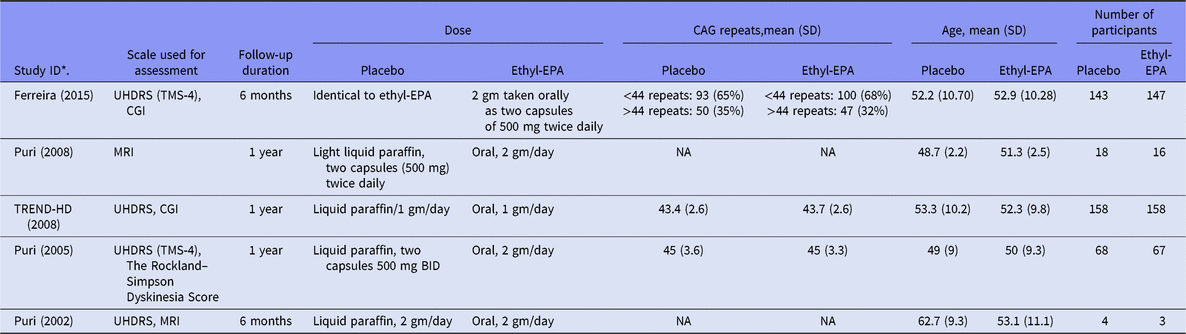
In this meta-analysis, 782 cases (ethyl-EPA 391, placebo 391) were included and were recruited from the UK, Germany, Portugal, Spain, Italy and Austria, the USA, Canada, and Australia. The HD patients’ age ranged from 50 to 63 with no significant difference in age across all trials between ethyl-EPA and placebo groups (Table 1).
Characteristics of the included studies

ethyl-EPA, ethyl-eicosapentaenoic acid; CAG, cytosine-adenine-guanine; UHDRS, unified Huntington disease rating scale; SD, standard deviation.
* All studies are double-blinded RCTs.
All studies used purified ethyl-EPA in a dose range of 1–2 gm/day. For placebo, all studies used a sub-laxative dose of liquid paraffin. All trials were double-blinded randomised trials.
The number of CAG repeats in the included patients ranged from 40 to 49 (Table 1). There was no significant difference of CAG repeats between the placebo and ethyl-EPA in all studies.
Quality assessment
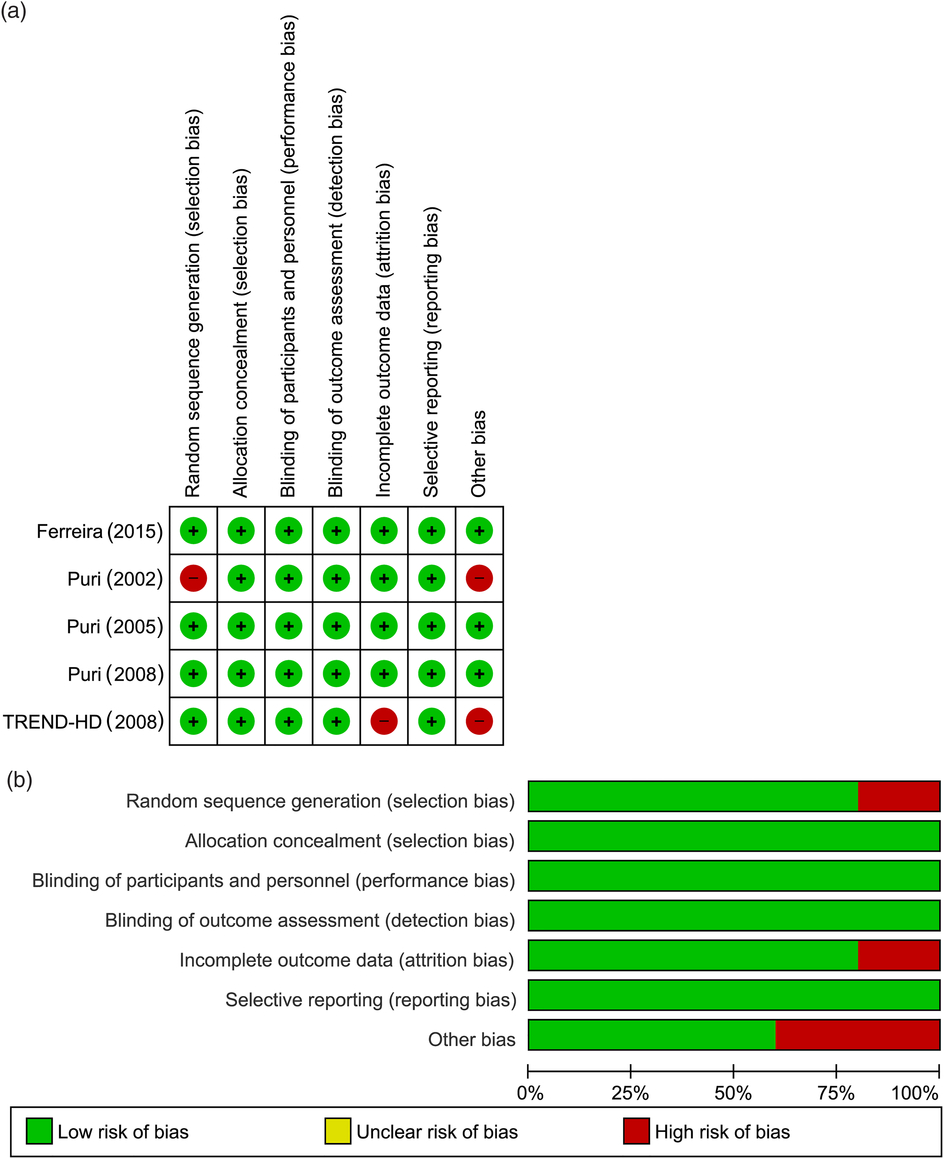
The results of quality assessment are shown in Fig. 2. Four RCTs had a low risk of bias; TREND-HD had attrition and other bias as illustrated in Supplementary Table 1.
Quality assessment of included studies as assessed by Cochrane risk of bias assessment tool. Red = high risk, blank = unclear, green = low.

Efficacy and safety of ethyl-EPA
Total Motor Score (TMS)
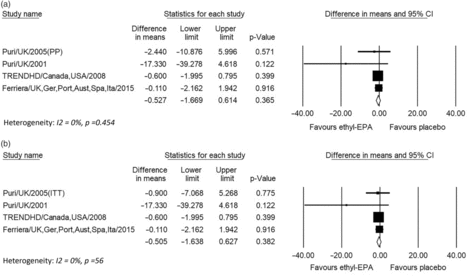
The fixed-effect model meta-analysis of studies at 6 months showed no significant improvement in the TMS of patients receiving ethyl-EPA compared with placebo [MD = −0.527, 95% CI (−1.67, 0.61), p = 0.365] with no significant heterogeneity (p = 0.454, I2 = 0%). The comparison of treatment effects between PP analysis and ITT analysis yielded the same insignificant effect of ethyl-EPA on TMS compared with placebo [Fig. 3(A) and (B)].
Fixed effect meta-analysis of the mean difference of scores of total motor score (TMS) between placebo and ethyl-EPA at 6 months. Each study is represented by points which have a size corresponding to its weight in the analysis. Mean and 95% confidence interval (C.I) are used for the overall effect size represented by diamond. We did a separate analysis for per protocol (A) and intention to treat analysis (ITT, B) used in Puri et al. (Reference Puri, Leavitt, Hayden, Ross, Rosenblatt, Greenamyre, Hersch, Vaddadi, Sword, Horrobin, Manku and Murck2005).

Sensitivity analysis was done by removing Ferreira et al. (Reference Ferreira, Rosser, Craufurd, Squitieri, Mallard and Landwehrmeyer2015) that used least mean squares for reporting their results, but it did not produce any significant change in the analysis [Supplementary Fig. 1(A) and (B)].
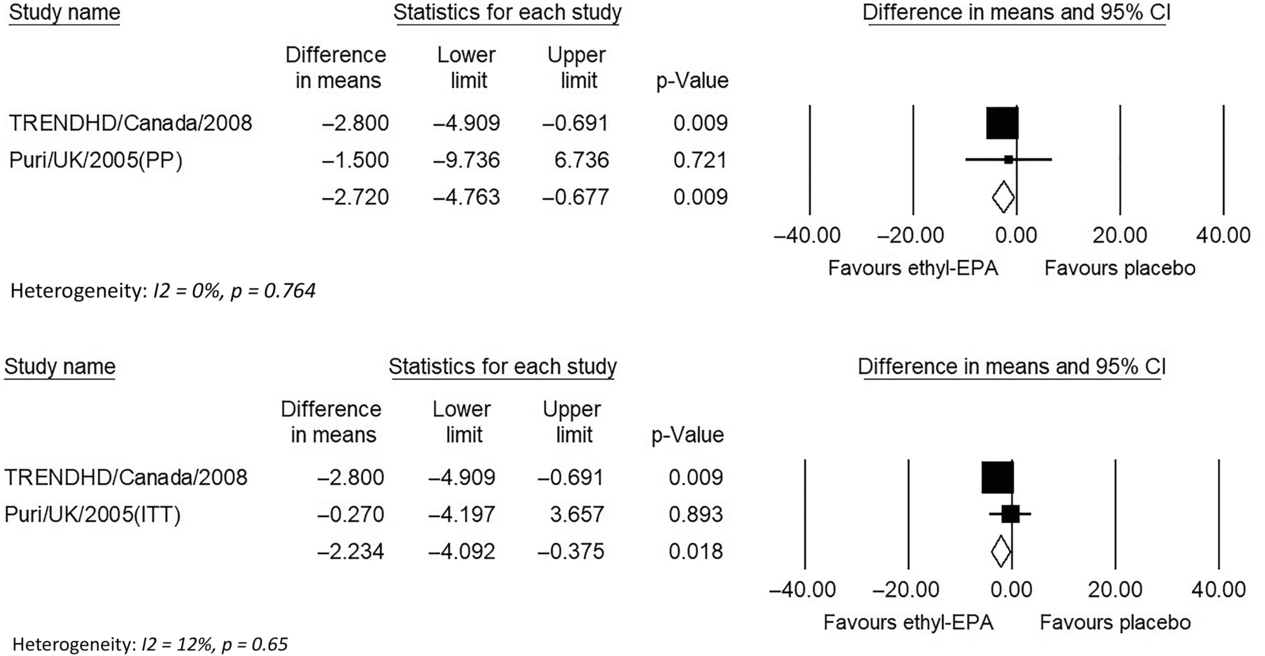
In contrast to the 6-month analysis, the fixed-effect model meta-analysis at 12 months yielded significant results [PP: MD = −2.72, 95% CI (−4.76, −0.68), p = 0.009; ITT: MD = −2.23, 95% CI (−4.09, −0.38), p = 0.018] with no significant heterogeneity [p = 0.764, I 2 = 0%; Fig 4(A) and (B)].
Fixed effect meta-analysis of the mean difference of scores of total motor score (TMS) between placebo and ethyl-EPA at 12 months. Each study is represented by points which have a size corresponding to its weight in the analysis. Mean and 95% confidence interval (C.I) are used for the overall effect size represented by diamond. We did a separate analysis for per protocol (A) and intention to treat analysis (ITT, B) used in Puri et al. (Reference Puri, Leavitt, Hayden, Ross, Rosenblatt, Greenamyre, Hersch, Vaddadi, Sword, Horrobin, Manku and Murck2005).

Post hoc analysis
Despite the significant results of the fixed-effect model meta-analysis of TMS after 12 months, we did a post hoc analysis because the TREND-HD study constituted 86% of the weight in the meta-analysis. The TREND-HD (Huntington Study Group TREND-HD Investigators, 2008) study has both attrition and detection bias as it included a 6-month open-label phase. We did a quality effect model meta-analysis that takes into consideration the quality of included studies. In case of the PP group, MD was −2.36 with 95% CI (−0.56, −4.48), while for the ITT group, MD was −1.96 with 95% CI (−0.004, −3.92).
Total Motor Score–4 (TMS-4)
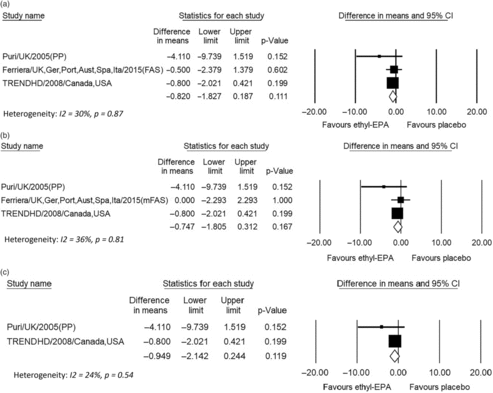
TMS-4 is a shortened version of the TMS that was used for the assessment of motor improvement in three studies (Siesling et al., Reference Siesling, Zwinderman, van Vugt, Kieburtz and Roos1997). Pooling of these studies at 6 months did not show any significant improvement of the score in the treatment group compared with the placebo group [MD = −0.82, 95% CI (−1.83, 0.19), p = 0.11; Fig. 5(A)]. Sensitivity analysis yielded the same insignificant results (Fig. 5 and Supplementary Fig. 2).
Meta-analysis of the mean difference of scores of shortened version of total motor score (TMS-4) between placebo and ethyl-EPA at 6 months. Each study is represented by points which have a size corresponding to its weight in the analysis. Mean and 95% confidence interval (C.I) are used for the overall effect size represented by diamond. We did a separate analysis for (A) only per protocol analysis (PP) of Puri et al. (Reference Puri, Leavitt, Hayden, Ross, Rosenblatt, Greenamyre, Hersch, Vaddadi, Sword, Horrobin, Manku and Murck2005), and full set analysis (FAS) of Ferreira et al. (Reference Ferreira, Rosser, Craufurd, Squitieri, Mallard and Landwehrmeyer2015) , (B) only per protocol analysis (PP) of Puri et al. (Reference Puri, Leavitt, Hayden, Ross, Rosenblatt, Greenamyre, Hersch, Vaddadi, Sword, Horrobin, Manku and Murck2005) and modified full set analysis (mFAS) of Ferreira et al. (Reference Ferreira, Rosser, Craufurd, Squitieri, Mallard and Landwehrmeyer2015), and (C) only per protocol analysis (PP) of Puri et al. (Reference Puri, Leavitt, Hayden, Ross, Rosenblatt, Greenamyre, Hersch, Vaddadi, Sword, Horrobin, Manku and Murck2005).

At 12 months, TMS-4 showed a significant improvement for the treatment group compared with the placebo group [MD = −2.225, 95% CI (−3.842, −0.607), p = 0.007] with no significant heterogeneity detected (p = 0.293, I 2 = 9%) in the case of the PP analysis [Fig. 6(A)]. When only including the ITT analysis with the other study, the mean difference was −1.831 [95% CI (−3.427, −0.235), p = 0.025] with no detected heterogeneity [p = 0.502, I 2 = 0%; Fig. 6(B)].
Fixed effect meta-analysis of the mean difference of scores of shortened version of total motor score (TMS-4) between placebo and ethyl-EPA at 12 months. Each study is represented by points which have a size corresponding to its weight in the analysis. Mean and 95% confidence interval (C.I) are used for the overall effect size represented by diamond. We did a separate analysis for per protocol (A) and intention to treat analysis (ITT, B) used in Puri et al. (Reference Puri, Leavitt, Hayden, Ross, Rosenblatt, Greenamyre, Hersch, Vaddadi, Sword, Horrobin, Manku and Murck2005).

Post hoc analysis
The quality effect model meta-analysis yielded the same significant results. For the PP analysis, the mean difference was −2.58 with 95% CI (−0.62, −4.54); for the ITT analysis, the mean difference was −1.64 with 95% CI (−0.32, −3.60).
Maximal chorea score
The score did not improve significantly after 6 months in patients receiving ethyl-EPA compared with placebo [MD = 0.345, 95% CI (−0.907, 0.218), p = 0.23] with no heterogeneity [p = 0.55, I 2 = 0%; Supplementary Fig. 3(A)], while it significantly improved in the ethyl-EPA group after 12 months [MD = −1.013, 95% CI (−1.793, −0.233), p = 0.011] with no heterogeneity [p = 0.423, I 2 = 0%; Supplementary Fig. 3(B)].
Post hoc analysis
Unlike the fixed-effect model, the quality effect model yielded insignificant results [mean difference = −0.99, 95% CI (0.97, −2.95)].
Stroop colour naming
At 6 months, no significant improvement was observed in patients receiving ethyl-EPA compared with the placebo group [MD = −0.496, 95% CI (−1.415, 0.423), p = 0.290] with no detected heterogeneity [p = 0.698, I 2 = 0%; Supplementary Fig. 4(A)]. Unlike other outcomes, the Stroop colour naming test score did not improve after 12 months [MD = −0.781, 95% CI (−2.382, 0.820), p = 0.339] with no significant heterogeneity [p = 0.698, I 2 = 0%; Supplementary Fig. 4(B)].
Symbol digital modality
Patients receiving ethyl-EPA did not improve significantly after 6 months compared to the placebo group [MD = −0.496, 95% CI (−1.415, 0.423), p = 0.290].
Clinical global impression scale
There was no significant improvement nor change in the symptoms or signs of the included patients in the ethyl-EPA group compared with the placebo group [RR = 1.056, 95% CI (0.78, 1.44), p = 0.73; RR = 0.9, 95% CI (0.76, 1.07), p = 0.24], respectively [Supplementary Fig. 5(B)]. Moreover, there was no significant risk for worsening of symptoms and signs in patients receiving ethyl-EPA compared with those receiving placebo [RR = 1.183, 95% CI (0.861, 1.627), p = 0.3; Supplementary Fig. 5(B)].
Adverse events
There are reported side effects in three studies (Murck & Manku, Reference Murck and Manku2007; Titova et al., Reference Titova, Sjögren, Brooks, Kullberg, Ax, Kilander, Riserus, Cederholm, Larsson, Johansson and Ahlström2013; Waitzberg & Garla, Reference Waitzberg and Garla2014). Only one study reported the side effects at 6 and 12 months (Huntington Study Group TREND-HD Investigators, 2008), while others reported side effects at 6 months.
Diarrhoea, fall, nasopharyngitis, and depression were reported in the three studies (Murck & Manku, Reference Murck and Manku2007; Titova et al., Reference Titova, Sjögren, Brooks, Kullberg, Ax, Kilander, Riserus, Cederholm, Larsson, Johansson and Ahlström2013; Waitzberg & Garla, Reference Waitzberg and Garla2014). There was no significant difference between ethyl-EPA and placebo regarding the risk for diarrhoea, fall, nasopharyngitis, and depression (Supplementary Fig. 6) at 6 months with a risk ratio of 0.92 (0.561, 1.493), 0.385 (0.140, 1.062), 1.486 (0.604, 3.661), and 1.218 (0.62, 2.41), respectively, with no significant heterogeneity (p = 0.70, I 2 = 12%).
No study reported specific side effects related to ethyl-EPA. Other reported side effects are summarised in Supplementary Table 2.
Qualitative synthesis
Puri et al. was excluded from the analysis because they used only MRI to assess the efficacy of ethyl-EPA unlike other studies in the analysis that used UHDRS subscales (Puri et al., Reference Puri, Bydder, Manku, Clarke, Waldman and Beckmann2008).
The Puri et al. study demonstrated how ethyl-EPA affected cerebral atrophy in HD patients (Puri et al., Reference Puri, Bydder, Manku, Clarke, Waldman and Beckmann2008). The study performed double-blinded sagittal three-dimensional T1 MRI for imaging of local and global brain atrophy in both ethyl-EPA and placebo groups at baseline, 6 months, 1 year of follow-up. They found a significant decrease in progressive brain atrophy at 6 months in ethyl-EPA-treated patients [mean change =−0.32, standard error (SE) = 0.15] versus placebo-treated patients (mean change = − 0.615, SE = 0.081, p < 0.05); however, in the second 6 months, the change in both arms was the same. Surprisingly, the overall reduction in global brain atrophy after 1 year of treatment in ethyl-EPA-treated patients was insignificant (mean change = −0.75, SE = 0.23) versus placebo-treated patients (mean change = −1.22, SE = 0.2, p < 0.06). The local analysis revealed a reduction of regional atrophy at the head of caudate nucleus and posterior thalamus after 1 year compared with the baseline in ethyl-EPA-treated patients. This was consistent with another study that revealed an increase in the ventricular size in the placebo group as a sign of progressive atrophy compared with the ethyl-EPA group that showed a decreased ventricular size (Puri et al., Reference Puri, Bydder, Counsell, Corridan, Richardson, Hajnal, Appel, Mckee, Vaddadi and Horrobin2002).
Discussion
This study was set out with the aim of assessing the efficacy of ethyl-EPA as an adjuvant treatment for HD. Furthermore, we also investigated how it affects progressive brain atrophy in HD.
The most obvious finding to emerge from the analysis is that the administration of ethyl-EPA for 12 months with a dose of 1–2 g resulted in a significant improvement of scores related to the motor functions of the patient, including the TMS [MD = −2.23, 95% CI (−4.09, −0.38), p = 0.018], TMS-4 [MD = −2.225, 95% CI (−3.842, −0.607), p = 0.007], and the maximal chorea score [MD = −1.013, 95% CI (−1.793, −0.233), p = 0.011]. Contrary to expectations, this study did not find a significant improvement on the scales related to the cognitive function, including Stroop colour naming test and the symbol digital modality test.
Previous literature proved the significance of EPA on the cognitive function in elderly (Titova et al., Reference Titova, Sjögren, Brooks, Kullberg, Ax, Kilander, Riserus, Cederholm, Larsson, Johansson and Ahlström2013; Waitzberg & Garla, Reference Waitzberg and Garla2014; Bauer et al., Reference Bauer, Crewther, Pipingas, Sellick and Crewther2014), but nothing was found to explain why there was no effect on the cognition of HD patients after 12 months. In addition, Puri et al. reported significant worsening of behavioural changes in the ethyl-EPA group versus the placebo group in the ITT analysis (Puri et al., Reference Puri, Leavitt, Hayden, Ross, Rosenblatt, Greenamyre, Hersch, Vaddadi, Sword, Horrobin, Manku and Murck2005). Moreover, after 6 months, ethyl-EPA failed to produce any significant improvement in any scales in the patients.
The improvement in motor function after 12 months is consistent with experimental evidence in mice that indicated that the administration of ethyl-EPA in the YAC128 mouse model improved motor functions (Van Raamsdonk et al., Reference Van Raamsdonk, Pearson, Rogers, Lu, Barakauskas, Barr, Honer, Hayden and Leavitt2005). Van Raamsdonk et al. delivered oral ethyl-EPA for 6 months and found a significant modest improvement in the motor function (Van Raamsdonk et al., Reference Van Raamsdonk, Pearson, Rogers, Lu, Barakauskas, Barr, Honer, Hayden and Leavitt2005). Also, Clifford et al. used essential fatty acid for successfully delaying the progression of motor symptoms in the experimental mice (Clifford et al., Reference Clifford, Drago, Natoli, Wong, Kinsella, Waddington and Vaddadi2002). This is contrary to human studies that only had a significant effect after 12 months (Puri et al., Reference Puri, Leavitt, Hayden, Ross, Rosenblatt, Greenamyre, Hersch, Vaddadi, Sword, Horrobin, Manku and Murck2005; Huntington Study Group TREND-HD Investigators, 2008).
Despite this improvement in the motor score, the improvement failed to have a significant effect on the clinical global or total functional capacity after 12 months. In all RCTs included in our analysis, the authors used semi-subjective UHDRS subscales for the assessment of ethyl-EPA efficacy (Siesling et al., Reference Siesling, van Vugt, Zwinderman, Kieburtz and Roos1998). Motor subscales of UHDRS failed to show any significant improvement after 6 months. The subjective nature of the scale may explain this variability. Vaccarino et al. suggested that scores such as saccade velocity and tongue protrusion had a high probability to be scored 4 or 0 than middle options, while chorea, gait, and rigidity were less scored as high as 3, 4 (Vaccarino et al., Reference Vaccarino, Anderson, Borowsky, Duff, Giuliano, Guttman, Ho, Orth, Paulsen, Sills and Van Kammen2011). Moreover, these scores are less sensitive to changes in motor severity especially in more severe cases (Vaccarino et al., Reference Vaccarino, Anderson, Borowsky, Duff, Giuliano, Guttman, Ho, Orth, Paulsen, Sills and Van Kammen2011). In addition, another study recommended the test to be done annually for follow-up to be sensitive to motor changes (Siesling et al., Reference Siesling, van Vugt, Zwinderman, Kieburtz and Roos1998). However, this evidence is contradicted by other studies that recommended using the UHDRS for research purposes (Huntington Study Group, 1996; Siesling et al., Reference Siesling, van Vugt, Zwinderman, Kieburtz and Roos1998; Klempir et al., Reference Klempir, Klempirova, Spackova, Zidovska and Roth2006). In addition, other trials used the UHDRS after 12 weeks, and it could detect improvement within this short duration (Kenney et al., Reference Kenney, Hunter, Davidson and Jankovic2007; Frank et al., Reference Frank, Testa, Stamler, Kayson, Davis, Edmondson, Kinel, Leavitt, Oakes, O’Neill, Vaughan, Goldstein, Herzog, Snively, Whaley, Wong, Suter, Jankovic, Jimenez-Shahed, Hunter, Claassen, Roman, Sung, Smith, Janicki, Clouse, Saint-Hilaire, Hohler, Turpin, James, Rodriguez, Rizer, Anderson, Heller, Carlson, Criswell, Racette, Revilla, Nucifora, Margolis, Ong, Mendis, Mendis, Singer, Quesada, Paulsen, Brashers-Krug, Miller, Kerr, Dubinsky, Gray, Factor, Sperin, Molho, Eglow, Evans, Kumar, Reeves, Samii, Chouinard, Beland, Scott, Hickey, Esmail, Fung, Gibbons, Qi, Colcher, Hackmyer, McGarry, Klos, Gudesblatt, Fafard, Graffitti, Schneider, Dhall, Wojcieszek, LaFaver, Duker, Neefus, Wilson-Perez, Shprecher, Wall, Blindauer, Wheeler, Boyd, Houston, Farbman, Agarwal, Eberly, Watts, Tariot, Feigin, Evans, Beck, Orme, Edicola and Christopher2016).
For trials assessing ethyl-EPA, the MRI results at 6 months were more reliable than UHDRS motor scores (Puri et al., Reference Puri, Bydder, Counsell, Corridan, Richardson, Hajnal, Appel, Mckee, Vaddadi and Horrobin2002). One of our included studies has assessed the outcome at 6 months by both MRI and UHDRS (Puri et al., Reference Puri, Bydder, Counsell, Corridan, Richardson, Hajnal, Appel, Mckee, Vaddadi and Horrobin2002). MRI was more sensitive and reliable to brain changes at 6 months.
Puri et al. investigated the effect of the number of CAG repeats on the significant motor outcome and found that ethyl-EPA has more significant effect on patients with lower CAG repeats than those with high CAG repeats (Puri et al., Reference Puri, Leavitt, Hayden, Ross, Rosenblatt, Greenamyre, Hersch, Vaddadi, Sword, Horrobin, Manku and Murck2005). They suggested that ethyl-EPA may be beneficial for patients with low CAG repeats and delayed onset, which needs further investigation.
The studies included in the analysis were assessed for bias that may affect the interpretation of results. Twelve-month results of the TREND-HD study (Huntington Study Group TREND-HD Investigators, 2008) were including a 6-month open-label phase. This could lead to attrition and detection bias. Detection bias was excluded by investigators because the improvement occurred only in the ethyl-EPA group, not in the placebo, but still the results remained inconclusive. Puri et al. (Reference Puri, Leavitt, Hayden, Ross, Rosenblatt, Greenamyre, Hersch, Vaddadi, Sword, Horrobin, Manku and Murck2005) did not report how they performed sequence generation. No detectable bias were found in other studies. That’s why our results should be interpreted cautiously especially at 12 months.
Our hypothesis implied that this improvement is not only symptomatic but also related to the delayed direct effect of ethyl-EPA on brain atrophy as evidenced by the double-blinded MRI studies that become apparent after 12 months (Puri et al., Reference Puri, Bydder, Counsell, Corridan, Richardson, Hajnal, Appel, Mckee, Vaddadi and Horrobin2002, Reference Puri, Bydder, Manku, Clarke, Waldman and Beckmann2008).
These two double-blinded studies suggest that there was a significantly less regional atrophy at the head of caudate nucleus and posterior thalamus in patients receiving ethyl-EPA compared with patients receiving placebo (Puri et al., Reference Puri, Bydder, Counsell, Corridan, Richardson, Hajnal, Appel, Mckee, Vaddadi and Horrobin2002, Reference Puri, Bydder, Manku, Clarke, Waldman and Beckmann2008).
Ethyl-EPA interferes with different reported mechanisms of neuronal degeneration of HD (Supplementary Fig. 7). A possible mechanism is activated immune response releasing cytokines, mainly interleukins, that activate apoptotic pathways that will eventually result in neuronal death, especially striatal cells (Cowan & Raymond, Reference Cowan and Raymond2006). These mechanisms are interfered by the strong anti-inflammatory effect of ethyl-EPA. In addition, EPA can protect neuronal cells by inhibiting interleukin-1-induced hippocampal cell apoptosis (Lynch et al., Reference Lynch, Moore, Craig, Lonergan, Martin and Lynch2003; Kawashima et al., Reference Kawashima, Harada, Kami, Yano, Imada and Mizuguchi2010).
Another mechanism implicated in neuronal death in HD is activation of the c-Jun N-terminal pathway (JNK pathway), which is considered one of the main pathways involved in neuronal death (Liu, Reference Liu1998; Yasuda et al., Reference Yasuda, Inoue, Hirabayashi, Higashiyama, Yamamoto, Fuyuhiro, Komure, Tanaka, Sobue, Tsuchiya, Hamada, Sasaki, Takeda, Ichijo and Kakizuka1999; Lynch et al., Reference Lynch, Moore, Craig, Lonergan, Martin and Lynch2003). This pathway is either activated by glutamate-mediated excitotoxicity on N-methyl-D-aspartate receptors, by inflammatory cytokines or by nuclear polyglutamine aggregates (Cowan & Raymond, Reference Cowan and Raymond2006; Estrada Sanchez et al., Reference Estrada Sanchez, Mejia-Toiber and Massieu2008). EPA was found to interfere with the above-proposed mechanism of neuronal degeneration of HD. It acts against many cytokines and lipopolysaccharides-induced activation of the JNK pathway (Zhao & Chen, Reference Zhao and Chen2005). It can also decrease the activity of AP-1 and p53 in epidermal and mesangial cells, but its effect on the pathology of the brain is still inconclusive (Liu et al., Reference Liu, Bibus, Bode, Ma, Holman and Dong2001). Experimental studies proved that EPA acts as a precursor of brain phospholipids (Philbrick et al., Reference Philbrick, Mahadevappa, Ackman and Holub1987; Block et al., Reference Block, Dorsey, Beck, Brenna and Shoulson2010), which is depleted by abnormal levels of the Huntingtin protein (Block et al., Reference Block, Dorsey, Beck, Brenna and Shoulson2010). A study proved its effectiveness in relieving oxidative stress in the mitochondria (Hsu & Yin, Reference Hsu and Yin2016).
In addition to its effect on brain atrophy, there was no significant side effects in the ethyl-EPA group, making it a perfect candidate for long-term therapy.
Recommendations for further trials
We recommend more trials to test the effect of EPA as a preventive treatment in prodromal HD to delay the onset of the disease. The effect of ethyl-EPA on brain atrophy should not be ignored, and more studies should be done. More trials with larger sample size and longer duration of treatment are needed to assess the real efficacy of ethyl-EPA after 12 months.
Limitation of the review
We faced some limitations during the study. Firstly, the few number of RCTs performed and small samples of the included studies led to a decreased power of the analysis and the inability to achieve conclusive results. Another limitation was that a small number of studies continued the trial for 12 months. More studies with larger sample sizes are needed to prove its effectiveness and to assess if these brain improvements will take time until it becomes evident on the clinical profile of patients, and if this is the cause of significant improvement only at 12 months not at 6 months.
Conclusion
Our results indicated a significant improvement in motor scores only after 12 months with no effect on other scales. However, these results should be interpreted cautiously.
Supplementary material
To view supplementary material for this article, please visit https://doi.org/10.1017/neu.2019.11.
Acknowledgements
We would like to thank the reviewers for their efforts to improve the manuscript.
Author contributions
NTH, KH: Principal investigators, revised the analysis and data and reviewed the manuscript
SM, NTH, KH: Formulation of the research idea
DSME-B, HIAH, AAE, CTAN, NPD, SM, MFD, SMK: Screening, extraction, quality assessment, characteristics table
SM, MG, SMK: Statistical analysis
SM: Post-hoc analysis, writing and figures
MFD, MG, SMK: Review and critique of writing.
Financial support
No funding was received for this study.
Conflict of interest
None