Like all American colonies, Massachusetts suffered from a chronic coin shortage in the seventeenth century. After its mint was closed by the Crown around 1684, and before issuing public paper money in 1690, there was an attempt to use a note-issuing private bank as the solution. An elaborate land bank scheme was imported in 1685 from England. It was promoted by the government in 1686, progressed privately in 1687, but was mysteriously aborted in 1688 after already experimenting with actual note printing.
Most scholars of the early American economy, including Andrew McFarland Davis, Joseph Dorfman, and Bernard Bailyn, tried to solve the following puzzle: why did the bank scheme collapse? Their explanations relate to economic, personal, political, and constitutional issues, but the decisive, specific events they have focused on had happened at least ten months before the bank was aborted. I evaluate these explanations in detail at the end of the article after telling the whole story.
Instead, I suggest a causal relation to a dramatic event that happened on July 12th, 1688, just four days before the bank was aborted: a direct attack by the royal governor on notable landowners, in which they were prosecuted for supposedly invading the Crown's land. I provide narrative evidence and quantitative evidence that this unprecedented attack shocked the colonists and sent them a message that all their land titles were worthless. Given that the bank was a land bank, I suggest that the governor's land policy was the reason for the collapse of the bank scheme. The invalidation of land titles turned Massachusetts land into what Hernando de Soto calls “dead capital,” which is capital that due to legal reasons cannot enter the financial system as a mortgage.Footnote 2
THE DOMINION OF NEW ENGLAND
In 1684 the Massachusetts Bay Company lost its charter.Footnote 3 Based on the English experience of the Interregnum and Restoration, the constitutional change made the colonists nervous about their land titles.Footnote 4 Towns and individuals obtained backup deeds from Native Americans,Footnote 5 while the Massachusetts General Court confirmed the titles that it and its towns had given. The court's very last act before expiring was to secure papers “such as refer to our title of our land, by purchase of Indians or otherwise.”Footnote 6
In May 1686 Massachusetts became the core of the Dominion of New England. Its royally appointed council had all the legislative, executive, and judicial authority. A local president, former magistrate Joseph Dudley, ruled until the arrival of a permanent governor.Footnote 7 Dudley appointed as his deputy his business partner, former magistrate William Stoughton.Footnote 8 In their private capacity, they were heavily involved in speculation on the vast lands occupied in King Philip's War (1675/76). Since most councilors were land speculators, it has been argued that they joined the council only to affect their titles.Footnote 9 Dudley and Stoughton found a new speculation partner in Captain John Blackwell, a distinguished Puritan and a real estate expert, who had just emigrated from England.Footnote 10
THE BANK
The Crown forced the colony to close its mint in approximately 1684. The resulting coin shortage was so severe that one town paid taxes in milk pails.Footnote 11 Blackwell had brought with him a bank scheme from England. Footnote 12 It was part of an English land banking movement, which began in 1650 and climaxed with the failed land banks of 1695/96. Footnote 13 The basic idea was to enable business loans upon mortgaged land on a regular basis. Footnote 14 These loans, at a 4 percent interest rate, were to be given in banknotes of 20 shillings or more.Footnote 15 The notes would help to ameliorate the liquidity problem, even if not for the smallest transactions. The bank was similar to a pawn shop, only that it would issue its own money and accept mostly land titles and some goods. This is not a coincidence, as the idea of land banks developed from the Italian pawn shops known as lombards.Footnote 16
To ensure a limit on the supply of notes, the bank's managers were to issue notes to only half or two-thirds of the market value of the deposited assets, thus taking into account large potential price drops. The managers would be supervised by directors. Both the managers and directors would be highly reputable businessmen of unquestionable personal creditworthiness. Indeed, the political and economic elite of Boston was recruited as partners in the bank. They would deposit £500 of their own real assets, creating a fund to compensate note holders if something went wrong.Footnote 17 Thus, the bank had mortgaged land titles and goods for its main assets, balanced by banknotes for liabilities and partners' equity.Footnote 18 Moreover, since it would be a partnership, the partners would all be jointly liable for all losses, so all of their own properties would be at risk. Therefore, they would have an incentive to make sure that the bank was well managed. The bank would also employ accountants, appraisers, and a lawyer, who could increase its credibility.Footnote 19
With this bound on the supply of notes, they would be valued in equilibrium if demand for the notes could be guaranteed. However, the nature of land made it impractical to make each note redeemable on demand like a contemporary London goldsmith note. Normally, the bank would redeem notes in coin only if it happened to have coin but it would not try to obtain any. Coin would have been obtained if borrowers repaid loans in coin or if buyers of foreclosed assets paid in coin. Redemption was assured only in case of liquidation.Footnote 20 This was a serious deficiency, and all land bank proposers tried to heap on their notes any demand they could. These ideas, like all seventeenth-century economic theories, were quite shaky. Moreover, there was not yet any successfully working example of a land bank anywhere.
The basic demand for notes was to come from borrowers who sought the return of their mortgaged assets. The bank would receive its own notes in loan repayments. Borrowers would prefer to get rid of notes instead of coin. The bank would discourage coin repayments with a 2 percent penalty. This, thought the bank partners, would encourage coin holders to voluntarily exchange coin for notes before paying the bank; thus note holders seeking coin would have someone with whom to make an exchange.Footnote 21 Such demand by borrowers could inspire general circulation in the same way that making paper money legal tender can inspire circulation. Even someone who doesn't need to pay a debt will accept the banknotes because he could use them to buy from a seller who does have a debt.Footnote 22 The bank would also accept notes when selling foreclosed assets. It would also broker a note-coin exchange market and encourage people to sign a contract that compelled them to sell goods for notes.Footnote 23
The bank was mainly based on land, with mortgaged goods being secondary. Only after landowners got currency could they hire labor, buy materials, and start production; later they could deposit produce in the bank and redeem the land.Footnote 24 The partners had to deposit land for at least 60 percent of their £500.Footnote 25 Land was better than goods (or coin) also because it was more durable, harder to steal, and its titles were easier to store.Footnote 26
Dudley's Council, which made Blackwell head of a trade committee, made the future notes legal tender for debts and taxes.Footnote 27 The power of such a mechanism in creating demand for money was well-known.Footnote 28 The council's support is not surprising given that Blackwell made Dudley and Stoughton bank directors. Another director was Councilor Wait Winthrop, a major land speculator and grandson of a legendary governor. Footnote 29
A NEW LAND POLICY
In December 1686 a royal governor arrived. Sir Edmund Andros's royal commission left the council intact and made Dudley his deputy. His commission and instructions mentioned that some unspecified land was either not disposed, or not granted in accordance with English law and thus in need of title confirmation. Andros was also required to examine the largest speculative land ventures.Footnote 30
Andros used these instructions to launch a total attack on all land titles. He first recommended that England reject the speculators' claims. Footnote 31 Moreover, he ruled that all titles were invalid. The land was granted by the Crown with the charter and reverted to the Crown when the charter was revoked. Native American deeds were deemed worthless, as depicted by this article's epigraph. The General Court did not seal its grants. Towns were not incorporated so they had no authority to grant land. Andros demanded that every landowner petition him to have the land surveyed and the title confirmed.Footnote 32 He also attacked non-mortgagable property by ruling that the towns' common lands were up for grabs and by giving Anglicans a foothold in Harvard and the Puritan churches. Footnote 33
Andros did not publicly announce the invalidity of titles, perhaps fearing a revolution.Footnote 34 Acting mostly behind the scenes, he encouraged cronies to lead by example and petition for land surveys, and to petition for shares in the common lands.Footnote 35 In a few home visits, he explained to people why their titles were invalid.Footnote 36 He ruled only on land cases brought before him by others.
The land policy reduced land value in three ways. First, plots with unconfirmed titles were up for grabs. Second, legal fees were very high. Footnote 37 Third, all plots that needed confirmation were liable to quitrents.Footnote 38 These effects can also explain Andros's motives. The colonists (and most historians) accused him of trying to give the colonists' land to his cronies and enriching the cronies with excessive fees. Quitrents would have helped his budget. In that era, colonies were supposed to send money to the Crown, not the other way around. Another possible reason for Andros's behavior was to assert his authority. It was standard in England to petition the Crown for a land grant on Crown lands.Footnote 39
The colonists argued in vain that their long possession and improvement of the land were sufficient to overcome technical defects in titles, that defects could be fixed in a blanket royal confirmation, and that according to English precedents and the Bible, the Native Americans could own and sell land.Footnote 40 Leading land speculators—Councilor Richard Wharton and bank officer Elisha Hutchinson—went to London to lobby for the removal of Andros or the elimination of his policy.Footnote 41 A relative of Dudley and Winthrop, Wharton had been powerful enough to construct the Dominion in the first place. The Lords of Trade in London supported him, so he sent home optimistic letters.Footnote 42 The colonists also thought they controlled the legal system. Dudley and Stoughton were Superior Court judges, while a local man was about to become the Dominion's police chief.Footnote 43 This explains the colonists' optimism. Diarist Samuel Sewall, for example, casually took possession of land he bought in April 1688, with no special concerns or precautions.Footnote 44 No steps were yet taken against those who ignored Andros's demands. The colonists waited patiently for the lobbyists' success. Footnote 45
And so the bank scheme moved forward.Footnote 46 Between April 1687 and January 1688 the partners adopted a constitution and rules, added former magistrate Elisha Cooke as a partner, and may have tried to make Governor Andros himself a partner.Footnote 47 Blackwell wrote a prospectus in 1687 and a very similar one was published in London sometime in 1688.
THE SHOWDOWN
On July 5th, 1688 Andros received a new royal commission as governor. It added New York and the Jerseys to the Dominion of New England, did not overrule his land policy, and ousted Dudley as his deputy and chief judge.Footnote 48 On July 12th the emboldened Andros issued writs of intrusion, prosecuting four rich landowners for illegally possessing the king's land.Footnote 49 They were diarist Sewall, the richest colonist Councilor Samuel Shrimpton, bank partner and former colony treasurer James Russell, and Joseph Lynde (of the epigraph).Footnote 50 They were involved in land disputes with Andros.Footnote 51 The attorney general said that all the rich would be targeted.Footnote 52
The colonists were shocked. One wrote: “Some in power have said that it is not for the king's interest that this people should enjoy it [the land], & if another people had it would be more for the king's interest than now.”Footnote 53 Sewall panicked by the “unexpected assault,” which labeled him one of the “violent intruders into the king's possession.” Reluctantly, he petitioned for surveys with Russell and Lynde. After sending letters and money to the London lobbyists, he joined them and wrote a Member of Parliament:
The title we have to our lands has been greatly defamed and undervalued: which has been greatly prejudicial to the inhabitants, because their lands, which were formerly the best part of their estate, became of very little value, and consequently the owners of very little credit. Footnote 54
The writs led more colonists to petition for surveys. Eleven petitions on July 16th—a daily record in the Andros era—were quickly followed by ten more petitions. This should be compared to a total of only 117 petitions since Andros had arrived 19 months earlier.Footnote 55
The bank relied on “good…unquestionable” titles to land.Footnote 56 Sewall's testimony that land could no longer create credit is a major clue to the land bank's fall. With no real achievement by the lobbyists, and no effective control of the legal system, the writs sealed the bank's fate. It was the first direct and formal attack on titles, making it clear that all titles were worthless. Four days later, on July 16th, right after the Sabbath, Blackwell aborted the bank. In a letter to the partners, he started liquidating the partnership, formally ending it the following month.Footnote 57
The prospectuses allowed deposits of goods at the bank as a partial alternative to land, but the bank could not stand on goods alone. Goods could only be used by some people some of the time and only at a later stage after production started. Moreover, the prospectuses mentioned the high risk of confiscation in a coin-based bank and this applied to goods as well. Under Andros, it was unsafe to put many goods in one place. He confiscated shipwrecks' treasures and oil-rich whales cast on public shores.Footnote 58 One crony suggested confiscating funds of a missionary corporation.Footnote 59 The colonists believed that all their “money, ships, goods, and merchandizes” would be seized by Andros.Footnote 60 Thus, goods alone could not support the bank. Moreover, a main motivation for land banks in general was to raise the value of land.Footnote 61 With land out of the picture, the partners—all of them large landowners—had little incentive to continue. Finally, the partners tied their hands in the prospectuses, arguing that bad deposited land titles would ruin the bank.Footnote 62
With no safe property to back notes, none could be technically issued according to the bank's constitution. Even amending this would not have helped. The legal tender status—unprecedented for private notes—was apparently cancelled by Andros. The 1687 prospectus only mentioned the council's 1686 “allowance and approbation” and spoke vaguely of “taxes facilitated.” The 1688 prospectus did not mention even that, and denied the need for any governmental support.Footnote 63 All that remained was the bank's commitment to accept its unbacked notes, and sellers' voluntary commitment to accept notes. There is no evidence that a contract of the latter type was created. Some local currencies today are successfully based only on such a contract, but the partners had no precedent to rely on.Footnote 64 To summarize, Andros's policies probably led the bank partners to expect that the notes would not be valued at all and thus no one would borrow from the bank. It is possible that they thought people would borrow, but the heavy discounts on all property values would make the whole enterprise unprofitable. Either way, the conclusion was clear.
THE LITERATURE'S EXPLANATIONS
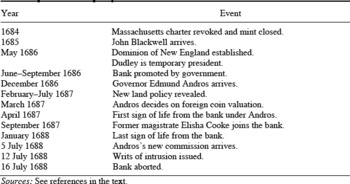
The literature offers many explanations for the bank's fate. One category of explanations says that the bank needed official approval, but Dudley had no authority to charter the bank, and even if he did then Andros's arrival invalidated that.Footnote 65 However, it was a partnership, and thus it needed neither a charter nor any other special approval.Footnote 66 There is also a timing problem. The bank was aborted a year and a half after Andros replaced Dudley at the head of the government (Table 1 lists important events).
TIMELINE OF EVENTS

Sources:
See references in the text.
Another view is that Andros closed the bank for one of the following reasons.Footnote 67 First, Blackwell had a Cromwellian past.Footnote 68 Second, the bank prospectus objected to Andros's policy of keeping the exchange rate artificially high. Third, Cooke, a hard core charter supporter who rejected England's authority, became a bank partner.Footnote 69 Here too, the timing is off. Blackwell's past was already known in 1686; as head of a 1686 trade committee, so was his view on exchange rates; and Cooke joined in September 1687.
Perhaps most importantly, all the above explanations are wrong also because Blackwell's letter to the partners indicates voluntary liquidation: “I perceive you have declined the concerning yourselves any further in the bank affairs.”Footnote 70
Others argue that the bank was aborted because the merchants did not join it.Footnote 71 The merchants preferred to increase the official value of foreign coin as a solution to the coin shortage. If a Spanish coin was worth more in Massachusetts than elsewhere, then people would bring it to Massachusetts. With coin imported, there would be no need for banknotes. However, the timing is wrong because the valuation of foreign coin had been settled in March 1687.Footnote 72 Moreover, the merchants' wish was rejected, so they should not have resisted the alternative solution offered by the bank. Finally, this explanation separates colonists to merchants vs. landowners, but Wharton—leader of the revaluation campaign—was by far the largest land speculator and his relatives led the bank.
CONCLUSION
I offer a new solution to one of the oldest puzzles in American banking history. Backed by both narrative evidence (Sewall's writings) and quantitative data (number of petitions), I argue that John Blackwell's Boston land bank was aborted on July 16th, 1688 because four days earlier the royal governor Sir Edmund Andros launched a harsh, surprising legal attack on important Massachusetts landowners. Andros's powerless councilors, some of whom were bank directors, testified later that he “resolved and practiced to make all men's titles quite null and void.”Footnote 73 The more general lesson is that an attempt to build a strong capital market for lending can be destroyed when uncertainty is created about the property rights to the collateral on which the lending is based.