Candidemia is the fourth most common bloodstream infection in hospitalized patients in the United States, with an attributable mortality rate of 30%–50%. Reference Morgan, Meltzer and Plikaytis1 Understanding candidemia epidemiology is important from clinical and public health perspectives due to its association with significant morbidity, mortality, and high cost of treatment. The proportion of candidemia caused by Candida albicans has been decreasing while non-albicans Candida (NAC), with notable decreased susceptibility to antifungal drugs, are becoming increasingly common. Reference Guinea2 Symptoms of C. albicans and NAC candidemia are indistinguishable and share similar risk factors, Reference Cheng, Yang and Yao3 making definitive diagnosis dependent on blood culture. This factor can delay appropriate antifungal treatment, a factor associated with increased mortality. Reference Morrell, Fraser and Kollef4 Therefore, initiating early effective antifungal therapy guided by local microbiology and epidemiology, including local antibiogram data, can significantly reduce morbidity and mortality. Understanding changing local risk factors for candidemia is also important in developing public health strategies to prevent infection.
In 2019 the Connecticut Department of Public Health (CT-DPH) made candidemia a laboratory-reportable condition and began statewide surveillance in conjunction with the Emerging Infections Program (EIP) through the United States Centers for Disease Control and Prevention. Previously, the EIP conducted statewide population-based surveillance of candidemia in Connecticut from 1998 to 2000. Reference Hajjeh, Sofair and Harrison5 We compared statewide surveillance data from two periods 1998–2000 (legacy cohort) and 2019 (recent cohort) to understand the changing epidemiology of candidemia in Connecticut.
Methods
Adult candidemia cases (age ≥20 years) were identified through statewide active laboratory surveillance at all acute-care hospitals in Connecticut. Standardized case report forms were completed for all incident cases identified. Cases identified within 30 days of the initial positive blood culture were considered duplicates. During both periods, laboratory records of all hospitals were audited every 6–12 months to ensure completeness of case ascertainment. Variables examined in univariate analysis included: species; community or hospital-onset infection; number of comorbid conditions; surgery 3 months preceding positive blood culture; presence of central venous catheter (CVC) and demographic variables. Time from admission to culture date ≥3 days was classified as hospital-onset infection. In-hospital mortality was compared between cohorts. Variables were analyzed at case-level. We used χ Reference Guinea2 tests to analyze difference in proportions between the 2 cohorts. Analyses were performed using SPSS version 25 software (IBM, Armonk, NY). The study qualified as exempt by the Human Investigation Committee of the Connecticut Department of Public Health.
Results
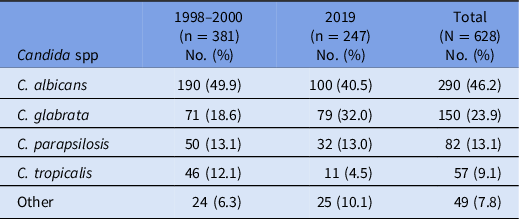
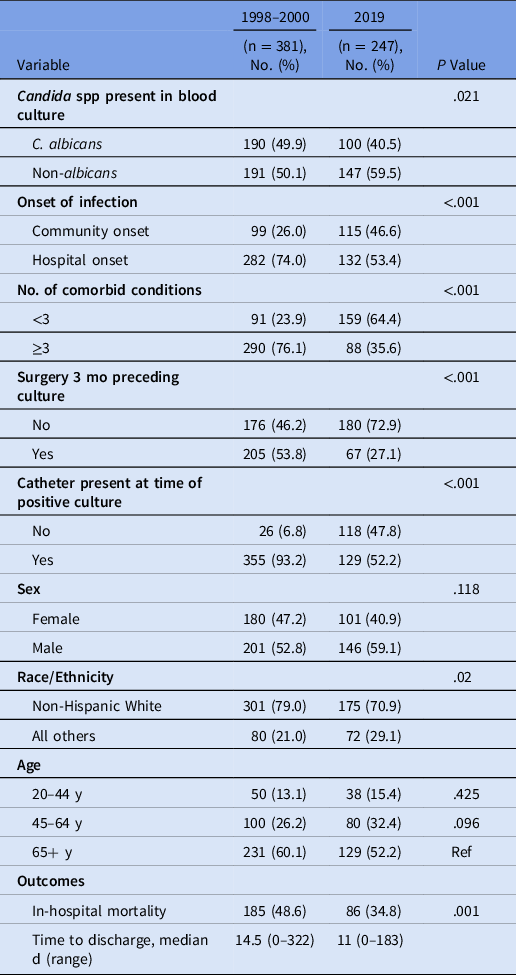
Of 628 candidemia episodes, 381 (61%) were from the legacy cohort (Table 1), with a mean 190.5 cases per year in the legacy cohort. The most frequent isolates were C. albicans (n = 290, 46.2%), followed by C. glabrata (n = 150, 23.9%) and C. parapsilosis (n = 82, 13.1%). Candida albicans was identified among 190 cases (49.9%) in the legacy cohort and 100 cases (40.5%) in 2019 (P = .02) (Table 2). Legacy-cohort cases were more likely to have had surgery (53.8% vs 27.1%; P < .01), a CVC (93.2% vs 52.2%; P < .01), ≥3 medical comorbidities (76.1% vs 35.6%; P < .01), and hospital-onset infection (74% vs 53.4%; P < .01). A greater proportion of legacy cases were non-Hispanic White patients (79.0% vs 70.9%; P = .02).
Candida Species Isolated from Blood Cultures of Candidemia Cases in Connecticut Adults from 1998–2000 and 2019

Note. Adults, aged ≥ 20 years. The legacy period was October 1998–September 2000.
Characteristics and Outcomes of Candidemia in Connecticut Adults, 1998–2000 and 2019

Note. Adults, aged ≥ 20 years.
In-hospital mortality was significantly higher in the legacy cohort (48.6% vs 34.8%; P < .01). The median time from culture to discharge among survivors was 14.5 days (range 0–322 days) in the legacy cohort versus 11 days (range 0–183 days) in the recent cohort.
Discussion
Using statewide active surveillance of 2 cohorts separated by a 20-year period, we describe multiple changes in candidemia microbiology, epidemiology, and outcomes in Connecticut. The increased frequency of NAC in 2019 is consistent with recent trends in North America and Europe but not in South America, which suggests that there are geographic drivers to changes in species distribution such as infection control, antimicrobial prescribing practices, and underlying patient conditions. Reference Giacobbe, Maraolo and Simeon6 Additionally, recent data from the Veterans’ Health Administration revealed similar temporal trends, particularly a reduced incidence of hospital-onset candidemia. Reference Suzuki, Perencevich and Diekema7 Notably, our study’s statewide surveillance data encompassed a broader adult population.
In the recent cohort, fewer cases of candidemia were associated with CVCs and recent surgery. These changes may be attributed to improved infection prevention practices within Connecticut hospitals, although other factors may have contributed. Community-onset candidemia accounted for an increased proportion of candidemia cases in the recent cohort. The increasing intensity of non–hospital-based care, including the growing use of long-term CVCs in ambulatory settings, may influence the rising incidence of community-onset infection.
This shift toward community-onset infections may also be attributable to increasing injection drug use (IDU) in the wake of the opioid epidemic. Prior work using EIP data collected from 2004 to 2014 demonstrated a 76% increase in candidemia hospital admissions attributed to IDU among 9 EIP surveillance sites. Reference Zhang, Shrum and Williams8 IDU-associated cases were associated with lower in-hospital mortality, shorter hospital stays, and had lower proportions of C. glabrata colonization than non-IDU cases. Reference Zhang, Shrum and Williams8 In our surveillance, in-hospital survival among those with candidemia was higher in the recent cohort, and among survivors, hospitalization duration was shorter. Several factors may have contributed to increased survival, including improvement in treatments and changes in patient demographics, notably younger age. Larger studies are needed to evaluate the impact of these variables on mortality to further understand these relationships.
A smaller proportion of patients with candidemia in 2019 were non-Hispanic White race, reflective of changes in the racial and ethnic breakdown of Connecticut residents. According to US Census data, the proportion of Connecticut residents who identified as White race dropped from 81% in 2000 to 67% in 2019. This is similar to what we observed among the 2 cohorts in which 79% of legacy cases identified as non-Hispanic White race compared with 71% among recent cohort cases. Further study is needed to understand racial and ethnic disparities associated with candidemia.
This study had several limitations. Data on IDU history and antifungal susceptibility testing were not consistently collected and could not be analyzed. Additionally, over the 2 decades between surveillance periods, advances in laboratory methods, antifungal treatment and prophylaxis, and disease management and treatment guidelines may have influenced the epidemiology and patient outcomes in this study. Evaluating the influence of these variables will be critical for future clinical and epidemiological studies of candidemia. Although our study encompasses a broad population through statewide surveillance, the characteristics and outcomes of patients with candidemia in Connecticut may not be generalizable to all geographical areas, particularly those outside the United States.
The impact of the coronavirus disease 2019 (COVID-19) pandemic, which occurred after our data collection, may have influenced the epidemiology of candidemia and the outcomes of patients with candidemia in Connecticut. Early data suggest that COVID-19 infection occurred frequently in patients with candidemia during the early phase of the pandemic. Reference Seagle, Jackson and Lockhart9 Additionally, the rate of CVC-associated bloodstream infections in the United States increased during the COVID-19 pandemic, Reference Weiner-Lastinger, Pattabiraman and Konnor10 which likely resulted in increased CVC-associated candidemia. Further study on the impact of the COVID-19 pandemic on candidemia epidemiology and outcomes is warranted.
Our analysis of statewide surveillance supports that the epidemiology and outcomes associated with candidemia in Connecticut have changed significantly over the last 20 years. Ongoing evaluation of the changing epidemiology of candidemia at the local, state and national levels will be critical in both preventing these infections and optimizing clinical management when these infections occur.
Acknowledgments
The contents of this manuscript are solely the responsibility of the authors and do not necessarily represent the official views of CDC.
Financial support
The CT Emerging Infections Program was supported by the Centers for Disease Control and Prevention (CDC Cooperative Agreement No. NU50CK000488).
Conflicts of interest
The authors report no conflicts of interest relevant to this article.