Maybe we should take a step back to consider the implications of employing concepts intricately intertwined with the oppressive history of Blacks in the United States, and measures developed during a time of civil rights activism, civil strife, and racial conflict between white and black Americans…. Scholars should acknowledge potential problems in their [concept] transference and be systematic in testing whether these measures are measuring the latent characteristic of other groups as they have for African-Americans.
(McClain et al. Reference McClain, Carew, Walton and Watts2009, 479).For decades, scholars and political actors have noted Blacks' political homogeneity despite growing social and economic heterogeneity. African-Americans' consistent policy liberalism and strong loyalty to the Democratic party affect national and local elections, help to maintain whatever progressive politics survive in the United States, sustain advocacy organizations, and provide the basis for an active and mostly united Congressional caucus. Why have well-off Blacks seldom become more socially, economically, and politically conservative as they became upwardly mobile or as their children grew up in the middle class? That, after all, was the pattern for non-Hispanic Whites as generations moved during the twentieth century from, for example, despised immigrants to lace-curtain Irish to Reagan Democrats to Republicans.
A standard answer has been that Black political homogeneity results from the unusually strong perception that, due to historical and contemporary experiences of group disadvantage and discrimination, one's own life chances depend heavily on the status and fortunes of Black Americans as a whole. That perception has led, in turn, to the rational substitution of group utility for individual utility in political decision-making, and often to a strong moral and emotional commitment to the group. In Behind the Mule, Michael Dawson formalized these connections through the concept of linked fate, which he operationalized in a pair of survey items (Dawson Reference Dawson1994). Those items are now canonical, having been asked of many samples in many surveys; over time, the items themselves became the inferential target.
But the theory of linked fate opens new questions even as it answers old ones. Is it unique to Black Americans, as the epigraph from McClain and her co-authors suggests? Or can the theory or its measurement be appropriately extended to other racial and ethnic groups, and even to non-racial social statuses such as gender or class? The few empirical applications of linked fate theory to cases other than Black racial identity have at times yielded puzzling results that sharpen these questions. For example, large majorities of survey respondents of all races or ethnicities report a sense of linked fate with the broad category of “other people in this country” (see the discussion below of the 2012 American National Election Study [ANES]); the seeming ease with which expressions of linked fate can be elicited is difficult to reconcile with its conceptualization as a deep group attachment with significant cognitive and emotional effects. But the research to date makes it impossible to fully understand the source, prevalence, political salience, or underlying meaning of linked fate beliefs throughout the American public. Nor, for that matter, can we understand even Black racial linked fate if we view it in isolation both from linked fate among non-Black groups, and from Black Americans' sense of linked fate with non-racial social statuses. In short, to understand how best to operationalize the concept of linked fate and to locate extant findings in their empirical context, we must examine it comparatively and simultaneously, across racial and ethnic groups and across social categories. That is the task of this paper.
This new examination of linked fate could yield one of two conclusions. Blacks might indeed be unique in the intensity and political salience of their sense of racial linked fate, as their history in the United States might lead one to believe. Alternatively, Blacks' racial linked fate might not be particularly distinctive in comparison with that of other groups or social statuses, or in comparison with Black Americans' own ties to other, non-racial identities. The latter finding would call into question the ways in which we measure Black racial linked fate, and how it affects Black political behavior.
We address those issues through original survey data probing linked fate beliefs among a large, multi-ethnic, and nationally representative sample of adult Americans. Respondents were asked the canonical item about racial or ethnic linked fate, as well as a variant addressing linked fate based on gender, class, or religion. What emerges from this analysis is a map of linked fate whose most striking feature is similarity across groups and identities. As a few other surveys have found, Blacks are not alone in their feelings of linked fate; Whites, Asians, and Hispanics also express high levels of racial linked fate. Moreover—and to our knowledge, this comparison is the first of its kind—Black racial linked fate is part of a constellation of beliefs that includes an equally strong sense of linked fate with class identity, and a substantial though lesser sense of linkage with others of the same gender or religion. Finally, in this survey at least, these beliefs, though widespread and robust, are rarely politicized and not consistently associated with disadvantaged social status. The most important of these results, although not all, are largely replicated in a smaller, opt-in survey.
We begin by briefly reminding readers of the historical and political roots of the concept of linked fate. We then move to a review of the scholarly literature on perceptions of linked fate across racial and ethnic groups and on links between such perceptions and political views or behavior. We then describe the primary data source and measures. Next, we report results on the prevalence of linked fate. That analysis has four foci: absolute levels and comparisons across racial and ethnic groups; a comparison of racial or ethnic linked fate with perceived linkages by class, gender, or religion; the (minimal) association between perceptions of linked fate and political views or behavior; and the lack of association with social status and the tendency toward high intra-individual consistency. Where appropriate, we compare our central findings with results in other surveys. Finally, we discuss the results and conclude with a reconsideration of the measurement of linked fate and suggestions for future research.
CURRENT KNOWLEDGE ABOUT LINKED FATE AND ITS POLITICAL ASSOCIATIONS: THREE THEMES
Groups figure prominently in the study of American politics, in which scholars routinely link individuals' political preferences to their group memberships and the psychological attachments and predispositions these memberships may generate. Such attachments begin most broadly with a sense of “group identity,” that is, the basic feeling of belonging that transforms objective group membership into a subjective reality with measurable cognitive and emotional effects. Identification, often operationalized with survey items that assess feelings of “closeness” to particular groups, (re)defines what the individual considers personally relevant and valuable. Perceptions of linked fate are conceptualized as representing a more developed stage of identification, a deepening of group attachments to include a belief that one's life chances are inextricably tied to the group. Whereas all but the most extreme social isolate may feel some sense of group identity, and whereas a group identity may emerge from any number of group memberships (e.g., dog owners, cyclists, and gourmands), feelings of linked fate are, in theory, more selective in their prevalence in the population and in the set of groups capable of eliciting this deeper connection. When psychological attachment extends beyond group identity to cognizance of shared interests with others in that group, the theory predicts that an individual is more likely to think and behave in ways that distinguish members of her group from non-members or from members who merely identify with the group label. Feeling bound by membership and not simply “close” to members, in sum, is an important antecedent to cooperation and giving priority to group objectives.
African-Americans in particular have a rich history of feeling bound by membership. From David Walker's 1829 Appeal to the Colored Citizens of the World to join in opposing slavery and abasement, through Martin Delaney's and Frederick Douglass's call for Blacks to collectively assert their rights and even nationhood, spokespeople have always seen group unity as a crucial weapon in the fight against racism and discrimination. They were joined in the twentieth century by churches, mosques, advocacy organizations, and political leaders, all of whom promoted shared commitments and a common identity. Political protest over police killings during the past few years has reinvigorated the tradition of Black racial solidarity, even while recognizing and welcoming non-Black coalitional and emotional alliances. In its broadest compass, the academic study of Black linked fate is an effort to capture the intermingled instrumental value and emotional ties that are implicit in the idea of racial solidarity.
It is not surprising then, that the concept of “linked fate” has become a focal point of political science research on the salience of groups in voting behavior, political activism, and public opinion. The keywords “linked fate” return 1,410 separate items in Google Scholar as of June 6, 2015.Footnote 1 Obviously, not all are relevant to this endeavor and one could not review even all that are relevant. Nevertheless, even cut by half or two-thirds, that figure suggests the breadth of use of this concept. To establish a base of knowledge on which to build our research, we reviewed roughly 60 articles, books, and book chapters of most relevance to political scientists. The review identified three dominant themes, each of which points to an element of the empirical investigation in this paper.
First and most basically, substantial shares of non-WhiteFootnote 2 survey respondents, especially African-Americans, express a sense of racial or ethnic linked fate. In seven surveys from 1984 through 2008, from 60% to 83% of Blacks perceived some level of racial commonality, with lower proportions in the 2000s compared with earlier decades (McClain and Stewart Reference McClain and Stewart2013). These surveys were either specific to African-Americans or had large Black samples and a strong focus on racial issues.Footnote 3 Three general population surveys find similar results; 80% of Blacks in the 2004 ANES, and 65% of Blacks in both the 2008 and 2012 ANES, agreed that “what happens to black people in this country will have something to do with what happens in your life.”
Fewer surveys have asked non-Black respondents about linked fate. Nonetheless, surveys show a sense of linked fate, sometimes at lower levels, among Asian-Americans (Junn and Masuoka Reference Junn and Masuoka2008; Kim and Lee Reference Kim and Lee2001; Lien et al. Reference Lien, Conway and Wong2004, 48–49; Masuoka Reference Masuoka2006), Latinos (Burnside and Rodriguez Reference Burnside and Rodriguez2009; Sanchez Reference Sanchez2006; Sanchez and Masuoka Reference Sanchez and Masuoka2010; Segura Reference Segura2012), Muslim Americans (Barreto et al. Reference Barreto, Masuoka and Sanchez2008), and occasionally Whites (White Reference White2007). In the 2012 ANES, 52% of Latinos and 62% of Whites agreed, as compared with 65% of Blacks, that their own life chances depend at least partly on the fortunes of their racial group. Results were similar for Latinos in the 2008 ANES, and slightly higher for a small sample in 2004.Footnote 4 A few researchers have taken the concept outside the United States, and found roughly similar proportions of non-Whites perceiving linked fate (Chen Reference Chen2012; Sawyer et al. Reference Sawyer, Peña and Sidanius2004).
Scholars who have looked beyond the basic distribution of linked fate beliefs have found nuance within these proportions. Among Blacks, the sense of linked fate varies by gender (Dawson Reference Dawson1994; Gay and Tate Reference Gay and Tate1998; Masuoka Reference Masuoka2006; Simien Reference Simien2005; Tate Reference Tate1993) and nativity (Hutchings et al. Reference Hutchings, Wong, Brown, Jackson and Faison2005; Watts Reference Watts2009), socio-economic status (Chong and Rogers Reference Chong, Rogers, Wolbrecht and Hero2004; Gay Reference Gay2004; Tate Reference Tate1993), education (Dawson Reference Dawson1994; Simien Reference Simien2005), racial composition of the work environment (Hajnal Reference Hajnal2007), religiosity (Reese and Brown Reference Reese and Brown1995), or skin color (Hochschild and Weaver Reference Hochschild and Weaver2007). It may vary with context or by substantive issue (Forman Jr. Reference Forman2011). Again as an example, in the 2012 ANES, 68% of Black men, compared with 60% of Black women, expressed a sense of shared fate (gender differences were smaller among Whites and Latinos).
Non-Black groups similarly show internal variation. Asian Americans' and American Muslims' sense of linked fate varies by nationality, and for Muslims also by religiosity (Barreto et al. Reference Barreto, Masuoka and Sanchez2008; Haynes and Skulley n.d. [c. Reference Haynes and Skulley2012]; Lien et al. Reference Lien, Conway and Wong2004, 48, 49). Latinos' sense of linked fate varies with an array of factors, though not (unlike with Blacks) with perceptions of discrimination (Sanchez and Masuoka Reference Sanchez and Masuoka2010). Some scholars are also developing comparisons across as well as within groups, thus strengthening the theoretical scaffolding around the construct of group-based linked fate (Chong and Kim Reference Chong and Kim2006; Junn and Masuoka Reference Junn and Masuoka2008; Sanchez and Masuoka Reference Sanchez and Masuoka2010). Dovi (Reference Dovi2002) offers another way of strengthening the theory of linked fate by developing the philosophical assumptions behind and normative implications of the perception.
In short, roughly half or more of African-Americans, Latinos, Asian Americans, American Muslims, and non-Hispanic Whites express a sense of shared fate, with some variations within each group, over time, or across surveys. Where racial or ethnic comparisons are available, usually a higher proportion of Blacks express that perception. That sets the context for the second theme running through the scholarly literature: an important but inconsistent association between a perception of shared fate and political views or behavior. As always with cross-sectional surveys, the causal relationship across attitudes or between attitudes and behaviors needs careful examination, but the literature at times shows associations between linked fate and political choices. Among Blacks a strong sense of shared racial fate is sometimes associated with support for Black nationalism (Block Reference Block2011), group solidarity (Hoston Reference Hoston2009), or support for descriptive representation (Manzano and Sanchez Reference Manzano and Sanchez2010; Schildkraut Reference Schildkraut2013a; Reference Schildkraut2013b; Tate Reference Tate2003). It is also in some cases linked to a commitment to coalitions among people of color (Brown and Shaw Reference Brown and Shaw2002; Reese and Brown Reference Reese and Brown1995), suspicion of the mainstream media (Davis and Gandy Reference Davis and Gandy1999; Dawson Reference Dawson2001; Harris-Lacewell and Junn Reference Harris-Lacewell and Junn2007; Skerry Reference Skerry1997), support for womanist ideology (Dawson Reference Dawson2001; Gandy Reference Gandy2001), preference for some or mostly Black neighbors (Gay Reference Gay2004; Krysan and Farley Reference Krysan and Farley2002), support for majority–minority Congressional districting (Tate Reference Tate2003), or political activities such as contributing money to a political candidate, signing petitions, and contacting a government official (Chong and Rogers Reference Chong, Rogers, Wolbrecht and Hero2004). These associations serve as the main empirical support for the theoretical claim that linked fate functions as a heuristic guiding Blacks' political decision-making.
Other groups also sometimes evince an association between a sense of linked fate and political behaviors or attitudes. Latinos with high linked fate are more likely to find Blacks to be palatable coalitional partners (McClain et al. Reference McClain, Carter, Soto, Lyle, Grynaviski, Nunnally, Scotto, Kendrick, Lackey and Cotton2006) or to support co-ethnic candidates (McConnaughy et al. Reference McConnaughy, White, Leal and Casellas2010). Asian-Americans' sense of linked fate is associated with voting and other forms of political participation, and sometimes with a sense of political efficacy (Lien et al. Reference Lien, Conway and Wong2004). Linked fate is associated with some policy views in some Asian nationalities (Haynes and Skulley n.d. [c. Reference Haynes and Skulley2012]) Interestingly, American Muslims with a strong sense of linked fate are less likely to be Republicans, but also more likely to identify with no political party than are others (Barreto and Bozonelos Reference Barreto and Bozonelos2009).
Not all researchers have found connections between a perception of racial or ethnic linked fate and liberal political and policy attitudes or behaviors, even among African-Americans. Blacks' sense of linked fate is not related to affect toward major political leaders (Davis and Brown Reference Davis and Brown2002), to evaluations of police (Howell et al. Reference Howell, Perry and Vile2004), or in some research to an “oppositional… identity” (Herring et al. Reference Herring, Jankowski and Brown1999, 374). Linked fate is either not associated at all with, or is associated with negative evaluations of, Black mayors' performance in office (Howell and Perry Reference Howell and Perry2004). Perhaps most interestingly, once mobilization by a political party is included in the analysis, a sense of shared fate is not associated with Blacks' or Latinos' self-reported likelihood of voting in either the 1996 or—surprisingly—the 2008 presidential election (Philpot et al. Reference Philpot, Shaw and McGowen2009).
Asians' sense of linked fate is associated with rejection of partisan identification (Lien et al. Reference Lien, Conway and Wong2004, 115), and is not consistently associated with policy views (Haynes and Skulley n.d. [c. Reference Haynes and Skulley2012]). Latinos' linked fate is negatively related to voter registration and is not related to voting in 2004 election, although it is occasionally related to non-electoral political action (Valdez Reference Valdez2011). In the 2012 ANES, Whites' perception of racial linked fate was associated with being a Republican or an Independent. In short, how linked fate connects with political views and behaviors, and whether its political valence differs across racial and ethnic groups, varies a great deal; it warrants more systematic theorizing and closer empirical examination.
The fact that a majority of Blacks, Whites, Hispanics, Muslim Americans, and possibly Asian-Americans perceive a shared fate with their groups, but that such a perception varies in its correlates and political associations, leads to the third theme in the extant literature: analysts differ in their interpretation of what lies behind the report of a sense of common fate with co-ethnics. As we noted earlier, Dawson originally framed linked fate as an assessment of rational self-interest, a “Black utility heuristic” (Dawson Reference Dawson1994). With that framing, it bears a family resemblance to other politically relevant heuristics such as the labels Republican, Democrat, socialist, or reactionary (Lau and Redlawsk Reference Lau and Redlawsk2001; Popkin Reference Popkin and Grofman1993). Understood as a heuristic, in short, linked fate is valuable precisely because it is associated with a set of interests organized in the political arena.
Since the original formulation, however, the connotation of linked fate for some scholars has become “a sense of belonging or conscious loyalty to the group” (Simien Reference Simien2005, 529; see also Meares Reference Meares1998). The reasoning here is that, given that the United States remains a racially discriminatory society, group solidarity (Shelby Reference Shelby2005) provides an essential shield against harm and a cherished emotional link to similar others. As Melanye Price puts it, “Any time individuals make normative statements about appropriate Black behavior in a possessive manner, linked fate is involved. It is omnipresent” (Price Reference Price2009, 7).
Understood as an expression of group loyalty or belonging rather than as a heuristic, linked fate need not have political connotations. One can feel a strong tie to religious or gender groups, but only some of those ties are politically salient in a given society or to a particular individual. Whether people's perceptions of linked fate should be understood as a rational calculation that subsequently informs their decisions about politics, or as an assertion of social connection whose political import is unclear, is an empirical question that remains unanswered. A broad, comparative investigation of when, how, and for whom perceptions of linked fate are connected to political behavior, and to social stratification and disadvantage, will help the analyst distinguish a general sense of belonging from a potentially salient heuristic.
This paper provides evidence on all three themes that emerged from our literature review. First, we examine the extent of perceived linked fate across four racial and ethnic groups, and with non-racial social categories—thus adding crucial new data measuring linked fate comparatively, and for evaluating the claim of Black distinctiveness. Second, we examine associations between linked fate perceptions and political views and behaviors. Finally, we compare across race or ethnicity and across gender, religion, and class in order to address the question of whether linked fate views should be understood as a heuristic device, a statement of group loyalty, or something else.
DATA AND MEASURES
We draw the primary data for this study from a survey-based experiment called Linked Fate in Social Status (LFSS). The survey was peer-reviewed and then funded through the Time-Sharing Experiments in the Social Sciences (TESS) program. It was conducted by Knowledge Networks (now GfK) in September 2009, using a racially stratified sample of their nationally representative online research panel. GfK recruits survey participants to become a part of their panel through a combination of random-digit dialing and address-based sampling. Once participants have agreed to be on the panel, they are sent surveys via email and respond through the internet. Respondents without computers are provided with a laptop and internet connection at no cost, while those with computers are compensated for filling out surveys with “points” that can be redeemed for cash. The linked fate results presented here are based on a single, self-contained module; GfK provided respondents' demographic characteristics based on their existing panel profiles. GfK used respondents' previously-reported racial identities to oversample minority groups in order to allow for sufficient statistical power for this survey. The sample includes 834 White, 725 Black, 788 Hispanic, and 420 Asian respondents. The response rate was 66.4% by AAPOR's RR3 measure.
The survey instrument included the standard two questions about linked fate, all worded as follows:
Do you think what happens to [R's RACE/ETHNICITY or CLASS or GENDER or RELIGION] people in this country will have something to do with what happens in your life? (If YES) How much will it affect you?
Responses to these items were coded zero (No), one (Not very much at all), two (Some), or three (Yes, a lot). We used the wording for these items originally developed by Dawson (Reference Dawson1994) and used in virtually all political science studies of linked fate since 1994, in order to make our analysis as comparable as possible with previous research.
Respondents (stratified by self-reported race or ethnicity) were shown both the racial version of the linked fate item and one non-racial linked fate item, randomized to be either about the respondent's self-reported gender, religion, or class. An item asking respondents to identify their social class always preceded the linked fate items. The order in which respondents were shown the racial and “other” linked fate items was also randomized. Whether the racial linked fate item was asked first or second affected responses only modestly and not consistently; a t-test of the experimental group means did not reject the null hypothesis that question order does not affect racial linked fate responses. Therefore all analysis presented here combines the two question-order groups, yielding 1,810 responses (550 Whites, 470 Blacks, 518 Hispanics, and 272 Asian-Americans).
RESULTS
This section first reports a comparison of linked fate perceptions across racial and ethnic groups in the United States. We then examine the prevalence of linked fate beliefs about non-race social categories, and the relationship of linked fate beliefs to each other, to social status, and to politics.
The Prevalence of Racial Linked Fate
Consistent with the few other surveys that compare across racial or ethnic groups, Black Americans in LFSS are not unique in exhibiting a sense of racial linked fate; most Whites and Asian-Americans also view their life chances as being determined to some degree by their group membership. The top left panel of Figure 1 reports the mean level of racial linked fate by racial and ethnic groups, on a scale from 0 (none) to 3 (a lot). Although the literature has paid particular attention to African-Americans, our analysis uncovers no statistically significant difference in average racial linked fate among Blacks, Whites, and Asians. On average, responses cluster in the middle of the range, with the group's perceived influence on life chances falling between “not very much” and “some.” By this measure, racial linked fate among Black Americans is neither particularly strong in an absolute sense nor distinguished from views of other groups.
Average linked fate perceptions, by racial or ethnic group, LFSS 2009

LFSS's most distinctive group with regard to racial linked fate is Hispanics, who express unusually low levels.Footnote 5 Only 45% of Latino respondents—compared with 77% of Blacks, 73% of Whites and 67% of Asian Americans—agree that “what happens to Hispanics in this country will have something to do with what happens in your life.” The difference between Hispanic linked fate and racial linked fate among other groups is statistically significant at the p < .05 level.
Without additional information, it is difficult to substantively interpret the mean levels of racial linked fate and the differences between Latinos and all others. Latinos may, for example, be genuinely more individualistic and less committed to deep group ties, or they may see high levels of intra-group variation and therefore perceive “other Hispanics” to be a less useful heuristic than a nationality-based one would be. It is possible that Hispanics (and/or Asian-Americans) would have expressed higher levels of linked fate had they been asked about a particular nationality group, since more are or descend from recent immigrants than is the case for Whites and Blacks.Footnote 6 Nonetheless, we used the broader pan-ethnic categories in order to maintain consistency across the four groups; this empirical question is worth further investigation.
What we can assert is that expressions of racial linked fate are remarkably common across three of the four groups. Moreover, given the earlier finding that responses do not vary with question order (i.e., whether the racial linked fate item was asked before or after an item about non-racial linked fate), we conclude that racial linked fate is not easily manipulated by survey context. That provides the platform from which we turn to the next question: how does racial linked fate compare with other types of possible linked fate?
Racial Linked Fate is Not Unique
Just as perceptions of linked fate are not limited to Black Americans in LFSS, neither are they limited to racial identity. Our analysis is summarized in the second, third, and fourth quadrants of Figure 1. The bar graphs in Figure 1 depict the mean reported levels of linked fate for each group of respondents, by identity type (race, class, gender, and religion). Figure 1 shows that most Americans, including Blacks, view their life outcomes as being shaped at least as much by their class as by their race. For Blacks, Whites, and Hispanics, class linked fate rivals or exceeds racial linked fate, with an average of 77% of respondents agreeing that what happens to members of their social class will have at least “some” effect on their own well-being. For Whites and Hispanics, class linked fate exceeds all other types of linked fate by statistically significant margins. Furthermore, higher proportions of all groups except Asian Americans responded “a lot” with regard to class linked fate than with regard to racial or ethnic linked fate.Footnote 7
Perceptions of class linked fate are robust to experimental manipulation. That is, as we noted above, whether a respondent receives a question about class linked fate before or after a question about racial linked fate has no effect on responses. A t-test comparing mean linked fate across experimental groups indicates that one cannot reject the null hypothesis of no difference. As footnote 8 explains, we do not think that LFSS respondents were primed to report higher class linked fate by the fact that earlier in the survey they were asked to identify their social class.Footnote 8
Here too, the overall findings have one exception. Although Asian-Americans resemble Blacks and Whites in their views regarding racial linked fate, they stand out for their comparatively low levels of class linked fate. Asian class linked fate is statistically significantly lower than what is observed among the other three groups, and lower than Asian racial linked fate. LFSS does not provide the evidence needed to explain this distinctive pattern; it is an important subject for further research.
Rather than class commonality, Figure 1 shows gender commonality to be an unusually salient basis for perceptions of linked fate among Asian-Americans. Gendered linked fate is, in contrast, relatively low among Hispanics. We have no persuasive argument about the disparity in levels of gender linked fate, but we note that the levels fall within the same overall range as linked fate for race and class.
Linked fate perceptions based on religion are the weakest for all racial and ethnic groups in LFSS, as in the smaller Mechanical Turk (MTurk) sample discussed at the end of the paper. Religious linked fate is never stronger than any other type of linked fate, and is often significantly weaker both statistically and substantively. Average religious linked fate among Blacks, for example, who regularly report higher church attendance than most other Americans, is only 1.08 on the four-point scale—lower than that of Whites, at 1.43. The difference is statistically significant at p < .05, though not substantively large.Footnote 9 However, although religious linked fate is weaker than any other type of linked fate, it is similar to other linked fate views in its robustness to experimental manipulation. As observed with race, class, and gender, there is no statistically significant difference in mean levels of religious linked fate across experimental groups.
We can now add to the initial finding: in the LFSS survey, not only racial linked fate, but also a sense of linked fate with regard to other social statuses is similar across most groups and is robust to experimental manipulation. Overall, Americans perceive their life chances to be linked to others of their class as much as to others of their race or ethnicity; some, although fewer, also perceive their life chances to be linked to their gender or religion.
Linked Fate is Not (Often) Political
LFSS shows another surprising result: rarely are linked fate beliefs associated with either political views or political participation. As we saw in the review of the literature above, this result accords with some, though not most, of the published scholarship on linked fate.
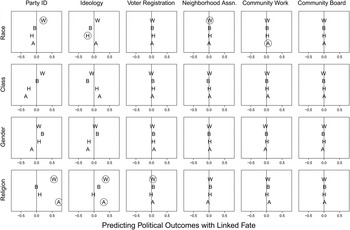
We arrived at this finding by examining the associations between a report of linked fate for each social status (race, class, gender, and religion) and for each racial or ethnic group of respondents, for six political outcomes. Two outcomes were attitudes: party identification (Democratic to Republican) and political ideology (liberal to conservative). The remaining four were behaviors: voter registration, participation in a neighborhood association, community work, and membership on a community board (on a scale ranging from no action to action). We then determined the bivariate linear regression coefficients for each relationship, along with their 95% confidence intervals (CIs).
Figure 2 shows the results of this analysis. The columns indicate the political view or activity; the rows indicate the social status that was the subject of a particular linked fate query; the placement of the letters within each block indicate the association for a racial or ethnic group ([W]hite, [B]lack, [H]ispanic, [A]sian) between the average report of linked fate and the average report of political activity or views. (Note that within each block, the vertical dimension has no meaning; the order goes from Whites on top to Asians on the bottom simply for ease of reading.) Each circled letter indicates a statistically significant relationship (at p < .05) between linked fate and a political activity or view.
Correlations between reports of linked fate for various social statuses and reports of political activities or views, by group, LFSS 2009

Thus, for example, looking at the bottom left panel (party identification by religious linked fate), we see that religious linked fate has a coefficient of .7 for Asian Americans, with a 95% CI running from .3 to 1.1. So a one-point increase in the religious linked fate score (e.g., from somewhat to very) is associated with a nearly one-point increase in the party identification score (which runs from 1 to 7, strong Democrat to strong Republican). If we move a few panels over to look at voter registration by religious linked fate, we see that the coefficient on religious linked fate is .04 for Asian-American respondents. A one unit change in religious linked fate is associated with a change of 4% in the probability that a respondent is registered to vote, and so on.
Although Figure 2 shows some variations—by respondent's group, social status being asked about, or political view or activity—what stands out is the paucity of strong associations. Among the 96 correlations (four groups × four social statuses × six political activities or views), only nine are statistically significant at the p < .05 level. A sense of linked fate is typically unrelated to political views or behavior. Nor is there much of a pattern even among the significant results. Strikingly, LFSS shows no associations between Blacks' linked fate and their political activity. If LFSS results can be trusted, this measure of linked fate is no longer showing any association with liberalism, Democratic partisanship, or political activity among Blacks and other non-White groups.
The Tendency Toward Group Connectedness
Finally, LFSS reveals that the best predictor of whether someone expresses a sense of linked fate with a given social group is not his or her own race, class, gender, or religion, or the object of the inquiry—but whether he or she expresses a sense of linked fate with some other social group. That is, at least in a measurement sense, individuals evince a general tendency toward more or less social connectedness; neither the particular group nor the individual's own particular characteristics matters very much.
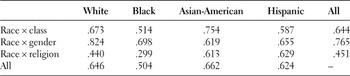
We show the evidence for this startling conclusion in two steps. First, consider intra-individual correlations in LFSS on linked fate responses, organized by respondent's racial or ethnic group. Table 1 provides the relevant evidence.
Intra-individual correlations between racial linked fate and linked fate with other social statuses, by group, LFSS 2009

The correlations extend from high to very high compared with the norm in the social sciences. The average correlation for a sense of linked fate between race and the other social categories ranges from .451 to .765. Only two of the 12 pairwise correlations in Table 1 are below .50—between race and religion among Whites (.440) and among Blacks (.299). These two slightly lower correlations may warrant further study, but they should not distract us from the overall finding of very high associations between a sense of racial linked fate and a sense of linked fate with another social category.Footnote 10
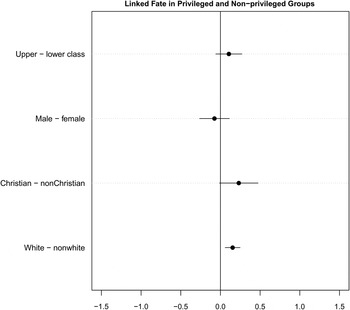
Second, contrary to the original theory and most subsequent explications, a perception of linked fate is not associated with disadvantaged status in LFSS. That is, respondents in both advantaged or high status groups and in disadvantaged or low status groups are equally likely to report linked fate. Figure 3 shows the LFSS evidence for all four types of linked fate.Footnote 11
Comparing perceptions of linked fate between high and low status groups, LFSS 2009 NOTE: LFSS respondents were divided fairly evenly between those in the self-defined upper or middle classes (938) and those in the working or lower classes (866). A total of 424 respondents reported “none” for religion; as explained in the text, they are included in Figure 2. There were Christians and 215 non-Christians, and 1,452 women and 1,315 men.

As with Table 1, these results are also straightforward: members of low status groups do not report more linked fate on the relevant dimension than do members of high status groups. In fact, when all non-White respondents are combined, Whites are significantly more likely to express racial linked fate than non-Whites. Even if one discounts that result as a fluke of the survey, we have no grounds in this survey for saying that a sense of linked fate is associated with social disadvantage. Women are no more likely than men to report gendered linked fate; poor and working class Americans are no more likely than middle and upper class Americans to express class linked fate; non-Christians are no more likely to express religious linked fate than Christians.
We see two plausible explanations for the high intra-individual correlations across linked fate items. The first is methodological; respondents received the two items consecutively, and the linked fate questions had identical wording except for the object (race or ethnicity, or one of the three other statuses of class, religion, and gender). Thus the results in Table 1 may be an artifact of the survey design. The second plausible explanation is substantive; a given individual may have a strong or weak propensity for moving from the relatively shallow state of group identity to the deeper state of connectedness with fellow group members.
LFSS does not permit us to distinguish between these two explanations; once again, we urge further research. However, the 2012 ANES provides some leverage, since it included not only racial and ethnic linked fate items but also a question about “women in this country” (female respondents only) and a new question about “other people in this country” (all respondents). The results show the same pattern of high intra-individual associations: 82% of Hispanics, 87% of Blacks, and 91% of Whites who reported linked fate with their racial or ethnic group also reported a sense of linked fate with others. Even higher proportions of women in each group who reported linked fate with their racial or ethnic group also reported a sense of gender linked fate. Pairwise correlations on the fully-scored linked fate variables (none, not much, some, and a lot) among race or ethnicity, women, and others are all above .6.
Still within the 2012 ANES, we also correlated linked fate responses with additional items to clarify whether these reports reflect deep attachments to particular social groups, rational calculations about one's relationship to one's group, or an individual's tendency toward moving beyond group identity to group connectedness. What we found is puzzling. Linked fate responses are very weakly related to responses on a feeling thermometer for each respective group—a result that should not obtain if high linked fate indicates emotional attachment to that group. Using unweighted survey data, the pairwise correlations between Hispanic and Black and White feeling thermometer scores and the corresponding linked fate item, as well as “feminist” feeling thermometer scores and “women” linked fate, are all below .15.Footnote 12 In addition, linked fate responses are very weakly related to perceptions of discrimination against each respective group—a result that should not obtain if high linked fate functions as a rational heuristic used by disadvantaged groups. Women who are one point higher on the five-point Likert scale for “discrimination against women,” for example, have a gender linked fate score about .2 points higher than those lower on the Likert scale. The same pattern holds for Black and Hispanic linked fate; White linked fate has a coefficient roughly half as large. All are statistically significant, but these results explain very little of the variation in linked fate scores, with an r 2 of around .02.
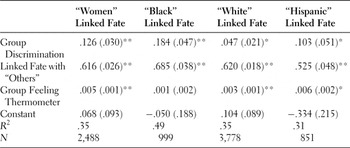
Finally, we ran a regression predicting linked fate scores in the 2012 ANES using three explanatory variables: perceived discrimination score for that social status, a feeling thermometer for that status, and linked fate with others. Table 2 presents the results of these regressions. The “others” coefficient is by far the strongest in all cases, with a standardized coefficient several times that of the other variables, whether we look at Black, Hispanic, White, or female linked fate. All of these results combined suggest that the current linked fate survey item does not measure an individual's attachment to a particular group, or her beliefs about that group's status in society. Instead, some individuals appear to have a generic tendency to report connectedness to many different social groupings.
Predicting linked fate with other items in the 2012 ANES

*p < .05; **p < .01.
Note: For racial/ethnic outcome variables, the Group Feeling Thermometer variable is based on their reported feelings toward their own racial/ethnic group (i.e. Blacks or Whites). For the Women Linked Fate regression, the feeling thermometer question asked only about feminists, not about women in general.
To the findings so far, then, we add another: LFSS shows not only that a sense of linked fate is similar across groups, is robust to experimental manipulation, is not systematically associated with political views or actions, and is not limited to racial or ethnic identity, but also that linked fate beliefs, for a given individual, are more related to one another than they are to the individual's social status or the group in question. Furthermore, as usually measured, perceptions of linked fate do not reflect either loyalty to a particular group or a heuristic calculation, despite their usual interpretation.
MTURK SURVEY
For purposes of both replication and extension, we used Amazon's MTurk service April and May 2015 to recruit participants (Berinsky, Huber, and Lenz, Reference Berinsky, Huber and Lenz2012). We used a two-stage sampling procedure in order to obtain enough non-White respondents. First, we recruited respondents (based in the United States, with at least a 95% task acceptance rate and 500 tasks completed) to take a demographic survey asking only race, class, gender, and religious identity. From among 1940 respondents, we chose a sample that included all Black, Hispanic, and Asian respondents (of which there were 125, 116, and 191, respectively), and 200 randomly-drawn Whites. We then posted a survey to MTurk visible only to these 632 respondents, later offering a bonus to anyone who had not taken the second survey. We collected 449 responses (86 Black, 88 Hispanic, 135 Asian, and 140 White respondents). We refer to this sample as the MTurk survey. We present figures and tables produced from this dataset in an online Appendix, but discuss the results briefly here.
The core results from the MTurk survey resembled those of LFSS, with one major exception. Racial linked fate is not unique to Blacks; people in all four racial and ethnic groups express at least a moderate sense of linked fate with members of their group. Unlike in LFSS, however, Blacks show a stronger sense of racial linked fate than members of other groups (see web Appendix for figures). We note that this is an opt-in sample, and that Black respondents in MTurk are more highly educated than are African-Americans as a whole.Footnote 13 We cannot determine whether the higher levels of Black linked fate in MTurk than in LFSS are an artifact of small sample size or unusually high levels of education (other studies have shown that highly educated Blacks are most likely to express linked fate), or are a genuine substantive change from 2009.
As in LFSS, we found extremely high linked levels of linked fate across the board, with class linked fate outstripping racial linked fate. Our finding that these levels do not vary with social status is only partly replicated in the smaller MTurk sample; it holds for class and religion, but does not hold for gender or the distinction between Whites and all non-Whites (driven mainly by the higher levels of Black racial linked fate discussed above).
We also found the same lack of consistent relationships between a sense of linked fate and political attitudes or participation in the smaller MTurk sample. We asked respondents about five outcomes: voter registration, voting, attending protests, organizational membership, and partisanship. The linked fate score for all four identities (race, gender, class, and religion) is not statistically or substantively associated with these five political outcomes in any systematic way when conditioning on race and gender; in some cases, the direction of the coefficients is reversed.Footnote 14 Finally, we also found relatively high intra-individual correlations in the MTurk sample, as reported above; racial linked fate scores correlated with gender, class, and religion scores at .54, .43, and .37, respectively. Notably, we observed these high intra-individual correlations despite the fact that these items appeared several minutes apart from each other on the survey instrument, separated by a large number of other survey questions. We take this as evidence that the correlations are not simply induced by the proximate location of similarly-worded survey questions.
DISCUSSION
While attention to the source and salience of common fate perceptions originated in the field of Black politics, in recent years some scholars have applied it to other groups, especially other races or ethnicities. That permits scholars to address the important analytic and empirical issues identified in the epigraph to this paper; after all, one cannot determine if Black-linked fate is unique or distinctive without comparative data among non-Blacks. Taking this advance a step further, the LFSS survey looks across other social statuses, thereby revealing patterns previously invisible given the usual focus on Black, or even racial and ethnic, linked fate. If the LFSS and other comparative surveys are correct, by the late 2000s Blacks were not distinctive in their reported levels of racial linked fate, and not distinctive in the robustness or stability of their view. Nor are measured levels of racial or ethnic linked fate distinctive in their level, robustness, or stability. Most LFSS respondents expressed as much or more commonality with regard to class, many did with regard to gender, and some did with regard to religion; the 2012 ANES found similar patterns. Few previous surveys have examined gender linked fate, and to our knowledge, none has examined perceptions of class and religious linked fate; we urge replication of the LFSS in order to determine if the findings in LFSS hold up.
Perhaps the most striking result in LFSS is that expressions of linked fate with regard to any of the four social statuses, and for all four racial or ethnic groups, are only weakly and unsystematically related to political ideology, partisanship, or particular political actions. Some earlier research has found this result, but to our knowledge no one has looked at such an extensive array of political activities or social statuses. It is particularly noteworthy that Blacks' reports of linked fate are the most unconnected to politics in LFSS.
Finally, the LFSS study suggests that people have a general tendency to report high or low linked fate, unrelated to the demographic characteristics of the individual or the social category in question. Intra-individual correlations are very high in both LFSS and the 2012 ANES, people with disadvantaged status were not disproportionately likely to perceive linked fate in LFSS, and the ANES shows linked fate to be associated with neither perceptions of discrimination (for heuristic use) nor a sense of closeness to that group (an indication of loyalty or belonging).
We initially speculated that responses to the standard linked fate item capture a psychological proclivity to connect or affiliate with others. We tested that speculation in the MTurk sample, and did not find compelling support for it. We revised standard scales widely used by social psychologists in order to create descriptive and normative indices of locus of control (whether a person feels that they can or ought to control their own life circumstances), a descriptive index of connectedness to others (whether people report that all humans are connected), and three normative indices of preferred connectedness (to one's local community, Americans, and the world in general). These six psychological measures were not highly correlated with our measures of (racial, gender, class, or religion) linked fate. Thus, we suspect that the concept being measured by the linked fate is neither connectedness nor locus of control, at least not as measured in this study.Footnote 15 The explanation for high intra-individual correlations among perceptions of linked fate across group identities remains unclear.
Given these results, it is clear that the linked fate survey item is not behaving as most theorists of linked fate would expect. We see two possible explanations for this pattern: either Black racial linked fate is no longer as unique or politically important as once posited, or the linked fate measure is not currently capturing linked fate as understood by researchers.
The LFSS study does not allow us to evaluate the first possibility, of a declining role for racial linked fate, but other survey evidence provides some basis for it. In 2007, two-fifths of Black respondents agreed that “Blacks today can no longer be thought of as a single race because the Black community is so diverse.” Young Black adults were especially likely to agree (Pew Research Center for the People and the Press 2007; no other group was asked this question). A year later, young Black adults were disproportionately likely to agree that “there is no general black experience in America.” In the same survey, three-fifths of Blacks and Latinos, compared with four-fifths of Whites, agreed that they had more in common with their class than their race; that was especially true for low-income respondents (Harris and Langer Reference Harris and Langer2008). In 2009, 60% of Blacks and 67% of Hispanics agreed that “in the last ten years… the values held by black people and the values held by white people have become more similar” (agreement was slightly lower in 2007), while only 22% of Blacks said that middle class and poor members of their race have “a lot in common” (results were the same in 2007) (Pew Research Center and National Public Radio 2009). To our knowledge, these questions were not asked in earlier years and have not been repeated, so we cannot say whether the responses reveal a genuine change since the 1980s in Americans' group identity or in their use of group trajectory as a heuristic. As is so often the case, more research is needed.
Alternatively, the surprising findings in LFSS may indicate that the measurement of linked fate does a poor job of capturing a persistent sense of group solidarity. In this view, what is most important in LFSS and the recent ANES is the apparent conflict between the concept of linked fate and the empirical fact of a mass public easily moved to express high levels of linked fate with a variety of social groups, even one as vague as “other people from this country.” That expressions of linked fate are often apolitical, and seemingly not related to social status or perceptions of discrimination or group closeness, contributes further to concern about a conflict between the standard measurement and new evidence. Again, we are limited by the available survey data, as LFSS was (to our knowledge) the first survey to ask some of the non-racial linked fate items. We hope that future research will uncover respondents' motivations for reporting linked fate, and shed light on what it is that this survey item measures.
At a minimum, our survey results suggest that theory and measurement of linked fate are poorly aligned; at a maximum, they suggest the declining significance of racially-unique linked fate beliefs. Until the many questions raised by the survey on Linked Fate in Social Status are answered, we conclude that the enormously fruitful concept of racial linked fate is due for empirical, and perhaps conceptual, re-examination.
Supplementary Material
To view supplementary material for this article, please visit http://dx.doi.org/10.1017/rep.2015.3
ACKNOWLEDGEMENTS
The authors thank Time-Sharing Experiments in the Social Sciences (TESS) for fielding the main survey. For their helpful comments, we thank Jeremy Freese and Penny Visser as PI's of TESS, seminar participants in the Harvard Political Psychology and Behavior Working Group, Bernard Fraga, and the editor and anonymous reviewers. Ariel White acknowledges a Harvard University grant from the Multidisciplinary Program in Inequality & Social Policy.