Introduction
A growing body of empirical evidence suggests that, overall, religiosity and spirituality are correlated with better psychological health (Koenig & Larson, Reference Koenig and Larson2001). Persons who attend religious services report fewer depressive symptoms (Smith et al. Reference Smith, McCullough and Poll2003) and, among those who are depressed, experience shorter time to remission of symptoms (Koenig et al. Reference Koenig, George and Peterson1998). Religiosity and spirituality may be protective for mental health through several pathways, both social and psychological. For example, social isolation is a major risk factor for depression and belonging to a religious community is often an important source of social integration (Ellison & George, Reference Ellison and George1994). Religious teachings and beliefs provide a coherent framework within which to interpret life's events (Berger, Reference Berger1967) and this may lead to a higher sense of meaning, coherence, and the sense that life has a larger purpose. The inability to make meaning out of life's events is a major risk factor for various psychological health problems and religiosity and/or spirituality may thus protect against this risk (Pargament, Reference Pargament1997; George et al. Reference George, Ellison and Larson2002). The term religiosity thus traditionally refers to the public aspects of religious engagement, such as attending religious services, whereas spirituality emphasizes the more personal and existential connection to something ‘greater than oneself’ (Pollner, Reference Pollner1989). A growing body of research on ‘spiritual well-being’ has further identified two aspects of spirituality hypothesized to be relevant to mental health: religious well-being and existential well-being (Ellison, Reference Ellison1983; Compton & Furman, Reference Compton and Furman2005). Religious well-being refers to the quality of a person's ‘relationship with God’ or a higher power whereas existential well-being reflects a person's sense of meaning and purpose in life (Ellison, Reference Ellison1983). Preliminary evidence suggests that existential well-being may be more important for mental health (Tsuang et al. Reference Tsuang, Williams, Simpson and Lyons2002) although the evidence is not consistent. Not all aspects of religiosity and spirituality are protective; for example, negative religious coping and religious struggle have been associated with worse health outcomes (Pargament, Reference Pargament2004). More research is needed to clarify the nature of the relationship between various aspects of religiosity and spirituality, and the risk of psychiatric disorders. Importantly, we explore both the possibility that any effects of religious service attendance are explained by aspects of spiritual well-being and that religious activity and spiritual well-being together influence depression. We therefore investigated the joint associations of religious service attendance and two aspects of spiritual well-being (religious and existential) on the risk of major depression.
Method
Study sample
The analysis was based on the adult offspring of participants in the National Collaborative Perinatal Project (NCPP). The NCPP was designed as a large, multi-site, community-based, observational cohort of pregnant women and their children (Broman, Reference Broman1987). Major findings from the NCPP have been summarized previously (Niswander & Gordon, Reference Niswander and Gordon1972; Broman et al. Reference Broman, Nichols and Kennedy1975). The New England Family Study (NEFS) was based on the Providence, Rhode Island and Boston, Massachusetts samples when offspring were 35–44 years old (2001–2004). Its main objective was to identify familial, early childhood and psychiatric factors linked to tobacco dependence later in life (Gilman et al. Reference Gilman, Martin, Abrams, Kawachi, Kubzansky, Loucks, Rende, Rudd and Buka2008). Screening questionnaires were mailed to 4579 of the 15 721 Boston and Providence NCPP offspring who survived until age 7. Of the 3121 questionnaires returned (68.2%), 2271 were eligible to participate based on combined inclusion criteria and a total of 1625 were successfully enrolled. In addition to a face-to-face interview, self-report questionnaires were sent to all participants; with the religiosity module included in 1431 questionnaires. Out of the 1290 surveys returned, 918 participants had complete data for all study variables: 343 participants did not have spirituality data and another 29 individuals were excluded because of invalid socio-economic or psychopathology data. Participants with complete spirituality data were more likely to be female (64% v. 52%), less likely to attend services (54% v. 60%) and more likely to have been diagnosed with major depression (29% v. 22%). However, there were no differences in age (both 39 years old), proportion married (both 61%) or socio-economic status (SES) (53 and 54 on the SES scale) between those with complete and incomplete spirituality data respectively. The final sample included 132 families with multiple siblings (120 sibling pairs, nine trios, two quartets and one family with five siblings).
Assessments
Religious service attendance
Religious service attendance was assessed by the question: ‘Do you go to a church or temple or other place of worship?’ Individuals with an affirmative answer were counted as attending religious services. A second identical question with reference to the respondent's childhood was used to construct a measure of lifetime continuity of religious service attendance: ‘While you were growing up, did you go to a church or temple or other place of worship?’ Individuals who answered affirmatively to both questions were counted as ‘continuous attendees’. Information was also available on whether the service attendance was ‘regular’ or ‘once in a while’. Preliminary analyses revealed that this further distinction did not explain any additional variance and a threshold effect emerged between the any versus none attendance groups in the relationship with major depression. As a result, all current analyses use the dichotomous any/none religious service attendance variable.
Spirituality
Spirituality was assessed with an adapted version of the 20-item Spiritual Well-Being scale (Ellison, Reference Ellison1983), which taps into two related constructs: religious well-being (10 items) and existential well-being (10 items). Religious well-being assesses the quality of a person's relationship with God or a higher power and is composed of items such as ‘I have a personally meaningful relationship with God’ and ‘I believe that God loves me’. Existential well-being reflects a person's sense of meaning and purpose in life and is composed of items such as ‘I believe there is some real purpose in my life’ and ‘I have a sense of well-being about the direction of my life’. Each item has a six-point Likert scale ranging from ‘agree a lot’ to ‘disagree a lot’. Responses were summed yielding a cumulative score ranging from 10 to 60. Participants with three or more missing values within each domain were excluded from the analysis. The religious and existential well-being scales have shown high internal consistency, with a Cronbach's α of 0.87 (existential) and 0.78 (religious) (Paloutzian & Ellison, Reference Paloutzian, Ellison, Peplau and Perlman1982). Both scales were divided into high, medium and low groups based on tertiles of their distribution to allow for the examination of nonlinear or threshold associations. The results were unchanged when using a continuous, or Z score, version of either scale.
Major depressive episode (MDE)
Trained interviewers determined the presence of lifetime MDE using the Composite International Diagnostic Interview (CIDI) and DSM-IV criteria. These criteria require the presence of at least five of the following symptoms during the same 2-week period, at least one of which is depressed mood or loss of interest: depressed mood, loss of interest or pleasure, weight or appetite changes, sleep problems, feeling agitated or lethargic, fatigue, guilt, trouble concentrating, and suicidality. Persons who met criteria for MDE at any point in their life were counted as having a lifetime history of MDE. Additional analyses focused on current depression that was derived using information on the timing of the most recent episode. Those with an episode that started in the previous year were considered currently depressed whereas those with an episode that occurred over a year ago were considered past cases.
Statistical analysis
The primary dependent variable was lifetime MDE diagnosis, which was treated as a binary variable. Preliminary analyses of religious activity frequencies and religious/existential well-being tertiles with the presence of MDE were conducted with χ2 tests. Logistic regression was used to estimate the associations between religious service attendance, spiritual well-being and major depression. Models were fitted using the surveylogistic procedure in SAS (SAS Institute, Cary, NC, USA), which adjusts variance estimates for the presence of sibling sets in the analytic sample. All models included controls for potential confounders: age, income, race, marital status and gender, which were decided a priori. Initial models included only one religion/spirituality independent variable per model (attendance, existential well-being, or religious well-being), followed by a model that included all three religion/spirituality variables. Models that were stratified by religious service attendance were used to examine initial evidence for effect modification in the association between existential/religious well-being and odds of MDE, which was then formally tested with a combined model that included an interaction term between existential/spiritual well-being and religious service attendance. Preliminary analysis did not reveal gender differences, so models are presented for the full sample and gender is statistically controlled for. Finally, the analysis was repeated using current MDE.
Results
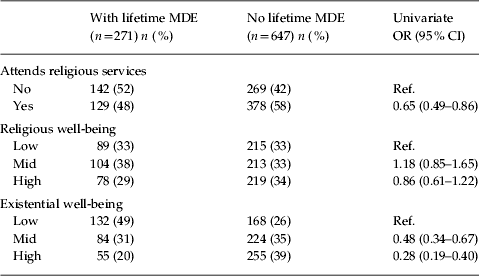
Of the 918 subjects available for this analysis, 64% were female, 87% were white and 62% were married. The prevalence of lifetime MDE was 30% (n=271). Women were more likely to have had a history of MDE compared to men (34.1% v. 21.4%, p<0.001) and individuals whose incomes were below the median were similarly at higher risk (35.2% v. 24.7%, p<0.01). Fifty-five per cent reported currently attending religious services; of these, 93% also reported attending services during childhood. Those with a history of MDE were less likely to report current religious service attendance (Table 1) and were also less likely to have high existential well-being levels. There was a high level of internal consistency of the existential and religious well-being scales in the NEFS sample (Cronbach's α=0.91 and 0.96 respectively); they were modestly correlated with each other (r=0.35, p<0.001) and mean levels of both religious and existential well-being were higher among those attending religious services (existential well-being: 50.2 v. 45.4, p<0.01; religious well-being 48.4 v. 36.6, p<0.01 among attendees and non-attendees respectively).
Prevalence of lifetime major depressive episode (MDE), religiosity and spirituality of study participants (n=918)

OR, Odds ratio; CI, confidence interval.
Main findings
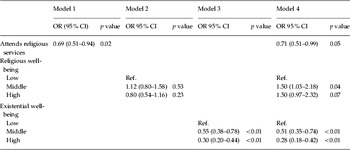
The results of the multiple logistic regression models of the association between each individual religiosity or spirituality variable and lifetime MDE are presented in Table 2. Religious service attendance was associated with a >30% decrease in the odds of lifetime MDE [model 1: odds ratio (OR) 0.69, 95% confidence interval (CI) 0.51–0.94] and religious well-being was not significantly associated with lifetime MDE (model 2: OR for high v. low religious well-being 0.80, 95% CI 0.54–1.16). Persons reporting middle or high levels of existential well-being had substantially lower risks of MDE. Compared to those with low levels of existential well-being, being in the middle tertile was associated with half the odds of lifetime MDE (model 3, OR 0.55, 95% CI 0.38–0.78), whereas being in the top tertile of existential well-being was associated with a 70% reduction in the odds of lifetime MDE (OR 0.30, 95% CI 0.20–0.44). In model 4, religious service attendance, religious and existential well-being were entered simultaneously, and both religious service attendance and existential well-being remained associated with a lower risk of depression. However, after adjusting for attendance and existential well-being, middle or high levels of religious well-being were associated with increased lifetime risk of depression as compared to those with low levels (OR for middle v. low tertile 1.50, 95% CI 1.03–2.18; OR for high v. low tertile 1.50, 95% CI 0.97–2.32).
Religious service attendance, religious and existential well-being and odds of lifetime major depressive episode (MDE)

OR, Odds ratio; CI, confidence interval.
Models adjusted for age, income, race, marital status and gender.
Interaction of religious service attendance with religious and existential well-being
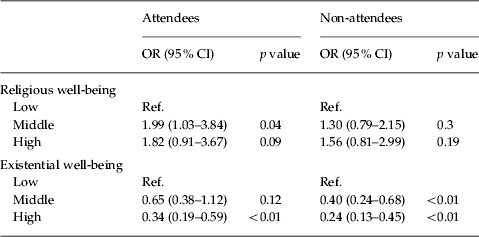
Next we explored whether attending religious services influenced the association between spirituality and depression. The interaction term between religious service attendance and religious well-being, when added to the logistic regression model of lifetime depression, was marginally significant (χ2=3.66, df=10, p=0.06), suggesting that the relationship between religious well-being and MDE may be stronger among those attending religious services. Among attendees, lifetime MDE prevalence was 19% among the low religious well-being tertile, 30% in the middle and 24% in the high religious well-being group. This pattern was less evident among non-attendees (33% v. 36% prevalence MDE among low v. middle/high religious well-being). The logistic regression models in Table 3 confirm this pattern: among attendees, the middle tertile of religious well-being was associated with a doubling of odds of lifetime MDE (OR 1.99, 95% CI 1.03–3.84) as compared to those with low religious well-being. High religious well-being was similarly associated with increased odds in this group (OR 1.82, 95% CI 0.91–3.67). Among non-attendees, this pattern was much less evident, with odds of depression not varying significantly according to levels of religious well-being.
Religious and existential well-being and odds of lifetime major depressive episode (MDE), stratified by religious service attendance

OR, Odds ratio; CI, confidence interval.
Models adjusted for age, income, race, marital status and gender.
This pattern is somewhat reversed in the case of existential well-being. The interaction between religious service attendance and existential well-being was marginally significant (χ2=2.97, df=10, p=0.09), but indicated that the protective relationship between existential well-being and depression is stronger among non-attendees. For example, among those who attend religious services, high levels of existential well-being were associated with a 66% reduction in the odds of MDE (OR 0.34, 95% CI 0.19–0.59), whereas among those who did not attend religious services, a 76% reduction in MDE odds was observed (OR 0.24, 95% CI 0.13–0.45) in the high existential well-being group (Table 3).
Additional analyses of current MDE episode
The final analysis aimed to determine whether the above associations remained significant for current or past episodes of MDE respectively. Out of the 271 individuals with lifetime MDE diagnosis, 145 were past episodes and 121 were currently depressed (five did not have valid duration data). Modeling current MDE yielded results consistent with the lifetime MDE models, although several coefficients were not statistically significant. Using model 4 in Table 2 as the basis for comparison, and after adjusting for past depression, religious service attendance was weakly associated with current MDE (OR 0.76, 95% CI 0.48–1.19). Religious well-being was again associated with increased odds of current MDE (OR for middle tertile of religious well-being 1.40, 95% CI 0.85–2.30 and OR for top tertile 1.69, 95% CI 0.95–3.01). Finally, high levels of existential well-being were significantly associated with lower odds of current MDE (OR 0.17, 95% CI 0.10–0.31). Comparing only those who reported continuous service attendance (childhood and currently) to those who have never attended did not result in any meaningful changes in the ORs. For example, again using model 4 in Table 2 for comparison, lifetime service attendance was associated with decreased odds of lifetime MDE (OR 0.72, 95% CI 0.51–1.00), whereas middle levels of religious well-being were associated with increased odds (OR 1.47, 95% CI 1.01–2.14). These results provide some reassurance that the main findings with lifetime MDE are not confounded by concurrent levels of depressed affect or lower levels of existential or religious well-being. Additionally, although the analysis is strictly cross-sectional, the high percentage of religiously active participants with continuous attendance, together with high overall levels of service attendance during childhood (90% in the whole sample), makes it less likely that any results are being driven by individuals who begin going to religious services as a result of depressive symptoms.
Discussion
In this study we found that religious service attendance, existential and religious well-being were all associated with the risk of MDE, albeit not in the same direction. Most notably, although religious service attendance and existential well-being were protective, religious well-being was associated with increased odds of MDE. To our knowledge, this is the first study to examine all three of these religiosity and spirituality factors together with the risk of MDE and also the first study to report a positive association between higher levels of religious well-being and the presence of a psychiatric illness.
Findings with religious service attendance
We found that individuals who reported any religious service attendance experienced an approximately 30% lower odds of MDE as compared to those who never attend services. This finding of an inverse association is consistent with previous research showing lower levels of depressive symptoms among those who report attending religious services (Strawbridge et al. Reference Strawbridge, Shema, Cohen and Kaplan2001; Braam et al. Reference Braam, Hein, Deeg, Twisk, Beekman and Van Tilburg2004). For example, Kendler et al. (Reference Kendler, Liu, Gardner, McCullough, Larson and Prescott2003) reported an 18% reduction in lifetime MDE risk associated with a social religiosity scale, which included religious service attendance. Furthermore, our observed association between attendance and MDE remained robust even after adjusting for both religious and existential well-being. This suggests that this protective relationship between religious service attendance and depression is unlikely to be completely mediated, or explained, by these two spirituality domains (which have their own independent effects). If causal, the protective association with service attendance may therefore be a direct result of the various social integration benefits associated with belonging to a religious community. Persons who attend religious services often have access to larger and more diverse social networks among their fellow members and various traditions and rituals facilitate the formation and long-term maintenance of both strong and weak ties (George et al. Reference George, Ellison and Larson2002). These religious ties may, in turn, confer protection against the development of depression in a similar fashion in which strong social ties have been reported to do (Glass et al. Reference Glass, De Leon, Bassuk and Berkman2006).
Findings with existential well-being
Of the three religiosity and spirituality variables considered in our analysis, existential well-being had the strongest associations with reduced odds of MDE. High levels of existential well-being were associated with reduced odds of MDE by >70%, when compared to low levels, independent of religious service attendance or religious well-being. Existential well-being has emerged as a powerful protective factor against depressive symptoms in other studies as well (Tsuang et al. Reference Tsuang, Williams, Simpson and Lyons2002; McCoubrie & Davies, Reference McCoubrie and Davies2006) and our results confirm this association for clinical levels of major depression. The existential well-being domain taps into an individual's sense of life purpose, meaning and satisfaction (Ellison, Reference Ellison1983), and so it might be expected that individuals who report such positive emotions would also be more resilient against depression.
Findings with religious well-being
The more surprising finding stemming from this analysis was that higher levels of religious well-being were associated with increased odds of MDE, an association most pronounced among those who reported attending religious services. Although no studies we are aware of have reported a positive association between religious well-being and depression, several have reported very weak inverse or null associations (Tsuang et al. Reference Tsuang, Williams, Simpson and Lyons2002; McCoubrie & Davies, Reference McCoubrie and Davies2006). The results in these prior analyses were similar to what we observed in our initial models, which did not simultaneously adjust for existential well-being and religious service attendance. It is therefore possible that an analytical approach comparable to ours would have revealed similar results. Other researchers have interpreted the stronger association of existential well-being with MDE, compared to religious well-being, to mean that one's own purpose in life is more important than the relationship with a higher being (Edmondson et al. Reference Edmondson, Lawler, Jobe, Younger, Piferi and Jones2005).
It is important to note that this analysis was not able to determine the temporal direction between higher levels of religious well-being and clinical levels of depression. The religious well-being domain taps into the strength of a person's relationship to a higher power and, thus, one interpretation of our findings is that an individual who is depressed relies more heavily on religious coping methods that, in turn, could lead to increased levels of religious well-being regardless of any changes in religious service attendance. This interpretation is supported by research showing that religious coping is very prevalent among clinically ill populations (Harrison et al. Reference Harrison, Koenig, Hays, Eme-Akwari and Pargament2001). Religious coping may itself be positive or negative, especially among persons who are struggling with their religious beliefs or may feel that God has abandoned them (Pargament, Reference Pargament2004).
Psychological research on attachment styles and religiosity provides another plausible explanation. This body of research suggests that, in some cases, higher levels of religiosity may be a marker of insecure attachment, which is a strong risk factor for mental health problems (Roberts et al. Reference Roberts, Gotlib and Kassel1996). According to attachment theory, individuals' attachment styles are set early in life based primarily on the nature of interactions with the primary caregiver. Barring any significant changes, children with a secure attachment to their primary caregivers grow into adults who are pro-social and capable of healthy, close relationships with others. Children who are insecure-avoidant or insecure-anxious develop into adults who either have trouble building close relationships or are constantly worried about being abandoned (Bowlby, Reference Bowlby1969, Reference Bowlby1973, Reference Bowlby1980; Hazan & Shaver, Reference Hazan and Shaver1987). Such insecure attachment is associated with increased risk of depression (Roberts et al. Reference Roberts, Gotlib and Kassel1996; Whiffen et al. Reference Whiffen, Kallos-Lilly and Macdonald2001). Although some cross-sectional research suggests that securely attached individuals are concurrently more religious (Granqvist & Hagekull, Reference Granqvist and Hagekull1999), other research has shown that increased religiosity may serve a compensatory role among individuals who have trouble making close relationships (Kirkpatrick, Reference Kirkpatrick1992, Reference Kirkpatrick1997). For example, Kirkpatrick found that insecure attachment is associated with increases in religiosity over time. In a 4-year longitudinal study, he found that women with insecure attachment approaches (avoidant or anxious) at the beginning of the study were more likely to find a new relationship with God or to have a religious conversion during the follow-up period, as compared to their securely attached counterparts (Kirkpatrick, Reference Kirkpatrick1997). Similar findings have been reported with childhood attachment relationships and adult religiosity, in that children with insecure relationships with their mothers became more religious than adults whose childhood parental relationships were more secure (Kirkpatrick, Reference Kirkpatrick1992). This finding suggests that, in some circumstances, a close relationship with God in adulthood (as reflected by high religious well-being) may be a compensatory effort, a search for a stable and secure attachment figure. In this interpretation, an insecure attachment style leads both to a higher risk of depression and to higher levels of religiosity, as reflected by a close relationship with God and higher scores on the religious well-being scale. A similar association may not be observed with religious service attendance as many other factors influence whether a person attends services and a binary measure like the one used in this study may not be sensitive enough to detect more subtle changes in attendance frequency. More detailed information on the attachment history of depressed individuals with high religious well-being would shed additional light on this association.
Limitations
The current study has several limitations worth noting. Most importantly, the associations described are cross-sectional and hence the temporal or causal relationship between the religiosity and spirituality variables and major depression cannot be ascertained. Although the stable rates of religious service attendance suggest that the main findings are not likely to be explained by changes in service attendance as a result of a depressive episode, the stability of religious and existential well-being remains unknown generally, and was not assessed in the NEFS. Longitudinal studies with multiple assessments of religiosity and spirituality and mental health are needed to more clearly ascertain the temporal relationship between these variables. The simple dichotomous measure of religious service attendance used in this analysis also masks variation in actual frequency of attendance. Although additional data were available on the overall regularity of attendance, they did not contribute any meaningful information and hence were not used. The NCPP sample is also not meant to be representative of the US population, or of the entire population of Providence, RI or Boston, MA so it is possible that our findings are unique to this particular sample, which had a restricted age range and was in the majority white and female. There is also the potential for bias resulting from the loss of respondents and incomplete data at each study wave over its 40-year course. We attempted to minimize this bias by including as covariates known predictors of non-response, but any residual bias may have led to either an under- or an overestimation of the correlation between religious attendance, spiritual well-being and odds of MDE. However, our findings on religious service attendance and existential well-being are consistent with previous research on this topic (McCoubrie & Davies, Reference McCoubrie and Davies2006). Future studies are needed to replicate these findings. Although the spiritual well-being scales have been validated in diverse populations (Ellison, Reference Ellison1983), some authors have noted that study participants sometimes ‘need to interpret the word “God” very broadly’ to answer the religious well-being items (Fernsler et al. Reference Fernsler, Klemm and Miller1999) and this may compromise some of the study's findings. Although the religious well-being scale is not meant to reflect any one specific religious teaching, denominational differences may influence how the individual items were interpreted: the original scale was created mostly with an Evangelical Protestant framework, whereas the majority of the study sample were Catholic.
Conclusions
Despite these limitations, the findings presented here have implications for how the study of individuals' religiosity and spirituality is approached. Most importantly, the findings suggest that various domains of religiosity and spirituality are differentially associated with the presence of major depression. There are likely to be complex interactions between factors and so an approach that is too simplistic, or one that focuses only on a single domain in isolation (such as only religious service attendance), may lead to incorrect conclusions about the true relationship between religiosity, spirituality and depression. More research is needed to disentangle the complex inter-relationships between religiosity, spirituality and mental health.
Acknowledgements
J.M. was funded by NIMH grants MH17119, R03MH080280 and by the Jack Shand Award from the Society for the Scientific Study of Religion.
Declaration of Interest
None.