The 2015 earthquake was the most destructive disaster that had occurred in Nepal since the 1934 Earthquake. It is estimated that 10,000 people died and that more than 22,000 persons were injured. Likewise, 8308 schools and 963 public health facilities were damaged. 1
Earthquakes have a range of negative psychological impacts on children. A review reported that 30%-50% of disaster-affected children demonstrated moderate to severe post-traumatic stress disorder (PTSD) symptoms.Reference Norris, Friedman and Watson 2 The prevalence of PTSD symptoms and other mental health consequences are reportedly higher in natural disasters when compared with other kinds of trauma,Reference Saigh and Bremner 3 , Reference Goenjian, Pynoos and Steinberg 4 ranging from 11.2%-11.3%Reference Dong, Zhao and Shi 5 at 12 months, 12.4%-13.9%Reference Jia, Tian and He 6 at 15 months, and 76%-95%Reference Goenjian, Pynoos and Steinberg 4 at 18 months after earthquakes among young children and early adolescents.Reference Wang, Chan and Ho 7
PTSD symptoms are consistently associated with individual objective factors like trauma severity,Reference Fujiwara, Yagi and Homma 8 - Reference McDermott, Lee and Judd 11 psychosocial support,Reference Otto, Henin and Hirshfeld-Becker 12 - Reference Udwin, Boyle and Yule 14 post-trauma environment, and severity of the event as well as with subjective factors like the demographics of the individualReference Goenjian, Walling and Steinberg 15 , Reference Kilic, Özgüven and Sayil 16 and perceived threat.Reference Lack and Sullivan 17 , Reference McDermott, Lee and Judd 11 Children and adolescents are a vulnerable population during and after a disaster. Disaster-related stress tends to decrease over timeReference Norris, Friedman and Watson 2 but prolonged disturbance in the family may lead to persistent symptoms, which may be due to shared trauma exposure that influences family dynamics. A disaster tends to increase family conflicts, and difficulties in the family environment increase the vulnerability of children to negative psychological consequences.Reference Felix, You, Vernberg and Canino 18
However, factors like family environment and functioning are rarely studiedReference McDermott and Cobham 19 ; thus, it is essential to consider family-level characteristics when studying children’s reactions in the aftermath of a disaster. Moreover, on the basis of existing reviews, it is found that child-centered disaster research has to explore components of family and how they relate to the mental health of children and adolescents.
Disaster affects rich and poor countries in different ways. Understanding and integrating the family-level characters in reducing post-disaster distress among children for a poor country like Nepal will be an important achievement. This study therefore aimed to the estimate the prevalence of PTSD symptoms and to determine individual-level and family-level predictors of PTSD symptoms among children affected by the 2015 earthquake in Nepal.
Methods
Study Design and Setting
A community-based cross-sectional study was carried out in Kathmandu District, Nepal. Kathmandu was one of the districts most affected by the 2015 earthquake.
Participants
The study population included children aged 7-16 years and their parents or first-degree relatives (direct care giver), who had been living in Kathmandu before the 2015 earthquake and for at least 6 months before the date of interview. Data collection was conducted in September and October 2016, which was 15 months after the 2015 earthquake. Multistage cluster sampling was carried out. In the first stage, 2 out of 5 urban and 3 out of 6 suburban municipalities of Kathmandu Valley were selected. In the second stage, from each selected municipality 10 wards were selected with probability proportional to sizebased on number of households in each ward. In the final stage, 800 children from the selected wards were chosen randomly. Mapping of the selected wards was carried out and houses were chosen randomly, taking either a school or health service center as a reference starting point. All eligible subjects in the selected households were included, and in case a house did not meet the inclusion criteria, a house from second list of houses in the wards was chosen. A total of 3 community health volunteers and a child psychologist were trained and employed to interview eligible subjects at their home.
Ethical approval was taken from Nepal Health Research Council (ref no. 150) and Prince of Songkla University (ref no. 59-183-18-5). Verbal and written consent was taken from family and children. Anonymity and confidentiality was maintained throughout the study.
Instruments
A face-to-face structured interview questionnaire was developed. The questions included those on socio-demographic characteristics of children and family, level of exposure to earthquake, PTSD symptoms, psychosocial support, and family function assessment. The questionnaire was reviewed by experts who were bilingual child psychologists.
Level of Exposure to Earthquake
Level of exposure to earthquakes among the children was evaluated with the During and After Earthquake Trauma Exposure Questionnaires. It was adapted from a Hurricane Exposure questionnaire and from previous disaster studies.Reference Xu and Liao 20 , Reference La Greca, Silverman, Vernberg and Prinstein 21 Each item was based on a “yes/no” choice. The total number of items was 29 and the scoring was on a continuous scale.
Child-PTSD Symptoms Scale (CPSS)
PTSD symptom severity was assessed using the CPSS, a translated and validated version of a questionnaire based on the Diagnostic and Statistical Manual of Mental Disorder diagnostic criteria for childhood PTSD. CPSS has 17 items for severity of PTSD symptomology, each on a 4-point Likert scale (0=never, 1=once in a week, 2=2-4 times in a week, and 3=5 or more times in a week); therefore, the range of the total score is from 0 to 51, a higher score indicating more severe PTSD symptoms. In the present study, the total score was categorized into score≤20—no and mild PTSD symptoms—and score >20—having moderate-to-severe PTSD symptoms. The clinical cut-off score, 20, was derived for classifying children with PTSD symptoms indicating the need for treatment from a validation study in Nepal.Reference Foa, Johnson and Feeny 22 , Reference Kohrt, Jordans and Tol 23
Psychosocial Support Questionnaire
The researcher-constructed psychosocial support questionnaire has 12 items on 5-point Likert scales to assess received psychological and material support and respondents’ satisfaction with received and perceived social support. The questionnaire was adapted from a social support questionnaire and modified based on country context.Reference Zimet, Dahlem and Zimet 24 , Reference Sarason, Levine and Basham 25 Mean score was used as cut off for categorizing high-acuity social support and low-acuity social support. The questionnaire was checked for face validity by a group of experts. Cronbach’s internal consistency index from the pilot study was 0.83.
Statistical Analysis
Epi-data 3.1 was used for data entry and Statistical Software R version 3.3.2 was used for data management and analysis. Descriptive data are presented as percentages, mean and standard deviation. The main outcome variable was having PTSD symptoms. Univariate analysis was performed using the χ 2 test. A mixed-effects random-intercept model was used to identify factors predicting PTSD symptoms among variables found to have P-value <0.2 from the univariate analysis. Finally, a P-value of <0.05 considered statistically significant.
Results
Among 800 children and 410 households approached, no one refused to cooperate, making an overall response rate of 100%. Twenty-nine children had lost their fathers, 4 of them had lost their mothers and 126 children had lost their relatives and friends. 326 children saw dead bodies and 124 children were trapped in ruin in the earthquake.
Demographic Characteristics
The mean (SD) age of the children was 11.6 (2.65) years and children were grouped into school-age (7-12 years) and adolescent-age (13-16 years) groups.Reference Wang, Chan and Ho 7 About half of them were in the adolescent-age group, female (52%), and had primary-level education (45.1%). A majority of them followed Hindu religion (71.4%). About half of the children’s families had an upper-middle income level (49.5%) and stayed permanently in Kathmandu (51.6%).
Prevalence of PTSD Symptoms by Individual-Level Characteristics
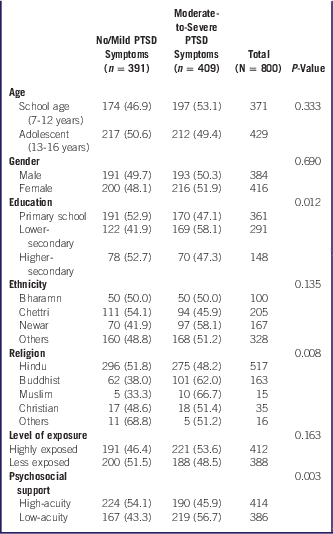
Of all 800 respondents, three had no symptoms of PTSD, 48.5% of children had mild PTSD symptoms, and 51.1% of children had moderate-to-severe symptoms of PTSD, with a higher prevalence among school-aged children (53.1%), female respondents (51.9%), children going to lower-secondary school (58.1%), following Buddhist religion (62.0%), and those with low acuity of psychosocial support (56.7%). Breakdown of individual-level characteristics is presented in Table 1.
Individual-Level Characteristics by Prevalence of Post-Traumatic Stress Disorder (PTSD) Symptoms

Prevalence of PTSD Symptoms by Family-Level Characteristics
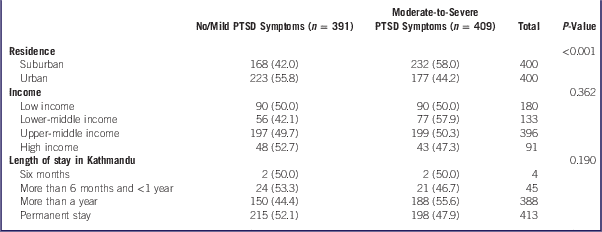
Altogether, 410 families were included in the study from urban and suburban settings and children from families living in suburban (58%) setting had a higher proportion of moderate-severe PTSD symptoms. Table 2 describes the family-level characteristics.
Family-Level Characteristics by Prevalence of Post-Traumatic Stress Disorder (PTSD) Symptoms

Association of Individual- and Family-Level Characteristics With PTSD Symptoms
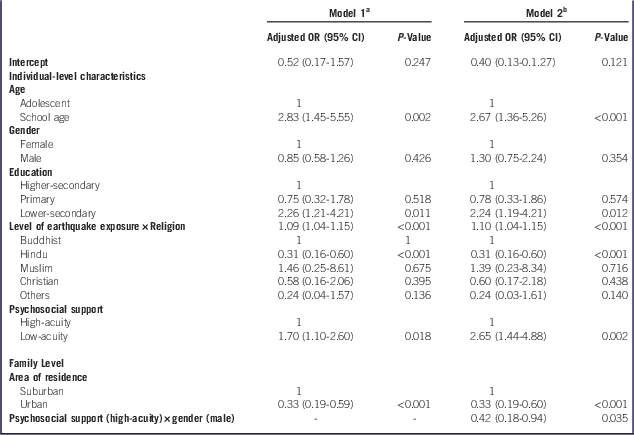
Multilevel modeling results are shown in Table 3 for PTSD symptoms. Model 1 and model 2 are random-intercept models. This implies that individual-level data were nested within a family and that the impact of predictors on PTSD symptoms was the same across families. Model 2 differs from Model 1 in that an interaction term between psychosocial support and gender is added. In model 1, children with a one unit higher score for level of earthquake exposure (adjusted odds ratio [AOR]=1.09), and those in the school-age group, were found to be more likely to have moderate–to-severe PTSD symptoms (AOR=2.83) than were children in the adolescent-age group. Children attending lower-secondary school were more likely to have moderate–to-severe PTSD symptoms (AOR=2.26) than were children attending higher school levels. Hindu children (AOR=0.32) were less likely to have severe PTSD symptoms than those who were Buddhist. Regarding family-level characteristics, children of families living in an urban area were less likely to have PTSD symptoms (AOR=0.33) than those living in suburban areas.
Association of Individual and Family-Level Characteristics with Post-Traumatic Stress Disorder Symptoms in Children

OR, odds ratio.
a Model 1: Without interaction term.
b Model 2: With interaction term (psychological support and gender).
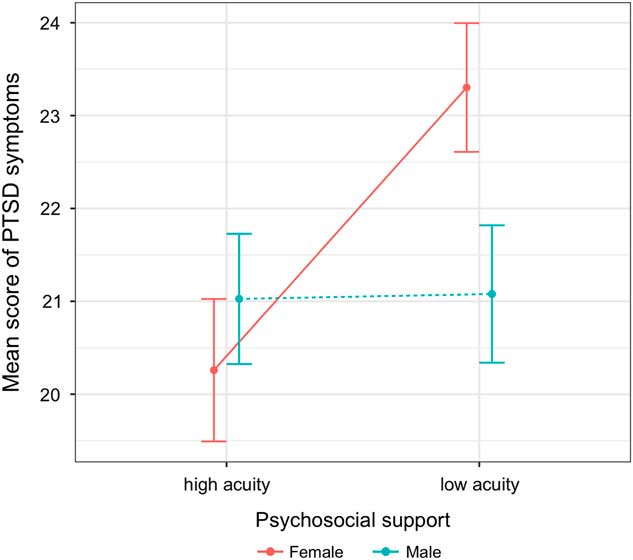
In model 2, after inclusion of interaction between psychosocial support and gender of the children, the effect of high-acuity psychosocial support (AOR=2.65) was found to be effective among female children (Figure 1).
Interaction Plot for Psychosocial Support and Gender. Vertical Lines Represent the 95% CI. PTSD, post-traumatic stress disorder.

Discussion
To our knowledge, this is the first community-based study carried out in Nepal after the 2015 earthquake related to PTSD reactions in children.
The prevalence of moderate–to-severe PTSD symptoms among these children was 51.1%, which is similar to that reported in a study in Turkey 3 months after an earthquake, in which 47.7% had severe PTSD symptoms,Reference Küçükoğlu, Yıldırım and Dursun 26 and to that in a study undertaken after 32 weeks of Hurricane Andrew, in which 51% had moderate and 38% had severe PTSD symptoms,Reference Shaw, Applegate and Schoor 27 and was higher than that found in Athens (35.7%).Reference Giannopoulou, Strouthos and Smith 28 High prevalence of moderate-to-severe symptoms of PTSD even a year after the earthquake was found in Nepal probably because of the occurrence of multiple aftershocks after the major earthquake, which continued to terrify people for 2 months, and because of the existence of a poor resilience trait in the country. 1
The prevalence of moderate-to-severe PTSD symptoms was high (53.1%) among school-age children (7-12 years). This is in keeping with findings from studies that PTSD and anxiety symptoms were more pronounced in 6-10-year-old children in L’AquilaReference Feo, Di Gioia and Carloni 29 and among those children younger than 13 years in Greece. However, this finding is in contradiction to findings from other studies where age had no significant association with PTSD symptomology,Reference Green, Korol and Grace 30 reflecting a less-clear relationship between age and PTSD reactions.Reference Meiser-Stedman 31 Many studies have reported that females are more prone to post-traumatic stress and depressive reactions.Reference Shannon, Lonigan and Finch 32 , Reference Vernberg, La Greca and Silverman 33 , Reference Goenjian, Pynoos and Steinberg 4 Nevertheless, our study is in parallel with a study in Italy and does not support a gender effect on PTSD symptoms or psychiatric reaction of children after a disaster. The prevalence of any PTSD symptoms was nearly equal between male (50.3%) and female children (51.9%). The lack of apparent effect of gender may be because of the roles of other mediating or moderating factors that were not considered in our analysis.
Children in lower-secondary school were more likely to have moderate-to-severe PTSD symptoms compared with those in higher-secondary school. This finding contrasts with most previous findings in which elementary school children had more severe PTSD symptoms compared with junior and high-school children.Reference Kar, Mohapatra and Nayak 34 Children at the primary level may be too young to fully realize the effects of trauma. Another possible reason in context of Nepal may be that most primary-level education has been changed according to the Early Childhood Development (ECD) concept where schools have a child-friendly environment with the availability of a psychological counselor, school nurse, and ECD-trained teachers. This ECD concept is based on the concept of holistic development of children and has grown rapidly after 2008 for addressing issues of the young child.Reference Raveis 35 Children at lower-secondary level are in the transitional phase between childhood and adolescence; thus, they may be vulnerable to an emotional experience.
Hindu religion appeared to be a protective factor against PTSD symptoms in the children. This confirms the findings of some studies explaining an association between religious affiliation and severity of post-traumatic reaction and resilience.Reference Blanc, Rahill and Laconi 36 A possible explanation for our result is that as Hindus have a strong religious orientation and practice, children in Hindu families may be more protected against a stressful event. However, there is still a lack of study to explain the particular mechanism by which religion protects children against post-traumatic reactions.
Level of exposure to the earthquake was found to be significant in the present study, which is consistent with the findings from previous studiesReference Ying, Wu and Lin 37 - Reference Trickey, Siddaway and Meiser-Stedman 39 that provide support for the “dose-response effect.” This trauma exposure was found to be non-discriminating as a categorical variable but demonstrated discriminatory power when it was used on a continuous scale; a similar recommendation was found in a previous study, which reported that use of a continuous scale is likely to be more sensitive.Reference Roussos, Goenjian and Steinberg 40
Consistent with previous research,Reference Fan, Long and Zhou 41 psychosocial support was associated with PTSD symptoms. In the present study, the effect of psychosocial support was significantly modified by gender. Females were found to be protected from severity of PTSD symptoms if they received and perceived high psychosocial support.
Among family-level characteristics, residence in an urban area reduced the probability of having PTSD symptoms in children, which confirms findings from a previous study.Reference Fan, Zhang and Yang 42 As many rescue programs were urban-focused after the earthquake, an urban setting was more likely to receive social support and appropriate medical assistance, which helped people normalize their lives after the disaster. A previous study explained that family residence had a significant relationship with PTSD outcome, possibly because confounders like family socio-economic status and length of stay in that place were not checked.Reference Fan, Zhang and Yang 42 However, in our study, we tried to control most of these factors, and place of residence remained significantly associated with PTSD symptoms.
There are some limitations in the study. Parental indicators such as parental demographics, parental psychopathology, and parent-child relationships were not included in the study and they may confound associations with the study variables. Finally, the cross-sectional design of this study limits its ability to draw conclusions on a definite causal relationship.
Conclusion
Notwithstanding these limitations, the results of this study have some important implications for psychological service providers in understanding children exposed to disaster and providing effective intervention to them and their family. This study suggests that various individual factors (level of exposure to earthquake, education, social support, and religion) and family factors (residence) are important risk factors for development of PTSD symptoms. Moreover, increased risk for PTSD symptoms among children living in suburban areas suggests that intervention programs need to focus more on those areas. In addition, children of school age or those at the phase of transition from childhood to adolescence are vulnerable to PTSD reactions, and therefore these populations should be given due attention when developing an intervention strategy.
Acknowledgments
The authors are grateful to all who were ready to participate in the study. The authors would also like to thank all research assistants for their dedication and hard work. The authors would like to express gratitude toward Dr Alan Geater and Mr Edward McNeil for their continued help and suggestions. This research was partly supported by the Graduate School of Prince of Songkla University and self-funded by the first author. The findings and conclusion of this study are those from all authors.