Improved DNA extraction methods have allowed increasing use of herbarium specimens for taxonomic and phylogenetic studies. Although DNA of historical specimens is often highly degraded, 250–800 bp long sequences have been obtained, for instance, from over 200 year-old specimens of angiosperms (Ames & Spooner Reference Ames and Spooner2008; Andreasen et al. Reference Andreasen, Manktelow and Razafimandimbison2009), from over 100 year-old oomycetes (Telle & Thines Reference Telle and Thines2008), and from a 74 year-old fungus (O'Gorman et al. Reference O'Gorman, Sholberg, Stokes and Ginns2008). Due to low concentration and poor quality of DNA, amplification of short, c. 300 bp, overlapping fragments has proven a most successful method (Drábková et al. Reference Drábková, Kirschner and Vlček2002; O'Gorman et al. Reference O'Gorman, Sholberg, Stokes and Ginns2008). The results are in striking contrast with lichen-forming fungi, which, in our experience, specimens older than 5–10 years usually tend either to fail or give poor quality sequences.
Here we report a successful amplification and sequencing of nuclear ribosomal ITS regions from a 75 year-old herbarium specimen of Aspicilia aschabadensis (J. Steiner) Mereschk (Turkmenistan, Central part of Kopetdag district, next to the border of Iran, stony part of mountain, to the SW of Solukli, 12 vi 1934, A Borisova [LE]). Using the same methods as described below, we have repeatedly obtained sequences from rather old Aspcilia specimens, viz. Aspicilia changaica (20 years old), A. transbaicalica (25 years old), A. jussuffii (29 years old), A. lacunosa (39 years old) and A. “desertorum” (39 years old). However, DNA extraction from an 80 year old specimen of Aspicilia tominii was not successful.
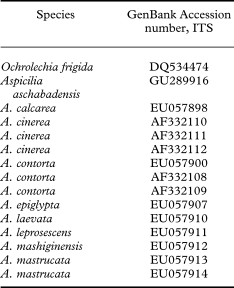
Species used in phylogenetic analysis and the GenBank Accession numbers of the specimens.

The phylogenetic position of the genus Aspicilia is still not well established. According to recent studies, the genus, as currently delimited, belongs to two families. In higher level phylogenetic studies by Schmitt et al. (Reference Schmitt, Yamamoto and Lumbsch2006) and Lumbsch et al. (Reference Lumbsch, Schmitt, Lücking, Wiklund and Wedin2007) the inclusion of Aspicilia in the family Megasporaceae was well supported. However, in the study by Miądlikowska et al. (Reference Miądlikowska, Kauff, Hofstetter, Fraker, Grube, Hafellner, Reeb, Hodkinson, Kukwa and Lücking2006), Aspicilia was nested within the family Pertusariaceae (see Sohrabi & Ahti Reference Sohrabi and Ahti2010).
Total DNA of the sample was extracted using Qiagen's DNAeasy Blood and Tissue Kit. For DNA extraction, c. 1 × 1 mm2 piece of medulla was used. We followed the instructions given by the kit manufacturer, except for the initial grinding and eventual elution, in which 160 µl of ATL (40 µl +120 µl) buffer was used instead of 180 µl suggested by the manufacturer.
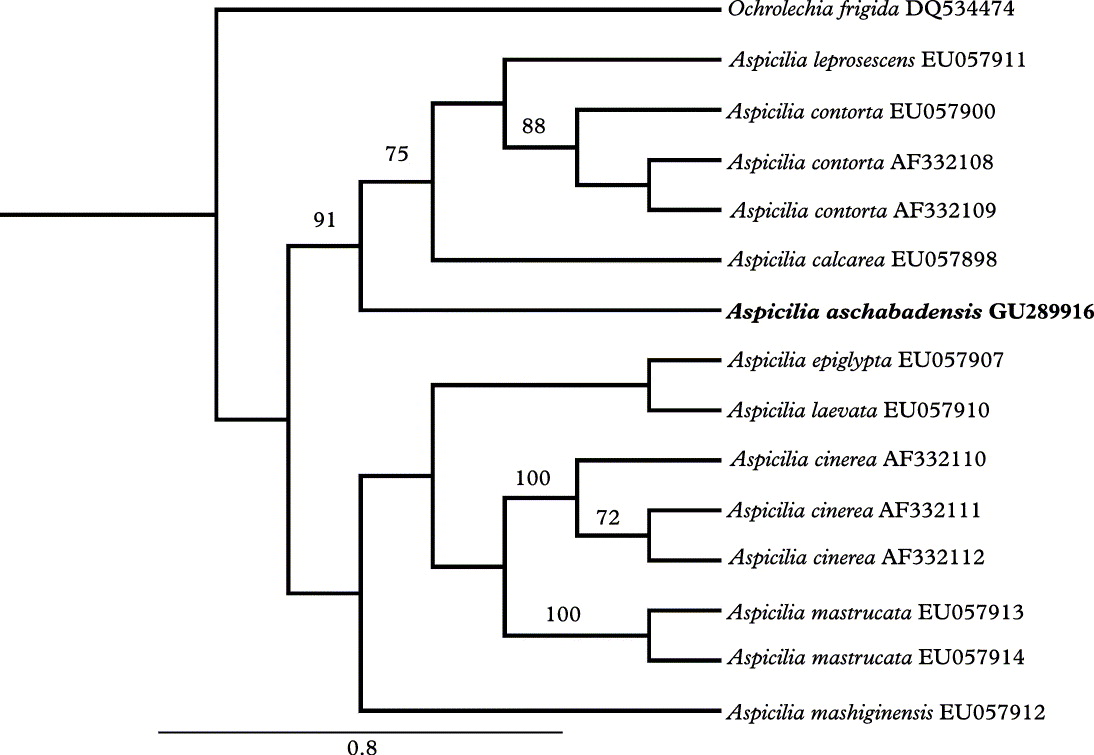
The most parsimonious tree obtained from PAUP* 4.0b10 based on ITS data. Bootstrap support values at nodes. Length 418 steps, CI = 0·677, RI = 0·618.
ITS regions of the nuclear ribosomal DNA were amplified using the following primers: ITS1F (Gardes & Bruns Reference Gardes and Bruns1993) and ITS 4 (White et al. Reference White, Bruns, Lee, Taylor, Innis, Gelfond, Sninsky and White1990). The PCR amplification was performed with Ready-To-Go PCR beads (Pharmatica Biotech) by adding 4 µl undiluted DNA, 1 µl of each primer (ITS1F/ITS4) (10 µM) and sterile water to a total volume of 19 µl for dissolving the beads. The Gene Amp PCR system 9700 (Perkin-Elmer) PTC-100 and PTC-200 Thermocyclers (MJ Research) were used under the following conditions: initial denaturation for 5 min at 95°C, followed by 5 cycles of 30 s at 95°C, 30 s at 58°C, and 1 min at 72°C; in the remaining 30 or 35 cycles the annealing temperature was decreased to 56°C; in the last cycle a final extension for 7 min at 72°C was included. An alternative condition with annealing at 56°C in the first 5 cycles and 54°C in the remaining cycles was also successfully used. PCR products were visualized on 1% agarose gel stained with ethidium bromide. Purification process and subsequent sequencing and final visualization of PCR products were performed as described by Macrogen (Macrogen Inc., Seoul, Korea, www.macrogen.com). ITS1F and ITS4 primers (10 µM) were used for sequencing. A BLAST search (Zhang et al. Reference Zhang, Schwartz, Wagner and Miller2000) was performed to ensure that the resulting ITS sequence was not contaminated. In addition, we used selected sequences obtained from BLAST and performed a phylogenetic analysis with PAUP to examine the position of Aspicilia aschabadensis (Table 1). Ochrolechia frigida was used as an outgroup species based on the results by Schmitt et al. (Reference Schmitt, Yamamoto and Lumbsch2006).
ITS sequences were aligned using Muscle, v4. Web Server located at CSC – IT Center for Science, Finland (Edgar Reference Edgar2004). The alignment was performed with the default parameters. The aligned sequences were analysed using PAUP*4·0b10 (Swofford Reference Swofford2002) with the following settings: heuristic search, random addition sequence with 500 replicates and TBR branch swapping. No more than 40 trees were saved for each replicate to save computation time. Gaps were treated as missing data. Support for each node was estimated using bootstrapping (1000 repetitions; otherwise similar search options as in the heuristic search) as implemented in PAUP*.
We obtained a 760 base pair long sequence from Aspicilia aschabadensis, including 262 base pairs from the SSU rDNA region, and full region of ITS1-5.8S-ITS2 with 489 base pairs and the remaining part was a very small fragment of LSU with 9 base pairs. The BLAST search indicated that an Aspicilia was amplified as the closest hits were various Aspicilia species. The ITS data set contained 504 characters of which 124 were parsimony informative. The PAUP analysis (Fig. 1) resulted in a single most parsimonious tree of 418 steps, with a consistency index (CI) of 0·677, and retention index (RI) of 0·618. The result suggests that the sistergroup to A. achabadensis is a group consisting of three species, A. calcarea, A. contorta and A. leprosescens.
To our knowledge, the sequence obtained in this study is the oldest record from lichen-forming fungi. Grube et al. (Reference Grube, DePriest, Gargas and Hafellner1995) have routinely extracted DNA from herbarium specimens as old as 35 years, but they do not mention from which species the DNA was obtained. The nuclear ribosomal repeat occurs in a great number of copies, therefore, it is a probable region where success of amplification from old material is most likely. According to Cubero et al. (Reference Cubero, Crespo, Jamshid and Bridge1999) the main problem of extracting pure DNA from lichenized fungi is the abundance of chemical compounds such as polysaccharides and phenolic compounds, which are difficult to eliminate and act as inhibitors in DNA extraction. Our successful result might therefore be due to the lack of secondary substances in Aspcilia.
The Iranian Ministry of Science and Technology financially supported the senior author's studies at the University of Helsinki. Gratitude is expressed to M. Andreev (St. Petersburg) for sending the Central Asian material and placing it at our disposal.